Launch & Growth
Does Domain Rating (DR) Affect SEO? The Truth About Ahrefs' Metric in 2026
Domain Rating is not a Google ranking factor, and Google has said so on the record. Here is what DR actually measures, what the correlation studies really show, why the backlinks behind the number still decide rankings, and how to use the metric without being fooled by it.

Contents (8)
Quick answer: Domain Rating (DR) does not affect Google rankings. DR is Ahrefs' own 0 to 100 estimate of a site's backlink profile strength, calculated from Ahrefs' crawl, and Google does not read it. John Mueller has stated flatly that Google does not use domain authority metrics from third-party tools. Ahrefs' 2025 study put the correlation between DR and SERP position at roughly 0.131, a weak relationship. The backlinks DR measures do move rankings, so DR is useful for benchmarking competitors and qualifying link prospects, not as a target.
Type "does domain rating affect SEO" into any marketing forum and you will get two confident answers that contradict each other. One camp says DR is everything and you should not bother targeting a keyword until you hit some threshold. The other says it is a made-up vanity number and anyone tracking it is wasting their time.
Both camps are wrong, and the truth is more useful than either version.
The short answer: DR itself does not affect your Google rankings. It is a score calculated by Ahrefs, a private company, and Google does not read it. But the thing DR measures, the strength of your backlink profile, absolutely does affect rankings. That distinction sounds pedantic until you realize it changes what you should actually do with your time and budget.
This article covers what DR really measures, what Google has said on the record, what the correlation studies show, and how to use the metric without letting it use you.
Key Takeaways
- Not a ranking factor: Google does not use DR, DA, or any third-party authority score as an algorithm input, and John Mueller has said so on the record.
- Weak correlation: Ahrefs' own 2025 study measured the DR-to-SERP-position correlation at roughly 0.131, with independent analyses landing near 0.14.
- What DR measures: Unique referring domains with at least one followed link, weighted by each linking domain's own DR and diluted by how many sites that domain links out to.
- What DR ignores: Content quality, traffic, Core Web Vitals, on-page optimization, and engagement. A site with great content and no links can sit at DR 4.
- Pages beat domains: Ahrefs' page-level UR correlates with rankings noticeably better than domain-level DR, which matches how Google ranks pages rather than domains.
- Gamed DR decays: Expired domains, PBNs, and bulk link packages inflate the number but not Google's signals, and Ahrefs recalibrates its model periodically.
- The social effect is real: Editors, journalists, and partners screen by DR, so a higher number changes outreach reply rates even though it changes nothing algorithmically.
What Domain Rating actually is
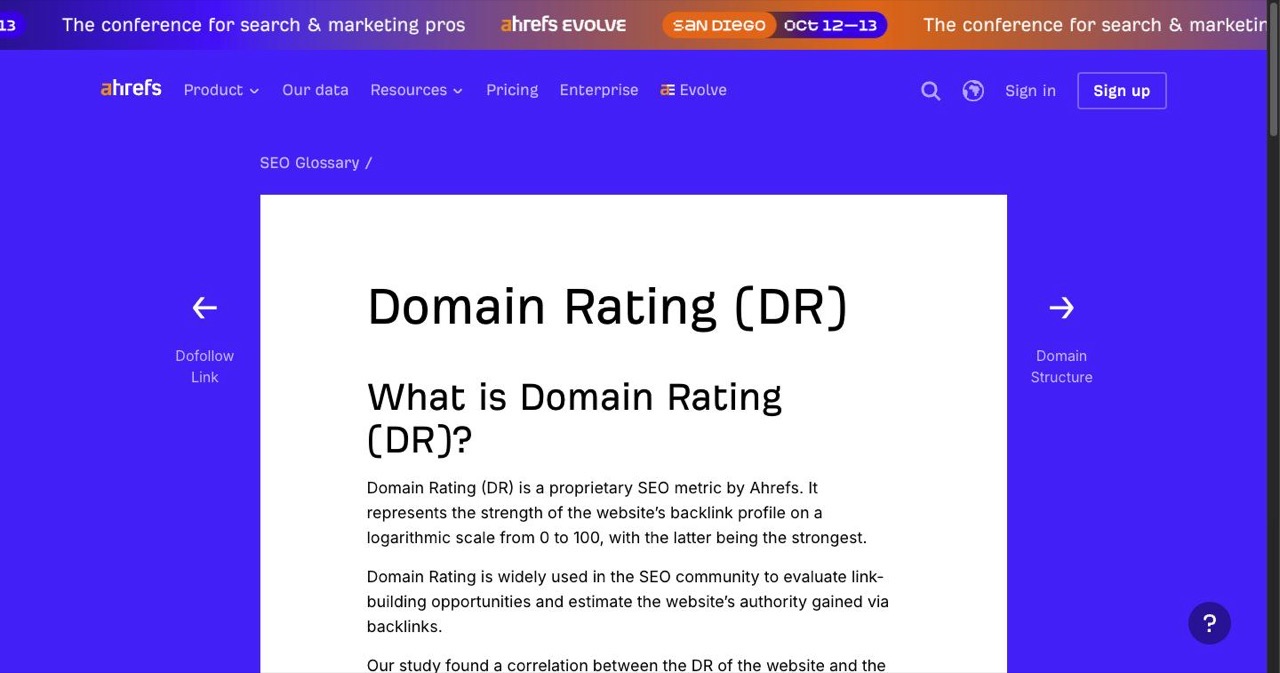
Domain Rating is Ahrefs' 0 to 100 score for the strength of a website's backlink profile, measured against every other site in their index. It is a relative ranking, not an absolute grade: your DR can drop without you losing a single link, simply because other sites gained links faster.
The calculation is public in outline. Ahrefs counts the unique domains linking to you with at least one followed link, weights each by that domain's own DR, then dilutes the value by how many other sites the linking domain points at. A DR 80 site that links to five domains passes far more weight than a DR 80 site that links to fifty thousand. The result lands on a logarithmic curve, which is why climbing from DR 20 to 30 takes a fraction of the work that DR 70 to 80 does.
The approach is similar in spirit to PageRank, the algorithm Google was built on, except computed at the domain level across Ahrefs' own crawl of the web.
Just as important is what DR ignores. It does not look at your content, your traffic, your Core Web Vitals, your on-page optimization, or whether anyone who lands on your site sticks around. A site with brilliant content and no links can sit at DR 4. A parked domain with a leftover link profile can hold DR 60 while hosting nothing at all.
DR, DA, and UR are three different rulers
People mix these up constantly, so a quick separation:
| Metric | Made by | Level | What it estimates |
|---|---|---|---|
| DR (Domain Rating) | Ahrefs | Domain | Backlink profile strength |
| DA (Domain Authority) | Moz | Domain | Likelihood of ranking, per Moz's model |
| UR (URL Rating) | Ahrefs | Page | Link strength of one specific page |
None of them talk to each other, and the same site scores differently in each. In Ahrefs' own studies, page-level UR correlates with rankings noticeably better than domain-level DR, which fits how Google works: it ranks pages, not domains.
Ahrefs itself is direct about the intended use. DR is for gauging relative link strength and qualifying link prospects. Their own documentation does not claim it is a ranking factor, because it is not.
Does DR directly affect Google rankings?
No. Google does not read Ahrefs' database, and it does not use DR, DA, or any third-party authority score as an input.
This is not an inference. Google's John Mueller has answered the question on the record more than once, including the flat statement: "We don't use domain authority at all in our algorithms." Other Google spokespeople have repeated the same point for years whenever the question resurfaces.
The 2024 leak of Google's internal API documentation added a wrinkle worth being honest about: the documents referenced a site-level signal that looks a lot like a domain quality score, despite years of Google downplaying domain-level authority. But that signal is Google's own internal calculation, built from Google's own data. It is not Ahrefs' number, and moving your DR does nothing to it directly.
The correlation numbers, honestly
If DR were a ranking factor, high DR would strongly predict high rankings. It does not.
Ahrefs' own 2025 study measured the correlation between DR and SERP position at roughly 0.131. Other independent analyses land in the same neighborhood, around 0.14. For context, that is a weak positive relationship: real, measurable, and nowhere near strong enough to hang a strategy on.
You can see the weakness in any SERP you care to check. Pages from DR 25 to 35 sites show up in the top ten for competitive commercial terms next to DR 85 giants. And high-DR sites rank badly all the time for queries their pages do not actually answer. If DR were the input, neither of those things would happen.
So why does any correlation exist at all?
Because backlinks are a confirmed ranking signal, and DR is a decent proxy for backlinks.
Google has been explicit since the beginning that links pointing at a page, weighted by the quality and relevance of the sites doing the linking, feed into ranking. PageRank's descendants are still in the pipeline. A site with a strong, clean link profile has more of that raw material, and a site with a strong, clean link profile also tends to have a high DR. The two rise together because they share a cause.
There are secondary effects too. Sites with more referring domains tend to get crawled more often, so new pages get discovered and indexed faster. And the kind of company that has earned links from hundreds of real domains usually also has the content, the brand searches, and the resources that help rankings through their own channels.
The number on the Ahrefs dashboard is the shadow. The link profile is the object casting it.
Why link building and directory presence still matter
Here is where the "DR is fake, ignore it" camp overcorrects. The score is third-party. The activities behind it are not, and they pay out in several currencies at once:
Rankings. Quality, relevant backlinks remain one of the strongest signals Google has. This is the direct SEO payoff, and it is real whether or not anyone ever looks at your DR.
Discovery and indexing. Every link is a path Google's crawler can walk. Young sites with almost no referring domains routinely struggle to get pages indexed at all; a few dozen real links changes that.
Referral traffic. A listing on a directory that people actually browse sends visitors directly, with no algorithm in between. We watch this happen on SaaSCity every week: products get found by people scrolling the city, not just by people searching Google.
Entity and brand signals. Consistent mentions across the web help search engines and, increasingly, AI assistants understand who you are. When ChatGPT or Google's AI Overviews cite sources for "best X tools," they pull from pages that exist because someone built presence beyond their own domain.
Deals and doors. Editors, journalists, affiliate managers, and partners screen by DR because it is the fastest signal available to them. Your outreach reply rate at DR 40 is not your reply rate at DR 8, even with the identical email. This is a genuine effect of the metric, just a social one rather than an algorithmic one.
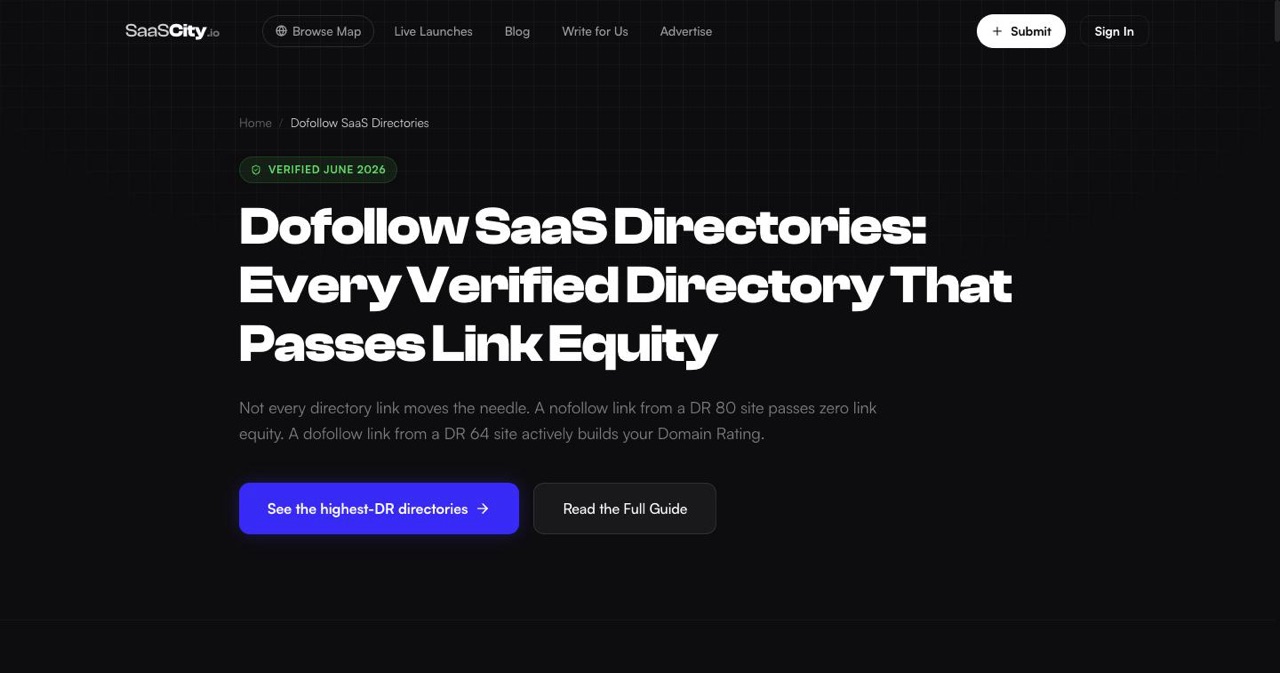
So the practical conclusion is almost the opposite of "ignore the number." Build the profile, and take the free wins first: real directories, launch platforms, reclaimed broken links, unlinked brand mentions. Our free dofollow directory list covers the ground, and listing on SaaSCity is free and includes a dofollow link once verified.
The caveat: DR can be gamed, and gamed DR is worthless
Because DR is a formula, people manipulate it. Expired domains with leftover authority, private blog networks, redirect chains, bulk link packages from marketplace gigs. These can inflate the number fast.
What they do not do is move the underlying signals Google reads. Google's systems discount or ignore most manufactured links, and some of them earn manual actions. Meanwhile Ahrefs recalibrates its model periodically and wipes patterns that look automated, so even the fake number tends to decay. You end up with the worst of both: guideline risk on the Google side and a score that will not hold on the Ahrefs side. If a tactic raises DR without creating anything a human would actually click, it is decoration.
How to use DR without fooling yourself
Treat DR as a diagnostic gauge, not a KPI. Four uses earn their keep:
Sizing up keywords. Pull the top ten for a term you want and look at the DR spread. If the lowest-DR page in the results is DR 65 and you are DR 18, that keyword is not winnable on authority yet, and knowing that saves you six months of content aimed at a page you were never going to take. If a DR 20 site is sitting in position four, the door is open.
Benchmarking competitors. Your DR means nothing in isolation. Your DR next to the five sites you actually compete with is a strategy input. "Good DR" is whatever your winnable SERPs say it is: competitive commercial terms often show top tens averaging DR 80+, while long-tail informational queries let DR 15 sites rank all day. Recent industry medians put typical funded SaaS companies around the mid 60s, but the only median that matters is your niche.
Qualifying link prospects. When you are choosing where to spend outreach hours, a relevant DR 60 site beats a relevant DR 10 site. This is the use case Ahrefs actually built the metric for.
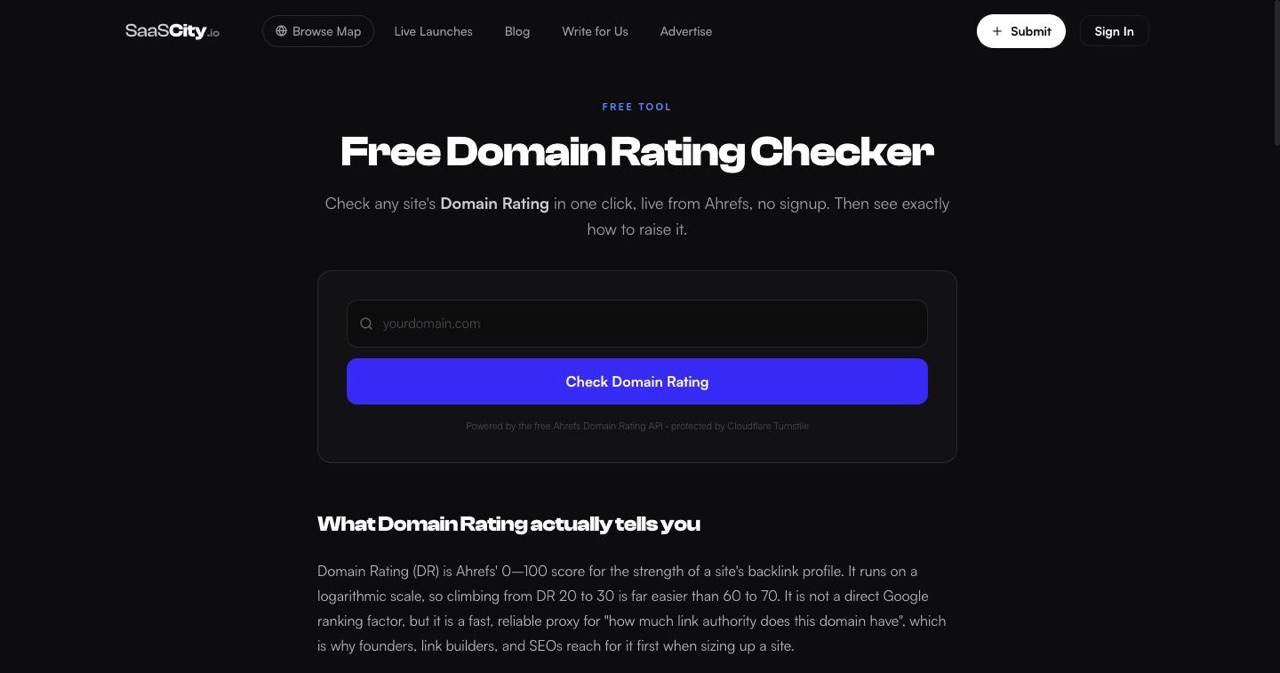
Tracking your own progress. If you run a link building push, DR rising over months tells you the referring domains are landing and counting. Check it monthly, not daily; the crawl lag makes daily checks noise. You can pull your number any time with our free Domain Rating checker, no account needed.
What DR is not: a scoreboard. If your DR climbs but your organic traffic, rankings, and signups do not, you have decorated a dashboard. Validate everything against Google Search Console, because that is Google telling you what it actually sees.
Myths worth killing
"Higher DR means higher rankings." A weak correlation of 0.131 says otherwise. Page-level relevance and page-level links beat domain-level authority constantly.
"You need DR X before you can rank." There is no threshold anywhere in Google's systems. Low-DR sites rank for the right queries every day. Thresholds exist only in guest-post guidelines and outreach filters, which are human conventions, not algorithms.
"Buying cheap links to pump DR is a shortcut." It is a shortcut to a number, not to traffic. The number decays on recalibration and the links never counted with Google in the first place. If you are going to pay for link building at all, pay for placements that would make sense even if DR did not exist. We wrote a full breakdown of what separates clean DR services from disposable ones.
"Our domain is strong, so any page we publish will rank." Domain strength raises the ceiling; the page still has to earn the query. High-DR sites publishing thin pages lose to focused small sites constantly, and the leak-era emphasis on page-level signals backs that up.
Moving the inputs instead of the number
Everything that legitimately raises DR is also just good SEO, which is the tidiest proof that the metric is a byproduct:
- Earn unique referring domains from relevant sites. Original data from your own product, free tools, and genuinely definitive guides are the assets that collect links for years without further work.
- Take the structural free wins. Quality directories and launch platforms, especially for a young site where the log curve makes every early referring domain count. The manual submission guide covers the process, and the high-DR directories worth the effort are the short list.
- Reclaim what you already earned. Broken links pointing at dead URLs and brand mentions that never got linked. An afternoon of work, and most sites have more of both than they think.
- Build topical depth. Comprehensive coverage of a narrow area earns links passively and helps every page in the cluster rank.
- Measure in two places. Ahrefs (or our free checker) for the link profile, Search Console for what Google actually does with it. When the two disagree, believe Search Console.
Expect the curve to fight you. Early points come fast; a site at DR 5 can hit DR 30 in weeks of focused work. Past 40, each point costs multiples of the last one, and that grind is exactly the part most founders run out of hours for. How to increase your Ahrefs DR sets out what actually moves the number and which routes are worth the hours.
The takeaway
Does Domain Rating affect SEO? Not directly, and Google has said so as plainly as Google says anything. DR is Ahrefs' estimate of your backlink strength, useful for benchmarking, prospecting, and sizing up keywords, and useless as a thing to optimize for its own sake.
But the question most people are really asking is "does the stuff that raises DR affect SEO," and there the answer is a firm yes. Backlinks move rankings. Directory presence moves discovery, referral traffic, and how both search engines and AI assistants understand your brand. A stronger, cleaner link profile pays out in every one of those channels, and a rising DR comes along for free as the receipt.
Optimize for the object, not the shadow.
Where to start today:
- Check your current DR and pull the DR of the top five results for one keyword you want. Now you know the real gap, not a guessed one.
- Take the free structural links: the free directory list is the map, and submitting to SaaSCity is free with a dofollow link once verified.
- If the remaining gap is measured in months of outreach, be honest about which routes you can actually sustain — how to increase your Ahrefs DR ranks them by what they cost you.
Get your SaaS in front of founders
List your product on the SaaSCity live city map - a permanent listing, real discovery, and a backlink from a high-DR directory. Free to start; upgrade for a dofollow link and a building on the map.