Launch & Growth
The New Startup Directories of Late 2026: Fresh Platforms and the 1,000-Row Meta-Lists That Index Them
There are now more lists of startup directories than there used to be startup directories. Here's the new class of launch platforms shipping in August 2026 (ScrollLaunch, Smol Launch, Startups Cult, BidSpot), the four big DR-ranked meta-lists compared row for row, and a triage system that turns a 1,669-entry archive into a 30-item work queue.


Contents (7)
Quick answer: The new startup directories of late 2026 are ScrollLaunch, Smol Launch, Startups Cult and BidSpot, alongside Nick Launches, and they share a shape: weekly cohorts instead of launch day, a permanent indexed product page, and a dofollow link conditional on a badge. Four meta-lists try to index all of them, from PostYourStartup's 128 rows to the SaaSCity superlist's 1,669. Filtered down, most founders end up with 30-50 targets worth submitting to.
Every figure in this post was pulled live on August 22–23, 2026 and is dated where it appears. Directory counts, prices and Domain Ratings move weekly; check the source before you spend anything.
There are now more lists of startup directories than there used to be startup directories.
That is not a joke about SEO spam. Four public archives currently claim to index every place you could submit a startup, and they disagree with each other by roughly a factor of thirteen, from 128 entries to 1,669. Meanwhile a fresh class of launch platforms shipped over the summer that doesn't fit the old mental model at all: no launch day, no 24-hour leaderboard, no traffic cliff at midnight. Weekly cohorts, permanent indexed pages, markdown twins for language models, public APIs, and a badge-for-dofollow bargain that has quietly become the industry standard.
If your directory strategy is still "post on Product Hunt, then paste the same blurb into forty sites from a 2024 listicle," you are working from a map of a country that reorganised its borders.
This post is the current map: what's new and worth a submission, which meta-lists to actually run your campaign from, and the part nobody publishes, which is how to compress a thousand-row archive into a work queue you can finish before your launch momentum evaporates.
We are not covering the August .lol bidding frenzy here. That wave, its economics, and whether any of it is worth a dollar got its own full breakdown two days ago. This is about the platforms built to still exist in 2027.
Key Takeaways
- The archives disagree wildly: SaaSCity's superlist holds 1,669 rows, Clakr 1,057, ScrollLaunch 1,017, and PostYourStartup stops at 128 on purpose.
- Launch week replaced launch day: nearly every new 2026 platform runs an ISO-week cycle with archived week pages instead of a 24-hour leaderboard.
- Badge-for-dofollow is the standard bargain: ScrollLaunch, Smol Launch, Nick Launches and SaaSCity all landed on the same structure independently.
- Paid entry clusters at $19: ScrollLaunch Premium $19, Smol Launch Premium $19, SaaSCity Quick Pass $19.99, with Smol Launch's $99/year Maker Pass the best per-launch economics for frequent shippers.
- Nick Launches has the strongest domain: DR 72 as checked on August 21, 2026, against SaaSCity's DR 56 at the time (66 in October 2026).
- Filter down to a finishable queue: 1,669 rows drop to 433 free-and-dofollow, 275 at DR 30 or above, and 30-50 after deduplication and category cuts.
- Verify the link after acceptance: curl the live listing and check for
rel="nofollow", since attributes get flipped site-wide in a single commit.
Four Structural Shifts Behind the New Class
Before the profiles, the shape of the change. Every platform below is a response to at least one of these.
1. The launch day died; the launch week replaced it. A 24-hour board rewards whoever can mobilise the most contacts before midnight UTC. A Monday-to-Sunday cohort rewards whoever ships something people keep upvoting on Thursday. Nearly every new platform in 2026 uses an ISO-week cycle, and archived week pages are now a standard SEO surface.
2. The listing page became the product. The old pitch was exposure on a leaderboard. The new pitch is a permanent, indexable /products/your-slug page with structured data, which keeps earning long after your cohort rolls over. The leaderboard is now marketing for the page, not the other way round.
3. Dofollow became conditional, everywhere, at once. Free tier, badge on your site, dofollow link. No badge, nofollow. Pay $19-39, dofollow with no badge. ScrollLaunch, Smol Launch, Nick Launches and SaaSCity all landed on materially the same bargain independently, because it's the only structure that survives both link-scheme scrutiny and freeloading.
4. Listings are being written for machines. Markdown twins of product pages, public read APIs, MCP endpoints, CLI submission. Founders didn't ask for these. They exist because AI assistants now cross-reference directories when they answer "best tool for X," and a page a model can parse cleanly is a page a model can cite.
One more thing worth naming, because it explains the volume rather than the shape: building a directory stopped being a build. Listings, categories, a submission form, Stripe checkout for featured slots, per-listing schema and a sitemap that stays current used to be a month of work. No-code directory builders now ship that whole stack out of the box, self-hosted or on their cloud, which is why the entry cost fell to a weekend. That is the supply side of a 1,669-row archive: the survivors compete on curation and traffic now, not on having shipped at all.
Where the new directories come from: the builder side
The clearest example of that supply side is DirectoryEasy, a no-code directory builder that is effectively the reference implementation of everything the platforms above sell. Its generator takes a one-line prompt ("AI tools directory", "SaaS showcase") and produces a working directory with categories, a submission form, user accounts and a per-listing page. From there you get the monetization stack the whole industry converged on: premium and featured listings with automated rotation, self-serve ad slots billed through Stripe or PayPal, publishing delays per plan, coupon countdowns, and a built-in blog. It also covers the operational things that separate a directory that survives its first year from one that becomes a dead row in someone's superlist: CSV and full-directory import/export, a redirects manager so URL moves don't bleed link equity, RSS feeds, role-based team access, and 22+ languages.
Pricing as of August 23, 2026 is either a cloud subscription or a one-time lifetime licence: $199 for a single directory, $349 for unlimited, with a stated early-bird ladder that climbs to $299 and $499. The self-hosted option matters more than it sounds. A directory whose backlinks live on someone else's platform can vanish with that platform, and running it on your own domain and server removes that risk.
Why this belongs in a post about submitting to directories: every one of the 1,669 rows in our archive was a decision somebody made to run a directory rather than list on one. When the cost of that decision is $199 and a weekend, expect the archive to keep growing faster than any meta-list can verify it, and weight your queue toward the directories with a curation story, not just a working checkout.
The New Platform Class, Profiled
Ranked by what a founder gets out of a listing today, not by domain age. We run one of the platforms in this class, SaaSCity, so it sits in a box after the ranking instead of inside it.
1. Nick Launches: the highest authority in the weekly-board class
Nick Launches runs a weekly leaderboard and is, on raw authority, the strongest of the new-generation boards: DR 72, checked August 21, 2026 against the same Ahrefs free API we use for our own figure. Its Week 34 of 2026 board carried 105 launches, with 572 products in AI, 538 in Productivity and 244 in Developer Tools across the full archive. Free tier follows the badge-for-dofollow rule. Paid tiers sit behind a sign-in; public reporting puts them at Starter $19, Pro $39, Premium $99, Ultimate $199. Verify at their checkout, not here.
Worth knowing: Nick Launches is a paid permanent sponsor of SaaSCity. We're recommending it anyway because DR 72 with a free dofollow path is objectively the best free link in this cohort, and hiding the relationship would be worse than disclosing it.
- Best for: the single highest-DR free dofollow you can get from a weekly board.
- Key caveats: pricing is not publicly readable; 40+ categories means a crowded board.
2. ScrollLaunch: the most machine-legible platform in the category
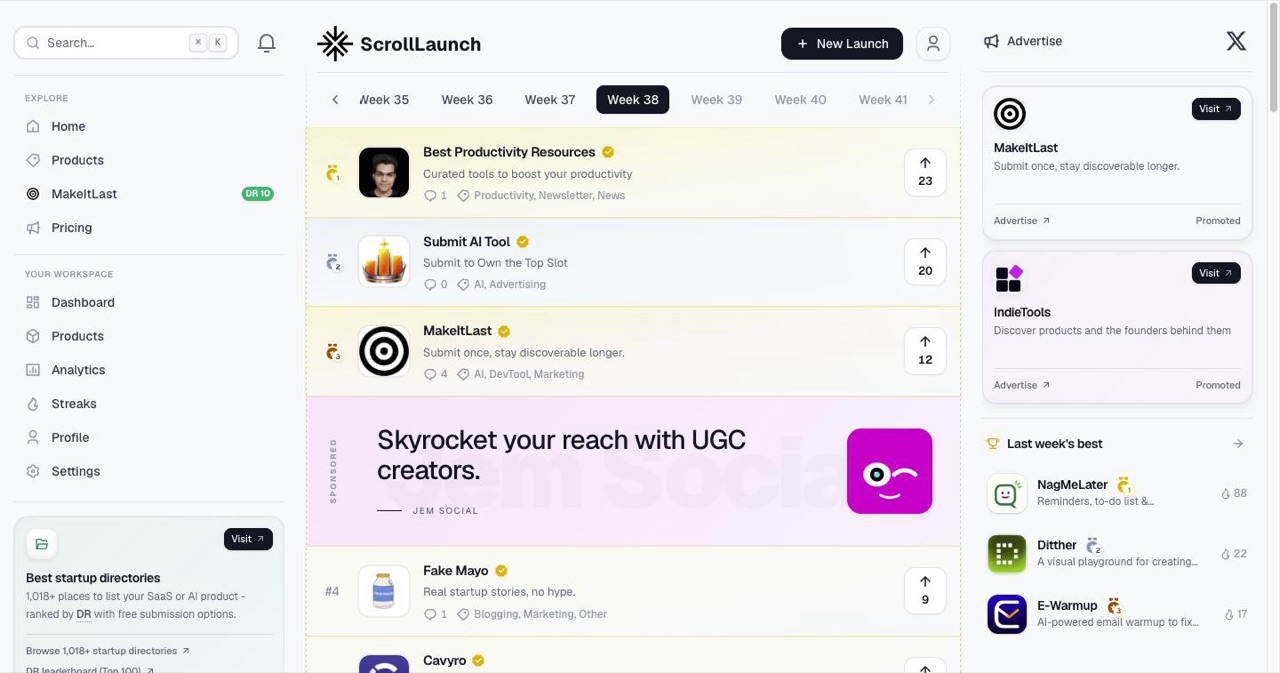
ScrollLaunch runs an ISO-week leaderboard with archived week pages at /week/{year}/{week} and a permanent product page per listing. What separates it is the plumbing: AI-readable markdown twins of every product page, a public REST API at /v1 requiring no key for reads, JSON-RPC over MCP so an agent can submit, and an official CLI (npx scrolllaunch). It is the first launch board built on the assumption that half its readers are language models.
Pricing, from their page on August 23, 2026: Free ($0, capped at 20 free listings a week, dofollow only while their badge stays on your site), Premium $19 (always-dofollow, gold badge, priority placement), Premium+ $39 (adds a roughly 1,800-word generated article on their blog with 4+ dofollow links). Ads run $19-29/week; newsletter sponsorship starts at $299 an issue.
One honest note on Premium+: an auto-generated 1,800-word article is a different thing from an edited one. It carries links, and it is also exactly the kind of page a spam update evaluates. Buy it for the links with your eyes open.
- Best for: anyone optimising for AI citation, and agent-driven submission workflows.
- Key caveats: free tier is capped at 20 a week and badge-gated; the generated-article tier is thin content by construction.
3. Smol Launch: the cleanest free tier terms
Smol Launch runs Monday-to-Sunday cohorts with community voting through Sunday and a ranking algorithm weighing vote velocity, maker reputation, engagement and fraud signals. Free submissions are capped platform-wide at 30 a week; free links are nofollow unless you install and verify their badge. Premium is $19 per launch and drops the badge requirement entirely for a permanent dofollow. Maker Pass is $99/year for unlimited launches with no badge work and no queue. Their done-for-you submission service, Launch Everywhere, runs $99 / $149 / $199 for progressively larger directory sets; featured spots are $19/week or $61 for four, and newsletter sponsorship is $49 an issue.
Of everything in this list, Smol Launch states its terms with the least ambiguity. You know exactly what the link is before you pay, which is rarer in this category than it should be.
- Best for: bootstrapped makers relaunching often; the Maker Pass is the best per-launch economics here if you ship more than five times a year.
- Key caveats: 30 free slots a week platform-wide is a real bottleneck; smaller audience than the DR-72 tier.
4. Startups Cult: not a launch board at all
Startups Cult, run by Ameen Ansari, is the one entry here that isn't competing for launch day. It's a tracker: 319+ startups, $65B+ in tracked funding rounds, 1,718+ active investors, and 1,903+ job listings as of August 23, 2026, with multi-currency funding data (USD, INR, EUR, GBP) and unusually strong coverage of the Indian ecosystem. Listing is free; there's a weekly Product Launchpad and optional paid Featured Spotlight slots.
The strategic read: this is a discovery-and-hiring surface, not a backlink play. Being in a funding-and-investor database is how you show up when someone is researching your category rather than browsing new toys.
- Best for: startups raising, hiring, or targeting the Indian market.
- Key caveats: young, small catalogue, and the link value is incidental. Go for the audience or skip it.
5. BidSpot and the pay-to-rank tail
BidSpot launched in the last days of August 2026 with a hybrid model: free listings on the back pages, $5+ bids to rank higher. It's the calmer descendant of the .lol wave, with a free floor and optional money on top, and the same verdict applies as to the rest of that family: fine as a $5 experiment, not a link-building strategy. The full economics of pay-to-rank boards, including why a public "this spot cost $400" board is the most legible paid-link footprint imaginable, are in the .lol frenzy breakdown.
- Best for: a cheap traffic test while the novelty holds.
- Key caveats: brand-new domain, no published traffic, and rank you can be outbid out of.
We run SaaSCity, so it is not in this ranking. Here are the numbers anyway, including the one we lose on. SaaSCity is an isometric city map where every listing is a building with its own permanent page. As of August 21, 2026: DR 56 (66 in October 2026), 1,364 active listings, and 271,969 unique visitors across the site in the trailing 30 days (Cloudflare edge uniques, which read higher than a filtered analytics number). Free listings get 15 slots each Monday; a verified badge on your site turns the free listing dofollow, and skipping the badge puts you in a capped queue with a nofollow link. Paid: Quick Pass at $19.99 for a next-slot listing, Premium at $39.99, which includes a launch post our editor writes and publishes on this blog within 3 days carrying 3 sponsored links to your site. Where we lose: Nick Launches has the stronger domain, DR 72 against our 56 at the time. We publish the whole head-to-head, losses marked as losses, at SaaSCity vs Nick Launches.
Quick comparison
| Platform | Model | Free tier | Free link | Paid entry | Standout |
|---|---|---|---|---|---|
| Nick Launches | Weekly leaderboard | Yes | Dofollow with badge | $19 (reported) | DR 72 |
| ScrollLaunch | ISO-week leaderboard | 20/week | Dofollow while badge stays | $19 | Markdown twins, API, MCP, CLI |
| Smol Launch | Mon–Sun cohort | 30/week platform-wide | Nofollow unless badge verified | $19 | $99/yr Maker Pass |
| Startups Cult | Funding + jobs tracker | Yes | Not stated | Featured slots | Investor and jobs data |
| BidSpot | Free floor + paid rank | Yes (back pages) | Not stated | $5+ | Cheapest experiment |
| SaaSCity (ours) | City map + permanent page | 15 slots/Monday | Dofollow with badge | $19.99 | Written launch post on Premium |
Prices and terms as published on August 23, 2026. Nick Launches paid tiers are from public reporting, not a first-party page.
The Meta-Lists: Four Archives, One Awkward Question
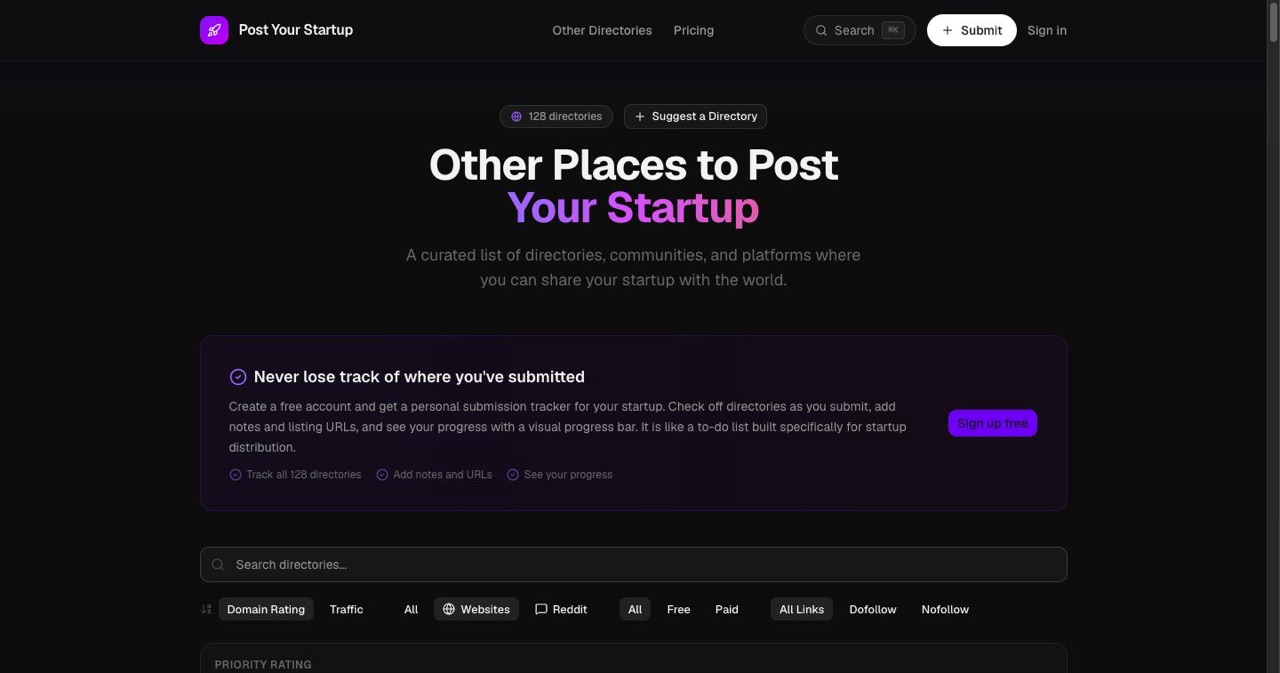
This is where 2026 genuinely improved. Four maintained, DR-annotated archives now exist, and running a campaign from one of them instead of a blog listicle saves most founders 40-70 hours.
| Meta-list | Rows | Link type shown | Admits unverified rows | Extras | Last refresh |
|---|---|---|---|---|---|
| SaaSCity superlist | 1,669 | 777 dofollow / 288 nofollow | Yes, 604 unverified | 13 categories, 681 free, 213 at DR 70+ | 2026-07-31 |
| Clakr | 1,057 | Dofollow/nofollow per row | Not surfaced | Submission CRM, per-directory guide pages | Verification pass June 2026 |
| ScrollLaunch | 1,017 | 594 dofollow | Not surfaced | 833 free, 15+ categories, conditional-link flag | 2026-08-21 |
| PostYourStartup | 128 | Dofollow flag per row | N/A at this size | Traffic estimates, free submission tracker | Actively maintained |
The awkward question, asked in good faith: what happened to the unknowns?
Our own list is 1,669 rows and openly marks 604 of them (36%) as unverified link type, plus roughly 40% with unconfirmed pricing. That is not a badge of quality, it's an admission. Verifying a link attribute means actually submitting or actually reading the live HTML of a published listing, and at four-digit scale nobody has done that for every row.
So when a comparably sized list reports a clean dofollow/nofollow split with no unknown bucket, one of two things is true: they did the work at a scale we haven't, or the unknowns were quietly assigned. Both are possible. The way to tell, for any list including ours, is to spot-check five rows against the live sites before you trust the other 1,000.
What each archive is genuinely best at:
- PostYourStartup: built by Timothy Bramlett on a DR 67 domain, and the only one of the four that pairs DR with traffic estimates, which is the number that actually predicts referral clicks. 128 rows live on the page as of August 23, 2026; his own posts cite 136. It stops early on purpose, and the built-in submission tracker with notes and a progress bar is the best free campaign tool in this group. Start here if you want a finishable list.
- Clakr: positions as a submission CRM rather than a list. Every directory has its own guide page ("Submit your startup to X: DR 41, freemium"), DR checked against the Ahrefs API, deduplicated by domain and brand, with per-submission status tracking. Best if you want the workflow and the data in one place.
- ScrollLaunch: freshest refresh date of the big three and the most usable filter UI, with a conditional link type as a first-class value, which is honest about how the badge bargain actually works.
- SaaSCity superlist: largest, and the one that keeps unverified rows visible as "unknown" rather than guessing. Dead sites and link farms were cut; the audit behind it shows where 1,306 of 2,972 domains went. Slice it by free and dofollow or DR 70+ if you'd rather skip the filtering.
Also worth a bookmark, smaller and less maintained: AllDirectories.org, DirectoryFinder, ListMy.site's 100-directory list, and the various GitHub awesome-saas-directories repos. Treat all of them as leads, not as verified data.
Turning 1,669 Rows Into a 30-Row Work Queue
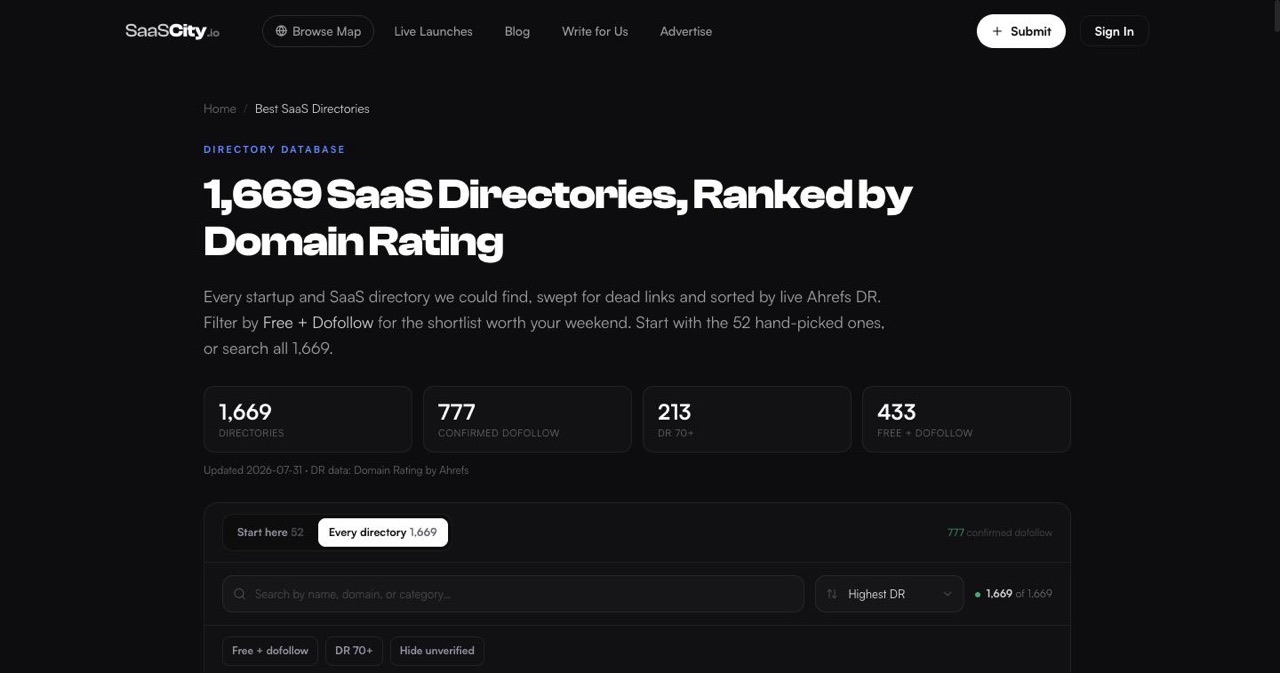
Here is the part the lists don't give you. A thousand rows is not a plan. It's a way to feel busy for a month and end up with sixty nofollow links from parked domains. The filter order below is what actually survives contact with reality, run against our own superlist so you can see the arithmetic.
Step 1: Free and dofollow first. 1,669 rows → 433. Free-and-dofollow is where the risk-adjusted value lives: no spend, real equity, no paid-link exposure.
Step 2: Set a DR floor. At DR ≥ 20 you keep 335. At DR ≥ 30, 275. At DR ≥ 50, 136. DR 30 is the pragmatic floor. Below it you're mostly submitting to sites with no crawl budget to pass on. Read what DR does and doesn't do before treating the number as gospel.
Step 3: Dedupe by root domain. The same brand appears repeatedly across .com, .io and .ai, and several "different" directories are one operator running a template on six domains. One submission per operator.
Step 4: Cut anything outside your category. Of our 13 categories, most products genuinely fit two or three. A listing in a category your buyers never browse is a link with no referral traffic attached, which is half the point gone.
Step 5: Screen out the five disqualifiers. In our free-and-dofollow set, 24 rows require a permanent badge exchange. That's the tolerable one. The others aren't:
- Reciprocal-link requirements beyond a simple badge: you're building their profile with your equity.
- Bot walls: if Cloudflare challenges you on the submit form, your listing likely isn't getting crawled either.
- Redirect farms: the "directory" is one page of outbound links with no traffic of its own.
- Paid-only under DR 20: you're funding someone's domain experiment.
- No published listing you can find: search
site:directory.com "a product you know is listed". If nothing is indexed, nothing you submit will be either.
What's left is typically 30-50 targets. That's two focused weeks at twenty minutes each, and every one is worth the twenty minutes.
Step 6: Verify after acceptance, not before. The single most common failure in directory campaigns: assuming the link you were promised is the link you got. Once your listing is live, check the actual attribute:
curl -s https://directory.example/your-listing \
  | grep -o '<a[^>]*yourdomain\.com[^>]*>'
If you see rel="nofollow" or rel="ugc", log it as nofollow in your tracker and move on. Attributes get flipped site-wide in a single commit, so re-check anything you paid for after 30 days. Our free DR checker will tell you whether the domain was worth it in the first place.
Track every row: site, date submitted, price, promised link type, verified link type, referral clicks. Half the domains in any 2026 list will not exist in 2028, and you will want to know which links you lost. The complete submission guide has the full tracking system if you want a template rather than a spreadsheet you design yourself.
What This Means for AI Visibility
One shift deserves its own note because it changes what "a good listing" means.
Language models answering "best CRM for freelancers" don't read your homepage and decide. They corroborate across sources, and directories are unusually well-structured corroboration: name, category, one-line description, pricing, alternatives, all in consistent markup across hundreds of entities. Being absent from that layer means being absent from the answer.
This is why ScrollLaunch shipping markdown twins and a keyless read API is more strategically interesting than its $19 price point, and why the shift to permanent product pages matters more than leaderboard position. A page that ranks on Monday and disappears on Sunday can't be cited. A page that persists, with clean structured data, is an entity signal that compounds.
Practical version: prefer platforms with permanent indexed pages over pure feeds, fill in the alternatives and category fields even when they feel like busywork, and keep your name, one-liner and pricing byte-identical across every listing. Inconsistency across directories is exactly what makes a model hedge instead of naming you. The full method is in our GEO and AEO guide.
The Honest Verdict
Do this: one strong launch on a weekly board, a permanent listing somewhere that will still exist next year, then a filtered 30-50 row pass through a meta-list over two weeks. That sequence is the whole strategy. Everything else is optimisation.
Skip this: paying for placement on a two-week-old domain because the founder's revenue screenshot went viral; buying 200-directory blast packages on the strength of a DR promise (we compared the services, and none of them controls what a directory lists); and any "guaranteed DR increase," which is a promise about someone else's algorithm.
Expect this: directory work is a compounding play with a slow start. Referral traffic shows within days from maybe five of your fifty listings. Authority effects take months. AI citation improvements are the slowest and least measurable of the three, and probably the most valuable in 2027.
The genuinely good news about late 2026 is that the research problem is solved. Four maintained archives, live DR data, free trackers, filter UIs. Knowing where to submit is no longer the scarce resource. The discipline to submit to thirty good places instead of three hundred bad ones is.
Start with a listing that outlives your launch week, then work the filtered list. If you want the shortlist rather than the archive, our nine directories worth your time and the Product Hunt alternatives roundup are the fastest way in.
Directories are a distribution channel, not a growth strategy. But in a year where the answer engines read them on your behalf, they're the cheapest way to be findable by both kinds of reader.
Get your SaaS in front of founders
List your product on the SaaSCity live city map - a permanent listing, real discovery, and a backlink from a high-DR directory. Free to start; upgrade for a dofollow link and a building on the map.