Build with AI
301 Commits. $70. Zero Supervision. Why Xiaomi MiMo-V2.5-Pro Is the Best LLM Backbone for Hermes Agent Right Now
A persistent autonomous agent running 1,000+ tool calls on a VPS just shipped 301 git commits and 60+ pages of production code for $70.12 total. The model behind it: Xiaomi MiMo-V2.5-Pro. Here's why this open-weight MIT-licensed backbone is the most compelling setup for Hermes Agent in June 2026.

Contents (9)
Quick answer: Xiaomi MiMo-V2.5-Pro is the strongest LLM backbone for Hermes Agent as of June 2026. It is an MIT-licensed open-weight MoE model with 1.02T total and 42B active parameters, a 1M token context window that holds past 500K, and hybrid sliding window plus global attention that cuts KV cache overhead roughly 7 times. A documented autonomous run produced 301 git commits across 387 million tokens at 96% cache hits for $70.12.
An autonomous agent running on a VPS. No human oversight. It writes a product backlog, builds the API, wires Stripe, pushes 301 git commits, ships 60+ pages of production code — and the full run costs $70.12.
That's not a pitch deck claim. That's a documented real-world test of Hermes Agent running on Xiaomi MiMo-V2.5-Pro, including 96% cache hit rates across 387 million tokens.
As of June 2026, the combination of Hermes Agent (Nous Research) + MiMo-V2.5-Pro is the most compelling agentic setup you can build right now. The model brings frontier-level long-horizon reasoning, 1M context that holds up under pressure, architecture that rewards cache-heavy agent loops, and pricing that makes 24/7 autonomous operation genuinely affordable. Open MIT license included.
If you're new to the agentic toolchain behind all this, our best AI agent coding token plans 2026 breakdown is a good primer on how pricing tiers actually shake out once you're past the demo stage.
Let's go through exactly what's here and why it matters.
Key Takeaways
- The cache math is the whole argument: 387 million tokens at 96% cache hits came to $70.12 instead of roughly $168 at full rate.
- Two models, two jobs: MiMo-V2.5 is omnimodal at 310B total and 15B active, while MiMo-V2.5-Pro is pure text at 1.02T total and 42B active for agentic work.
- Long context that survives the distance: GraphWalks and BFS/Parents benchmarks at 512K to 1M show retention holding where earlier models degrade.
- MIT license with no strings: Open weights, commercial use and fine-tuning, with vLLM and SGLang recipes published on Hugging Face.
- Pricing dropped hard on May 27, 2026: Cache-hit input fell as much as 99%, and Pro lists at $0.435/M input and $0.87/M output against a $1.80/M median.
- Speed is the trade-off: Roughly 44 tokens per second with a 3.16s time to first token, against an open-weight median of 58.2 t/s.
- Self-hosting Pro is not realistic for most: The 1T parameter model needs multiple high-end GPUs, so use the API for Pro and self-host the 15B-active V2.5.
What Hermes Agent Actually Does (And Why Model Choice Is Everything)
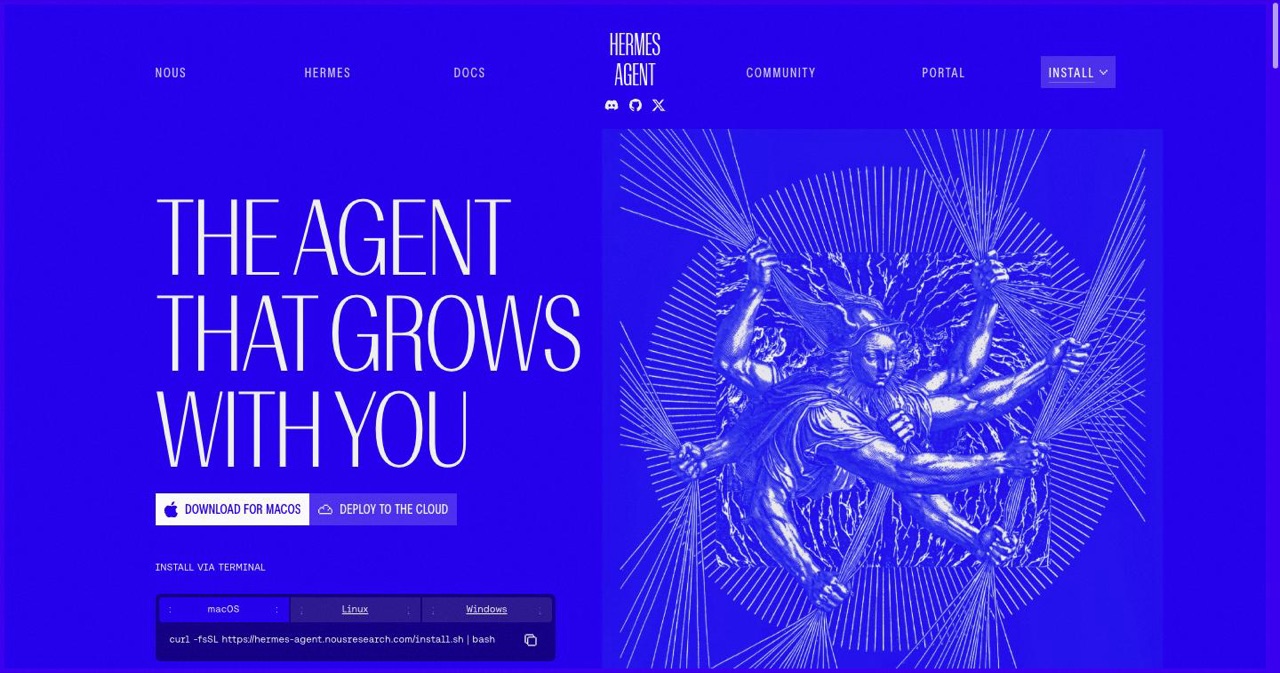
Hermes Agent is an open-source autonomous AI agent built by Nous Research, launched February 25, 2026. It is not a coding copilot. Not a chatbot wrapper. It's a persistent daemon that lives on your server, accumulates knowledge across every session, writes its own reusable skills from experience, and reaches you across 20+ platforms — Telegram, Discord, Slack, WhatsApp, Signal, email, CLI, and more.
The four loops that make it different from everything else:
- Persistent memory: Agent-curated facts written to MEMORY.md, full-text search (FTS5) across all sessions with LLM summarization for cross-session recall
- Autonomous skill creation: After complex tasks (5+ tool calls), Hermes automatically writes reusable skill documents
- Skill self-improvement: Skills get patched during use when they're wrong, outdated, or incomplete — no human needed
- Scheduled autonomy: Natural language cron scheduling. Set a task, Hermes handles it while you sleep
It crossed 175,000 GitHub stars in under four months because it solves a real problem: persistent memory and async execution that session-based tools like Claude Code simply don't have by design. For a wider view of the broader agent ecosystem, the Claw Era roundup covers the half-dozen agentic systems competing for the same developer mindshare.
The model you point it at shapes everything — instruction following quality, long-context coherence, how many agent rounds you can run before costs get painful. Which brings us to April 2026.
The MiMo-V2.5 Series: What Xiaomi Actually Shipped
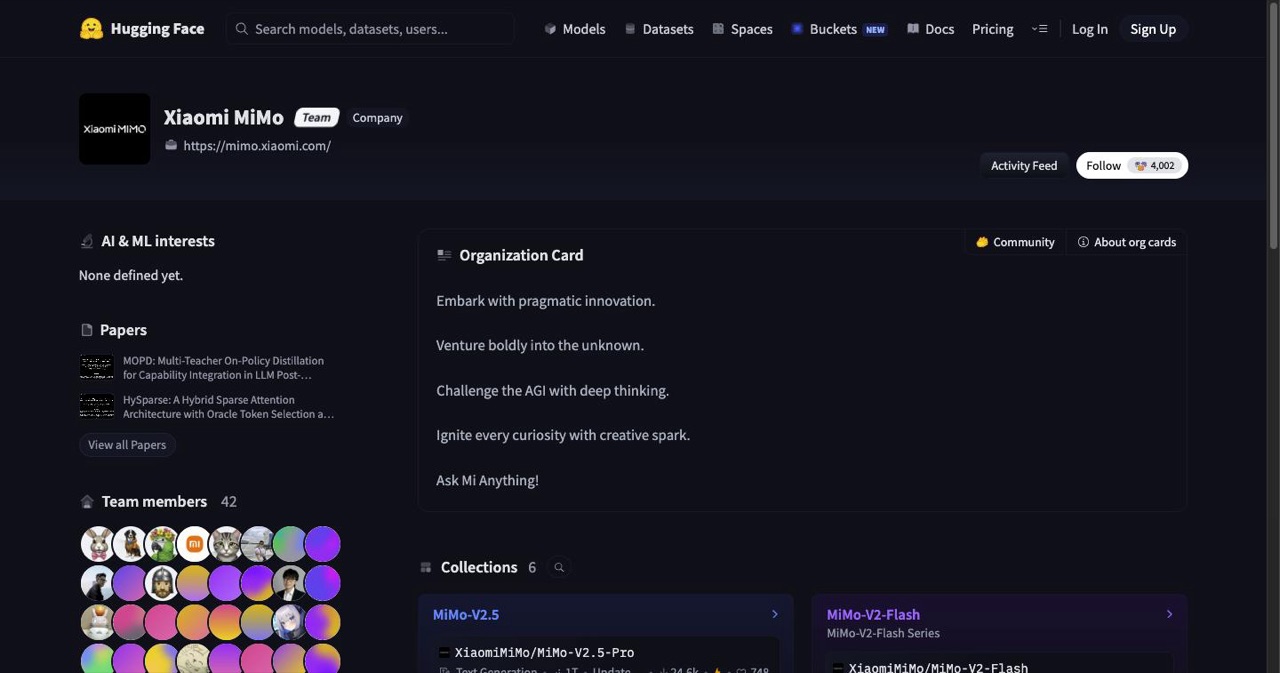
Two flagship models under full MIT license — open weights, commercial use, fine-tuning allowed, no extra authorization. The Hugging Face org XiaomiMiMo hosts the weights, model cards, and self-hosting recipes.
MiMo-V2.5 (April 22, 2026) — The Omni Foundation
- 310B total parameters / 15B active — Sparse MoE
- Native omnimodal: text + image + video + audio via dedicated in-house encoders
- 1M token context window
- Built on MiMo-V2-Flash backbone
This is the more accessible of the two. Multimodal-native at roughly half the cost of Pro. For Hermes agents that need to analyze screenshots, parse UIs, or process audio — it handles it natively without a separate vision endpoint.
Benchmark highlights: 87.7 on Video-MME (competitive with Gemini 3 Pro), 81.0 on CharXiv RQ, 77.9 on MMMU-Pro.
MiMo-V2.5-Pro (April 27, 2026) — The Agentic Flagship
- 1.02T total parameters / 42B active — MoE
- Pure text, purpose-built for maximum agentic and long-horizon performance
- 1M token context window
- Hybrid Sliding Window + Global Attention (6:1 SWA:GA ratio, 128 window) + 3-layer Multi-Token Prediction (MTP)
The architecture detail that matters: the hybrid attention design cuts KV cache requirements by approximately 7×. That's what makes cache hit rates so high in agent workloads. High cache hits = costs collapse. We'll come back to this.
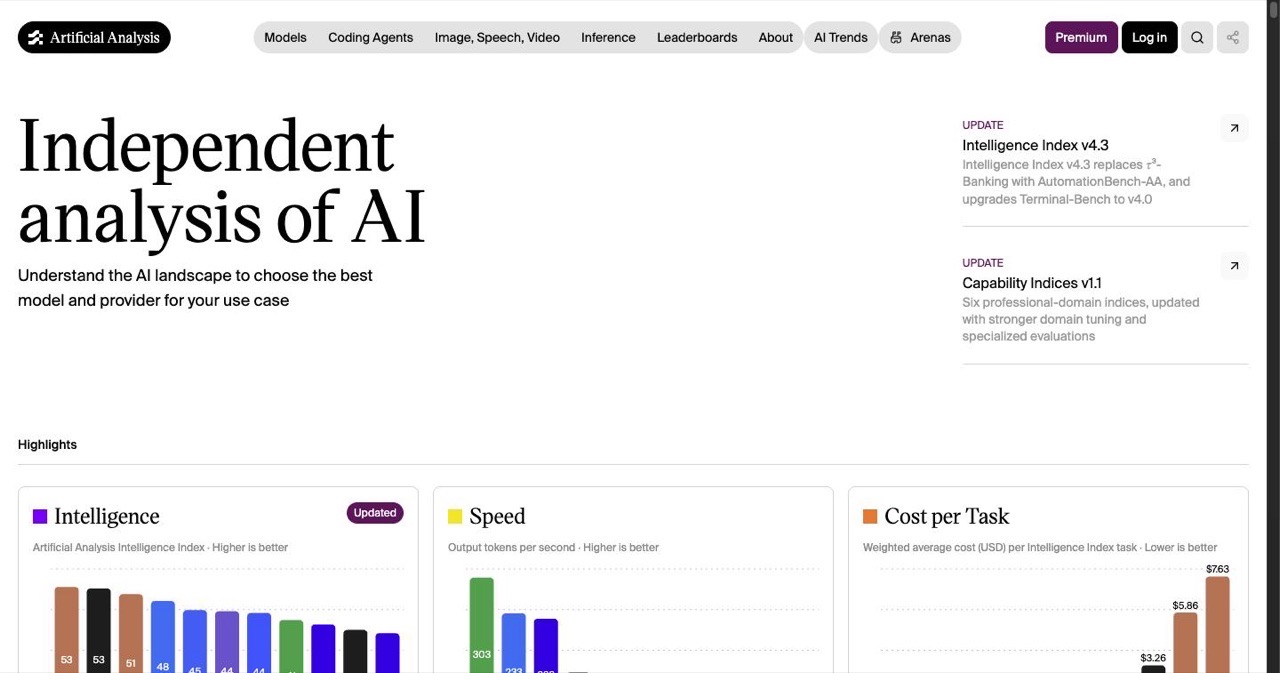
Benchmarks: GSM8K 99.6, MATH 86.2, strong SWE-bench Verified and SWE-bench Pro scores, #1 or top-tier open-source on ClawEval and GDPVal-AA. Scores 54 on the Artificial Analysis Intelligence Index (open-weight median: 31). Ranked #10 of 565 published models overall, #15 of 283 for agentic tasks specifically.
Why MiMo-V2.5-Pro and Hermes Are Built for Each Other
The Context Problem Is Actually Solved
Hermes runs long. Full project histories. Skill libraries. Cross-session summaries. Conversation context. The model needs to hold massive context without quality degradation at 500K+ tokens.
MiMo-V2.5-Pro's 1M window isn't marketing. Long-context benchmarks (GraphWalks, BFS/Parents) at 512K–1M show retention holding up where prior models fall apart. The full project history, all skill documents, all .hermes.md context files — they fit. You don't have to choose what to drop.
Tool Call Coherence Over Thousands of Iterations
This is harder to capture in a benchmark but immediately obvious in practice. Hermes runs hundreds to thousands of tool calls in a single autonomous session. State tracking, goal maintenance, self-correction, knowing when to escalate — the model has to hold it all together.
MiMo-V2.5-Pro was post-trained explicitly for this: long-horizon tool-use trajectories, complex multi-step planning, autonomous prioritization without external nudges. Xiaomi describes it as capable of completing "professional tasks that would take human experts days or weeks, involving more than a thousand tool calls" with maintained coherence. The $70 autonomous build session — 301 commits, landing pages, APIs, Stripe integration, bug fixes — was not a cherry-picked demo.
For builders running a fleet of agents overnight, the same architecture is showing up in open-source AI SaaS boilerplates — the same long-context backbone patterns are now powering productized agent stacks.
The Cache Math Is What Makes This Affordable
Most people look at the listed token price and stop there. For agent workloads, that's wrong.
Agent loops are structurally cache-friendly. The system prompt, memory file, and skill documents don't change between tool calls. Context accumulates and gets reused. Natural cache hit rates of 80–96% are common in real Hermes sessions.
MiMo-V2.5-Pro's hybrid attention architecture reduces KV cache overhead by ~7×. The economics in an actual session look like this:
| Session Type | Tokens Used | Effective Cost |
|---|---|---|
| Cold start (no cache) | 387M tokens | ~$168 at full rate |
| With 96% cache hits | 387M tokens | $70.12 actual |
That's not a discount. That's the structural result of high cache hit rates against aggressively low cache-hit pricing. The architecture and the workload pattern are aligned.
Pricing: Where It Gets Seriously Interesting
On May 27, 2026, Xiaomi permanently cut API prices — cache-hit input pricing dropped as much as 99%. Here's the current pay-as-you-go picture:
| Model | Input (Cache Miss) | Output |
|---|---|---|
| MiMo-V2.5 | $0.14/M | $0.28/M |
| MiMo-V2.5-Pro | $0.435/M | $0.87/M |
MiMo-V2.5-Pro output at $0.87/M beats the median output price across comparable models ($1.80/M per Artificial Analysis). And again — that's before caching reduces your effective cost further. For background on how pricing across the broader LLM market compares, our complete guide to AI tool directories rounds up the platforms where these economics are most visible.
Token Plans: The Right Structure for 24/7 Agents
One subscription unlocks all 9 models: V2.5-Pro, V2.5, ASR (SOTA bilingual/dialect/audio), and the full TTS suite. TTS is currently free — no credit consumption. Credit quotas were boosted 5–8× on May 27, 2026.
| Tier | Monthly Price | Monthly Credits | ~V2.5-Pro Tokens (Cache Miss) | ~V2.5 Tokens (Cache Miss) |
|---|---|---|---|---|
| Lite | ~$6/mo | 4.1B | ~13.7M | ~41M |
| Standard | ~$16/mo | 11B | ~36.7M | ~110M |
| Pro | ~$50/mo | 38B | ~126.7M | ~380M |
| Max | ~$100/mo | 82B | ~273.3M | ~820M |
The real numbers are better than this table shows. Cache hits for V2.5-Pro consume 2.5 credits/token; cache misses consume 300 credits/token. In warm, cache-heavy Hermes sessions, your effective throughput is 10–50× the "cache miss" estimate above.
A Lite plan at $6/month can sustain a persistent Hermes agent through serious daily workloads once sessions are warm. The Max tier covers thousands of complex autonomous agent rounds per month. Annual plans run ~12% cheaper. Night hours (00:00–08:00 Beijing time) apply a 0.8× consumption multiplier.
Deprecation note: Legacy V2-Pro and V2-Omni models auto-route to V2.5 pricing from June 1. Full deprecation is June 30, 2026. Switching model names now ensures best pricing and avoids surprises.
Benchmark Snapshot
| Metric | MiMo-V2.5-Pro Score |
|---|---|
| GSM8K | 99.6 |
| MATH | 86.2 |
| GPQA Diamond | 66.7 |
| SWE-bench Verified | 78.9 (WildClawBench Overall) |
| Intelligence Index (AA) | 54 (open-weight median: 31) |
| Overall model rank (AA) | #10 of 565 |
| Agentic task rank (AA) | #15 of 283 |
The Honest Caveats
Speed: MiMo-V2.5-Pro generates at ~44 tokens/second with a ~3.16s time-to-first-token. The open-weight median is 58.2 t/s. For simple tasks where response time matters above all, smaller models win. For sustained autonomous agent sessions where quality and coherence matter more, the tradeoff is worth it.
Self-hosting Pro needs serious hardware. The 1T parameter model requires multiple high-end GPUs. MiMo-V2.5 (15B active) is far more accessible for self-hosting. Use the API for Pro; self-host V2.5 if you want local inference.
April 2026 release means the ecosystem is still maturing. OpenRouter integration works well. Hermes compatibility is confirmed. But it's newer ground than established Claude or OpenAI endpoints — expect some rough edges.
How to Set This Up
If you're already running Hermes Agent, the switch takes under five minutes. The general install flow is covered in the how to set up OpenClaw guide — the Hermes wiring pattern is similar at the LLM-provider layer.
- Update Hermes:
hermes updateto get v0.14.0 or later - Set your provider: OpenRouter API key, or direct Xiaomi platform endpoint (
platform.xiaomimimo.com) - Set the model:
hermes model→xiaomi/mimo-v2.5-pro - For multimodal tasks (screenshots, UI analysis, audio): route to
xiaomi/mimo-v2.5
Maximizing cache value in Hermes sessions:
- Keep system prompts and memory files stable — avoid mid-session rewrites
- Load all context files (
.hermes.md,AGENTS.md, skill documents) at session start - Use Hermes' built-in cross-session prefix cache (1-hour TTL on OpenRouter and Nous Portal)
Self-hosting? vLLM and SGLang optimized recipes are on Hugging Face: XiaomiMiMo/MiMo-V2.5 and XiaomiMiMo/MiMo-V2.5-Pro.
The Bottom Line
For a session-based tool, model choice is mostly about quality-per-task. For Hermes — a persistent, self-improving, always-on agent that runs thousands of tool calls across weeks-long projects — model choice shapes what the whole thing is capable of.
MiMo-V2.5-Pro was built for exactly this pattern. Long context that holds up past 500K tokens. Coherence across thousands of tool calls. Architecture that rewards the cache-heavy structure of agent loops. MIT license with no strings attached.
At $0.87/M output, with aggressive cache pricing cutting real costs by 80–96% in practice, running on a Token Plan that starts at $6/month and includes multimodal plus premium voice — there's no alternative at this capability tier with comparable economics right now.
The $70 autonomous build session is not exceptional. It's what Hermes on MiMo-V2.5-Pro looks like when you let it run.
If you're building in this space and want a place to ship what your agent produces, SaaSCity is a free, instant-index directory where every listing gets a permanent indexed page, a DR 66 backlink, and discoverability that compounds, and paid listings become a 3D building on a live city map. Drop your project in, pick a plan, and let the next iteration of your agent's output have a real home on the open web. The complete guide to SaaS directory submissions walks through how to stack it with the other 25+ directories worth submitting to for compounding SEO lift.
Start here: platform.xiaomimimo.com or via OpenRouter (xiaomi/mimo-v2.5-pro). Full model cards and self-hosting recipes at HuggingFace/XiaomiMiMo. Hermes Agent docs and install at hermes-agent.nousresearch.com.
One config change. Let it run.
Get your SaaS in front of founders
List your product on the SaaSCity live city map - a permanent listing, real discovery, and a backlink from a high-DR directory. Free to start; upgrade for a dofollow link and a building on the map.