SaaS Business
How to Tell if a SaaS Niche Is Too Small to Make Money (Run the 1,000-Buyer Test)
Small niches are where most bootstrapped SaaS starts, and where plenty of it stalls. This guide gives you the customer math behind every revenue goal, the 1,000-buyer test, and one real niche sized end to end.

Contents (15)
- The numbers that decide whether a niche is big enough
- What makes a SaaS niche too small
- TAM, SAM and SOM: only the last one pays you
- How many customers you need for $5K MRR, $10K MRR or $1M ARR
- Three rules of thumb from founders and investors
- How big a niche you need for each goal
- We sized a real niche: software for yoga teachers
- Nine warning signs your niche is too small (or won't pay)
- Green flags that make a small niche worth it
- Why a small niche can still beat a big market
- How to tell if a SaaS niche is too small: the 8-step test
- A niche scorecard you can fill in
- What AI changes about the minimum viable niche
- Before you build: run the 1,000-buyer test
- FAQ
You can count every yoga teacher on the planet and still not know whether an app for them will pay your rent. Headcount is the first number founders reach for, and it's the weakest one. The answer comes from three numbers multiplied together: how many of those people you can reach, how many will pay you every month, and how much each one pays. Then you hold the result up against a revenue goal you've written down.
Quick answer: A SaaS niche is too small when the buyers you can reach, times the share you can realistically win (plan on 2% to 5%), times your price, can't hit your revenue goal. The fastest check is what we call the 1,000-buyer test: try to list 1,000 real buyers who have the problem and already spend money on it. Those are prospects you can name. At 2% to 5% capture they turn into 20 to 50 paying customers, so passing only clears the floor. If you can't get to 1,000, a $30 to $100 a month subscription won't work there. Raise the price, widen the segment, or build it as a feature of something bigger.
This guide collects the rules of thumb we trust, from Jason Cohen, Jason Lemkin, Pear VC, Bessemer Venture Partners and David Skok, and turns them into tables you can reuse. Then it tests them on one real niche: a $20 a month invoicing app for independent yoga teachers. Every number in that case study comes from a public page, from our free calculators or from an assumption we label as one, and every screenshot in this post was captured in Chrome on 30 October 2026.
The numbers that decide whether a niche is big enough
| Question | Pass line | Source |
|---|---|---|
| How many paying customers does a small, sustainable SaaS need? | About 1,000, at $30 to $100 a month | Jason Cohen, A Smart Bear (2023) |
| How many people or companies should have the problem? | About 10 million consumers, or 100,000 businesses | Jason Cohen (2023) |
| What share of their market do even the biggest winners hold? | 0.1% to 2% of their addressable market at IPO | Pear VC market sizing guide (2021) |
| How many reachable buyers do you need per paying customer? | 10 if everything goes right, 20 to 50 to plan with | Our working range, explained below |
| What price lets vertical SaaS reach venture scale? | About $10,000 a year per customer | Jason Lemkin, SaaStr (2024) |
| Do the unit economics work? | LTV above 3x CAC, CAC paid back within 12 months | David Skok, SaaS Metrics 2.0 |
| What's the floor for a $30 to $100 a month product? | You can list 1,000 real buyers who have the problem and already spend money on it | The 1,000-buyer test (this guide) |
None of these is a law. They're the first lines we check, and the sections below show where each one comes from and when it bends.
What makes a SaaS niche too small
A niche is only too small for a particular goal. The same 9,000 reachable yoga teachers can support a decent one-person business and still be a hopeless venture pitch. So the work starts with the goal and runs backwards from there.
The formula is short:
Reachable revenue = buyers you can reach × share you'll win × monthly price × 12
A niche can fail that formula in four different ways, and each failure has its own fix:
- Too few buyers. This is the only failure that's really about size, and the fixes are a higher price, a wider segment or a different market.
- Buyers who won't pay every month. They feel the problem but have no budget, or they solve it once and leave. A one-time product or a service may suit them better than a subscription.
- Buyers you can't reach at a sane cost. They exist, but not in any search, list, community or marketplace you can get into, so each customer costs more to win than they'll ever pay you.
- A problem that shows up too rarely. A once-a-year pain gives you once-a-year usage, and people cancel software they don't use.
Counting people only tests the first of the four, which is why headcount alone can't tell you whether a niche is big enough.
TAM, SAM and SOM: only the last one pays you
Market sizing has three layers, and they get mixed up constantly:
- TAM (total addressable market) is every possible buyer of this kind of product, multiplied by what each would pay in a year.
- SAM (serviceable available market) is the part of TAM your product, language, regions and channels can serve today.
- SOM (serviceable obtainable market) is the part of SAM you can realistically win in the next two or three years.
For an indie founder, SOM is the one that turns into revenue. TAM has one job: telling you whether even a dominant share of the market would matter.
There are two ways to get the numbers. Top-down starts from a big published figure, like the size of the whole fitness software market, and takes a percentage of it. Bottom-up counts buyers you can identify and multiplies them by what they'd pay. Pear VC's market sizing guide tells founders to size bottom-up and to use top-down figures only to sanity-check the result.
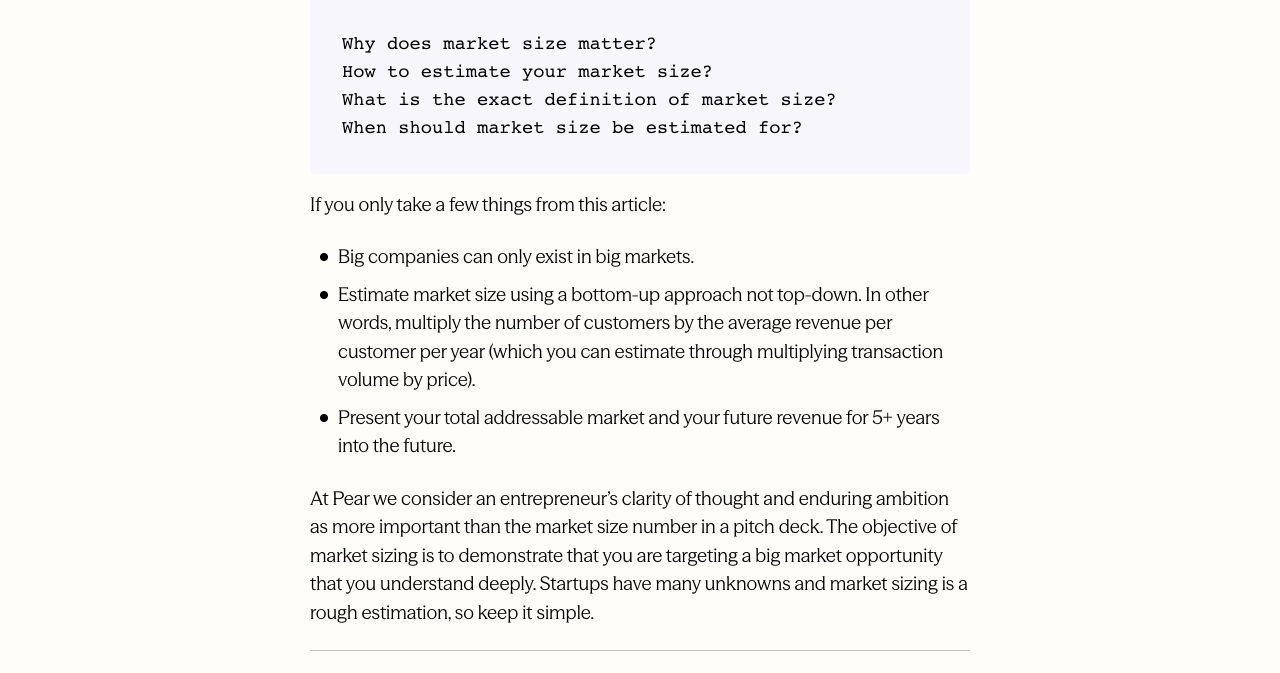
The same guide has a figure worth remembering: by the time tech companies go public, they typically hold somewhere between 0.1% and 2% of their addressable market. If the companies that make it to an IPO hold 2% or less, a plan that wins 10% of a niche in year one needs a very good reason.
You can run the three layers in a spreadsheet, or in SaaSCity's free TAM SAM SOM calculator. It sizes bottom-up from accounts and annual contract value, breaks SAM into regions, segments and channels, and warns you when SOM climbs above 2% of TAM, the top of Pear's range. We use it in the case study further down.
How many customers you need for $5K MRR, $10K MRR or $1M ARR
Price decides more than market size does. The table shows how many paying customers each revenue goal needs at five price points, rounded up:
| Monthly price | $5K MRR | $10K MRR | $250K ARR | $500K ARR | $1M ARR |
|---|---|---|---|---|---|
| $20 | 250 | 500 | 1,042 | 2,084 | 4,167 |
| $50 | 100 | 200 | 417 | 834 | 1,667 |
| $100 | 50 | 100 | 209 | 417 | 834 |
| $250 | 20 | 40 | 84 | 167 | 334 |
| $1,000 | 5 | 10 | 21 | 42 | 84 |
A $20 a month tool needs 50 times as many customers as a $1,000 a month tool to reach the same revenue. That gap matters far more than whether your niche has 20,000 people in it or 60,000.
These are customers you hold at the same time, so churn makes the real number bigger. At 5% monthly churn, keeping 500 customers means signing about 25 new ones every month just to stay level. If you don't know your churn yet, our churn rate calculator and churn playbook are a good place to start, and the ARR calculator converts between monthly and yearly figures.
The buffer: buyers you must reach for every customer you win
Nobody converts a whole market. Jason Cohen, who founded Smart Bear and WP Engine, works this out with Fermi estimates in his essay Excuse me, is there a problem?: roughly 1% of impressions become visitors and roughly 1% of visitors pay, so about 10 million impressions turn into 1,000 paying customers. He treats 1,000 paying customers as the minimum for a sustainable small company at $30 to $100 a month, and expects getting there to take about two years.
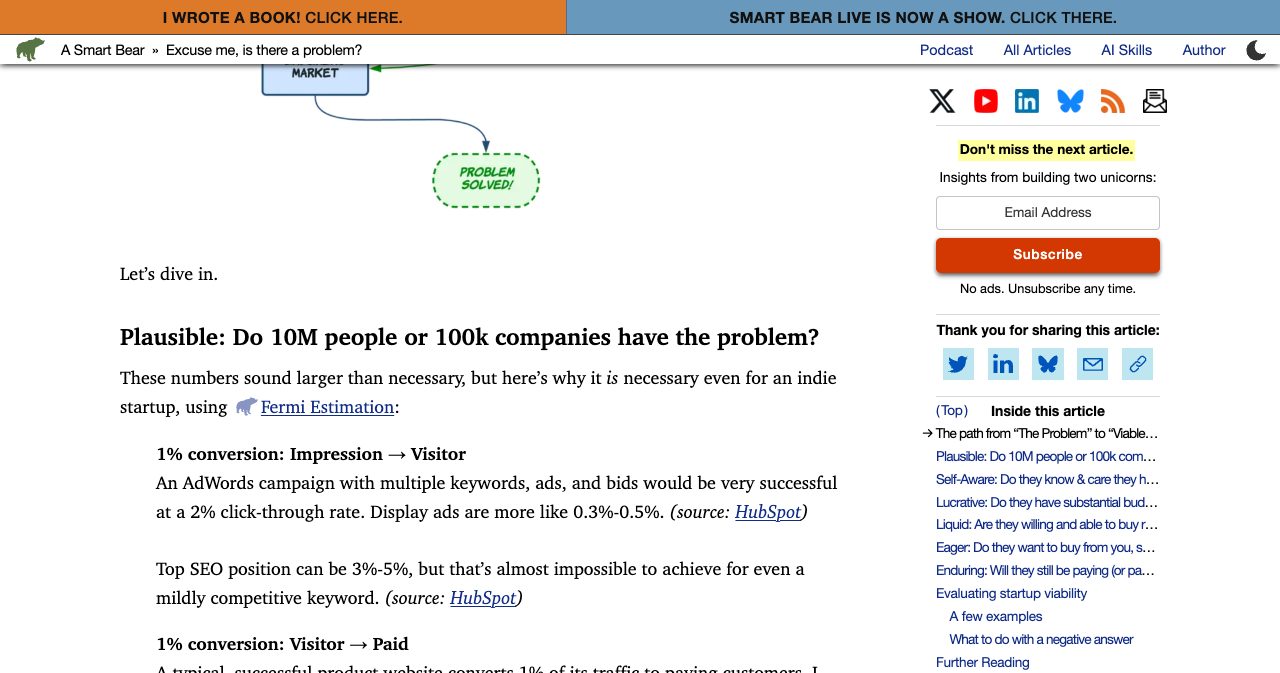
For a niche, it helps to think in reachable buyers rather than impressions. Our planning range is a 2% to 5% capture rate over two or three years, which means 20 to 50 buyers you can reach for every paying customer. A 10x buffer (10% capture) is the optimistic floor. For $1M ARR, that works out like this:
| Monthly price | Customers for $1M ARR | Buyers to reach at 10% capture | At 5% capture | At 2% capture |
|---|---|---|---|---|
| $20 | 4,167 | 41,670 | 83,340 | 208,350 |
| $50 | 1,667 | 16,670 | 33,340 | 83,350 |
| $100 | 834 | 8,340 | 16,680 | 41,700 |
| $250 | 334 | 3,340 | 6,680 | 16,700 |
| $1,000 | 84 | 840 | 1,680 | 4,200 |
Why plan on 2% to 5%? Partly because of Pear's IPO figure, and partly because capture multiplies several leaky steps: whether a buyer ever hears of you, whether they try you, and whether they stay. The two numbers measure different things. Pear's range is a share of the whole addressable market, while our capture rate applies only to buyers you can reach. In the yoga case below, winning 5% of the reachable market works out to 0.45% of TAM, well inside Pear's range. If you start with a warm audience or an exclusive partnership, use a higher number. If you're starting cold, don't.
Three rules of thumb from founders and investors
The tables tell you what your goal needs. These rules of thumb come from people who have built and funded SaaS companies, and they're worth knowing even when your goal is much smaller than theirs.
Jason Cohen: 10 million people or 100,000 companies
Cohen's first test is whether enough people have the problem at all. If you sell to consumers, he wants around 10 million who have it, and below that he argues the market is too small even for an indie company that plans to stay small forever. If you sell to businesses, there are far fewer potential customers, but they pay much more and convert at higher rates, so about 100,000 companies is enough.
He calls this test Plausible, and it's the first of six. The other five ask whether buyers know they have the problem (Self-Aware), have a real budget for it (Lucrative), can buy now (Liquid), want to buy from you specifically (Eager) and will still be paying a year later (Enduring). He also allows an exception: a high-priced product in a small niche can make a fine company. That exception is the one most bootstrappers are betting on.
Jason Lemkin: $10,000 a year, or a much bigger market
SaaStr founder Jason Lemkin looks at the same question from the investor side, in a post titled How Big Should The Addressable Market Be to Go into Vertical SaaS?, first published in November 2024. He looks for two things: whether everyone in the industry will use the product, and whether it's core enough to charge $20,000 a year, or at least $10,000. His examples include Toast, which he says gets about $10,000 a year from small restaurants, and ServiceTitan, which gets $10,000 or more from plumbers and HVAC companies. In his words: "To me, $10k is the firewall."
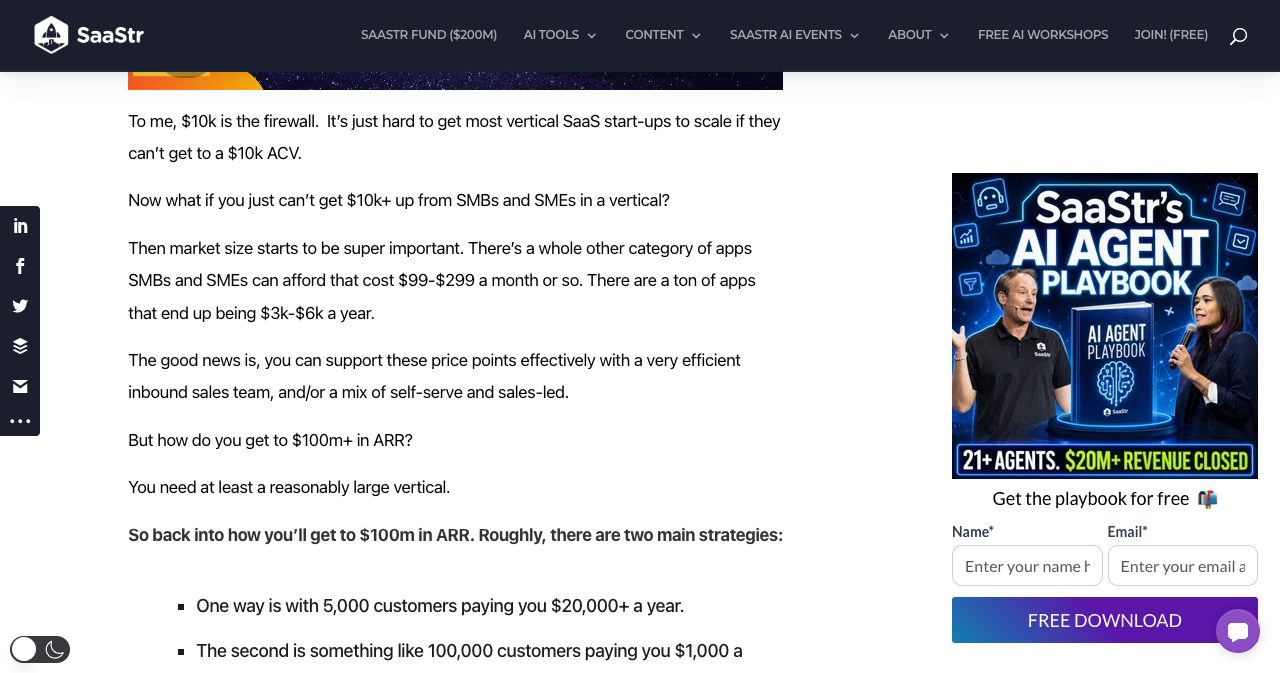
Below that price, he says, market size starts to matter a great deal. Apps that small businesses can afford at $99 to $299 a month still work, sold through an efficient inbound team or a mix of self-serve and sales. To reach $100 million in ARR he backs into two paths: about 5,000 customers paying $20,000 or more a year, or about 100,000 paying $1,000. His test is whether 10% penetration of the market gets you there.
That's a venture filter. A solo founder can pass with far smaller numbers, but the logic carries over: pick a price, back into the customer count, then ask what share of the market that count represents.
Bessemer: doubt about TAM is the top reason to pass
Bessemer Venture Partners put it bluntly in its 2017 founder's guide to vertical software: lack of confidence in the total addressable market is the number one reason the firm passes on vertical software companies. The same guide describes the second acts that successful vertical companies use to grow past their first market, including integrated payments, cross-selling, marketplaces and acquisitions. Lemkin's post makes a similar point about payments and going multi-product early.
For a small founder, that investor doubt is good news. The niches funds walk away from are the ones where a bootstrapped company can grow without a funded rival showing up next quarter.
How big a niche you need for each goal
Put the customer math and the capture range together and each goal gets its own pass line:
| Goal | Price | Paying customers | Buyers you need to reach (2% to 5% capture) |
|---|---|---|---|
| $5K MRR side income | $29 a month | 173 | 3,460 to 8,650 |
| $10K MRR, full-time solo | $49 a month | 205 | 4,100 to 10,250 |
| $40K MRR, small team | $99 a month | 405 | 8,100 to 20,250 |
| $1M ARR company | $100 a month | 834 | 16,680 to 41,700 |
| $100M ARR venture outcome | $1,000 to $20,000 a year | 5,000 to 100,000 | A market where 10% penetration covers it (Lemkin) |
For a micro SaaS run by one person, the market size you need lands somewhere between 3,000 and 20,000 reachable buyers. That's why niches that look tiny to an investor can suit one person well: big enough to fund a good living, too small for a funded company to bother with.
The floor sits around 1,000 named buyers. At 2% to 5% capture, 1,000 buyers give you 20 to 50 customers, which is a side project at $30 to $100 a month. Below that, the niche usually suits a service, a one-time product or a feature inside someone else's tool. High prices change the picture: at $500 a month or more, a few hundred named buyers can carry a real business, as long as churn stays low.
We sized a real niche: software for yoga teachers
Rules of thumb are easy to agree with and hard to apply, so we ran one niche through them with public data. The pitch is a $20 a month invoicing app for independent yoga teachers. It ticks every box on the usual micro-SaaS checklist: small, specific and ignored by big companies.
Step 1: count the buyers you can name
Start with a list someone else has already counted. Yoga Alliance, which describes itself as the largest global network of yoga professionals and schools, says on its Meet Yoga Alliance page that it has about 100,000 members in more than 100 countries.
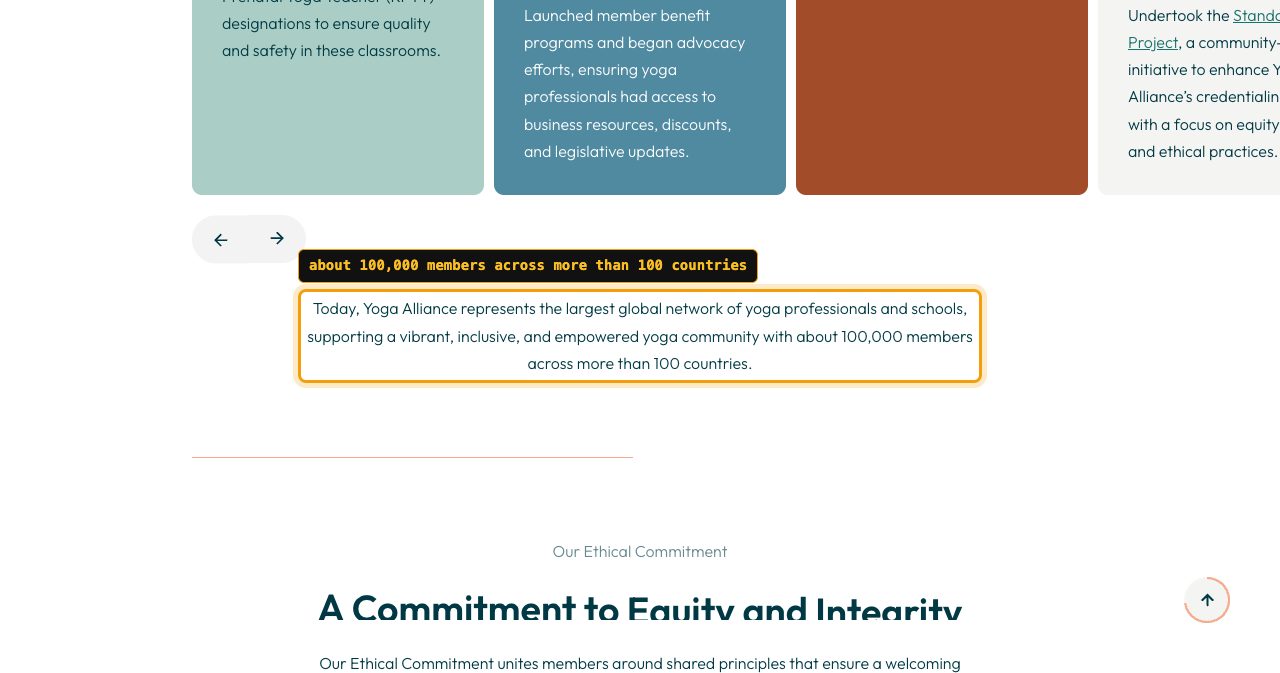
That figure includes schools as well as teachers, and plenty of teachers never register with anyone, so treat it as a rough count of credentialed professionals rather than the whole market. It's still the right kind of number, because it's published and you can check it. Then we cut it down with three assumptions, which you should replace with your own:
- 60% of members are in regions an English-language product can sell to.
- 50% of those are independent teachers who bill their own clients, rather than being paid by a studio.
- 30% of those are reachable through the channels you'll really use, such as search, a couple of communities and maybe one partnership.
That leaves 9,000 teachers in the serviceable market. Every one of those percentages is a guess, which is fine at this stage. Writing them down means each one can now be tested on its own.
Step 2: check that money already moves
A niche where nobody pays for anything has already given you its answer. So the next check is prices, and the yoga market has plenty of them.
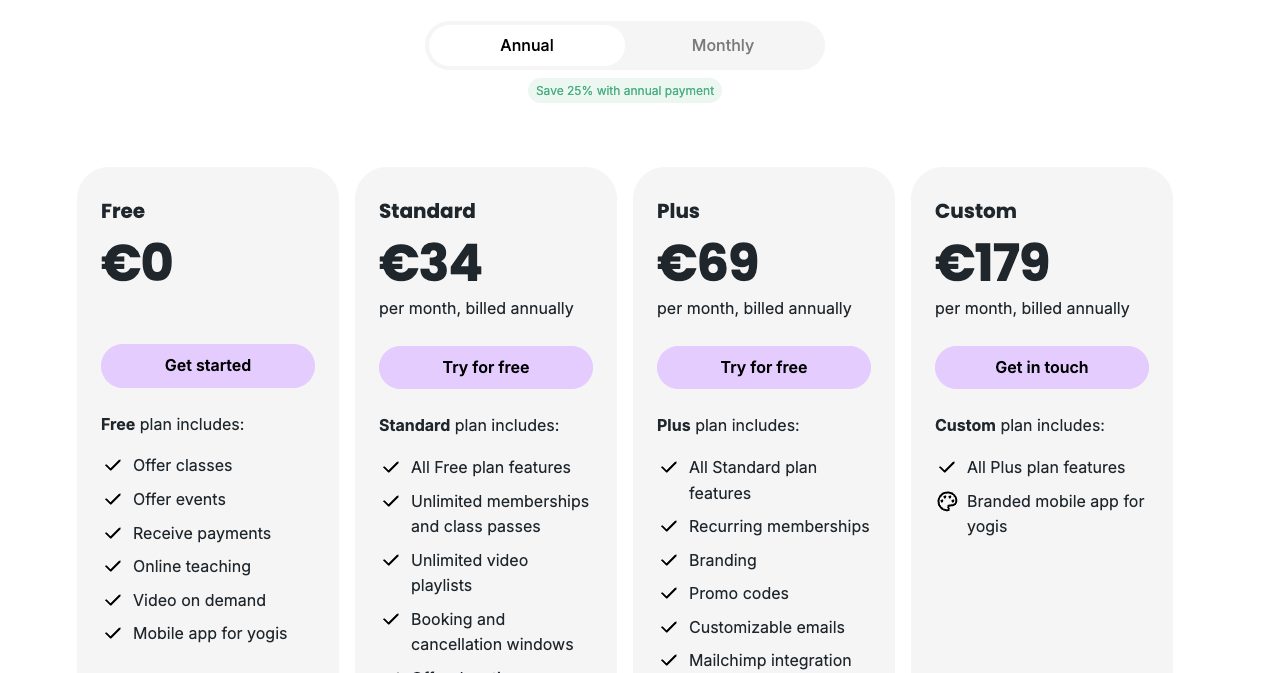
Momoyoga, a booking platform built for yoga teachers and studios, charges €34, €69 or €179 a month on annual billing for its Standard, Plus and Custom plans. Its free plan already includes classes, events and receiving payments, with a 5% platform fee on online payments on top of Stripe's fee.
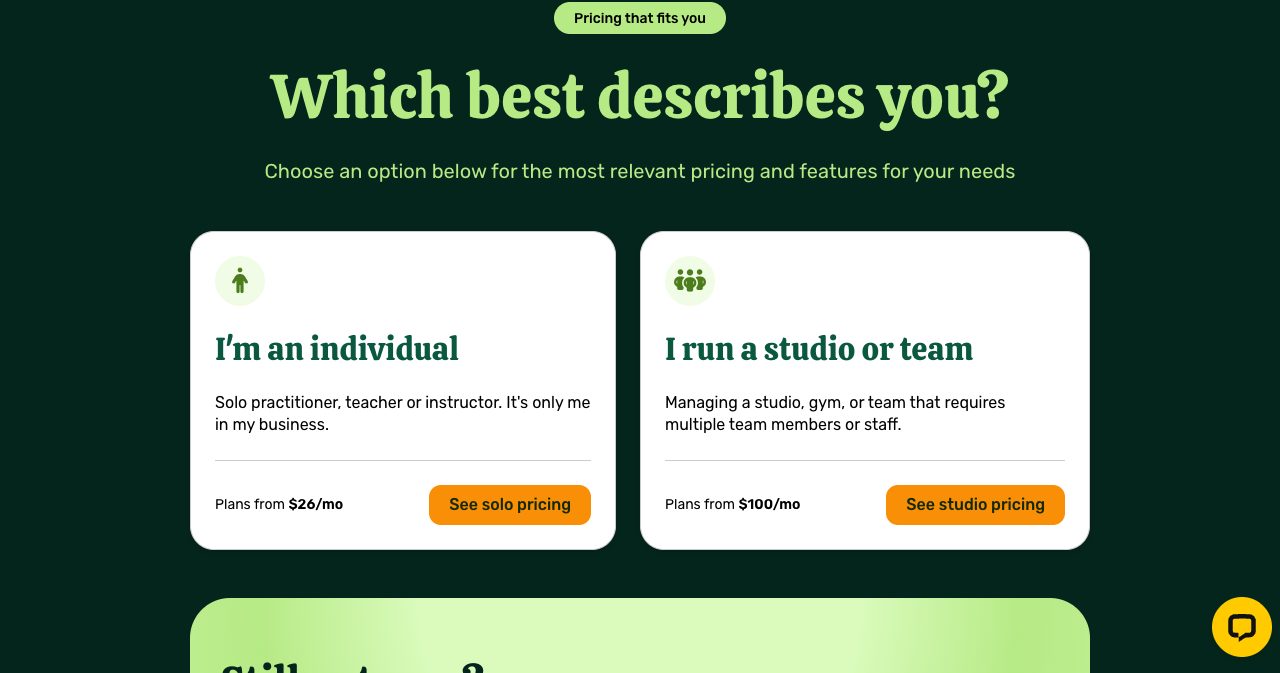
OfferingTree sells booking, websites and client management to the same people. Its solo plans start at $26 a month and its studio plans at $100 a month. Its pricing page says more than 2,000 business owners and studio leaders trust it, and its site carries comparison pages against eight named rivals: Mindbody, WellnessLiving, Momence, Mariana Tek, GloFox, Arketa, Punchpass and Walla. Vendor claims are marketing, but a vendor that bothers to fight eight rivals by name is telling you the money is real.
Capterra's Yoga Studio Software category listed 196 products when we checked. The first listing under its default Featured Partners sort, Acuity Scheduling, shows billing and invoicing among the yoga studio features reviewers value most, next to online payments.
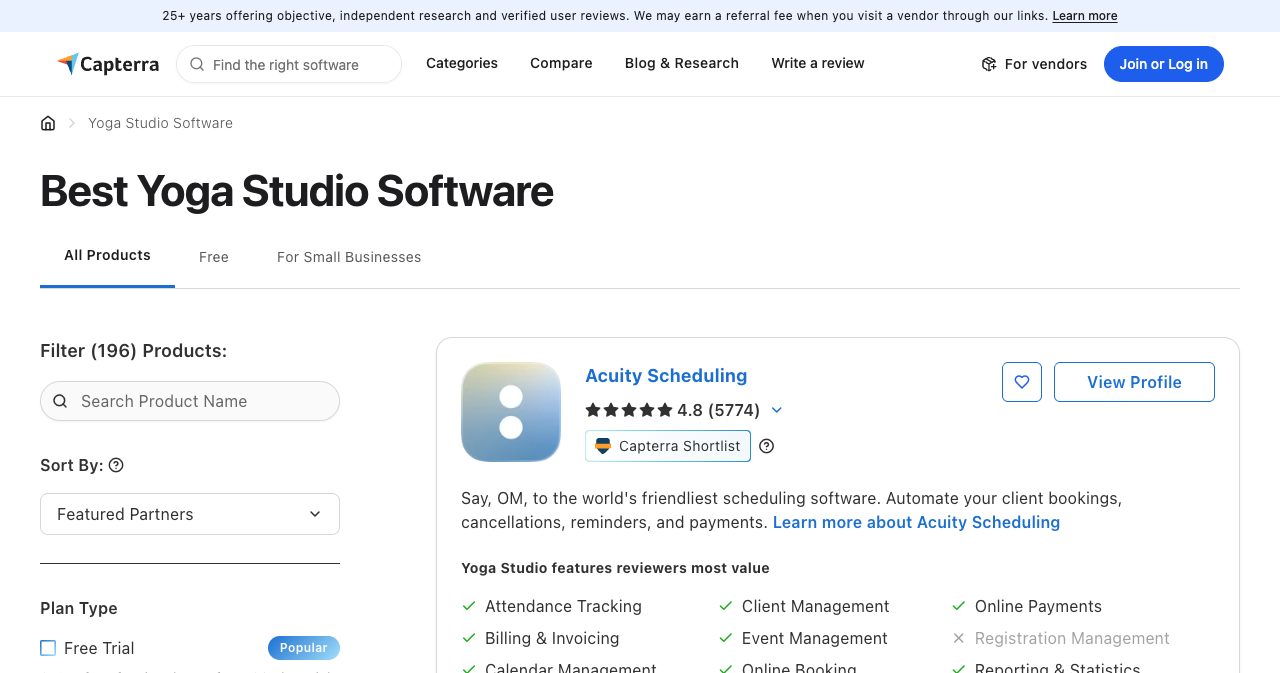
That's a green flag for the space and a red flag for our pitch. Teachers and studios clearly pay for software, from $26 a month at OfferingTree to €179 a month at Momoyoga. But billing and payments come built into the tools they already use, and Momoyoga includes payments even on its free plan, so a standalone invoicing app would be selling convenience against something teachers already have.
Step 3: read search demand carefully
Google Trends only shows relative interest, so compare your niche's search term with a sibling whose size you understand. We put yoga studio software next to pilates studio software and gym management software, worldwide, over five years.
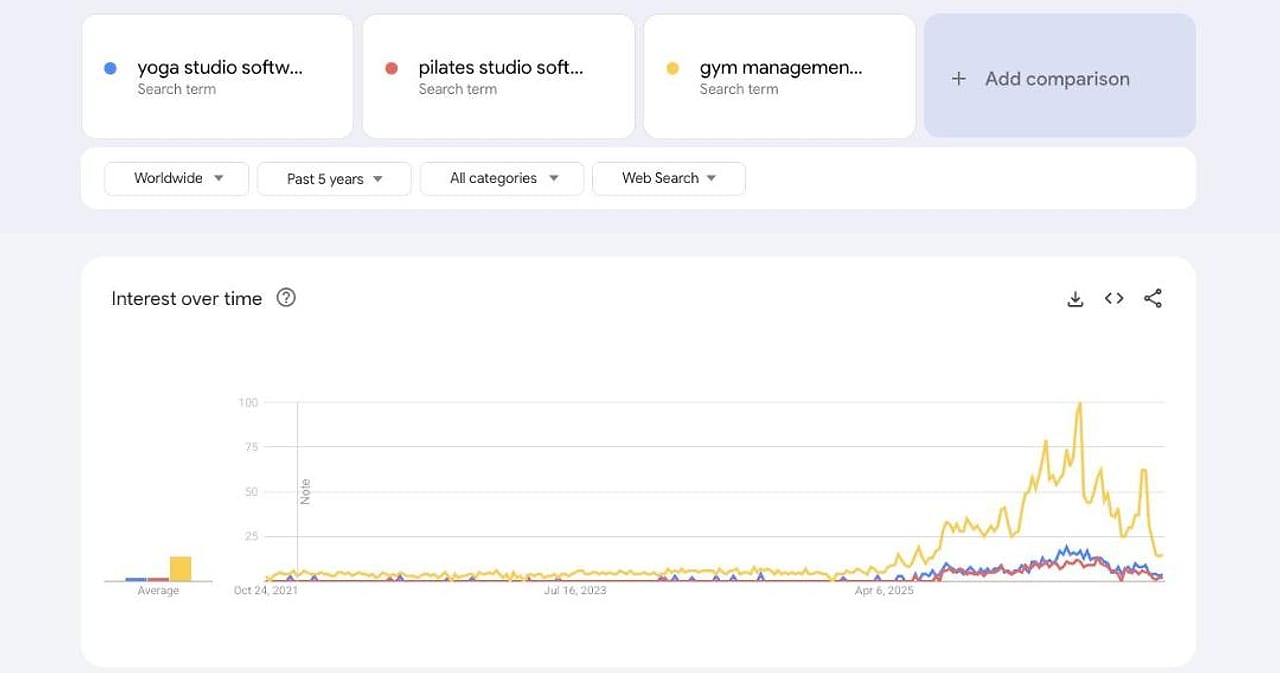
The data behind that chart says more than the lines do:
- Yoga studio software averaged 2 on Trends' 0 to 100 scale over five years. Gym management software averaged 14, seven times as much.
- Yoga studio software registered zero in 174 of the 262 weeks, and pilates studio software in 193. Trends shows a zero when a term doesn't have enough search data, which is a signal in itself.
- In the last 52 weeks, all three terms jumped together. Yoga studio software averaged 9.3, against 2.3 in the 52 weeks before, and gym management software went from 13.4 to 45.7. When every term in a category rises at once, look for a cause outside your niche before you celebrate.
For our pitch, that means search alone won't feed a $20 product. Customers would have to come from communities, partnerships and integrations, which costs more per customer and pushes CAC up.
Step 4: run the math
In the TAM SAM SOM calculator we entered 100,000 accounts paying $240 a year ($20 a month), the 60%, 50% and 30% shares from step 1, and a goal of winning 5% of SAM over three years.
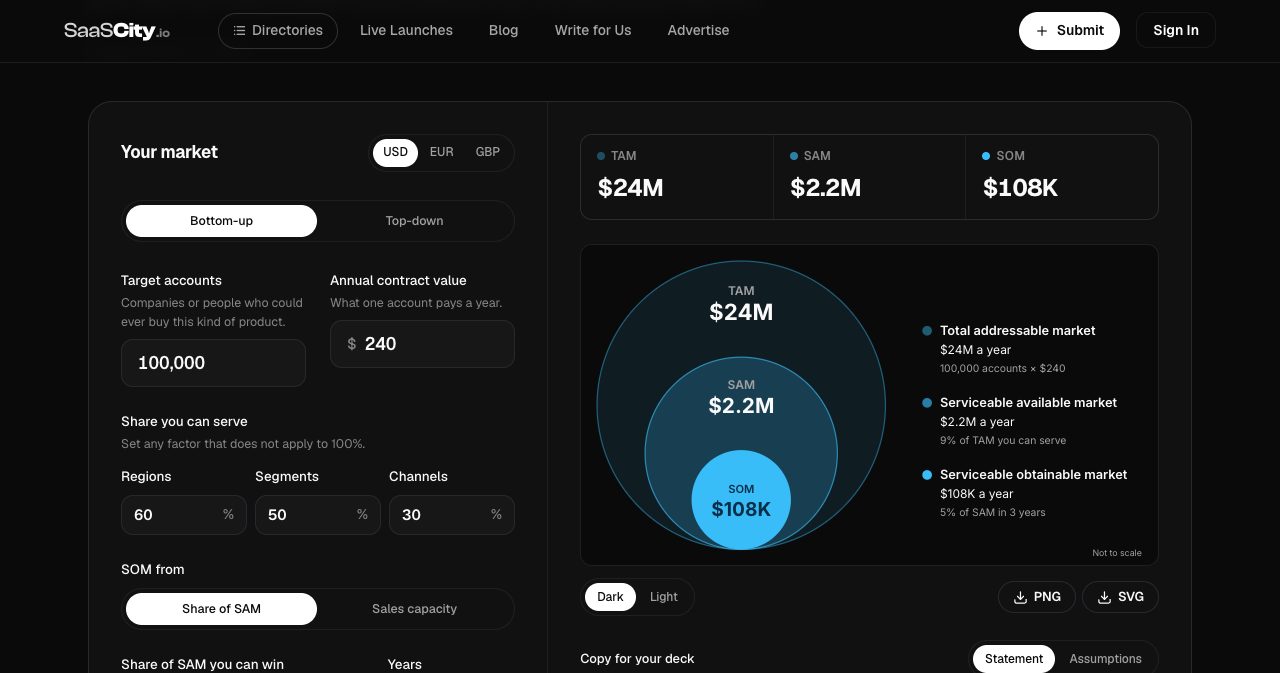
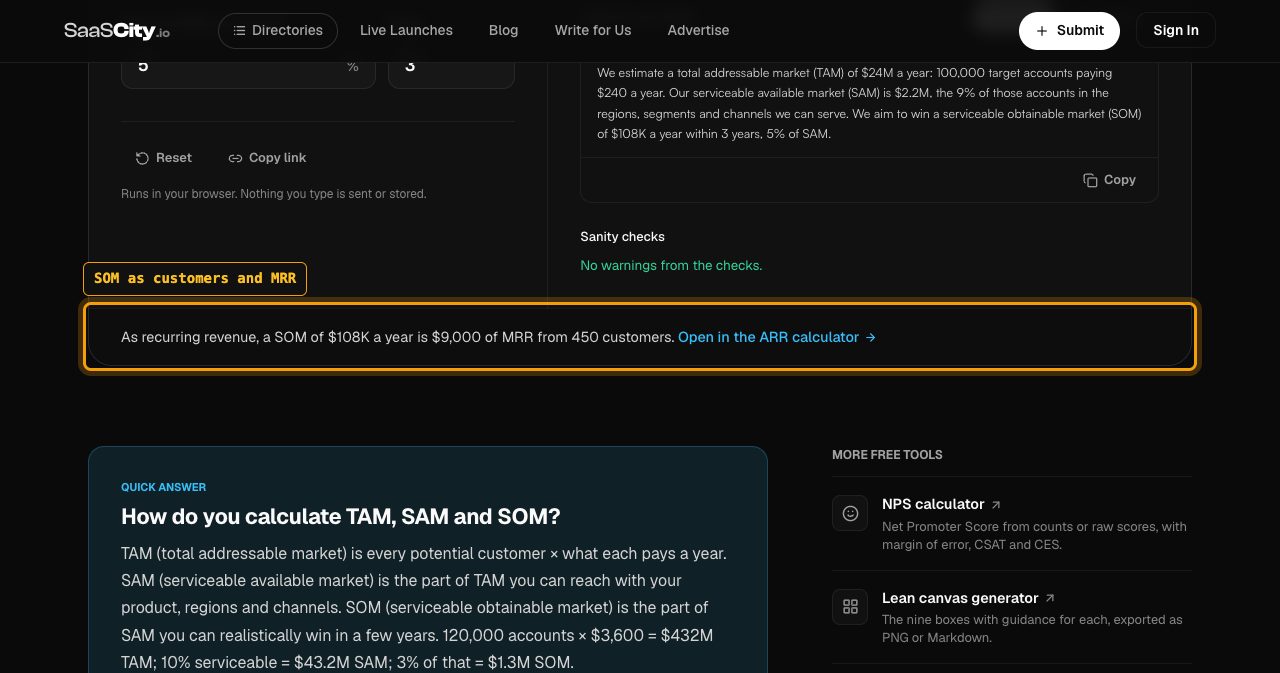
TAM comes out at $24 million a year, which sounds fine until you follow it down. SAM is $2.2 million, the 9% of accounts you can serve. SOM, 5% of SAM in three years, is $108,000 a year. The calculator then turns that into the number that matters: about $9,000 of MRR from 450 customers, three years in, if everything goes to plan.
Then the unit economics. We assumed 80% gross margin, 5% monthly churn and a $250 cost to acquire each customer through content and community work. The churn figure is a guess on the cautious side: Lemkin warns that churn is all over the place with small businesses, and a one-person yoga business is about as small as they come. The LTV:CAC calculator puts lifetime value at $320 and the ratio at 1.3 to 1, which it rates weak. Each customer takes 15.6 months to pay back what it cost to win them, against an average lifetime of 20 months.
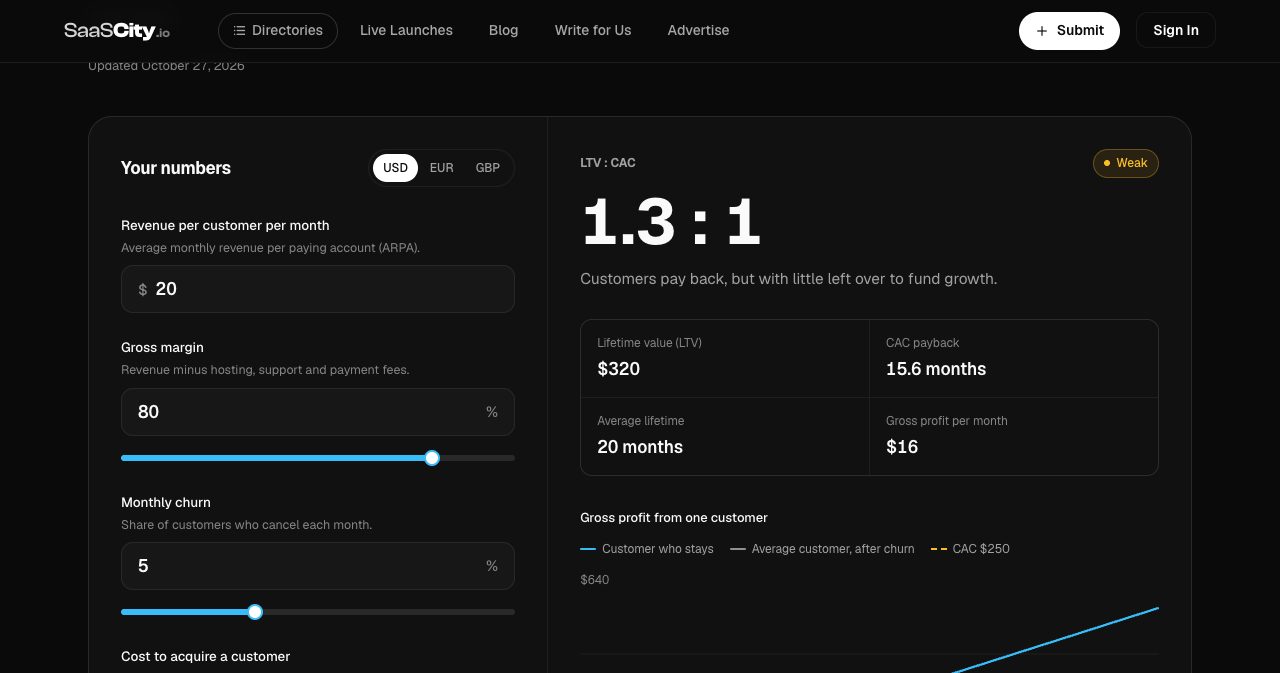
David Skok's guidelines in SaaS Metrics 2.0 call for LTV above three times CAC and payback within 12 months, and our pitch misses both.
The verdict
As a standalone $20 a month invoicing app, this niche is too small. The best case after three years is around $9,000 MRR with weak unit economics, in a market where the core feature comes bundled with tools teachers already pay for.
The same niche passes if the product changes shape:
- Do the whole job. Teachers already pay from $26 a month (OfferingTree, which bundles a website builder) to €34 a month (Momoyoga Standard) for booking and payments. At $35 a month with 3% churn and the same $250 CAC, lifetime value rises to $933, LTV:CAC to 3.7 to 1, and payback drops to about 9 months. Our price increase calculator shows how many customers a jump like that can cost you before it stops paying off.
- Widen the segment. OfferingTree's site lists yoga next to Pilates, dance, coaching, martial arts, pole and wellness studios. That's the usual expansion path: start with one kind of teacher, then add the next one over.
- Move upmarket. Studios pay $100 a month and more, have staff to train on the tool, and are likely to churn less than a solo teacher who may stop teaching altogether.
What the data can't settle is competition. With 196 products in one Capterra category, a new entrant needs a wedge, some job the existing tools do badly. That's a separate question from size, and a good one to bring to your first 20 customer calls.
Nine warning signs your niche is too small (or won't pay)
- Nobody spends money near the problem. When there are no paid competitors and nobody hires a freelancer for the job, that usually means there's no demand either.
- A free option covers most of the job. If the buyer's platform already does it for free, the way Momoyoga includes payments on its free plan, you're selling convenience, and convenience is hard to charge for every month.
- You can't find the buyers online. The search term reads zero on Trends most weeks, and you find fewer than about 50 distinct complaints about the problem across Reddit, forums and review sites.
- You can't build a list. If you can't name 50 prospects in an afternoon, reaching them later won't get easier.
- The problem shows up once a year. People cancel software they only open at tax time.
- The buyer has no budget, or no authority to spend it. Students and hobbyists rarely pay monthly, and plenty of employees can't expense a new tool.
- You get interest without urgency. Signups and likes pile up, but nobody pre-pays or books a call, which makes a thin niche easy to mistake for a real one.
- Demand is shrinking. Search interest has fallen for 12 months or more, or the category is consolidating around one or two players with strong lock-in.
- LTV can't cover CAC. At your price and a realistic churn rate, a customer never earns back what it cost to win them.
Green flags that make a small niche worth it
- People already pay for something worse, usually software they complain about in reviews.
- The complaints put a cost on the problem, such as hours lost every week.
- You can reach 50 qualified prospects in two weeks without paying for ads.
- Prices of $50 to $500 a month are normal in the niche, so you won't be the first to ask for real money.
- Competition is fragmented: several small vendors and no clear winner.
- Something is changing, like a new regulation that creates paperwork nobody wants to do by hand.
- You have an edge a competitor can't copy quickly, such as years spent working in the industry.
Vertical niches tend to score well on this list, mostly because a product that fits one workflow exactly can charge more than a generic tool, and word of mouth moves fast when every buyer knows every other buyer. Our lists of vertical micro SaaS ideas and boring SaaS ideas making $5K MRR are built on the same logic.
Why a small niche can still beat a big market
Lemkin's view, in another SaaStr post called Is a Big Market Really Better than a Niche Market?, is that a big market beats a niche one. In the same post he notes that small markets can grow into large ones when something in them changes, that they're often less crowded, and that most companies start in a small segment of a large market and widen it every year. The post points to eSignature, which SaaStr describes as growing from about $1 million in 2006 to $5 billion in 2023.
For a solo founder, the trade often favors the niche. Small markets attract fewer funded competitors and fewer price wars. A product built around one workflow can often charge more than a horizontal tool asks for the same feature, and lower churn compounds that. Owning a small beachhead also gives you somewhere to expand from, whether that's the next segment over, a team plan or payments.
How to tell if a SaaS niche is too small: the 8-step test
- Write down your revenue goal and price. Be specific, as in $10K MRR within 24 months at $49 a month, because every later step divides by these two numbers.
- Turn the goal into a customer count. Divide the yearly revenue goal by the yearly price and round up, then add churn: at 5% monthly churn, holding 500 customers means winning about 25 new ones every month.
- Count the buyers you can name, bottom-up. Use association member counts, LinkedIn job titles, industry directories, licence registers, community sizes and competitor customer counts, then apply honest shares for region, segment and channel to get SAM.
- Check that money already flows. Find paid competitors, their prices and review counts, plus the freelancers, agencies and paid templates doing the job today. The recent launches on SaaSCity and on Product Hunt also show who else just started in the same niche.
- Read the demand signals. Look at five years of search interest against a sibling niche, how active the communities are, and how many distinct complaints you can find.
- Run the unit economics. At a realistic churn rate and acquisition cost, aim for LTV above 3x CAC and payback within 12 months.
- Test willingness to pay. Put the real price on a landing page, do 20 short calls, or take pre-orders, and count payments and booked calls. Likes and free signups prove very little.
- Decide against kill criteria you wrote first. For example, fewer than 1,000 named buyers or fewer than 5 of 20 calls willing to pay means you stop or reshape the idea.
If you want a longer pre-build list, our startup idea validation checklist covers problem interviews, waitlists and pricing tests in more detail.
A niche scorecard you can fill in
Score each line from 1 to 5. It's the quickest way to compare two or three niche ideas side by side.
| Criterion | 1 point | 3 points | 5 points |
|---|---|---|---|
| Buyers you can list | Under 1,000 | 1,000 to 10,000 | Over 10,000 |
| Money already spent | Nobody pays for anything nearby | Cheap tools and the odd freelancer | Paid competitors with reviews and rising prices |
| Price buyers accept | Under $10 a month | $20 to $50 a month | $100 a month or more |
| How often the pain shows up | Once a year | Monthly | Weekly or daily |
| Reach | Paid ads only | A few communities | 50 qualified buyers contactable in two weeks |
| Competition | None, or one dominant player | Crowded and undifferentiated | Fragmented, with clear gaps |
| Your edge | None | Some domain knowledge | Insider experience, an audience or a partner |
Out of 35, a score of 28 or more is worth building, 21 to 27 is worth a cheap test, and under 21 means move on or change the shape of the idea. Our yoga invoicing app scores 17: 3 for buyers, 2 for money spent on this exact job, 3 for price, 3 for frequency, 3 for reach, 2 for competition and 1 for edge, since we have no inside track with yoga teachers.
What AI changes about the minimum viable niche
AI coding tools have made a small SaaS much cheaper to build and run, so a niche that supports $5K MRR can pay for itself sooner than it could a few years ago. Some ideas that used to fail on cost now pass.
The revenue side hasn't moved. A $20 product still needs 500 customers for $10K MRR, and those customers still have to find you. Cheaper building also helps everyone who wants to copy you, and a single feature can now be cloned in days. We covered how hard that shift hit public SaaS valuations in the SaaSpocalypse.
So the advantage moves to what a quick clone can't copy: knowing the industry, owning distribution, holding data, earning trust, and sitting deep enough in a workflow that switching hurts. In a small niche in 2026, the scarce skill is finding a problem worth paying for and reaching the people who have it.
Before you build: run the 1,000-buyer test
Listing 1,000 buyers doesn't prove a niche is big enough. Failing to list them comes close to proving it isn't. So the last check before you write code is the one this guide is named after: open a spreadsheet and give yourself a week of desk research to fill 1,000 rows with real buyers who have the problem and already spend money on it, each with a name, a company or a community you can reach them through.
If you stall at a few hundred rows, the niche is too small for a $30 to $100 a month product as you've framed it. Raise the price, widen the segment, or build the idea as a feature inside something bigger. If you fill all 1,000, score the idea on the scorecard above and run the 8-step test. If it passes all three, its small size may turn out to be the best thing about it, because nobody bigger is coming for it.
Once the niche passes, the first 50 customers are a distribution problem, and our guide to getting your first 100 users covers that part. If your buyers are founders, makers or small software teams, put the product where they browse. A free SaaSCity listing goes through a review queue (add our badge to your site and its link becomes dofollow), and Quick Pass at $19.99 skips the queue and adds a building on the city map within 24 hours. Our guide to submitting a SaaS to directories covers the other listings worth having, and our list of the best subreddits for indie hackers covers the communities.
FAQ
How do I know if my SaaS niche is too small?
Multiply the buyers you can reach by the share you can realistically win (2% to 5% is a sensible planning range) and by your yearly price. If the result can't reach your revenue goal, the niche is too small for that goal. A fast check is the 1,000-buyer test: if you can't list 1,000 real buyers who have the problem and already spend money on it, a $30 to $100 a month subscription won't work there.
How many customers do I need for $1M ARR?
Divide $1,000,000 by what one customer pays in a year. At $20 a month that's 4,167 customers, at $50 it's 1,667, at $100 it's 834, at $250 it's 334 and at $1,000 a month it's 84. Those are customers you hold at the same time, so churn means you have to win more than that over the years.
What is the minimum market size for a SaaS business?
There's no single number, because it depends on price. Jason Cohen's rule of thumb for products at $30 to $100 a month is about 10 million consumers or 100,000 businesses with the problem, which is enough to end up with 1,000 paying customers. A solo founder aiming for $10K MRR at $49 a month needs roughly 4,100 to 10,250 buyers they can reach.
Is a niche with only a few thousand potential customers too small?
Not if they pay enough. Between 2,000 and 10,000 reachable buyers at $50 to $100 a month can support $10K MRR at a 2% to 5% capture rate. At about 1,000 named buyers, that capture rate gives you only 20 to 50 customers, which is a side project at $30 to $100 a month, so the niche usually suits a service, a one-time product or a higher price.
What is the difference between TAM, SAM and SOM?
TAM is every potential customer multiplied by what each would pay in a year. SAM is the part of TAM your product, regions, language and channels can serve today. SOM is the part of SAM you can realistically win in the next few years. For a small SaaS, SOM is the only one that predicts revenue, and Pear VC advises sizing bottom-up and using top-down figures only as a sanity check.
Is having no competitors a good sign?
Usually not. No competitors more often means no demand, or a problem people already solve with free tools, than an empty field waiting for you. A healthy niche has a few paid competitors with real customers who complain about price, dated design or missing features. That proves money moves, and the complaints show you where the gap is.
Can a small niche grow into a big business?
Yes, if you keep widening it. SaaStr founder Jason Lemkin notes that most companies start in a small segment of a large market and expand that segment every year. Common routes are adjacent verticals (yoga to Pilates to dance studios), moving upmarket from solo users to teams, and adding payments, which both Bessemer and SaaStr point to in vertical software.
How do I count potential customers in a niche?
Count bottom-up from lists you can check: association member counts, LinkedIn job titles, industry directories, licence registers, community sizes, and competitor customer counts or review volumes. Then apply honest shares for region, segment and channel. Write every assumption down so you can test and replace each one on its own.
Does AI make smaller SaaS niches viable?
It lowers the cost of building and running a small product, so a niche that supports $5K MRR can pay for itself sooner. It doesn't change how many customers you need to reach a revenue goal, and it makes copying easier, so the advantage moves to distribution, domain knowledge, data and trust.
What LTV to CAC ratio does a niche need to be worth it?
Aim for lifetime value above three times customer acquisition cost and for earning back CAC within 12 months, the guidelines David Skok sets out in SaaS Metrics 2.0. In our yoga example, a $20 a month tool with 5% monthly churn and a $250 CAC lands at 1.3 to 1 and needs 15.6 months to pay back, against a 20-month average customer lifetime.
Get your SaaS in front of founders
List your product on SaaSCity - a permanent listing, real discovery, and a dofollow backlink from a high-DR directory. Free with a badge; upgrade for a building on the live city map.