News
Ideogram 4: The Open-Weight Image Model That Actually Renders Text
Ideogram 4 is a 9.3B-parameter open-weight Diffusion Transformer with a 0.97 English OCR accuracy score — the highest of any open-weight model — plus JSON-structured layout control that lets you define exact text placement, color palettes, and object positions before a single pixel is generated.

Contents (9)
- Key Takeaways
- What Ideogram 4 Actually Is
- The Architecture: Why a DiT Built From Scratch
- JSON Prompting: The Feature That Changes Everything
- Benchmarks: Where It Wins, Where It Doesn't
- List Your AI Tool on SaaSCity
- What This Means for SaaS Builders
- Where the Competition Actually Stands
- The Actual Implication
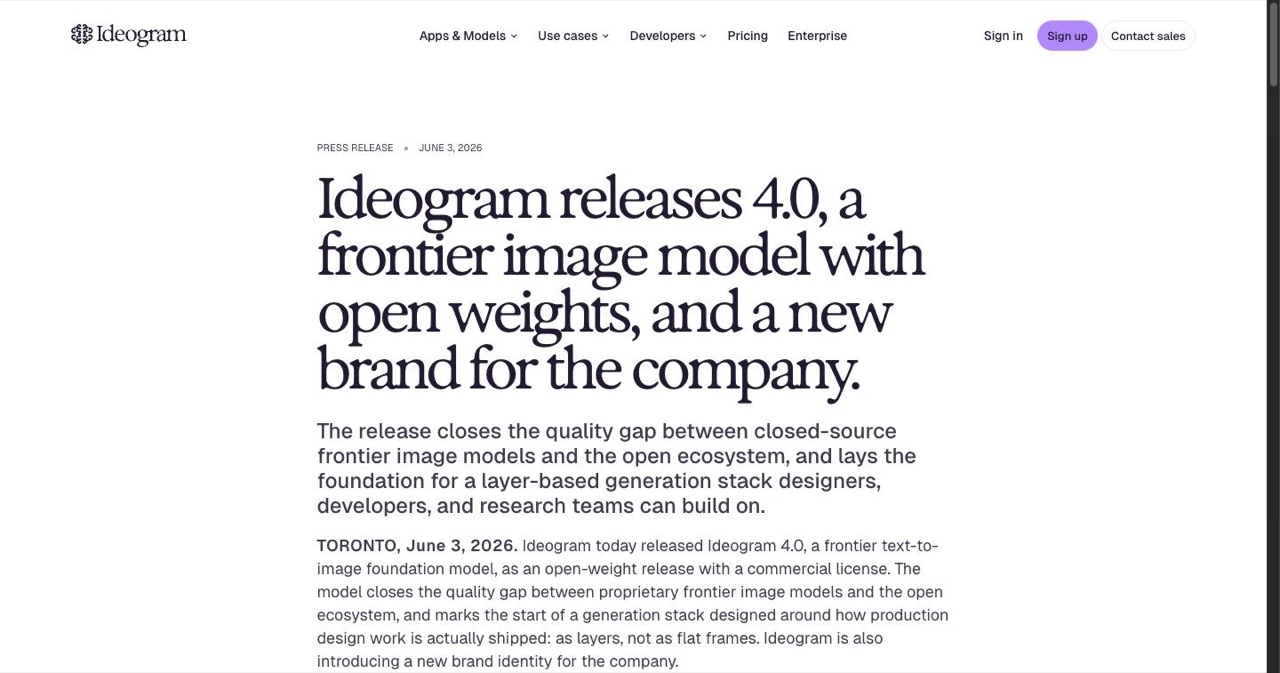
Quick answer: Ideogram 4 is a 9.3B-parameter single-stream Diffusion Transformer that Ideogram released on June 3, 2026 as its first open-weight model. It scores 0.97 on the X-Omni English OCR benchmark, the highest of any open-weight model at that scale, and accepts JSON prompts that pin text layers to bounding boxes on a 0-1000 grid with a palette of up to 16 hex values. The NF4 checkpoint runs on one 24GB GPU; commercial use needs a paid license.
Midjourney can't spell reliably. DALL-E adds phantom words. Stable Diffusion treats text as decoration. Ideogram 4 scores 0.97 on English OCR accuracy — and its weights are open.
That combination didn't exist six months ago.
Ideogram dropped Ideogram 4 on June 3, 2026 — a 9.3B-parameter single-stream Diffusion Transformer built from scratch for design-first generation. It's the company's first open-weight model, and it does something no open-weight competitor currently matches: it takes a JSON object describing exact text positions, hex color palettes, and typography layers, and generates images that actually honor those constraints.
This isn't a text-to-image upgrade. It's a design system that produces images.
Key Takeaways
- Open weights, first time: Ideogram 4 is Ideogram's first open-weight model, a 9.3B-parameter single-stream Diffusion Transformer trained from scratch on structured JSON caption data.
- OCR score of 0.97: It leads every open-weight model at its parameter scale on the X-Omni English OCR benchmark for typography accuracy and multi-line text layout.
- JSON layout control: Up to six text layers with normalized
[y_min, x_min, y_max, x_max]bounds on a 0-1000 scale, a palette of up to 16 hex values, and relative object positioning. - Runs on one 24GB GPU: The NF4 quantized checkpoint fits consumer hardware; FP8 needs about 32GB. Both ship through Hugging Face, with ComfyUI support from day one.
- DesignArena rank: Roughly 1285 Elo, first among open-weight models and second overall, about 115 points ahead of HunyuanImage 3.0 at 80B parameters.
- Photorealism is the weak spot: Midjourney v7, Adobe Firefly, and closed photorealistic models beat it clearly on realistic photos.
- License matters before you ship: Free weights cover research and local experimentation only; the Non-Commercial Model Agreement requires a paid license for revenue-generating use.
What Ideogram 4 Actually Is
Before going deep, let's be clear about the target.
Most image generation models are optimized for photorealism. Feed them a prompt, get back a plausible photo. For editorial content, concept art, or stock image replacement — fine. But anyone who's tried to generate a product poster, a social card, or a branded banner with any major model has hit the same wall: the text is garbled, the layout is unpredictable, and the colors drift from the brand palette.
Ideogram 4 is built specifically for that gap. Design-first AI image generation where the output needs to work as a real artifact — a poster that goes on a print run, a header that ships in a marketing email, a product card that lands on an e-commerce page.
The model runs on a single 24GB GPU with the NF4 quantized checkpoint. Commercial rights require a paid license; research and local experimentation use free weights available through Hugging Face. ComfyUI support shipped day one.
The Architecture: Why a DiT Built From Scratch
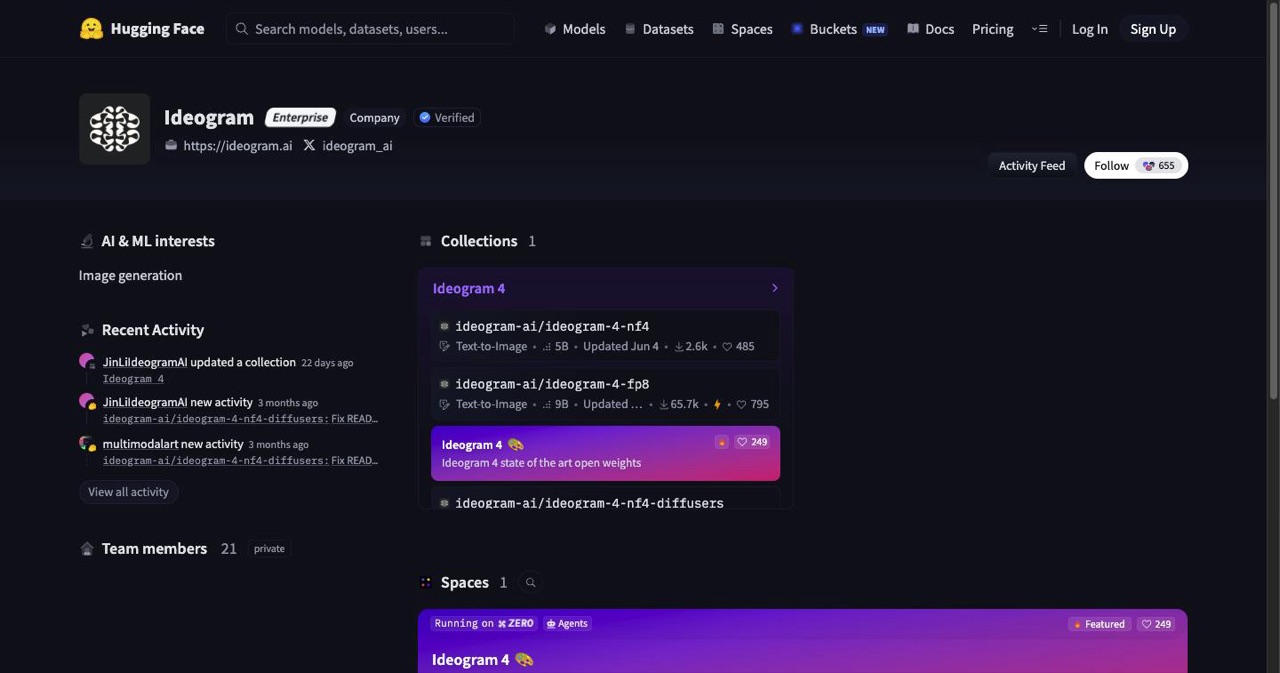
Ideogram didn't fine-tune Stable Diffusion or fork FLUX. Ideogram 4 is a 9.3B-parameter single-stream Diffusion Transformer trained from scratch on structured JSON caption data.
The "single-stream" part matters technically. Most recent image models — including FLUX.1 — use a dual-stream architecture that keeps image tokens and text tokens in separate pathways before merging. Single-stream processes them together from the first layer. The tradeoff: more computationally expensive per step, but cross-modal alignment — the model's ability to understand what text says and where it should appear in the frame — is significantly tighter.
For a model whose core job is putting the right text in the right place, that alignment is the whole product.
Quantized checkpoints at launch:
- FP8: High-fidelity, ~32GB VRAM
- NF4: Compressed for consumer hardware, runs on 24GB GPU
Both are available through Hugging Face. The architecture scales resolution automatically from 256 to 2048 pixels, in multiples of 16, without a separate upscaling pass.
JSON Prompting: The Feature That Changes Everything
This is where Ideogram 4 separates from every other open-weight image model at this scale.
Standard image generation is probabilistic: describe what you want in text, get a plausible interpretation. The model decides where elements land. Run the same prompt twice, get two different compositions. For creative exploration, fine. For production design workflows that need consistency and repeatability, this is a structural problem.
Ideogram 4's JSON prompting system lets you specify:
- Text bounding boxes: Up to six independent text layers, each with normalized coordinates (
[y_min, x_min, y_max, x_max]on a 0–1000 scale), text content, and typography weight - Color palette: Up to 16 hex values constraining the generation's color space
- Object positioning: Relative-to-frame placement for non-text elements
- Style attributes: Declarative control over rendering style, lighting, and texture
A concrete example. Instead of prompting "a coffee shop poster with white text on dark background," you send:
{
  "background": "warm dark roast aesthetic, muted browns and blacks, steam rising from cup",
  "text_layers": [
    {
      "text": "MORNING RITUAL",
      "weight": "bold",
      "bounds": [50, 100, 200, 900]
    },
    {
      "text": "Open 6am · Specialty Coffee · Cold Brew on Tap",
      "weight": "regular",
      "bounds": [220, 100, 280, 900]
    }
  ],
  "palette": ["#1A0F0A", "#F5E6D3", "#C4A882", "#FFFFFF"]
}
Run that JSON 50 times and you get 50 compositionally consistent posters with variable aesthetic takes on the same layout. That's not possible with any other open-weight model today.
The model validates JSON structure before running inference — predictable errors at the API layer, not surprise garbage in production.
Benchmarks: Where It Wins, Where It Doesn't
The honest picture, not the press release version.
Text rendering (decisive lead): Ideogram 4 scores 0.97 on the X-Omni English OCR benchmark — the highest of any open-weight image model at this parameter scale. The next open-weight competitor trails by a meaningful margin. For typography accuracy, multi-line text layout, and text-in-image generation, this is the current state of the art in open models.
DesignArena (the relevant leaderboard):
| Model | DesignArena Elo | Type | Parameters |
|---|---|---|---|
| Top closed models | Above 1300 | Closed | N/A |
| Ideogram 4 | ~1285 | Open-weight | 9.3B |
| HunyuanImage 3.0 | ~1170 | Open-weight | 80B |
| FLUX.2 | ~1150 | Open-weight | ~12B |
Ideogram 4 sits #1 among open-weight models and #2 overall in DesignArena — roughly 115 Elo points ahead of the next open competitor. It does this at 9.3B parameters, while HunyuanImage 3.0 runs 80B to get within 115 points below. That's a significant efficiency gap.
When Google updated the image arena leaderboard earlier this year, the same pattern held: closed models dominate general photorealism, open-weight models carve out leads in specialized categories. Ideogram 4's specialization is precisely what production SaaS workflows need.
Where it trails: Photorealism. Ideogram 4 is built for graphics, not photographs. Against Midjourney v7, Adobe Firefly, and the best closed photorealistic models, it loses on that dimension clearly. If your use case is "generate a realistic photo of a person," there are better tools. If it's "generate a banner with a correct headline in the right font weight in brand colors," Ideogram 4 beats everything open and competes with the closed field.
List Your AI Tool on SaaSCity
You built something that generates, processes, or deploys AI images. The developers and founders evaluating their stack right now need to find it.
SaaSCity.io is the directory for AI tools and modern software products — built for active buyers, not tourists.
- Free to list: Submit your product in under 2 minutes at no cost.
- Dofollow backlinks: Every listing earns SEO-moving backlinks that raise your Domain Rating — covered in our complete guide to increasing domain rating.
- 3D city map: Your product gets a building in the interactive SaaSCity map, not a row in a spreadsheet.
- Reach early adopters: Founders, engineers, and tooling buyers — not passers-by.
Submit your product today and get in front of the people who build with AI.
What This Means for SaaS Builders
If you're building a product, think about Ideogram 4 in three distinct ways.
1. Image Generation as a Pipeline Component
The JSON interface means you can treat Ideogram 4 as an API layer inside a templated design system. Feed it structured data — product names, prices, color codes, copy — and get production-ready images back. For e-commerce product cards, social preview images, email headers, ad creatives, or personalized marketing assets at scale, the repeatability of JSON-controlled AI image generation is the unlock.
You're not prompting anymore. You're parameterizing a template.
2. Embedded Design Tools
Building a product that generates visual assets for users? Ideogram 4's API — through Ideogram's hosted endpoint or fal.ai's serverless inference — gives you text-accurate, layout-controlled generation without managing GPU infrastructure. Three hosted quality tiers let you match inference cost to output quality requirements.
For a prototype or internal tool, the free weights running locally are enough to prove the concept. If you're building a full AI SaaS product, budget the commercial license before you ship. The Non-Commercial Model Agreement is clear: any revenue-generating use requires a paid commercial license.
3. Self-Hosted Inference
The open weights make self-hosting viable in ways closed models never will. One 24GB GPU running the NF4 checkpoint generates design assets without per-image API costs. At scale — thousands of images per day — the unit economics shift decisively toward owning the inference layer.
This is the same argument as open-weight sovereign AI deployment: control over your pipeline, no per-call pricing that scales against you, no vendor lock-in on a capability that becomes core to your product. The open weights are the moat.
Where the Competition Actually Stands
FLUX.2 is the most direct open-weight comparison for general image quality. Capable model, active community. No JSON prompting interface. DesignArena Elo sits roughly 135 points below Ideogram 4. For layouts where text accuracy matters, it's not the same league.
Stable Diffusion 3 runs a massive ecosystem of fine-tunes and community tooling. Still probabilistic layout, still weak text rendering. The community breadth is real; the design precision isn't there.
Midjourney and Adobe Firefly produce more photorealistic outputs and have strong commercial rights clearance (particularly Firefly's training data story). Neither offers a JSON interface. Neither can take a template and generate 500 compositionally consistent brand assets at programmatic scale. Firefly's commercial story is compelling; its layout control story is not.
DALL-E 3 is still widely deployed in products. Still introduces spelling errors in multi-line text. Still makes compositional decisions you can't override with coordinates.
The gap Ideogram 4 fills is specific: design-first generation with programmatic layout control. It's not trying to beat Midjourney at photorealism. It's trying to replace the Figma-to-export workflow for templated asset generation. That's a different race, and right now Ideogram 4 is running it alone among open-weight models.
The Actual Implication
Open-weight image generation just got a layout system.
That sounds incremental. It isn't. Every design workflow built on templates — e-commerce, email marketing, social advertising, personalized content at scale — has been blocked from using AI image generation because the outputs couldn't honor constraints. You can't ship a product card where the price might appear anywhere on the image, or a campaign header where the headline might be missing a letter.
JSON-controlled, bounding-box-positioned, palette-constrained text-in-image generation changes that constraint. It moves image generation from a creative exploration tool into a production pipeline component — something you can wire into a backend, parameterize with data, and trust to output something that ships.
The photorealism gap versus closed models is real and will narrow as training scales. The JSON interface and the open weights are structural choices baked into how the model was trained. Those stay. And as the quality ceiling rises, the layout control advantage compounds.
If you're evaluating AI image generation for anything beyond "make a cool picture," Ideogram 4 is the first open-weight model worth building production infrastructure around. The best AI tools directories are already indexing it. Start running the NF4 weights before your competitors do.
Resources:
- Official release notes: ideogram.ai/news/ideogram-4.0
- Weights and model card: Hugging Face — ideogram-ai
- Commercial API access: ideogram.ai
- Serverless inference: fal.ai
SaaSCity.io covers AI tools and image generation platforms. Explore the SaaSCity directory to discover what's shipping right now — or list your own product.
Get your SaaS in front of founders
List your product on the SaaSCity live city map - a permanent listing, real discovery, and a backlink from a high-DR directory. Free to start; upgrade for a dofollow link and a building on the map.