News
Ornith-1.5: Open-Source LLMs That Write Their Own Training Curriculum (and Trade Blows With Claude Opus 4.8)
Ornith-1.5 is out: 9B, 35B, and 397B open models trained on self-generated tasks and RL rollouts. MIT license, phone-ready quants, scores near Claude Opus 4.8.

Contents (10)
Quick answer: Ornith-1.5 is an MIT-licensed open-source LLM family released by DeepReinforce's Ornith team on August 19, 2026, in three sizes: a 397B MoE flagship, a 35B MoE that activates about 3B parameters per token, and a 9B dense model with a ~1.5 GB Mobile quant for phones. Its distinguishing feature is a GRPO-optimized loop where the model proposes its own tasks, builds the harnesses that grade them, and generates the RL rollouts. Ornith's own numbers put the 397B at 86.1 on Terminal-Bench 2.1 against Claude Opus 4.8's 85.
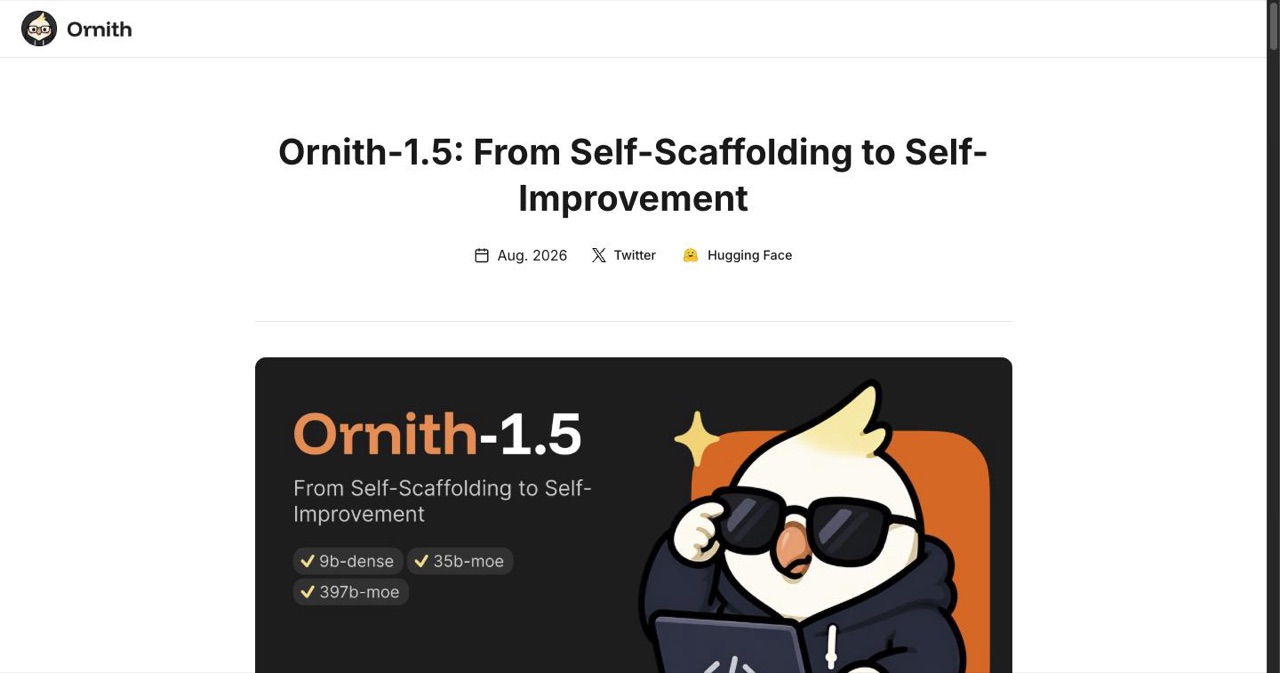
Most open-model releases in 2026 follow the same script: bigger corpus, more RL polish, a benchmark table, a Hugging Face link. Ornith-1.5, which DeepReinforce's Ornith team dropped this morning with a cheerful "Aloha!", follows a different one. The headline isn't the scores, even though the scores are good. It's that the model generated a meaningful part of its own training curriculum: it proposed the tasks, built the harnesses to grade them, and produced the rollouts that fed reinforcement learning. Task, test, and answer, all from the same model, in a loop.
The family covers three sizes under an MIT license: a 397B MoE flagship, a 35B MoE that activates only about 3B parameters per token, and a 9B dense model whose quantized Mobile variant squeezes into roughly 1.5 GB and runs on a phone. Ornith's own numbers put the flagship next to Claude Opus 4.8 on several agentic and coding benchmarks. Nobody outside the company has verified anything yet, since the launch is hours old. But the training method alone makes this one worth reading past the table.
Key Takeaways
- Three sizes, one license: 397B MoE, 35B MoE (~3B active per token), and 9B dense plus a ~1.5 GB 9B-Mobile quant, all MIT licensed with no acceptance form.
- Closed training loop: The model proposes tasks, generates the verification harness, and produces solution rollouts, with all three stages optimized by GRPO.
- Reward design does the work: Task reward multiplies validity, frontier difficulty (targeting roughly a 20% success rate), and novelty, so a zero in any term zeroes the whole reward.
- Flagship benchmarks: 86.1 on Terminal-Bench 2.1 (Claude Opus 4.8: 85), 86 on SWE-Bench Verified, 92.8 on GPQA Diamond, 56 on DeepSWE (Claude Opus 4.8: 59).
- The 35B is the deployment pick: Roughly 67.8 to 68.5 on Terminal-Bench 2.1 and 79 on SWE-Bench Verified while activating about 3B parameters per token.
- Day-one quants: FP8, GGUF, MLX, and NVFP4 in the ornith-ai Hugging Face collection, with Ollama, LM Studio, AtomicChat, and Unsloth support.
- All numbers are vendor-reported: Averaged over 5 runs by Ornith, with no independent replication yet and a noted 85.1 vs 86.1 variance in the launch materials.
What is Ornith-1.5?
Ornith-1.5 is the second release in the Ornith line from DeepReinforce, a research team with prior open work in reinforcement learning and agent loops (CUDA-L1 and IterX among them). Ornith-1.0 landed in June 2026 focused on self-scaffolding for agentic coding. Version 1.5 extends that into what the team calls end-to-end self-improvement, and scales it across three sizes:
| Model | Architecture | Active params | Notes |
|---|---|---|---|
| Ornith-1.5-397B | MoE | (flagship) | Frontier-class scores, needs multi-GPU |
| Ornith-1.5-35B | MoE | ~3B per token | The efficiency play |
| Ornith-1.5-9B | Dense | 9B | Single-GPU friendly |
| Ornith-1.5-9B-Mobile | Dense, quantized | ~1.5 GB on disk | iPhone / Android / edge |
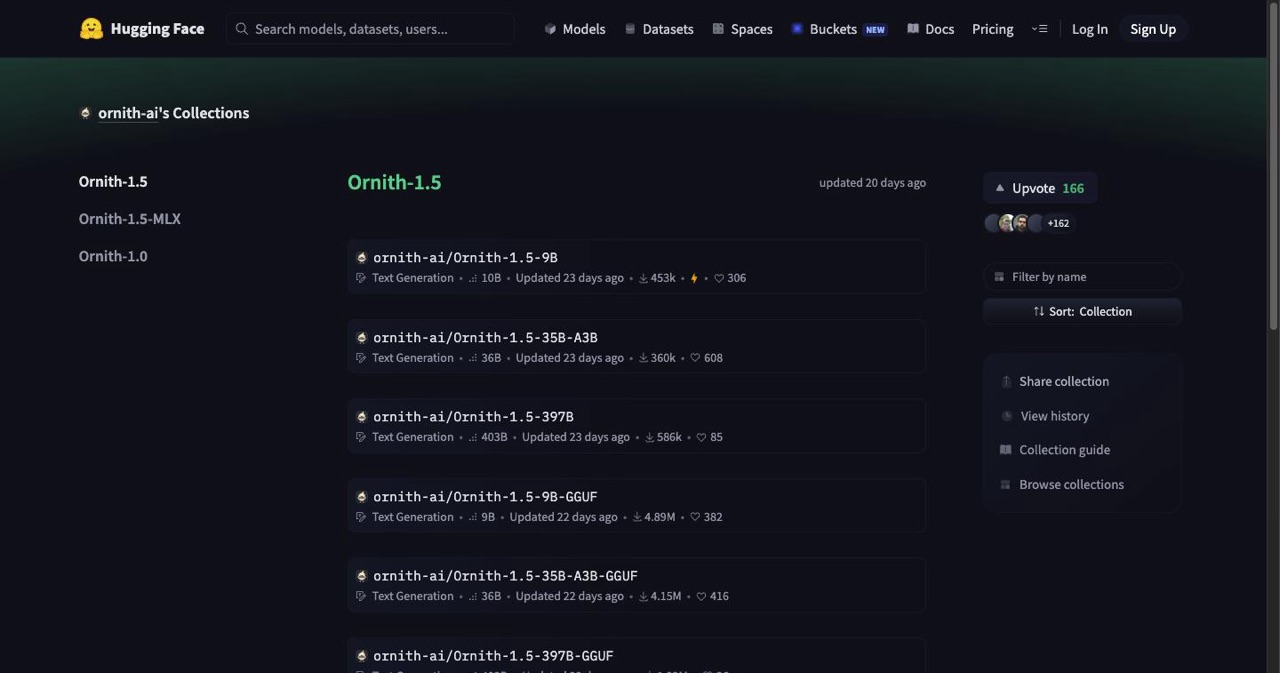
Everything is MIT licensed, so commercial use, fine-tuning, and redistribution are all fair game with no acceptance form and no usage tiers. Quantized variants shipped on day one in FP8, GGUF, MLX, and NVFP4, and the whole set lives in the ornith-ai collection on Hugging Face. The models run in Ollama and LM Studio, plug into OpenCode and Hermes Agent for agent work, and Unsloth supports fine-tuning.
Day-one quants across four formats is the kind of release hygiene that used to take the community two weeks of volunteer work. It's becoming table stakes for serious open releases, and I'm glad.
From self-scaffolding to self-improvement
Here's the part that matters more than any single score.
Ornith-1.0's trick was self-scaffolding: instead of humans writing the evaluation harness for each RL task, the model generated the scaffold and the solution together, and RL optimized both. That removed one human bottleneck. But the tasks themselves still came from a fixed, human-curated pool, and a fixed pool goes stale. Once the model saturates it, learning stops.
Ornith-1.5 removes the last human step. The loop now has three stages, all optimized with GRPO:
- Task proposal. The model invents new problems for itself.
- Scaffold generation. It builds the task-specific harness that will verify solutions.
- Solution rollouts. It attempts the tasks, and the verified outcomes become RL training signal.
The obvious failure mode is a model that feeds itself garbage: trivial tasks it always solves, impossible tasks it never solves, or rigged harnesses that grade everything as correct. The reward design is where Ornith earns the paper. The task reward multiplies three terms: validity (is this a real, verifiable task; a hard gate, not a soft penalty), frontier difficulty (the target is roughly a 0.2 empirical success rate, so the model succeeds about one attempt in five), and novelty (near-duplicates of existing tasks score low). Multiplication means a zero in any term zeroes the whole reward. A valid but trivial task earns nothing. A novel but unverifiable one earns nothing.
The harness gets its own reward covering alignment, fidelity, and hack-resistance, which is the team's answer to the oldest problem in RL: given any exploitable grader, the model will find the exploit. Whether hack-resistance actually holds at scale is exactly the kind of claim that needs outside eyes. But targeting a 20% success rate is a genuinely elegant way to keep the curriculum pinned to the edge of the model's ability. Too easy and there's no gradient worth having. Too hard and there's no signal at all. One-in-five sits in the zone where practice pays.
If this loop works as described, it changes the economics of frontier training. Curated task datasets are expensive, slow to build, and finite. A curriculum that expands itself is none of those things.
The benchmarks, with the necessary asterisk
All numbers below come from Ornith's blog post, averaged over 5 runs. No independent replication exists yet. One early writeup at TestingCatalog already noted a small variance in the launch materials (85.1 versus 86.1 on Terminal-Bench in different places), which is worth keeping in mind before anyone treats a half-point gap as a ranking.
Ornith-1.5-397B
| Benchmark | Ornith-1.5-397B | Reference point |
|---|---|---|
| Terminal-Bench 2.1 (Terminus-2) | 86.1 | Claude Opus 4.8: 85 |
| SWE-Bench Verified | 86 | |
| SWE-Bench Pro | 65.1 | |
| SWE-Bench Multilingual | 79.6 | |
| DeepSWE | 56 | Claude Opus 4.8: 59 |
| HLE (no tools / with tools) | 44.6 / 56.1 | |
| ClawEval | 81.4 | |
| Toolathlon-Verified | 71.2 | |
| GPQA Diamond | 92.8 | |
| BrowseComp | 86.6 | |
| MCP-Atlas | 80 | |
| WideSearch | 80.8 | |
| NL2Repo | 59.5 | |
| Frontier-Bench v0.1 | 13.5 |
Ornith says the 397B leads GLM-5.2 and DeepSeek-V4-Flash-0731 on Terminal-Bench and posts state-of-the-art results among open models of comparable size across the agentic suite. The full comparison tables against those two, plus Kimi K3 and Ornith-1.0, are on the official blog. For background on the peers: we covered DeepSeek-V4-Flash and its price-performance ambush, GLM-5.2's hallucination showdown with GPT-5.5, and Kimi K3's trillion-parameter fight with Qwen 3.8-Max when each of those shipped.
Two honest readings coexist here. Beating Claude Opus 4.8 on Terminal-Bench by a point while losing DeepSWE by three is parity, not victory. And parity with a frontier closed model, from MIT-licensed weights you can download today, is still a remarkable place for open models to be in August 2026.
Ornith-1.5-35B
The 35B is the one I'd actually deploy. Ornith reports roughly 67.8 to 68.5 on Terminal-Bench 2.1, 79 on SWE-Bench Verified, 72.5 on ClawEval, and 89.2 on GPQA Diamond. The claim is that it outperforms Qwen 3.6-35B across the board and beats dense Gemma 4-31B and Meta's Muse Glimmer-30B despite activating a fraction of their parameters per token. About 3B active parameters means inference costs closer to a small model while scoring like a mid-size one. If the numbers hold up, that's the best cost-per-benchmark-point in the family. Our Qwen 3.6-27B local development writeup covers the niche this size class competes in.
Ornith-1.5-9B and 9B-Mobile
The 9B dense posts 46 to 47 on Terminal-Bench 2.1, 70.6 on SWE-Bench Verified, 66.5 on ClawEval, and 86.4 on GPQA Diamond. Ornith claims it beats much larger dense models on many coding and agentic tasks. The Mobile quant at ~1.5 GB is the sleeper release: a model that scores 70+ on SWE-Bench Verified and fits on a mid-range Android phone did not exist a year ago at this quality level.
Against closed models: the actual trade
The comparison to Claude Opus 4.8 will drive the discourse, so let's be precise about what's being traded. On Ornith's numbers, you give up a few points on some benchmarks (DeepSWE) and gain a few on others (Terminal-Bench). What you get in exchange is everything open weights always buy: zero per-token API spend once you own the hardware, full data privacy, no rate limits, no deprecation risk, and the right to fine-tune. If your agent workload burns serious tokens, the math in our AI coding token plans comparison shows how fast API bills stack up; self-hosting a 35B that activates 3B params flips that equation for a lot of teams.
What you don't get is anyone to call when it breaks, and you don't yet get independent evidence that the scores survive contact with reality. Both matter.
How to get started
The practical path depends on your hardware:
- Laptop or desktop: pull the 9B (or the 35B if you have the RAM) through Ollama or LM Studio. GGUF quants for both are in the Hugging Face collection; Mac users should grab the MLX builds.
- Phone or edge device: the 9B-Mobile quant is purpose-built for it. AtomicChat already routes Ornith models if you'd rather not wire it up yourself.
- Serious inference: the 397B needs a multi-GPU node; FP8 and NVFP4 quants cut the footprint on H-series and B-series hardware.
- Fine-tuning: Unsloth supports the family, and the 9B is small enough to tune on a single 24 GB card.
- Agent builders: OpenCode and Hermes Agent both list day-one support.
If you're evaluating open models as the foundation of a product rather than a toy, our open-source AI SaaS boilerplates comparison maps the stack around the model, and the Apertus deep dive covers the compliance-first end of the open-weights spectrum that Ornith, notably, does not compete on. Ornith published benchmarks, not training-data provenance.
Early reception
The @ornith_ announcement thread cleared 350k views, roughly 2k likes, and 300+ reposts within hours, with follow-up posts on the 35B, the Mobile quant, and ecosystem support. Reading through the replies, the pattern is consistent: the loudest praise targets the self-generated curriculum rather than the leaderboard. "Model creates its own training data" is the quote making the rounds, and I think that instinct is right. Scores decay in relevance within a quarter; a training method compounds.
The rest of the early chatter splits between excitement about the MIT license plus day-one quants, people asking about multimodal support (no answer from Ornith yet), and cost comparisons against closed APIs. There's no criticism thread of substance so far, but there's also been no time for one. The absence of skepticism on launch day is a fact about launch day, not about the model.
What this means if you're building a SaaS
Three concrete takeaways for builders, since that's who reads this site.
First, the 35B changes the self-hosting calculus. A model with ~3B active parameters that (reportedly) scores 79 on SWE-Bench Verified is cheap enough to serve that "we run our own model" stops being a vanity line and starts being a margin decision.
Second, the 9B-Mobile opens genuinely offline product categories. On-device agents, field tools with no connectivity, privacy-first apps where data never leaves the phone. At 1.5 GB the model ships inside your app bundle.
Third, wait two weeks before betting the roadmap on any of the numbers. Every score in this post is vendor-reported. Independent evals will land soon, and open models have a history of benchmark haircuts once they do. The MIT license isn't going anywhere in the meantime.
Building on Ornith-1.5? List your product on SaaSCity
If you're shipping something on top of open models, whether that's an agent product, a fine-tuned vertical tool, or an on-device app running the 9B-Mobile, SaaSCity.io is a directory built for exactly that audience. Every listed product becomes a building in an interactive 3D city browsed by founders, engineers, and early adopters looking for new tools.
- Listing is free and takes about 2 minutes.
- Listings earn dofollow backlinks that move your domain rating. The domain rating guide explains why that compounds.
- Your product shows up on the 3D map, which remains the most distinctive directory experience in the space.
FAQ
What is Ornith-1.5? An open-source LLM family from Ornith / DeepReinforce, released August 19, 2026: 397B MoE, 35B MoE (~3B active), and 9B dense with a ~1.5 GB Mobile quant. MIT license across the board.
How does the self-improvement work? The model proposes tasks, generates the harnesses that verify them, and produces RL rollouts, all optimized with GRPO. Task reward multiplies validity, frontier difficulty (targeting ~20% success), and novelty; the harness has its own reward for alignment, fidelity, and hack-resistance.
Is it free for commercial use? Yes. MIT license, no restrictions, no acceptance form.
Can I run it on a phone? The 9B-Mobile quant is ~1.5 GB and targets iPhone, Android, and edge hardware.
How does it compare to Claude Opus 4.8? On Ornith's own 5-run averages: ahead on Terminal-Bench 2.1 (86.1 vs 85), behind on DeepSWE (56 vs 59), and comparable across most of the agentic and coding suite. Vendor-reported, not yet independently verified.
Where do I download it? The ornith-ai collection on Hugging Face, with FP8, GGUF, MLX, and NVFP4 quants. Works with Ollama, LM Studio, and AtomicChat.
What changed since Ornith-1.0? 1.0 generated scaffolds and solutions; 1.5 also generates the tasks, which closes the loop into a self-expanding curriculum.
Coverage is day-of (August 19, 2026); check the official blog for corrections as independent numbers arrive. SaaSCity.io covers open-model releases and AI tooling. Explore the directory or list your own product.
Get your SaaS in front of founders
List your product on the SaaSCity live city map - a permanent listing, real discovery, and a backlink from a high-DR directory. Free to start; upgrade for a dofollow link and a building on the map.