News
Muse Spark Open: Meta's 816B Open-Weight Model Runs on Two Mac Studios — Here's What It Does to Your AI Bill (2026)
Meta released Muse Spark Open on October 15, 2026, an 816-billion-parameter open-weight model tuned to run across two M5 Ultra Mac Studios. Here is the honest breakdown of the 22,000 USD hardware floor, the hosted endpoint alternatives, and what the limited commercial license means for your software product. SaaSCity tracks where founders deploy their capital, and whether buying desktop supercomputers beats renting tokens depends entirely on your inference volume.

Contents (10)
- Key takeaways
- Inside the 816B architecture: what Meta published
- The Apple collaboration and the 22,000 USD hardware floor
- Downloadable weights and the Muse Model License catch
- The inference math: desktop cluster vs cloud instances vs hosted APIs
- Meta's strategic wedge against the Chinese labs
- The founder decision framework: when to use Muse Spark Open
- The distribution hedge: why owned traffic outlasts model cycles
- Questions software founders ask about Muse Spark Open
- The bottom line on your infrastructure margin
Quick answer: On October 15, 2026, Meta launched Muse Spark Open, an 816-billion-parameter mixture-of-experts model (42 billion active parameters per token) with a 1-million-token context window. Optimized through Apple's MLX framework, it is the first open-weight model of its scale capable of running on two paired 512GB M5 Ultra Mac Studios. While the announcement captured number one on Hacker News with 854 points, the local hardware barrier exceeds 22,000 USD. For most SaaS startups, hosted open-weight endpoints like Together AI, Fireworks, or OpenRouter offer a much faster path to lowering inference bills without committing five figures to desktop silicon.
Someone convinced your engineering team that parking an 816-billion-parameter artificial intelligence model on your desk is a sound financial choice.
On October 15, 2026, Meta released Muse Spark Open. Within hours, the announcement grabbed the top spot on Hacker News, collecting 854 points and 427 comments before midnight. The reaction made sense. For two years, the conventional assumption was that frontier-class artificial intelligence belonged exclusively in liquid-cooled server racks owned by cloud hyperscalers. Meta and Apple broke that assumption by demonstrating an 816B model running across two Mac Studios connected on a standard desk.
Meta declared it "the most capable US open-weight model to date." Apple engineers spent months tuning it. Mark Zuckerberg and Apple hardware chief John Ternus exchanged public congratulations on social media, while Meta AI chief Alexandr Wang told Axios on October 15 that both companies were excited to see the two giants playing nice again.
You are reading this on a startup directory blog, so let us put our disclosures right where you can see them. SaaSCity is a gamified startup directory featuring a live city map and human editorial review. Every accepted software tool receives a free listing page and a building on our interactive map. Adding the SaaSCity badge to your website secures a dofollow backlink and reserves your spot in our weekly Monday launch batch, which we cap at 15 products per week. If you want to skip the badge and the queue, Quick Pass costs 19.99 USD one-time and goes live within 24 hours. Our Premium tier costs 39.99 USD one-time, adding an editorial launch post written by our staff within three days with three followed links, and we also maintain a Max tier at 99 USD. Our domain sits at DR 65 at the last Ahrefs refresh. We cover model releases because software founders are constantly calculating whether infrastructure shifts can rescue their gross margins. We will touch on why distribution outlives model churn toward the end of this piece.
Key takeaways
- 816B total, 42B active: Muse Spark Open uses a sparse mixture-of-experts architecture with a 1-million-token context window and native multimodal capabilities.
- Two Mac Studios required: Running the model locally demands two 512GB M5 Ultra Mac Studios pooling one terabyte of unified memory via Apple's MLX framework.
- The 22,000 USD hardware barrier: Apple's 256GB Mac Studio starts at 10,799 USD per TechGig reporting, so a paired 512GB desktop cluster represents a major capital expense.
- Limited commercial terms: The Muse Model License is not OSI-approved open source, requiring legal diligence before commercial SaaS deployment.
- Hosted endpoints exist: Together AI, Fireworks, Baseten, Modal, OpenRouter, Groq, and Nebius provide hosted API access without hardware overhead.
- Helion GPU acceleration: Custom kernels in SGLang deliver 1.03x to 3.95x kernel-level speedups on NVIDIA and AMD GPUs, plus a 3 percent end-to-end speedup on AMD MI350.
- Calibrated release strategy: Meta keeps its closed frontier system, Muse Wonder Full, subscription-only while using Muse Spark Open to pressure Chinese open-weight rivals.
Inside the 816B architecture: what Meta published
The official launch went live on October 15, 2026, through the Meta AI Research announcement, titled "Introducing Muse Spark Open, The Most Capable US Open-Weight Model to Date."
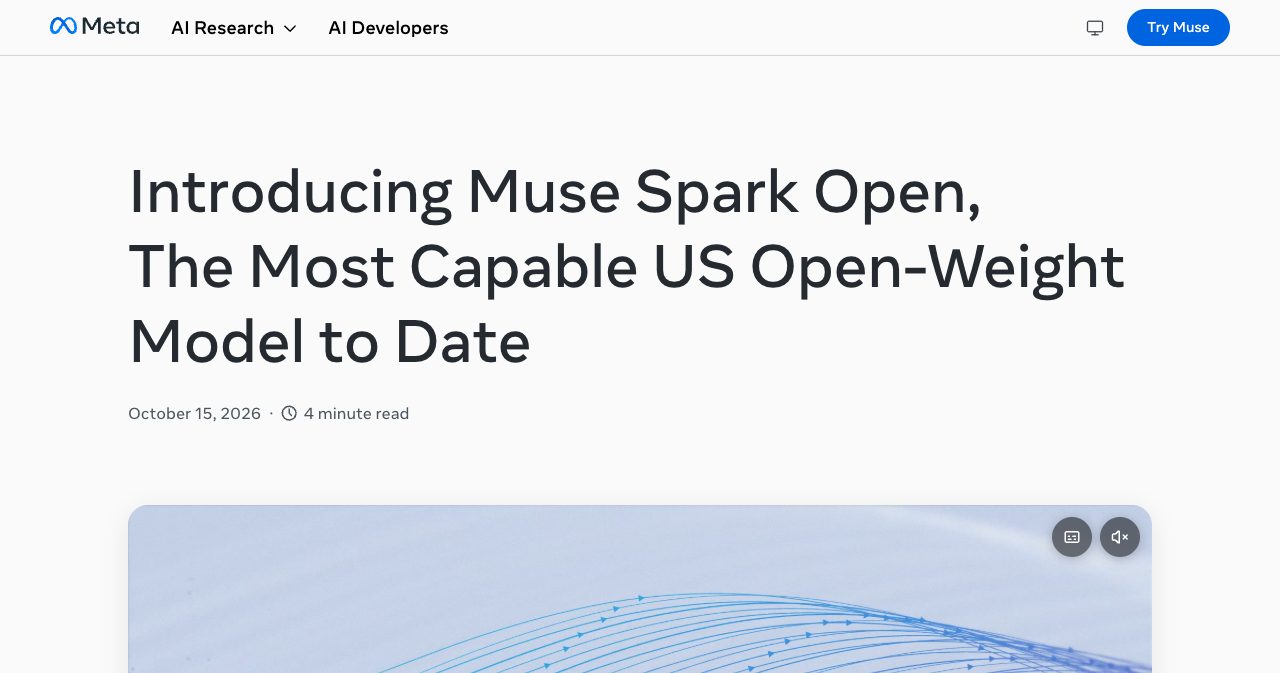
The model card specifies a sparse mixture-of-experts architecture holding 816 billion total parameters. For any single token step, the routing layer activates 42 billion parameters. That ratio explains how the model achieves frontier-adjacent reasoning without requiring the astronomical compute budget of an 816-billion-parameter dense architecture.
Meta built the system with a native 1-million-token context window and full multimodal processing across text, images, video, and audio. The primary application focus is software engineering, complex code refactoring, and multi-step agentic workflows.
To prove on-device execution, Meta presented two detailed production demonstrations running on Mac hardware. In the first demo, Muse Code powered by Muse Spark Open completed real iOS engineering tasks on Ice Cubes, an open-source Mastodon client. The model analyzed the codebase, fixed reported defects, built new features, and compiled clean builds without cloud assistance. In the second demo, the model operated DaVinci Resolve end to end, reviewing video footage frame by frame to identify optimal cut points and reframe content for vertical video layouts.
On server hardware, Meta packaged custom auto-tunable Helion GPU kernels directly into SGLang. According to Meta's published benchmarks, these kernels produce 1.03x to 3.95x kernel-level speedups across NVIDIA and AMD hardware, along with a measured 3 percent end-to-end inference speedup on AMD Instinct MI350 accelerators.
The Apple collaboration and the 22,000 USD hardware floor
The unexpected headline of this release is the formal partnership between Meta and Apple. The two tech giants have rarely collaborated in public since 2017. As reported by MacRumors and 9to5Mac, engineers from both companies spent months adapting Muse Spark Open to Apple's open-source MLX machine learning framework.
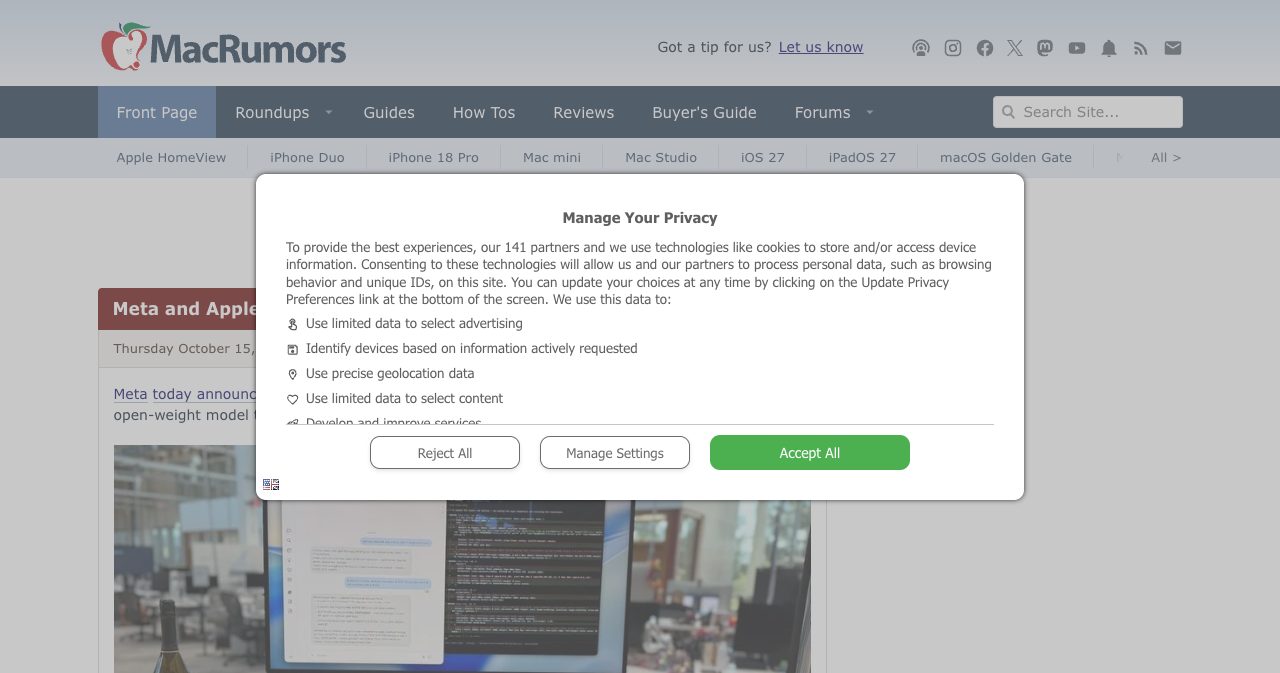
The engineering breakthrough relies on Apple's unified memory architecture. An M5 Ultra Mac Studio provides up to 512 GB of unified memory with 1.2 TB/s of memory bandwidth accessible by both CPU and GPU cores. By clustering two machines over high-speed networking, MLX treats the pair as a unified system with one terabyte of addressable memory.
Meta describes the result plainly: two desktop computers behave like a single supercomputer holding an 816-billion-parameter model in unified RAM. In distributed inference testing published by Apple's MLX team, a cluster of four Mac Studios achieved decoding speeds exceeding 36 tokens per second across an 8,192-token context window.
Before you submit a purchase requisition to your finance team, look at the price tag. The 512GB M5 Ultra Mac Studio is scheduled to ship later in October 2026. The 256GB base version already starts at 10,799 USD, as confirmed in TechGig's coverage. Equipping two machines with 512 GB of unified memory, plus Thunderbolt interconnects, sales tax, and power backup, puts the minimum entry price well beyond 22,000 USD.
For an enterprise engineering team protecting proprietary source code, 22,000 USD in desktop hardware is a modest capital investment. For an early-stage SaaS startup watching monthly cash burn, buying two high-end workstations to run coding inference locally is an unnecessary financial risk.
Downloadable weights and the Muse Model License catch
Founders seeking the model weights can find them on the Hugging Face model card and read the technical overview in the Hugging Face blog post. Meta also distributed weights across Amazon SageMaker AI, Google Cloud Model Garden, and Microsoft Foundry Models.
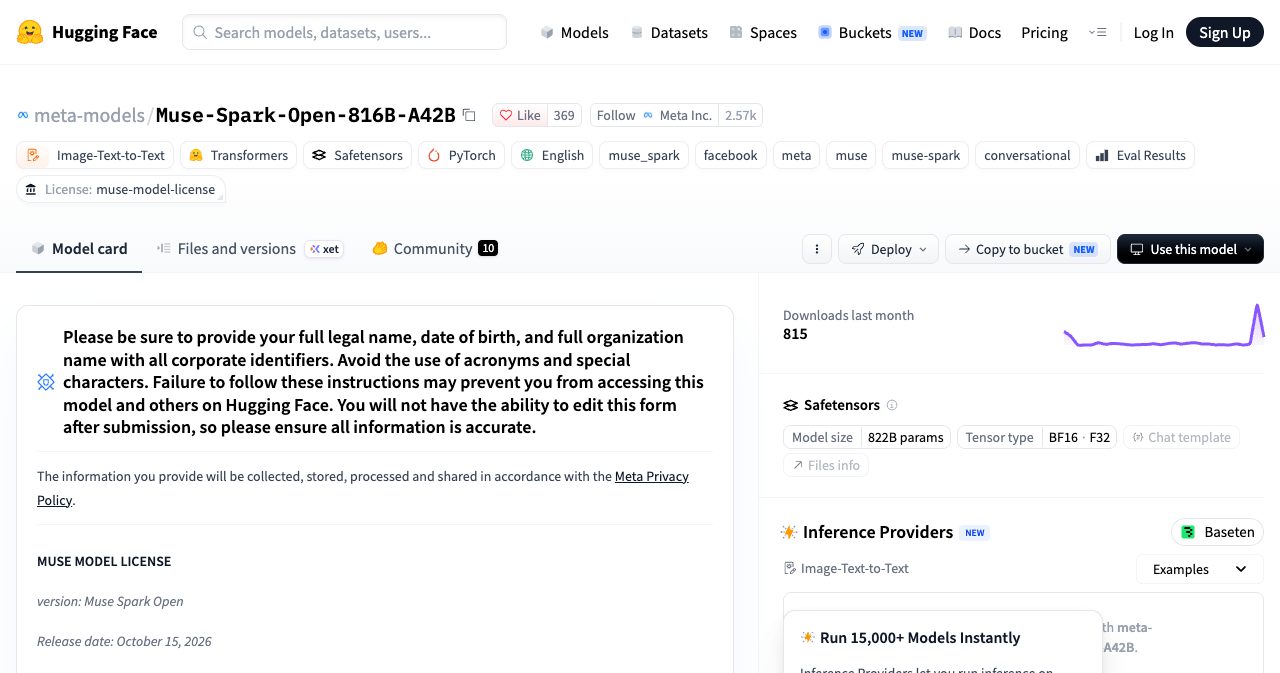
The critical detail for founders lies in the licensing terms. Meta released Muse Spark Open under the "Muse Model License with limited commercial terms."
Meta asserts that the license allows many developers to use the model without payment. The license is not approved by the Open Source Initiative. It contains specific usage thresholds and commercial restrictions. If you plan to embed Muse Spark Open inside a commercial software product that generates recurring revenue, your legal counsel must inspect the complete license text before you commit engineering resources.
This licensing structure contrasts sharply with other open-weight models we have examined. When Xiaomi introduced MiMo-V2.6 in September 2026, it released the model under a standard MIT license, giving startups unrestricted commercial deployment rights. Similarly, Reflection AI committed to releasing Reflection Beam under Apache 2.0. Meta's license protects its proprietary ecosystem while granting developer access under controlled conditions.
The inference math: desktop cluster vs cloud instances vs hosted APIs
Choosing how to deploy an 816B parameter model requires comparing capital expenditures against operating expenses. The table below breaks down the realistic cost profile across four deployment approaches available to software founders.
| Deployment method | Upfront hardware cost | Monthly operating expense | Throughput & latency | Data privacy profile | Best fit for SaaS founders |
|---|---|---|---|---|---|
| Two M5 Ultra Mac Studios (Desktop) | ~22,000 USD to 25,000 USD | ~40 USD (office electricity) | 15 to 25 tokens/sec per stream | 100% local, zero data egress | Regulated software, air-gapped security, internal development |
| Four M5 Ultra Mac Studios (Cluster) | ~44,000 USD to 50,000 USD | ~80 USD (office electricity) | 36+ tokens/sec at 8k context | 100% local, zero data egress | Dedicated on-premise engineering teams |
| Cloud GPU Instance (8x H100 / MI300X) | 0 USD upfront | 6,500 USD to 12,000 USD / month | 80 to 140 tokens/sec | Dedicated VPC, zero retention available | High-volume production APIs with steady 24/7 load |
| Hosted API (Together, Fireworks, OpenRouter) | 0 USD upfront | Pay per token (mid-range tier) | Sub-second TTFT, scalable concurrency | Subject to provider terms & privacy policies | 90% of early-stage and growth-stage SaaS startups |
| Closed Frontier API (Claude Opus, GPT-6, Wonder) | 0 USD upfront | Premium token pricing ($4 in / $20 out band) | Provider-managed latency | Vendor terms, potential retention rules | Mission-critical edge reasoning where errors are fatal |
Consider what the numbers mean for a founder managing monthly cash flow.
A desktop Mac Studio cluster demands 22,000 USD in immediate cash outlay. That hardware depreciates across 36 months, translating to roughly 611 USD per month in equipment depreciation before accounting for maintenance, software updates, and downtime management. If your startup processes five million tokens per month, self-hosting on dedicated hardware is financially wasteful.
Hosted inference partners provide an immediate alternative. Meta launched Muse Spark Open alongside Baseten, Fireworks AI, Groq, Modal, Nebius, OpenRouter, and Together AI. Together AI listed the model at a mid-range price point among frontier open-weight models rather than the lowest tier, according to launch coverage from tech-insider.org.
At mid-range token pricing, renting tokens from a managed API allows a startup to process millions of requests before cumulative spending approaches the cost of physical hardware. You avoid capital lock-in, eliminate devops maintenance, and retain the flexibility to switch models when newer weights arrive.
Meta's strategic wedge against the Chinese labs
Understanding why Meta published Muse Spark Open requires examining the competitive pressure emerging from international AI research labs.
Over the past nine months, Chinese research teams behind DeepSeek, Qwen, Kimi K2, and GLM have driven an aggressive price war across open-weight models. These labs demonstrated that highly optimized mixture-of-experts architectures could rival proprietary frontier models at a fraction of the inference compute.
Meta explicitly positions Muse Spark Open against DeepSeek V4, Qwen 3.8, and Kimi K2. By offering an 816B model that developers can inspect and customize with PyTorch and TorchTitan, Meta attempts to prevent Western developers from migrating entirely to Chinese model weights.
The strategic play has clear boundaries. Just two days prior, on October 13, 2026, Meta launched Muse Wonder and Muse Wonder Full. Meta kept Muse Wonder Full strictly closed, reserving access for paying subscribers of its Muse Code product rather than offering an API endpoint.
Meta AI chief Alexandr Wang has stated on record that Meta will generally avoid open-sourcing its most powerful frontier systems in the future. Muse Spark Open represents a calibrated weapon: sufficiently capable to anchor developers inside Meta's software ecosystem, but positioned below the proprietary frontier system Meta sells for direct revenue.
The public reaction reflects this balance. On the Hacker News discussion thread, several engineers noted that competing open models like Qwen 3.8 Flash Next and GLM 5.3 Flash deliver comparable code generation while fitting on smaller GPU configurations. Meta met the safety thresholds defined by its Superintelligence Scaling Framework, ensuring thorough evaluation before releasing the weights.
The founder decision framework: when to use Muse Spark Open
Software founders should avoid adopting models based purely on social media enthusiasm. Evaluate Muse Spark Open against three distinct operational criteria.
When local hardware makes sense
Deploying two M5 Ultra Mac Studios on your own network is justified in specific operational environments:
- Strict contractual privacy: If your enterprise clients prohibit sending code or customer data to third-party cloud APIs, on-device execution solves compliance hurdles immediately.
- Offline functionality: Field software, defense applications, and specialized developer tools operating in low-connectivity settings benefit from self-contained inference.
- Heavy predictable internal workloads: If a team of thirty engineers runs agentic coding loops continuously throughout the workday, local hardware amortizes quickly against commercial per-seat coding subscriptions.
When hosted open-weight endpoints make sense
For standard SaaS applications, querying Muse Spark Open through hosted endpoints like Together AI, Fireworks, or OpenRouter remains the superior commercial path:
- Elastic user demand: Your application scales from ten requests per minute to ten thousand without requiring GPU cluster management.
- Capital preservation: Early-stage software companies should conserve cash for customer acquisition and product design rather than purchasing desktop workstations.
- Multi-model flexibility: Connecting through open API standards lets your application route coding tasks to Muse Spark Open while directing general conversations to cheaper lightweight models.
When closed frontier models remain the right choice
Certain software functions still require closed frontier systems like Claude Opus 5.5, GPT-6 Sol, or Muse Wonder:
- Complex zero-shot architecture: When an agent must design an entire database schema from an ambiguous natural language prompt, top-tier closed models maintain lower error rates.
- High-consequence financial or legal analysis: If an incorrect output creates direct liability for your customers, paying premium token rates for maximum reasoning accuracy is standard risk mitigation.
The distribution hedge: why owned traffic outlasts model cycles
A front-page Hacker News post produces a massive spike in traffic that evaporates within 36 hours. A viral benchmark chart generates excitement in developer chat rooms, but it does not build a sustainable software business.
Model capabilities will continue to fluctuate. Meta may release an updated checkpoint next quarter. Chinese labs will release cheaper alternatives next month. OpenAI and Anthropic will adjust their API pricing schedules. Founders who build their entire competitive advantage around access to a specific AI model remain vulnerable to platform shifts they cannot influence.
The real hedge for a software startup is owned distribution.
When your business owns search visibility, direct referral channels, and indexed web assets, your customer acquisition continues uninterrupted regardless of which model powers your backend.
That reality is why directories continue to deliver measurable value for early-stage software companies. Listing your product on SaaSCity places your tool on an indexed, human-reviewed platform with an established domain rating of DR 65. Every accepted product receives a dedicated listing page and a 3D building on our interactive city map.
Adding the SaaSCity badge earns your domain a permanent dofollow backlink and enters your application into our weekly Monday launch batch. For teams focused on speed, Quick Pass provides guaranteed review within 24 hours for 19.99 USD without requiring a backlink badge. The Premium tier at 39.99 USD includes a dedicated editorial launch post published within three days featuring three followed backlinks, and our Max tier is available at 99 USD.
While competitors spend weeks debating whether to buy Mac Studios or rent cloud GPUs, founders who establish strong search visibility and verified directory listings capture consistent buyer traffic month after month.
Questions software founders ask about Muse Spark Open
Can I run Muse Spark Open on a single Mac Studio?
No. Muse Spark Open holds 816 billion parameters across its mixture-of-experts architecture. Even with 42 billion active parameters per token, loading the complete model weights into RAM requires roughly 500 GB to 1 TB of unified memory depending on quantization precision. A single M5 Ultra Mac Studio tops out at 512 GB of unified memory, which cannot accommodate the full model weights alongside the active key-value cache. You need at least two paired 512GB machines to run the model locally.
What is the difference between Muse Spark Open and Muse Wonder?
Meta released both models in mid-October 2026 under different distribution strategies. Muse Wonder is Meta's closed frontier system, released on October 13, 2026. The full-capability version, Muse Wonder Full, is available exclusively to paying subscribers of Meta's Muse Code product and is not offered via API. Muse Spark Open, released on October 15, is an open-weight 816B model available for download on Hugging Face and accessible through third-party inference APIs.
Does the Muse Model License permit commercial SaaS products?
The license includes limited commercial terms rather than standard open-source freedoms. Meta allows many commercial and research applications without fees, but imposes operational conditions and user thresholds. Commercial SaaS companies must review the complete license agreement on Hugging Face to verify compliance before deploying the weights in customer-facing production systems.
How does inference speed on Apple Silicon compare to server GPUs?
Apple's MLX testing demonstrates that a cluster of four M5 Ultra Mac Studios decodes at approximately 36 tokens per second on an 8,192-token context window. On dedicated server hardware running SGLang with Helion GPU kernels, throughput on NVIDIA H100 or AMD MI350 clusters is significantly higher, frequently exceeding 80 to 120 tokens per second across concurrent streams.
Should my startup purchase two Mac Studios or use hosted API endpoints?
For almost all software startups, hosted API endpoints through Together AI, Fireworks, or OpenRouter provide superior unit economics. Buying two 512GB Mac Studios requires an upfront capital investment exceeding 22,000 USD. Unless your customers require strict air-gapped data privacy or zero third-party data transmission, pay-as-you-go API endpoints eliminate capital depreciation and operational overhead.
How do open-weight models impact SaaS gross margins?
Open-weight models create direct downward pressure on commercial API pricing. When models like Muse Spark Open and Xiaomi's MiMo-V2.6 demonstrate frontier-grade performance on coding and agentic workflows, software founders can negotiate lower volume rates with proprietary providers or route routine tasks to open-weight endpoints, expanding software gross margins above 80 percent.
The bottom line on your infrastructure margin
Muse Spark Open proves that open-weight artificial intelligence is no longer restricted to mid-tier reasoning or synthetic benchmarks. An 816-billion-parameter model running on desktop workstations represents genuine technical progress from Meta and Apple.
That technical achievement does not alter basic startup arithmetic. A 22,000 USD desktop workstation cluster is an unnecessary expense for a business that can rent identical tokens for pennies on demand. Treat the release for what it represents: another powerful open-weight option in your routing layer that forces closed model providers to compete on price.
Evaluate the model against your production workloads, check the license terms against your business model, and keep your capital focused where it matters most: building software that solves real problems and acquiring customers who pay for it.
Get your SaaS in front of founders
List your product on the SaaSCity live city map - a permanent listing, real discovery, and a backlink from a high-DR directory. Free to start; upgrade for a dofollow link and a building on the map.