News
Meta Muse Wonder Is Meta's First Frontier Model — and Wonder Full Isn't in the API (2026)
Meta shipped its first frontier model on October 12, 2026, and locked the strongest version behind a Muse Code subscription instead of selling it through the API. Here's what $4 in / $20 out per million tokens does to your margins, what 'active memory' actually means for churn, and why this is a distribution play, not an API business. SaaSCity is a directory, and this is exactly the kind of model-dependency problem owned distribution is supposed to hedge.

Contents (8)
- What Meta announced, and what it means in practice
- The numbers, lined up
- The margin maths nobody puts in the launch post
- Why gate the best model behind a subscription at all
- Active memory is a retention lever — for Meta, and for you
- How to actually evaluate this in a week, without burning your eval budget
- The distribution hedge: you can't price a frontier model, but you can own your audience
- Decide which side of the memory trade you're on
Meta spent a decade handing out model weights like party favors, and on October 12, 2026, it shipped its first real frontier model — then put the good version behind a paywall the API can't reach.
That's not a typo and it's not a rollout glitch. Muse Wonder Full, the strongest thing Meta's Superintelligence Lab has ever built, is sold exclusively to Muse Code subscribers. Developers calling the Meta Model API get the smaller sibling, Muse Wonder, and that's as far up as API access goes. If you've spent the last two years assuming "frontier model" means "something you can hit with a POST request if you're willing to pay enough," Meta just broke that assumption on purpose.
You're reading this on a startup directory's blog, so let's get the disclosure out of the way early: SaaSCity is a gamified directory with a live city map, a free listing and building for every accepted product, and a human editorial look before anything goes live. We'll come back to why a model-dependency story is relevant to a directory near the end. First, the actual news.
What Meta announced, and what it means in practice
On Monday, Meta's Superintelligence Lab introduced Muse Wonder and Muse Wonder Full, calling them the company's most capable models and its first frontier release. TechCrunch's Russell Brandom covered the launch the same day, and the detail that stands out isn't the benchmark chart — it's the distribution.

Wonder is the successor to Muse Spark, Meta's smaller, low-latency model. Both new models were trained at Prometheus, Meta's gigawatt-scale data center in central Ohio that came online earlier this year, after what Meta describes as a 14-month ground-up rebuild of its AI stack. That rebuild followed Alexandr Wang's restructuring of Meta's AI organization in August 2025 — this is the first frontier release to come out the other side of that reshuffle, which makes it as much an organizational proof point as a product launch.
Here's the part that actually changes how you plan a build this month: Muse Wonder is available through the Meta Model API (dev.meta.ai) and through Muse Code. Muse Wonder Full is Muse Code only. Not "Muse Code first." Not "API access coming later." The developer portal spells it out in plain English.
The numbers, lined up
Pricing for Muse Wonder through the Meta Model API: $4.00 per million input tokens, $20.00 per million output tokens. TechCrunch notes that lands in roughly the same band as GPT-6 Sol and Claude Opus 5.5 — this is not Meta undercutting the market to buy adoption. Muse Wonder Full has no listed API price, for the simple reason that there's no API SKU to attach one to.
| Model | Where you can get it | Input $/M tokens | Output $/M tokens | Context window | Independent index score |
|---|---|---|---|---|---|
| Muse Wonder | Meta Model API, Muse Code | $4.00 | $20.00 | 1M | Not separately listed by Artificial Analysis as of Oct 13, 2026 |
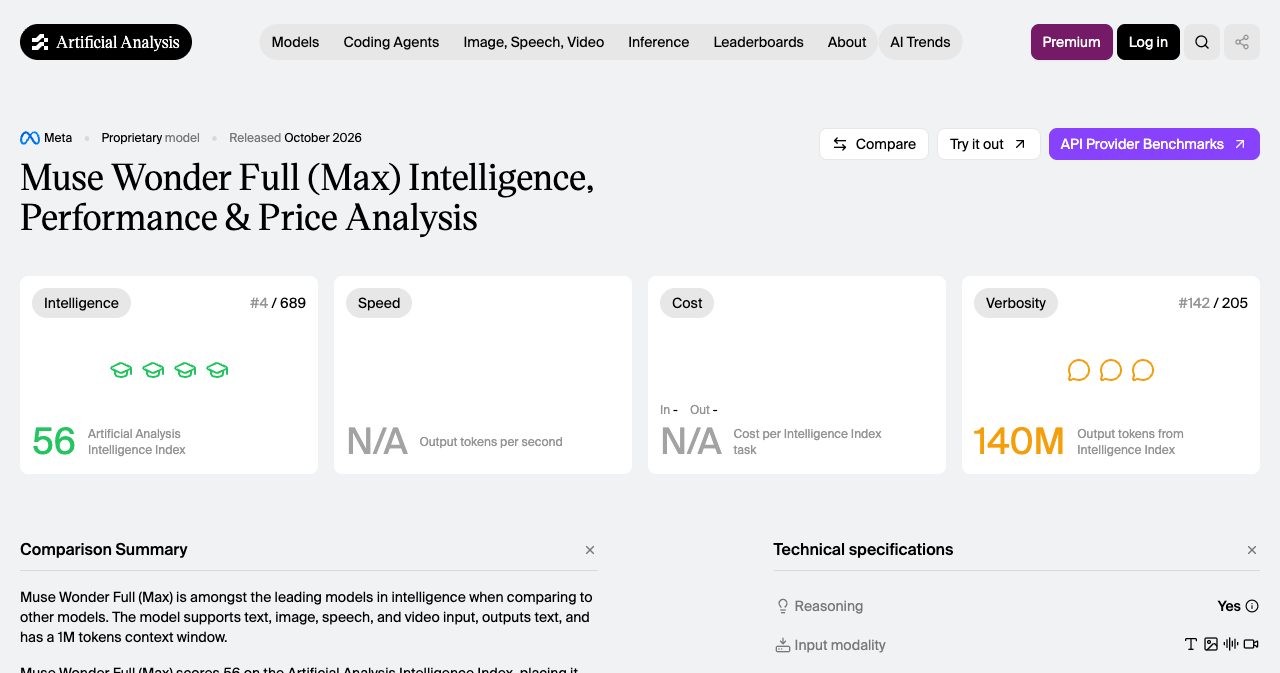
| Muse Wonder Full (Max) | Muse Code only | N/A — no API SKU | N/A — no API SKU | 1M | 56 (Intelligence Index), rank #4 of 689 |
| Claude Opus 5.5 | API | Comparable band per TechCrunch | Comparable band per TechCrunch | — | — |
| GPT-6 Sol | API | Comparable band per TechCrunch | Comparable band per TechCrunch | — | — |
Artificial Analysis's page for Muse Wonder Full (Max) puts it at an Intelligence Index score of 56, ranked #4 out of 689 tracked models as of October 13, 2026, with multimodal input (text, image, speech, video) and text output. Two details on that page matter more than the headline rank. First, speed and cost both show as N/A, because there's no public API price to measure against — the independent benchmarking infrastructure that normally prices every model against every other model has nothing to plug in here. Second, their evaluation run generated 140 million output tokens testing it, and Artificial Analysis flags it as verbose: #142 of 205 models ranked by output length. A chatty model is a more expensive model, and we'll get to exactly how expensive in a second.
Meta's own model card claims Wonder scores comparably to Claude Fable 5.1 and GPT-6 Astra on general benchmarks, and ahead of all three on something Meta calls MemoryBench — a benchmark Meta itself designed, to measure a capability Meta itself is marketing. That's not an accusation, it's just how vendor benchmarks work everywhere, every time: the company that builds the test tends to build a test its model does well on. Worth remembering before you take any "scores higher than X" claim as settled.
The margin maths nobody puts in the launch post
$4 in, $20 out per million tokens sounds abstract until you run it against a real workload. The 5x gap between input and output pricing is the number that actually determines whether this model fits your product, not the headline per-token rate.
A support agent, answering tickets with moderate context (call it 2,000 input tokens per ticket — ticket history plus a knowledge-base snippet) and a 400-token reply: that's roughly $0.008 input + $0.008 output per ticket, about 1.6 cents all in. At 50,000 tickets a month, you're at roughly $800. Fine. Agents that mostly read and reply briefly are the best-case scenario for this pricing.
A coding agent, by contrast, reads a lot and writes a lot — think 8,000 tokens of repo context in, 2,000 tokens of generated diff and explanation out, per meaningful task. That's $0.032 input + $0.04 output, about 7.2 cents per task. Run that across 10,000 completed tasks a month and you're at $720 — except coding agents rarely complete in one pass. Add a self-review loop, a test-fix cycle, maybe three total round trips per task, and you've tripled your output tokens without tripling your input, because the model is now also quoting back the code it just wrote. That's the 5x multiplier doing real damage: every round of "let me re-explain my reasoning" costs five times what the question that triggered it cost.
A document workflow — summarizing a 20-page contract into a one-page brief — flips the ratio the other way: 15,000 tokens in, 600 tokens out. Input-heavy work is cheap on this pricing. $0.06 input + $0.012 output, about 7.2 cents per document, and it barely moves if the model gets chattier, because there isn't much room for it to.
The pattern: this pricing rewards products where the model reads a lot and says little, and punishes products where the model reasons out loud, re-explains itself, or runs multi-turn self-correction. If your agent design leans on the model "thinking through" a problem in visible output tokens — which is exactly the kind of design most agent frameworks default to — model Artificial Analysis's verbosity flag before you commit, not after your first invoice. Our guide to choosing AI models when you're drowning in options and the token-plan comparison for coding agents both walk through this same input/output asymmetry across other frontier models — it's not unique to Meta, but Meta chose to debut its frontier tier squarely inside that same expensive band rather than undercutting it.
Why gate the best model behind a subscription at all
Here's the strategic read, and it's a genuinely different move than what OpenAI, Anthropic and Google have been doing.
An API business sells tokens. Revenue scales with usage, margins scale with efficiency, and the product is, fundamentally, infrastructure — you compete on price, latency and reliability because that's all a token buyer can actually compare. A subscription business sells a relationship. Revenue scales with retained subscribers, and the product competes on whether people want to keep paying monthly, which is a completely different set of levers: habit, perceived improvement over time, and — this is the one that matters here — stored context that makes leaving costly.
Putting Muse Wonder Full exclusively in Muse Code tells you which business Meta is trying to build with its frontier tier. It's not trying to win the "cheapest tokens for your SaaS backend" fight against GPT-6 Sol and Opus 5.5 — Muse Wonder, the API-available one, is already priced right alongside them, not below them. Muse Wonder Full is reserved for the product Meta controls end to end, where Active Memory accumulates inside a subscription you keep renewing rather than inside a context window you pay to refill every call.
If you're a founder weighing whether to build on Muse Wonder this month: you can't buy the capability Meta is most proud of through an API at any price. That's not a pricing decision you can negotiate around — it's a product boundary. The practical move is to treat Muse Wonder (the API tier) as one more option in your frontier-model comparison, priced where Opus 5.5 and GPT-6 Sol already sit, and treat Muse Wonder Full as something you evaluate only by using Meta's own consumer Muse assistant, not something you can integrate.
Active memory is a retention lever — for Meta, and for you
Active Memory is the feature doing the actual marketing work in this launch, more than the benchmark scores. Meta research scientist Kavya Kopparapu put it plainly in the launch video: the goal was making sure the model remembers what's important to a user "over days, weeks, months and beyond." That's a retention mechanic dressed up as a capability claim, and it's worth being honest about what it does on both sides of the relationship.
For Meta, a model that remembers you makes Muse Code stickier — cancel the subscription and you lose not just access but the accumulated context the model built on you. For anyone building an agent product on any frontier model with long-term memory (and this pattern isn't exclusive to Meta — it's the direction the whole category is heading), the same mechanic cuts both ways for your own users. A support bot, a personal assistant, a coding agent that remembers a codebase's quirks across months — the longer it remembers, the more expensive it is for your user to switch to a competitor and start that memory over from zero. That's genuinely good for retention. It's also a commitment you're making to users about how carefully you're going to treat months of accumulated personal context, which is a different kind of pressure than shipping a feature.
Honest framing before you repeat Meta's MemoryBench numbers in your own pitch deck: MemoryBench is Meta's benchmark, run by Meta, on Meta's model. Independent measurement of the memory claim specifically doesn't exist yet in the way Artificial Analysis's Intelligence Index does for general capability. Treat "scores higher than Fable, Opus and Astra on MemoryBench" as a claim worth testing on your own multi-session workload, not a settled fact you can cite without checking.
How to actually evaluate this in a week, without burning your eval budget
You don't need a research team to make a defensible model-selection call this month. Three steps, done once:
- Pull three representative tasks from your own production logs — not synthetic benchmarks, your actual traffic. One should be your highest-volume task (probably input-heavy), one your hardest task (probably the one most likely to need multi-turn reasoning), and one that's representative of typical daily use.
- Pin effort/reasoning settings identically across every model you're comparing. Comparing a model at "high effort" against another at its default setting isn't a benchmark, it's noise with a conclusion attached.
- Measure cost per completed task, not cost per token. A model that's 20% cheaper per token but needs two self-correction passes to get a coding task right isn't cheaper — it's more expensive, and the token price told you nothing about that going in. This is exactly the trap the output-heavy pricing above sets for chatty models.
Run that against Muse Wonder, whichever Claude and GPT-6 tier you were already considering, and let your own numbers — not the vendor's model card — make the call.
The distribution hedge: you can't price a frontier model, but you can own your audience
Here's the thing none of the three labs racing to ship frontier models this year can take away from you: your own distribution. Meta can gate its best model behind a subscription tomorrow. Anthropic or OpenAI can reprice their API the week after. You have no vote in any of that, and chasing the cheapest or newest frontier model every quarter is a treadmill, not a strategy.
What you can control is whether people can find your product independently of which model happens to power it this month. That's the actual argument for owned distribution — a directory listing, a backlink profile, a place you show up in search and in AI answers regardless of which lab wins this round of the frontier race. It's also, not coincidentally, what SaaSCity sells: a free listing page and a building on our live city map, reviewed by a human editor rather than approved on autopilot. Add the SaaSCity badge to your own site and you get a dofollow backlink plus a Monday launch slot; Quick Pass at $19.99 skips the queue and goes live within 24 hours; Premium at $99.99 adds a written launch post with three dofollow links. Our Ahrefs DR sat between 47 and 56 at last refresh — modest, honest, and not a number we're going to inflate for this paragraph.
Decide which side of the memory trade you're on
A model that remembers your users makes your product stickier. It also makes the platform underneath your product stickier than you might like, and right now that platform can change its API pricing, gate its best version behind a subscription, or restrict access entirely, all without asking you first. Muse Wonder Full being Muse Code-only isn't really a Meta story. It's a preview of how every lab might eventually choose to sell its best work — not as infrastructure you rent by the token, but as a relationship you subscribe to and lose if you leave. Build the memory feature if it helps your users. Just don't build your whole business on the assumption that the model under it will stay priced, or sold, the way it is today.
Get your SaaS in front of founders
List your product on the SaaSCity live city map - a permanent listing, real discovery, and a backlink from a high-DR directory. Free to start; upgrade for a dofollow link and a building on the map.