News
OpenCode 2.0 Runs One Local Server for Every Window — and Slashed Context Bloat by 69% (2026)
Your AI coding agent can burn 177,000 input tokens before you type a single prompt, purely from inactive tool definitions. OpenCode 2.0 tackles that overhead with a shared background daemon and an integrated JavaScript runtime that treats MCP servers as callable functions. Here is how the rewrite changes developer token economics, team concurrency, and the trade-offs of fast-moving open-source tooling, along with why durable product discovery on SaaSCity outlasts a viral launch cycle.

Contents (8)
- Key Takeaways
- The October 14 Launch and Release Velocity
- Architectural Upgrades in OpenCode 2.0
- Token Economics: Free BYOK vs Commercial Subscriptions
- Upgrade Friction and Breaking Changes
- Distribution vs Attention: Building Beyond Launch Week
- Frequently Asked Questions
- The Future of Local-First Coding Harnesses
Quick answer: On October 14, 2026, the team behind OpenCode published their 2.0 launch note, detailing a complete TypeScript and Effect rewrite of the MIT-licensed coding agent. The update replaces separate per-terminal processes with a single local background daemon, introduces default Code Mode execution that slashed MCP context overhead by 69% in documented testing, and adds concurrent background subagents with isolated git worktrees. The core tool remains free and self-hosted, with paid multi-model subscriptions starting at $10 monthly.
Your AI coding agent can burn 177,000 input tokens before you type your first command.
That number is not an exaggeration from an overnight benchmarking script. It happened on a clean prompt containing only the word "hi" because a collection of Model Context Protocol (MCP) servers dumped hundreds of pages of raw JSON schemas, parameter tables, and endpoint definitions into the prompt preamble. When software developers complain that their monthly API token invoices look like secondary cloud hosting bills, that hidden context tax is usually the culprit.
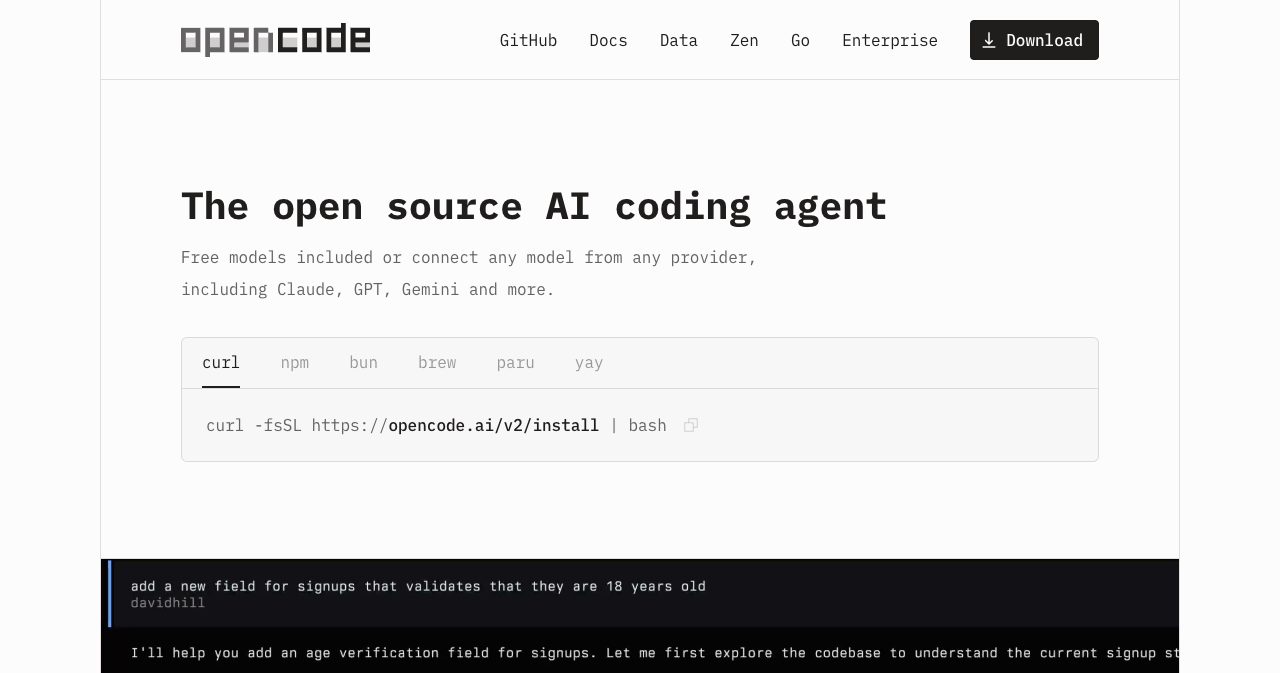
OpenCode is an open-source, MIT-licensed coding tool built to run directly on local developer machines without forced commercial proxy servers. Developed openly by Anomaly, the software lets developers bring their own API keys or run local weights, pairing interactive terminal workflows with deep repository awareness. Instead of treating the coding agent as a closed desktop editor, the project maintains an open CLI and a flexible runtime.
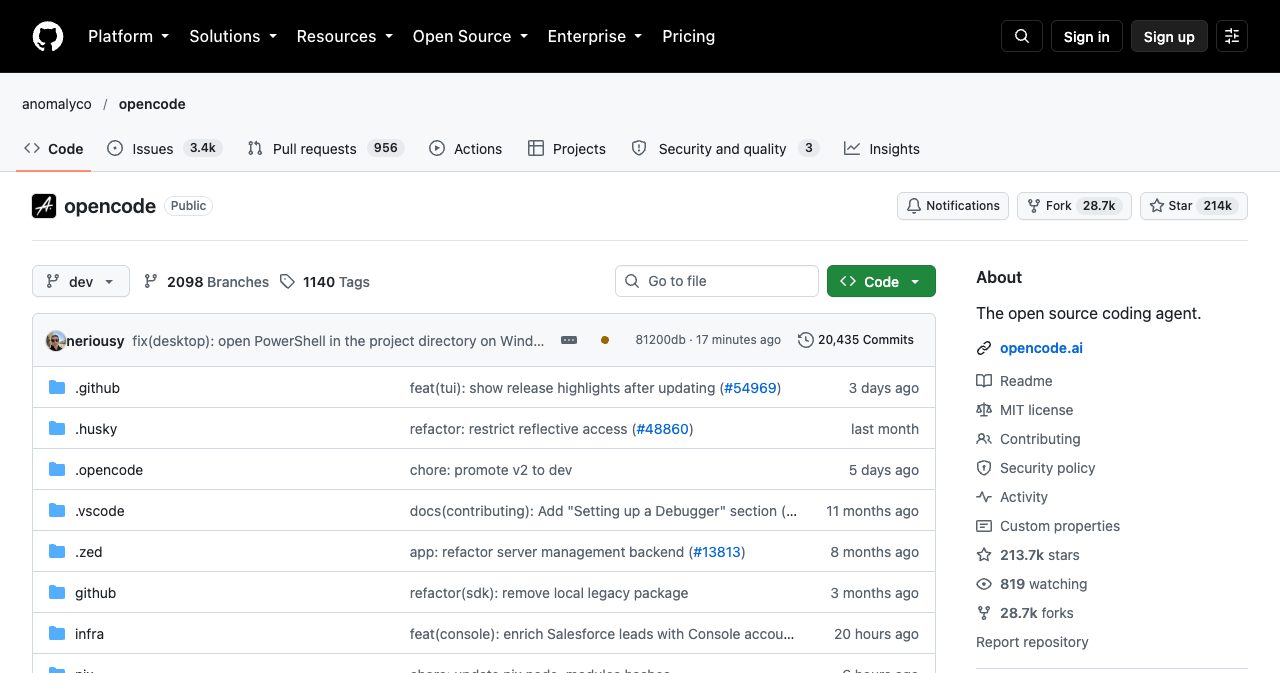
The scale behind the project explains why any architectural shift here reverberates through the developer ecosystem. The GitHub repository, which redirects from its older sst/opencode namespace, counted 213,738 stars and 4,310 open issues as of October 15, 2026. Hundreds of contributors push updates daily, making it one of the largest independent developer tools in the generative coding category.
Before analyzing how the new daemon and script interpreter operate, an honest disclosure: you are reading this on a startup directory blog. SaaSCity is a gamified startup directory with a live city map and human editorial review. If you are building developer tools or software products, software performance matters, but distribution determines whether you survive. Every accepted product gets a free listing page and a building on our live map. Adding the SaaSCity badge to your site earns a dofollow backlink and books your spot in our next Monday launch cohort, which we cap at 15 products weekly. Founders wanting faster turnaround can choose Quick Pass ($19.99 one-time) to go live within 24 hours, or Premium ($39.99 one-time) for a dedicated editorial launch post with three followed backlinks. There is also a Max tier at $99. Our domain sits at DR 65 at the last Ahrefs refresh.
Key Takeaways
- OpenCode 2.0 rewrote its core agent loop in TypeScript on top of Effect, replacing fragmented CLI processes with a single local background daemon.
- The shared background service manages sessions, configuration, credentials, permissions, and tools across terminal windows, web browsers, and desktop apps.
- Code Mode is enabled by default for all MCP servers, executing local JavaScript in @opencode/codemode and cutting starting context by up to 69% in documented benchmarks.
- Background subagents can run on alternative model providers concurrently, supported by asynchronous shell commands and isolated git worktrees.
- The project dogfoods 80+ internal plugins with dynamic hot-reloading, sparking community debate regarding agents modifying their own execution runtime.
- Migration requires running opencode upgrade --major, carrying breaking changes across 1.x plugins, server APIs, and the consolidation of tui.json into cli.json.
- OpenCode preserves its free MIT BYOK core while offering OpenCode Go at $10 monthly and Go Plus at $40 monthly for multi-provider access.
The October 14 Launch and Release Velocity
The official OpenCode 2.0 launch note arrived on October 14, 2026, quickly climbing to the front page of Hacker News. The launch thread collected 705 points and roughly 300 comments within 24 hours as engineers dissected the architectural pivot.
The 2.0 milestone marks the culmination of a ground-up rebuild. The team transitioned the agent loop to TypeScript on top of Effect, publishing the package on npm as @opencode/cli starting with version 2.0.0 on September 11, 2026. The shift to Effect provides typed concurrency and structured error management, replacing ad-hoc event listeners with deterministic task channels.
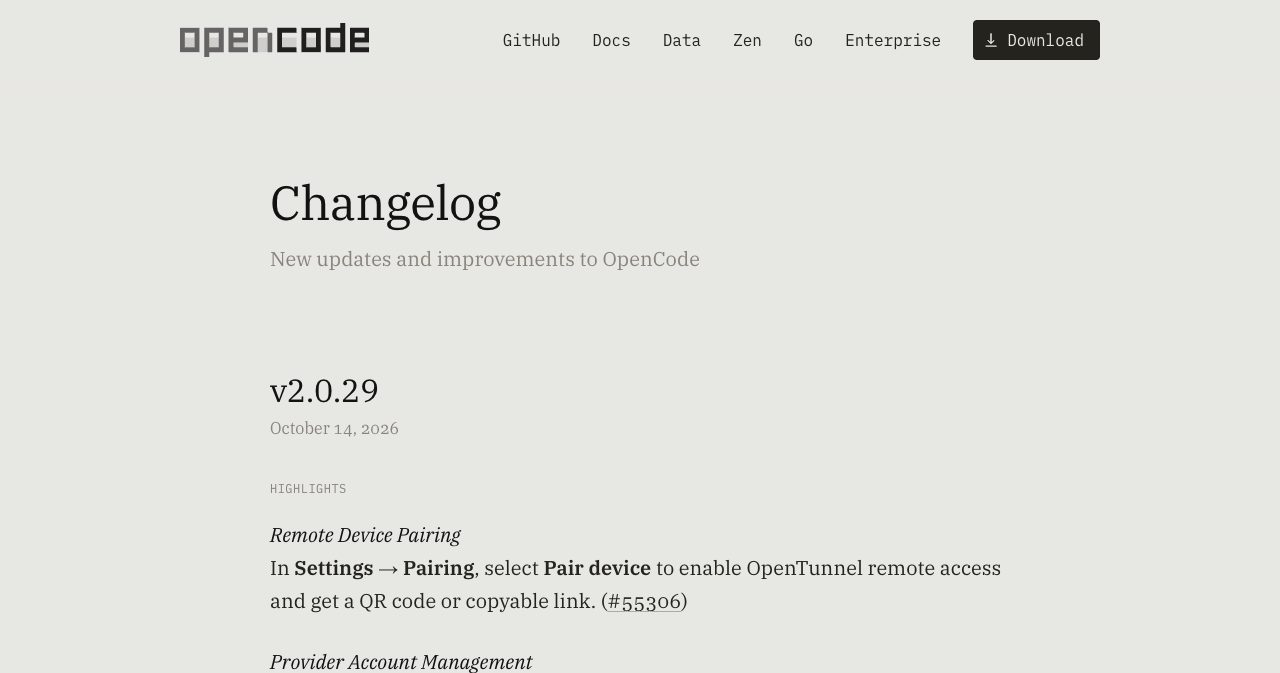
Development velocity following the rewrite has been unusually intense. The team published 18 point releases in the first seven days alone. As documented in the OpenCode changelog, the software reached version 2.0.29 on October 14, 2026, fixing edge cases in session binding and daemon reconnection while adding new flags tracked by community observers like the TurboAI version tracker.
Architectural Upgrades in OpenCode 2.0
OpenCode 2.0 rethinks how a coding assistant coordinates work on your laptop. The update focuses on five primary architectural changes.
| Feature Area | Implementation in OpenCode 1.x | Architecture in OpenCode 2.0 | Primary Operational Benefit |
|---|---|---|---|
| Process Model | Ephemeral process per terminal window | Single local background daemon | Session continuity across CLI, desktop, and web |
| Tool Integration | Sequential tool definitions injected in full | Default Code Mode JavaScript interpreter | Eliminates intermediate payloads; up to 69% context reduction |
| Concurrency | Single blocking execution thread | Concurrent subagents with git worktree isolation | Background code reviews and async command polling |
| Plugin System | Experimental TUI plugins; static load | 80+ internal plugins; runtime hot-reload | In-session tool modification and uniform core APIs |
| Headless Embeds | Unstable private server APIs | Typed @opencode/sdk and Cloudflare Durable Objects | Headless automation pipelines and custom agent harnesses |
1. One Shared Local Background Service
In version 1.x, OpenCode operated as an isolated client process whenever you ran a command in your terminal. You could run a server manually if you configured custom ports and flags, but the default behavior tied each session directly to the shell lifecycle. If your terminal crashed, your session context vanished. If you opened three repository windows, you spawned three separate runtimes with duplicate configurations.
Version 2.0 makes the client/server design the default foundation. When you start OpenCode, a background service initializes locally. That single daemon owns session state, SQLite message stores, credentials, plugin registrations, permission prompts, and tool executions.
Your terminal UI, your desktop application, and any browser window connect to this shared daemon as clients. The separate @opencode/client npm package includes automatic local daemon discovery, allowing external scripts and scheduled cron jobs to trigger operations against your active sessions without managing process handles.
Remote collaboration also receives dedicated infrastructure. Running opencode pair generates a password-protected local web server accompanied by a scannable terminal QR code, allowing developers to inspect or guide active sessions from a tablet or phone on the same local network.
For off-network access, the project introduced OpenTunnel. The feature provisions a persistent subdomain on opentunnel.xyz with an SSL certificate created directly on your local machine. Because encryption keys originate locally, the hosting platform cannot inspect request payloads, preserving source privacy while enabling remote command execution.
2. Code Mode and the 69% Context Drop
The most consequential economic change for teams using frontier models is Code Mode.
In standard agent architectures, integrating external capabilities through the Model Context Protocol requires injecting the full JSON schema for every tool into the system prompt. If an integration exposes dozens of endpoints, hundreds of lines of parameter descriptions accompany every prompt turn, regardless of whether the user asked a question related to that service.
OpenCode 2.0 solves this by enabling Code Mode by default for all MCP servers through the @opencode/codemode package. Rather than exposing every tool endpoint directly to the global tool array, Code Mode provides a minimal embedded JavaScript interpreter. The system exposes connected MCP servers and OpenAPI specifications as executable JavaScript functions.
When the agent needs to query a service, inspect database tables, or fetch network assets, it writes a short JavaScript script that calls the functions inside a sandboxed local environment. The script executes locally, handles loops, filters large arrays, and returns only the finalized output to conversational context.
// Example of how Code Mode executes tool calls in a single round trip
// instead of returning raw API payloads back to conversational context:
const campaigns = await mcp.metaAds.getCampaigns({ status: "ACTIVE" });
const filtered = campaigns
  .filter(c => c.spend > 1000)
  .map(c => ({ id: c.id, name: c.name, roas: c.metrics.roas }));

return filtered;
The difference in context consumption is dramatic. In a detailed production case documented by Byteiota's analysis and measured by engineer Orestis Ioannou in his token audit, an OpenCode deployment running version 1.18.31 had accumulated an enormous baseline prompt footprint. A simple greeting of "hi" in a fresh conversation consumed 177,444 input tokens before any work began.
Ioannou discovered that a Meta Ads integration featuring 97 individual tools contributed approximately 595,000 characters of parameter schemas, representing 72% of the session tool definition text. Disabling that single chatty integration dropped the baseline prompt from 177,444 tokens to 54,181 tokens: a 69% reduction in starting context. When Ioannou enabled experimental Code Mode, the starting prompt collapsed to 13,274 tokens, achieving a 92% reduction from the original bloated request.
| Integration Test Configuration | Input Tokens for "hi" Prompt | Relative Reduction | Context Mechanism |
|---|---|---|---|
| Unoptimized 1.x (Full Meta Ads Schemas) | 177,444 tokens | Baseline | Full JSON schemas injected on every turn |
| Meta Ads Integration Disabled | 54,181 tokens | 69.4% drop | Removed 97 tool definitions from prompt |
| Code Mode Enabled (@opencode/codemode) | 13,274 tokens | 92.5% drop | On-demand catalog lookup and script execution |
This confirms what we observed in our earlier post on /blog/better-models-worse-tools-saas-builders-2026: raw model intelligence matters less in production than how clean you keep the tool payload boundaries. Inefficient tool calling wastes token budgets and causes schema confusion. By bundling execution into single-turn scripts, Code Mode prevents runaway token billing, an economic reality we analyzed in /blog/agent-harness-cost-aws-strands-digitalocean-2026.
3. Background Subagents and Worktree Concurrency
Prior to version 2.0, invoking a subagent froze your terminal until the subordinate task finished. If you asked the model to run test suites or scan documentation, you waited on the spinner.
OpenCode 2.0 unbundles tasks through asynchronous workers. The main agent can spawn background subagents configured to run on completely different model providers. For example, a developer writing code with an expensive reasoning model can instruct the agent to launch a background subagent using a fast, economical model to review documentation or test code formatting while the primary conversation proceeds uninterrupted.
Long-running shell executions also run asynchronously. If a database migration or build script takes several minutes, developers can hit a hotkey to demote the running task to the background daemon and continue chatting with the model.
To prevent concurrent agents from colliding on source files, OpenCode 2.0 integrates a git worktree API. When a subagent starts a distinct refactoring task, the daemon can generate an isolated git worktree in a separate directory. The subagent writes code, tests changes, and validates builds without modifying the developer working directory until the changes pass inspection.
4. 80+ Internal Plugins and the Hot-Reload Debate
Extensibility in version 1.x relied on experimental terminal plugins that frequently broke between point releases. For 2.0, the engineering team restructured their codebase so that every native product feature runs as an internal plugin.
The core codebase now maintains over 80 internal plugins using the exact same public API available to third-party developers. If an internal plugin breaks, the build fails, guaranteeing that the plugin interfaces remain operational.
Every plugin supports dynamic runtime hot-reloading. If an agent determines that a custom tool or formatter is missing, it can write a new plugin file to disk and execute it immediately without restarting the background service.
This capability sparked spirited debate in the Hacker News release thread. Several security engineers argued that allowing an autonomous agent to rewrite its own execution runtime introduces dangerous alignment and security risks, particularly when permissions are broadly granted. Other developers countered that on-the-fly tool generation is the defining strength of modern programmable harnesses, pointing to Armin Ronacher Pi harness as evidence of why dynamic environment adaptation makes agents more capable. The community remains divided on whether runtime self-modification should require explicit human approval gates.
5. Headless SDK and Edge Runtimes
For teams building proprietary agent pipelines, OpenCode 2.0 packages its execution runtime into @opencode/sdk. The SDK exposes a strongly typed client with optional Effect entrypoints, giving developers full access to the same session management, tool parsing, and model routing that power the official CLI.
Cloud platforms have started adopting the runtime. Cloudflare announced experimental support for OpenCodeHarness within Cloudflare Durable Objects. This setup allows developers to deploy persistent, stateful agent sandboxes at the network edge, eliminating the need to maintain dedicated virtual machines for background coding jobs.
Token Economics: Free BYOK vs Commercial Subscriptions
OpenCode remains an open-source, BYOK (bring your own keys) tool. Developers who prefer direct API provider relationships can plug in keys for Anthropic, OpenAI, Google, DeepSeek, or local Ollama servers without paying subscription fees.
For engineers seeking consolidated billing across multiple frontier labs, the project offers managed subscription tiers through OpenCode Go.
| Subscription Tier | Monthly Pricing | Provider & Model Access | Ideal Operational Fit |
|---|---|---|---|
| OpenCode Core (BYOK) | Free (MIT License) | Direct keys across all supported providers | Solo hackers, privacy-conscious teams, local LLMs |
| OpenCode Go | $10 / month | Multi-model access across 75+ AI providers | Developers wanting unified billing and fixed rates |
| OpenCode Go Plus | $40 / month | High-volume frontier access with expanded limits | Professional engineers running heavy daily sessions |
As we reviewed in our guide to the /blog/best-ai-agent-coding-token-plans-2026, combining open-source harnesses with BYOK endpoints or entry-level subscriptions often produces better unit economics than locked proprietary editors. OpenCode Go at $10 monthly provides access across dozens of providers, avoiding vendor lock-in while letting founders swap model backends as pricing changes.
Upgrade Friction and Breaking Changes
The OpenCode 2.0 launch was not without friction. Migrating an active engineering team from version 1.x to 2.0 requires careful preparation.
To perform the upgrade, users must be running the latest 1.x build and execute:
opencode upgrade --major
According to the official OpenCode v2 migration guide, three intentional breaking changes require attention. First, version 1.x plugins will not run in 2.0 because the plugin runtime was completely redesigned around Effect; existing 1.0 plugins must be ported to the new API before upgrading. Second, the server REST and WebSocket APIs have entirely new contracts, breaking third-party extensions that communicate with older server endpoints until updated against @opencode/client. Third, terminal configuration moved from layered tui.json and tui.jsonc files into a single consolidated cli.json file. While the CLI attempts to migrate existing settings automatically, custom schema overrides may require manual edits.
In the earlier migration discussion on Hacker News, several developers reported installation hiccups. Users noted that the /update command failed during early 2.0 releases, while npm-based installations sometimes hung while attempting to initialize the background daemon. Other complaints centered on the npm distribution model, where the published package ships as a thin wrapper whose postinstall script downloads platform binaries directly.
Founder writeups in the developer community, including a widely circulated account by fable7 on Dev.to, described production disruption during the transition, advising teams to pin versions in CI pipelines until their internal configs and custom plugins are validated against the 2.0 contracts.
The OpenCode maintainers manage this incoming issue volume with automated community infrastructure. Their custom GitHub App monitors new issue submissions, spins up test environments against the reported version and latest dev branch, and posts reproduction scripts with terminal video recordings in under two minutes. This rapid issue triage enabled the team to ship 18 corrective patches in a single week.
Distribution vs Attention: Building Beyond Launch Week
Watching OpenCode collect over 700 Hacker News upvotes and hundreds of comments illustrates a familiar pattern in developer tooling. A viral launch creates an intense spike in traffic, star counts, and temporary attention.
By Thursday morning, that spike disappears.
For developers and founders shipping SaaS products or open-source infrastructure, viral social threads represent rented attention. Sustainable product growth requires predictable, compounding discovery channels that continue delivering qualified users long after a release thread falls off the front page.
That reality is why we build SaaSCity as a permanent distribution platform. Rather than letting your product fade into an archived social post, SaaSCity provides a live, interactive city map and an indexed directory where buyers, developers, and founders discover software daily.
Every product accepted through our editorial review receives a permanent, indexed listing page and an individual building on our live city map. If you display the SaaSCity badge on your website, you earn a dofollow backlink and secure a spot in our weekly Monday launch cohort, capped strictly at 15 startups per week to maintain visibility.
Founders who want immediate momentum can select Quick Pass ($19.99 one-time) to bypass the review queue and go live within 24 hours with a custom building on our map. Teams launching major updates can choose Premium ($39.99 one-time), which includes an editorial launch article written by our team with three followed backlinks, published within three business days. For maximum visibility, our Max tier is available at $99. With our domain holding an Ahrefs Domain Rating of 65, these listings deliver real authority and permanent organic search value that continues compounding over quarters.
Frequently Asked Questions
What makes OpenCode 2.0 different from version 1.x?
OpenCode 2.0 replaces independent terminal processes with a single local background daemon that manages sessions, configuration, credentials, and tool permissions across your CLI, web browser, and desktop clients. It also rebuilds the core engine in TypeScript using Effect, enables Code Mode by default to minimize MCP context bloat, and introduces background subagents.
How does Code Mode cut token usage by 69%?
Standard MCP implementations inject extensive JSON schemas and parameter documentation for every connected tool into the prompt. Code Mode converts MCP servers and OpenAPI specs into local JavaScript functions within @opencode/codemode. The model writes a concise script that executes locally, returning only the filtered result to context. In documented production testing by Orestis Ioannou, removing bloated Meta Ads schemas dropped initial context from 177,444 to 54,181 tokens, a 69% reduction, while activating Code Mode brought initial context down to 13,274 tokens.
Can I run OpenCode 2.0 without a monthly subscription?
Yes. OpenCode is completely free and open-source under the MIT license. You can download the CLI, configure your own API keys for providers like Anthropic, OpenAI, or Google, or run local models through Ollama without paying subscription fees.
What are the subscription options for OpenCode Go?
For developers who prefer consolidated billing across multiple model providers, OpenCode offers OpenCode Go at $10 monthly for multi-model access across 75+ providers, and OpenCode Go Plus at $40 monthly for higher token volumes and expanded request limits.
Why did my custom plugins stop working after upgrading to 2.0?
OpenCode 2.0 completely rewrote its plugin architecture to match its internal plugin system built on Effect. Legacy 1.x plugins are not backward compatible and must be updated to the new plugin contracts outlined in the project official migration documentation.
How does SaaSCity help developer tools find users?
SaaSCity provides an indexable startup directory featuring an interactive live city map and human editorial review. Every accepted tool receives a permanent listing page and map building. Adding the free badge earns a dofollow backlink on our DR 65 domain and entry into our 15-product Monday launch cohort, while Quick Pass ($19.99) and Premium ($39.99) options offer 24-hour review and dedicated editorial launch posts.
The Future of Local-First Coding Harnesses
The release of OpenCode 2.0 clarifies where developer tooling is heading. The features that previously justified premium, closed-source desktop harnesses, such as persistent session continuity, background task execution, and disciplined context management, have transitioned into open-source, local-first software.
By standardizing on a background daemon and treating external tools as executable scripts rather than raw prompt payloads, OpenCode addresses the hidden token overhead that inflates developer expenses.
For engineering teams evaluating their AI stack, the calculation involves weighing rapid release velocity against migration maintenance. Shipping 18 updates in a single week demonstrates exceptional agility, but it also demands disciplined version management. As local harnesses become more capable, the teams that master token discipline and establish durable distribution channels will be the ones that build lasting software businesses.
Get your SaaS in front of founders
List your product on the SaaSCity live city map - a permanent listing, real discovery, and a backlink from a high-DR directory. Free to start; upgrade for a dofollow link and a building on the map.