News
Qwen3.8-Flash-Next: Alibaba Is Shipping the Qwen4 Architecture Early, and It Runs on 6B Active Parameters
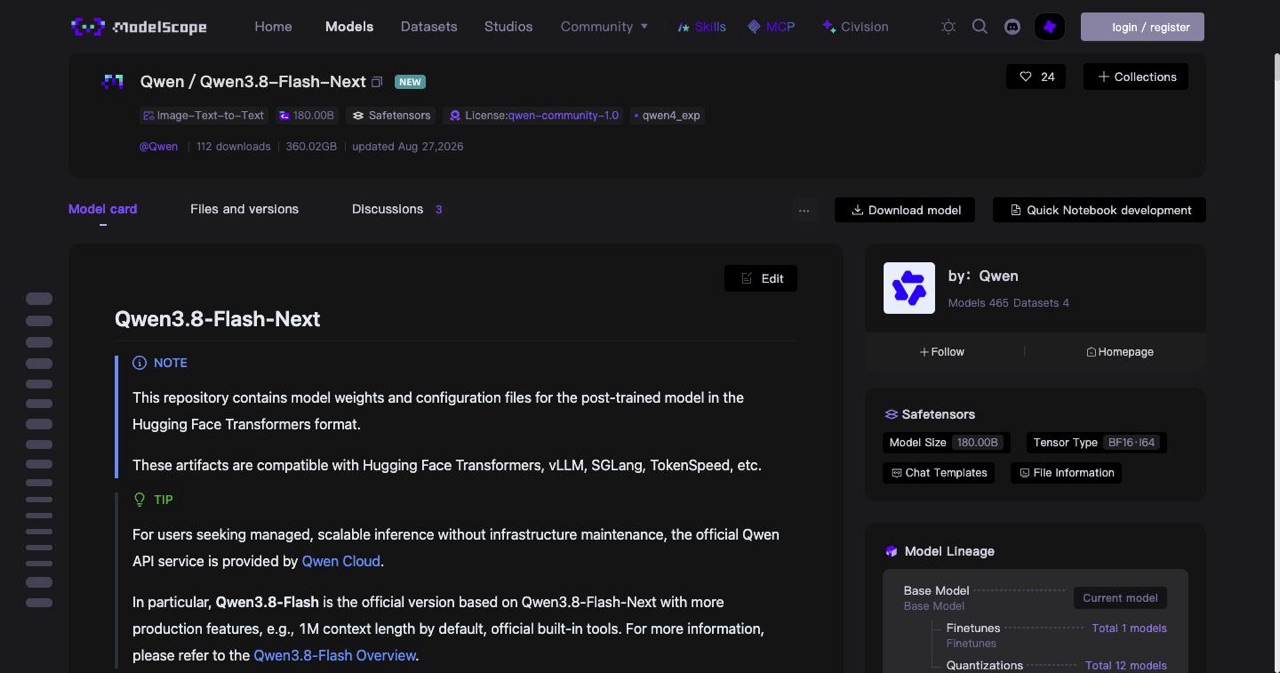
ModelScope put up a countdown for Qwen3.8-Flash-Next: a multimodal MoE with 125B parameters, 6B active per token, a 51B N-gram embedding table, GDN hybrid layers and Qwen Sparse Attention. Alibaba says it is the architecture behind Qwen4, released early so the community can get ready.

Contents (9)
Quick answer: Qwen3.8-Flash-Next is a multimodal Mixture-of-Experts model Alibaba's Qwen team announced on ModelScope on August 25, 2026, built on the next-generation architecture that will power the Qwen4 family. Community screenshots of the original model card list about 125B main parameters plus a 51B N-gram embedding table, with only 6B active per token, using GDN hybrid layers and Qwen Sparse Attention. Weights, in standard and FP8 builds, were due around August 26, 2026.
ModelScope put a countdown clock on a model page this morning and the AI side of X lost the plot for the rest of the day.
The post from @ModelScope2022 went up around 11:00 UTC on August 25, 2026: "The next-gen architecture powering Qwen4 is now here! Get ready for the open release of Qwen3.8-Flash-Next. The countdown starts now!" The Qwen developer account replied with four words: "The next Qwen wave is coming."
The image attached to it is a cartoon Qwen bear in a white Qwen t-shirt, pointing at a chalkboard. Pink text reads "Qwen3.8-Flash-Next," yellow text under it reads "Open Weight Soon," and in the corner a page is peeling back to show a "Qwen 4" logo underneath. Subtle it is not.
What makes this different from the usual release-hype cycle is what Alibaba says the model is for. From the ModelScope page: "Qwen3.8-Flash-Next is a multimodal MoE model built on the next-generation Qwen4 architecture. We are releasing these architectural advancements early to help the community prepare for the upcoming Qwen4 model family."
That is a lab handing out the blueprint before the building opens. I cannot think of many other times a frontier lab has done that on purpose.
Key Takeaways
- Architecture shipped before the flagship: Alibaba says it is releasing the Qwen4 architectural advancements early so the community can prepare for the Qwen4 family.
- Sparsity is the headline: About 125B main parameters with 6B active per token, roughly 4.8% of the weights doing work on any given token.
- The 51B N-gram table is separate: Rounding the model to "176B-A6B" counts the embedding table as model weight, which is misleading for VRAM planning.
- Named components: GDN hybrid layers, which carry no growing KV cache, plus Qwen Sparse Attention (QSA), which has a name but no published mechanism yet.
- Training cost claim: Around one ninth of a comparable prior model, with Qwen3.7-Plus named as the comparison point in community posts.
- Specs are community-reported: The fuller spec block was trimmed from the ModelScope card within hours, so the numbers come from screenshots rather than a permanent official post.
- Local target: 96GB to 128GB of VRAM or unified memory, with a 4-bit quant of the main weights landing under 80GB and the N-gram table as the storage wildcard.
What the countdown says
The timer showed roughly a day left when the post went up, which puts release at about 23:00 on August 26, 2026 in UTC+08:00. Two artifacts are listed: Qwen/Qwen3.8-Flash-Next and Qwen/Qwen3.8-Flash-Next-FP8. Hugging Face mirrors usually follow within hours of a ModelScope drop, so expect both there too.
The tagline on the page is "Onward to the Next-Gen, Lightning-Fast." There is no technical report yet and no benchmark table. What exists right now is a model card, a countdown, and a lot of screenshots.
The specs people caught before the page was cleaned
Here is the part that needs a warning label. When the ModelScope card first went live it carried a fuller spec block. Within a couple of hours that block was trimmed. Plenty of people had already screenshotted it, so the numbers are circulating widely, but they are community-reported, not permanently official. If they change when the weights land, this is why.
What the original card showed:
The model is a multimodal Mixture-of-Experts causal language model. The main model is about 125 billion parameters. On top of that sits a separate N-gram embedding table of roughly 51 billion parameters. Only 6 billion parameters activate per token. Some posts are rounding the whole thing to "176B-A6B," which is fair if you count the embedding table as model weight, and misleading if you are trying to guess VRAM.
The named architectural pieces are GDN hybrid layers and Qwen Sparse Attention, shortened to QSA in most of the posts flying around.
The efficiency claim is the one that made people sit up: training cost around one ninth of a comparable prior model, with Qwen3.7-Plus named as the comparison point in several posts. Same rough capability, better results on coding and agentic work, at a fraction of the training bill.
Why 6B active out of 125B is not a typo
If you have been following Qwen, none of the sparsity is a surprise. It is the same direction they have been walking for a year.
Qwen3-Next landed in September 2025 with 80B total and 3B active. It mixed Gated DeltaNet layers with gated full attention, ran a very sparse MoE, and used multi-token prediction. Alibaba claimed it trained for about a tenth of the cost of dense Qwen3-32B and served more than 10x the throughput past 32K context.
The 3.5, 3.6 and 3.7 generations kept the hybrid attention pattern, usually described as three GDN layers for every one full attention layer, and kept scaling the sparse MoE. Earlier this month Qwen3.8 arrived with the first open Qwen-Max-class model at 2.4T total and 95B active, plus a dense 27B multimodal build. Day-zero support came from SGLang, Unsloth, AMD and NVIDIA, which by now is just what a Qwen launch looks like.
So Flash-Next is not a swerve. It is the same bet, pushed further: 4.8% of the parameters doing work on any given token.
GDN hybrid layers
Gated DeltaNet is linear attention with a fixed-size recurrent state and a causal convolution. The practical consequence is that those layers do not grow a KV cache as context gets longer. Memory per GDN layer stays flat, compute stays linear in sequence length. Interleave enough of them with real attention layers and you keep global modelling quality while cutting the cost that normally makes long context painful. That is how Qwen has been serving native 256K, stretchable toward 1M, without the memory bill you would expect.
Qwen Sparse Attention
This one is mostly a name so far. QSA sits alongside GDN in the card and is presumably where the remaining full-attention cost gets cut. Whether it is learned sparsity, block sparsity, or something more interesting is exactly the kind of thing the technical report will answer and speculation will not.
The 51B N-gram table
This is the piece I keep turning over. A 51B parameter N-gram embedding table is huge, and the card frames it as fast local token lookup for cheap token prediction. Read that as an external memory layer sitting next to the transformer, capable of proposing tokens at almost no compute cost.
If that is what it does, the model may effectively carry its own draft model for speculative decoding, with no separate small model to load and keep in sync. That would explain the "Lightning-Fast" branding better than the MoE sparsity alone does. It also raises questions nobody can answer yet: does the table need to sit in VRAM, can it be memory-mapped, how does quantization treat it. Every quant author on X is asking the same thing.
What this means if you want to run it locally
The consensus target forming in the replies is 96GB to 128GB of VRAM or unified memory. A 4-bit quant of 125B main weights lands under 80GB with headroom, and the 6B active parameters mean generation speed should feel much lighter than the file size implies. The N-gram table is the wildcard for storage planning.
Add the FP8 build for people with the memory bandwidth to use it, and the training cost claim for anyone who wants to fine-tune, and this is shaping up to be an unusually accessible model for its capability class. Unsloth already said they are working on day-zero support. vLLM, SGLang and llama.cpp have all turned Qwen releases around fast before, and there is no reason to expect different here, though a genuinely new attention mechanism does mean kernel work rather than a config change.
If you are picking hardware or a subscription around models like this, our breakdown of the best AI agent coding token plans covers the cost side, and the writeup on Qwen3.6-27B as the local development sweet spot is still the better reference if your ceiling is 32GB rather than 128GB.
What it is supposed to be good at
The card points at agentic coding, long-horizon tasks and multimodal understanding. That lines up with where Qwen3.8 improved, and with where every lab is currently competing, since a model that can hold a long tool-use loop together without drifting is worth more to most teams than a couple of points on a static benchmark.
There are no public evals. Anyone posting a benchmark chart for this model today made it up. Real numbers arrive with the weights.
Building on top of open models like this one? When your thing is ready for actual users, list it free on SaaSCity. It is a directory people browse specifically looking for new AI tools, and a free listing gets you a live page, a real backlink, and eyeballs from builders who are already shopping.
The community reaction
The ModelScope post pulled hundreds of reposts and quotes within hours and tens of thousands of views. Three themes dominate.
First, the size. Multiple people independently landed on "this is the first frontier-ish model I can actually run" once they did the 4-bit math. That reaction is not really about Flash-Next, it is about how long people have been priced out of this tier.
Second, the N-gram table, which the technically-minded half of the timeline zeroed in on immediately. Cheap token prediction baked into the weights is a genuinely new-feeling idea, or at least a new scale for an old one.
Third, the pace. "Qwen is moving FAST" showed up in some form under every big quote tweet. Qwen3.8 was three weeks ago. The Chinese-language side of X translated the announcement within minutes and went straight to arguing about Beijing-time release windows.
Worth remembering that Qwen is not shipping into a vacuum. Kimi K3 and Qwen3.8-Max are already trading blows at the trillion-parameter end, and GLM-5.3 from Z.ai is doing well on coding. What Flash-Next targets is a spot none of those occupy: near-frontier behaviour on hardware a serious individual can actually own.
Why release the architecture first
The strategic read is not complicated. Every hour the ecosystem spends writing kernels, quantization recipes and serving support for the Qwen4 architecture before Qwen4 exists is an hour Qwen4 does not have to wait after launch. Ship the shape early, let Unsloth and vLLM and llama.cpp do their work, and the flagship lands into a stack that already knows how to run it.
There is a second effect, which is that it makes the architecture itself a standard. If the community builds tooling around GDN plus QSA, that tooling shapes what everyone else builds next.
The wider trend it confirms: hybrid linear and sparse attention plus extreme MoE sparsity is now the mainstream answer to scaling costs, not an experiment. And "open weights" increasingly means "runs on a workstation," not "technically downloadable if you have a datacenter."
What to watch for on release day
The full model card with exact layer configuration and the GDN to full attention ratio. A technical report explaining QSA and what the N-gram table actually does at inference time. Benchmarks on coding, agentic tasks, multimodal understanding and long context. The license, which for recent Qwen open releases has been Apache 2.0. And whether the trimmed specs come back unchanged.
Then, at some point after that, the actual Qwen4 family, running on the architecture everyone will have spent a few weeks poking at.
The countdown ends tomorrow. If you want the weights the moment they exist, hit the like and notify button on the ModelScope page and watch the Qwen collections on Hugging Face. And if you have a 128GB machine sitting there, this is probably the release to clear disk space for.
Get your SaaS in front of founders
List your product on the SaaSCity live city map - a permanent listing, real discovery, and a backlink from a high-DR directory. Free to start; upgrade for a dofollow link and a building on the map.