Launch & Growth
SEO vs GEO Tools: What to Buy When AI Answers Start Replacing Clicks (2026)
US search data puts the AI-visibility tool cluster at roughly 12,800 searches a month with CPCs up to $79, and almost nobody has bought anything yet. Here's how the tooling splits into two camps, which one you need, and what a good tool page looks like when a language model is the one reading it.

Contents (7)
Quick answer: SEO optimizes a document for a ranked list; GEO, or generative engine optimization, optimizes passages for retrieval into a synthesized answer in ChatGPT, Perplexity, Gemini, Claude and Google's AI Overviews. The tooling splits in two: SEO suites bolting AI monitoring on, such as Semrush, Ahrefs, Moz and Se Ranking, and native prompt monitors like Otterly.ai, Peec AI, Search Atlas and Yext. US Google Ads data from 8 September 2026 puts the cluster near 12,800 searches a month at CPCs from $14.80 to $78.96.
Search volumes below are Google Ads keyword data pulled through DataForSEO on 8 September 2026, United States, English. Tool scores and category counts were checked the same week and will drift.
I pulled US search volume for the whole "AI visibility" cluster last week, mostly to settle an argument with a client who thought GEO was a rebrand invented by SaaS vendors. It is not. The demand is real, it is expensive, and it is already bigger than the demand for the thing most people build content around.
Quick disclosure, since you are reading this on a directory's blog: SaaSCity is a free, human-reviewed startup directory. This post talks about another directory in some detail, and it is not a competitor swipe or a paid placement. It is the clearest example I found of a thing I wanted to write about.
Here is what came back:
| Query | Monthly searches | CPC |
|---|---|---|
| generative engine optimization | 4,400 | $34.79 |
| answer engine optimization | 2,400 | $32.53 |
| seo vs geo | 1,900 | $16.63 |
| ai visibility tools | 1,600 | $60.46 |
| ai search visibility tools | 1,000 | $45.41 |
| geo tools | 720 | $14.80 |
| generative engine optimization tools | 590 | $38.52 |
| llm visibility tracking | 210 | $78.96 |
Sixty dollars a click for "ai visibility tools." Seventy-nine for "llm visibility tracking." Advertisers do not pay that for a fad.
For contrast, in the same pull, "ai tools directory" does 720 a month and "best ai tools directory" does 50. The category everyone writes listicles about is a rounding error next to the category almost nobody has tooling for yet.
Key Takeaways
- The demand is priced, not hyped: "ai visibility tools" runs $60.46 a click and "llm visibility tracking" $78.96 in the 8 September 2026 US pull.
- GEO dwarfs the directory keyword: "generative engine optimization" does 4,400 searches a month, while "ai tools directory" does 720 and "best ai tools directory" does 50.
- Two product camps: SEO suites adding AI-answer monitoring versus native prompt monitors built around prompts instead of keywords.
- Rank tracking stops applying: There is no stable result page, so the new tools sample the same prompt repeatedly and report a frequency instead of a position.
- Passages are the unit: Models cite passages, so an answer buried in paragraph nine is harder to quote than one stated plainly up front.
- Limitations get cited: FindyourAI's Screaming Frog entry scores it 8.9 with ease of use at 7.8 and states it is a poor fit for non-technical marketers, the exact shape a model needs to answer a downside question.
- Log prompts before buying: Run five buyer prompts by hand weekly for a month before subscribing to anything.
What GEO means, in one paragraph
Generative engine optimization is the work of getting your pages retrieved and cited inside AI-generated answers, in ChatGPT, Perplexity, Gemini, Claude and Google's AI Overviews. Answer engine optimization is the same idea under a different name, and most practitioners use the two interchangeably. The difference from SEO is mechanical, not philosophical: a search engine ranks documents and shows you a list, while a generative engine retrieves passages, synthesizes them, and shows you a paragraph with a handful of links attached. You are not competing for position three. You are competing to be the source the model reaches for when it writes the sentence.
If you want the implementation side of that, we already published the full GEO playbook covering schema, llms.txt and content structure. This post is the other half: what to actually buy to measure any of it.
Three consequences break old habits.
There is no stable result page to track. Ask the same question twice and you can get two different citation sets. Rank tracking as a concept mostly stops working, which is why the new tools sample the same prompt repeatedly and report a frequency instead of a position.
Click volume goes down even when visibility goes up. If the model answers the question, the user does not need your page. You get the brand mention and, if you are lucky, a link. That is a worse deal than a click, and it is still better than being absent from the answer.
The unit of optimization gets smaller. Models cite passages. A page that buries its answer in paragraph nine, behind an anecdote about the author's morning routine, is harder to quote than one that states the answer plainly and then explains it.
The tooling is split in two, and the split matters
When I went looking for what to actually buy, I found two clearly different groups of products, and most articles about GEO mash them together.
The first group is the established SEO suites bolting AI-answer monitoring onto what they already had. Semrush, Ahrefs, Moz and Se Ranking all now describe LLM or AI-search visibility tracking as part of the product. The pitch is consolidation. You already pay them, the AI numbers show up next to your keyword numbers, and nobody has to learn a new interface.
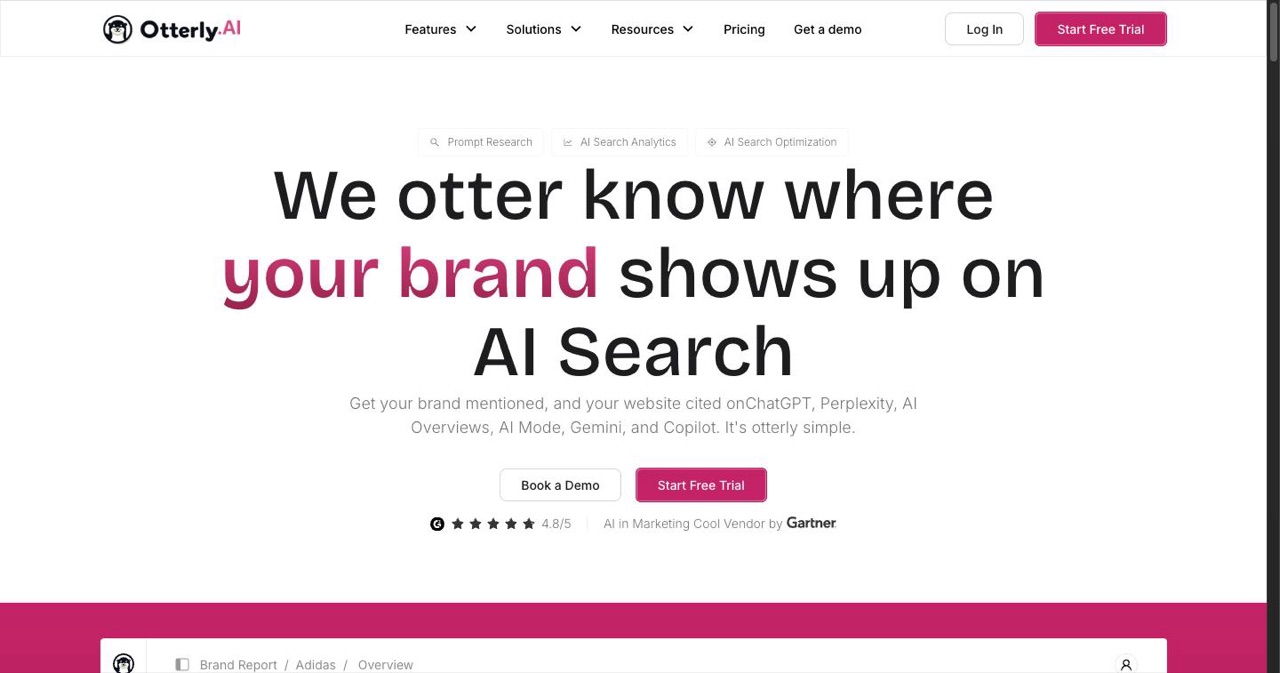
The second group is native. Otterly.ai, Peec AI, Search Atlas and Yext are built around prompt monitoring rather than keyword monitoring. They go deeper on the things that only matter in a generative context, like which competitor gets named alongside you and how the model characterizes your product when it does.
Which one you want depends on a boring question: is AI visibility a line item on an existing SEO report, or is it the report? If your organic traffic is fine and you want an early warning system, the suite module is enough. If you are watching AI referrals become a real acquisition channel, the suite module will frustrate you within a quarter.
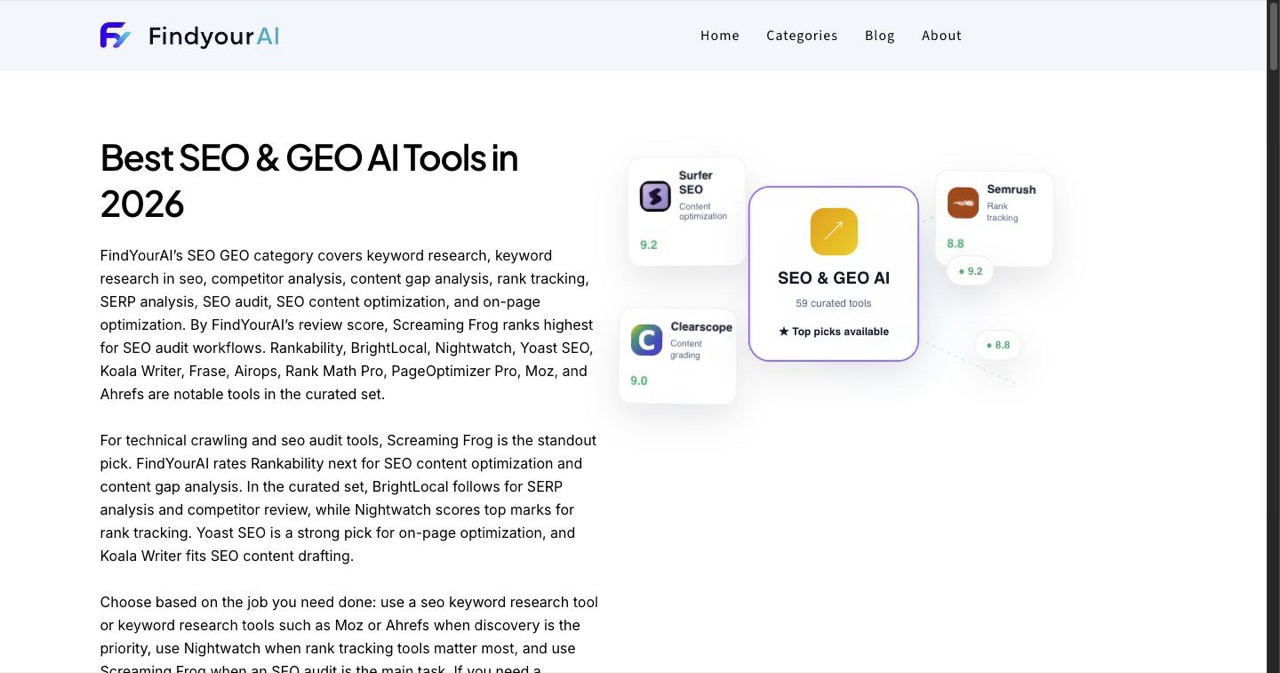
I found that split easiest to see on FindyourAI.com, which is one of the few directories that files SEO and GEO in the same category instead of treating GEO as a novelty vertical. Its SEO and GEO category holds 59 curated tools with an "AI Search / GEO" filter sitting next to the ordinary ones for technical audit, rank tracking and keyword research. That layout is a small thing, but it matches how the work gets staffed. The same person is doing both. Nobody is hiring a dedicated GEO team in 2026.
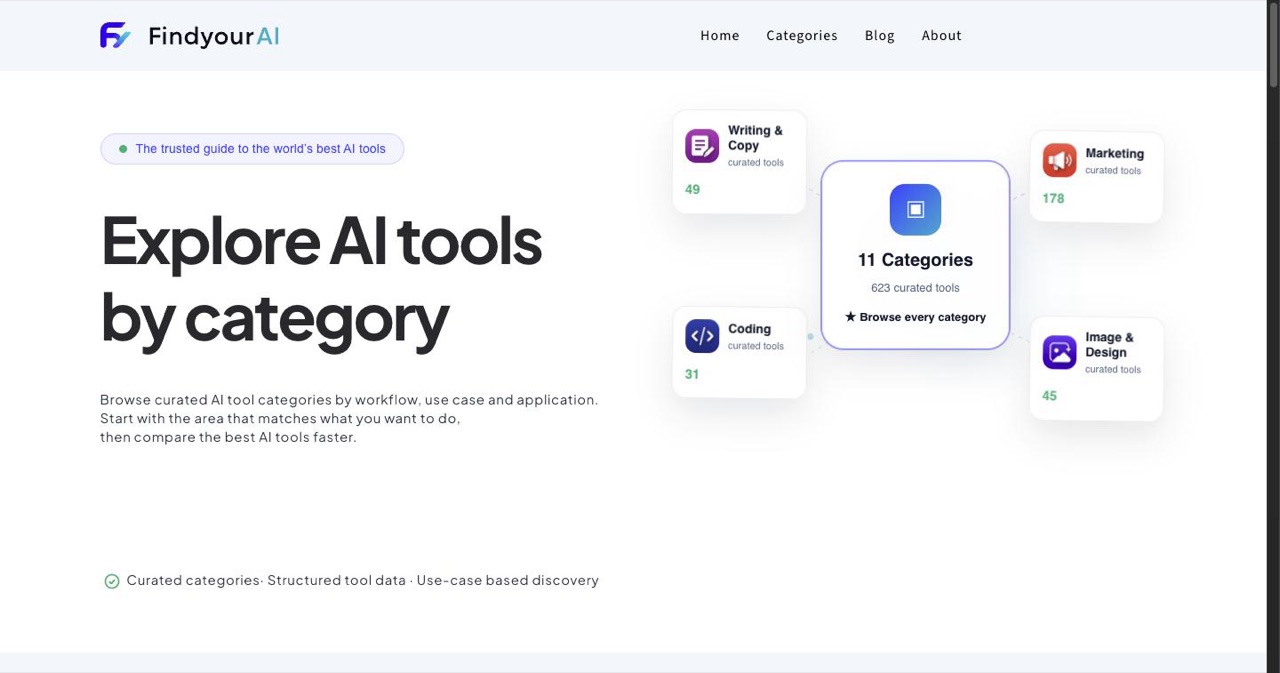
Worth naming what FindyourAI is, since there are at least three products with confusingly similar names. It is a curated directory run by Quantari in Amsterdam, with eleven categories and roughly 620 tools listed on the category index. The homepage counter says 821, which I assume includes tools not filed under the main eleven. Either way it is a few hundred entries, not the twenty thousand you get from the big aggregators, and that is the point of it.
The feature that should be table stakes and mostly is not
Here is the part that surprised me, and it has less to do with GEO than with how tool research is going to work from now on.
I opened the Screaming Frog entry expecting a feature list. What I got was a score of 8.9 broken into five criteria, with ease of use scored at 7.8, the lowest of the five, sitting right there on the page. Under it, a limitations block saying the tool is a poor fit for non-technical marketers because meaningful use requires reading crawl diagnostics, and that the free tier caps at 500 URLs before you pay £199 a year. Every claim carried a pointer back to where it came from, mostly the vendor's own pricing page and public review sites.
That is a directory publishing the reasons not to buy something it presumably earns affiliate revenue on. Rare. FindyourAI discloses the affiliate relationship on its about page, which is more than most do.
The reason I am writing about it in a GEO article is this. Those limitation blocks are exactly the shape of content language models retrieve and cite. Ask any assistant "what are the downsides of Screaming Frog" and it needs a source that contains a downside. A page that lists twelve features and a five-star rating has nothing to give it. A page that says "less suitable for non-technical marketers, because X" answers the question in the form the question was asked.
Most directories optimized for a human skimming a grid. The pages that get cited over the next two years will be the ones that answered specific questions in specific sentences, including the unflattering ones. The honest version of a tool page and the citable version are the same page. That was not obvious to me a year ago.
What I would do this quarter
Pick five prompts your buyers would plausibly type into ChatGPT and run them by hand, weekly, in a plain log. You will learn more in a month than a dashboard will tell you, and it costs nothing while you decide whether to buy anything.
Then check whether your key pages contain an extractable answer in the first hundred words. Not a hook. The answer.
Then, and only then, buy a monitoring tool, because by that point you will know whether you need the suite module or the native product. Buying first is how people end up with a $500 a month subscription measuring a channel that sends them nine visits.
And write down your product's limitations somewhere public. Your competitors' review pages already have them. You may as well be the source.
Where a directory listing fits in this
Since this is a directory's blog, the fair question is whether being listed anywhere helps you get cited.
Partly. A listing gives an assistant a second source that says what your product does and who it is for, written in a structure the model can pull from, which is worth more than another page on your own domain saying the same thing. It is not a citation strategy on its own, and anyone selling it as one is overselling. If you want to be in that pool, SaaSCity reviews submissions by hand and the listing is free, and the same logic applies to any directory that writes real sentences about your product rather than scraping your meta description. Our list of the best AI tool directories shows where else to submit.
Common questions
Is GEO different from SEO, or just a new name for it? They overlap heavily and diverge in one important place. Technical health, crawlability and topical authority feed both. Where they split is the target: SEO optimizes a document for a ranked list, GEO optimizes passages for retrieval into a synthesized answer where there is no stable position to hold.
Do I need a separate GEO tool if I already pay for Semrush or Ahrefs? Probably not yet. Both now include AI and LLM visibility tracking. Move to a native tool such as Otterly.ai or Peec AI when AI-referred traffic becomes a channel you report on rather than a curiosity.
How do I know if AI assistants are citing my site? Check your analytics for referrals from chatgpt.com, perplexity.ai and gemini.google.com, which most platforms now pass. And sample the prompts manually, repeatedly, because a single check tells you nothing about frequency.
Why is CPC so high on these keywords? Because the buyers are enterprise SEO teams with budget and no incumbent solution. High CPC with low volume usually means an underserved market rather than a hot one.
What makes a page more likely to be cited? It contains the answer to a specific question in a specific sentence. Including the answers that do not flatter you.
How much search demand is there for GEO tooling right now? Roughly 12,800 US searches a month across the eight queries in the table above, at CPCs between $14.80 and $78.96.
Get your SaaS in front of founders
List your product on the SaaSCity live city map - a permanent listing, real discovery, and a backlink from a high-DR directory. Free to start; upgrade for a dofollow link and a building on the map.