Growth & SEO
OpenAI and Microsoft Admitted the Doom Loop: What It Means for Your SaaS Traffic (2026)
Unsealed court records from September 17, 2026, prove Microsoft and OpenAI internally acknowledged that generative answers create a doom loop, reducing publisher referral clicks by 83 to 93 percent. For software founders, informational content marketing is no longer a dependable acquisition channel. Here is what the unsealed evidence proves, how Google Zero reshapes software funnels, and why platforms like SaaSCity offer a durable path forward.

Contents (8)
- Main takeaways
- The receipts inside the 92 unsealed pages
- The traffic collapse in cold numbers
- Why publisher data is a leading indicator for your SaaS funnel
- The mechanics of Google Zero across software pages
- Five distribution models that survive the search referral collapse
- Practical audit: how exposed is your SaaS traffic?
- The path forward for software builders
Quick answer: On September 17, 2026, 92 pages of unredacted court records in The New York Times lawsuit against Microsoft and OpenAI confirmed what software founders suspected for years: AI search engines were engineered to replace web clicks. Microsoft internal telemetry revealed click-through rates plunged 83 to 93 percent when Bing Copilot generated direct answers. OpenAI leadership conceded internally that chatbots are largely substitutive, noting users have no reason to click once an answer appears. For SaaS companies, writing generic informational blog posts no longer guarantees customer acquisition. Builders must shift distribution toward direct brand demand, platform ecosystems, and verifiable entity citations on curated directories.
You are reading this analysis on a directory blog. SaaSCity is a gamified startup directory featuring a live city map and human editorial review. Our domain sits at DR 47 to 56 at the latest Ahrefs refresh. Our free tier provides an indexed profile page and a building on the city map. Founders who add the SaaSCity badge to their site receive a dofollow backlink and an entry into our Monday launch queue. We also offer Quick Pass at $19.99 for 24-hour review, Premium at $39.99 with a written launch post containing three dofollow links, and Max at $99 with billboard placement, a ticker slot, and a homepage pin for 30 days. We run a directory because direct discovery channels matter when search engines stop sending traffic. The rest of this article examines the court disclosures and the tactical steps SaaS teams need to take right now.
Main takeaways
- Unsealed court records: On September 17, 2026, news plaintiffs unsealed a 92-page summary judgment brief in federal court citing internal communications from Microsoft and OpenAI leadership.
- The doom loop admission: Microsoft strategy memos acknowledged that generative models destroy their own content supply chain by undermining the economic viability of original content publishers.
- Traffic telemetry: Microsoft internal search logs showed click-through rates fell 83 to 93 percent for New York Times sites and 83 to 91 percent for Daily News properties when users queried Bing Copilot instead of standard search.
- Zero incentive to click: OpenAI ChatGPT head Nick Turley stated internally that conversational agents are largely substitutive, while an OpenAI engineer noted that users refuse to click reference links regardless of placement prominence.
- Executive awareness: OpenAI staff documented methods to bypass publisher paywalls while leadership celebrated commercial upside, and Satya Nadella conceded under oath that chatbots substitute for publisher sites.
- SaaS impact: The referral collapse invalidates standard informational content funnels, meaning generic tutorials and glossary posts will no longer deliver consistent software signups.
- Viable alternatives: Founders must transition toward branded search demand, integration ecosystems, direct audience channels, and structured directory presence.
The receipts inside the 92 unsealed pages
On Thursday, September 17, 2026, media executive Jason Kint of Digital Content Next surfaced an unredacted 92-page memorandum in the Southern District of New York. The brief was filed by news plaintiffs led by The New York Times against OpenAI and Microsoft. For two years, tech companies publicly claimed AI summaries would send qualified readers to original publications. The unsealed records prove that internal assessments inside Microsoft and OpenAI told the opposite story.
Brent Hecht, Microsoft Director of Applied Science, repeatedly sounded alarms in internal communications. Hecht warned colleagues that scraping news content to train artificial intelligence represented "an astonishing theft of unprecedented proportions." He characterized the unauthorized collection of publisher archives as perhaps the "largest theft of labor in human history." Addressing corporate claims that training on scraped text fell under legal exceptions, Hecht argued internally that relying on fair use made "a complete mockery of the idea of 'fair use.'"
Another internal Microsoft strategy document unsealed in the filing gave this dynamic a formal name:
"Our AI content strategy has started a 'doom loop' that will hurt the performance of our models and the entire web at the same time: It is highly unusual that an end-product threatens the economic foundations of its essential suppliers, but that is the situation we have created for our LLM business with respect to its 'content supply chain.'"
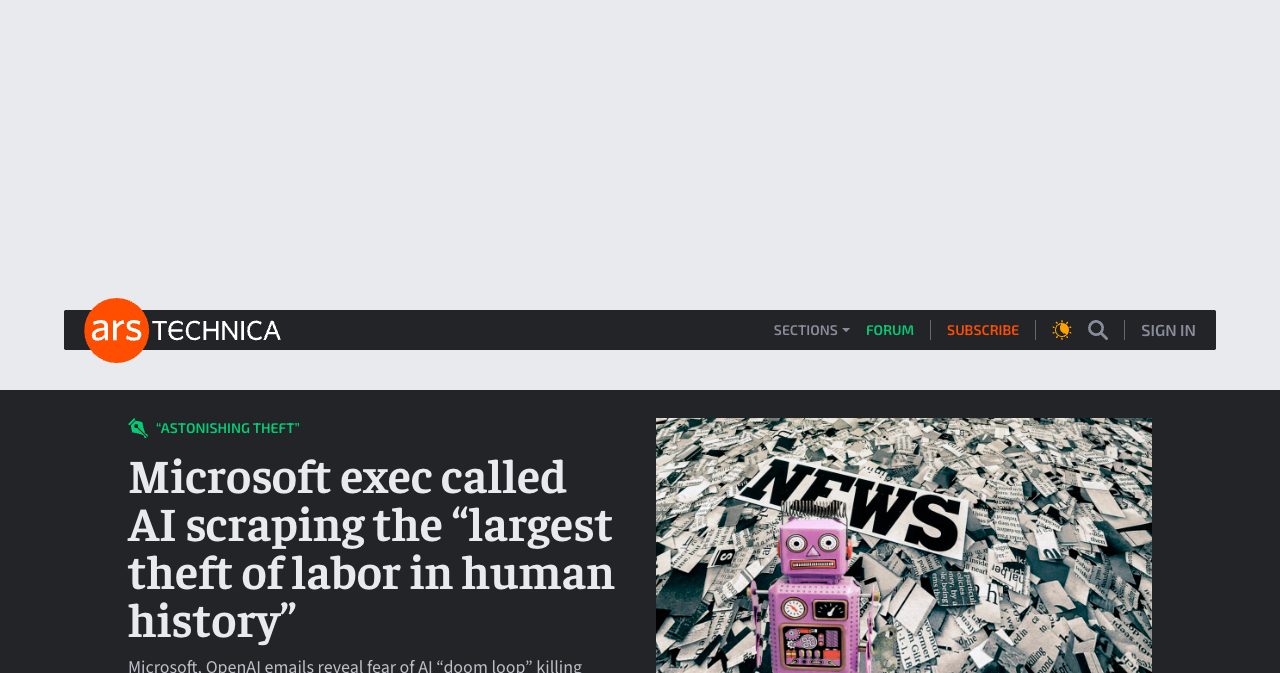
The disclosures reported by Ars Technica and 404 Media demonstrate that technical leaders understood the structural risk. Another cited Microsoft document noted: "Millions of people around the world will soon consider large models 'hoovering up' all their work to be an astonishing theft of unprecedented proportions," stating that "almost no one intended for content they created to be used in this fashion, nor are they compensated for its use." In another exchange, Microsoft staff discussed what Hecht described as an "accidental cover up," considering filters that would restrict publishers from seeing whether their copyrighted works had been ingested into training sets.
The internal paper trail at OpenAI matched Microsoft's findings. Nick Turley, head of ChatGPT at OpenAI, wrote in team discussions that commercial products trained on news content represented an "existential threat" to publishing businesses. Turley described conversational models as "largely substitutive, period" and projected that chatbots "will get more and more substitutive as they get better." Examining user clicking behavior directly, Turley reached an unmistakable conclusion: there is "no good reason to click" once a chatbot provides an answer. An OpenAI software engineer corroborated this finding, stating: "no matter how prominently we show the links, users won't click."
Policy leadership shared that assessment. Jack Clark, OpenAI Policy Director, recorded that the industry was "creating systems that substitute for the labor of the people that define the culture of society." ChatGPT was described internally as a modern newsstand, yet the financial mechanics differed from physical print distribution. OpenAI President Greg Brockman spoke candidly about commercial incentives, writing that he was deeply motivated by the "gazillions" in commercial revenue the technology could unlock. When OpenAI engineer Nick Ryder messaged Brockman describing "a hack to get around nytimes paywall" for data ingestion, Brockman replied, "Ah, nice."
Under sworn deposition, Microsoft Chief Executive Officer Satya Nadella testified that chatbots have functioned as substitutes for publisher platforms. Nadella observed that AI interfaces keep users on the host platform by delivering answers directly instead of sending them to source domains. Nadella stated that paywalled material ought to be licensed and noted that he would have exercised Microsoft's contractual authority to demand model retraining had he known paywalled text had been scraped.
A Microsoft spokesperson later maintained that Nadella's deposition and the company's defense remain consistent, describing his statements as broad reflections on information consumption rather than legal conclusions on copyright infringement. The spokesperson also dismissed Hecht's written memos, asserting that they reflected one employee's personal opinion rather than Microsoft's corporate stance.
The traffic collapse in cold numbers
The internal documents contained hard telemetry measuring what happens to user clicks when a conversational interface sits between a searcher and the web.
Microsoft internal traffic records documented that click-through rates for the Times and Daily News properties fell 83 percent to 93 percent when queries ran through Bing Chat and Copilot instead of standard Bing search. Reported figures for Times domains specifically came in 87 percent to 93 percent lower, and 83 percent to 91 percent lower for Daily News sites. Across the other publisher plaintiffs evaluated in the case, CTR reductions ranged from 51 percent to 94 percent.
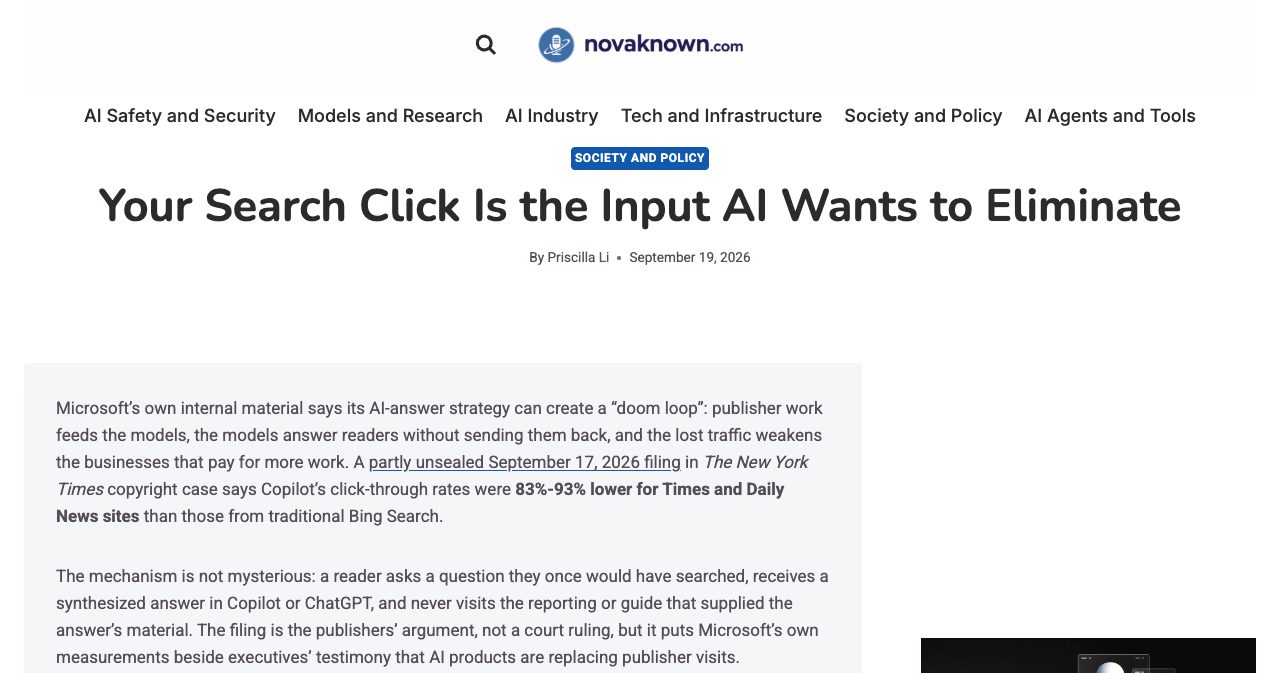
As reported by The Verge, OpenAI's own economic and media consultants reached comparable conclusions. Those experts attributed declining publisher referrals to AI answer modules such as Google AI Overviews, projecting that total search referral volume across the web could drop by as much as 60 percent.
| Search Environment | Measured Click-Through Impact | Internal Assessment |
|---|---|---|
| Bing Chat / Copilot (New York Times domains) | 87% to 93% CTR drop | Direct substitution for publisher site visits |
| Bing Chat / Copilot (Daily News domains) | 83% to 91% CTR drop | Users consume summary on page |
| Bing Chat / Copilot (broad publisher cohort) | 51% to 94% CTR drop | Structural reduction in outbound navigation |
| Search referral drop from AI summaries (OpenAI estimate) | Up to 60% loss in total referrals | Driven by tools like Google AI Overviews |
| Prominent link citations in chat answers | Negligible link engagement | Users refuse to click regardless of citation design |
These statistics represent internal measurements by the firms deploying the technology. Both Microsoft and OpenAI continue to contest liability in court, arguing that model training constitutes transformative fair use under United States copyright law. Both companies deny legal substitution and maintain that AI tools assist users in discovering web resources. The legal claims remain at the summary judgment stage, with news plaintiffs indicating readiness for trial.
The strategic takeaway for operators does not depend on the courtroom verdict. The engineering logs establish an empirical truth: when software delivers answers directly on a results screen, click-through rates collapse.
Why publisher data is a leading indicator for your SaaS funnel
It is tempting for software founders to view media litigation as an isolated publishing dispute. A developer selling database monitoring or an indie hacker building a micro-SaaS might assume that news reporting shares little common ground with B2B software marketing. That assumption ignores how content-led SaaS acquisition functions in practice.
For a decade, SaaS marketing teams copied the distribution playbook invented by online publishers. You targeted informational queries related to your product category, publishing tutorials, glossary entries, and troubleshooting guides. A prospective buyer typed a question into Google, clicked your blue link, read your post, and encountered your signup form.
Consider the queries software buyers search every day: "how to calculate customer churn in Postgres", "Stripe webhook signature verification failed nodejs", "best open source monitoring tools for Kubernetes", or "SOC2 compliance checklist for early stage startups." Each of those queries used to generate thousands of organic visits for developer tools and business software.
Today, Google AI Overviews and desktop AI assistants read your documentation, summarize your troubleshooting steps, format the code block, and present the solution directly on the search page. The engineer gets the answer, pastes the code, and closes the browser tab.
Your analytics dashboard records an impression without a visit. Traditional rank tracking tools indicate that your page still holds position one, yet your organic traffic graph slides downward month after month. Tracking this gap requires moving beyond legacy ranking metrics to modern tracking systems, as detailed in our guide on SEO vs GEO tools for AI visibility.
When Microsoft measured an 83 to 93 percent CTR drop on news queries, they measured human browsing psychology. If someone finds what they need without leaving the page, they do not click. That rule applies to software tutorials just as aggressively as it applies to news reporting. Founders relying on standard organic launch cycles must rethink their approach, updating the sequences found in our SaaS launch playbook for 2026.
The economic consequence for software startups is severe. In B2B SaaS, paid search acquisition costs on Google Ads routinely reach $15 to $45 per click for competitive commercial terms like "cloud billing software" or "compliance automation platform." Startups relied on organic informational content to bring down their blended customer acquisition costs. When organic visits evaporate, customer acquisition costs surge, destabilizing the unit economics of bootstrapped and seed-funded software companies.
The mechanics of Google Zero across software pages
The term Google Zero describes a search environment where the search engine answers queries on its own interface, sending zero outbound clicks to the web. In the wake of unsealed admissions from OpenAI and Microsoft, we can map how Google Zero breaks down across different types of SaaS pages.
Broad informational searches ("what is ARR", "how to format dates in React") face the steepest drop. Because multiple authoritative guides exist across the web, AI models synthesize them completely. Users have no reason to visit your domain. Founders who attempted to counter this decline by scaling up programmatic SEO with automated writers have found themselves caught in an expensive trap: generating thousands of thin articles only feeds crawlers with more text to summarize without returning clicks.
Comparison queries face similar substitution. SaaS teams spent years constructing tables for "Product A vs Product B" or "Top Alternatives to Tool C." When a prospect enters a comparison query today, answer engines synthesize features, user ratings, and pricing directly into a formatted comparison chart. If your software is not mentioned in the underlying training data or grounding retrieval, your product never enters the evaluation set.
The Princeton University study on Generative Engine Optimization analyzed what makes content visible to these generative systems. Researchers observed that adding authoritative statistics boosted visibility in AI answers by roughly 37 percent, and citing reputable external sources increased visibility by 40 percent. Conversely, aggressive keyword repetition reduced visibility. Software teams must format their content so machines can ingest and cite verified data points, a methodology covered in our breakdown of how to optimize your website for AI citations, GEO and AEO.
Documentation pages are transformed by code assistants. When developers paste stack traces into Cursor or Claude Code, the assistant delivers the fix without routing the engineer to your portal. Technical teams are responding by publishing lightweight, markdown-based resources. Providing machine-readable documentation endpoints ensures that when AI coding agents solve problems for developers, they credit your library and use your recommended implementation patterns.
Five distribution models that survive the search referral collapse
If informational search clicks are disappearing, how does a software startup acquire customers in 2026? The answer requires building distribution channels that do not depend on a user clicking a blue link in a generic search box.
First, invest in branded search and direct reputation. When a user searches for your specific product name, AI engines cannot substitute another tool without failing user intent. If someone types "PostHog pricing" or "Linear keyboard shortcuts," they want that exact company. Branded search volume remains resilient to the Google Zero drop because the searcher has already decided to investigate your product. Generating that demand requires marketing outside search: speaking on podcasts, writing opinionated technical essays, building in public, and producing software that users recommend directly to colleagues.
Second, establish presence on curated directories and structured entity databases. In an AI-mediated web, directory listings provide entity verification. Large language models do not trust claims made on a vendor's own marketing page. When ChatGPT, Gemini, or Perplexity answer queries like "best self-hosted CRM for European agencies," they pull from neutral, third-party databases to identify which software products genuinely exist.
Securing complete profiles across authoritative directories creates the consensus footprint that AI recommendation systems look for, as explored in our report on the SEO benefits of listing SaaS products in directories. Domain rating remains an important metric for evaluating discovery platforms, ensuring your profile is indexed and crawled frequently, a concept examined in our analysis of whether domain rating affects SEO. You can evaluate which discovery hubs justify your time using our DR-based framework for choosing SaaS launch directories.
Managing submissions requires discipline. Founders can compare providers in our review of directory submission services compared, explore high-impact launch options in our guide to platforms for SaaS founders to get visibility, and evaluate specialized launch channels in our roundup of Product Hunt alternatives for SaaS. You can also monitor emerging discovery networks in our guide to new startup directories late 2026 meta lists.
This is where SaaSCity fits into a modern acquisition stack. SaaSCity provides a live city map where software tools earn visibility through community activity and human editorial review. The free plan grants you a listing page and a building on the interactive map. When you add the SaaSCity badge to your website, you unlock a dofollow backlink and an assigned Monday launch slot. For teams wanting immediate traction, Quick Pass costs $19.99 for a 24-hour review, Premium costs $39.99 and includes a custom launch post with three dofollow links, and Max costs $99 for 30 days of billboard placement, ticker visibility, and a pinned homepage slot. Our domain holds a DR of 47 to 56, providing an indexed foundation that search engines and AI engines crawl regularly.
Third, build for ecosystem integrations and marketplace app stores. Users spend working hours inside major software ecosystems: Shopify, Slack, GitHub, Figma, and Stripe. Building plugins, integrations, and apps for these platforms bypasses search engines completely. When a merchant needs an inventory synchronization tool, they search the Shopify App Store, not Google. Platform ecosystems hold immense distribution power, demonstrated clearly when Shopify acquired Tailwind CSS to deepen its control over developer tooling.
Fourth, execute direct community distribution to secure initial customers. Early stage software growth requires direct, manual conversations with potential buyers. Founders must participate in niche communities where target users solve problems: developer Discord servers, specialized Subreddits, private Slack groups, and GitHub discussions. Demonstrating competence and sharing practical solutions in these channels builds trust faster than generic search content ever could. We outline concrete steps for executing this strategy in our playbook on how to get first 100 users for a SaaS startup.
Fifth, publish primary data and proprietary research. AI models can summarize publicly available consensus information effortlessly. What they cannot synthesize is proprietary data they have never seen. If your software processes invoices, publish quarterly benchmarks on payment turnaround times. If your product optimizes databases, publish head-to-head query benchmarks. Original research creates a defensible content moat: an AI answer engine cannot answer "what was the average B2B SaaS churn rate in Q2 2026" without attributing the statistic to the specific research report that surveyed hundreds of companies.
Practical audit: how exposed is your SaaS traffic?
To evaluate your risk in an environment shaped by AI substitution, audit your existing organic traffic sources against the framework below.
| Content Type / Traffic Source | AI Substitution Risk | Expected Traffic Trajectory | Strategic Founder Action |
|---|---|---|---|
| Broad informational guides ("What is...") | Severe (80% to 95% drop) | Near-total loss of search clicks | Prune low-converting articles; stop producing generic top-of-funnel content |
| Competitor comparison roundups | High (60% to 80% drop) | Steady decline as AI chat provides comparative matrices | Place structured feature data on trusted third-party directories |
| API references and syntax guides | High (50% to 75% drop) | Erosion as developers use IDE assistants | Expose machine-readable llms.txt files and MCP endpoints for agent access |
| High-intent branded queries | Minimal (0% to 10% change) | Stable or growing alongside brand equity | Claim your branded SERP by securing all major directory profiles |
| Platform app stores and directories | Zero (Independent of search) | Growing referral share | Expand presence on curated platforms, app marketplaces, and community directories |
Auditing your traffic involves checking your Google Search Console query reports. Separate your branded search terms from unbranded informational queries. If more than 60 percent of your total inbound clicks come from top-of-funnel educational terms, your acquisition pipeline is highly vulnerable to generative summaries. Diversify your traffic mix immediately by shifting marketing hours away from drafting basic explainer articles toward building integration partnerships, engaging directly in relevant communities, and publishing original benchmark data.
The path forward for software builders
The unsealed court filings from September 17, 2026, confirmed what practitioners experienced in their analytics dashboards. The doom loop is not a theoretical model or a hostile accusation from plaintiffs. It is a documented consequence of conversational search, acknowledged in writing by the scientists and executives who built the systems.
When users receive immediate answers, they stop clicking external links. An OpenAI engineer summarized the reality concisely: no matter how prominently links are displayed, users will not click.
Accepting that reality changes how software builders must spend their time and capital. The era of scaling software on the back of generic search engine optimization has concluded. Winning software teams in 2026 are not hiring content mills to produce derivative articles that AI overviews will summarize into oblivion.
Instead, resilient founders are focusing on product excellence, cultivating memorable brands, integrating into active platform ecosystems, and establishing verified footprints on trusted directories. You cannot rely on search engines to volunteer traffic they want to keep for themselves. Take control of your discovery footprint, claim your building on SaaSCity, and build a business that speaks directly to customers.
Get your SaaS in front of founders
List your product on the SaaSCity live city map - a permanent listing, real discovery, and a backlink from a high-DR directory. Free to start; upgrade for a dofollow link and a building on the map.