Reviews
Shoe-Size.com Review 2026: A Free Shoe Size Converter That Tells You Where Every Number Comes From
Shoe-Size.com is a free shoe size converter that reads 40 brands' published charts, turns a measured foot into a size and explains why a US 9 is EU 42.5 at Nike but EU 42 2/3 at Adidas. Here is what each tool does, how the numbers are built and how to use it before your next online order.

Contents (16)
- Shoe-Size.com in short
- Who is behind Shoe-Size.com
- The converter: three tools in one panel
- Compare brands: your Nike size at 39 other brands
- One US 9, five different EU numbers
- The CM on the box is not always your foot
- Start from your foot: the foot length tool
- Brand pages that answer the question you actually searched
- Widths, kids and the sizes nobody explains
- Real measured data: the average shoe size
- How the numbers are built
- What to know before you rely on it
- How it compares with other ways to find your size
- A five-minute routine for your next online order
- The verdict
- Frequently asked questions
Disclosure: this is a sponsored review.
Product details were checked against shoe-size.com, its converter, brand, methodology, about, legal and privacy pages, and the Swiss commercial register on November 20, 2026.
Quick answer: Shoe-Size.com is a free shoe size converter for US, UK, EU and CM/JP sizes. It compares your size across 40 brands using each brand's published chart, turns a measured foot length into a size, and covers kids, widths, socks, ski boots and hockey skates. There is no sign-up, no app and no advertising, and every chart names its source.
You find the right pair online, open the size menu, and the numbers stop making sense. Your trainers at home say US 9. The shop lists EU sizes. One brand prints EU 42.5 for a US 9, another prints 42 2/3, and a third wants to know your foot length in centimeters, which you have never measured. Order the wrong size and the evening ends with a returns label.
Shoe-Size.com, which calls itself Shoe Size Converter, was built for exactly that moment. It converts between every common sizing system, compares what 40 brands print for the same foot, and turns a measured foot into a size. It also does something most size charts skip: it tells you where each number comes from and why two charts disagree. This review walks through every tool on the site, what it does well, what to keep in mind, and how to use it before your next order.
Shoe-Size.com in short
Shoe-Size.com is a free, browser-based shoe size converter for men's, women's and kids' sizes in the US, UK, EU and CM/JP systems. Its three core tools convert one sizing system to another, compare your size at one brand with 39 other brands, and find the smallest size that fits a measured foot. Around them sit 40 brand size charts, regional charts for Japan, Korea, China, Mexico, Australia, Italy and Brazil, kids' and toddler charts by age, a shoe width chart, sock, ski boot, snowboard boot and hockey skate charts, and 11 sizing guides. There is no account, no app to install, no advertising and no tracking cookies. The site is run by Stefan Schulze for CAESS GmbH in Dürnten, near Zurich, Switzerland.
| Quick facts (November 20, 2026) | |
|---|---|
| What it is | Free shoe size converter and size chart reference |
| Price | Free, no sign-up |
| Sizing systems | US men's, US women's, US kids' (C and Y), UK, EU, CM/JP, foot length in cm or inches, Mondopoint |
| Brands | 40 brand charts, men's, women's and kids' where the brand publishes them |
| Core tools | Convert sizes, compare brands, measure your foot |
| Extra charts | Width, kids and toddlers by age, socks, ski boots, snowboard boots, hockey skates, average shoe size |
| Regions | Japan, Korea, China, Mexico, Australia, Italy, Brazil |
| Ads and tracking | No ads, no tracking cookies, cookie-free analytics |
| Language | English |
| Run by | CAESS GmbH, Dürnten, canton of Zurich, Switzerland |
Who is behind Shoe-Size.com
Shoe-Size.com belongs to CAESS GmbH, a small Swiss company registered in the canton of Zurich in 2023. CAESS runs a laser workshop in Dürnten, a gift brand and a calculator site with about 150 calculators. Stefan Schulze, the company's managing director, runs the shoe size site himself: he writes the guides and maintains the charts and conversions. His background is in automation technology and sales, and on the company's own site he is described as the person who builds its websites.
The site went live in November 2026, and it shows its work. Each guide carries a byline and a date, the About, privacy and methodology pages show when they were last updated, and the methodology page was revised on November 20. If a number no longer matches a brand's current chart, the About page asks you to email the page and a link to the brand's chart so it can be checked.
Two promises sit at the bottom of the site. Shoe-Size.com is "not affiliated with, endorsed by, or sponsored by any brand it lists," and the privacy policy says it uses no advertising and no tracking cookies. Visits are counted with Ahrefs Web Analytics, which sets no cookies, and the only form on the site, a box for suggesting a brand or comparison, asks for no name or email address. If ads or cookies are ever added, the policy says a consent option comes first.
The converter: three tools in one panel
Everything starts with a single panel called "Find your size". It sits on the homepage and on most chart pages, so you never have to hunt for the tool. A toggle in the corner switches between inches and centimeters, and the site remembers your choice in your own browser.
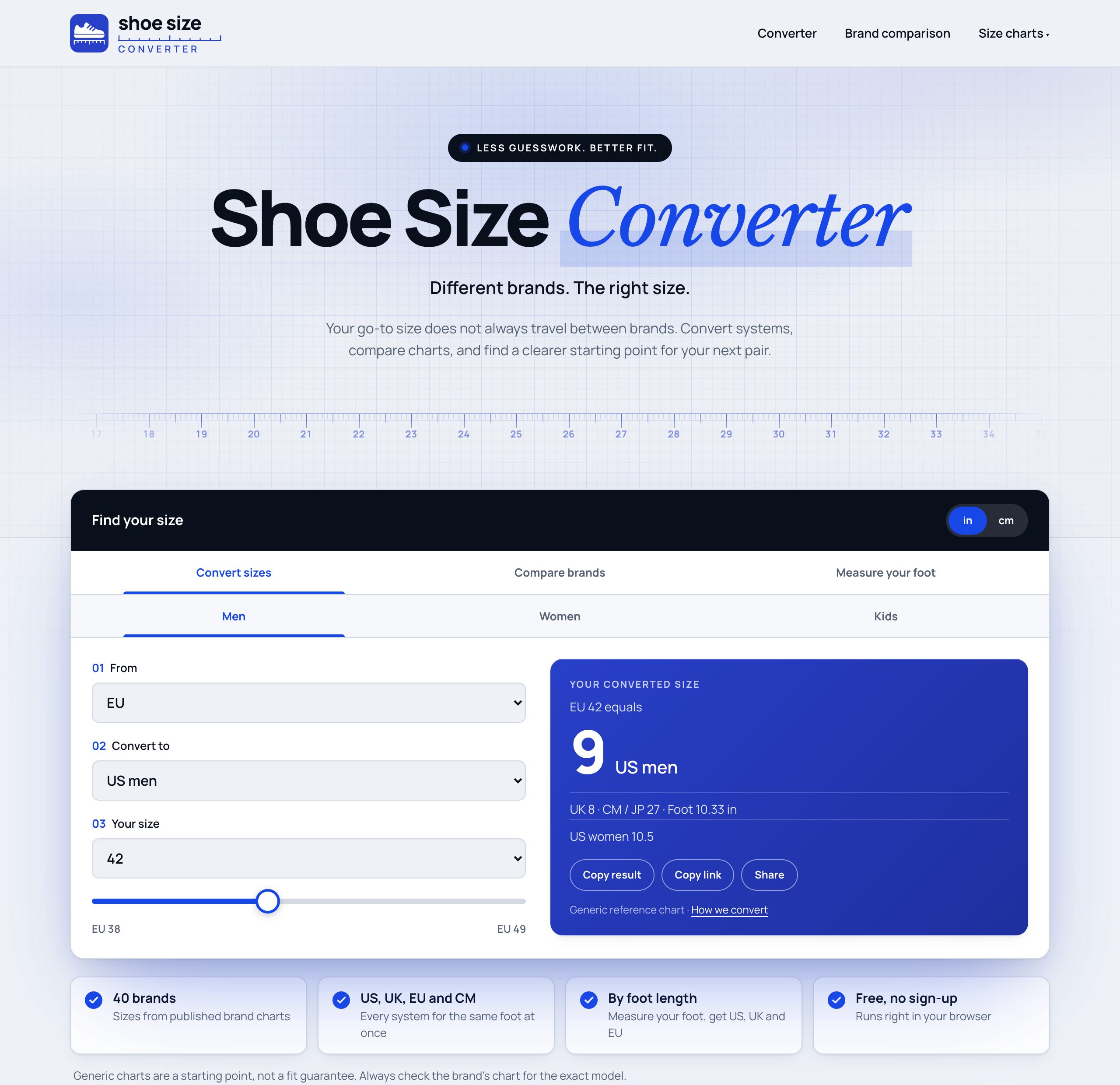
The converter on the Shoe-Size.com homepage: EU 42 converts to a US men's 9, with UK, CM/JP, foot length and the US women's size on the same card. Screenshot: shoe-size.com, November 2026.
The first tab, Convert sizes, does the classic job. Pick men, women or kids, choose the system you have and the one you need, then use the dropdown or the slider. The answer arrives as one large number with everything else underneath. EU 42, for example, comes back as a US men's 9, a UK 8, a CM/JP label of 27, a foot of 10.33 inches and a US women's 10.5. You get every system for the same foot at once, which is handy when a shop lists UK sizes and your own shoes say US.
Each result has three buttons: Copy result, Copy link and Share. The link button is more useful than it looks, because the link carries your settings. Send it to whoever is buying you a present and it opens on the same conversion you saw.
A short line sits under every generic result: "Generic reference chart · How we convert". The site treats the generic chart as a starting point, and it says so plainly on the homepage: generic charts are a starting point, not a fit guarantee, so check the brand's chart for the exact model. That is the reason the second tab exists.
Compare brands: your Nike size at 39 other brands
The Compare brands tab answers the question most people really have: "I wear a 9 in Nike, what do I order from this other brand?" Choose your brand, choose the one you are buying, enter your size in US, UK or EU, and the tool reads both brands' published charts.
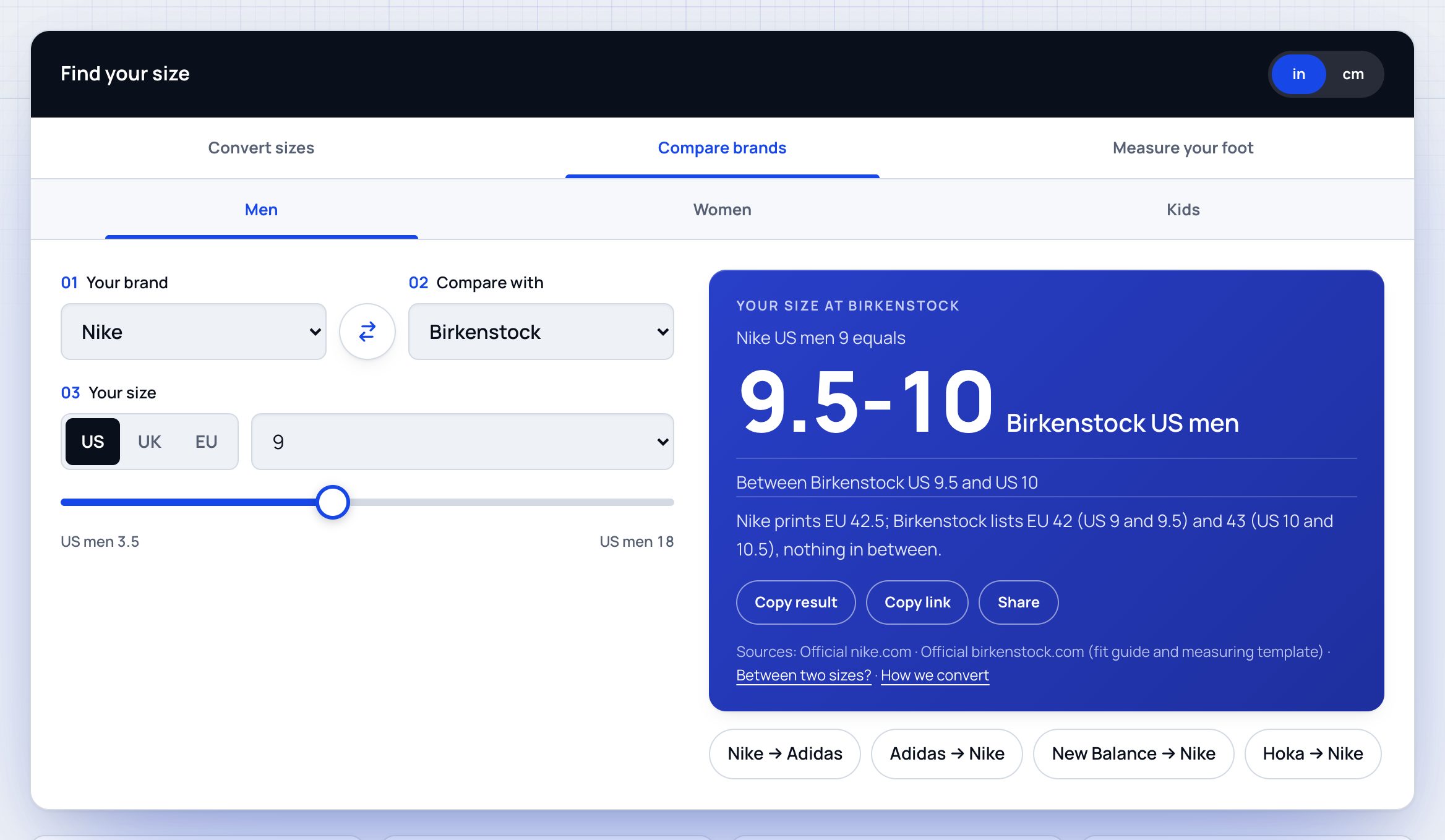
Nike to Birkenstock: Nike prints EU 42.5 for a men's 9, Birkenstock only makes EU 42 and 43, so the tool shows both options and says why. Screenshot: shoe-size.com, November 2026.
What makes the result trustworthy is the sentence underneath it. The tool always says which label it matched on. A Nike men's 9 converts to an Adidas 9 because both brands print CM 27 on the box. It converts to a Vans 9.5 because both brands print EU 42.5 for those sizes. And when there is no clean match, it says that too: Nike prints EU 42.5, Birkenstock lists EU 42 and EU 43 and nothing in between, so your Birkenstock size is a 9.5 or a 10. You see the reasoning and both sources, and you decide.
The full set of brands is on the brand size comparison page. It covers sneaker and running names such as Nike, Adidas, New Balance, ASICS, Hoka, On, Brooks, Saucony and Altra, everyday brands like Vans, Converse, Skechers, Clarks and ECCO, boots from Dr. Martens, Blundstone, Timberland, Red Wing and Ariat, comfort and barefoot brands like Birkenstock, Dansko, Crocs and Vivobarefoot, fashion labels such as Golden Goose, Christian Louboutin, Steve Madden and Kurt Geiger, and three kids' specialists: Stride Rite, See Kai Run and Ten Little. Of the 40 charts, 37 are transcribed from the brand's own size chart. For Puma, Reebok and Hoka the chart comes from a retailer that reproduces it, and the page labels them "Via retailer" so you know.
One US 9, five different EU numbers
If you have ever suspected that shoe sizes are a mess, the brands page proves it in one table. It lists what every brand prints for a US men's 9 and a US women's 8.
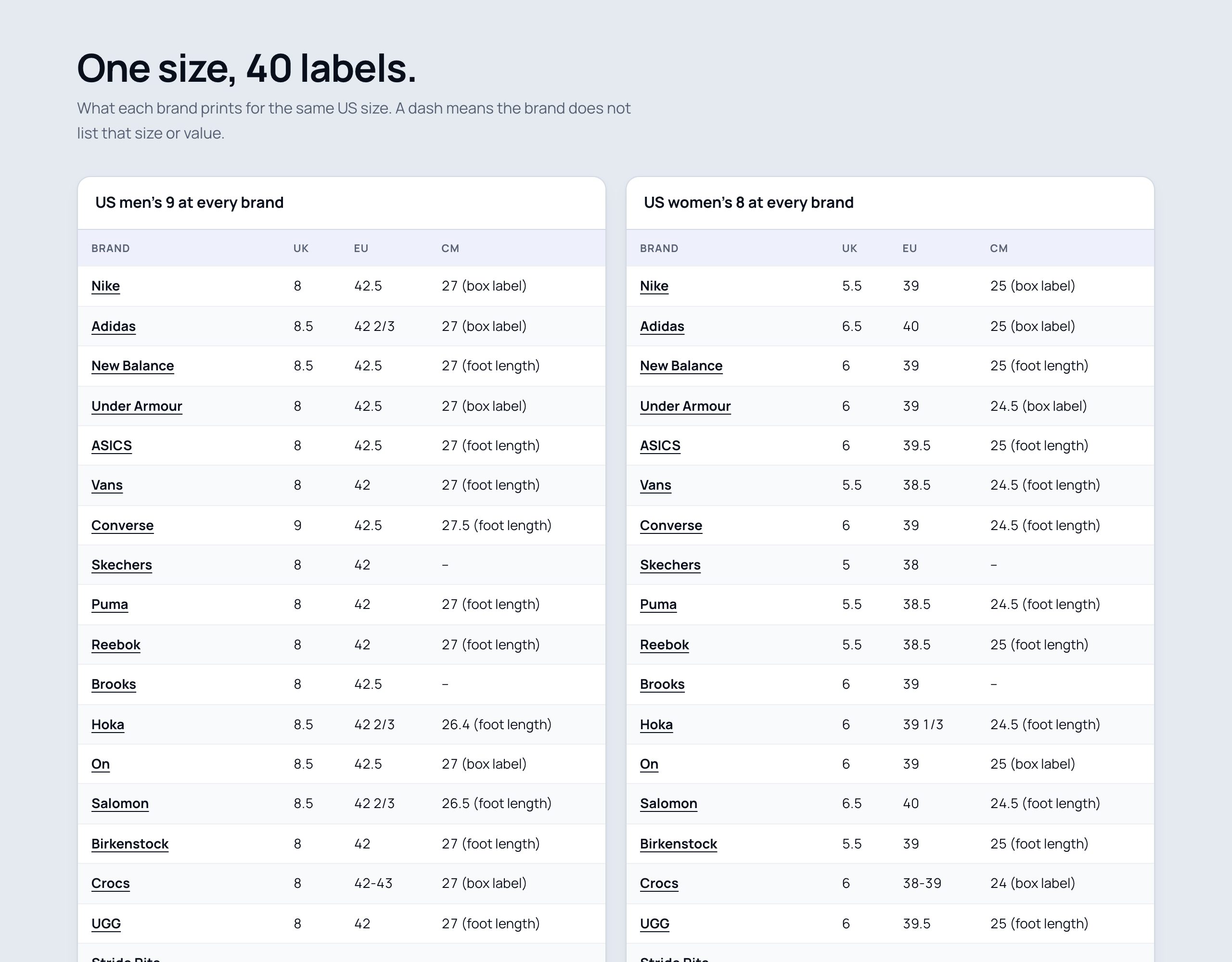
"One size, 40 labels": the same US size at every brand, with a note on whether the CM value is a box label or a foot length. Screenshot: shoe-size.com, November 2026.
For a US men's 9 the charts print five different EU numbers: 42, 42.5, 42 2/3, 43, and 42-43 at Crocs. Vans says 42, Nike 42.5, Adidas 42 2/3, Merrell and Timberland 43. None of these is a typo. The site explains the reason in its guide on EU fractions: an EU size steps in Paris points of 2/3 cm, a US half size in about 4.2 mm, so brands that convert exactly land on thirds and the others round them. Adidas, Hoka and Salomon print thirds, six brands including Birkenstock and Dr. Martens use whole EU sizes only, and most of the rest use halves.
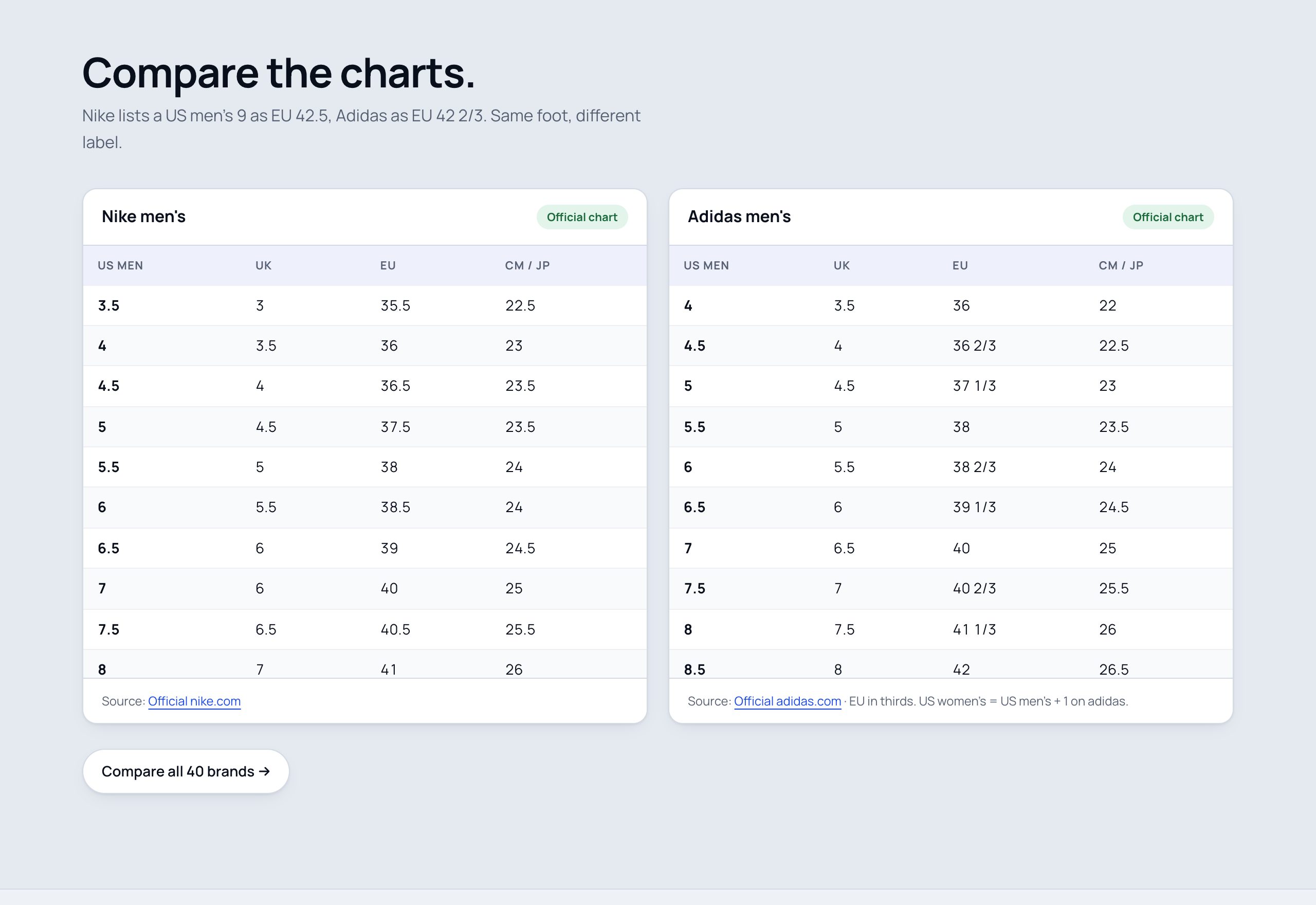
Nike and Adidas men's charts side by side, each with a link to the official source. Screenshot: shoe-size.com, November 2026.
The practical lesson, repeated across the site, is to convert the EU number exactly as the brand prints it. A 42.5 at Nike and a 42 2/3 at Adidas describe the same foot.
The CM on the box is not always your foot
This is the detail that catches most people out, and Shoe-Size.com spells it out on every brand page. The CM or JP number on a shoe box can mean two different things.
At 10 of the 40 brands it is a label. Nike prints 27 cm on a US men's 9, but the foot that fits that shoe measures about 26.2 cm. At 25 brands the number is the actual foot length: New Balance also prints 27 cm on a US men's 9, and it means a 27 cm foot. The remaining five brands publish no CM values. Every brand page says which reading its chart uses, and the comparison tool only matches on CM when both brands use it the same way.
So if you measure your foot at 26.5 cm and look for "26.5" on a Nike chart, you will pick a size too small. Measure first, then use a foot length tool, which brings us to the third tab.
Start from your foot: the foot length tool
The Measure your foot tab skips the labels entirely. Enter your foot length in centimeters or inches and it returns the smallest men's, women's and kids' size whose foot length is equal to or larger than yours.
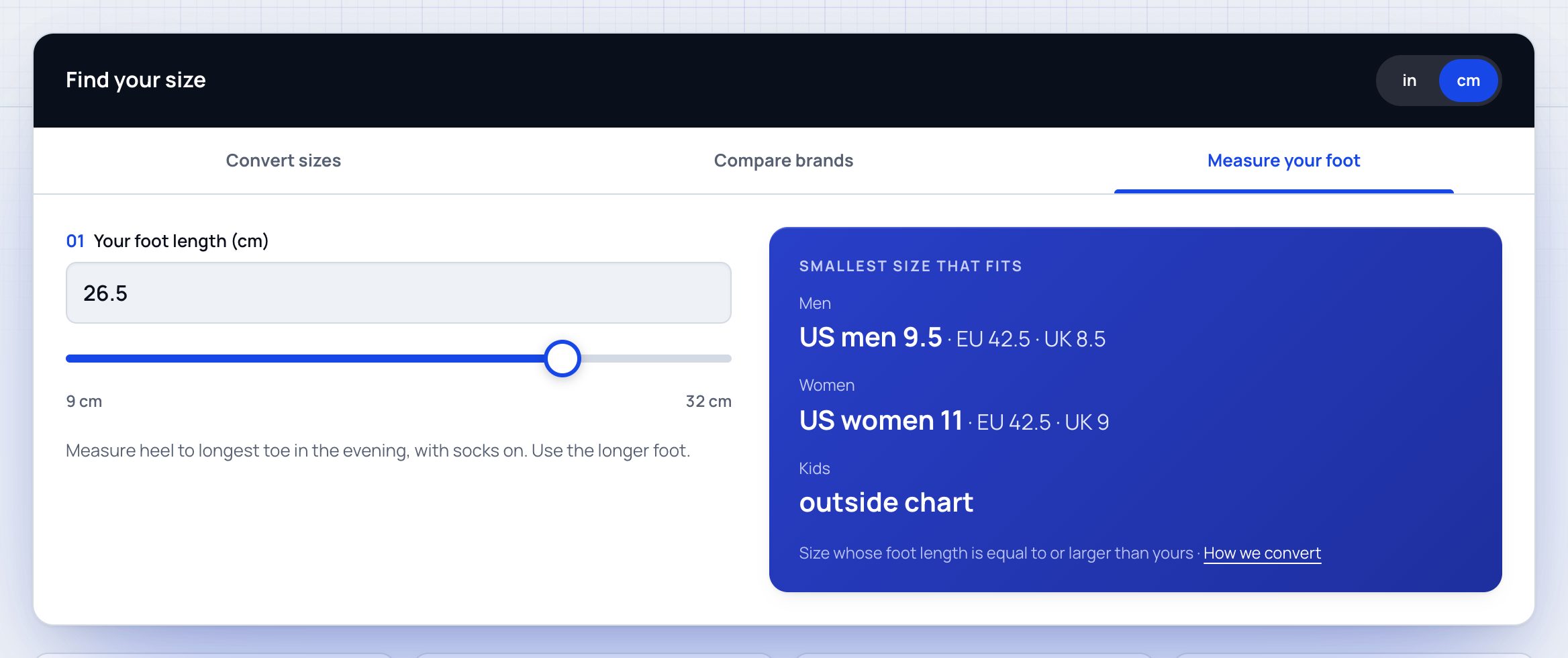
A 26.5 cm foot comes back as a US men's 9.5 or a US women's 11, with EU and UK sizes next to each. Screenshot: shoe-size.com, November 2026.
The math behind it is published. For men the site uses the Brannock scale, the one printed on the metal measuring device in shoe shops: US men's size = 3 × foot length in inches − 22. Women's sizes on the site are men's plus 1.5, the convention most retailers and brands use. The methodology page adds that Nike's official men's chart matches this formula on every row. It also explains why a Brannock reading in a shop can come out half a size smaller for women: the device counts women's sizes as men's plus 1.
The foot length to shoe size chart lists every length with its sizes, plus a table showing what CM means at each brand.
How to measure your foot at home
You need a sheet of paper, a pen, a ruler or tape measure, a wall and your socks. The site's guide to measuring your foot sets out the method in a few steps:
- Measure at the end of the day, when feet are often at their largest.
- Tape the paper to the floor with its short edge against the wall.
- Put your socks on and stand on the paper with your heel gently touching the wall, weight on both feet.
- Hold the pen upright and mark the tip of your longest toe, which for some people is the second toe.
- Measure from the wall edge to the mark, to the millimeter or the nearest 1/16 inch.
- Repeat with the other foot and use the longer measurement.
The guide makes a point worth remembering: a single millimeter can matter. On the generic chart a 26.2 cm foot is a men's 9, and a 26.3 cm foot already needs a 9.5. Measure twice, and a third time if the two readings differ by more than a millimeter or two.
Brand pages that answer the question you actually searched
Each of the 40 brands has its own page, and each one opens with the question people type into a search bar. The Nike page opens with "Do Nikes run small?" and answers in the first line: no, because Nike's chart matches the Brannock foot length scale.
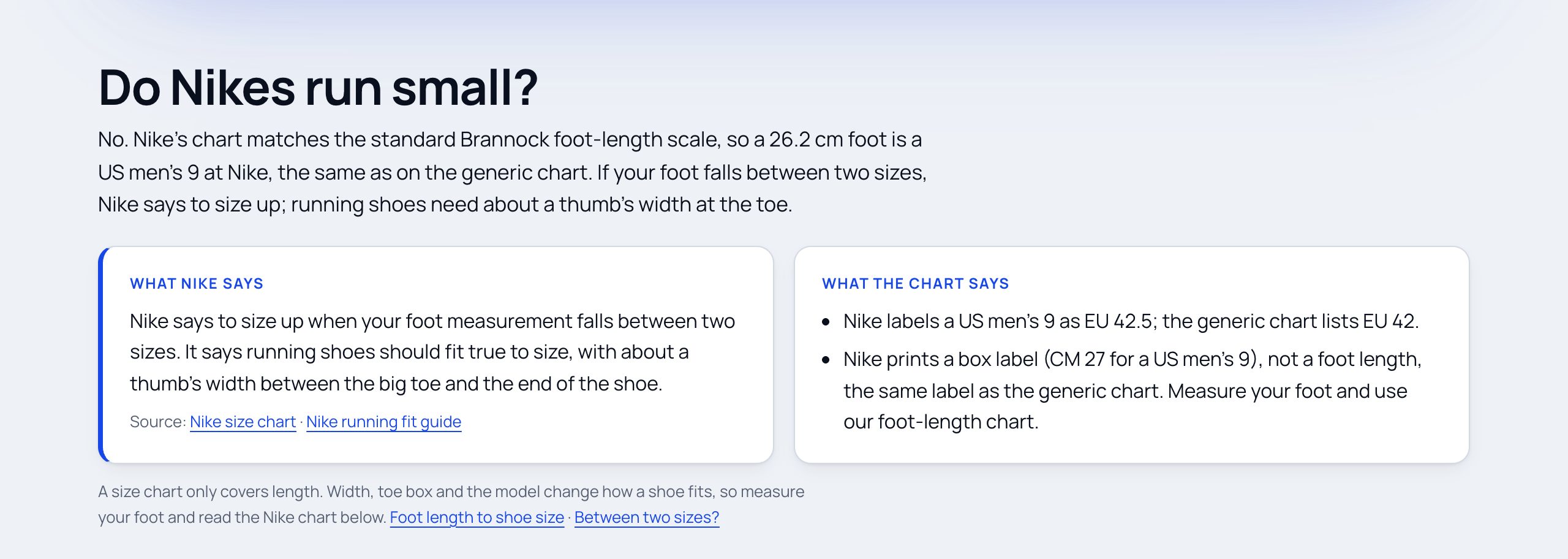
The Nike page separates what Nike says from what its chart shows, with links to both sources. Screenshot: shoe-size.com, November 2026.
Below that, two boxes keep advice and data apart. "What Nike says" quotes the brand's guidance, size up between two sizes and leave about a thumb's width at the toe of a running shoe, with links. "What the chart says" lists the facts: Nike labels a US men's 9 as EU 42.5, and its CM figure is a box label. The page then covers Jordan sizing (Jordans use Nike's charts, so a Jordan 10 is a UK 9 and EU 44), full men's, women's and kids' tables, the widths Nike offers, and a short FAQ.
If you are stuck between two sizes, the site's guide on sizing up or down collects what the brands themselves advise. Nike, New Balance and Dr. Martens say take the larger size. Converse says its Chuck Taylor All Stars run large, so go half a size down. K2 says size down in snowboard boots because the liners pack out. The guide also suggests checking whether the problem is width rather than length before you go up half a size, which saves a lot of returns.
Widths, kids and the sizes nobody explains
Three more areas cause real confusion when you buy shoes, and each has its own chart on the site.
Shoe width letters
Width letters change meaning with gender, and the width chart shows it in four rows. A D is medium for men and wide for women. A 2E is wide for men and extra wide for women.
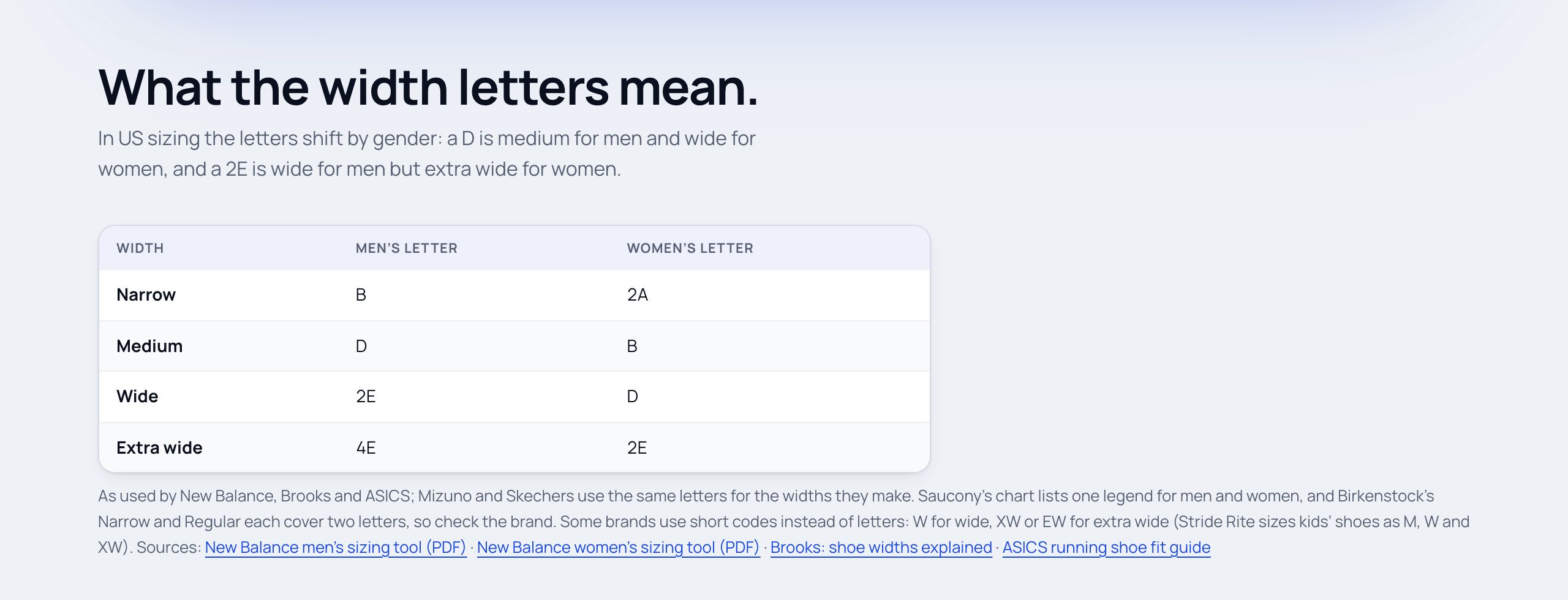
Width letters for men and women, as used by New Balance, Brooks and ASICS. Screenshot: shoe-size.com, November 2026.
Below the letters, New Balance's own data turns them into centimeters: a men's US 9 fits a foot 10.4 cm wide in D, 10.7 cm in 2E and 11.0 cm in 4E. A list of brands shows which widths each one offers, but only where the brand's own site confirms them.
Kids' sizes by age
Parents get some of the site's most useful pages. The kids shoe size chart by age explains the C sizes (toddlers and little kids, 1C to 13.5C) and Y sizes (big kids, 1Y to 7Y), then shows what children of each age actually measure.
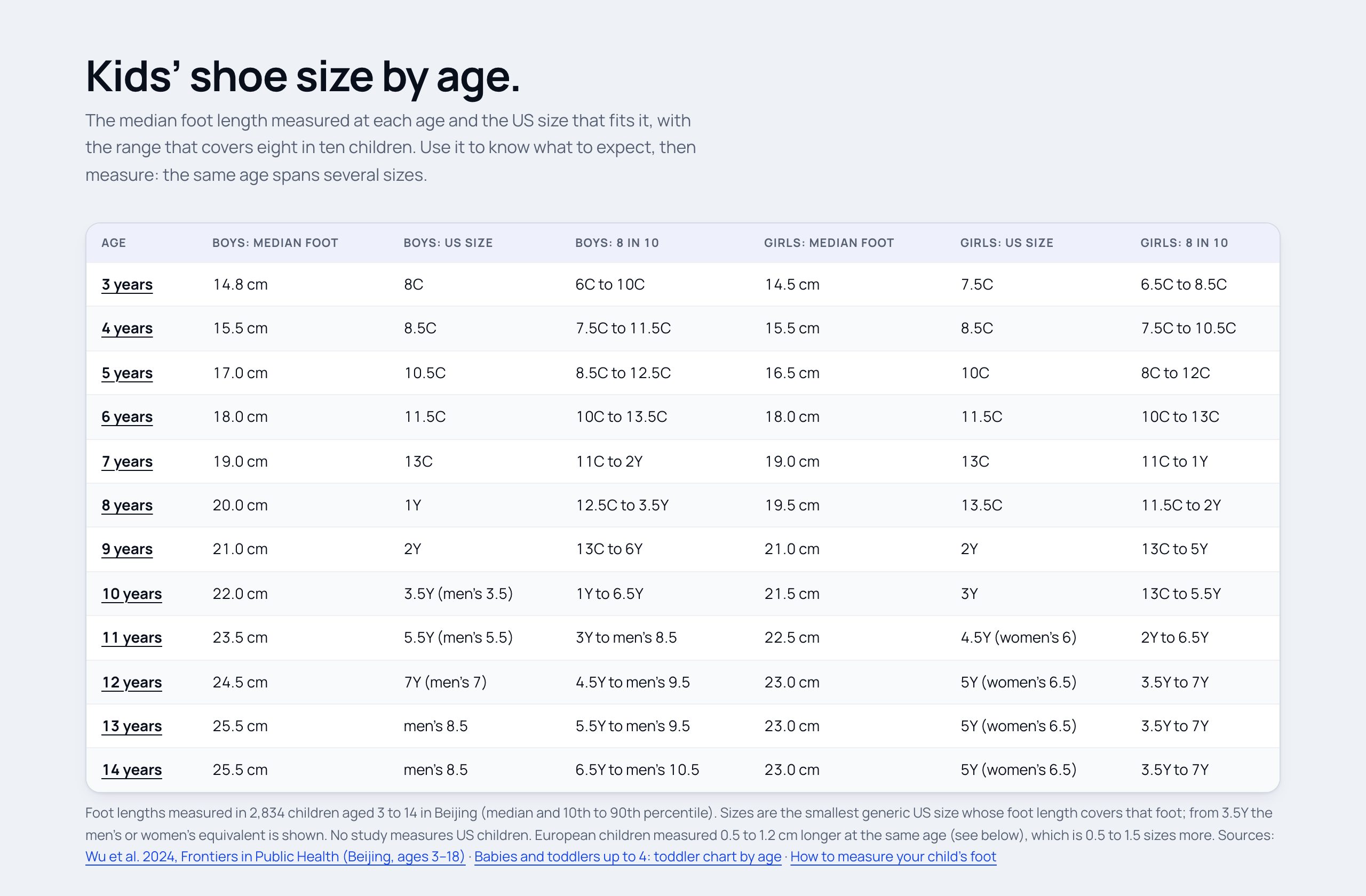
Measured foot lengths and sizes for ages 3 to 14, with the range that covers eight in ten children. Screenshot: shoe-size.com, November 2026.
The table uses foot lengths measured in 2,834 children in Beijing, published in Frontiers in Public Health in 2024, and a second table compares them with a 2025 Czech study, where children of the same age measured 0.5 to 1.2 cm longer. The page points out that this gap is one reason age charts on different sites disagree. The takeaway is practical: measured 5-year-olds wear 10C to 11.5C, 10-year-olds 3Y to 3.5Y, and children of the same age can be six sizes apart, so use age as a guide and measure the foot. Stride Rite, quoted on the page, says children's feet can grow half a size every 2 to 4 months and recommends measuring every two months.
There are separate pages for each age from 3 to 14, and a toddler chart that sets Nike's age labels (4C at 12 months, 6C at 2 years, 7C at 3 years) against measured feet, which tend to run larger.
Ski boots, snowboard boots, hockey skates and socks
Sports gear has its own logic, and each gets a page. Ski boots use Mondopoint, which is simply your foot length in centimeters: a 26.5 cm foot takes a 26.5 boot. Snowboard boots also follow foot length, and at Burton and K2 a 27 cm foot is a US men's 9 or a women's 10, because women's snowboard sizes sit one size above men's rather than 1.5. Hockey skates run small: Bauer and CCM put a men's shoe 10 in a senior skate 8.5. Socks come in letter sizes that vary by brand, so a US men's 9 is a medium at Nike and Darn Tough but a large at Smartwool.
Real measured data: the average shoe size
The average shoe size page is a good example of the site's approach. It is built on ANSUR II, a 2012 US Army survey that measured the feet of 6,068 adults aged 17 to 58, and it links to the survey and its methods paper.
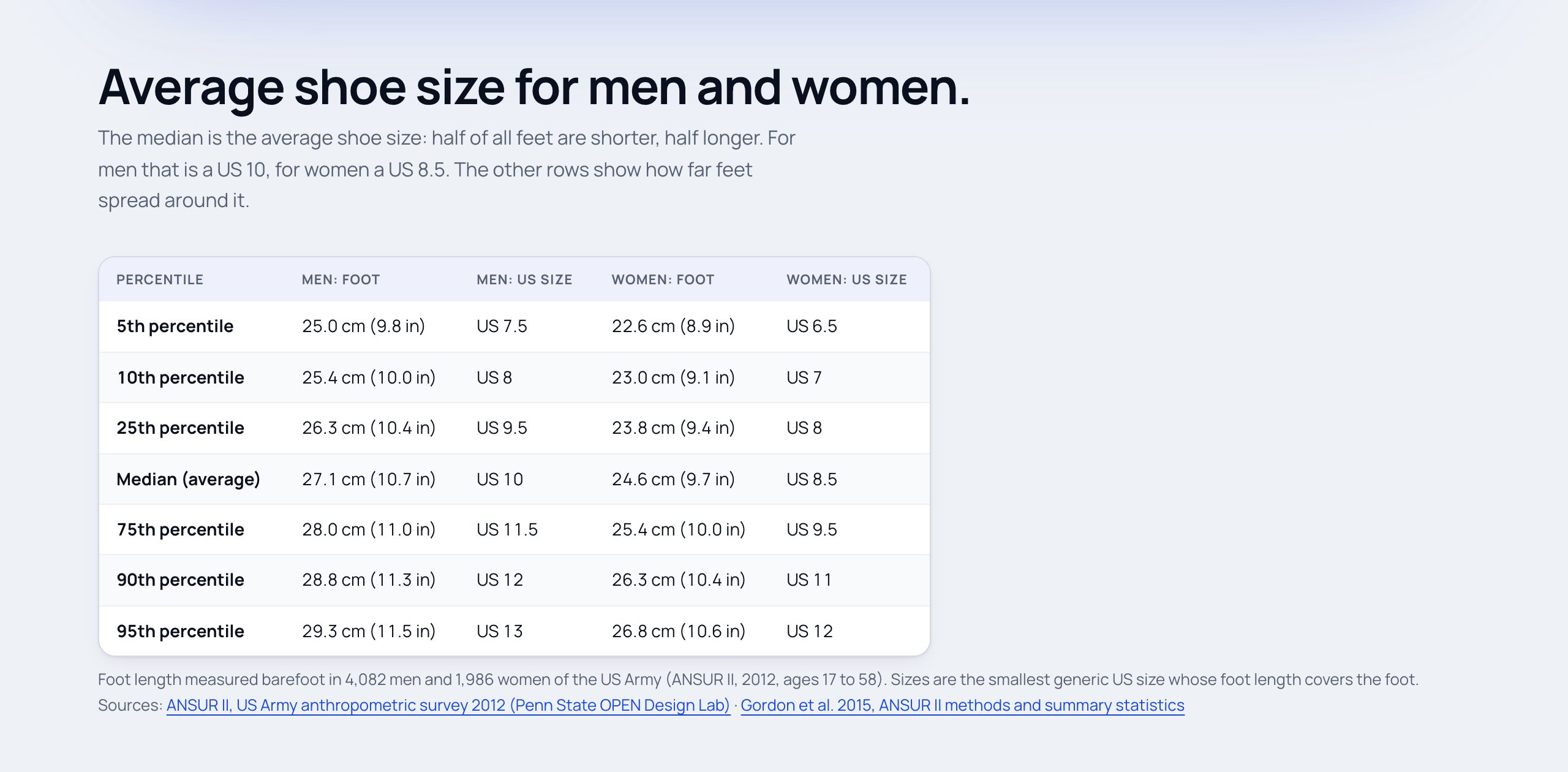
Average shoe size by percentile, built from the ANSUR II survey, with links to the survey and its methods paper. Screenshot: shoe-size.com, November 2026.
The median man has a 27.1 cm foot, a US men's 10 (EU 43, UK 9). The median woman has a 24.6 cm foot, a US women's 8.5 (EU 39.5, UK 6.5). Half of all men wear a 9.5 to 11.5, half of all women an 8 to 9.5. If you have ever wondered whether a men's 12 is big, the answer is yes: 15 percent of men need a 12 or larger. The page also covers height. Taller people have longer feet, but each inch of height adds only about 3.5 mm of foot length, so the site recommends measuring rather than guessing from your height. It notes, too, that soldiers are younger and fitter than the average adult.
How the numbers are built
A size chart is only as good as its sources. Shoe-Size.com's methodology page lists every rule and every source, including the points where sources disagree.
Two examples show the level of care. First, UK sizes: some charts, including Zappos's and the Brannock device's, put UK half a size below US men's, while the ISO/TS 19407:2015 conversion tables, Clarks and most brands use a full size. The site follows ISO and says so, and the US to UK page shows the step each brand uses. Second, EU sizes: the site used the Zappos retail chart's EU column until November 2026, then replaced it, because Zappos adds one EU size per US size while a US size is really 1.27 EU sizes. At larger sizes that drift reached one to one and a half EU sizes below what the brands print. Men's EU sizes now follow the standard EU column of Clarks' UK fit guide, women's follow ISO/TS 19407:2015, and both stay within half a size of the brands' median on most sizes.
The guide "How Shoe Sizes Are Calculated" is worth reading if you like to understand the system. In short:
- US and UK sizes count barleycorns, an old unit of one third of an inch (8.47 mm), from different starting points.
- EU sizes count Paris points of 2/3 cm along the last, the form a shoe is built on, so EU 42 is a 28 cm last made for a foot of roughly 26 cm.
- Mondopoint, used for ski boots and in Japan and Korea, is the foot length itself in centimeters or millimeters.
- Three US sizes make one inch and four EU sizes make 26.7 mm, so the two systems never line up exactly.
The methodology page ends on a rule that tells you a lot about the site: if a number on Shoe-Size.com differs from the brand's current chart, the brand's chart is right.
What to know before you rely on it
Shoe-Size.com is a reference, and it is clear about what a size chart can and cannot tell you. A few points are worth knowing before you use it:
- A chart covers length. Width, toe box shape and the individual model still change how a shoe fits, so the site sends you to the model's own size guide before you buy.
- The 40 brands cover most big sneaker, running, boot and comfort names. For a brand outside the list, the generic chart and the foot length tool are your starting point, and the suggestion box takes requests.
- Three brand charts (Puma, Reebok and Hoka) come from retailer copies, and they are labeled as such.
- The site is in English and works in the browser; there is no phone app. The layout adapts to a phone screen, and the Copy link button makes a result easy to save or send.
None of this takes away from the tools. It is the same advice a good shoe shop gives: measure, read the brand's chart, then decide.
How it compares with other ways to find your size
| Option | What you get | Where it falls short |
|---|---|---|
| Shoe-Size.com | Generic conversion, 40 brand charts compared directly, foot length sizing, kids, width and sports charts, sources on every page | English only, covers 40 brands |
| A brand's own size guide | The final word for that brand's shoes | One brand at a time, and CM can mean label or foot |
| A retailer's conversion table | A quick generic chart while you shop | One table for every brand |
| General calculator sites | A single converter among many other tools | No brand-by-brand comparison |
For a one-off conversion, any chart will do. When you are buying a brand you have never worn, or comparing what two brands print for your size, a tool that reads both brands' charts and shows its reasoning saves a lot of guessing.
A five-minute routine for your next online order
- Measure your foot once, in the evening, with socks on, and note the longer foot in centimeters.
- Put that length into the Measure your foot tab to get your generic US, UK and EU sizes.
- Open the Compare brands tab, enter the brand you already wear and your size there, and pick the brand you are about to buy.
- Read the line under the result. If it shows two sizes, check the brand's advice on its Shoe-Size.com page or in the between-sizes guide.
- If the shop lists widths, check the width chart, especially if your usual size feels tight across the ball of the foot.
- Copy the result link and keep it for next time.
The verdict
Shoe-Size.com does the job a shoe size converter should do, and then it explains itself. The converter is fast and clear, the brand comparison reads real brand charts and tells you which label it matched on, and the foot length tool gets you away from box labels altogether. The supporting pages, from kids' sizes by age to width letters and ski boot Mondopoint, are built on named sources and measured data.
It is a fit for anyone who buys shoes online, parents sizing growing feet, and anyone ordering a brand they have never worn. It is free, needs no account and carries no ads, so the easiest way to judge it is to measure your foot tonight and run your own numbers.
Frequently asked questions
Is Shoe-Size.com free?
Yes. Shoe-Size.com is free, needs no sign-up and runs in your browser. It has no advertising and no tracking cookies.
Who runs Shoe-Size.com?
Shoe-Size.com is run by Stefan Schulze, managing director of CAESS GmbH, a company based in Dürnten in the canton of Zurich, Switzerland. The site is independent and not affiliated with any shoe brand.
Is EU 42 a US size 9?
On the generic chart, EU 42 is a US men's 9 and a UK 8, and for women a US 10.5. Brands round differently, though: Nike prints EU 42.5 for a US men's 9 and Adidas prints 42 2/3, so check the brand's chart for the shoe you are buying.
Why do Nike and Adidas list different EU sizes for the same US size?
EU sizes step in 2/3 cm and US half sizes in about 4.2 mm, so the systems never line up exactly. Adidas converts exactly and prints thirds (42 2/3), while Nike rounds to halves (42.5). Both describe the same foot.
Is the CM on a shoe box my foot length?
Not always. At 10 of the 40 brands on Shoe-Size.com, including Nike, the CM or JP number is a box label: a Nike men's 9 is labeled 27 cm but fits a foot of about 26.2 cm. At 25 brands, including New Balance, the CM number is the foot length. Measure your foot and use a foot length chart instead of the box label.
How do I measure my foot for shoe size at home?
Tape a sheet of paper to the floor against a wall, stand on it in socks with your heel touching the wall, and mark the tip of your longest toe with an upright pen. Measure from the wall edge to the mark, repeat with the other foot, and use the longer measurement. Do it in the evening, when feet are often at their largest.
Should I size up or down between two sizes?
Most brands say size up, including Nike, New Balance and Dr. Martens. Converse says its Chuck Taylor All Stars run large, so go half a size down, and K2 says to size down in snowboard boots. If the shoe feels tight across the ball of your foot while your toes have room, try a wider fit before a longer size.
What is the average shoe size for men and women?
In the ANSUR II survey of 6,068 US adults, the median man had a 27.1 cm foot, a US men's 10, and the median woman a 24.6 cm foot, a US women's 8.5. Half of men wear a 9.5 to 11.5 and half of women an 8 to 9.5.
What size shoe does a 7-year-old wear?
Measured 7-year-olds wear a median US 13C, both boys and girls, but eight in ten boys that age fall anywhere between 11C and 2Y. Use age as a starting point and measure your child's foot.
How do I convert men's to women's shoe sizes?
Add 1.5 to a US men's size to get the US women's size for the same foot, so a men's 9 is a women's 10.5. Some brands use a different gap: Converse, Crocs, Birkenstock, KEEN, Timberland and Veja use 2, and Adidas uses 1.
Does Shoe-Size.com cover ski boots and hockey skates?
Yes. The ski boot chart converts Mondopoint, your foot length in centimeters, to US, UK and EU sizes. The hockey skate chart covers Bauer and CCM, where a men's shoe 10 is a senior skate 8.5. There are also snowboard boot and sock size charts.
Is there a Shoe-Size.com app?
No. Shoe-Size.com works in the browser on a phone or computer, with nothing to install. The Copy link button saves any result as a link you can open again later.
Get your SaaS in front of founders
List your product on SaaSCity for $19.99, one-time: a permanent listing and a building on the live city map.