News
Supabase Is Acquiring Turso: The Database-per-Agent Bet, Explained for SaaS Founders (2026)
Supabase is buying Turso, the company rebuilding SQLite for a world where every agent and tenant gets its own database. Here's what the deal says about where databases are heading, what it means if you already run Turso in production, and how a small SaaS team can hedge the bet. SaaSCity is a startup directory, so the stack advice here comes with a disclosure attached.

Contents (9)
- What the two companies actually announced
- Why one-database-per-agent is a real cost curve
- One big database or one per agent: the trade-offs
- The graduation path is the best promise and the hardest to test
- What the skeptics got right
- A boring hedge for a small team
- Where SaaSCity fits in this
- Questions founders are asking about the deal
- The bet, and who pays for it
Somewhere in your stack, an agent is about to create a database you didn't ask for. That's the bet Supabase just made.
Quick answer: On 2 October 2026, Supabase announced it is acquiring Turso, the company that rebuilt SQLite in Rust and sells a cloud for very large numbers of small databases. Supabase says it already launches more than one million databases a week. The deal's stated goal is to make a database as cheap and disposable as a file, with Postgres as the production destination. No purchase price was disclosed. For a small SaaS, the useful question is not who won. It's what your stack costs when every user, tenant or agent gets a database of its own.
You're reading this on a startup directory's blog. SaaSCity is one of those directories, so treat the infrastructure opinions below accordingly. I'll flag where the advice points toward us, and where it doesn't.
What the two companies actually announced
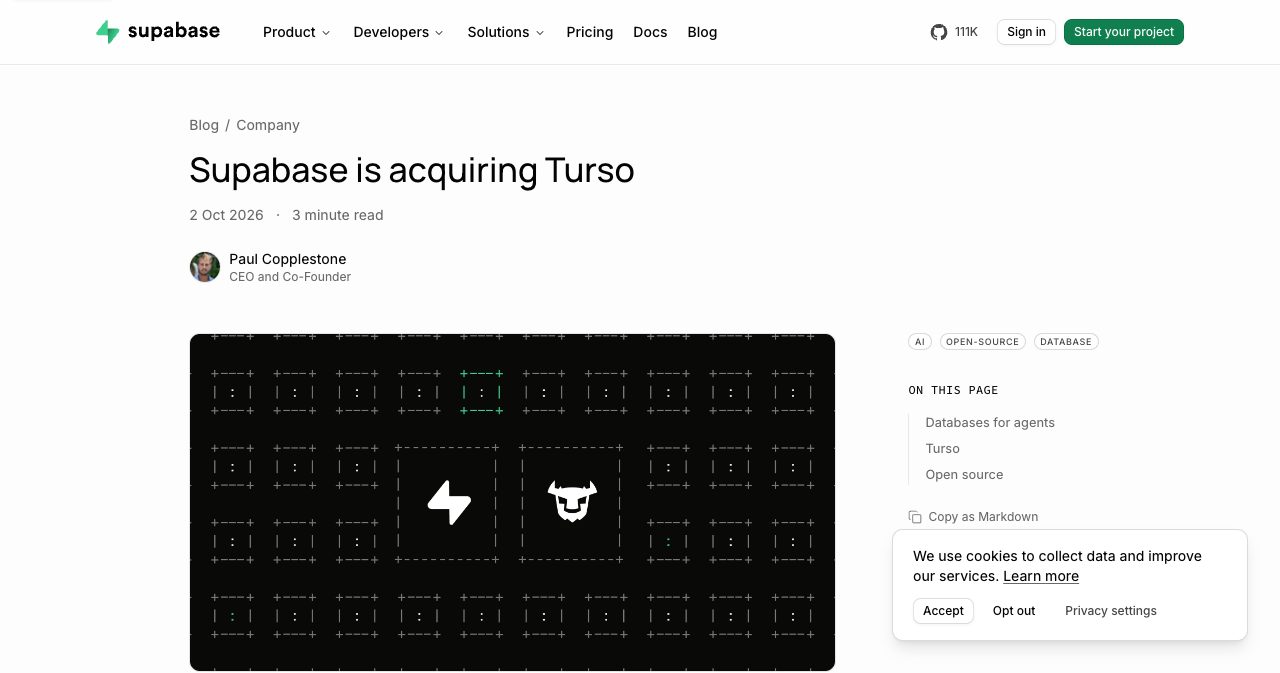
Both companies published posts on 2 October 2026. Supabase's announcement lays out the rationale: agents are creating databases at a pace that existing infrastructure wasn't built for, and small workloads shouldn't need a dedicated machine each. Supabase frames SQLite as the fit for small, on-demand databases and Postgres as the place those projects end up when they go to production.
Turso's post, written by cofounder Glauber Costa and also dated 2 October 2026, is more specific about the product. Turso rewrote SQLite from the ground up as open source, and lifted the single-writer limitation that makes the original engine awkward for server workloads. Its cloud runs on a diskless, WAL-on-S3 architecture, which is how it provisions databases on demand. It also offers bring-your-own-cloud deployments.
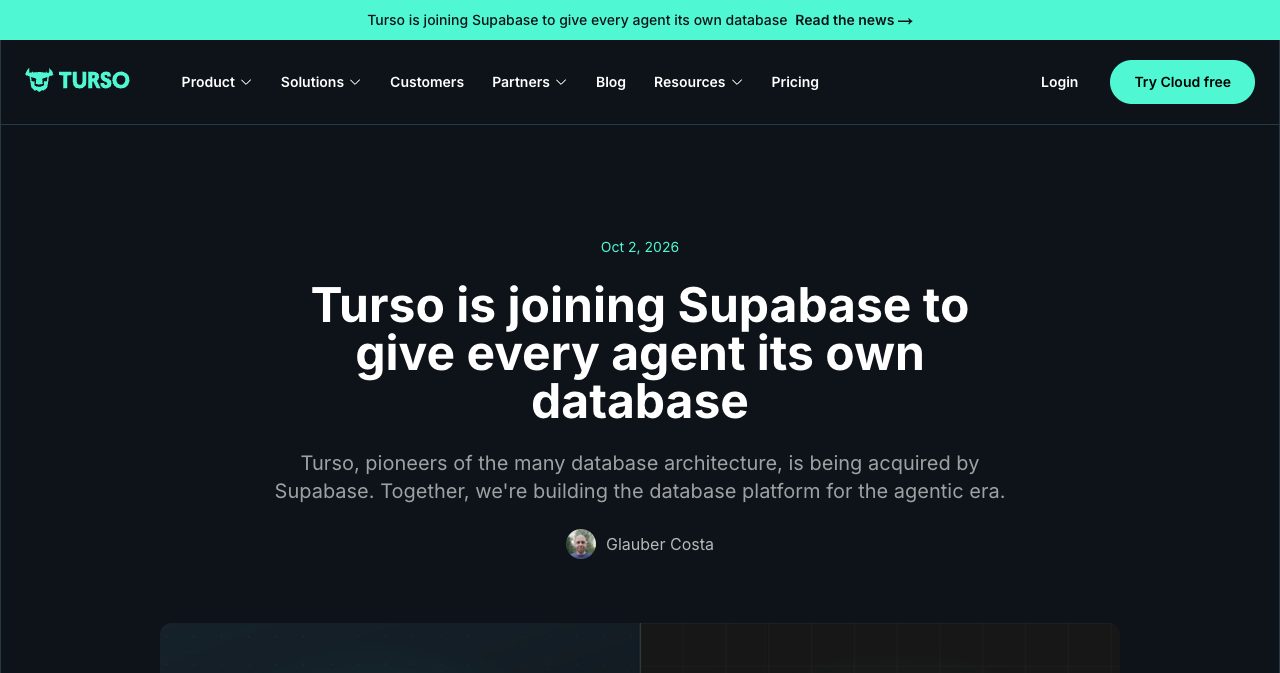
The people moving across are Costa, who joins Supabase to lead its agentic infrastructure work, and Turso's other cofounder, Pekka Enberg. The announcements say Turso's databases, APIs and workflows keep running, and that Turso Database stays open source and actively developed. Neither post gave a price, a valuation or a timeline for folding the two products together. Anyone quoting a figure for this deal is guessing, or reading a source I couldn't verify.
Why one-database-per-agent is a real cost curve
The database used to be the expensive, singular thing in your app. You provisioned one Postgres, put your tables in it, and tuned the instance until it behaved. That model still fits most products.
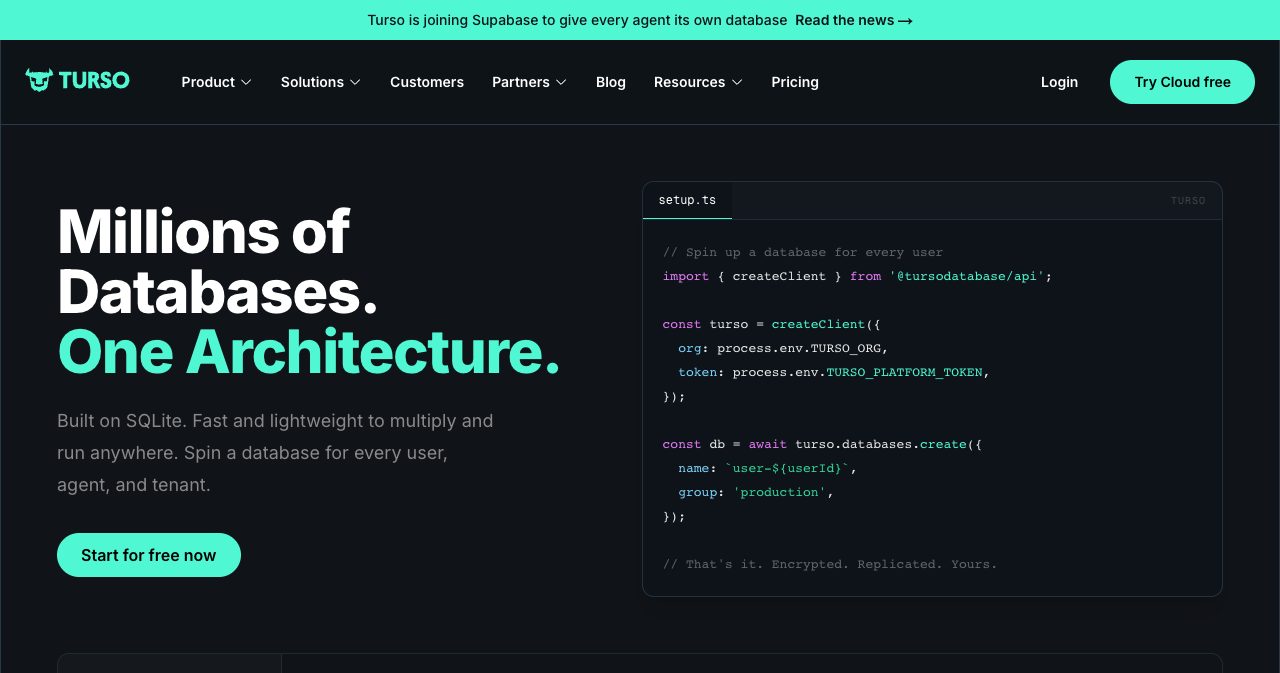
Agents broke the assumption. An AI feature that gives each user a scratch workspace, a memory store or a sandboxed project creates a database per unit of work. Multiply that by thousands of users and the number stops being a rounding error. Supabase's own figure, more than one million databases a week, is what that pattern looks like at platform scale.
The cost question changes shape. With one big database, your bill scales with instance size and connections. With a database per agent, it scales with how many databases exist, most of which sit idle most of the time. Turso's architecture is built around exactly that: keep idle databases cheap, load them when a request arrives, and let a single server carry a very large number of them. Costa's post states the ambition plainly: "I've had a goal to serve upwards of a billion databases to our customers."
That's the thesis under the acquisition. The unit of a database has shrunk from one per app to one per user, one per tenant, one per agent. Your choice of database now carries a cost curve, and that curve depends on how many databases your code is willing to create.
One big database or one per agent: the trade-offs
| Factor | One big database (Postgres, shared schema or RLS) | Database per agent or tenant (often SQLite) |
|---|---|---|
| Isolation unit | Rows and policies inside one cluster | Whole database file per user, agent or tenant |
| Main cost driver | Instance size, connections, storage | Number of databases, most of them idle |
| Blast radius of a bug | One bad policy can expose many tenants | A bug stays inside one file, but there are many files to fix |
| Schema migrations | Run once | Run across every database, so drift becomes a real risk |
| Cross-tenant analytics | Ordinary SQL joins | You build an aggregation pipeline |
| Backups | One backup job | Per-database backups, or a fleet-wide process |
| Operational skill needed | Postgres tuning, RLS discipline | Fleet tooling, provisioning, observability per file |
| Best fit | Most B2B SaaS, shared data, reporting | Per-user workspaces, agent memory, strict tenant isolation |
The table is the honest version of the argument. Per-tenant databases buy you isolation and cheap idle cost. They cost you fleet management. A single Postgres with row-level security is simpler to run and easier to reason about, which is why the Supabase RLS exposure story matters so much: a single shared database is only as safe as its policies, and that's a discipline problem, not a licence to ignore it.
The graduation path is the best promise and the hardest to test
The most useful line in both announcements is the promise of a path from SQLite to Postgres. Turso's post and Supabase's post both describe moving a lightweight agent project into a production application without rewriting it. Supabase has talked about carrying that path all the way to petabyte scale through Multigres, its work on scaling Postgres.
I want to be precise about what's been promised. What's been published is a direction: a shared developer experience from prototyping to production, and one company owning both ends of the route. What I could not find, in either announcement or in the coverage I read, is a published migration tool, a compatibility matrix between Turso's SQLite dialect extensions and Postgres, or a dated delivery schedule. Those details are where graduation paths usually break.
So test the claim yourself. Take a real schema from your SQLite project, load it into Postgres, and run your queries, your constraints and your migrations. Note every place the dialects disagree. That exercise tells you more than any roadmap, and it's worth an afternoon before you commit.
What the skeptics got right
The Hacker News thread on the deal reached 205 points and 112 comments when I read it, and it was not a victory lap. One Turso user wrote that they hoped Turso "survives this, and doesn't become another 'incredible journey'", which is a fair summary of how acquired infrastructure tends to go. Others asked why anyone would rewrite SQLite, which has a long reputation for being one of the most heavily tested pieces of software in existence. Another commenter argued that Turso is still much slower than stock SQLite on ClickBench.
Those objections are not the same thing, and they deserve separate answers. The rewrite question is a technical argument about whether Turso's changes earn their complexity, and the benchmark is something you can rerun on your own workload. The independence question is about incentives. Acquisitions can fund a product or quietly deprioritise it, and neither company has yet shown which way this one goes. Both things can be true at once: the deal can be good for Turso's engineering and still be a reason to hold a plan B.
Hold both readings. Supabase's stated plan is to keep Turso running and developing. The open-source commitment is real on paper. But a promise in a launch post is a weaker guarantee than a license file, a second hosting option and a tested export path.
A boring hedge for a small team
If you already run a Turso database in production, nothing in the announcements says it breaks tomorrow. The risk is slower and more ordinary: pricing changes, support priorities shift, a feature you rely on gets folded into a different product. These are the mitigations I'd apply to any vendor I can't leave in an afternoon.
- Keep the schema in standard SQL. Avoid vendor-only extensions in your core tables. If you need one, isolate it behind a single module so it can be replaced.
- Keep the migrations in your repository. Versioned SQL files that run against any engine beat a dashboard that only exists in one vendor's console.
- Keep a local copy. A SQLite file on a developer machine or CI runner is a working replica you can point the app at without the vendor.
- Test an export every quarter. Pick a real database, export it, load it into a second engine, and run your test suite. If that takes a week, you have a risk, not a backup.
- Separate environments per stage. Development, staging and production should not share a database, so a change on one side can't quietly become a change on the other.
- Write down your exit. One page: where the data goes, which engine it lands on, who runs the migration. You won't need it until you do, and then you'll be glad it exists.
None of this is exciting. That's the point. Acquisitions usually don't break products through a single dramatic event. They break them through a pile of small assumptions nobody tested.
Where SaaSCity fits in this
We run SaaSCity, a gamified startup directory with a live city map and human editorial review. Our own stack is not the subject of this post, and I'm not going to claim it is. The relevant point is for founders who list here: keep your listing copy, screenshots and descriptions in a folder you own, the same way you'd keep your schema portable.
If you're shipping a small product and want it found, the listing side is cheap to start. A free listing gets you a page and a building on the map, and a free submission books a Monday launch slot. Adding the SaaSCity badge to your site earns a dofollow backlink. If you want it live faster, Quick Pass is $19.99 and goes live within 24 hours, and Premium is $39.99 and adds a launch post we write and publish for you. Our Domain Rating sits somewhere between 47 and 56 at the last Ahrefs refresh, so treat it as a useful signal, not a guarantee. Verify the current numbers on the pricing page before you decide.
Where SaaSCity doesn't help: if your database problem is a scaling problem, a directory listing will not fix it. For the infrastructure side of an indie stack, our zero-cost developer toolkit for shipping production apps covers what you can run without a bill, and the agent harness cost comparison looks at what agent workloads actually cost to run. If you're weighing a move off hosted Supabase altogether, our self-hosting alternatives guide is the place to start.
Questions founders are asking about the deal
Did Supabase acquire Turso, and when? Yes, announced 2 October 2026. Neither company disclosed a purchase price.
Is Turso still open source? Turso says Turso Database remains open source and actively developed. Check the license file and release notes yourself before you rely on that.
Should a small SaaS use SQLite or Postgres for multi-tenant data? Start with one Postgres and row-level security unless a specific isolation or compliance requirement says otherwise. Split tenants into their own databases when you can name the reason.
What's the SQLite-to-Postgres path? A stated direction, not yet a published migration tool. Test it with your own schema before you plan around it.
What if I already run Turso? Nothing breaks overnight. Keep schemas in standard SQL, keep migrations in your repo, and rehearse an export.
The bet, and who pays for it
Supabase is betting that the next wave of databases gets created by software, not by people, and that a developer's first database should be the same tool as their production one. Turso is betting that a SQLite rewrite with a serverless cloud can carry that load. Both bets are reasonable. Neither is proven at the scale they describe.
For a founder, the bet that matters is smaller. Ask what your own app does when it creates its hundredth database, then its ten-thousandth. If you can't answer, you haven't priced your architecture yet. Do that before the vendor decides the answer for you.
Get your SaaS in front of founders
List your product on the SaaSCity live city map - a permanent listing, real discovery, and a backlink from a high-DR directory. Free to start; upgrade for a dofollow link and a building on the map.