Glossary
Link farm: how to spot one before you submit
Plenty of the sites on free directory lists are link farms with a submit form. They take your product and give you a link that Google's systems are built to ignore. This page shows how to tell them from real directories and what to do about links you already have.

Founder, SaaSCity
Updated
Checked against the sources listed at the end.
- 193
- Link farms and spam in our study
- 6.5%
- Of the 2,972 domains checked
- 0
- Their median Domain Rating
- 25
- Still labeled dofollow on lists
Contents (8)
What is a link farm?
A link farm is a website, or a group of sites, that exists to hand out links rather than to be read. It accepts almost any site, usually for money or a link back, and its pages have no real audience. Google's spam policies treat links like these as link spam, and its systems work to neutralize them.
Also called: link network, link selling site
What a link farm looks like
A link farm is a site whose product is outbound links. Its pages exist so that other sites can be linked from them, and the owner earns by selling those links or trading them.
The term is SEO slang. Google's spam policies never use it and describe the practice instead: link spam is "the practice of creating links to or from a site primarily for the purpose of manipulating search rankings." A link farm is a site built for exactly that.
Some look like blogs, with a "write for us" page that prices guest posts. Others look like directories, with a submit form, categories and thousands of listings nobody reads. The second kind is the one founders run into, because it turns up on free directory lists.
What a link farm costs you is mostly time. In our 2026 study the median Domain Rating among link farms was 0, so even by the metric they sell on, they had nothing to offer.
Link farm vs PBN vs a real directory
All three put links on pages. What differs is who the pages are for and whether the owner hides the purpose.
A PBN, or private blog network, is a set of sites under one owner, often built on expired domains that still have links, dressed up as independent blogs so that their links to the owner's sites look natural. A link farm does not bother to hide: it lists anyone who pays or swaps. A real directory lists products because people come to it to find products, and the link is a side effect; directory submission covers how to pick one.

What a real listing looks like
SaaSCity, the launch directory we run, reviews every listing by hand. Each product gets a permanent page, a dated launch week and a building on the city map, and new products launch in weekly cohorts. Run it through the signs below before you submit, like any other directory.
What Google's link spam policy says
Google treats what link farms do as link spam and builds its systems to neutralize it. Its spam policies, last updated August 28, 2026, list examples that cover how link farms work:
- Buying or selling links for ranking purposes, including exchanging money, goods or services for links.
- Excessive link exchanges ("Link to me and I'll link to you"), or partner pages made only for cross-linking.
- Using automated programs or services to create links to your site.
- Low-quality directory or bookmark site links.
- Creating low-value content primarily to manipulate linking and ranking signals.
Neutralized or penalized
In December 2022 Google said its AI-based spam system, SpamBrain, can detect both sites buying links and "sites used for the purpose of passing outgoing links", and that credit passed by such unnatural links is lost as they are neutralized. That is the usual outcome. A manual action is the other one: Google issues it when a human reviewer finds a pattern of unnatural, artificial, deceptive or manipulative links pointing to your site, for example after you bought links or joined a link scheme.
Signs a directory is a link farm
Read three listings and the site's own sales pages; a link farm usually gives itself away within a minute. These are the patterns we used to remove 193 link farms and spam sites from 2,972 domains in our 2026 study:
- Every page offers guest posts, sponsored posts or link insertions, often with a price list.
- It accepts anything: casinos, plumbers and essay mills sit next to software.
- Listings have no description a person wrote, only scraped text, keyword lists or nothing at all.
- There are no signs of readers: no votes, comments, reviews or recent activity.
- The Domain Rating is close to zero. The median among the link farms in our study was 0.
- The submit form asks which anchor text you want. A directory that lists products links to them by name.
Labels and DR are not proof
A "dofollow" label on a directory list proves nothing: 25 of the 193 link farms in our study were still labeled dofollow on the lists they came from. A respectable DR does not clear a site either, because bought and inherited links can inflate it. Trust the signs above over either number.
Why link farms end up on directory lists
Because lists are padded to look big and nobody rechecks them. Our raw list had 2,972 domains; 1,306 of them (44%) were dead, broken, link farms or not directories at all. A list's size tells you nothing, and a list with no date is a list nobody checks.
Link farms survive on these lists because they accept every submission, so they look like an easy win, and because a submit form makes them look like a directory. The working list we kept after the review has 1,666 directories as of the October 6, 2026 sweep, with link farms removed.
What to do if you already have links from one
Usually nothing. Google says that in most cases it can assess which links to trust without additional guidance, and that most sites will not need its disavow tool.
Its disavow help page sets two conditions, and both must hold: you have a considerable number of spammy, artificial or low-quality links pointing to your site, and they have caused a manual action or likely will. A few link farm listings left over from a submission spree rarely meet that bar.
- Check for a manual action Open the Manual Actions report in Search Console. If it lists none, Google has not taken manual action against your site, and the links are most likely being ignored.
- Stop adding more Drop the rest of the list you were working through, and stop any service that keeps submitting you to sites like these.
- Ask for removal if it bothers you Most link farms will not answer, and that is fine. Removal matters mainly when you are cleaning up after a manual action.
- Disavow only after a manual action, or when one is likely For an unnatural links manual action, Google's steps are: export your links from Search Console, ask site owners to remove the bad ones or mark them nofollow, disavow what you could not remove (a domain: line covers a whole site) and then request a review. Google warns that blindly disavowing every backlink is not a good-faith effort.
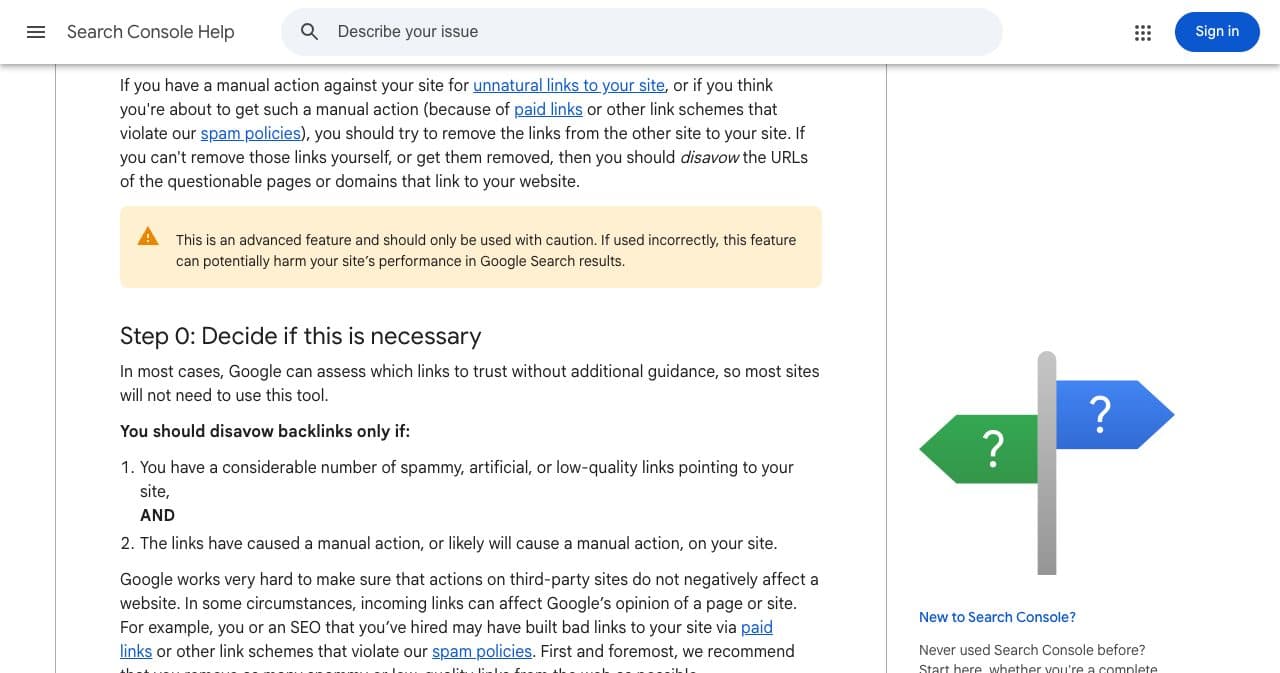
Disavow is a sharp tool
Google calls it an advanced feature that can harm your site's performance in Search if used incorrectly. It also does not work with Domain properties in Search Console, only with URL-prefix properties.
Link farm: FAQ
- What is a link farm in SEO?
- A website, or group of sites, that exists to hand out links, usually for money or a link back, rather than to be read. Google's spam policies treat links made primarily to manipulate rankings as link spam.
- What is the difference between a link farm and a PBN?
- A PBN hides that its sites share an owner and poses as a set of independent blogs. A link farm openly lists anyone who pays or swaps. Both exist to pass links, and both fall under Google's link spam policy.
- Can links from a link farm hurt my site?
- Usually they are ignored: Google says it can assess which links to trust in most cases. A pattern of links you bought or built to manipulate rankings can lead to a manual action, and that is when cleanup and disavow matter.
- Should I disavow links from link farms?
- Only if you have a considerable number of spammy links and they have caused, or likely will cause, a manual action. Those are Google's two conditions, and most sites never meet them.
- How can I tell if a directory is a link farm?
- Read three listings and look at what the site sells. Unrelated businesses side by side, listings with no written description and pages selling guest posts or link insertions are the signs we used to find 193 link farms in our study.
- Are all free directories link farms?
- No. Google names low-quality directories as link spam, not directories as such. Our dataset has 419 free directories with a followed link that passed our review.
How we checked
Definitions follow the primary sources below; numbers come from our directory dataset. Last checked on .
Put your product on the map
Free with our badge, or $19.99 to go live within 24 hours.