News
Meta Bought Conductor. You Have 16 Days to Get Your Workspaces Out (2026)
Meta's engineers were already using Conductor. On November 4, 2026, Meta bought the company, closed sign-ups and gave Conductor Cloud 16 days before its data starts getting deleted. Here are the exact dates, an eight-step way out, the open-source alternatives developers are moving to, and what the deal tells anyone building on top of someone else's model.


Contents (8)
- Did Meta acquire Conductor? Yes, and here's what it actually bought
- Conductor Cloud shutdown dates: what breaks on November 4, 13 and 20
- How to export Conductor data and move cloud workspaces to local
- Best Conductor alternatives in 2026, compared
- Why do AI labs keep buying coding agent harnesses?
- How to choose a coding agent harness that won't disappear
- FAQ
- What would you lose if your tool shut down tomorrow?
Meta's own engineers were already Conductor users. On November 4, Meta bought the company, and now nobody else can even download the app.
Quick answer: Meta acquired Conductor, the Mac app for running Claude Code, Codex and other coding agents in parallel, on Wednesday, November 4, 2026. New sign-ups and downloads stopped that day. Conductor Cloud goes read-only on November 13 and starts deleting data on November 20. The local app keeps working until early 2027. Terms weren't disclosed.
That's 16 days from the announcement to the first deletions, and only nine before Conductor Cloud stops taking new messages. If you ran agents in the cloud, the clock matters more than the deal. If you only ran Conductor on your Mac, you have until early 2027, which is long enough to try two or three replacements on a real repo before you commit.
You're reading this on a directory's blog, so here's the framing up front. SaaSCity is a gamified startup directory with a live city map and a human who reviews every listing before it goes live. We have no inside line to Conductor or Meta. This piece is built from Conductor's announcement, changelog, docs and archived pricing page, the reporting from TechCrunch and SiliconANGLE, each alternative's own site and GitHub repo, and the Hacker News thread, all read on November 4 and 5, 2026.
One naming note before the search results confuse you: this is not Orkes Conductor, the workflow engine built on the Apache-2.0 Conductor OSS project that started at Netflix. The Meta deal doesn't touch it.
Did Meta acquire Conductor? Yes, and here's what it actually bought
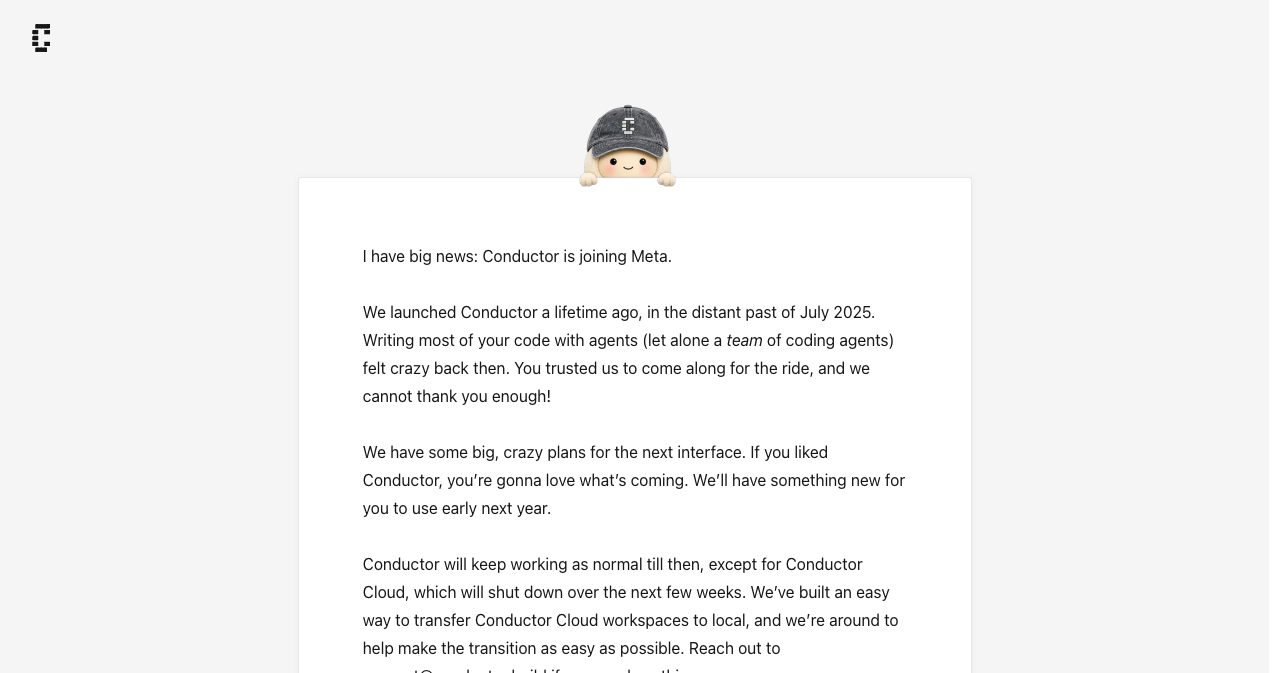
Yes. Meta confirmed the acquisition to TechCrunch on November 4, 2026, but wouldn't comment further, and SiliconANGLE reports that the terms weren't disclosed. Axios broke the story. Conductor's own announcement, signed by CEO Charlie Holtz, opens with "I have big news: Conductor is joining Meta," and the page footer now reads "Conductor from Meta."
If you never used it: Conductor is a Mac app that runs several coding agents at once, each in an isolated copy of your repo. Every workspace is a git worktree on its own branch, with its own terminal and diff, and you review and merge what the agents produce. The agents aren't Conductor's. Its docs say it runs "Claude Code, Codex, Cursor, and OpenCode in parallel," which means Anthropic's Claude Code, OpenAI's Codex and the rest, on your own subscriptions or API keys. That makes Conductor what developers call a coding agent harness: the app that starts, isolates and supervises AI coding agents someone else trained, and gives you one place to review and merge their work. Conductor Cloud put the same agents on hosted machines so they kept working with your laptop shut. Per the Cloud docs, each cloud workspace was an isolated microVM with 8 vCPUs, 16 GB of RAM, 32 GB of ephemeral NVMe storage and Amazon Linux 2023.
The product started as a Show HN post in July 2025, "Conductor, a Mac app that lets you run a bunch of Claude Codes at once," which reached 228 points. The company behind it, formally Melty Inc., was founded in 2024 by Holtz and CTO Jackson de Campos, per SiliconANGLE.
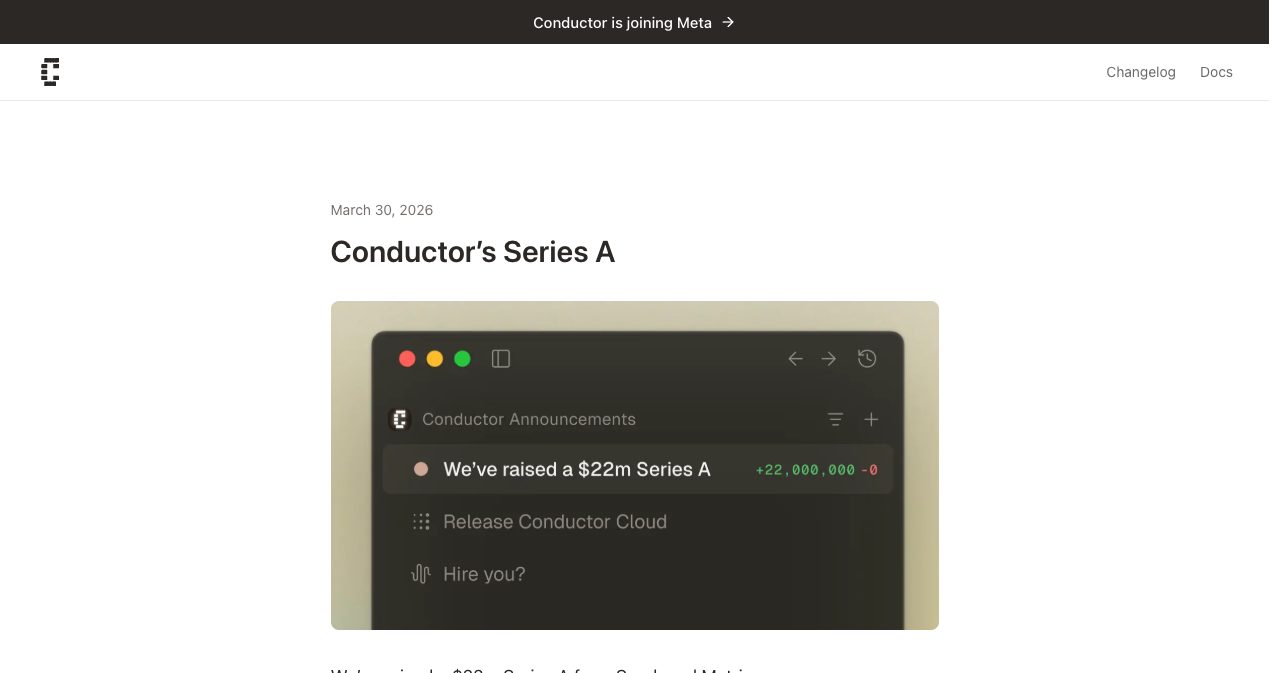
Growth came fast. On March 30, 2026, Conductor announced a $22 million Series A from Spark and Matrix: Ilya Sukhar at Matrix, who had led the seed round and joined the board, Nabeel Hyatt at Spark, Y Combinator, and founders of Notion and Linear. The post claimed 10x user growth since January and said Google, Meta, HubSpot, Chime, Intercom, Ramp, Datadog, Block, Flexport, Rippling, Amazon, Spotify "and more all have dozens of engineers using Conductor." SiliconANGLE says the website now claims more than 100,000 users.
Meta is on that list. Seven months before it bought the company, the buyer had already watched its own engineers use the product.
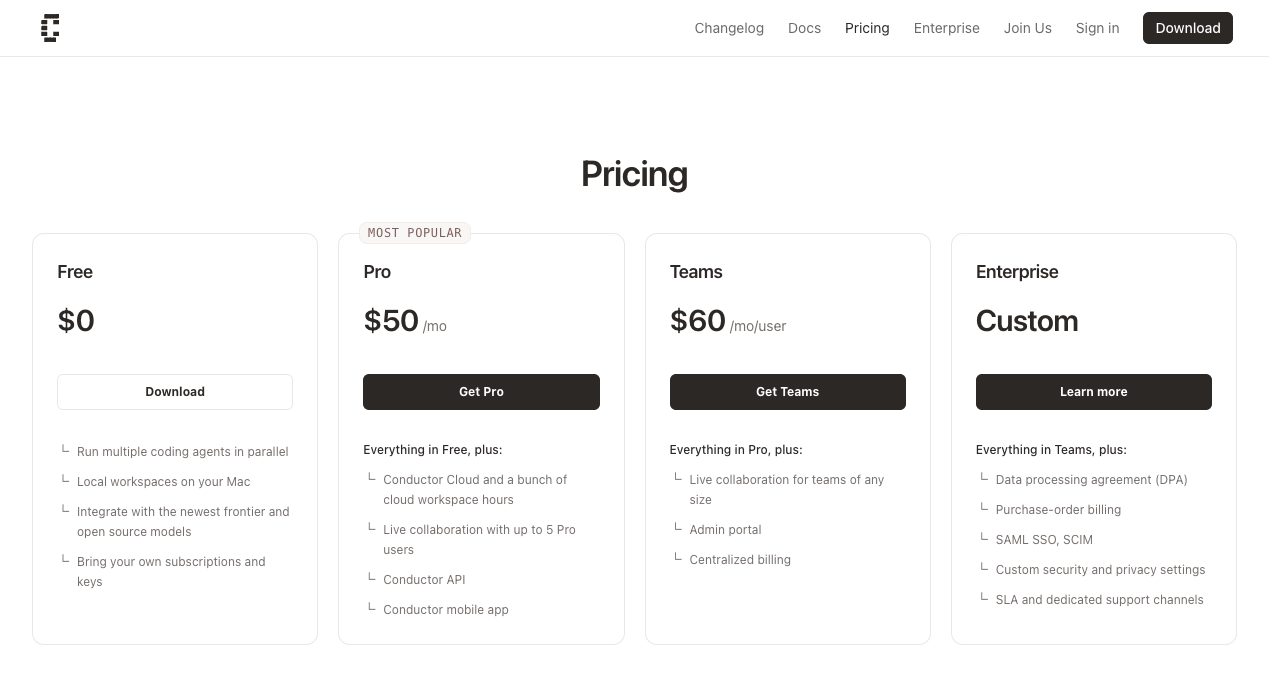
The business model was simple. The archived pricing page shows four tiers: Free at $0 (local workspaces, "bring your own subscriptions and keys"), Pro at $50 a month (Conductor Cloud with "a bunch of cloud workspace hours," live collaboration for up to five Pro users, the Conductor API and the mobile app), Teams at $60 per user per month (admin portal, centralized billing) and a custom Enterprise tier with a DPA, purchase-order billing, SAML SSO and SCIM.
So what did Meta pay for?
Revenue is the easy thing to rule out. Conductor is refunding active subscribers and switching off its paid cloud product within 16 days, which isn't how you treat an income stream you just bought. Three things are left.
The first is a team that ships quickly. SiliconANGLE, citing people familiar with the deal who spoke to Axios, says Meta expects the team's speed at shipping products to help it build its next generation of AI coding tools. The second is an interface people already liked for supervising many agents at once; Holtz's letter promises "big, crazy plans for the next interface" and "something new for you to use early next year."
The third is fit. On August 5, 2026, Meta launched Muse Code, which TechCrunch described as "a new terminal coding agent aimed at programmers looking for assistance with complex tasks across large software code bases." Mark Zuckerberg's own pitch for it: "When a job is big enough, it fans out to separate sub-agents working in parallel in isolated worktrees." That's Conductor's core idea running inside Meta's own agent, so the deal gives Meta a polished interface for something its agent already does, plus the people who built it.
Where the team lands is less clear. TechCrunch reports that Holtz named Alexandr Wang, Meta's chief AI officer, and Nat Friedman, head of product at Meta Superintelligence Labs, and wrote on X: "I'm convinced MSL has the highest talent density of all the labs." It fits the rest of Meta's year in agents: it bought Moltbook, the AI-agent social network, in March, launched Muse Code in August, then released the closed Muse Wonder models on October 12 and Muse Spark Open, an open-weights model aimed at coding and long-running agent work, on October 15, per SiliconANGLE. TechCrunch adds that Meta's Muse has passed 10 million users.
Conductor Cloud shutdown dates: what breaks on November 4, 13 and 20
Conductor Cloud stops accepting new messages on Friday, November 13, 2026, and Conductor starts deleting cloud user data on Friday, November 20, 2026. The local Mac app keeps running until early 2027. The table pairs each date on the announcement page with what it means in practice.
| Date | What Conductor says happens | What it means for you |
|---|---|---|
| Wednesday, November 4, 2026 | New users can't sign up or download the app. Free users can't upgrade. Pro users keep Pro features for free | You can't bring a new teammate onto Conductor |
| Friday, November 13, 2026 | Conductor Cloud goes read-only: old chats readable, data exportable, no new messages. Active subscribers get refunds | A cloud agent halfway through a task can't be told to finish it |
| Friday, November 20, 2026 | Conductor Cloud shuts down and deletion of cloud user data begins | Anything not transferred, exported or pushed is gone |
| Early 2027 (no exact date) | Local Conductor stops getting new models and critical bug fixes, winds down, and all user data is deleted | The Mac app stops being maintained, so plan to be elsewhere by then |
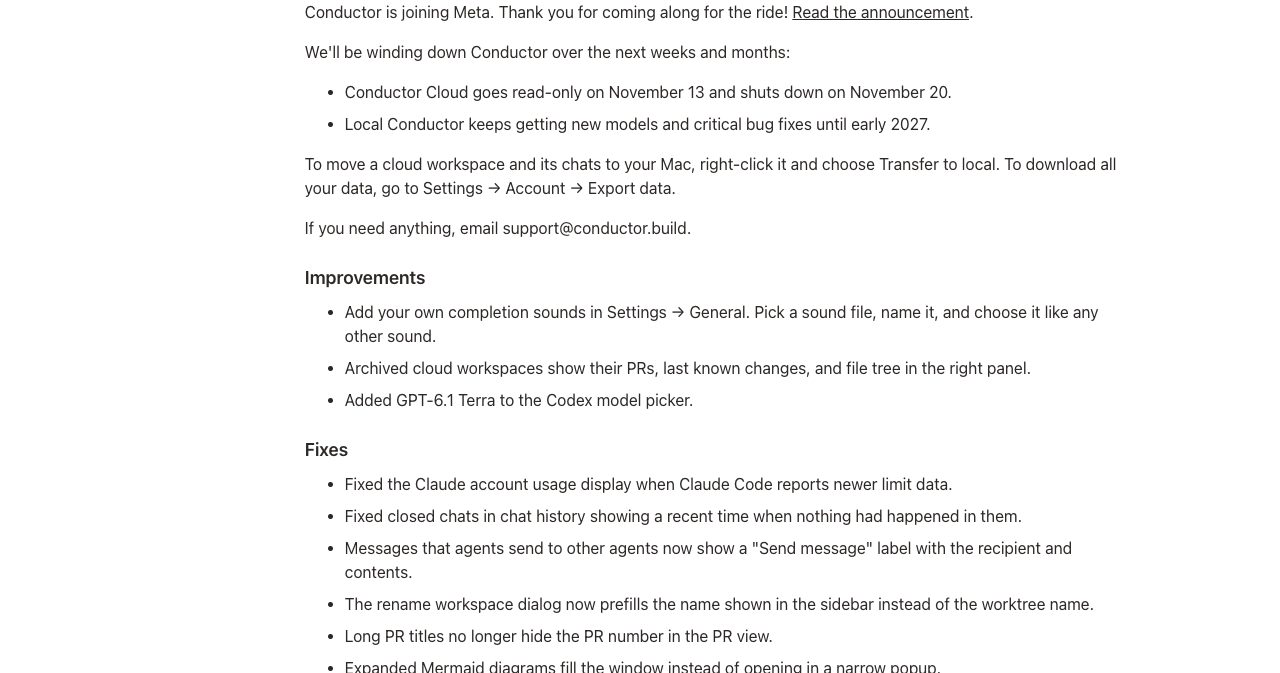
The same day, Conductor shipped version 0.93.0, titled "Conductor is joining Meta." The notes announce the wind-down, then list the release's improvements, starting with "Add your own completion sounds in Settings → General." GPT-6.1 Terra also lands in the Codex model picker. The whiplash is real, though I'd rather see a team ship fixes on its way out than go silent. One item helps with the move itself: archived cloud workspaces now show their PRs, last known changes and file tree in the right panel.
For unfinished work, November 13 is the date to plan around. After it you can still read and export, but you can't prompt an agent. The local app also has a deadline, just a vaguer one: the FAQ says Conductor will "delete all Conductor user data when the app shuts down in early 2027," and gives no exact date.
Sixteen days is short. When The Browser Company shut down Arc, members got 61 days between the announcement and the kill date, as we covered in our Arc shutdown breakdown. On Hacker News, one commenter answered Conductor's "next weeks and months" wording with "Months? More like weeks."
How to export Conductor data and move cloud workspaces to local
Right-click each cloud workspace and choose Transfer to local, then go to Settings → Account → Export data for a full archive. Do both before November 13 if an agent still has work to finish, and before November 20 at the very latest.
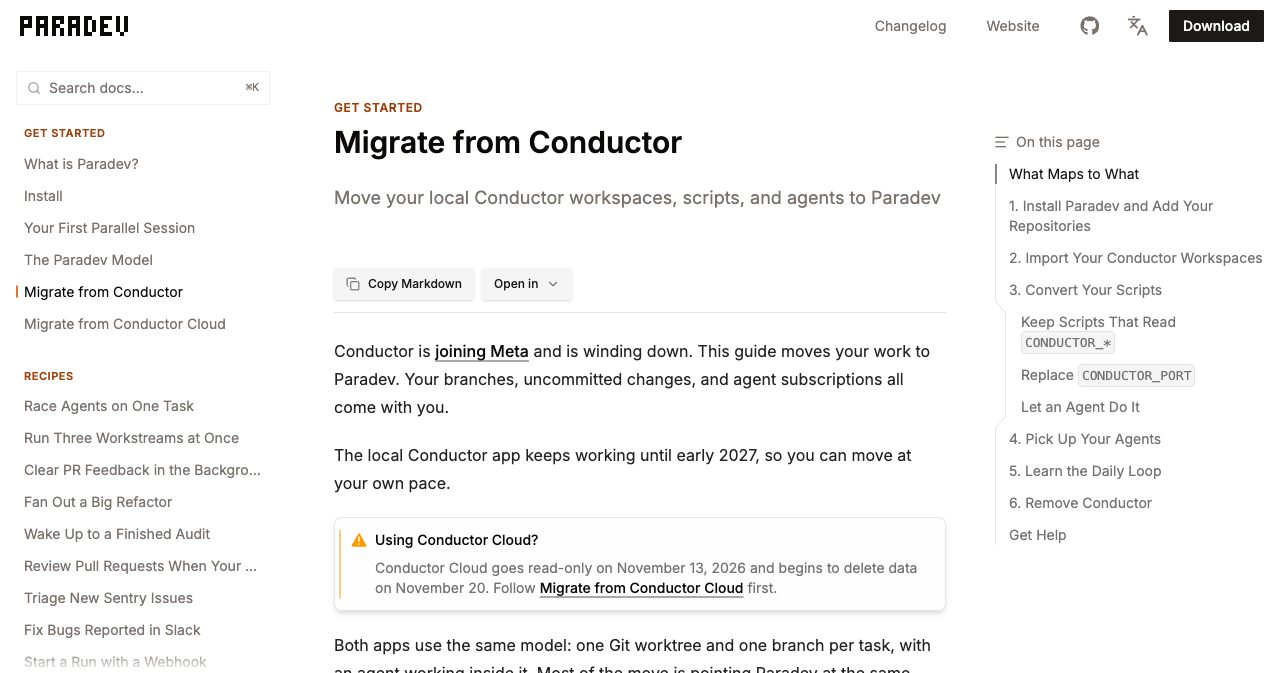
Conductor documents those two moves and nothing else. The order below is mine, put together from Conductor's FAQ and the migration guides Paradev and Orca published after the announcement. I moved git near the front, because pushing takes a minute and protects the code even if every other step goes wrong.
- Let running cloud agents finish before November 13. Conductor Cloud goes read-only on Friday, November 13, 2026. After that you can read chats and export data but can't send new messages, so any cloud agent that still needs a prompt to finish its task has to get it before then.
- Commit and push every branch. In each cloud workspace, commit everything, including untracked files (git add -A), and push the branch to GitHub. A pushed branch is the one copy of your code that no tool's shutdown can delete.
- Transfer each cloud workspace to local. In the Conductor app, right-click a cloud workspace and choose Transfer to local. Conductor says this moves the workspace and its chats to your Mac.
- Export the full archive. Go to Settings → Account → Export data and save the archive somewhere backed up. Orca and Paradev both say they can't import Conductor chats, so this file is your record of them.
- Save your scripts and settings. Copy the setup and run scripts from your conductor.json, plus any environment variables and secrets your workspaces relied on, into your repo or password manager. Paradev's guide converts conductor.json to .paradev/config.json; Orca's moves scripts to orca.yaml.
- Open your existing worktrees in the next tool. Conductor workspaces are ordinary git worktrees, so a local tool can open them in place. In Orca, add the same checkout as a project and show hidden worktrees; in Paradev, right-click the project and choose Import untracked worktrees.
- Move laptop-closed work to a machine you control. Conductor Cloud's job was keeping agents running while your Mac slept. Replace it with an always-on machine over SSH, a self-hosted daemon such as Paseo's, or a hosted option such as Paradev's cloud workspaces or boxes.dev.
- Check your refund and plan for early 2027. Active subscribers get a refund, per Conductor's announcement; email [email protected] if yours doesn't arrive. Local Conductor keeps working until early 2027, when Conductor deletes all user data, so finish the move well before then.
Paradev's local guide adds two cautions worth copying whichever tool you pick: leave Run setup script off when importing, and afterwards quit Conductor without archiving the imported workspaces there, since both apps now point at the same folders on disk. If you get stuck, Holtz's letter says the team is "around to help make the transition as easy as possible."
Best Conductor alternatives in 2026, compared
The closest like-for-like replacements are Orca, Paseo, T3 Code and Paradev, which are all open source and all use the same one-worktree-per-agent model. If Conductor Cloud was the part you actually paid for, boxes.dev is the cloud-only option.
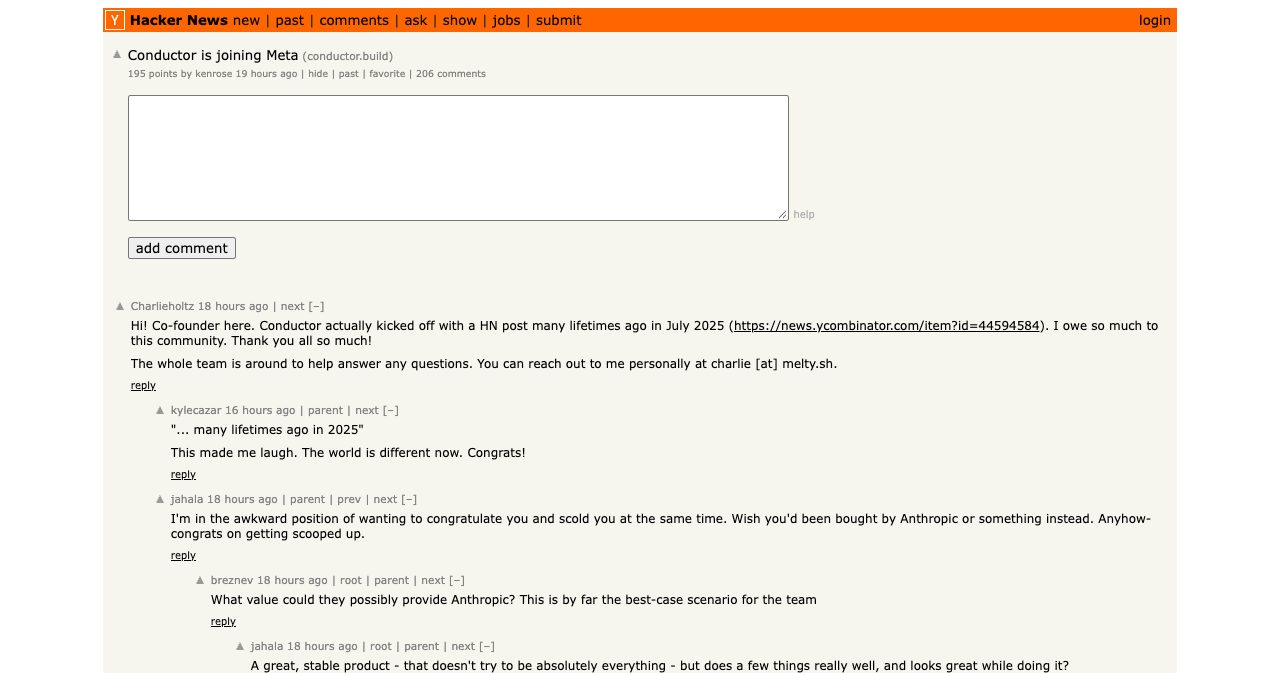
The Hacker News thread on the deal turned into a migration marketplace within hours. By the morning of November 5 it had 195 points and 206 comments, and well over a dozen tools had been pitched in it, several by their own founders. The boxes.dev founder introduced it as "yet another T3/Conductor competitor," which is about as honest as a product pitch gets. One commenter, iamunr, described their week like this: "Literally just went to go 'all in' on conductor yesterday… And today we're doing a refund + moving the org to t3.codes instead."
Every cell in this table was checked against the vendor's own site or GitHub repo on November 5, 2026, and star counts are rounded.
| Tool | What it is | Local or cloud | Licence | Price | Conductor migration path | Best for |
|---|---|---|---|---|---|---|
| Conductor (reference) | Mac app for parallel agents in git worktrees | Local Mac app; hosted Cloud until November 20 | Proprietary | Was Free, $50 Pro, $60/user Teams | n/a | Nobody new: sign-ups closed November 4 |
| Orca | Desktop "agent IDE" with terminals, diffs and a browser | Local on macOS, Windows, Linux; remote via SSH, self-hosted Orca Server or your own cloud VMs | MIT, ~116,000 stars | Free | Guide; opens Conductor worktrees in place, no chat import | Local Conductor users who want the closest swap |
| Paseo | Open-source agentic development environment | Daemon on your laptop, a VM, Docker or a fleet; optional encrypted relay | Apache-2.0, ~23,000 stars | Free | Comparison page; no import tool found | Self-hosters who drive agents from a phone |
| T3 Code | "The open-source control plane for coding agents" | Local server with desktop, web and mobile clients; self-host | MIT, ~47,500 stars | Free | None found | Remote-machine workflows, if you can live with early bugs |
| Paradev | Open-source workspace for Claude Code, Codex and other agents (formerly Superset) | Local-first macOS app; cloud workspaces in beta on Team plan | MIT, ~16,000 stars | Free; $20 Pro; $60 Team; $200 Ultra per user/month | Two guides: local import and Conductor Cloud | Cloud users who still want a hosted option |
| boxes.dev | "Cloud computers for Claude Code and Codex" | Cloud only, a Linux devbox per agent | Not verified | $0 trial; $19 to $249 per user/month | None found | People who mainly used Conductor Cloud |
Orca
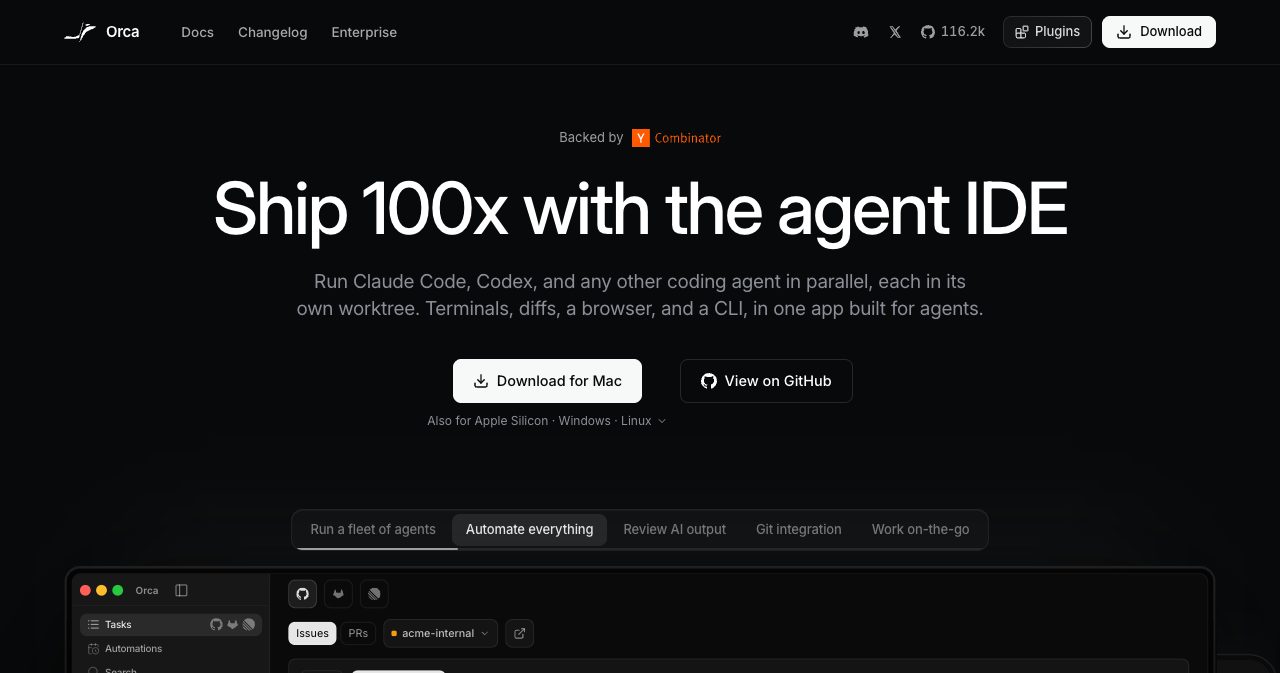
Orca says it runs "Claude Code, Codex, and any other coding agent in parallel, each in its own worktree," on macOS, Windows and Linux, with an iOS and Android companion app. Its GitHub repo is MIT-licensed with about 116,000 stars. The migration guide is the most direct of the bunch: "Conductor workspaces are ordinary git worktrees, so Orca opens them in place. Nothing is copied or moved." The catch for Cloud users is stated just as plainly: "Orca doesn't host machines." Remote work runs over SSH, on a self-hosted Orca Server, or on cloud VMs from a provider you already use, such as Fly, Modal or Vercel Sandbox. One of Orca's developers pitched it in the HN thread, and a user there said they'd already switched because Conductor lacked mobile support for local instances.
Paseo
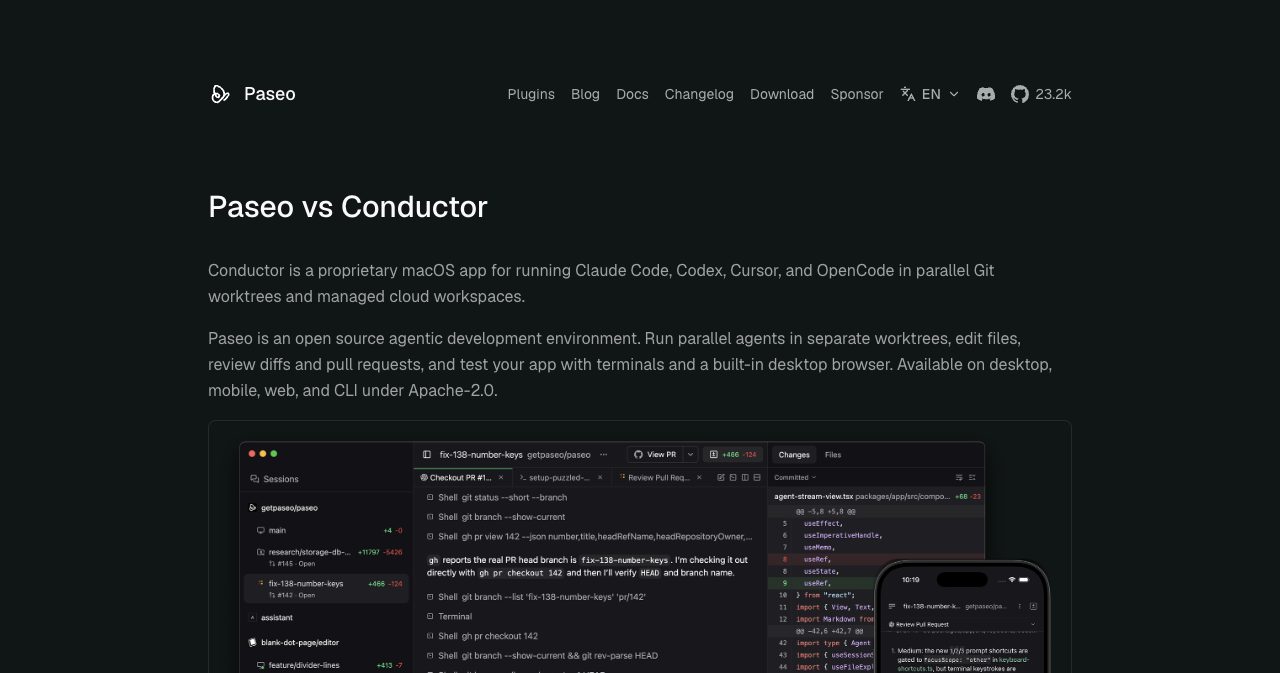
Paseo is Apache-2.0, has about 23,000 stars on GitHub, and is built around a daemon you run "on your laptop, on a VM, in Docker, or across a fleet," then reach from desktop, web, mobile or the CLI. Remote traffic can go through an optional hosted relay that's end-to-end encrypted. It runs Claude Code, Codex, OpenCode, Pi, Antigravity and, a little awkwardly given the news, Meta's own Muse Code natively. Two HN commenters recommended it for driving agents from a phone. There's no import tool. There is a Paseo vs Conductor page, and that page comes up again in the founder section below.
T3 Code
T3 Code is MIT-licensed, has about 47,500 stars on GitHub, runs as a local server with desktop, web and mobile clients, and supports Claude Code, Codex, Cursor, Grok Build, OpenCode, Google Antigravity and fx. An HN user wrote that "T3 code especially for remote machine workflows is unmatched." Its README is refreshingly blunt: "We are very very early in this project. Expect bugs." Budget time for that before you move a whole team onto it.
Paradev
Paradev renamed itself from Superset and has the most complete Conductor paperwork of anyone: a local guide whose Import untracked worktrees option keeps "paths, branches, and uncommitted changes," plus a separate Conductor Cloud guide. It's MIT-licensed with about 16,000 stars, and it's the one open-source option here with its own hosted cloud workspaces, in beta on the Team plan. Pricing runs from Free through Pro at $20, Team at $60 and Ultra at $200 per user per month. The desktop app is macOS-first; Linux is an experimental AppImage and Windows isn't available yet.
boxes.dev and the rest
boxes.dev keeps nothing on your laptop: each agent gets a cloud Linux devbox, and plans run from a 20-hour free trial to $249 per user per month, with extra hours at $0.40. We couldn't find a public repo or licence. herdr (Apache 2.0, macOS, Linux and Windows) keeps agents running in a background core after the window closes, and Podium (Apache-2.0) is built around a coordinator agent that plans tasks before anything lands. Hive's founder offered Conductor users a free three-month subscription in the thread; we couldn't load hive.codes to verify the product, so treat that as a claim.
Or skip the third-party harness
If you only ever ran Claude Code, the lab's own tooling may already cover you. One HN commenter argued that "Conductor is really no different from Claude Code Desktop now, aside from multiple harness and models." Our guide to Claude Code subagents, background agents and agent teams shows how far you get natively. If you'd rather own the interface outright, look at how Spotify did it with Xirp, its vendor-neutral agent environment, where every session gets its own worktree and any agent can plug in. Spotify was on Conductor's Series A customer list too. For an open-source agent that you can run entirely on your own machine, see our write-up of OpenCode 2.0's shared local server.
Why do AI labs keep buying coding agent harnesses?
Because each lab now sells a full coding product, and the harness is the screen where developers decide which agent does the work. Owning that screen is easier than competing with it. Here is what changed hands, or got built in-house, in 2026.
| Date | Company | Move | Layer of the stack |
|---|---|---|---|
| June 11, 2026 | OpenAI | Plans to acquire Ona (Gitpod GmbH) | Cloud sandboxes where agents keep running after you close your laptop |
| November 2, 2026 | OpenAI | Publishes Pando, its internal Git engine | Where the code lives |
| November 4, 2026 | OpenAI | Agrees to acquire Pierre Computer Company | Code storage for agents, plus the Trees and Diffs libraries inside Codex |
| November 4, 2026 | Meta | Acquires Conductor | The workspace where you run and review many agents |
Per SiliconANGLE's June 11 report, Ona's sandboxes "remain online when the developers who use them shut down their workstations," which is the same job Conductor Cloud did for its Pro users. On November 4, the day of the Conductor news, OpenAI said it will acquire Pierre. SiliconANGLE reports that Pierre's Trees and Diffs libraries already "underpin the interface of OpenAI's Codex programming tool," that its code storage service cut Lovable's code retrieval latency by about 70%, that terms weren't disclosed, and that Trees and Diffs stay open source. Axios framed that deal as OpenAI taking aim at Microsoft's GitHub. Two days earlier, OpenAI had described Pando in "Scaling Git at OpenAI".
Add it up and OpenAI is assembling the sandboxes agents run in (Ona), the Git engine its own code lives in (Pando) and the storage and review layer inside Codex (Pierre). Meta's purchase covers the screen where a developer watches the agents work.
Is it safe to build your workflow on an AI coding harness?
It's safe as long as the harness holds nothing you can't carry out. Conductor shows both halves. Locally, lock-in was close to zero: workspaces were plain git worktrees, which is why Orca can open them without copying a file. In the cloud, your chats and running state sat on servers with a deletion date you didn't choose.
A harness also sits in an awkward spot commercially. It runs agents someone else trained, on plans someone else prices, under rate limits someone else sets. Conductor's last changelog includes a fix for "the Claude account usage display when Claude Code reports newer limit data." That's typical of the work: when a lab changes a plan, a limit or a CLI, the harness spends a release catching up. Meanwhile the labs keep building the harness into the agent. Muse Code already fans out sub-agents into worktrees.
HN commenters put it more bluntly. One called the deal "an acquihire of a closed source offering" and added that "we do need the code so that we can continue using it in case of these M&A's." Another noted that "its usually AI labs that are following through with some of the biggest buys lately." A third asked something none of the tools in the table above can answer yet: "I wonder what would be the way to protect OSS like this from this kind of end?"
Before you move into whatever Meta ships next, compare data terms. Conductor's FAQ says, "We have never sold or trained on Conductor user data, and we still won't." Meta's Muse Code has a Contributor tier that, per VentureBeat on August 5, 2026, prices tokens at $0.10 per million input and $0.20 per million output in exchange for "explicit permission to use your prompts and completions to train future Meta models." Nobody knows what terms the new product will carry. Read them before you point it at a private repo.
How to choose a coding agent harness that won't disappear
Score the next tool on portability before features: a self-serve export, work stored in git and plain files, your own API keys, a self-host option and an open-source licence. The table scores Conductor on each.
| Check | What to look for | How Conductor did |
|---|---|---|
| Export path | A documented, self-serve export of everything, not "email support" | Yes: Transfer to local and Settings → Account → Export data, though no other tool imports the chats |
| Open format | Work stored where other tools can read it: git branches, worktrees, plain config files | Code yes, as plain git worktrees; chats only as an export archive |
| Bring your own keys | Agents run on your own subscriptions or API keys | Yes, from the Free tier up |
| Self-host option | You can run the backend on a machine you control | No. Paseo's comparison page says Conductor couldn't connect to a cloud machine you operate |
| Licence | MIT or Apache-2.0, so the code can outlive the company | Proprietary |
Conductor scored well where most users lived, on local work with their own keys, and badly where the money was. The paid cloud tier held the most state, and it's the first part being switched off. Keep that in mind when a new tool's best features all sit behind its hosted plan.
An open licence has limits too. You can fork the code, and then the fork is yours to maintain. T3 Code's README says the project is "(mostly) not accepting contributions yet," and even a 116,000-star repo like Orca's depends on the company behind it to keep shipping. The licence gives you the right to keep running the code after the company changes course, a right Conductor Cloud users don't have this week.
What dev-tool founders should take from this
If your product coordinates someone else's model, you inherit that company's pricing power, rate limits and strategic mood. Conductor's Free tier ran on the user's own subscriptions, which made adoption painless and left the expensive part of the product with the labs. It's a fine way to grow. It's hard to defend, because a lab can fold the coordination layer into its own agent whenever it decides that layer matters, as Muse Code's worktree sub-agents show. The parts a lab is slow to copy are the ones users can verify: an export that works, a cloud that runs on their own machines, and a name they find when they go looking.
The last of those moved fastest this week. Within a day of the announcement, Paradev and Orca had Conductor migration guides live, and Paseo's comparison page carries the title "Open Source Conductor Alternative With Linux, Windows, and Mobile." When a tool dies, the alternatives that win are the ones with a migration guide, an import path and a page that ranks for "<tool> alternative." The time to write yours is before a competitor posts its shutdown notice.
It's the same play SaaSCity readers run on the directory side: own the pages people land on when they're shopping for a replacement. If you build in this category, a free listing on SaaSCity gets you a listing page and a building on the city map. Add the SaaSCity badge to your site and you get a dofollow backlink from a domain rated DR 71 at our latest Ahrefs refresh (November 5, 2026), plus a Monday launch slot. Quick Pass ($19.99) goes live within 24 hours, Premium ($39.99) adds a written launch post with three links, and Max ($99.99) adds 30 days of billboard, ticker and homepage pin. For launch channels beyond ours, our Product Hunt alternatives comparison covers 25 of them.
FAQ
Did Meta acquire Conductor?
Yes. Conductor announced on Wednesday, November 4, 2026 that it is joining Meta, and Meta confirmed the acquisition to TechCrunch the same day without commenting further. Axios reported the deal first. Financial terms were not disclosed, per SiliconANGLE. Conductor, formally Melty Inc., was founded in 2024 by CEO Charlie Holtz and CTO Jackson de Campos and raised a $22 million Series A in March 2026 from Spark Capital and Matrix. The team says it will ship something new early in 2027.
When does Conductor Cloud shut down?
Conductor Cloud goes read-only on Friday, November 13, 2026: you can still read old chats and export data, but you can't send new messages. On Friday, November 20, 2026 it shuts down and Conductor begins deleting cloud user data. That is 16 days after the November 4 announcement. Conductor's announcement page and its 0.93.0 changelog both give these dates, and active subscribers get a refund.
Is Conductor still available after the Meta acquisition?
Only to existing users, and only for now. Local Conductor keeps working and keeps getting new models and critical bug fixes until early 2027, according to Conductor's announcement of November 4, 2026. After that the app winds down and Conductor says it will delete all user data. New users can no longer sign up or download the app, free users can't upgrade, and existing Pro subscribers keep Pro features for free until the wind-down.
How do I export my Conductor data?
In the Conductor app, go to Settings → Account → Export data to download an archive of all your Conductor data. Do it before November 20, 2026, when Conductor starts deleting cloud data. Push your git branches separately, because code on GitHub is the copy that survives any tool. Orca and Paradev, two alternatives that published Conductor migration guides after the announcement, both say they cannot import Conductor's chats, so keep the archive as your record.
How do I transfer a Conductor Cloud workspace to local?
Right-click the cloud workspace in the Conductor app and choose Transfer to local. Conductor says this moves the workspace and its chats to your Mac. Do it before Friday, November 13, 2026 if an agent in that workspace still needs new prompts, because Cloud goes read-only that day, and before November 20 at the latest. Paradev's Conductor Cloud guide also recommends committing everything with git add -A and pushing each branch first.
Will I get a refund for Conductor Pro or Teams?
Active subscribers will get a refund, according to the FAQ on Conductor's announcement page published November 4, 2026. Pro cost $50 a month and Teams $60 per user per month on Conductor's archived pricing page. Until the wind-down, existing Pro users keep Pro features for free. If a refund doesn't arrive, Conductor's listed support address is [email protected], and Charlie Holtz's letter says the team is around to help with the transition.
How much did Meta pay for Conductor?
Nobody has said. Meta confirmed the acquisition to TechCrunch on November 4, 2026 but declined to give details, and SiliconANGLE reported that terms were not disclosed. The only public reference points are Conductor's own: a $22 million Series A announced on March 30, 2026 from Spark and Matrix, with Y Combinator and founders of Notion and Linear also investing, and a claim of more than 100,000 users on its website, as reported by SiliconANGLE.
What are the best Conductor alternatives in 2026?
For local, worktree-per-agent work like Conductor's: Orca (MIT, macOS, Windows and Linux, opens Conductor worktrees in place), Paseo (Apache-2.0, self-host the daemon on any machine), T3 Code (MIT, a local server with desktop, web and mobile clients) and Paradev (MIT, macOS, with Conductor and Conductor Cloud migration guides). For a hosted stand-in for Conductor Cloud, boxes.dev runs each agent in a cloud Linux devbox from $19 per user per month. All were checked on vendor sites on November 5, 2026.
Which Conductor alternatives can import my workspaces?
Orca and Paradev both published Conductor migration guides after the November 4, 2026 announcement. Orca opens Conductor workspaces in place because they are ordinary git worktrees, so nothing is copied or moved. Paradev's Import untracked worktrees option keeps paths, branches and uncommitted changes, and it has a separate guide for Conductor Cloud. Neither can import Conductor's chat history. Paseo publishes a Paseo vs Conductor comparison page, but we found no import tool.
Why do AI labs keep buying coding agent harnesses?
Because the labs now sell complete coding products and want the interface developers work in. On November 4, 2026, Meta bought Conductor and OpenAI agreed to buy Pierre Computer Company, whose Trees and Diffs libraries already underpin parts of the Codex interface, per SiliconANGLE. OpenAI had announced plans to buy Ona, a cloud sandbox company, on June 11, 2026. A harness that runs other companies' agents depends on their pricing and rate limits, which makes it easier to absorb than to compete with.
How do I choose a coding agent harness that won't disappear?
Check five things before features. Export: is there a self-serve export of everything? Format: does your work live in git branches and plain config files other tools can read? Keys: do agents run on your own subscriptions or API keys? Self-hosting: can you run the backend on a machine you control? Licence: is it MIT or Apache-2.0, so the code can outlive the company? Conductor passed on export, keys and git, and failed on self-hosting and licence.
Is Conductor the same as Orkes Conductor?
No. The Conductor that Meta acquired on November 4, 2026 is the Mac app from Melty Inc. for running coding agents such as Claude Code and Codex in parallel. Orkes Conductor is the workflow engine from Orkes, which maintains Conductor OSS, an Apache-2.0 durable execution platform that originated at Netflix. The two share a name and nothing else, and the Meta deal does not affect Conductor OSS or Orkes.
What would you lose if your tool shut down tomorrow?
Whatever isn't in git. For Conductor Cloud users this week, that means chats, cloud runs and setup scripts, and for local users it means the same list with a few more months of slack.
Conductor's best idea was that the agents never belonged to it. You brought Claude Code or Codex, it gave each one its own room, and you got a clean way to review the work. People loved it for that, and it made the company easy to buy, because a lot of what Meta acquired is a habit: open one window, fan out five agents, merge what's good. Every lab wants to own the window where that habit happens, and they all have the money to try.
So before you install the next one, run a small test. Imagine it posts a 16-day shutdown notice tomorrow morning. If your honest answer is "nothing, it's all in git," choose on features and enjoy it. If anything else is on the list, that's the part of your workflow that belongs to someone else. Move that part first.
Get your SaaS in front of founders
List your product on SaaSCity - a permanent listing, real discovery, and a dofollow backlink from a high-DR directory. Free with a badge; upgrade for a building on the live city map.