Reviews
Is My App Slop Review 2026: The $27 Audit That Shows You What Customers See Before They Do
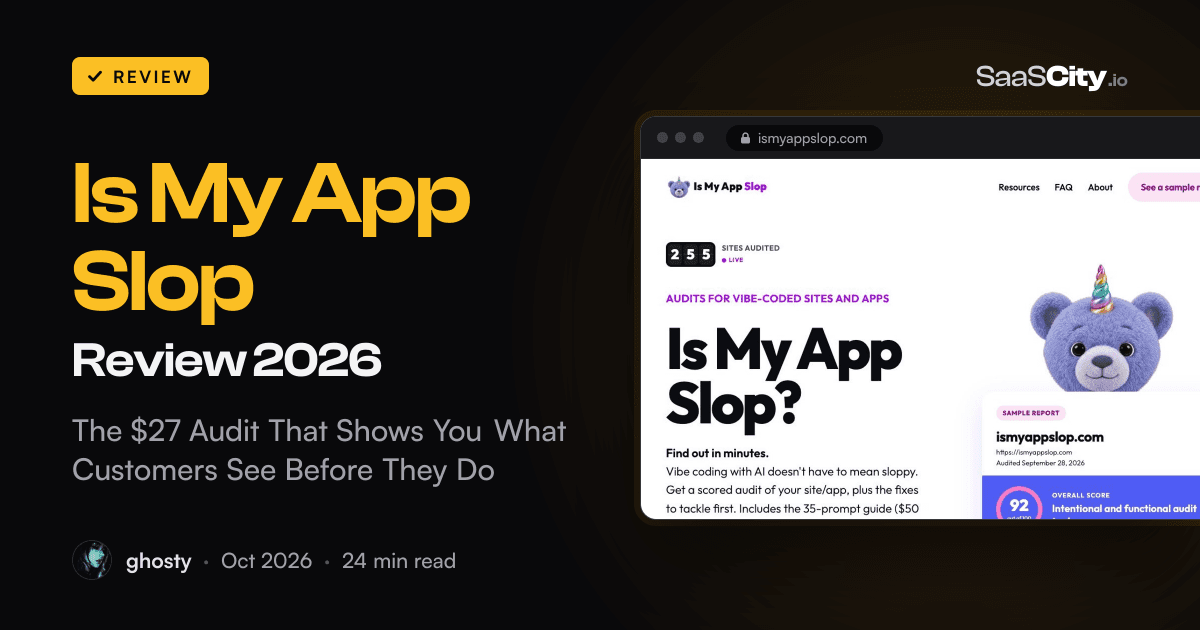
Is My App Slop (ismyappslop.com) is a $27 one-time audit for websites and web apps built with Lovable, Bolt.new, Replit and other AI tools. It clicks through your live public pages like a customer would, scores them on six areas, flags the tells that make a build look generated and ranks the fixes with prompts you can paste back into your builder. We went through the full sample report, the nine-step process, the refund terms and the averages across 237 audited apps.

Contents (16)
- Is My App Slop at a glance
- What is "AI slop" on a website?
- What is Is My App Slop?
- How does an Is My App Slop audit work?
- What does Is My App Slop score?
- What's in the report?
- What does a real Is My App Slop report look like?
- How much does Is My App Slop cost?
- Who's behind Is My App Slop?
- How is it different from a free scanner, a chatbot or a human audit?
- What doesn't Is My App Slop do?
- Is there free material before you buy?
- How to get the most out of your audit
- Who should use Is My App Slop?
- Is Is My App Slop worth $27?
- FAQ
Disclosure: this is a sponsored review.
Product details checked against ismyappslop.com (the homepage, How it works, the full sample report, About, Contact, the Terms of Service and the resources library) on October 27, 2026. Every screenshot was captured in Google Chrome from those live pages the same day.
Quick answer: Is My App Slop is a $27, one-time audit for websites and web apps, made with products built in Lovable, Bolt.new, Replit and other AI builders in mind. You paste a public URL and your email, and an AI agent called Christian clicks through your live pages the way a customer would. A few minutes later you get a score out of 100, a breakdown across six areas, the "slop tells" it found and a ranked list of fixes, each with a prompt you can paste straight into your builder. There's no account and no subscription, and if the report isn't useful you can get a full refund within 24 hours.
AI builders have made the first 80 percent of a product almost free. You describe an app, and twenty minutes later there's a landing page with a gradient hero, three feature cards and a pricing table. The trouble starts when a stranger lands on it. The headline could describe any product, the "Contact" link scrolls back to the top, and the footer still says 2024. The signup form says thanks and never sends the email it promised, and on a phone the main button hides under a cookie banner. None of that takes long to fix. The hard part is noticing it when you've looked at the same screen two hundred times.
That gap is what Is My App Slop was built for. Below is how the audit works, what a real report looks like, what it costs, and where it fits next to free scanners, chatbots and human audits.
Is My App Slop at a glance
- A one-time audit of a public website or web app, delivered as a web report and a PDF in a few minutes.
- Made for vibe-coded products, and it works on any public site, whatever it was built with.
- Scores six areas: Clarity and Promise, Craft and Design Integrity, Trust and Legitimacy, Flow and Usability, Mobile and Access, and Conversion and The Ask.
- Clicks your links and buttons, walks your main call to action, and tests up to three forms with clearly labeled test details if you allow it.
- Ranks every fix by impact and pairs it with a prompt for Lovable, Bolt.new, Replit, Cursor or whatever you build with.
- Checks for AI-generator fingerprints and compares your page with competitor pages it actually fetched.
- Costs $27 once through Stripe, with no account and nothing that renews. A 35-prompt guide valued at $50 is included.
- Refunds you automatically if the audit can't finish, and in full within 24 hours if the report isn't useful.
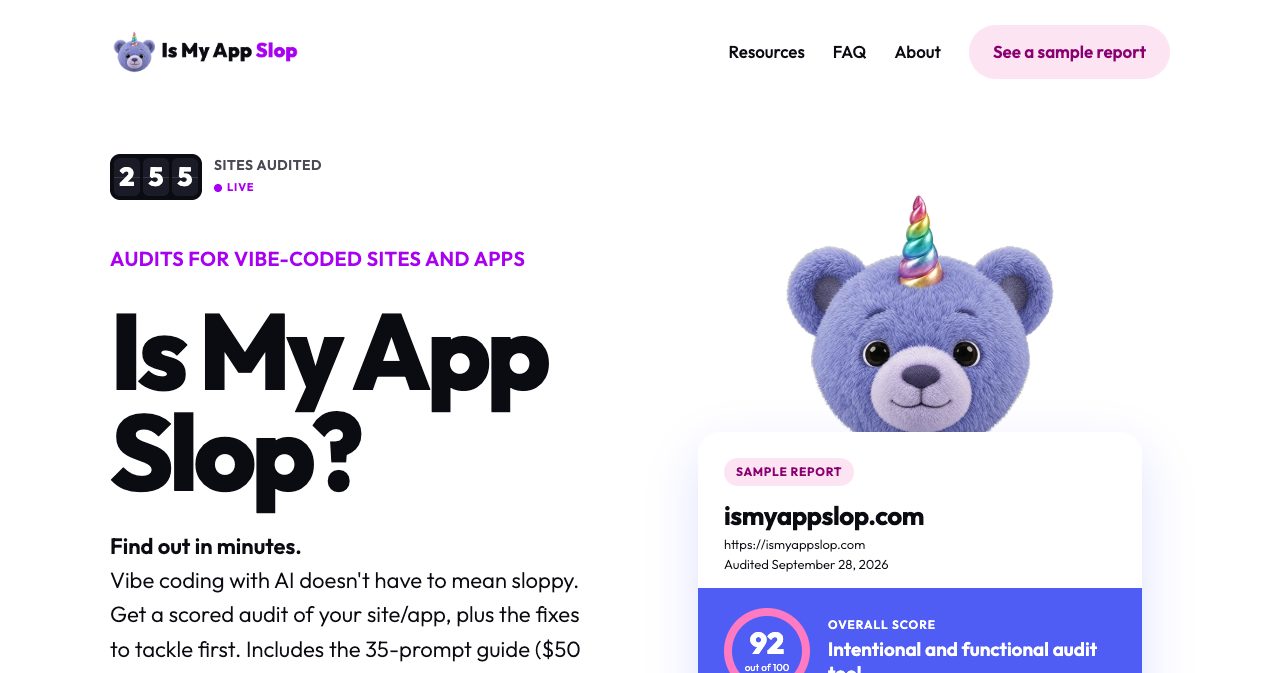
- Made by Build Labs and led by Kathryn Finney, author of the Wall Street Journal bestseller Build the Damn Thing. The homepage counter showed 255 sites audited when we checked.
What is "AI slop" on a website?
AI slop is work that looks generated rather than made. On a website, that's the template nobody changed, the headline that could sit on any SaaS homepage, the stock illustration and the button that goes nowhere. One of those on its own is harmless. Together they tell a visitor that nobody checked the site before it shipped, and that impression forms within seconds, long before anyone reads your feature list.
The tells are specific once you know them. Corner radii that don't match between cards and buttons. A default icon set. Testimonials from people who don't seem to exist. An old footer year, a placeholder privacy policy, no real way to reach anyone. A price that only appears on the third click. Most visitors couldn't name any of these, but they react to all of them, usually by closing the tab.
Vibe coding didn't invent these problems. Templates and page builders produced them for years. AI builders just produce them faster, on pages that otherwise look polished, which makes them harder to spot from the inside. For the visual side in more depth, our guide to avoiding AI slop in vibe-coded frontends walks through the design fixes.
What is Is My App Slop?
Is My App Slop (IMAS for short) audits the live public pages of a website or web app and tells you whether it reads as a real product or as slop. It's a Build Labs product from Kathryn Finney's team in Chicago, and it applies the rubric from her book Build the Damn Thing to your actual site.
It's for people who built something quickly with AI and want an outside read before customers, investors or the press see it: solo founders, indie hackers, designers shipping their own products and small teams in the week before launch. The audit reads what a customer sees at your link. It doesn't look at your code, and it doesn't care which tool you used, so a Lovable app, a Bolt.new prototype, a Replit deployment, a template site with AI-written copy and a hand-built Next.js app all get scored the same way. IMAS isn't affiliated with Lovable, Bolt or Replit, and it says so.
How does an Is My App Slop audit work?
Your side takes about a minute. You paste your URL and email, tick a box confirming you own the site or have permission to test it, and pay $27 through Stripe. Then you can close the tab if you like. The report link arrives by email, and if you stay on the page, the report opens there when it's ready.
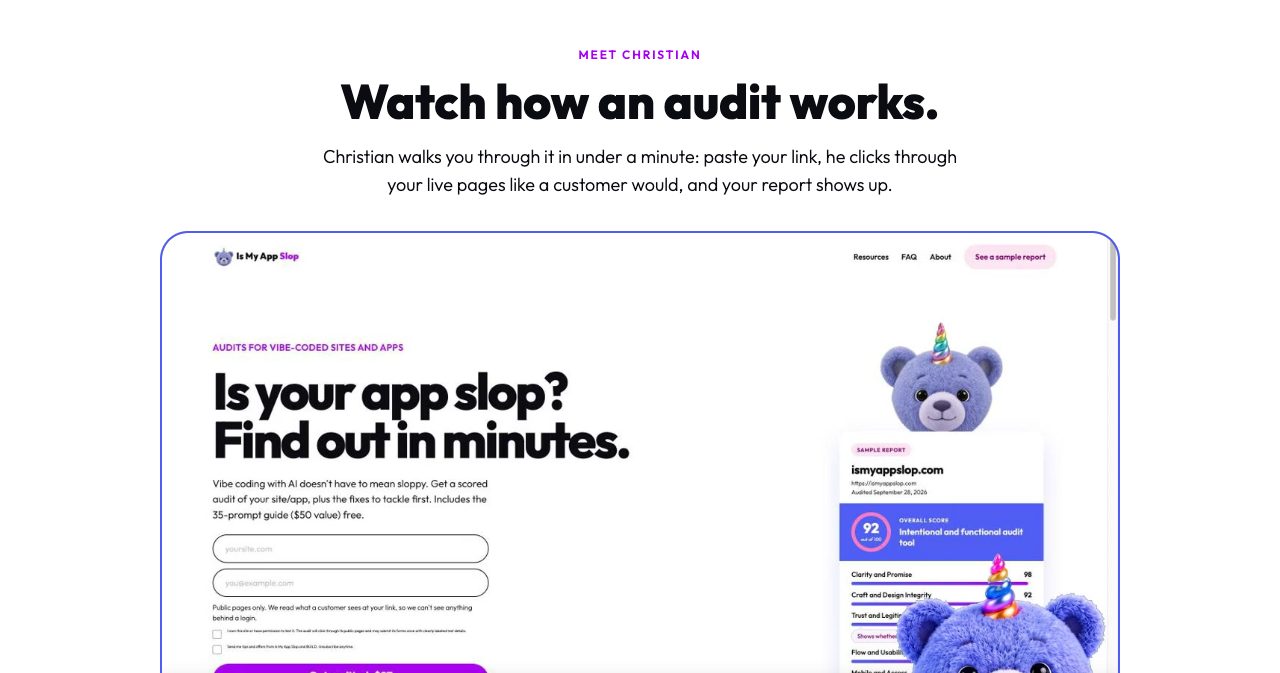
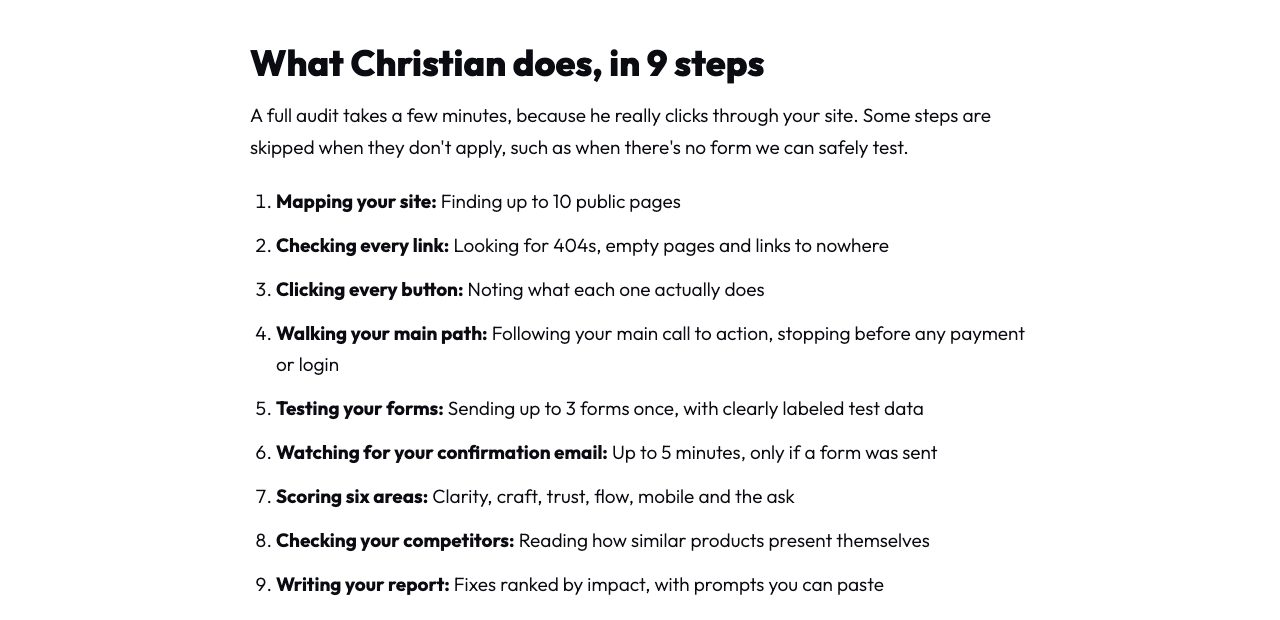
Behind that, an AI agent the site calls Christian does the work. The step-by-step walkthrough of an audit breaks it into nine steps:
- Mapping your site: it finds up to 10 public pages.
- Checking every link, looking for 404s, empty pages and links that lead nowhere.
- Clicking every button and noting what each one actually does.
- Walking your main path: it follows your main call to action and stops before any payment or login.
- Testing your forms: it sends up to three forms once, with clearly labeled test data.
- Watching for your confirmation email for up to five minutes, but only if a form was sent.
- Scoring six areas: clarity, craft, trust, flow, mobile and the ask.
- Checking your competitors by reading how similar products present themselves.
- Writing your report, with fixes ranked by impact and prompts you can paste.
Steps 3 and 6 matter most for vibe-coded apps. A screenshot can't tell you that "Book a demo" opens an empty modal, or that your waitlist form shows "Thanks!" and then never sends the email it promised. Clicking can. The audit renders each page, captures it at desktop and mobile sizes, and records what happened when it pressed things, so the score reflects how the site behaves as well as how it looks.
It's careful about where it stops. It never enters payment details, it stops at any login, and it only submits forms after you've ticked the permission box. Test entries are labeled as coming from Is My App Slop, so you'll recognize them later in your inbox, CRM or analytics. It's worth giving a quick heads-up to whoever reads your form submissions.
What does Is My App Slop score?
Every site gets the same rubric, and every score comes only from what the audit could observe on your public pages. When it couldn't test something, the report says so rather than guessing.
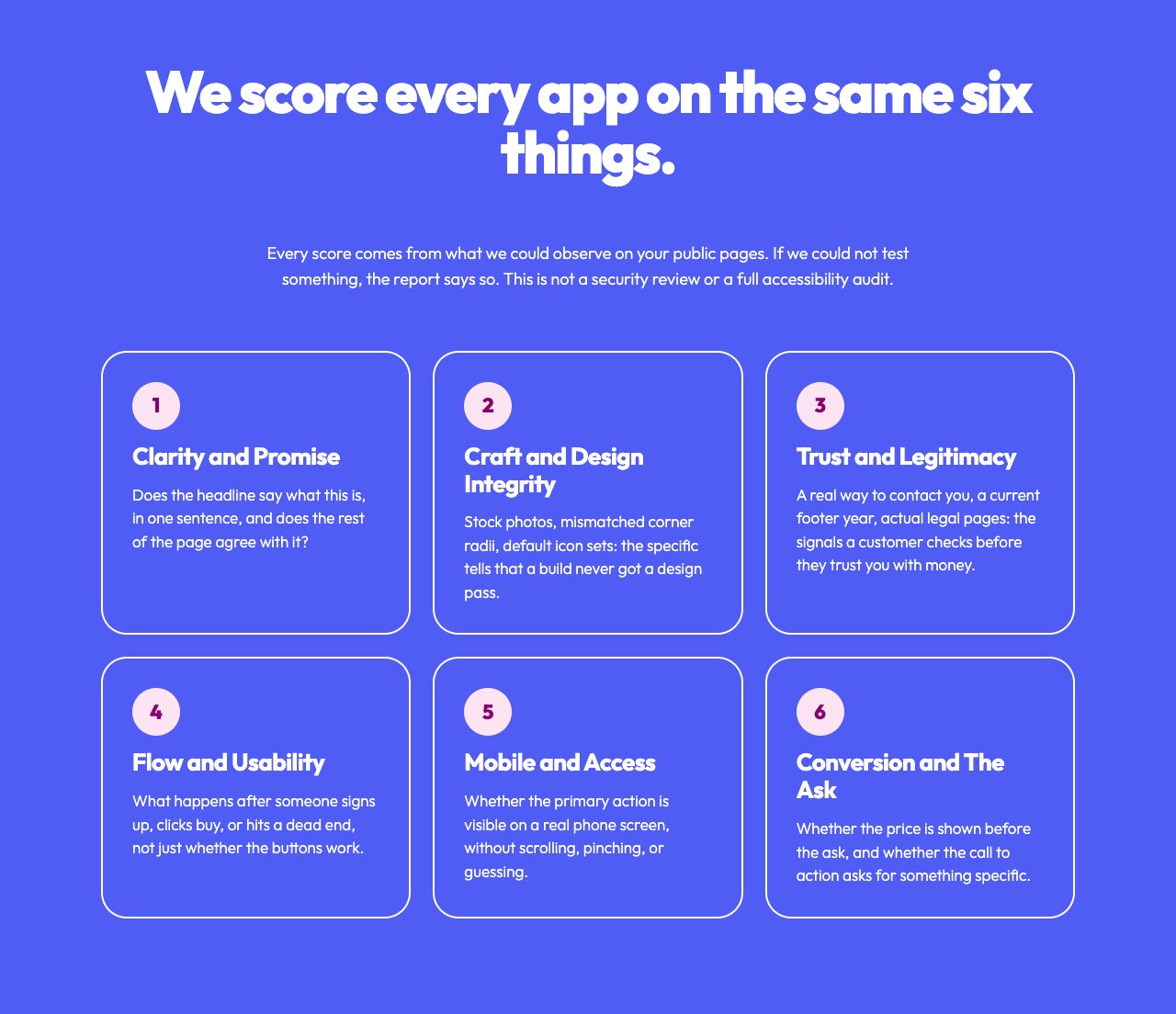
1. Clarity and Promise
Does the headline say what the product is in one sentence, and does the rest of the page back it up? "Supercharge your workflow with AI" loses points here. After five seconds, a visitor should be able to tell a friend what you sell.
2. Craft and Design Integrity
This is the "did anyone do a design pass?" score. Stock photos, mismatched corner radii, default icon sets and the familiar look of an untouched AI template all count against you. A plain page can still score well, as long as it looks like someone made decisions.
3. Trust and Legitimacy
These are the signals people check before they hand over money: a real way to contact you, a current footer year, actual legal pages, a person or company behind the product. AI builders rarely add them unless asked, so this is often where a quick build gives itself away.
4. Flow and Usability
What actually happens after someone signs up, clicks buy or hits a dead end. Working buttons are the minimum. The real question is whether each click leads somewhere sensible, with an obvious next step.
5. Mobile and Access
Can someone on a real phone see your primary action without scrolling, pinching or guessing? This covers the mobile experience and basic access, and IMAS is clear that it isn't a full accessibility audit.
6. Conversion and The Ask
Is the price shown before you ask for anything, and does the call to action ask for something specific? "Get started" scores lower than "Start your 14-day trial", because with the second one the visitor knows what they're agreeing to.
What's in the report?
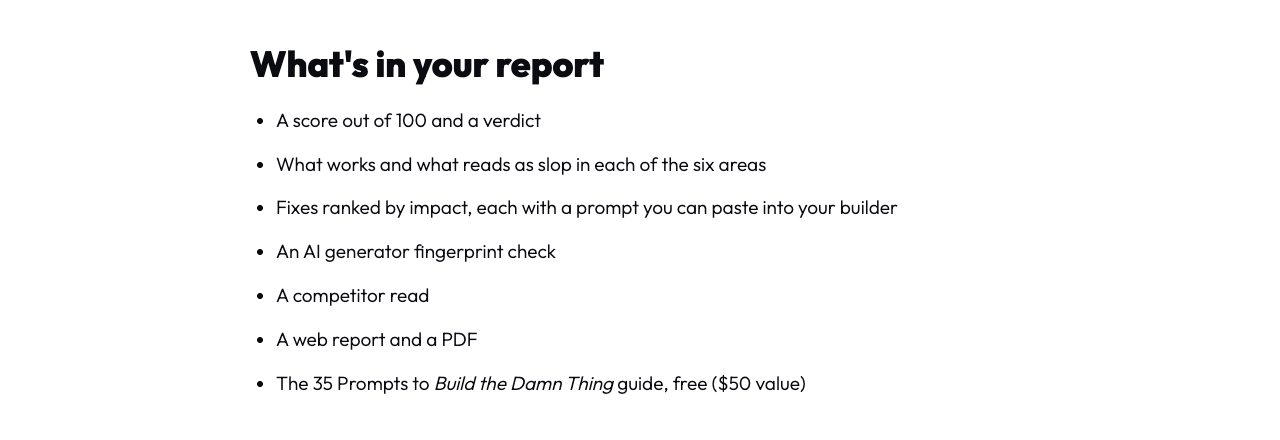
Each report includes:
- an overall score out of 100 and a verdict, such as "Real product";
- what works and what reads as slop in each of the six areas;
- fixes ranked by impact, in plain language, each with a prompt you can paste into your builder;
- an AI-generator fingerprint check;
- a competitor read, based on competitor pages the audit actually fetched;
- the report as a web page and as a PDF;
- the 35 Prompts to Build the Damn Thing guide.
The prompts are the most practical part. Every fix comes in two pieces: a sentence that says what to change and why, and a short instruction written for an AI builder. You don't have to turn "make the mobile cookie banner smaller" into something Lovable or Bolt will act on, because the report has already done it. Paste the prompt, check the result and move on to the next.
The ranking helps just as much. The report names one place to start: the top fix in your lowest-scoring area. When you've got eighteen suggestions and one free evening, that's how you decide what comes first.
What does a real Is My App Slop report look like?
You don't have to take the description on trust. IMAS publishes a full sample report of its own website, audited on September 28, 2026, with every section a paying customer gets. Only the competitor read is summarized.
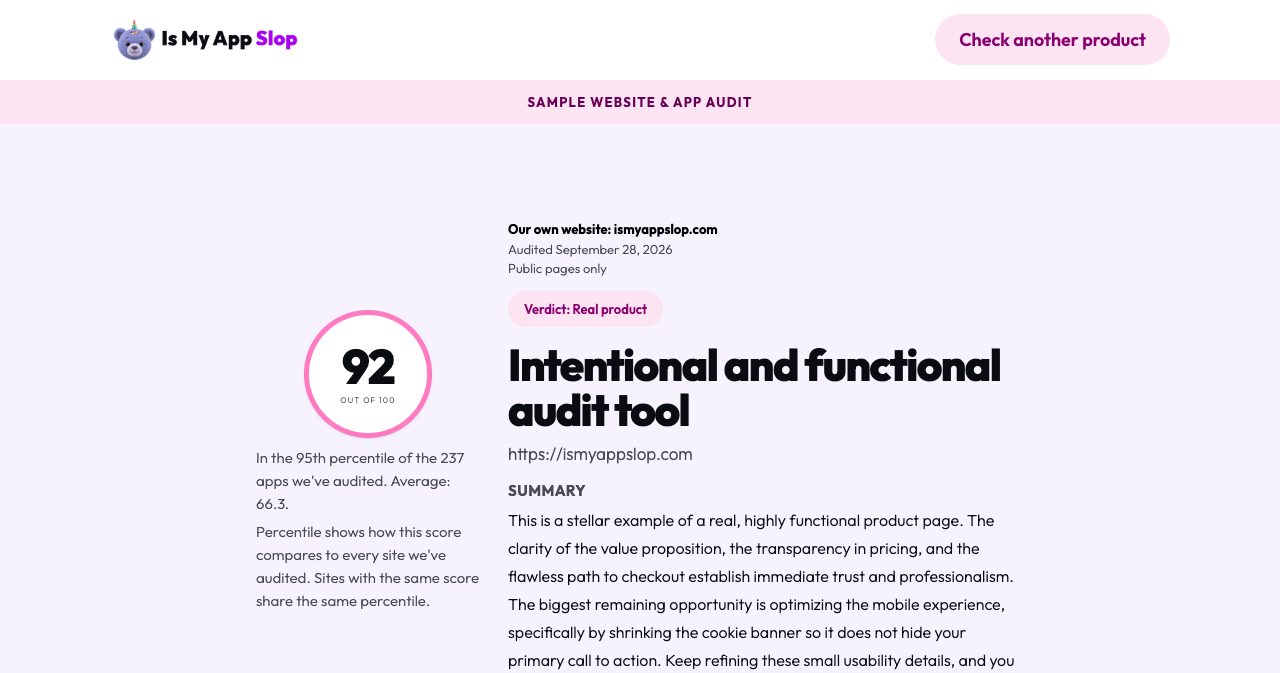
The site scored 92 out of 100, with the verdict "Real product" and the one-line read "Intentional and functional audit tool". That put it in the 95th percentile of the 237 apps audited at that point, where the average was 66.3. Here's the breakdown next to the average for each area:
| Area | ismyappslop.com | Average across 237 audits |
|---|---|---|
| Clarity and Promise | 98 | 76.8 |
| Craft and Design Integrity | 92 | 59.5 |
| Trust and Legitimacy | 96 | 59.1 |
| Flow and Usability | 90 | 65.4 |
| Mobile and Access | 75 | 73.3 |
| Conversion and The Ask | 98 | 63.8 |
| Overall | 92 | 66.3 |
The sample doesn't flatter its own product, and that's the best thing about it. Mobile and Access came in at 75, only the 36th percentile, because the cookie consent banner covered the main call to action on a phone when the page first loaded. The Flow section also flagged that the banner's "Opt out" button gave no visible response when clicked. Both are the small, costly kind of problem the tool exists to catch, and both were sitting on its maker's own homepage.
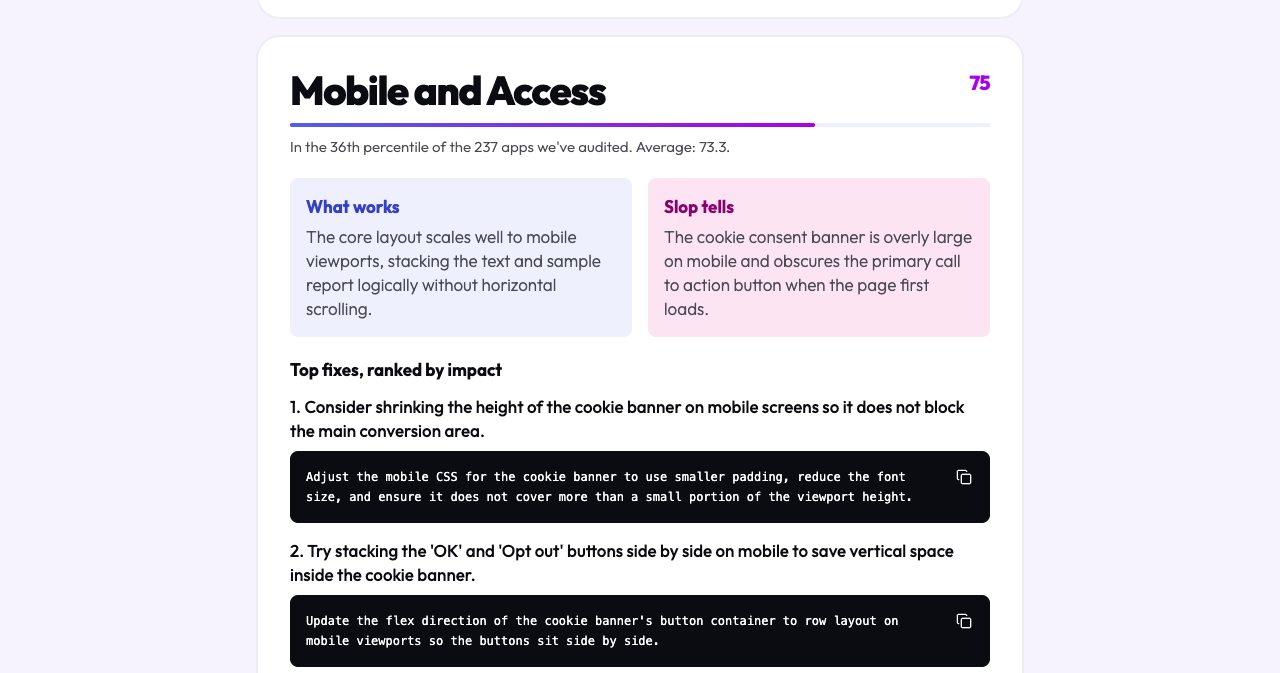
Each area puts "What works" and "Slop tells" side by side, then lists the ranked fixes. The first mobile fix is to shrink the cookie banner on small screens, and the prompt under it tells the builder to cut the banner's padding and font size so it covers only a small part of the screen. The second suggests putting the two banner buttons side by side to save vertical space. Both are things you could paste and ship in ten minutes.
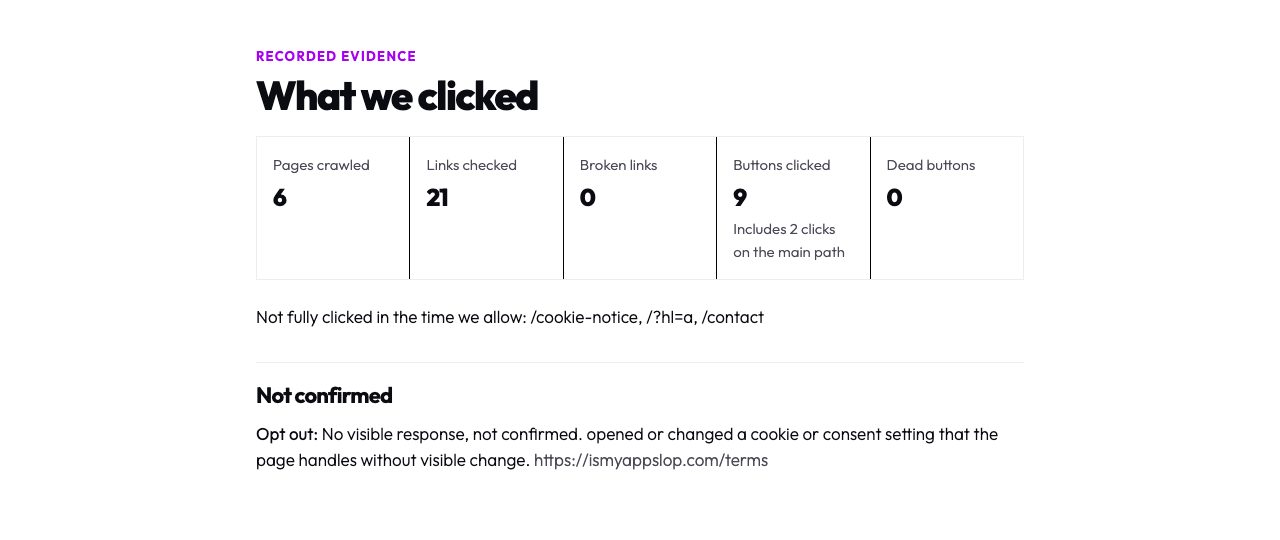
The "Recorded evidence" section shows what the agent actually did. On its own site it crawled 6 pages, checked 21 links (none broken) and clicked 9 buttons, two of them on the main path, with no dead buttons. It also lists the pages it couldn't fully click in the time allowed and the clicks it couldn't confirm. That's useful, because a score is only worth as much as the evidence under it.
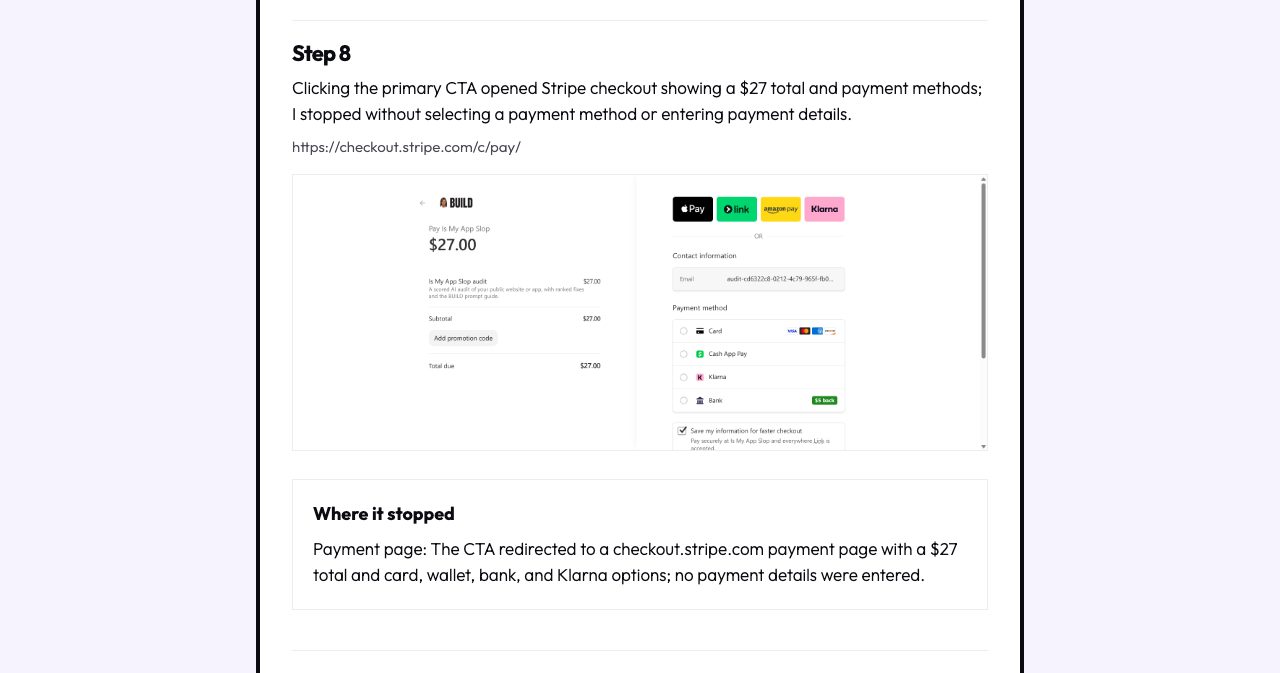
The main path is written out step by step, with a screenshot at every step. On the sample, the agent found the "Get audited, $27" button, filled in the URL and email fields, ticked the permission box and clicked through to Stripe checkout, where it stopped without choosing a payment method. If your own signup flow breaks at step three, this is where you'll see it, with a screenshot of the moment it broke.
One small detail we noticed: the sample report suggested a line about refunds near the purchase button, and the live homepage now has one right under the hero button.
What the averages say about vibe-coded sites
The averages in the sample report are some of the most useful numbers on the site, because they describe every site IMAS had scored, and given who the tool is for, most of those were likely built with AI. Two patterns stand out.
Clarity is the strongest area on average, at 76.8. AI is good at writing a clear headline once you've told it what the product does. Trust (59.1) and Craft (59.5) are the weakest. That's about what you'd expect. An AI builder will happily generate a hero section, but it won't set up a real contact page, write proper terms, keep your footer current or make the design decisions that make a page look like yours. A person still has to do those jobs, and they're the ones visitors use to decide whether to believe you.
Conversion averages 63.8, so plenty of AI-built pages either hide the price or ask for something vague. If you only have an hour before launch, trust, craft and the ask are where it'll pay off most.
How much does Is My App Slop cost?
It's $27, once. Payment runs through Stripe, prices are in US dollars, and there's no account to create and nothing that renews. On the checkout captured in the sample report, Stripe offered cards, Apple Pay and other wallets, Cash App Pay, Klarna and bank payment.
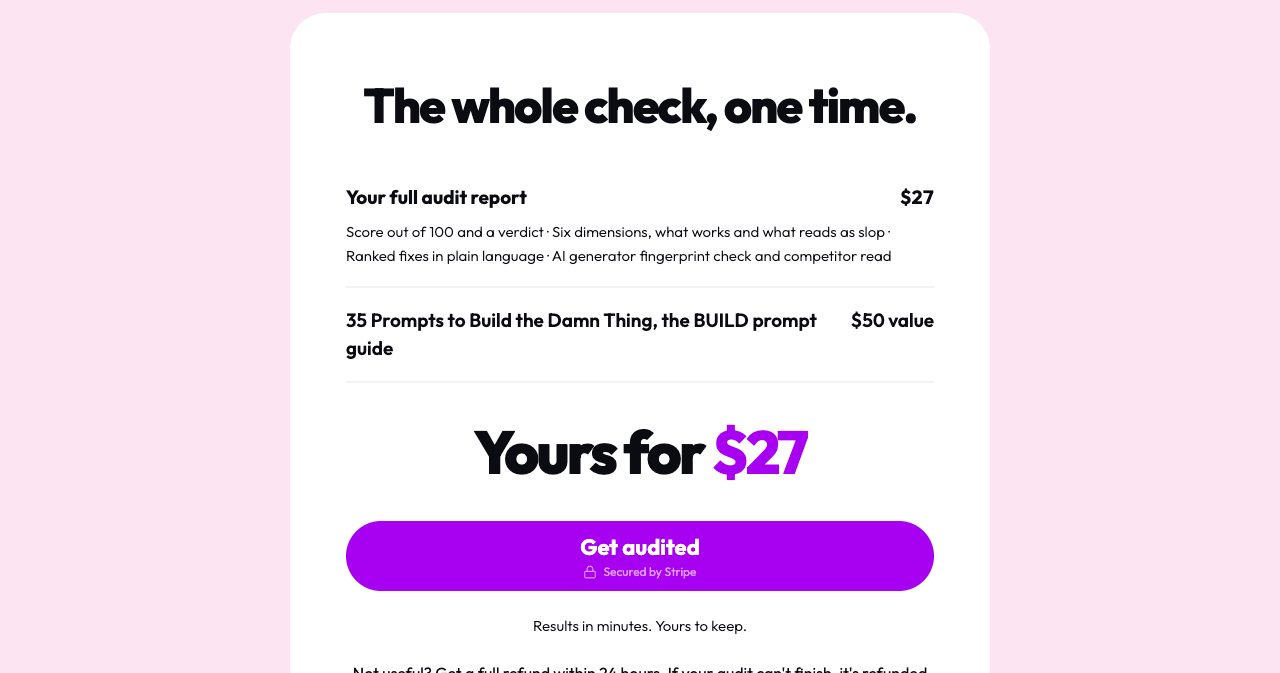
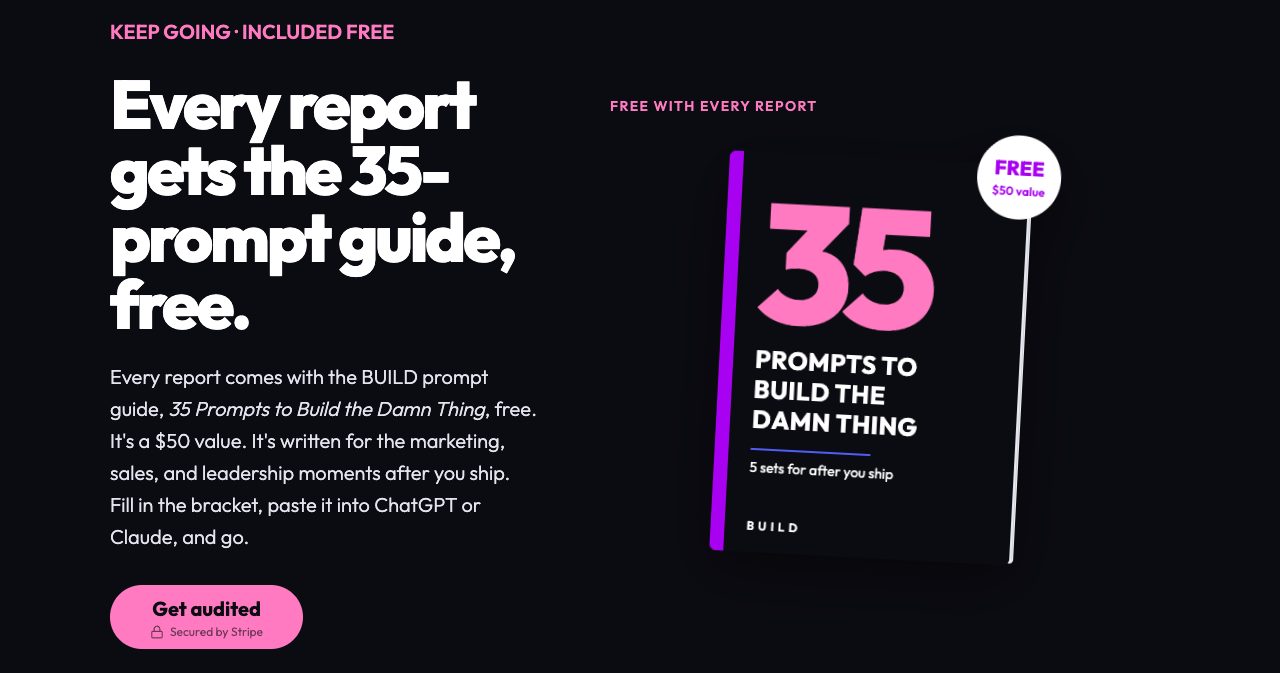
Every report comes with 35 Prompts to Build the Damn Thing, a BUILD prompt guide that IMAS values at $50. It's written for the stretch after you ship, with five sets of prompts for marketing, sales and leadership moments. You fill in the brackets, paste a prompt into ChatGPT or Claude and go. It's a sensible pairing, because once your site stops reading as slop, the next job is getting people to it.
What if the report isn't useful?
The refund policy is about as simple as they come:
- If the audit can't finish, for example because of a login wall, a blocked crawler or a site that's down, you're refunded in full automatically.
- If it finishes and you don't find the report useful, you can ask for a full refund within 24 hours of delivery. Open the report, select "Request a refund" and answer three short questions, and the refund goes through automatically. You keep access to the report.
- There's one refund of this kind per email address. Refunds go back to the original payment method, and most banks show them within 5 to 10 business days.
For a $27 product, that takes most of the risk away. You can read the sample report before you pay, and if your own report doesn't help, you get your money back without having to argue with anyone.
Who's behind Is My App Slop?
IMAS was founded by Kathryn Finney and is made by Build Labs, "a Genius Guild company" based in Chicago. Finney wrote Build the Damn Thing: How to Start a Successful Business If You're Not a Rich White Guy, a Wall Street Journal bestseller and a practical playbook for founders who don't fit the usual venture mould.
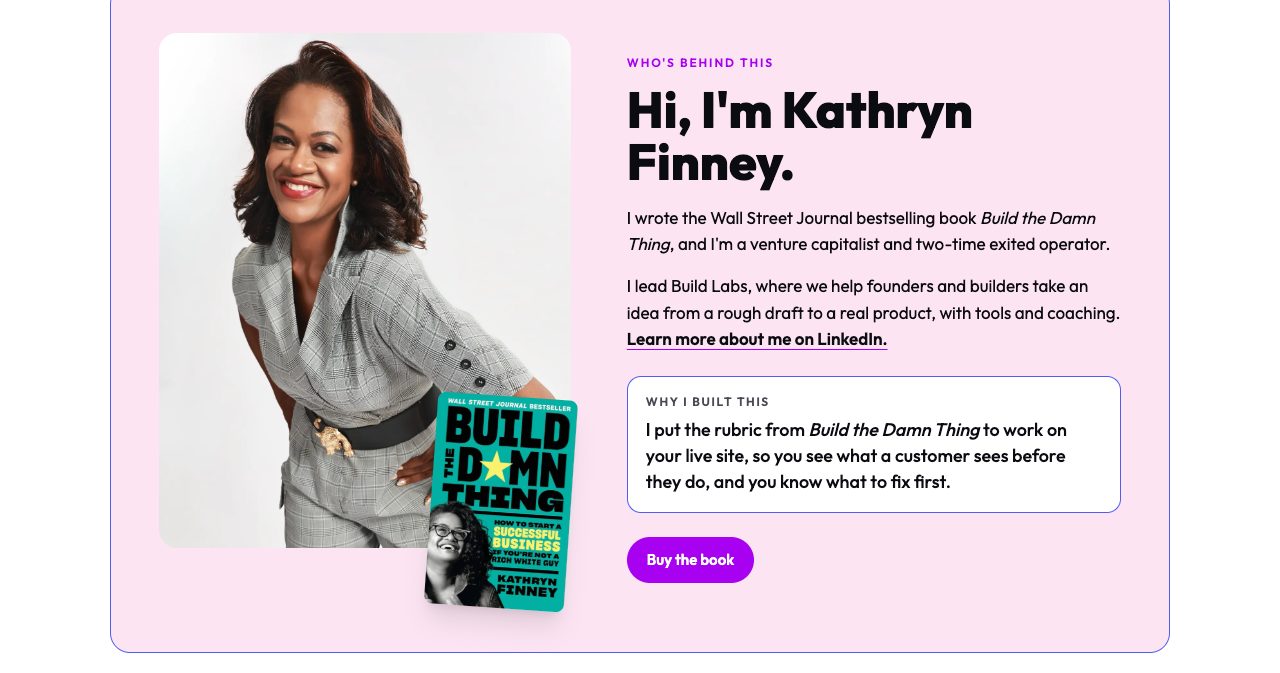
She's a venture capitalist and a two-time exited operator. She built and sold The Budget Fashionista, founded digitalundivided to back Black and Latinx women founders, and leads Genius Guild, which invests in underrepresented founders. Build Labs grew out of the book, with tools and coaching that help founders turn a rough draft into a real product.
Her reason for building IMAS is easy to follow. AI makes it simple to ship something that looks finished and isn't, and most audit tools either chase speed scores or hand back a vague opinion. So she took the rubric from the book and pointed it at live sites, so builders can see what a customer sees before the customer does. For a first-time founder, that's useful background to have behind a rubric: it comes from someone who has built companies, invested in them and watched what makes people trust one.
Support runs by email at [email protected], for questions about a report, refunds and data deletion.
How is it different from a free scanner, a chatbot or a human audit?
It's a fair question, since there are free options. Here's how they compare:
| Option | What it looks at | What you get | Cost |
|---|---|---|---|
| Is My App Slop | Rendered public pages, desktop and mobile screenshots, real clicks, forms and fetched competitor pages | A score out of 100, six areas, ranked fixes with paste-ready prompts, a web report and a PDF | $27, one time |
| Free scanners (Lighthouse, PageSpeed Insights and similar) | Page code, load speed, technical SEO and automated accessibility rules | Performance and technical scores | Free |
| Asking a chatbot | Whatever you paste in or describe | An opinion that shifts with your prompt, usually without clicking anything | Free or part of a subscription |
| A human UX or CRO audit | Anything you give access to, including logged-in flows | Deep, tailored recommendations | Usually hundreds of dollars or more, and days to arrive |
Free scanners answer a different question. They'll tell you whether a page is fast and technically sound, but not that your headline is vague, your contact link is broken or your page looks like hundreds of other AI templates. Running both is a good idea, because they check different things.
A chatbot can give you a reasonable opinion on copy you paste in, but it only knows what you tell it. IMAS renders the page, clicks things, scores against a fixed rubric instead of a mood, looks for builder fingerprints and fetches real competitor pages. The fixed rubric also makes your score comparable with every other site it has audited, and with your own site after a round of fixes.
A good human audit goes deeper than any automated tool and can cover screens behind a login. It also costs a lot more and takes longer. IMAS is the quick, inexpensive read you run first, and if you still want a person afterwards, you'll be able to brief them much better.
What doesn't Is My App Slop do?
IMAS is upfront about its limits, and they're worth knowing before you buy.
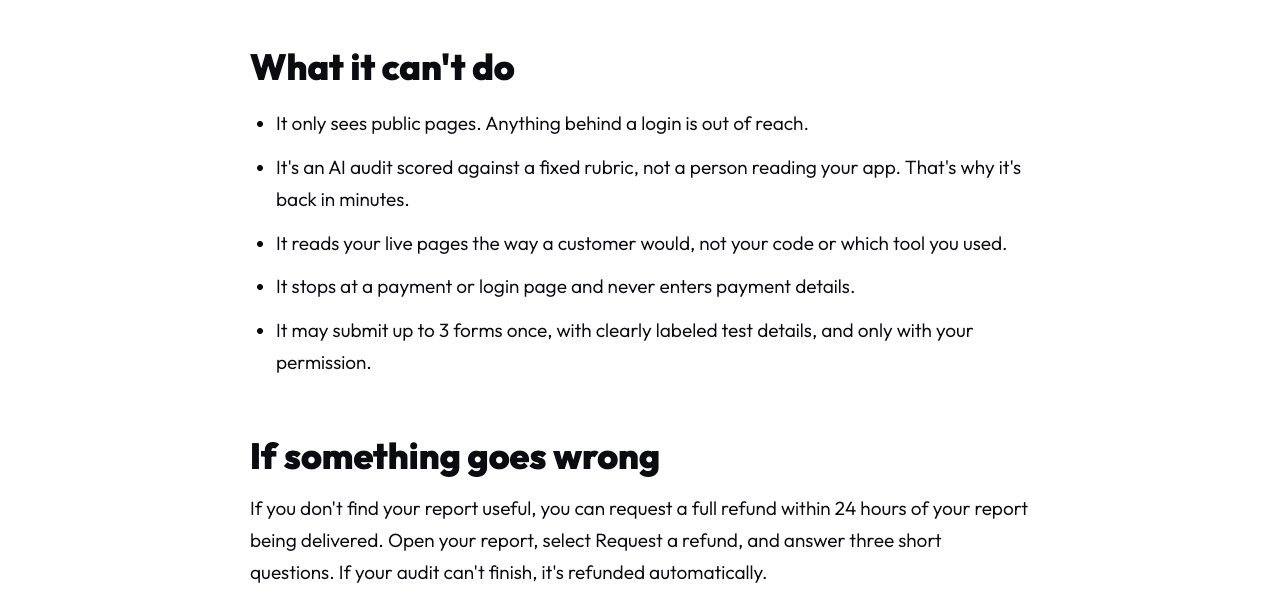
- It only sees public pages. Your dashboard, any onboarding behind a login and paid areas are out of reach, so submit your homepage or main landing page.
- It's an AI audit against a fixed rubric, not a person reading your app, which is why it's back in minutes.
- It isn't a security review or a full accessibility audit. If your app stores user data, work through our pre-launch security checklist for vibe-coded startups as well.
- It may not manage to interact with every dynamic element, and the report flags what it couldn't test.
- With your permission, it may submit up to three forms once with labeled test details, and those can show up in your inbox, customer list or analytics.
- It sends your public page content, screenshots included, to third-party services for analysis, so don't submit a page that shows anything you wouldn't want processed.
- Your report lives at a private link that anyone holding the link can open. Share it only with people you mean to, and email support if you want it deleted.
None of this is unusual for an automated audit. IMAS just says it more plainly than most.
Is there free material before you buy?
There's plenty. The resources page holds 53 free guides in five topics: Test your app, Audit your app, Fix and launch, Plan and spend smart, and Spot AI slop. They're practical rather than theoretical. There's a 20-minute self-check for AI slop, a three-task usability script, a step-by-step workflow for testing a Lovable app, a landing page audit checklist and a launch checklist for vibe-coded apps. Tool comparisons such as Lovable vs Bolt.new vs Replit and Cursor vs Lovable are in there too.
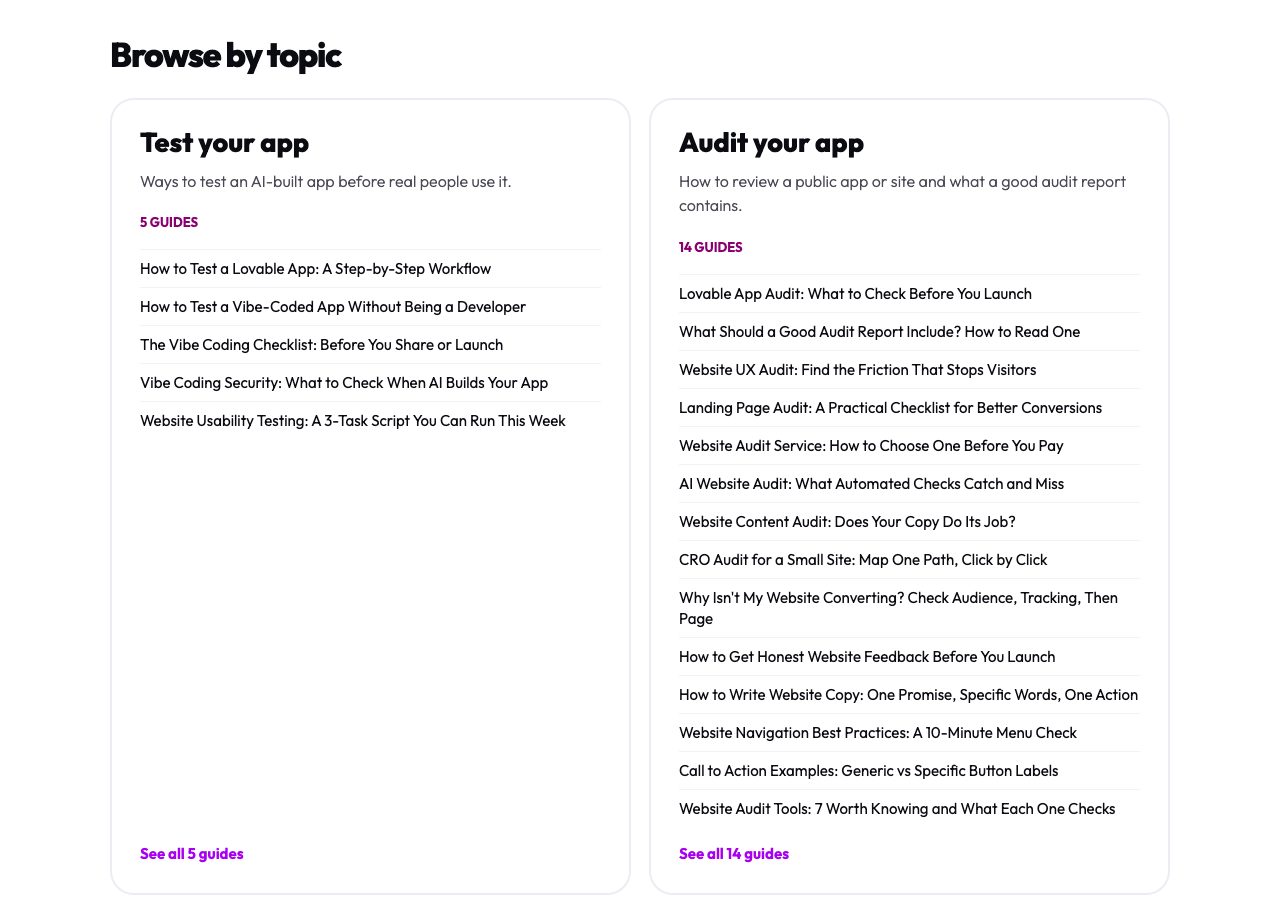
They're worth reading even if you never order an audit, and they say something good about the product. A team that has written 53 evidence-first guides on testing AI-built apps has spent a lot of time thinking about what "finished" actually means.
How to get the most out of your audit
A few habits make the $27 go further:
- Pick the page that matters most. For most products that's the homepage, or the landing page you'll send launch-day, ad or investor traffic to.
- Fix what you already know is broken. If you know the footer year is wrong or the contact page is empty, sort that out first, so the report spends its attention on things you can't see.
- Warn whoever reads your form submissions, since the audit may send up to three clearly labeled test entries.
- Start where the report tells you to, with the top fix in your lowest-scoring area.
- Paste one prompt at a time into your builder and check the result before the next. AI builders handle one clear change better than five at once.
- Go back through the slop tells after each round. Most are small enough to clear in an afternoon.
- Keep the PDF. It makes a handy before-and-after record for a co-founder, an advisor or an investor update.
- When the score is where you want it, launch. Our list of where to list a vibe-coded app covers the directories worth your time.
Who should use Is My App Slop?
It suits you if you:
- built a site or app with Lovable, Bolt.new, Replit, v0, Cursor or another AI tool and are about to show it to real people;
- are launching on Product Hunt, a directory or a community and need the page to hold up in front of a few hundred strangers;
- are about to send the link to investors, a journalist or your first big customer;
- have stared at your own landing page for so long that you can't really see it anymore;
- want specific, ranked fixes instead of "make it pop".
It's less useful if you:
- need a security review or a penetration test;
- need a formal accessibility conformance audit against WCAG;
- want feedback on screens that sit behind a login;
- already pay a designer you trust for regular UX reviews.
Is Is My App Slop worth $27?
For most people shipping an AI-built product, yes. The problems it looks for cost far more than $27 when they slip through: a broken flow that quietly loses signups, a missing trust signal that stops a purchase, a phone layout that hides the button you paid to send people to. The fixes arrive ranked and already written for your builder, so you spend the evening fixing things instead of working out what's wrong.
What we liked most is how open the whole setup is. The rubric is public. The sample report shows the product's own weak spots. Every score is tied to recorded evidence, the limits are written down, and if the report doesn't help, you get your money back. The team behind it has a long record of helping founders build real companies, and the free library shows the same care.
If you're about to launch, read the sample report first, then get your Is My App Slop audit for the page you're about to send people to. It takes a few minutes, and you'll know what to fix before your visitors notice it.
FAQ
What is Is My App Slop?
Is My App Slop (ismyappslop.com) is a one-time AI audit for public websites and web apps, made with vibe-coded products in mind. It clicks through your live pages the way a customer would, scores them out of 100 across six areas, lists what reads as AI slop and ranks the fixes, each with a prompt you can paste into your AI builder. It's a Build Labs product founded by Kathryn Finney.
How much does Is My App Slop cost?
$27, paid once through Stripe. There's no account and no subscription, and nothing renews. Every report includes the 35 Prompts to Build the Damn Thing guide, which Is My App Slop values at $50.
How long does an audit take?
A few minutes. The agent really clicks through your site, so it isn't instant, but you can close the page after paying. The report link is emailed to the address you paid with, and it opens on the page if you wait.
Does Is My App Slop work for apps built with Lovable, Bolt.new or Replit?
Yes. It audits any public website or web app, whether it was built with Lovable, Bolt.new, Replit, another AI tool, a template edited with AI or by hand. It reads your live public pages, not your code, and it isn't affiliated with Lovable, Bolt or Replit.
Can Is My App Slop audit pages behind a login?
No. It only audits public pages, the ones a customer sees when they open your link. Submit your homepage or main landing page, not a page that needs someone to sign in.
Is a person reviewing my app?
No. It's an AI audit scored against a fixed rubric, which is why the report comes back in minutes. The rubric is the same for every site, so scores are comparable across sites and across your own fixes.
What does Is My App Slop score?
Six areas: Clarity and Promise, Craft and Design Integrity, Trust and Legitimacy, Flow and Usability, Mobile and Access, and Conversion and The Ask. Every score comes from what the audit could observe on your public pages, and the report says when something couldn't be tested.
What happens if the report isn't useful?
You can request a full refund within 24 hours of delivery by opening your report, selecting Request a refund and answering three short questions. The refund is issued automatically and you keep the report. If the audit can't finish at all, for example because of a login wall or a site that's down, it's refunded automatically.
Will the audit submit my forms or buy anything?
With your permission, it may submit up to three forms once using test details clearly labeled as coming from Is My App Slop, so those entries can appear in your inbox or CRM. It follows your main call to action but stops at any payment or login page and never enters payment details.
How is Is My App Slop different from Lighthouse or asking ChatGPT?
Free scanners like Lighthouse and PageSpeed Insights check speed and technical SEO. A chatbot works from whatever you paste in. Is My App Slop renders your live pages, takes desktop and mobile screenshots, clicks your buttons and forms, scores against a fixed six-area rubric, checks for AI builder fingerprints and compares you with competitor pages it actually fetched.
Who makes Is My App Slop?
Build Labs, a Genius Guild company in Chicago, led by Kathryn Finney. She wrote the Wall Street Journal bestseller Build the Damn Thing and is a venture capitalist and two-time exited operator. Support is at [email protected].
If you're building a SaaS, an AI tool or a service for founders, SaaSCity is a free, human-reviewed startup directory with a live city map, where your listing is a permanent page that other founders browse.
Get your SaaS in front of founders
List your product on the SaaSCity live city map - a permanent listing, real discovery, and a backlink from a high-DR directory. Free to start; upgrade for a dofollow link and a building on the map.