News
Java4Shell: Sixty-Four A's and an Equals Sign Broke Java, and Keycloak, Jira and Jenkins With It (2026)
Sixty-four A's and an equals sign make an unpatched Java server write 62 bytes past the end of an array, and Calif turned that into pre-auth RCE on Keycloak, Jira, Confluence, Jenkins, Artifactory and PingFederate. Java4Shell (CVE-2026-114938) only bites on AVX-512 x86 servers, which covers the current x86 instance families at AWS, Google Cloud and Azure. Here is the fifteen-minute exposure check, the fixed build for each major distribution, and what to tell your customers.
Contents (14)
- Java4Shell triage in one table
- What is Java4Shell, and how does a Base64 string become remote code execution?
- Why does Java4Shell have two CVSS scores, 9.2 and 8.1?
- Which Java versions and products are affected by Java4Shell?
- Is my server actually exploitable? The fifteen-minute check
- How do I patch Java4Shell across a small fleet?
- What if I can't patch today? Do the -XX flags actually work?
- Keycloak, Jira, Confluence, Jenkins, Artifactory: what do the vendors say?
- Why did a fix sit in a closed pull request for two months?
- Is anyone exploiting Java4Shell yet?
- What should I tell my customers and put on my security page?
- The part of Java4Shell you control
- FAQ
- Sources
Sixty-four capital A's followed by one equals sign will make an unpatched Java server write 62 bytes past the end of an array.
That's the whole trigger: a 65-character string that looks like a typo, needs no login, and only has to reach a header or token that some Java service decodes before it checks who you are.
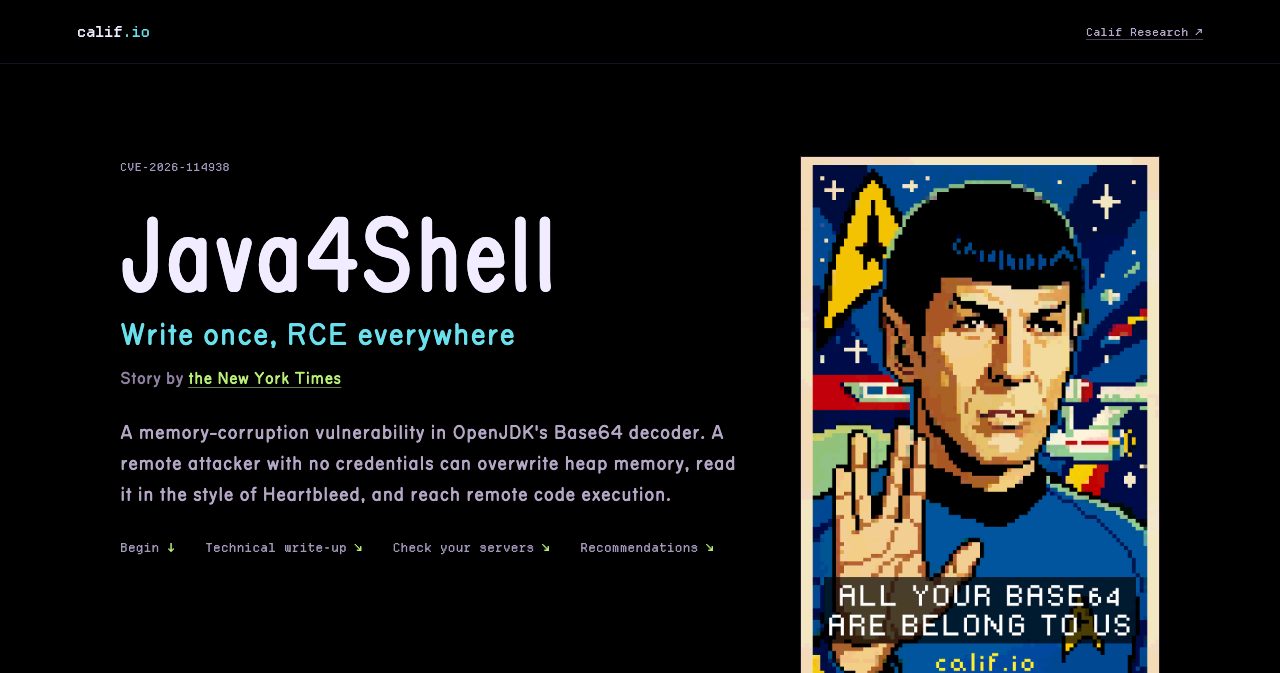
Java4Shell (CVE-2026-114938) is a heap memory-corruption bug in the hand-written AVX-512 Base64 decoder inside OpenJDK, disclosed by research firm Calif on November 17, 2026. It hits OpenJDK 17.0.6 and later plus 21, 25 and 27 on Intel Ice Lake or AMD Zen 4 and newer x86-64 servers. Fixed builds: 17.0.21.1, 21.0.13.1, 25.0.5.1 and 27.0.1.1.
Your product might be written in TypeScript. Your login page probably isn't. Calif says it got pre-authentication remote code execution against default installs of Keycloak, Jira, Confluence, Jenkins, JFrog Artifactory and PingFederate, which reads like an inventory of the back office at a mid-size SaaS company. If you can't patch today, start each affected JVM with -XX:-UseBASE64Intrinsics and restart it.
Facts checked on November 18, 2026, the day after disclosure. Vendor builds are still landing, so confirm yours on the vendor page linked in the patch table. SaaSCity is a startup directory, not a security vendor, and nothing we sell fixes this; every technical claim below links to the researcher or vendor who made it.
Java4Shell triage in one table
Whether Java4Shell matters to you comes down to four things: the CPU, the Java build, one default JVM flag, and whether outside input reaches a Base64 decoder. Find your row.
| Your setup | Exposed? | What to do |
|---|---|---|
| ARM64 servers (AWS Graviton, Ampere, Azure Cobalt, Google Axion) | No, per Equixly and JFrog | Patch on your normal cycle |
| x86 without AVX-512 VBMI (Skylake, Cascade Lake, AMD EPYC before Zen 4) | No, the vulnerable path never runs | Patch on your normal cycle |
| x86 on Ice Lake or Zen 4 and newer, running Java 17.0.6+, 21, 25 or 27 | Yes | Patch today, or set the flag today |
| Standard Java 8 or Java 11 | No, per Chainguard and Adoptium | Take the same release for its other fixes |
| Oracle Java 8 Performance Pack, 8u511b33-perf | Yes, per Oracle's list via Tenable | Move to 8u513-perf |
| Self-hosted Keycloak, Jira, Confluence, Jenkins, Artifactory or PingFederate on affected x86 | Yes, pre-auth RCE shown by Calif | First in line |
| Hosted products such as Jira Cloud | The vendor runs the JVM | Ask the vendor for its status |
What is Java4Shell, and how does a Base64 string become remote code execution?
Java4Shell is an integer underflow in a piece of hand-written x86 assembly that the HotSpot JVM swaps in for java.util.Base64 decoding, and the underflow becomes a 64-byte write that runs off the end of a heap array. Despite the name, it isn't a Log4j-style library bug you fix by bumping a dependency in pom.xml: the code lives in the JVM itself, so the fix is a new Java runtime.
When a Java method gets called often enough, HotSpot's JIT compiler replaces certain library routines with intrinsics: machine code written by hand for specific CPUs, because it's faster than anything the compiler would generate. Base64 decoding has one. On chips with AVX-512 VBMI it works through the input in 64-byte blocks, then handles whatever is left over with a masked tail sequence.
That tail is where it breaks. Calif's write-up, by researcher Quang Luong, walks through it. Send 64 A's and one =. The main loop eats the 64 A's, leaving a single leftover byte. The tail code computes the output length for that leftover as zero, then subtracts one for the padding character and lands on -1. The mask built from that number has every bit set, so instead of writing nothing, the stub writes all 64 bytes. Java allocated a 50-byte result array for the 65-byte input, and the write starts at offset 48. Sixty-two bytes land past the end. On older OpenJDK 17 builds the trigger is 128 A's plus =.
The decoder does reject the input with an IllegalArgumentException. The problem is timing. Chainguard's analysis, written by CISO Quincy Castro, points out that the exception fires after the write, so the memory next door is already overwritten by the time Java notices anything is wrong.
How much of that overflow can an attacker steer? Most of the 62 bytes come from the stub's own lookup table. Calif says bytes 0 and 1 are attacker-controlled and bytes 48 through 63 are always 0x9a. What the attacker does control is the size of the array, which decides what sits beside it on the heap. Line up the right neighbor and you can corrupt it, read memory you shouldn't see (Calif compares this stage to Heartbleed), and with an application-specific chain, run code.
That last step is where the work is. Calif states plainly that there is no universal exploit. A Hacker News commenter quoting Calif's own list of requirements put it well: each chain needs a decoder route, a way to write, a way to read back, a heap layout and an application action, and "every target needs a bespoke profile." Calif even rented a VM in the same cloud region as its target to keep network jitter low enough for the heap grooming to work. So mass exploitation will be slow. A patient attacker going after your login server is a different question.
Why does Java4Shell have two CVSS scores, 9.2 and 8.1?
Both numbers are real; they come from two versions of the scoring system looking at the same facts.
Calif rates Java4Shell 9.2, Critical, under CVSS 4.0. The OpenJDK Vulnerability Advisory of November 17, 2026 files it under hotspot/compiler at 8.1, High, under CVSS 3.1, and Equixly's breakdown gives the full vector: AV:N/AC:H/PR:N/UI:N/S:U/C:H/I:H/A:H.
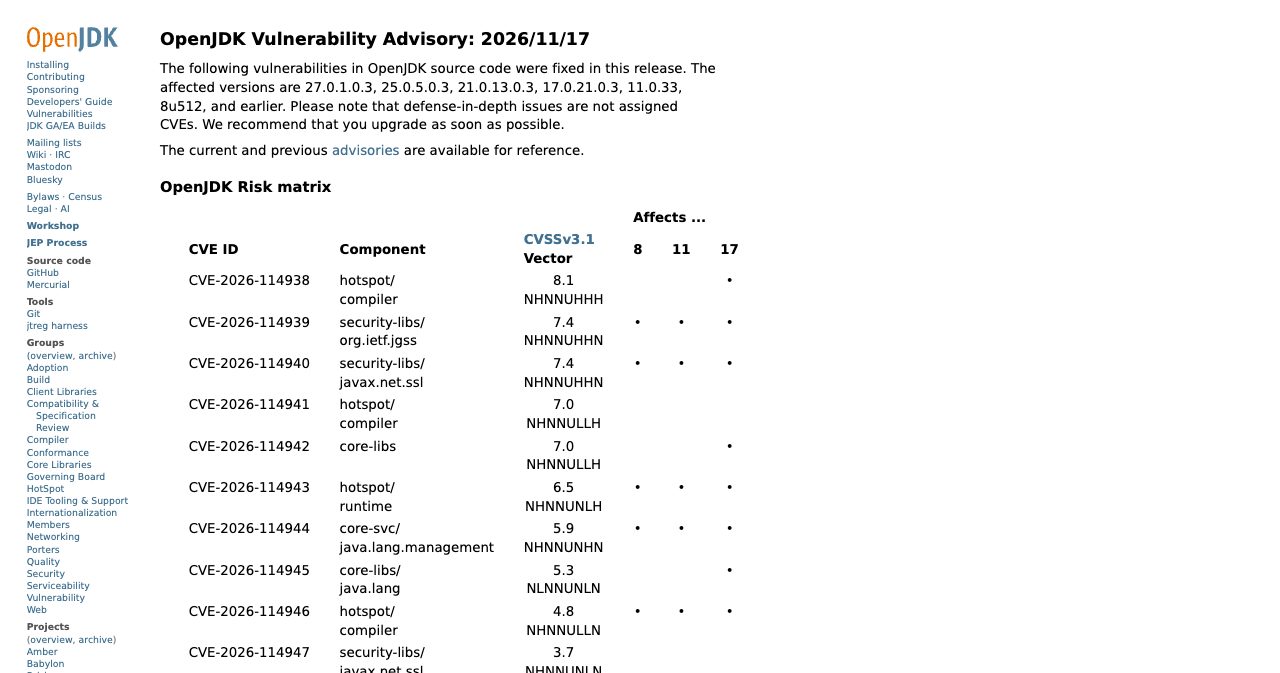
Read that vector letter by letter and only one metric sits below maximum: AC:H, high attack complexity. The rest says the attack works over the network, needs no privileges or user interaction, and costs you confidentiality, integrity and availability in full. Oracle rates the complexity high, as Tenable and Aikido both note, which fits the per-target chains and heap grooming Calif describes. Flip AC to Low and the same CVSS 3.1 vector scores 9.8. Red Hat skips the arithmetic and calls it Critical in RHSB-2026-018.
For triage, the 8.1 is mostly a statement about how hard the exploit is to build. The impact half of the vector is already maxed out, and that's the half your customers would feel.
Which Java versions and products are affected by Java4Shell?
Java4Shell affects OpenJDK 17 from 17.0.6 onward and every build of 21, 25 and 27 before the November 17, 2026 fixes, but only on x86-64 CPUs with AVX-512 VBMI.
| Java line | Vulnerable builds | Fixed build | Source |
|---|---|---|---|
| 8 (standard) | Not affected | 8u514 ships other fixes | Chainguard, Adoptium |
| 8 Performance Pack (Oracle) | 8u511b33-perf | 8u513-perf | Tenable |
| 11 | Not affected | 11.0.33.1 ships other fixes | Chainguard, Adoptium |
| 17 | 17.0.6 through 17.0.21.0.3 | 17.0.21.1 | Calif, Equixly |
| 21 | Up to 21.0.13.0.3 | 21.0.13.1 | Calif, Equixly |
| 25 | Up to 25.0.5.0.3 | 25.0.5.1 | Calif, Equixly |
| 27 | Up to 27.0.1.0.3 | 27.0.1.1 | Calif, Equixly |
Read the fourth digit. Oracle's fixed builds end in .1, a detail Upwind and Check Point both call out. A dashboard that says "17.0.21" could mean the vulnerable 17.0.21.0.3, or October's 17.0.21+9, which ComputingForGeeks found still shipping in Debian bookworm and trixie on November 18. Only 17.0.21.1 and later carry the fix.
Every major distribution builds from the same source, so the bug travels with it. Calif's list: Amazon Corretto, Eclipse Temurin, Microsoft Build of OpenJDK, Azul Zulu, BellSoft Liberica, SAP SapMachine, Red Hat's OpenJDK, Oracle OpenJDK, Oracle Java SE and Oracle GraalVM for JDK.
The CPU decides whether the bug exists for you
AVX-512 VBMI is a set of 512-bit vector instructions found on newer x86 chips, and the vulnerable Base64 stub only runs on CPUs that have it, so a JVM on any other chip never reaches the buggy code. Calif's list of chips with it: Intel Xeon Ice Lake, Sapphire Rapids, Emerald Rapids and Granite Rapids, plus AMD EPYC and Ryzen on Zen 4 and newer. Red Hat's bulletin goes further and names the cloud instance families most likely to be affected: AWS C6i, M6i, R6i, C7i, M7i and R7a; Google Cloud C3, C3D, C4, C4D, N4, N4D, M3 and M4; Azure Dsv5, Dsv6, Dasv6, Dasv7 and related D-series v5 to v7.
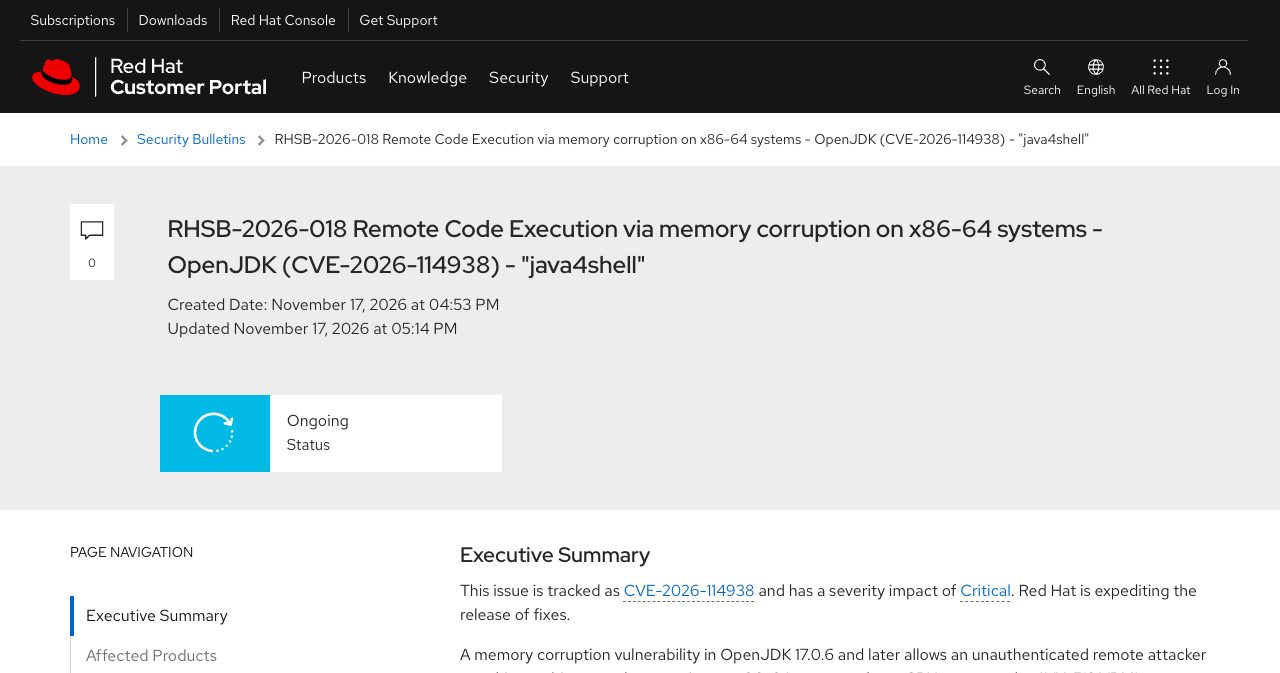
ARM64 is out entirely. Equixly lists AWS Graviton, Ampere, Azure Cobalt, Google Axion and Apple Silicon as unaffected, and ran 794 crafted inputs against Temurin 17.0.21 on arm64 without a single stray write. Older x86 is out as well: Skylake, Cascade Lake and Cooper Lake Xeons, plus EPYC before Zen 4. On Hacker News, one commenter put the AMD cutoff at server chips from 2023 onward, since Naples, Rome and Milan top out at AVX2.
So "we're on ARM" is a real mitigation. "We're on x86" is not an excuse, because the current x86 instance families at AWS, Google Cloud and Azure on Red Hat's list are exactly the silicon this bug needs.
Products Calif broke
Calif tested popular Java products in their default configurations. Pre-authentication remote code execution: Keycloak, Atlassian Jira, Atlassian Confluence, JFrog Artifactory, Jenkins and PingFederate. Post-authentication: Apache Kafka Broker, Apache Solr, Elasticsearch, Gerrit and Spinnaker. It also showed RCE in sample apps built on Apache Struts and Spring Boot, and calls every one of these lists non-exhaustive. BleepingComputer's report by Lawrence Abrams carries the same lists.
Calif also says samczsun shared a client-side exploit: a Java program that opens a TLS connection to a malicious server can be compromised even if it exposes no service at all. Think webhook senders, link-preview bots, SDKs that call third-party APIs, and AI agents that fetch URLs through a Java HTTP client. Outbound-only is not a safe category this time.
Is my server actually exploitable? The fifteen-minute check
A host is exploitable only when four conditions line up: the CPU has AVX-512 VBMI, the JVM is an unpatched 17.0.6+, 21, 25 or 27 build, the Base64 intrinsic is on (it is by default), and untrusted Base64 reaches java.util.Base64. Check them in that order, because the first one clears the most machines.
Start with the CPU. This is Calif's check for Linux:
grep -m1 '^flags' /proc/cpuinfo | tr ' ' '\n' | grep -E '^(avx512f|avx512bw|avx512vbmi|bmi2)$'
All four flags have to print. Three out of four and the vulnerable stub never runs. Do this per instance family, not per account, since a mixed fleet can have one family exposed and the next one clean.
Next, find every JVM and its real version:
ps -C java -o pid=,args=
readlink -f /proc/<PID>/exe
jcmd <PID> VM.version
Equixly's warning matters here: java -version describes the first Java on your PATH, not the one Jira launched from its own install directory. Check Point adds that bundled runtimes don't get OS updates at all, and that Atlassian's installers ship their own.
Then look at the flags:
jcmd <PID> VM.flags
java -XX:+PrintFlagsFinal -version | grep -E 'UseAVX|UseBASE64Intrinsics'
The first command reads the running process. On an affected CPU and build, if neither -XX:-UseBASE64Intrinsics nor -XX:UseAVX=2 appears, the vulnerable path is live. The second shows what a fresh JVM on that host would pick up, including anything set through JAVA_TOOL_OPTIONS.
Last, ask where outside Base64 meets a Java decoder before authentication. Chainguard's harness crashed while fuzzing the code that reads the HTTP Authorization header, before any credential check. Upwind says to start your log review with Authorization headers too, and Aikido adds login headers and file uploads. Basic auth is the obvious one, since its whole value is Base64.
For containers, the base image is the runtime. Check the FROM line in each Dockerfile and rebuild once the base updates, as Equixly advises. Include the side services nobody owns. Our write-up on an AI agent framework the FBI says reached admin in under three hours found side apps nobody watched among its usual ways in.
Don't treat a quiet trigger test as a clean bill of health. ComputingForGeeks fired the 64- and 128-character triggers at several last-vulnerable builds on November 18 and got a plain exception each time, while Upwind reproduced the overflow on Temurin builds running on an AWS c6i. So a probe that comes back clean tells you little; go by the build number and the CPU flags.
How do I patch Java4Shell across a small fleet?
The fix goes into the Java runtime: install your distribution's fixed build or rebuild containers from a patched base image, then restart every JVM. Here's where each vendor stood on November 18, 2026.
| Distribution | Fixed builds | Source |
|---|---|---|
| OpenJDK upstream | 17.0.21.1, 21.0.13.1, 25.0.5.1, 27.0.1.1 | Chainguard, JFrog Security Research |
| Oracle Java SE | 17.0.21.1, 21.0.13.1, 25.0.5.1, 27.0.1.1; 8u513-perf | Tenable |
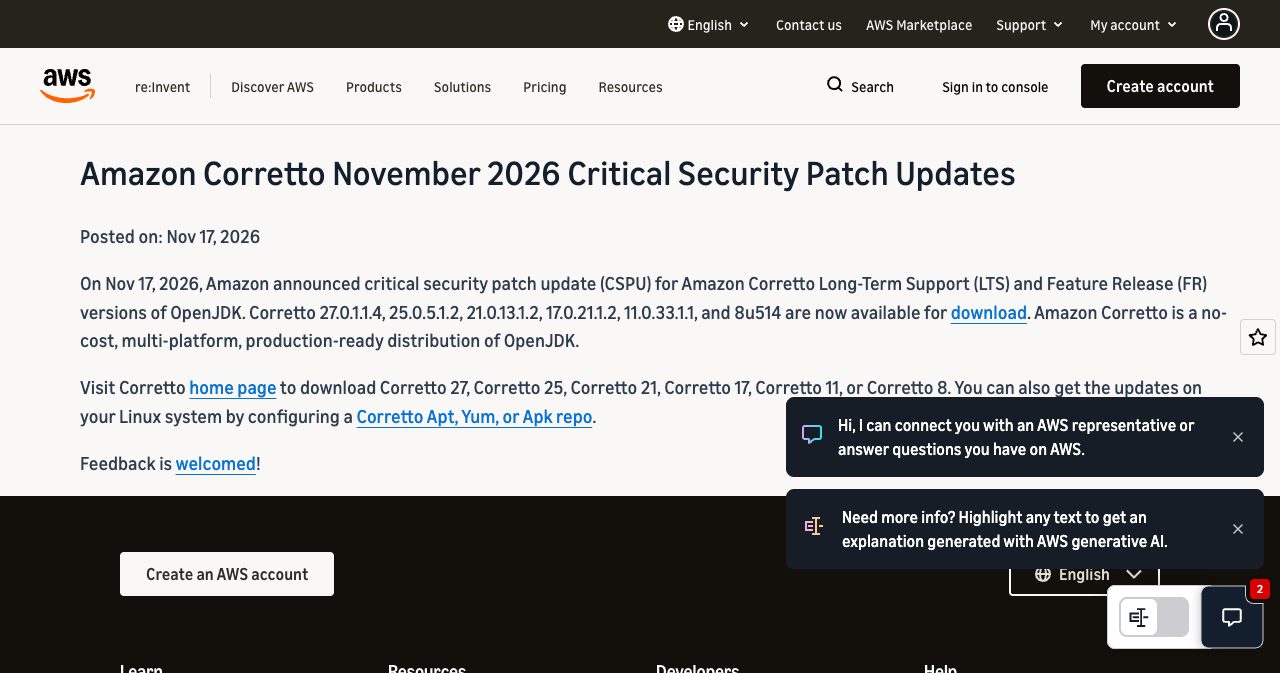
| Amazon Corretto | 17.0.21.1.2, 21.0.13.1.2, 25.0.5.1.2, 27.0.1.1.4 | AWS, Nov 17 |
| Azul Zulu (Community) | 17.70.201, 21.54.201, 25.38.201, 27.30.201 | Azul release notes, Nov 17 |
| Eclipse Temurin | 17.0.21.1+2, 21.0.13.1+2, 25.0.5.1+2, 27.0.1.1+4, publishing as testing completes | Adoptium, Nov 18 |
| Chainguard and Wolfi images | openjdk-17 17.0.21.1, openjdk-21 21.0.13.1, openjdk-25 25.0.5.1, openjdk-27 27.0.1.1 | Chainguard |
| Alpine 3.23 and 3.24 | openjdk17 17.0.21.1_p2-r0, openjdk21 21.0.13.1_p2-r0, openjdk25 25.0.5.1_p2-r0 | ComputingForGeeks |
| Red Hat (RHEL 8, 9, 10; Red Hat build of OpenJDK 17, 21, 25) | Fixes being expedited, errata to follow | RHSB-2026-018 |
| Debian | Fixed in sid (17.0.21.1+2 and up); bookworm and trixie pending | ComputingForGeeks |
| Ubuntu 24.04 | No security notice yet | ComputingForGeeks |
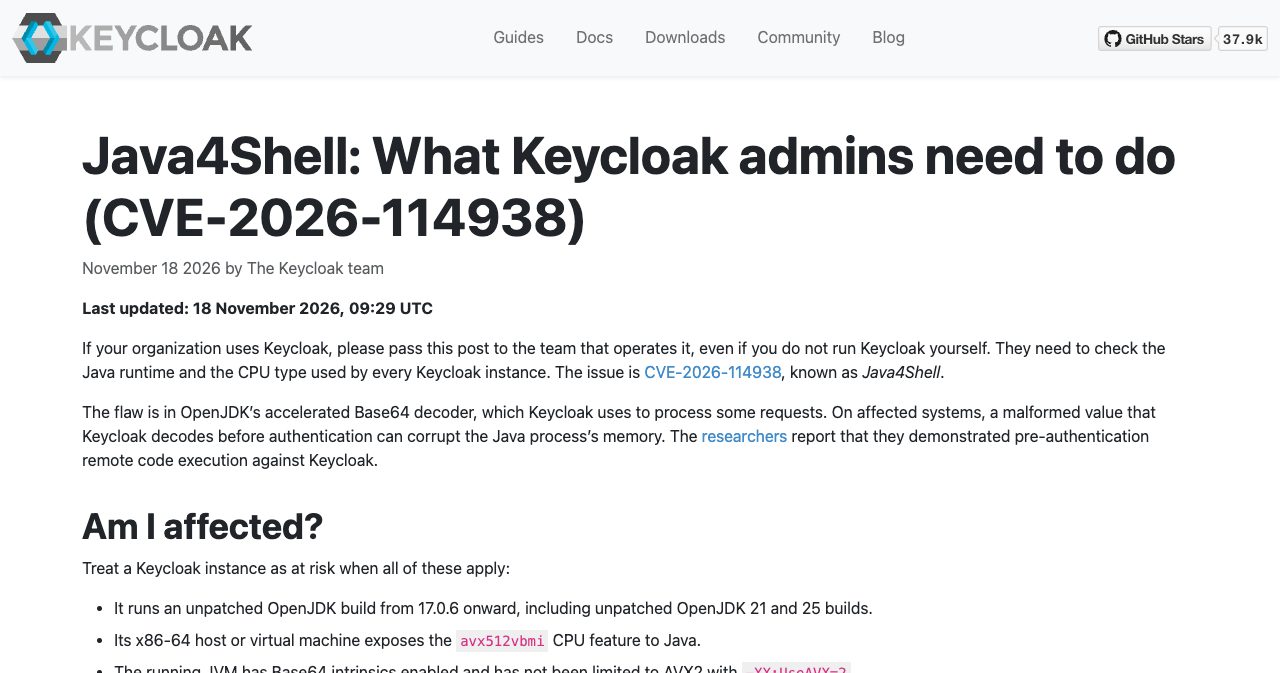
| Keycloak container images | No fixed image yet; use the flag | Keycloak, Nov 18 |
Microsoft Build of OpenJDK and BellSoft Liberica were still listed as unconfirmed in Check Point's November 18 roundup, so look at their release pages before you assume anything. The Azul builds above carry JDK 17.0.21.1+2, 21.0.13.1+2, 25.0.5.1+2 and 27.0.1.1+4, and Azul's table lists CVE-2026-114938 by number.
The order I'd follow on a fleet of five to fifty boxes:
- Inventory every JVM, including bundled ones. List hosts, containers, vendor appliances, CI runners and internal tools that run Java. Products such as Jira and Confluence ship their own runtime, so an OS update does not touch them.
- Rank by exposure. Identity providers first (Keycloak, PingFederate), then Jira, Confluence, Jenkins and Artifactory, then other internet-facing Java that handles logins, tokens or uploads, then internal systems and Java clients.
- Check the CPU and the build. Run the four-flag CPU check and jcmd VM.version on each host. ARM64 hosts and x86 hosts without AVX-512 VBMI drop to your normal patch cycle.
- Set the flag where no patch exists yet. Start the JVM with -XX:-UseBASE64Intrinsics through JAVA_TOOL_OPTIONS or the product's own option (JAVA_OPTS_APPEND for Keycloak, a jvm.options.d file for Elasticsearch), restart it, and confirm the flag with jcmd VM.flags.
- Install the fixed build and restart. Upgrade to 17.0.21.1, 21.0.13.1, 25.0.5.1, 27.0.1.1 or your vendor's equivalent, or rebuild container images from a patched base and redeploy. A running JVM keeps the old code until it restarts.
- Confirm on the running process. Run jcmd VM.version against the live process and look for the .1 build. Once that checks out, you can drop the flag and get the faster decoder back.
- Watch for crashes and odd Base64. Look for new hs_err_pid log files, SIGSEGV crashes, bursts of IllegalArgumentException from java.util.Base64, and Base64 values ending in = whose length is not a multiple of 4. On an exposed identity provider, treat unexplained crashes since November 17 as a reason to rotate signing keys and sessions.
The ranking in step 2 is Check Point's, and it's the right one. The hunting signals in step 7 come from Upwind and ThreatDefence. If step 7 turns something up, assume anything that process could read is exposed and replace it; our LiteLLM credential stealer write-up has rotation steps for exactly that situation.
For a small team the patch costs nothing, but the restart does. A single-node Jira restart is a maintenance window your support inbox will notice, and a single Keycloak node going down blocks every login that runs through it until it's back. The flag needs a restart too, so no path avoids one. Where your vendor's fixed build is already out, skip the flag and spend that one restart on the real fix.
What if I can't patch today? Do the -XX flags actually work?
Yes, with conditions: -XX:-UseBASE64Intrinsics sends decoding through the bounds-checked Java code and is Red Hat's preferred interim fix, while -XX:UseAVX=2 works only on x86 and stops ARM JVMs from starting at all.
Chainguard describes the trade-off of the first flag: the JVM "uses the bounds-checked Java decoder, at some throughput cost." Red Hat's bulletin and Keycloak's guidance both pick it. Classmethod tested it on Corretto on November 18 and showed that the flag takes effect when passed through JAVA_TOOL_OPTIONS, with PrintFlagsFinal reporting UseBASE64Intrinsics = false {product} {environment}. For the claim that it stops the out-of-bounds write, Classmethod points to Upwind's lab tests on an AWS c6i.
The second flag is blunter. -XX:UseAVX=2 switches AVX-512 off for the whole JVM, which removes the vulnerable path along with every other AVX-512 optimization. Calif's warning: apply it on x86-64 hosts only, because OpenJDK on ARM doesn't recognize it and will fail to start. If one Helm chart deploys to a mixed x86 and Graviton fleet, that flag takes down the ARM half. Skip -XX:DisableIntrinsic=_base64_decodeBlock as a standalone fix, too; Upwind says it fails as written, and Check Point says not to rely on it alone.
One person in the Hacker News thread got lucky. Their team had set UseAVX=2 on every JDK host the year before for unrelated thermal problems, which left them outside the blast radius by accident.
Where the flag goes depends on the product:
- In containers and systemd units, set
JAVA_TOOL_OPTIONS=-XX:-UseBASE64Intrinsics, which the JVM reads at startup. - In Keycloak's official images, use
JAVA_OPTS_APPENDand append to any existing value rather than replacing it. A maintainer notes in the tracking issue that the 26.8.2kc.shalready appends that variable, so no image rebuild is needed. - With the Keycloak Operator, put
JAVA_OPTS_APPENDin the Keycloak custom resource underspec.unsupported.podTemplate. The Keycloak team's warning: "Configuring the Operator does not configure the Keycloak pods that it manages." - For Elasticsearch, Check Point recommends a file in
jvm.options.d.
You can also filter at the edge while you wait. AWS added three rules to its AWSManagedRulesKnownBadInputsRuleSet in Version_1.28: Java4Shell_HEADER, Java4Shell_QUERYARGUMENTS and Java4Shell_BODY, all defaulting to Count. A second Classmethod test found the region's default was still Version_1.26, so you have to pin 1.28 yourself, and only the header variant of the trigger matched when set to Block. In your own code, Chainguard suggests rejecting Base64 whose length, after stripping whitespace, isn't a multiple of 4, before it reaches decode. The US Cybersecurity and Infrastructure Security Agency (CISA), in its November 17 alert, recommends the same kind of input validation plus limits on unauthenticated access. All of these buy time until the JVM update lands.
Keycloak, Jira, Confluence, Jenkins, Artifactory: what do the vendors say?
As of November 18, Keycloak has the most specific guidance (set the flag now, fixed images to follow), Red Hat rates the bug Critical and is expediting fixes, and for Jira, Confluence, Jenkins and Artifactory the fix is the Java runtime underneath them.
Keycloak is the sharpest problem on the list. Teams run it as the single sign-on and identity provider for everything, often including enterprise customers who log in through it, so a pre-auth bug there reaches the identity plane for every customer you onboarded that way. One Hacker News reply spelled out the risk: picture "a semi-working exploit that dumps some parts of heap memory with live tokens," pointed at the Keycloak instances visible on the public internet.
The Keycloak team's post, last updated November 18 at 09:29 UTC, says the x86-64 images 26.8.2-1 and 26.8.2-2 bundle an affected OpenJDK 21.0.13 build, that ZIP and tarball installs can be affected too, and that it "cannot recommend a specific fixed Keycloak image" yet. It also warns not to use the Keycloak version number alone to decide whether a deployment is fixed. The tracking issue, keycloak/keycloak#55293, is labeled severity/critical, and a pinned maintainer comment promises fresh container images as soon as OpenJDK fixes are available for them.
Red Hat's RHSB-2026-018, created on November 17, covers RHEL 8, 9 and 10 and the Red Hat build of OpenJDK 17, 21 and 25. It says any Red Hat product supported on RHEL is potentially affected, including RHEL-based containers and OpenShift. Its summary: "Pre-authentication remote code execution has been demonstrated."
For Jira and Confluence Data Center, the runtime that counts is the one in the install directory, which Check Point notes doesn't move when you patch the OS. Jira Cloud and Confluence Cloud run on Atlassian's JVMs, so there's nothing for you to restart there. Jenkins and Artifactory follow the same rule as any Java app: whatever JVM the controller or server runs on is what you patch. JFrog's research team published its own Java4Shell explainer on November 17, listing the fixed upstream versions and saying Xray and JFrog Catalog already flag the CVE in scans. For Elasticsearch, use the jvm.options.d flag above. Check Point puts PingFederate next to Keycloak at the top of its patch order, for the same identity-provider reason.
Why did a fix sit in a closed pull request for two months?
Because nobody reviewed it. Pull request openjdk/jdk#32781 described the exact bug on September 9, 2026, received no reviews, drew an inactivity warning from a bot on November 4, and was closed by its author the same day without merging.
The pull request is titled "8392044: AVX-512 Base64 decoder overwrites output buffer on short padded tail." Its description names the routine (StubGenerator::generate_base64_decodeBlock() on the x86-64 AVX-512 VBMI path), explains that the padding path pushes the output size below zero, gives the trigger "A".repeat(64)+"=", and proposes the fix: return early to Java when fewer than four bytes are left. The comment carries GitHub's Member badge, and the OpenJDK bot tagged it hotspot-compiler and set the required reviews to two. It got zero.
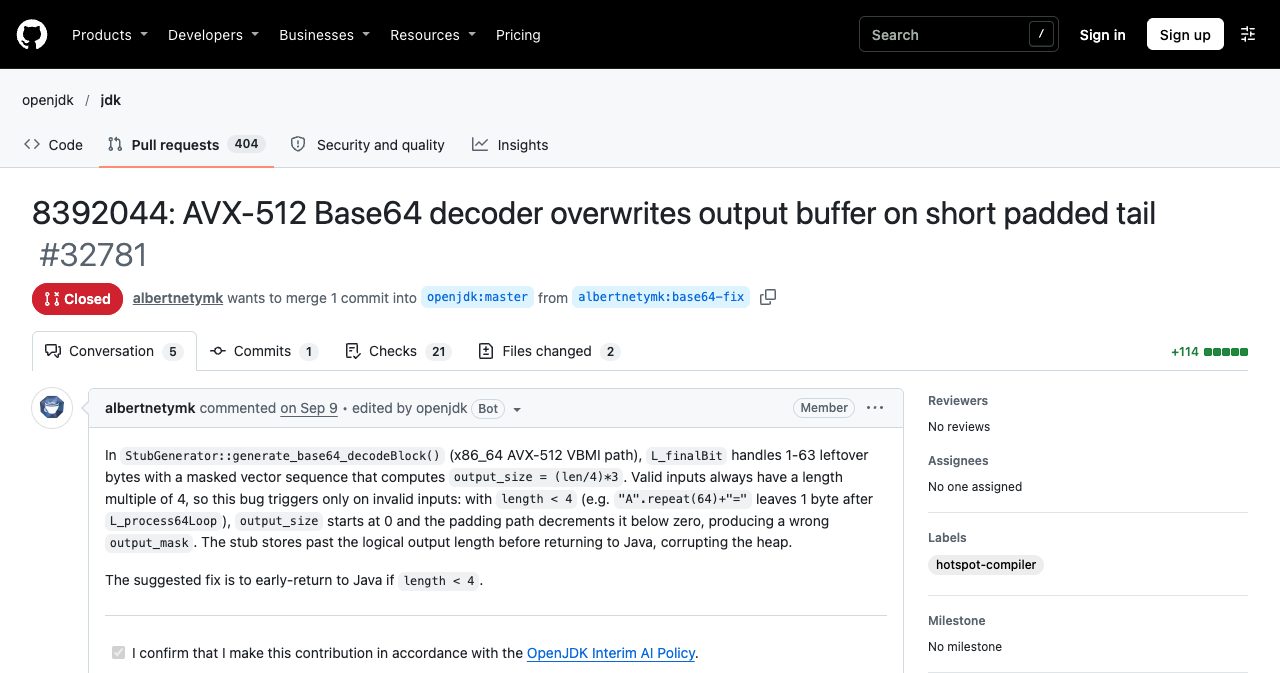
On November 4 the project's bridgekeeper bot posted that the PR had been inactive for more than eight weeks and would be closed automatically after another eight. The author closed it that day. Chainguard describes it as "auto-closed without merging, so the bug stayed open in shipped builds." Either way, the outcome for users was the same. Nothing on the PR page says why it went unreviewed.
There was a second track. Endor Labs diffed the jdk-27.0.1-ga and jdk-27.0.1.1-ga tags and found a four-line fix, JDK-8393212 "Base64 optimization improvements", which it says was committed under embargo on October 14, 2026. Endor marks the link between that fix and the CVE as not confirmed. The public PR and the embargoed fix never reference each other.
Then the discoveries piled up. Chainguard puts it bluntly: "This bug was found three different times in the last few weeks." The September PR was the first. Chainguard dates Calif's find to October 30. Chainguard's own came on November 13, when its Harness tool was writing fuzzing harnesses for the credential parsers of an open-source Java server cluster. One run died after about three minutes with a JVM crash, a SIGSEGV inside base64_decodeBlock, and Chainguard's agents confirmed the server reached that code before checking any credential. Chainguard reported it to Oracle.
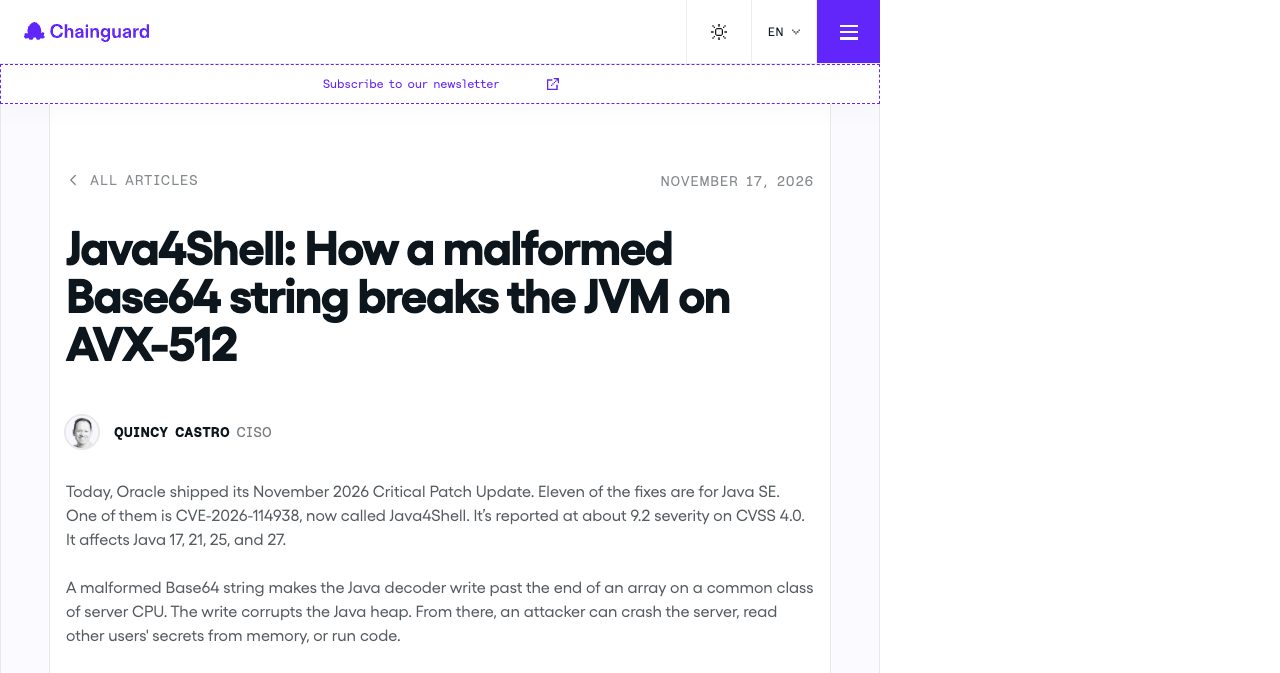
Calif's economics are the part to remember. Quang Luong found the bug in about an hour and had the first working exploit two hours later, and "the total token cost was less than $200." The write-up names Codex as the tool he pointed at the code, and describes the result as "the centaur hacker, part human, part AI." The AI found the bug and humans built the chains. On Hacker News, commenter fweimer added that an open model, GLM 5.3, produced a Java test reproducing the overrun from the sources with the fix removed, while noting that turning it into a reliable exploit "probably still requires some expertise."
Funny coincidence: this is the second bug this month where a long run of the letter A did the damage. On November 5, OpenSSH shipped a fix for one where a password of 300 A's opened passwordless SSH accounts on Alpine Linux.
Chainguard's closing argument is the part founders should take away. Discovery, it writes, "is not even half of the battle." Fixing requires "numerous vendors patching rapidly" and "organizations upgrading just as fast." And: "One CVE maps to many Java builds. Each one needs its own patched release. And then each release needs to be adopted." Finding this bug took an afternoon, while shipping the fix took a coordinated release across Oracle, OpenJDK and a dozen distributions, and getting it onto your servers still waits on your restart. The bottleneck moved from finding bugs to shipping fixes, and the last mile of shipping belongs to you.
Is anyone exploiting Java4Shell yet?
Not confirmed as of November 18, 2026: Aikido, Tenable and ThreatDefence report no exploitation in the wild, and the CVE is not on CISA's Known Exploited Vulnerabilities catalog.
CISA still wants it patched now. Its November 17 alert, "Critical Java Vulnerability Requires Immediate Patching," says: "CISA strongly urges organizations to immediately patch the recently disclosed Oracle Java vulnerability." It tells teams to find Java bundled inside third-party apps, container images and appliances, to put internet-facing systems first, and to watch for "rogue runtimes, unexpected JVM crashes, and suspicious Java processes."
On the exploit side, Calif writes: "We are holding back the application-specific exploits for now," and says the chains stay private until people have had a chance to upgrade. Its public reproducer runs the trigger inside a 4096-byte array and prints REPRODUCED when 62 bytes change, so it's safe to run. Tenable reports that Immersive's Kevin Breen posted on X that he has a functional proof of concept, and notes it hasn't been released.
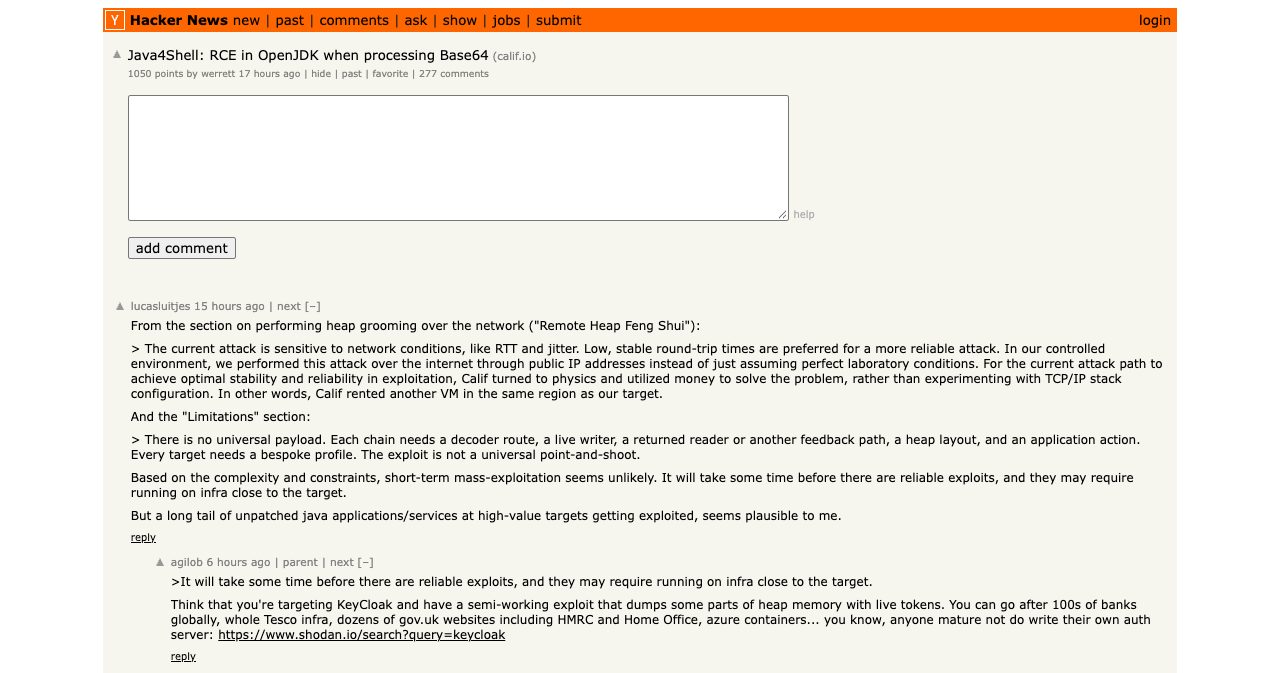
The main Hacker News thread passed 1,000 points within a day. Its top comment is a sober read: the commenter thinks short-term mass exploitation is unlikely, then adds, "But a long tail of unpatched java applications/services at high-value targets getting exploited, seems plausible to me." Another commenter noted that Debian wasn't patched at the time of writing, which matches the distribution table above.
Compare that with Calif's previous disclosure. PHP2Shell went from patch day to CISA's exploited list in five days, with honeypot hits before the embargo even lifted. Java4Shell is harder to weaponize per target, so the clock may run slower, but the targets (identity providers, CI servers, artifact stores) are worth a lot more to an attacker.
The New York Times covered the bug on November 17, and Calif links that story from the top of its disclosure page. Expect the question from people at your company who have never opened a terminal.
What should I tell my customers and put on my security page?
Tell customers which of your systems run affected Java, what you did and when, and whether they need to do anything, in plain words and with dates.
They will ask. Expect a named bug like this one in the next security questionnaire you get, and after a story in the Times, expect it sooner. The worst answer is "we're a Node shop, so we're not affected" from a team whose SSO runs on Keycloak. The second worst is "no evidence of exploitation" from a team that never opened the logs.
A status note that works:
On November 17, 2026, Oracle and OpenJDK fixed CVE-2026-114938 (Java4Shell), a memory-corruption bug in Java's Base64 decoder on certain x86 processors. [Component names] run Java on affected hardware. We applied the vendor's interim mitigation on [date] and installed the fixed Java build on [date]. [Component names] run on ARM processors or unaffected Java versions. Our review of logs and crash reports from November 17 onward found [result]. Customers do not need to take any action. [Or: customers running our self-hosted agent should update to version X, which bundles Java 21.0.13.1.]
If you ship anything Java to customers (an on-prem install, an agent, an SDK), say which of your releases bundle which JVM. samczsun's client-side exploit means a customer's Java client talking to a hostile server is in scope too, so your SDK users want to know.
Then put the note somewhere a buyer will find it. Buyers reach you through more doors than your homepage, and the careful ones end up on your security page. A directory listing is one of those doors, including on SaaSCity, a gamified startup directory with a live city map and human editorial review. A free listing gets you a page; add the SaaSCity badge to your site and you get a Monday launch slot. Quick Pass ($19.99) goes live within 24 hours, and Premium ($39.99) adds a written launch post with three links. None of that patches a JVM. It does mean more people will read the security page you write this week, so make it a good one.
The part of Java4Shell you control
Three separate parties found this bug in a little over two months. One posted the fix in public and watched it sit unreviewed, another needed an hour and less than $200, and Chainguard tripped over it three minutes into fuzzing a credential parser. Finding bugs like this is cheap now, and it is going to stay cheap.
The expensive part is the distance between a fixed build on a vendor's download page and a restarted JVM on your server. That distance is the only part of this story you control. The Optimizely supply chain attack made the same point about third-party scripts the same week: a vendor's code turned into the customer's incident.
So run the four-flag grep before lunch. Find the Keycloak box nobody has touched in a year and restart it with the fixed build. Then ask yourself a harder question: if the next runtime bug landed tomorrow, how many hours would it take your team to find every copy of the thing it lives in?
FAQ
What is Java4Shell (CVE-2026-114938)?
Java4Shell is the name Calif gave CVE-2026-114938, a heap memory-corruption bug in OpenJDK's hand-written AVX-512 Base64 decoder, disclosed on November 17, 2026. A malformed input of 64 'A' characters plus one '=' makes the decoder compute a negative output length and write 64 bytes, 62 of them past the end of a 50-byte array. Calif showed heap leaks and, with application-specific chains, pre-authentication remote code execution in Keycloak, Jira, Confluence, Jenkins, Artifactory and PingFederate.
Which Java versions are affected by Java4Shell?
OpenJDK 17 from 17.0.6 onward, plus Java 21, 25 and 27, up to builds 17.0.21.0.3, 21.0.13.0.3, 25.0.5.0.3 and 27.0.1.0.3, per Calif and Equixly on November 17, 2026. Oracle also lists its Java 8 Performance Pack build 8u511b33-perf. Standard Java 8 and Java 11 are not affected, per Chainguard and Adoptium. Downstream builds count too: Amazon Corretto, Eclipse Temurin, Azul Zulu, Microsoft Build of OpenJDK, BellSoft Liberica, SAP SapMachine and Red Hat OpenJDK.
Which Java builds fix Java4Shell?
OpenJDK and Oracle shipped 17.0.21.1, 21.0.13.1, 25.0.5.1 and 27.0.1.1 on November 17, 2026, plus 8u513-perf for Oracle's Performance Pack. Amazon Corretto's fixed builds are 17.0.21.1.2, 21.0.13.1.2, 25.0.5.1.2 and 27.0.1.1.4. Azul's November 17 Zulu builds carry 17.0.21.1+2 through 27.0.1.1+4, and Adoptium began publishing Temurin builds with the same numbers on November 18. Red Hat said on November 17 it is expediting fixes. A build ending in .0.3 is still vulnerable.
Which CPUs are affected by Java4Shell, and is ARM safe?
Only x86-64 CPUs with AVX-512 VBMI run the vulnerable code: Intel Xeon Ice Lake, Sapphire Rapids, Emerald Rapids and Granite Rapids, and AMD Zen 4 or newer, per Calif. Red Hat's RHSB-2026-018 names AWS C6i, M6i, R6i, C7i, M7i and R7a, Google Cloud C3, C4, N4 and M3 families, and Azure D-series v5 to v7. ARM64, including AWS Graviton, Ampere, Azure Cobalt and Google Axion, is not affected, and neither are Skylake-era Xeons or AMD EPYC before Zen 4.
How do I check if my server is vulnerable to Java4Shell?
Check /proc/cpuinfo on Linux: Calif says the flags avx512f, avx512bw, avx512vbmi and bmi2 must all be present. Then find each running JVM with ps, resolve its binary with readlink -f /proc/PID/exe, and read the real version with jcmd PID VM.version, because java -version only reports the first Java on your PATH. An unpatched 17.0.6 or later, 21, 25 or 27 build on such a CPU, started without -XX:-UseBASE64Intrinsics, is exposed.
Are Keycloak, Jira, Confluence, Jenkins and Artifactory vulnerable to Java4Shell?
Calif demonstrated pre-authentication remote code execution against default configurations of Keycloak, Atlassian Jira, Atlassian Confluence, JFrog Artifactory, Jenkins and PingFederate, and post-authentication RCE in Kafka, Solr, Elasticsearch, Gerrit and Spinnaker. Each is exposed when it runs an affected JVM on AVX-512 VBMI hardware. Keycloak said on November 18, 2026 that its 26.8.2-1 and 26.8.2-2 x86-64 images bundle an affected OpenJDK 21.0.13 build and told admins to set -XX:-UseBASE64Intrinsics until fixed images ship.
Does -XX:-UseBASE64Intrinsics mitigate Java4Shell?
Yes, as an interim measure. The flag makes the JVM use the bounds-checked Java decoder instead of the AVX-512 assembly stub, at some throughput cost, according to Chainguard, and Red Hat's RHSB-2026-018 calls it the preferred mitigation. The alternative, -XX:UseAVX=2, disables AVX-512 for the whole JVM and works only on x86-64; Calif warns that ARM JVMs do not recognize it and fail to start. Either flag needs a JVM restart and stays temporary until the fixed build is installed.
Why does Java4Shell have two CVSS scores, 9.2 and 8.1?
Calif scored it 9.2 (Critical) under CVSS 4.0. The OpenJDK and Oracle advisories of November 17, 2026 score it 8.1 (High) under CVSS 3.1, with the vector AV:N/AC:H/PR:N/UI:N/S:U/C:H/I:H/A:H. The only metric below maximum is AC:H, high attack complexity, which reflects the per-target heap grooming an exploit needs. With attack complexity set to Low, the same CVSS 3.1 vector scores 9.8. Red Hat rates the bug Critical in RHSB-2026-018.
Is Java4Shell being exploited in the wild?
Not as of November 18, 2026. Aikido, Tenable and ThreatDefence report no confirmed exploitation, and the CVE is not in CISA's Known Exploited Vulnerabilities catalog, although CISA issued a November 17 alert urging organizations to patch immediately. Calif is holding its application-specific exploits private, and its public reproducer only shows the overflow inside a safe array. Immersive's Kevin Breen said on X that he has a functional proof of concept, which Tenable notes has not been released.
What happened with OpenJDK pull request #32781?
Pull request openjdk/jdk#32781, titled "8392044: AVX-512 Base64 decoder overwrites output buffer on short padded tail", was opened on September 9, 2026. It described the bug using the input 'A'.repeat(64)+'=' and proposed an early return to Java when fewer than four bytes remain. It received no reviews. On November 4, 2026, after a bot flagged eight weeks of inactivity, its author closed it without merging, so shipped Java builds stayed vulnerable until the November 17 release.
Who found Java4Shell, and how much did it cost?
Quang Luong of Calif found it in about one hour and built the first working exploit two hours later, for less than $200 in model tokens, with Calif's write-up naming OpenAI's Codex as the tool. Chainguard found the same bug independently on November 13, 2026, when a fuzzing harness built with its Harness tool crashed in base64_decodeBlock about three minutes into a run. Chainguard dates Calif's find to October 30 and counts the September 9 pull request as the third discovery.
Do I need to patch Java4Shell if my product isn't written in Java?
Probably. Your product may be TypeScript or Python while your identity provider, CI server, wiki and artifact store run on Java. Calif's pre-authentication list covers Keycloak, Jira, Confluence, Jenkins, Artifactory and PingFederate, and samczsun shared a client-side exploit that compromises a Java program opening a TLS connection to a malicious server. Check every JVM in your infrastructure, including runtimes bundled inside vendor products, which OS updates do not patch, as Check Point noted on November 18, 2026.
Sources
- Java4Shell: Write once, RCE everywhere (Calif, November 17, 2026)
- OpenJDK Vulnerability Advisory: 2026/11/17 (OpenJDK, November 17, 2026)
- 8392044: AVX-512 Base64 decoder overwrites output buffer on short padded tail, PR #32781 (openjdk/jdk on GitHub, opened September 9, 2026)
- Java4Shell: How a malformed Base64 string breaks the JVM on AVX-512 (Chainguard, Quincy Castro, November 17, 2026)
- CVE-2026-114938: Pre-auth heap overflow in Java 17, 21, 25, and 27 (Equixly, November 17, 2026)
- Critical Java4Shell flaw allows RCE attacks on major Java applications (BleepingComputer, Lawrence Abrams, November 17, 2026)
- RHSB-2026-018: Remote Code Execution via memory corruption on x86-64 systems, OpenJDK (Red Hat, November 17, 2026)
- Critical Java Vulnerability Requires Immediate Patching (CISA, November 17, 2026)
- Java4Shell: What Keycloak admins need to do (Keycloak, November 18, 2026)
- Mitigate OpenJDK Base64 intrinsic vulnerability, issue #55293 (keycloak/keycloak on GitHub, opened November 17, 2026)
- Java4Shell (CVE-2026-114938): Frequently asked questions (Tenable, Satnam Narang, November 17, 2026)
- Java4Shell (CVE-2026-114938): Check Your Java Services Now (Check Point, November 18, 2026)
- Java4Shell RCE: affected versions and fix (Aikido, November 17, 2026, updated November 18)
- Java4Shell: What We Know Now and What Comes Next (Upwind, November 17, 2026)
- Java4Shell (CVE-2026-114938): Pre-Auth Heap Overflow in OpenJDK (Endor Labs, Peyton Kennedy, November 17, 2026)
- Java4Shell: What We Know About the Critical OpenJDK RCE Vulnerability (JFrog Security Research, November 17, 2026)
- Java4Shell CVE-2026-114938: Patch Vulnerable OpenJDK (ComputingForGeeks, updated November 18, 2026)
- Java4Shell CVE-2026-114938: Java 17 RCE checks and hunting (ThreatDefence, November 18, 2026)
- Amazon Corretto November 2026 Critical Security Patch Updates (AWS, November 17, 2026)
- November 2026 Monthly Update Release Notes (Azul, November 17, 2026)
- Eclipse Temurin guidance for CVE-2026-114938 "java4shell" (Adoptium, November 18, 2026)
- Updating Corretto, setting JVM flags and an AWS WAF count rule for Java4Shell (Classmethod, November 18, 2026)
- AWS WAF Known Bad Inputs rules for Java4Shell (Classmethod, November 18, 2026)
- Java4Shell: RCE in OpenJDK when processing Base64 (Hacker News thread, November 17, 2026)
- The New York Times story on the bug, linked from Calif's disclosure (November 17, 2026)
Get your SaaS in front of founders
List your product on SaaSCity for $19.99, one-time: a permanent listing and a building on the live city map.