Reviews
Raileon Review 2026: Miami's Managed AI Automation at $1,999 a Month
Raileon is a Miami managed service that designs, builds and then runs custom software, automation and AI Modules inside the tools a business already pays for, with monthly care from $1,999. Here is what it builds, how the approval model protects you, which of its 84 integrations can really act, what the free Business Checkup measures and how the monthly maths works out.

Contents (19)
- Raileon at a glance
- What Raileon is, and why it is easy to check out
- What Raileon actually builds
- What that looks like in a normal week
- How an engagement works
- The approval model, which is the strongest thing here
- Integrations: 84 apps, and what each status means
- The free Business Checkup
- The $299 Business Audit
- Pricing, line by line
- Raileon Social and Raileon Ads
- Security and data
- Who is behind it
- The Miami and South Florida angle
- Who gets the most out of Raileon
- Raileon vs DIY, a freelancer, an agency or a hire
- Questions to bring to the free call
- Verdict
- FAQ
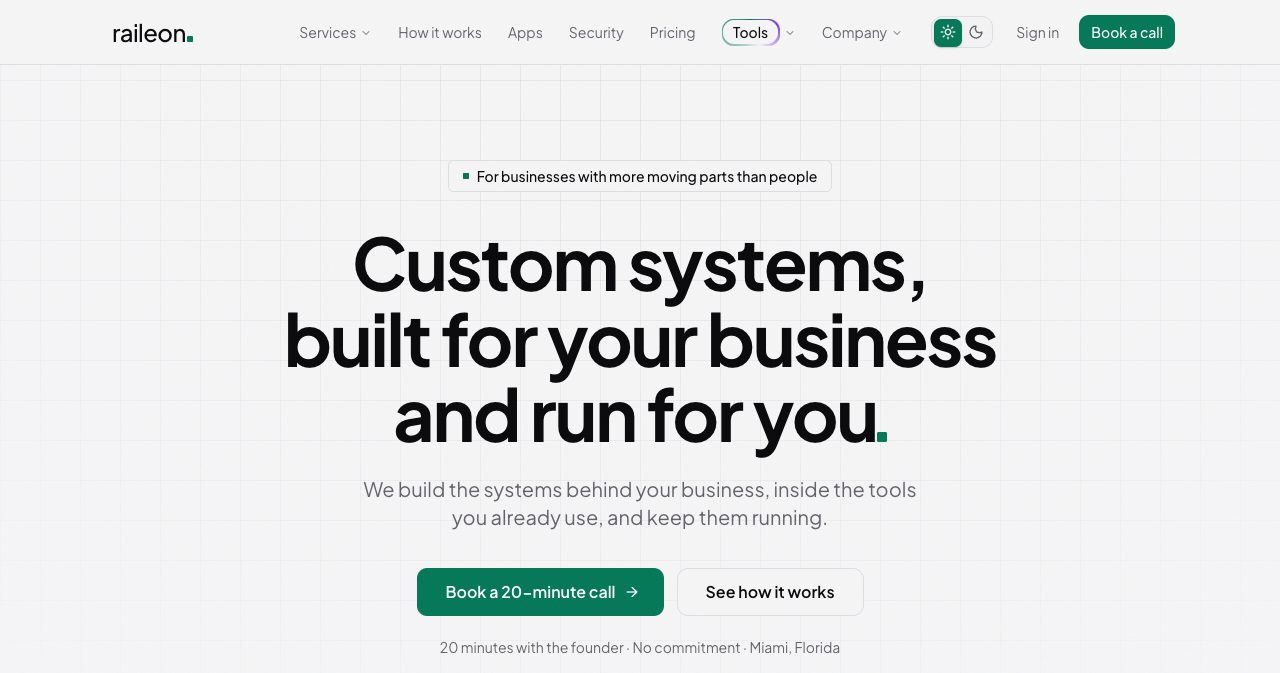
Product details checked against raileon.com, its pricing, security, integrations, about, tools and docs pages on October 21, 2026. Screenshots taken from the live site in Google Chrome the same day.
Quick answer: Raileon is a Miami company that designs, builds and then runs custom automation, software and AI "Modules" for small and mid-sized businesses, inside the tools those businesses already pay for. Monthly care starts at $1,999, new builds are quoted per project, and there is a genuinely free 30-second Business Checkup if you want to see how it thinks before you talk to anyone. It is built for businesses with real repetitive work and nobody technical on staff — the kind of firm where leads pile up in an inbox because everyone is already doing three jobs.
Most automation tools hand you a box of parts and wish you luck. Raileon takes the opposite position: you describe how your business runs, its team builds the systems, connects them to your existing software, and then keeps the whole thing running every month. Think of it as renting a small operations and engineering team rather than buying a tool. You do not log into a blank canvas and drag boxes around; you get a private dashboard, a set of workflows that do specific jobs, and a human on the other end when something needs to change.
We looked at it the way we look at everything on SaaSCity — pricing pages, documentation, security claims, and what happens after the demo.
Raileon at a glance
- Managed service, not software: design, build, run, monitor, fix, update and back up.
- Monthly care from $1,999, with setup, AI usage and extra work quoted in a written proposal.
- Operated by SkyRaileon LLC, a Florida LLC based in Miami, run by founder and CEO Konstantin.
- Work is organised into custom software, automation, AI Modules and team training.
- Approvals and an audit log by default; payments, ad spend, e-signatures and public posts always wait for a person.
- 84 apps listed and 79 connectable today, with a published status for every one.
- A free 30-second Business Checkup and a $299 Business Audit as no-risk entry points.
- A security page that states plainly where the company stands on SOC 2, ISO 27001, penetration testing and HIPAA.
What Raileon is, and why it is easy to check out
Two things are worth separating before anything else, because both cause confusion.
The first is what you are buying. This is a service business, so there is no app store listing to poke at. What there is instead is unusually good documentation for a custom-development shop: the four invoice lines, the five-step process, the status of all 84 integrations, the security model with its certification position spelled out, a free tool you can run in 30 seconds, and a sample audit report you can read before paying. That is the reason this review can be specific instead of vague, and it is also the first good sign about the company.
The second is the name. Raileon, with an "i", is not Raleon, the e-commerce retention platform. Different company, different product, different city. If you landed here after searching for the retention tool, you are in the wrong place. If you were looking for a managed automation partner in South Florida, carry on.
What Raileon actually builds
The work is organised into four areas, plus two packaged marketing services. Here is how each reads once you strip the marketing language off it.
1. Custom software
Private dashboards, customer portals, internal tools and connections between systems you already use. This is the "we will build the thing you wish existed" part, quoted per project.
2. Automation
The repetitive work: lead follow-up, client intake, CRM updates, weekly reporting. Raileon is refreshingly candid that plain rules beat AI for predictable steps, because rules are cheaper and more reliable. AI gets used where a step needs judgment, like reading a document or drafting a reply.
3. Custom AI Modules
A Module is one workflow that does one real job on a schedule. The company's own examples are following up with leads, updating a CRM and producing a weekly report. Unlike a chatbot, a Module does not sit waiting for you to type something: it does the work, and by default asks before anything customer-facing goes out. Modules answer from your own documents, rules and tone, and run in a private workspace with spending limits.
4. Team training
Hands-on sessions so your people know how to use what was built, and how to handle client information safely around AI. It is the part most vendors skip, and probably the part that decides whether any of it gets adopted.
What that looks like in a normal week
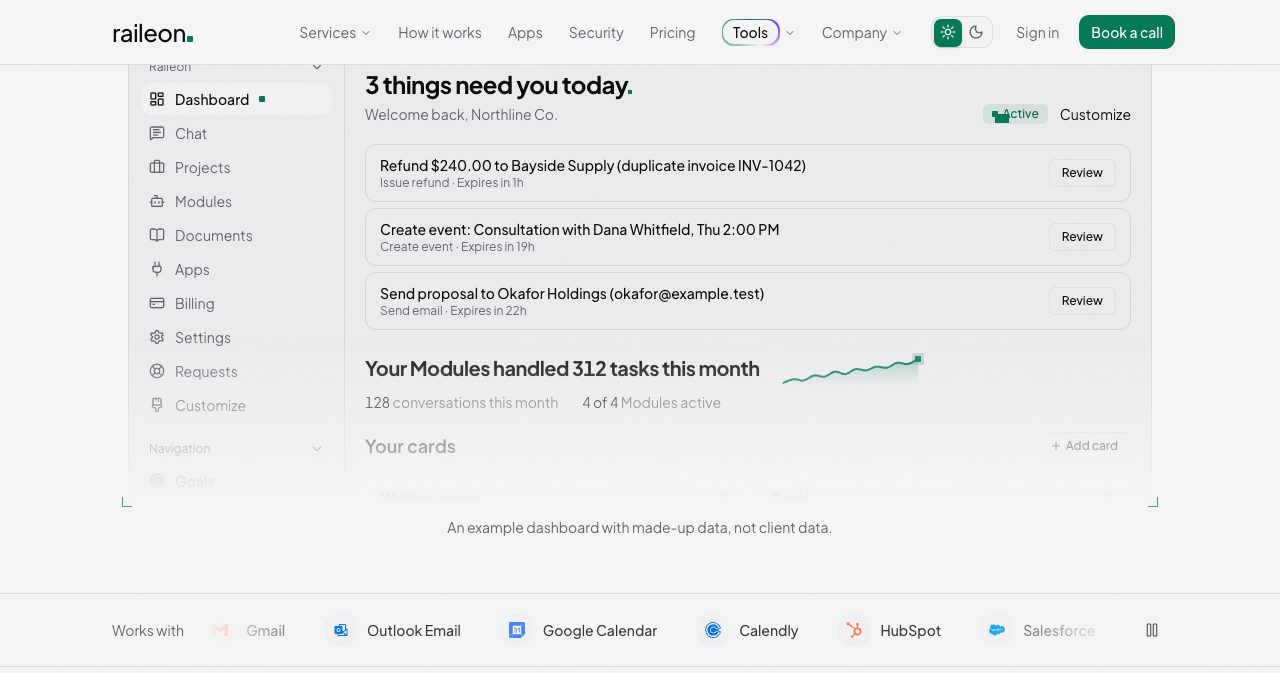
The homepage walks through four before-and-after scenarios, labelled as illustrative with example figures rather than measured results. Read them as the shape of the work rather than as proof — the shape is the useful part:
- Lead follow-up. A lead fills in a form; instead of someone noticing hours later, a reply is drafted immediately, you approve it, and a meeting lands on your calendar.
- Client intake. Details arriving by email, phone and web form get gathered into one record, a welcome email is drafted, and your CRM updates after you approve.
- Weekly reporting. The Monday-morning scramble of pulling numbers from four tools becomes a finished report waiting in your inbox.
- Client outreach. Every month a personal note is drafted for each past client, and nothing goes out until you sign off.
None of that is science fiction, and if you run a ten-person firm you have probably muttered "someone should automate this" about at least two of the four. The value is not novelty. It is that somebody else owns the build, the monitoring and the fixing.
How an engagement works
The process runs in five steps, and the best part is that the first two cost nothing.
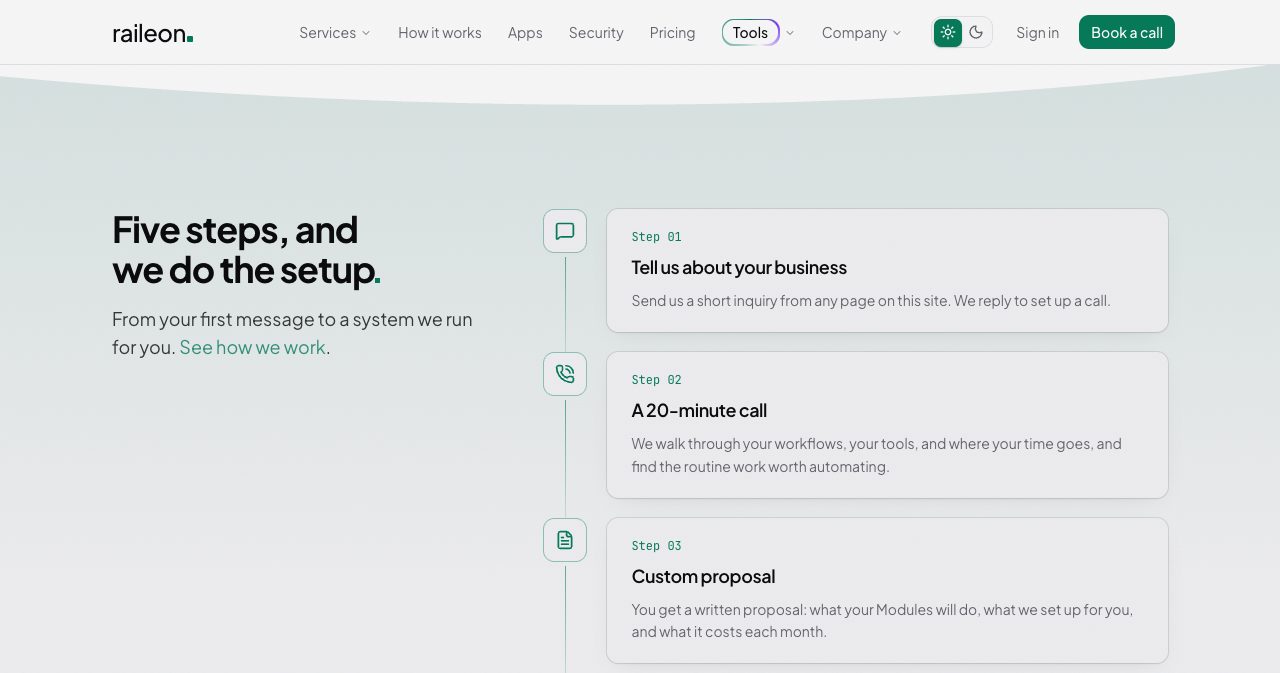
- You send a short inquiry from any page on the site, and Raileon replies to set up a call.
- A 20-minute call with the founder, no commitment and no credit card, mapping the work that repeats, the tools it lives in and where the hours go.
- A written proposal: what your Modules will do, what Raileon sets up and what it costs each month. One written price before anything starts.
- Sign and pay online in one step. That first payment covers the setup fee, if your proposal has one, plus your first month.
- Build and go live, then managed care: monitoring, fixes, updates, daily backups and a dashboard showing what your Modules did.
The timeline is scoped with you rather than promised on a marketing page, which is how custom work actually behaves. Ask for milestones in the proposal and you will get them in writing, tied to the scope you agreed.
The approval model, which is the strongest thing here
The honest reason owners are nervous about "AI that acts for you" is the horror story where it emails a client something stupid. Raileon's answer to that is structural rather than a promise to be careful:
- By default, anything that reaches a client waits for your approval.
- Payments, purchases, ad spend, e-signatures and public posts always wait for a person, and the company says that cannot be switched off.
- Every action is recorded in an audit log, including who approved it.
- A monthly AI budget can be set, with a warning email as you approach it; at the limit, Modules pause until it is raised or the month resets.
- A separate daily and monthly safety limit is always on, so a runaway Module cannot quietly run up your AI bill.
That last pair is more practical than it sounds. Usage-based AI costs are the sneaky part of any automation project, and a hard stop built into the product suggests people who have been burned before — and who decided not to pass that experience on to you.
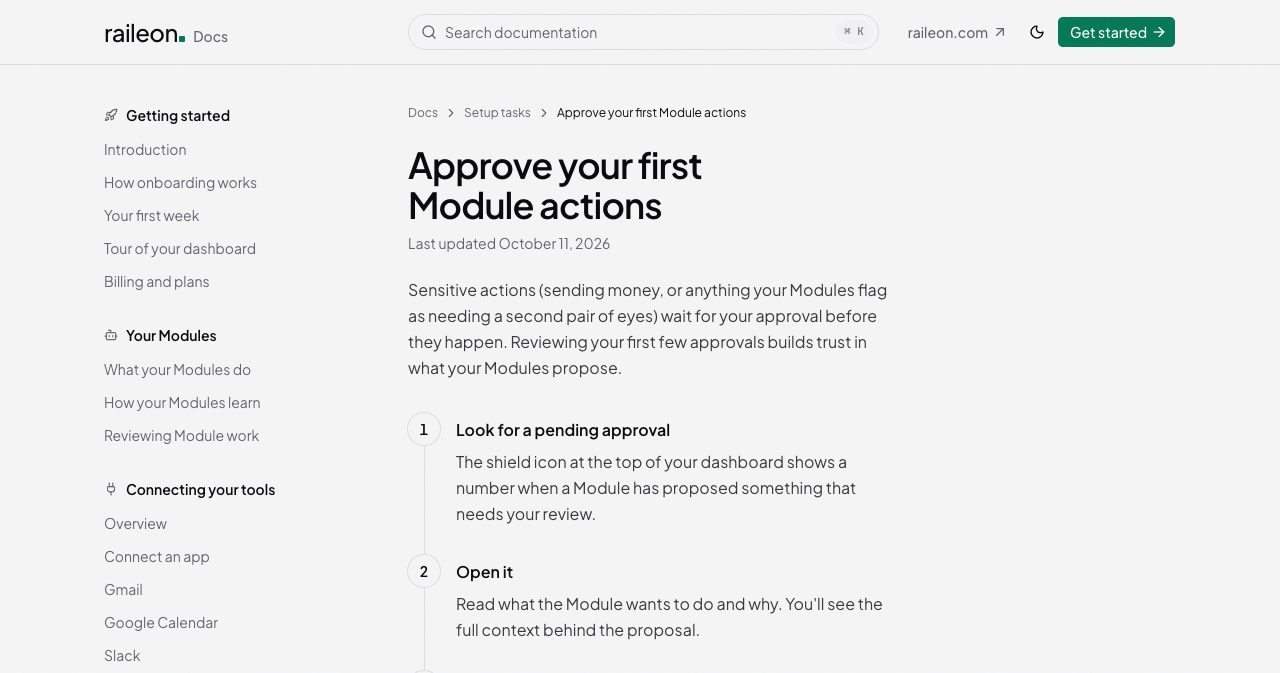
The practical tip: settle during the proposal stage which actions are low-risk enough to run without a click and which deserve your eyes. Raileon says approval rules are set with you, so that is a conversation you get to have while it is still easy to change — and it is the difference between a workspace that saves you hours and one that just moves them around.
Integrations: 84 apps, and what each status means
The apps page lists 84 apps in total, and 79 of them connect today. The headline number is less useful than the status attached to each app, and Raileon publishes that for every single one:
| Status | Apps | What it means |
|---|---|---|
| Ready | 56 | Modules can read, and often act, on the connected app |
| Link only | 19 | Connect the account today; Module actions for it are on the way |
| On request | 4 | Available when your Raileon team switches it on |
| Coming soon | 5 | Not available yet |
The categories are broad: email and calendar (Gmail, Outlook, Google Calendar, Calendly, Cal.com, Zoom), messaging and voice (Slack, Telegram, Google Chat, Aircall, Dialpad, RingCentral), CRM and support (HubSpot, Close, Pipedrive, Follow Up Boss, Zendesk, Freshdesk), accounting and payments (QuickBooks, Xero, Stripe, Shopify, FreshBooks, Wave, Bill.com, Sage, Expensify), legal and real estate (Clio, Filevine, PracticePanther, Smokeball, DocuSign, Dotloop, MLS through the RESO Web API), and projects and files (Airtable, Monday.com, Trello, Google Drive, Dropbox, OneDrive, Box).
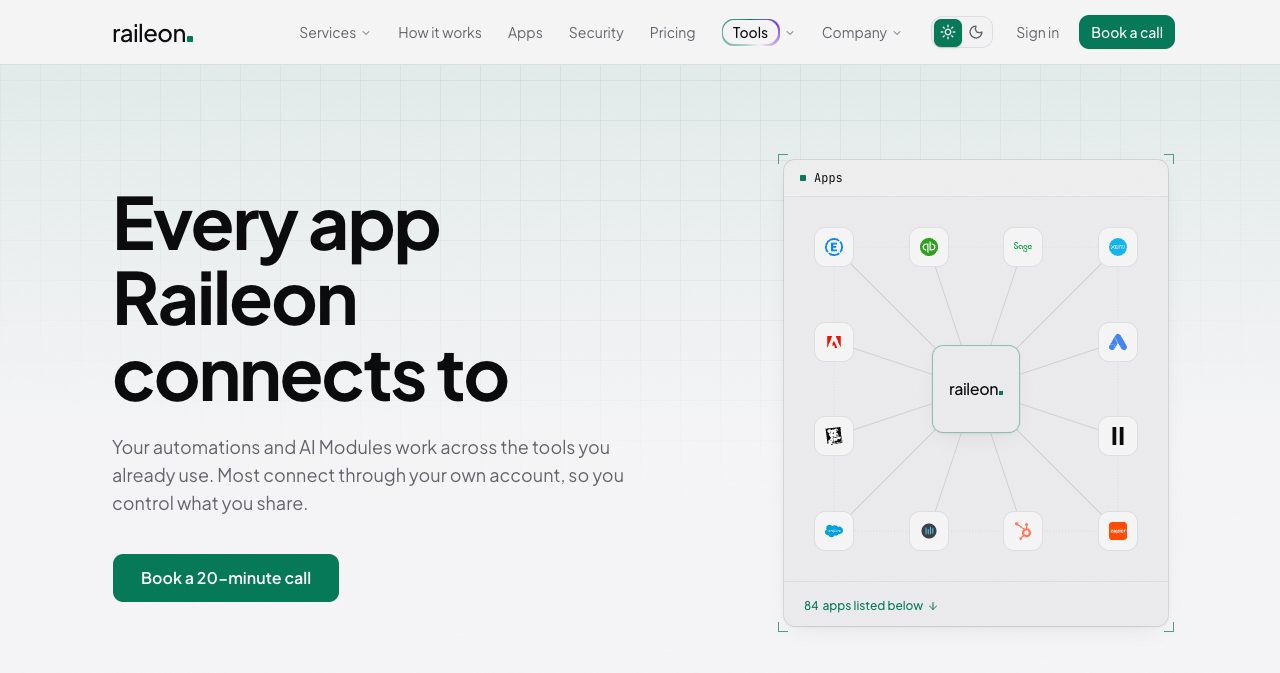
The statuses are the part worth reading closely, because they are the difference between a connection and an automation. Gmail, HubSpot, Slack, Calendly, QuickBooks, Xero, Stripe, Clio, Follow Up Boss and Monday.com are Ready — read, act, or both. Salesforce, Notion, Asana, Microsoft Teams and Dotloop are Link only for now, so you can connect the account while the Module actions catch up. Google Ads, WhatsApp Business and Twilio SMS are On request, which means one message to your Raileon team. Anyone can check their own stack on the integrations page, and the proposal confirms each app's status before go-live, so nothing about your setup is left to guesswork.
Two details Raileon publishes itself are worth knowing. A personal Gmail account has to sign in again roughly every seven days, while a Google Workspace account does not, and Google and Microsoft each need a one-time app setup inside your own account — which the team does with you on a call, so it takes minutes rather than an afternoon of Googling OAuth scopes.
The free Business Checkup
This is the easiest way to see Raileon work without talking to anyone, and it is genuinely free: no card, no account, no email needed for the initial result. The checkup runs four of the company's twelve audit areas live, in roughly half a minute.
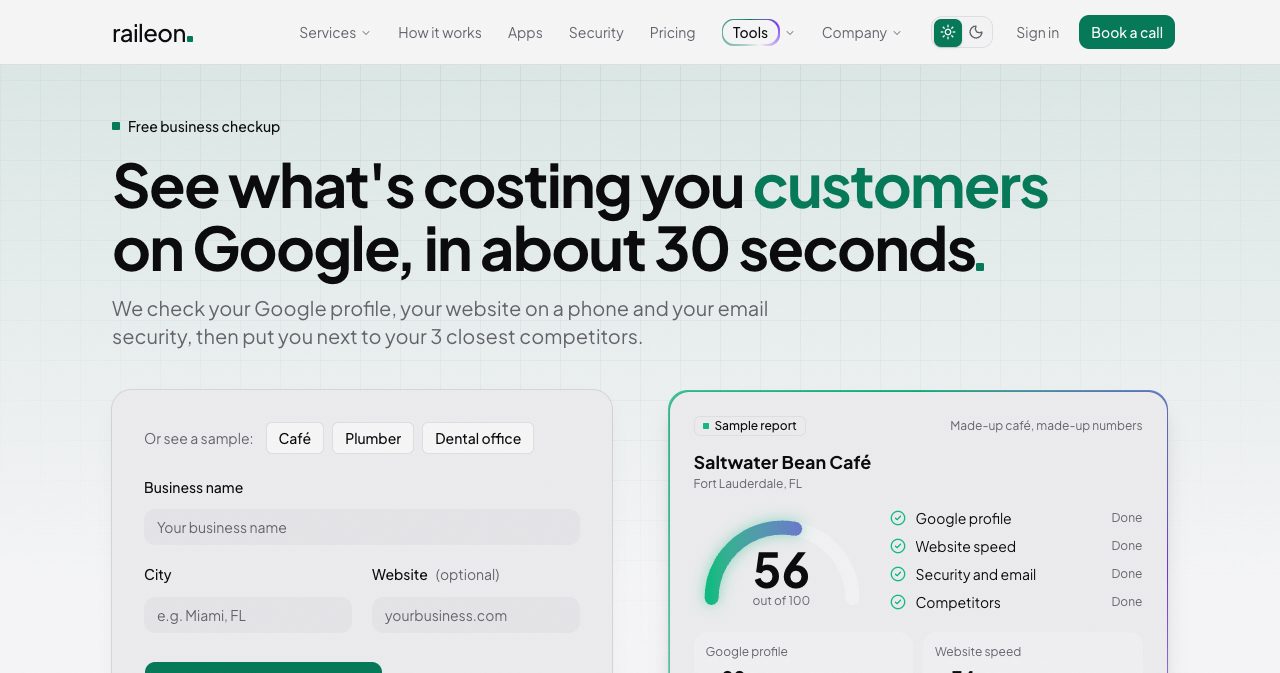
What it checks:
- Your Google profile — rating, reviews, photos, opening hours, website link and phone number, as Google Maps shows them.
- Website speed on a phone — a PageSpeed Insights test of your homepage, measuring how long until the main content shows.
- Email security — your SPF, DKIM and DMARC records, which tell inboxes whether mail really came from your domain.
- Your three closest competitors — the nearest businesses of your type on Google Maps, compared on rating, reviews, photos and phone speed.
You enter a business name and city, website optional. Raileon finds you on Maps, tests the site, reads your email records and pulls your nearest competitors, then returns a score out of 100, a list of what it found and what each issue is likely costing you. The full side-by-side needs an email address.
The email-security check is the standout, because most small businesses have never looked at SPF, DKIM and DMARC and many are quietly easy to spoof. Raileon publishes a separate email security check and research on spoofing at law firms, which tells you exactly where the founders' attention sits.
It is deliberately a 30-second snapshot rather than a diagnosis: four areas now, the other eight in the paid audit. On data, everything is stated up front instead of buried in a modal. The checkup creates no account, Google listing details are kept for up to 30 days so the same business is not looked up twice, speed and email results are cached for 15 minutes, and if you enter your email, Raileon stores it with your business name, city, website, score and findings and may follow up. That is a fair trade for a free tool that tells you something real about your own site.
The $299 Business Audit
The paid audit is Raileon's fixed-price starting point: $299 on a fall special until November 30, 2026, against a regular $599. A person reviews how your business runs today and you get the report before the walkthrough call. It adds eight areas to the free four: a lead response test that emails you like a real customer and times the reply, automation opportunities, Google reviews analysis, search and SEO, website and conversion, accessibility, keyword rankings for 20 money searches, and AI search visibility across ChatGPT, Google's AI answers and Perplexity.
Raileon publishes a sample report you can read before paying, which is the right first move: you see the format, the depth and the tone before you spend anything.
At $299 the audit stands up on its own, and that is the genuinely useful thing about it. The AI search visibility check alone earns the price — more customers now ask an assistant who to call, and very few local vendors measure whether they get named or which competitor does. You can buy the audit, take the ranked fix list and implement it yourself; Raileon says that is allowed, and it is priced so that it can be. Plenty of buyers will want help with two or three of the fixes afterwards, which is presumably the point of pricing it this low, and it is a fair way to earn the bigger conversation.
Pricing, line by line
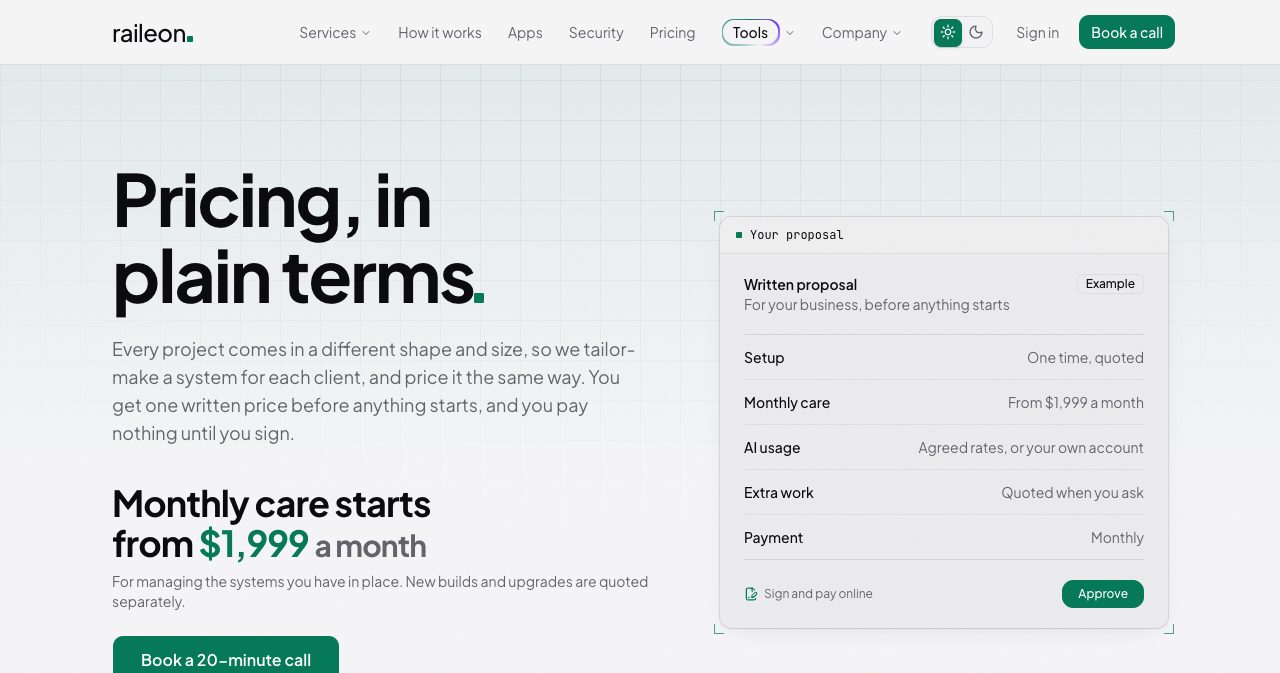
Custom-work vendors usually say "contact us" and stop. Raileon publishes four invoice lines, all of which appear in your proposal:
| Line | What it covers | Price |
|---|---|---|
| Setup | Designing, building and connecting your system; some proposals have none | One time, quoted per job |
| Monthly care | Hosting, monitoring, fixes, updates | From $1,999 a month |
| AI usage | Raileon provides AI at agreed rates, or you use your own account with no markup | As used |
| Extra work | New builds, upgrades, websites, SEO, ads, training | Quoted first, added only with your yes |
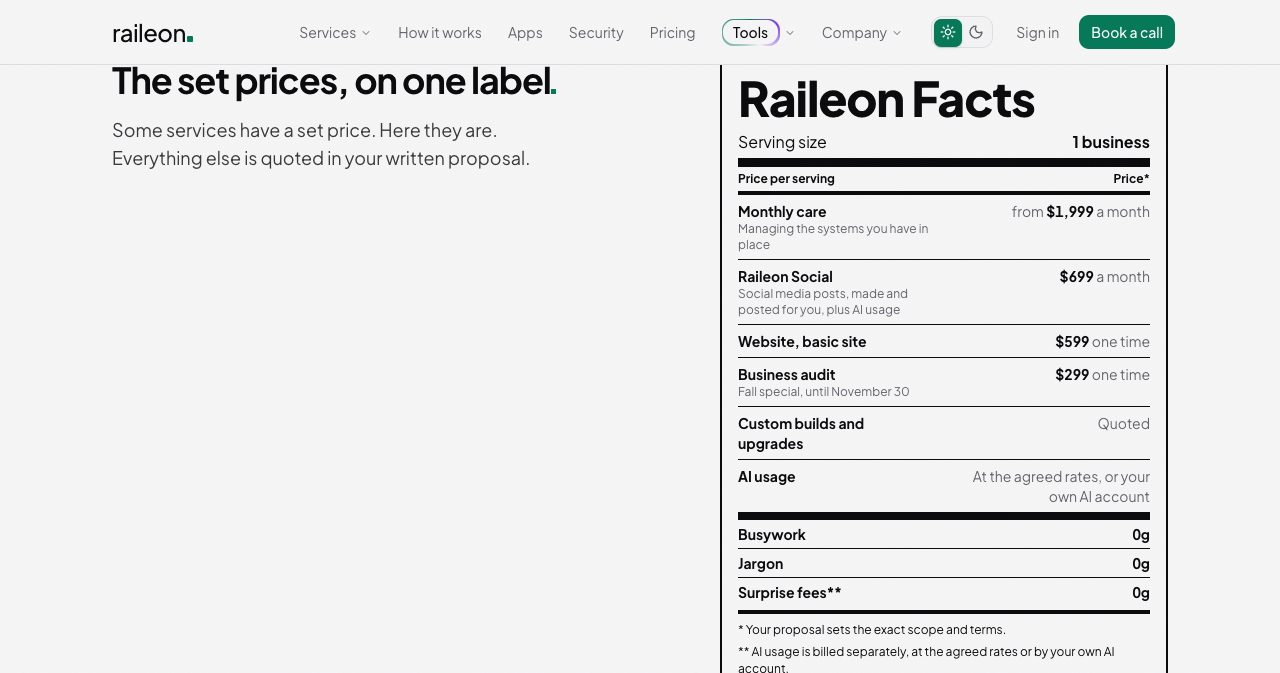
The set prices, as they appear on one label:
- Monthly care — from $1,999 a month
- Raileon Social — $699 a month, plus AI usage
- Basic website — $599 one time
- Business audit — $299 one time, fall special until November 30
- Custom builds and upgrades — quoted
The same label lists "busywork", "jargon" and "surprise fees" at 0g, which is a joke that only lands if the invoices back it up. It is also a fair summary of the page: you can read the whole thing in two minutes and know exactly what you would be signing.
The arithmetic, out loud
Monthly care at the starting price is $1,999 × 12 = $23,988 a year, before any setup fee and before AI usage. Real projects run higher, because price moves with the number of processes, the systems connected, how much judgment is involved, the edge cases your business actually has, volume, and how fast you need a response when something breaks.
The number only makes sense against what it replaces, and that comparison is usually kind. $1,999 a month is roughly a few days of a good administrator's time, except the administrator comes with monitoring, backups, fixes, a dashboard and an approval flow, and does not take holidays at the worst possible moment. If your workflows win back a part-time admin's worth of hours and stop leads going cold, the case makes itself. If your only repetitive job is one weekly spreadsheet, a freelancer or a DIY tool is the right-sized answer — and Raileon's own material is clear that simple rules beat AI on simple work. There is an ROI calculator on the site; run it with your own conservative numbers and let the arithmetic argue.
The billing mechanics
- You pay nothing until you sign.
- At signing you pay setup, if any, plus your first month.
- After that, one monthly invoice: plan, per-task work and post-billed AI usage where Raileon provides the AI.
- Payment is automatic by card on file or invoiced with 15 days to pay, per your agreement.
- Either side can cancel on 30 days' written notice, with no penalty and no exit fee.
On refunds the terms follow the standard shape for a monthly service: fees already paid are not returned except for billing errors, an uncured breach by Raileon, a termination after you object to a new sub-processor (pro rata, setup fee excluded), or where the law requires it. In practice, the first month is committed and the 30-day notice with no exit fee is what keeps you free afterwards, which is a better deal than most agencies offer.
Raileon Social and Raileon Ads
Beyond the custom systems, two packaged marketing services, both worth judging on their own terms.
Raileon Social — $699 a month plus AI usage. Planning, creation and posting of weekly content across up to nine platforms: Instagram, Facebook, TikTok, LinkedIn, X, YouTube Shorts, Google Business Profile, Pinterest and Threads. You get a monthly calendar to approve, captions and hashtags, an initial profile cleanup, a short monthly report and a dashboard for approvals. Posts go out from a real phone, which the company says avoids bot flags — a detail that tells you they have watched accounts get throttled. The scope is defined clearly: paid ads, replies to comments and DMs, and photo shoots sit outside it, and AI-generated images and video cost extra or run through your own AI account. If social is your bottleneck and you want a consistent calendar without hiring a content person, $699 is a sane entry point.
Raileon Ads — management fee in your proposal. Management of Google Ads (Search, Maps, YouTube), Microsoft Advertising and Meta, with optional LinkedIn or Google Local Services. Campaigns run in accounts you own, you pay ad spend directly to the platforms, and the fee is set out in your proposal. Weekly optimisation, call tracking and a monthly report are included. Paying the platforms directly is exactly the right structure, because you keep the accounts and the conversion history if you ever leave.
Security and data
This is where Raileon earns the most credit. Its security page reads like something written by the engineer who has to run it, not by a marketing team.
What is in place:
- A dedicated instance per customer — a hardened container with encrypted storage, its own private network, a read-only filesystem, restricted system calls, non-root execution and per-customer resource limits.
- Encryption — TLS 1.2 or higher in transit, encrypted at rest, and integration credentials protected by a separate key per workspace.
- Daily encrypted backups held separately from the running instance, with an automated weekly restore check.
- No AI training on your data, and its AI provider's commercial terms say the provider may not train on customer content. The exception is if you hire Raileon to train your own model, which then stays yours.
- Audit-logged support sessions for staff access to your workspace, kept for 24 months.
- Breach notification within 72 hours for personal-data breaches, set out in its Data Processing Addendum.
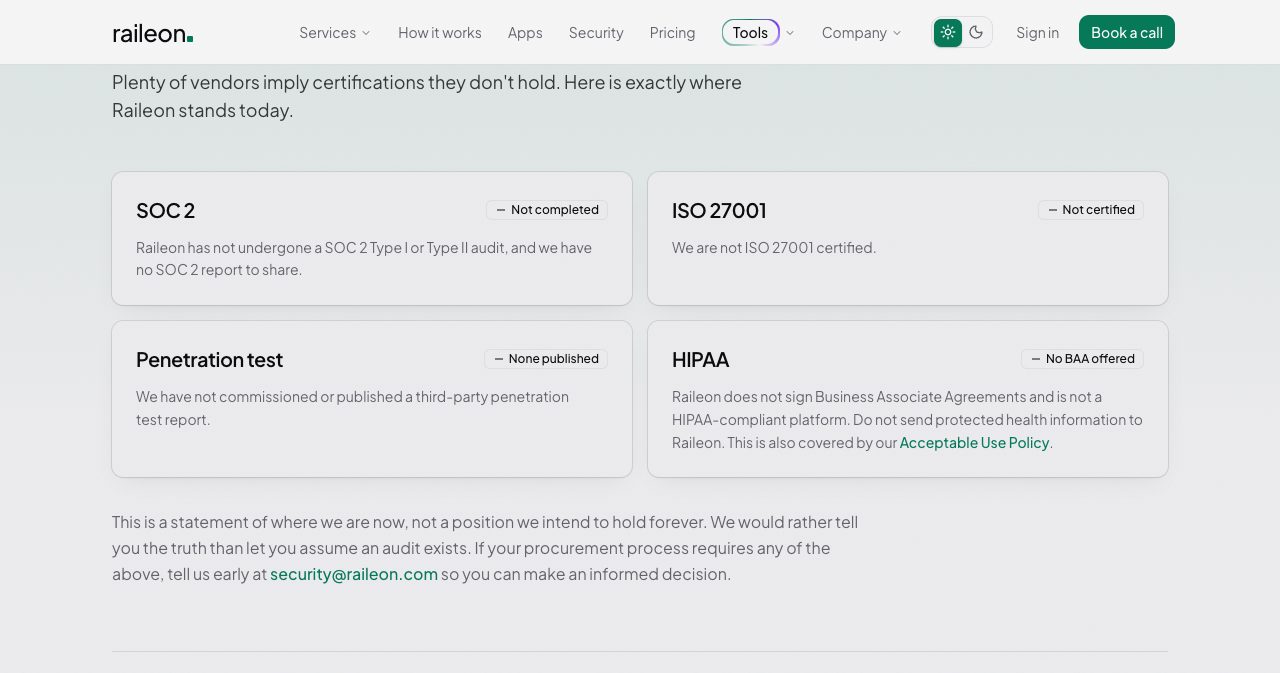
Where certifications stand, in the company's own words: no completed SOC 2 audit and no report to share, no ISO 27001 certificate, no published third-party penetration test, and no HIPAA Business Associate Agreements. Raileon calls that "a statement of where we are now, not a position we intend to hold forever", and says it would rather tell you the truth than let you assume an audit exists. That is rare. Most vendors in this bracket imply a certification they do not hold and leave procurement to discover it in month three.
What it means for you practically: for ordinary small-business data — leads, invoices, schedules, client notes — the controls above are strong for a company this size, and the engineering detail is more than a business of this scale usually publishes. If your procurement process requires SOC 2 or ISO 27001 today, Raileon asks you to say so early at [email protected] so nobody wastes a call, and it will scope work that keeps regulated data out. For clinics, dental offices and med-spas it is explicit: do not send protected health information.
A few finer details are published too. It has not configured zero data retention with its AI provider, so the provider may keep API data for a limited period for abuse monitoring; the weekly restore check confirms a backup unpacks rather than spinning up a live copy, so a full restore is done by hand; staff administrative access to servers and backups sits outside the support-session audit log; and after cancellation you get a seven-day window to export your data. Put the export on the calendar the day you give notice and seven days is plenty.
If compliance paperwork is already on your roadmap, our guide to the EU AI Act for SaaS founders covers the same procurement questions from the buyer's side.
Who is behind it
The founder and CEO is Konstantin, based in North Miami. His published bio covers more than 15 years in systems, processes, automation and development, and businesses built from scratch including tech ventures that ended in acquisitions. He also writes that he lost $25,000–30,000 to development companies that missed deliverables and cancelled mid-build — which explains a lot about how Raileon is priced and documented, and is a more useful origin story than most.
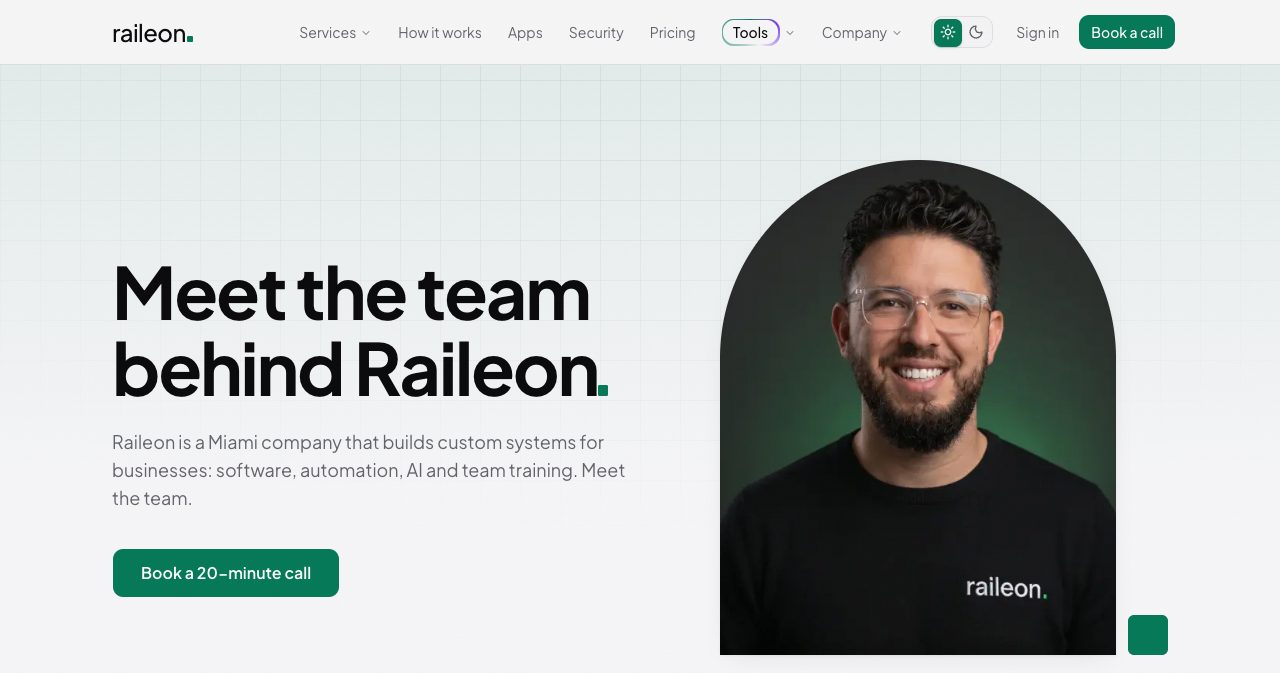
The team is small and named: Elijah as lead engineer, Andrew as full-stack developer and system administrator, plus marketing, HR and QA roles. Konstantin takes the first call himself, and the company says clients deal with real engineers based in Miami rather than a call centre. For a service you will depend on, that is the point — you know who gets the page when a workflow breaks at 8 a.m. on a Monday, and it is the person who built it.
That founder-led shape is the trade you are making: you deal with the people who do the work, at a company that is still early and building its public footprint. Take the call and ask him about the builds himself. A founder who has done the work answers differently from a salesperson reading a deck, and that is worth more than a wall of logos.
The Miami and South Florida angle
Raileon is genuinely local: the team is in Miami, the founder is in North Miami, and you can book a call or phone (786) 733-8337. For a South Florida owner that has practical upsides — same time zone, a conversation instead of a ticket, and people building your system who know a market where the competitor is usually down the street.
The integration list lines up neatly with industries that are dense across Miami-Dade, Broward and Palm Beach counties:
- Real estate brokerages — Follow Up Boss and MLS access through the RESO Web API, both Ready, which suits lead response and listing follow-up. Dotloop is Link only for now, so signing workflows are a question to raise on the call.
- Law firms — Clio, Filevine, PracticePanther and Smokeball for intake and matter updates, plus published research on email spoofing at law firms.
- Accounting and bookkeeping — QuickBooks, Xero, Bill.com and Karbon for reporting and month-end prep.
- Home services, restaurants and local retail — Google Business Profile, review handling and speed-to-lead, which is exactly what the free checkup measures.
One note for the region's clinics, dental offices and med-spas: the checkup works on public data, so running it on your practice is harmless, and Raileon is upfront that it does not sign a HIPAA BAA, so patient information stays out of the workspace.
Who gets the most out of Raileon
- You run a business with more moving parts than people, and have clear repetitive work in leads, intake, reporting or invoicing.
- You have nobody technical on staff and do not want to hire.
- You want one accountable team for software, automation, AI and training instead of juggling a freelancer, an agency and three subscriptions.
- You are comfortable approving drafted actions, and want AI assisting rather than acting unsupervised.
- You use mainstream tools marked Ready — Gmail, HubSpot, QuickBooks, Stripe, Clio, Monday.com.
The best sign that it fits is a specific one: you can name three workflows off the top of your head that eat hours every week, and nobody in the business has time to build them. If you are instead looking for a tool you control end to end, this is a managed service and you are hiring a team rather than buying software — better to know that before the call. And if you are smaller than the profile above, the free checkup and the $299 audit still stand on their own.
Raileon vs DIY, a freelancer, an agency or a hire
Raileon's own homepage compares itself to in-house hiring, agencies, freelancers and DIY with ChatGPT. That is a self-serving table, as these always are, so here is a more even-handed one. Prices are left out because they vary wildly by market and scope.
| Option | Best when | What you are weighing |
|---|---|---|
| Raileon (managed service) | You want the whole thing built and run, and have several workflows worth automating | A monthly commitment, in exchange for one accountable team that builds it and runs it |
| DIY with Zapier, Make or n8n | You are comfortable building and maintaining workflows, and the needs are simple | Your own time on maintenance, and the rewiring when something changes |
| Freelancer | One well-defined project with a clear end | Availability, management of the work, and knowledge that leaves with them |
| Marketing agency | Your main need is campaigns and creative, not operations | Deeper campaigns, lighter back-office automation unless you ask for it |
| In-house hire | You have steady, full-time technical work | Salary and benefits, hiring time, and depth in one person |
A fair question is whether you could build Raileon's workflows yourself with a no-code tool. Often yes, for the simple ones — Raileon lists Zapier and Make webhooks as supported connections, so it is not pretending those tools do not exist. What you are paying for is the part those tools do not include: someone to design around your messy reality, handle exceptions, watch the system and fix it. Whether that is worth $1,999 a month is a function of what your own hours cost. Our piece on whether AI is actually replacing jobs makes the same point from the other direction.
Questions to bring to the free call
Use the first call well. These are the questions we would bring, roughly in this order:
- Which three workflows would you build first, and what would each save in hours per week, based on my numbers rather than a template?
- Which of my apps are Ready, and which are Link only or On request? Can the proposal list the status of each?
- What is the setup fee, what exactly is inside monthly care, and what counts as "extra work"?
- What is a realistic AI usage figure for me, and what budget cap would you set on day one?
- Which actions run without my approval, and which always need it?
- Can I speak to a current client in a business like mine?
- What is the timeline to go live, in writing, with milestones?
- If I cancel, how do I export everything inside the seven-day window, and in what format?
- What happens when a Module makes a mistake — who fixes it, how fast, and is there a response-time commitment?
- Will my data ever reach a third party that is not on the sub-processors list?
Raileon's published material already answers half of this list, which is another reason to start there. The other half is what the free call exists for.
Verdict
Raileon is easy to recommend for a particular buyer, and unusually easy to describe. The pricing is public and specific, down to the invoice lines. The approval model is built into the product rather than bolted on afterwards, with payments, ad spend and public posts that cannot skip a human. The security page tells you where the company stands instead of hinting at certifications it does not hold. The entry points — a free 30-second checkup and a $299 audit — let you judge the thinking before committing to a monthly relationship. And the integrations are broad in exactly the places small businesses live: Gmail, HubSpot, Slack, QuickBooks, Xero, Stripe, Clio, Monday.com and MLS.
The company is young, founder-led and small on purpose, which is both the appeal and the thing to size up on the call. Its strongest integrations are the ones marked Ready, so build your first Modules there. SOC 2, ISO 27001 and HIPAA are not in place yet, and Raileon states that before you have to ask. It is a managed service, so you are buying a team and a monthly commitment rather than a tool you keep — which is the whole point, and the reason the workflow ownership question matters.
Our recommendation: run the free Business Checkup on your own business. If the findings are useful, read the sample audit report, then take the free 20-minute call with the questions above in front of you. Bring the three workflows that eat your week and see how the plan comes back. If the numbers pencil out against your actual hours, Raileon looks like exactly the partner it advertises: people who build the system, run it, and let you get back to the work that grows the business. Its own tagline is "put your operations on rails", and for a firm with more moving parts than people, that is a good description of what the first month feels like.
FAQ
What is Raileon?
Raileon is a Miami, Florida company, operated by SkyRaileon LLC, that designs, builds and then runs custom software, automation and AI-powered workflows for businesses inside the tools those businesses already use. It calls each workflow a Module. It is a managed service, not a self-serve tool: Raileon's team builds the system, connects the apps, monitors it, fixes it and backs it up.
Is Raileon the same company as Raleon?
No. Raileon at raileon.com is a Miami managed automation and AI services company. Raleon at raleon.io is a separate e-commerce retention platform. The names differ by one letter, so search results mix them up constantly.
How much does Raileon cost?
Monthly care starts at $1,999 a month for running systems already in place. Setup is quoted per project and some proposals have none, AI usage is billed at agreed rates or through your own provider account with no markup, and extra work is quoted before it starts. Set prices include Raileon Social at $699 a month plus AI usage, a basic website at $599 one time, and the Business Audit at $299 until November 30, 2026.
What is a Raileon Module?
A Module is one workflow that does one real job on its own schedule, such as following up with leads, updating a CRM or producing a weekly report. AI Modules add judgment where a step needs it, like reading a document or drafting a reply. Unlike a chatbot, a Module does not wait to be asked, and by default anything customer-facing waits for your approval.
Is there a free trial or a free tool?
There is no trial of the managed service. The free Business Checkup needs no card and no account and runs four checks in about 30 seconds: your Google Business Profile, your website speed on a phone, your SPF, DKIM and DMARC email records, and your three closest competitors on Google Maps. The first 20-minute call with the founder is also free.
What does Raileon's $299 Business Audit include?
The audit adds eight areas to the four free checks: a lead response test, automation opportunities, Google reviews, search and SEO, website and conversion, accessibility, keyword rankings for 20 money searches, and AI search visibility across ChatGPT, Google's AI answers and Perplexity. You get a report with fixes ranked by impact and a walkthrough call. The $299 price is a fall special until November 30.
Which apps does Raileon integrate with?
The integrations page lists 84 apps, of which 79 connect today: 56 marked Ready, meaning Modules can act on them, 19 marked Link only, meaning you can connect the account today while Module actions follow, and 4 marked On request. Five more are coming soon. Gmail, HubSpot, Slack, QuickBooks, Xero, Stripe and Clio are Ready, and each app's status is confirmed in your proposal.
Can Raileon's AI send emails or spend money without approval?
By default anything that reaches a client waits for your approval, and Raileon says that payments, purchases, ad spend, e-signatures and public posts always wait for a person and cannot be switched off. Every action is written to an audit log with who approved it. Approval rules for other tasks are agreed with you during onboarding.
Is Raileon SOC 2, ISO 27001 or HIPAA compliant?
Not yet, and Raileon says so on its own security page: no completed SOC 2 audit, no ISO 27001 certificate, no published penetration test, and no HIPAA Business Associate Agreements. The company calls it a statement of where it is today rather than a position it intends to hold forever, asks customers not to send protected health information, and asks procurement teams to raise requirements early at [email protected].
How do you cancel Raileon and what happens to your data?
Either side can end the service on 30 days' written notice with no penalty or exit fee. As with most monthly services, fees already paid are not refunded except for billing errors, an uncured breach by Raileon, certain sub-processor objections or where the law requires it. After cancellation you have a seven-day window to export your data from the dashboard, so export early and keep the copy.
Can you cap AI spending on a Raileon workspace?
Yes. A monthly AI budget can be set with your team or from the AI budget card on your dashboard. You get a warning email as you approach it, and when it is reached the Modules pause until it is raised or the month resets. A separate daily and monthly safety limit is always on, so a runaway Module cannot quietly run up a bill.
Does Raileon work with businesses outside Miami?
The company is based in Miami, its founder is in North Miami, and it says clients deal directly with its engineers rather than a call centre. Its public material now describes clients across the United States, so the local advantage is strongest for South Florida businesses in the same time zone, while the service itself is not limited to Miami.
Get your SaaS in front of founders
List your product on the SaaSCity live city map - a permanent listing, real discovery, and a backlink from a high-DR directory. Free to start; upgrade for a dofollow link and a building on the map.