News
Sign in with ChatGPT and the OpenAI Marketplace: What Dev Day 2026 Actually Does to Your SaaS (2026)
The model everyone expected at Dev Day 2026 never shipped. Instead OpenAI handed itself the login screen of thousands of apps, opened a Marketplace with soft rankings, and quietly put an allowance cap in the middle of your billing model. Here's what actually changed, the interest-form tell that should worry you, and why SaaSCity's pitch is that distribution you own beats distribution you rent.


Contents (8)
- What actually shipped on September 29
- Sign in with ChatGPT: the login screen is the prize
- The Marketplace and plugin extensions: a real channel, while it's soft
- Dots and the mixed reviews nobody's hiding
- The price ladder, and the model that didn't show up
- Dev tools, briefly
- The 30-day founder playbook
- Where do your first 1,000 users in 2027 actually come from?
The biggest announcement at OpenAI's Dev Day 2026 wasn't a model. It was a permission screen.
You are reading this on a directory's blog, so let's get that out early: SaaSCity is a gamified startup directory where founders claim a building on a live map, get a free listing page, and pick up a dofollow backlink once they add the badge. More on that later. The thing Dev Day 2026 revealed is that distribution is moving again, and founders who figure out what to own versus what to rent in the next month will be ahead for years.
On September 28, the day before the keynote, OpenAI confirmed it had quietly scrapped GPT-6.1 Astra's planned October release. The model fell short of the company's own bar on "staying within scope and authorization" — confirmed by OpenAI on September 28 as Reuters reported and corroborated across the Dev Day recaps. The model everyone expected never showed up on stage. What showed up instead was an identity system, a storefront, a pricing ladder, and a cap mechanic dressed as a perk. If you build software for a living, that's the part worth reading twice.
What actually shipped on September 29
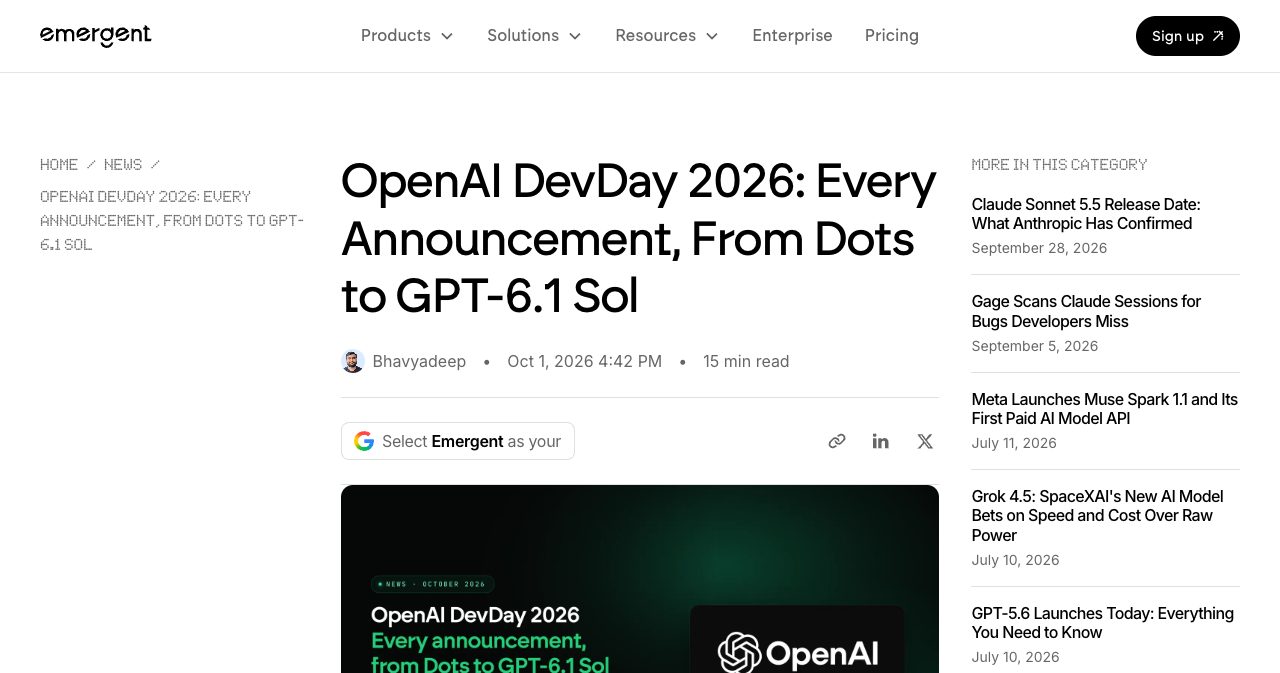
Dev Day 2026 ran at Fort Mason in San Francisco. OpenAI's own recap counts more than 20 announcements; emergent.sh's breakdown counts 25. Nothing here is a single headline — it's a stack of smaller moves repositioning ChatGPT as infrastructure rather than just a chat window.
| Announcement | What it does | Who gets it |
|---|---|---|
| Sign in with ChatGPT | Third-party login using ChatGPT identity, no chat data shared | 16 launch partners, expanding |
| Plan usage scope | Lets a user spend their ChatGPT allowance inside a connected app | Open-source and locally hosted apps; paid SaaS waitlisted |
| OpenAI Marketplace | Redesigned plugin directory with ranking and discovery | All developers, submission required |
| Plugin extensions | Full apps running inside ChatGPT/Codex with sidebars and dashboards | All ChatGPT plans |
| Dots | Always-on agents with their own cloud computer and browser | Pro ($100/mo) and Business Premium, not in EEA/Switzerland/UK |
| GPT-6.1 Sol | Cheaper near-frontier model, $2/$10 per million tokens | ChatGPT Work and Codex, Plus through Enterprise |
| Pro 500 | New top-tier plan, 25x Plus allowance, Ultrafast included | $500/month |
A recap from Memeburn frames the whole event as "consolidation, not a moonshot," and that reading holds up once you line the announcements against each other. Nothing here is a new capability so much as a new way to charge for, gate, or distribute what OpenAI already has.
Sign in with ChatGPT: the login screen is the prize
This is the one to sit with. Sign in with ChatGPT lets a user authenticate into your app using their ChatGPT name, email and profile picture. OpenAI is explicit that no conversations and no memory get shared through this flow — identity only, not context.
Sixteen partners launched with it: Notion, Vercel, Devin, Warp, Amp, Conductor, plus the open-source crowd — OpenCode, OpenClaw, Pi and T3. Lovable is listed as "coming soon." That's a list of tools your team probably already uses, which is the point. OpenAI isn't starting with niche apps. It's starting with tools developers already trust, so "just sign in with ChatGPT" feels unremarkable by the time it reaches you.
Identity sign-in and plan usage are two separate permissions, and conflating them is the easiest mistake a founder could make reading the announcement too fast. Plan usage lets a Plus or Pro subscriber spend their existing ChatGPT allowance inside a connected app instead of paying you separately for AI calls. Sounds generous. It isn't a reserved pool.
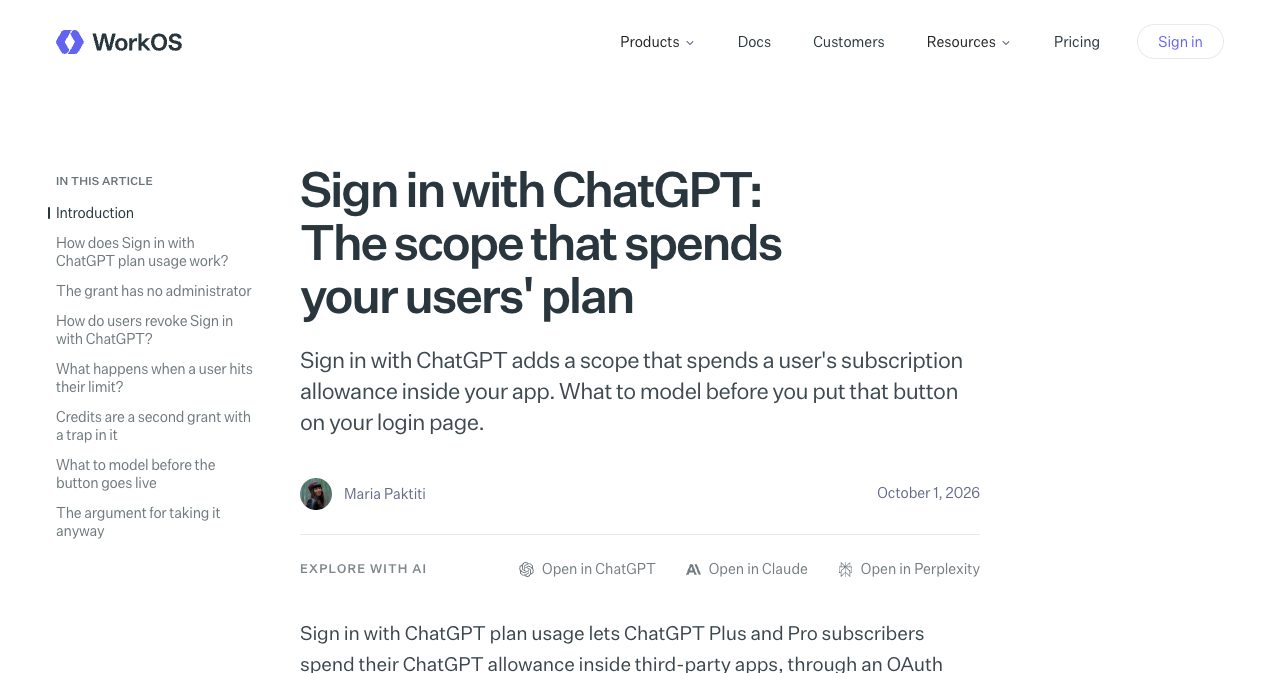
WorkOS published a detailed breakdown on October 1 worth reading if you're evaluating this. The core mechanic: plan usage is a cap, not a reservation. It neither reserves capacity for your app nor raises the user's overall ceiling. On Plus plans, every connected app shares one five-hour usage window. A user can max out your app's allotment because a different app they connected that morning already chewed through the shared window, and there's nothing your product can do about it. If you were picturing a clean, predictable free tier for your AI features, it isn't one. It's a courtesy layer that can run dry for reasons outside your control.
Then there's the tell. OpenAI's current documentation for plan usage is written for open-source and locally hosted apps. If you're running a paid, remotely hosted product — most B2B SaaS — you don't get a working integration. You get pointed at an interest form instead. Read that as a prioritization signal, not an oversight. Paid SaaS products are in a queue, and queues like this tend to come with strings — revenue share, review gates, scope restrictions — by the time they open.
None of this means skip it. Treat Sign in with ChatGPT as a login convenience alongside your own auth, never a replacement, and treat plan usage as a nice-to-have for free-tier users, never your billing model. The day OpenAI reprices, re-scopes or gates that allowance — and platforms that control a login screen eventually do — you want your product still standing on its own account system.
The Marketplace and plugin extensions: a real channel, while it's soft
Distribution has moved twice before in the SaaS era. The open web gave founders Google. Mobile gave Apple and Google the app stores. Both openings were enormous and both closed hard once ranking calcified and incumbents learned to game it.
The OpenAI Marketplace is opening number three, and it's early enough that ranking inside it is still soft. OpenAI announced a redesigned plugin submission flow, a Plugin Creator tool, and better ranking and discovery both inside the directory and inside live conversations. Layer that on top of 1.2 billion weekly ChatGPT users and you have a storefront with app-store-scale reach and none of the app-store-scale competition yet. That gap won't last. Early mobile developers who nailed App Store optimization in 2010 built real businesses off rankings unreachable today. The same clock just started running again inside ChatGPT.
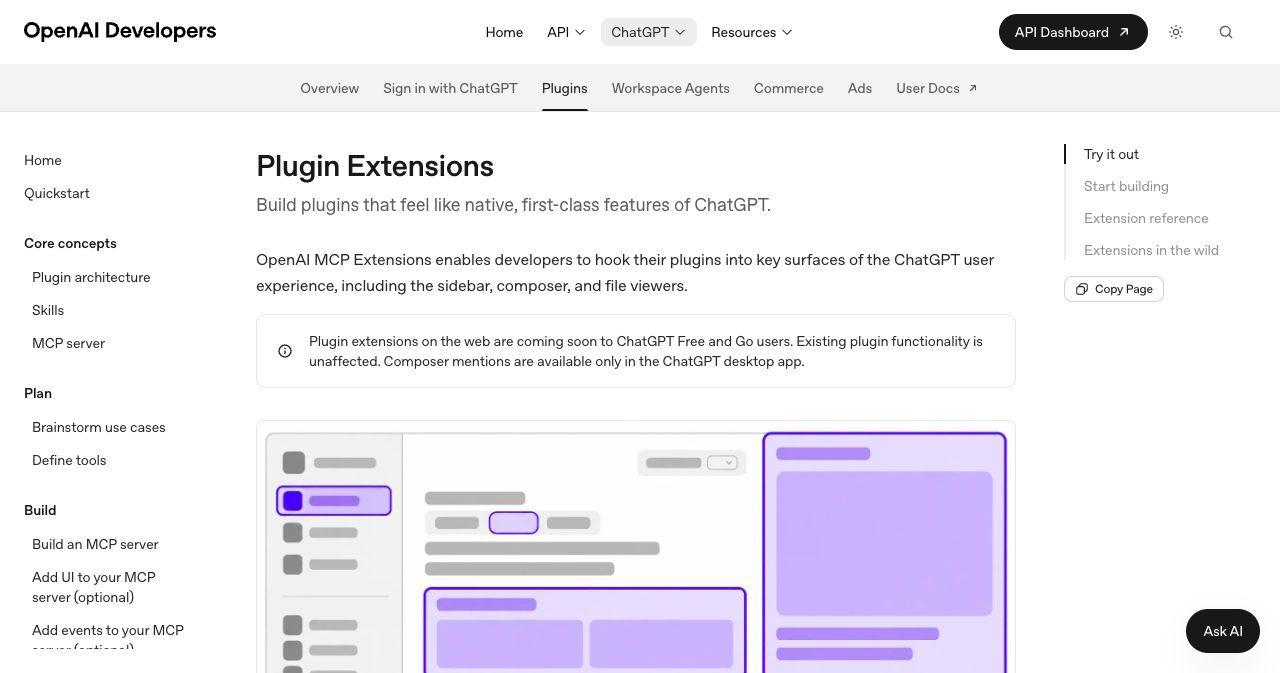
Plugin extensions are the technical half of this story. Full apps now run inside ChatGPT and Codex with their own sidebar, custom file viewers and dashboards — on every plan, not gated behind Pro. The extensions documentation also describes MCP Events, built on what OpenAI calls MCP 2.0 with webhook delivery, letting a plugin kick off an automation the moment something changes in a connected app. Sites built directly in ChatGPT can host plugins now too, collapsing another step between "build something" and "it's discoverable inside the one interface 1.2 billion people check weekly."
If your product can reasonably live as a plugin — a dashboard, a file viewer, an automation trigger — Dev Day just handed you a reason to build one this quarter. Rank while it's still winnable. Just don't confuse appearing in the Marketplace with owning the relationship; we cover that trade-off in our piece on model fatigue and choosing AI models for SaaS.
Dots and the mixed reviews nobody's hiding
Dots are OpenAI's always-on agents, each running on GPT-6 Astra with its own cloud computer and browser, connecting to more than 4,000 apps through plugins. The first dot comes included with Pro ($100/month) and Business Premium, rolling out in eligible markets — excluding the EEA, Switzerland and the UK, likely a regulatory hedge. Chatting with a dot doesn't count against usage limits, but any task it kicks off in Codex or ChatGPT Work does. Specialist dots with their own identity sit in an enterprise preview, with a Microsoft Agent 365 integration reportedly planned.
The reviews so far aren't the usual Dev Day glow. Every's writeup judged the dots too buggy to recommend, and Simon Willison — rarely shy about calling a keynote what it is — described the whole event as deliberately conservative. Consistent, though, with a company that pulled its flagship model three days before showtime and filled the slot with packaging instead.
The price ladder, and the model that didn't show up
ChatGPT now runs three Pro tiers: $100, $200 and $500 a month. OpenAI's own help documentation lays out Pro 500 as the new ceiling — 25 times the Plus usage allowance, plus Ultrafast, a speed tier running up to 8x faster token generation in Codex (around 300 tokens per second) and up to 6x faster through the API. Pro 200 reopened to new subscribers at a lower allowance than before Dev Day. Existing Pro 200 subscribers keep their old allowance only until October 29, 2026.
Underneath the ladder sits GPT-6.1 Sol: $2 per million input tokens, $10 per million output, cached input at $0.10 — a fifth of GPT-6 Astra's standard pricing, per OpenAI. A 1,050,000-token context window, up to 128,000 tokens of output, API id gpt-6.1-sol. It's live in ChatGPT Work and Codex for Plus, Pro, Business, Enterprise and Edu — not yet in standard chat. The timing matters more than the number: Anthropic shipped Claude Sonnet 5.5 at the same $2/$10 price point the day before, and Gemini 4 Argon landed at an identical rate the same window. Three labs, same price, same week. That's not competition anymore — that's a floor. If frontier-adjacent intelligence converges on one price across vendors, the model you build on stops being your moat and becomes a commodity input you can swap.
Which brings us back to the model that didn't ship. OpenAI confirmed on September 28 that GPT-6.1 Astra's October release was off, because the model fell short of the company's own standard on staying within scope and authorization. No replacement frontier model took the stage the next day. Two signals, same direction: pricing is compressing toward parity across labs, and even the lab setting the pace can't guarantee its next model ships on schedule. If your roadmap depends on a model being available on a specific date, Dev Day 2026 is the week that assumption got more expensive.
For the deeper story on a flagship model getting pulled or delayed, see our coverage of the GPT-6 Astra rollout and the LiveNeRF benchmark work on model drift in Opus 5.5 — "the model you planned around quietly changed under you" isn't a new pattern, it just moved up the release calendar this time.
Dev tools, briefly
A refreshed Codex CLI with voice steering, a new /agents view, worktrees and session resuming; Code Review on every plan; an Agents API with computer use, live now; a Decisions API in limited preview with no published pricing yet. OpenAI also reported Responses API traffic up 100x year over year at 99.9% uptime — one reason the company seems comfortable experimenting with pricing and access tiers.
The 30-day founder playbook
Here's what I'd actually do with this, not just read about it.
Week one: Decide whether your product is a plugin candidate — a dashboard, a file viewer, anything with a natural automation trigger. Sketch it. Rank now, while the Marketplace is still soft.
Week two: Add Sign in with ChatGPT as an option, not a replacement. Keep your own auth and user table as the system of record — never let a login screen you don't control become the only place your user data lives.
Week three: Free or open-source, look at plan usage integration. Paid and remotely hosted, submit the interest form and build billing as if the answer is "not yet."
Week four: Audit what you own versus what you rent. Your domain, your email list, your own indexed content, a directory listing on a site you don't need permission to appear on — those survive a platform repricing. A Marketplace ranking, a plan-usage allowance, a dot integration — those don't. Same logic behind why directory listings still carry real SEO weight in 2026: a link on a domain you don't operate is still more durable than a ranking inside somebody else's app.
The honest plug: hundreds of indie SaaS products are chasing the same soft Marketplace rankings right now, inside a platform none of them control. A free SaaSCity listing — a building on the live city map, a page with human editorial review, a dofollow backlink once you add the badge — is a smaller channel, but one OpenAI can't reprice on you overnight. Quick Pass at $19.99 goes live within 24 hours; Premium at $99.99 adds a written launch post with three dofollow links. The domain sits around DR 47-56 at the last Ahrefs refresh. Not a replacement for showing up inside ChatGPT — the part of your distribution stack that's still yours next year, whatever OpenAI announces at Dev Day 2027.
For more on frontier model economics while you plan those 30 days, see our breakdown of Anthropic's IPO prospectus for SaaS founders — the identity and pricing moves at OpenAI aren't happening in isolation.
Where do your first 1,000 users in 2027 actually come from?
That's the real question Dev Day 2026 raised, whether or not it meant to. If the honest answer is "wherever ChatGPT's ranking algorithm sends them," you've outsourced your growth strategy to a company that just scrapped a flagship model three days before launch without warning. Rent the channel. Build the plugin. Take the sign-in convenience. Just spend equal energy on the parts of your distribution still standing after the next keynote.
Get your SaaS in front of founders
List your product on the SaaSCity live city map - a permanent listing, real discovery, and a backlink from a high-DR directory. Free to start; upgrade for a dofollow link and a building on the map.