News
AI Video Faster Than Real Time: Inside MiniMax H3 Max
fal's post-trained MiniMax H3 Max renders a 5-second 768p clip with audio in under 3 seconds — faster than you can watch it. Inside the endless-AI-video moment.

Contents (12)
- Key Takeaways
- The backstory, in one section
- What fal actually changed
- The streams: what "infinite" looked like in practice
- What this does not do yet
- Running it yourself: local H3 versus hosted Max
- Moderation, licensing, and the bill
- Which path to pick
- What to watch next
- Quick answers
- The takeaway
- Building in AI Video? Don't Launch Into Silence
Quick answer: MiniMax H3 Max is fal Research's post-trained variant of MiniMax's open-weight H3 video model, published August 27, 2026. It renders a 5-second 768p clip with synchronized stereo audio in under three seconds, roughly 35x the throughput of MiniMax's own H3 endpoint, which puts generation time below playback time for the first time. It does text-to-video and image-to-video only at 480p or 768p, priced at $0.04 per second on launch promo and $0.08 from September 1, 2026.
Key Takeaways
- The threshold crossed: generation dropped below playback time, which turns video from a batch job into a stream.
- Measured speed: under 3 seconds for a 5-second 768p clip with audio, ~35x MiniMax's endpoint per fal and over 50x base H3 per Design Arena.
- H3 Max is not MiniMax H3: the base model reaches 2K with omni-reference input; Max is capped at 768p, text-to-video and image-to-video only.
- Weights are split: H3 base weights are on Hugging Face under a community license; fal's Max post-train is closed and API-only.
- The license has territory limits: the H3 Community License excludes the US, EU, UK and South Korea from local deployment.
- Local is two orders slower: a single RTX 4090 takes roughly 133 seconds at 864x480 for a 5-second clip.
- 15 seconds is the coherence ceiling: longer work is chained by injecting the previous clip's video and audio latents.
- Moderation has no tooling for it: Twitch and Kick both removed Rehan Sheikh's always-on generative stream, which ended up on Rumble.
- Always-on is expensive: at post-promo 768p rates a 24/7 channel costs roughly $288 a day.
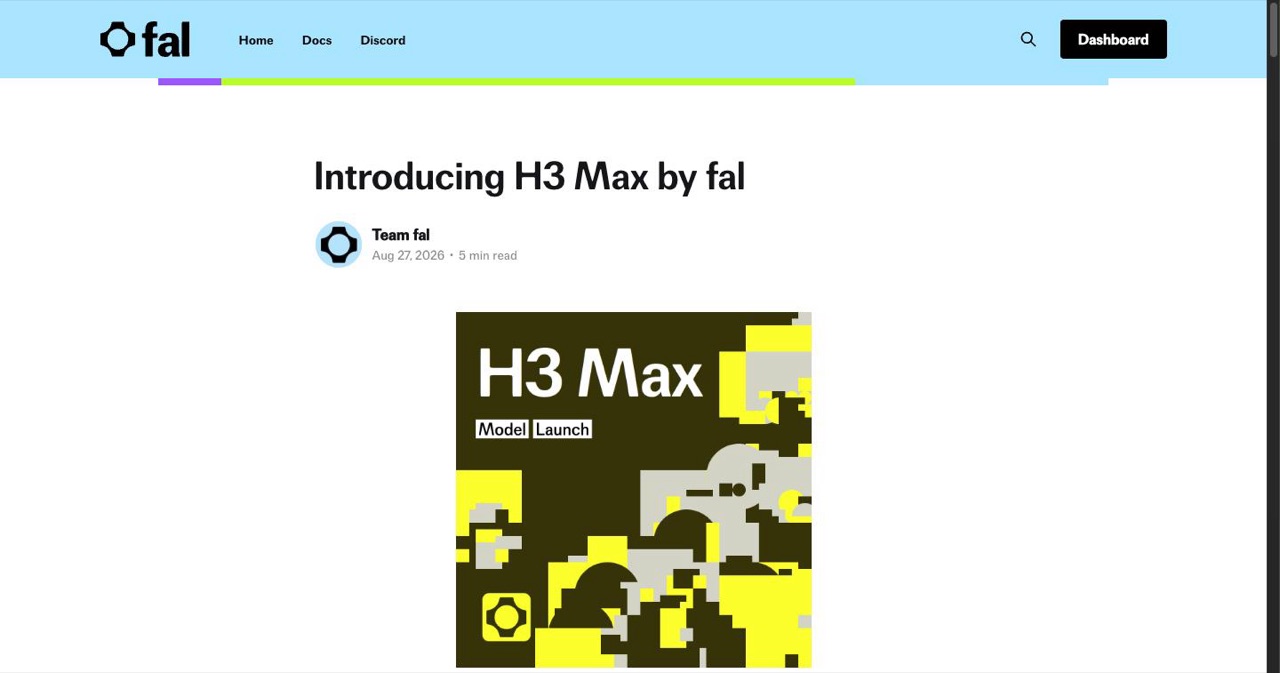
On August 27, 2026, fal published H3 Max, a post-trained variant of MiniMax's open-weight video model and quietly broke a threshold the field had been walking toward for two years: generation time dropped below playback time.
The number is small and the consequence is not. fal's H3 Max renders a 5-second 768p clip, with synchronized stereo audio, in under three seconds. Two days later, a fal engineer wired it to a Twitch stream and let it run. It did not run out of footage, because it cannot — every nine seconds of wall clock produced roughly fifteen seconds of show.
Pieter Levels, who shipped his own version of the same idea a day later, put the before-and-after plainly: "Before it'd take let's say 2-5 minutes to generate 15 seconds of video."
That is the whole story. Everything below is the mechanics: what the base model is, what fal actually changed, who measured the speed claims, what the streams looked like, what breaks, and what any of it is worth if you are building rather than watching.
| Base model | MiniMax H3 (Hailuo 3) — launched July 31, 2026; open weights August 3 |
| Size | ~33B omni-modal transformer; text + image + video + audio in, video + stereo audio out |
| Clip length | 5–15 seconds, 24 fps |
| Speed play | fal H3 Max: 5s @ 768p in under 3 seconds |
| Throughput | ~35× MiniMax's own H3 endpoint (fal); >50× measured by Design Arena |
| Scope | H3 Max is text-to-video and image-to-video only, 480p/768p — not 2K |
| Price | $0.04/sec at 768p on promo, $0.08/sec after September 1, 2026 |
| Catch | Max weights are closed; base weights carry territory restrictions |
The backstory, in one section
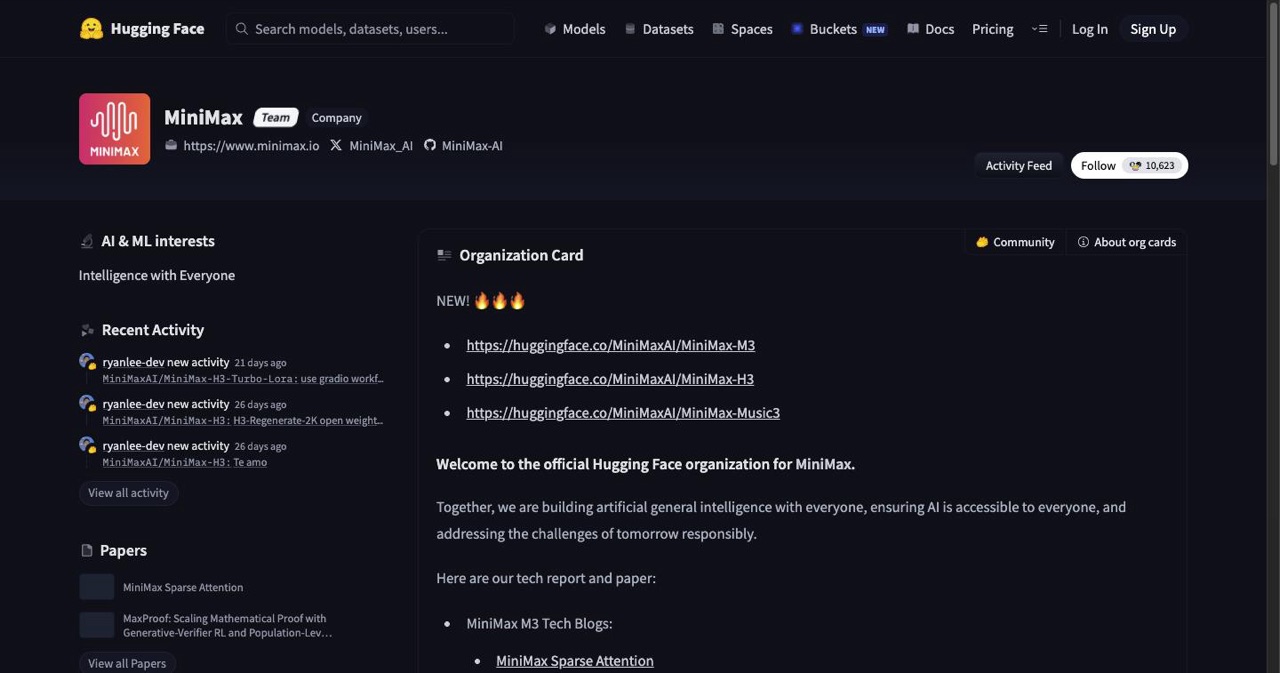
MiniMax H3 launched on July 31, 2026 and put downloadable weights on Hugging Face three days later. It is a ~33-billion-parameter omni-modal transformer: one model that reads text, images, video, and audio in a single context and returns video with native 32 kHz stereo — dialogue, foley, score, and room tone generated in the same pass rather than bolted on afterward.
Hosted, it goes up to 2K at 24 fps, takes up to nine reference images plus three video and three audio clips, and accepts prompts long enough (~7,000 characters) to describe a sequence instead of a single take. The naming is a mess in search: MiniMax H3 is the model, Hailuo is the consumer brand, and people type both. Same thing.
The part that mattered for what happened this month is the license. MiniMax released H3 under a community license, not an open-source one, and its terms exclude the United States, the European Union, the United Kingdom, and South Korea from local deployment rights. Weights being downloadable is not the same as weights being yours to run. But downloadable was enough for a third party with a serving stack to do something MiniMax had not.
What fal actually changed
H3 Max is not a MiniMax product tier. It is fal Research's own post-train of the open H3 weights, with the inference path co-designed against it — which is the part most speed announcements skip. fal's framing is explicit: the speedup comes from designing the serving engine and the post-training together, not from dropping new weights into a generic runtime. The work ran on NVIDIA GB200 NVL72 systems.
The post-training itself used fal's in-house reinforcement learning framework against real generation workloads and human preference data, tuned for prompt adherence, audio-visual quality, and aesthetics. So the pitch is not "same quality, faster" — it is "better preference scores and higher throughput," which is the unusual claim.
The tradeoff is scope. At launch H3 Max does text-to-video and image-to-video only, at 480p or 768p (768p default, 1344×768, 24 fps), with 5–15 second durations and an optional final keyframe. No 2K. No omni-reference. fal's model page listed reference-to-video as arriving later the same week. If you need 2K output or instruction-based editing, you are still on the full H3 API.
The speed numbers — and who measured them
Speed claims are only useful with attribution attached, so here it is by source rather than as one blended figure.
| Claim | Number | Source |
|---|---|---|
| 5s clip @ 768p with audio | under 3 seconds | fal, first-party |
| Throughput vs MiniMax's H3 endpoint | ~35× | fal, first-party |
| Throughput vs comparable-quality models | ~15× average | fal, first-party |
| Speed vs base H3 | >50× | Design Arena, independent |
| Image-to-video / text-to-video latency | 6.4s / 4.7s | Todd Jackson, hands-on |
| 15s block for a livestream | ~9 seconds | Rehan Sheikh, hands-on |
| Design Arena Elo | 1,341 | Design Arena |
| Artificial Analysis Elo (I2V with audio) | 1,201 ±11 over 2,177 samples | Artificial Analysis |
The spread between "35×" and "50×" is not a contradiction — they measure different baselines. fal compares against MiniMax's hosted endpoint; Design Arena compares against base H3 as it benchmarks it. Both are large enough that the distinction only matters if you are writing the spec sheet.
Pricing and access, as of August 29, 2026
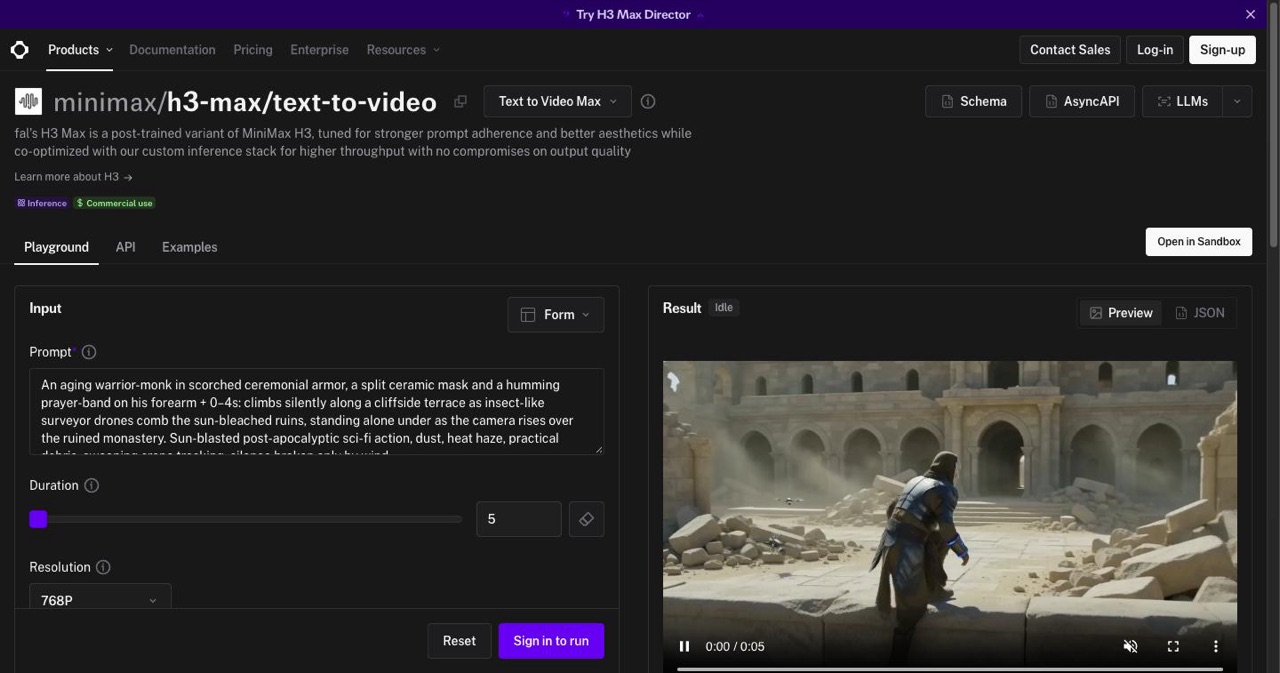
fal ran a 50% launch-week promo: $0.025 per second at 480p and $0.04 per second at 768p, reverting to $0.05 and $0.08 on September 1, 2026. A 5-second 768p clip is about $0.20 on promo and $0.40 after.
There is a real free tier: five 5-second 768p generations per day with native audio, no signup, and five more per day at up to 15 seconds once you sign in. That is enough to evaluate the thing properly before you wire a card to it.
One disambiguation worth holding onto: MiniMax also lists its own faster hosted "H3 Max" SKU. It is not fal's post-trained model. If you are reading a benchmark or a price, check which one it is measuring.
The streams: what "infinite" looked like in practice
Sheikh's infinite interdimensional cable
Rehan Sheikh, an engineer at fal, hooked H3 Max to a Twitch broadcast of continuously generated, channel-surfing surreal TV — his framing was Rick and Morty's interdimensional cable. His own post: "Minimax H3 Max has generates video faster than you can watch it so I hooked it to a twitch livestream!"
There is no pre-rendered loop. A new ~15-second block lands every ~9 seconds, so the playback buffer grows instead of draining. Chat could change what came next. As one viewer put it, this is "the beginning of TV becoming unique for every person watching it."
Then the platforms answered. Twitch removed the stream. Kick removed it too. It ended up on Rumble. Nothing about the model changed between those three decisions — see the moderation section, because this is the part builders underestimate.
Infinite Slop
Pieter Levels shipped Infinite Slop the next day: a 24/7 interactive stream where whatever you type in chat becomes the next scene, with the model attempting to connect it to the previous clip so a storyline actually persists. fal sponsored it outright, because at 24/7 the inference bill is the product. Levels credits the idea to Marc-Antoine Foujols and Sheikh's original stream.
MiniMax's own account read the implication back to itself: "Anime can now keep going forever with H3 Max, instead of dropping one episode at a time."
Why faster-than-real-time is a category change, not a benchmark flex
Here is the mechanic in one line: if generation is slower than playback, video is a batch job; if it is faster, video is a stream.
Everything downstream follows from that inversion. A batch job gets queued, rendered, reviewed, and published. A stream can be interrupted, steered, remixed, and kept running — which means the audience becomes an input rather than an audience. Chat-directed television is the first obvious shape, but it is not the interesting one. The interesting ones are the applications where a generated scene now costs less than a second of someone's attention: NPC-driven worlds that render what you look at, personalized channels, live commerce, in-session game cutscenes, kids' stories that go where the kid goes.
None of that was blocked by quality. It was blocked by latency, and latency is the axis that just moved.
What this does not do yet
Some of the reaction is running well ahead of the artifact, so:
- Single-pass coherence is still 15 seconds. Everything longer is assembled.
- Identity lock is not solved. Some creators are calling character consistency cracked; others report Max is too weak to hold a face across a long sequence without LoRAs or reference scaffolding. Both camps are looking at real output. The honest read is that it holds for a shot and drifts across a film.
- 768p is 768p. For a stream nobody is pausing, fine. For a client deliverable, not fine.
- The streams are crude television. They are proof of a mechanism, not proof of a market. "Infinite" and "worth watching for an hour" are different problems, and only one of them got solved this week.
Running it yourself: local H3 versus hosted Max
The open weights are what made this more than one company's demo — the community layer arrived within weeks. But the local-versus-cloud gap is not close.
On a single RTX 4090, a 5-second 24 fps generation from open H3 measures roughly 182 seconds at 608×352 and 133 seconds at 864×480. Against under 3 seconds on Max, that is two orders of magnitude, and it is the whole reason live streams run in the cloud. Turbo LoRAs help — they cut sampling from about 20 steps to about 6 — but they do not close a 50× gap.
Watch system RAM more than VRAM, which surprises people: full INT8 runs have been reported peaking around 93 GiB of system memory, while VRAM peaked near 21.9 GB at 864×480. Low-VRAM ports exist. They are minutes per clip, not seconds.
For long form, the community answer is sectioned generation with latent handoff in ComfyUI. Each section is a legal-length H3 clip, and the previous clip's video and audio latents are injected as context into the next segment, so speech and motion continue across the cut rather than restarting. Tooling like MiniMax-H3-Longvideos auto-detects H3's frozen tail frames for a safe handover and stitches with a short crossfade plus an audio de-click.
One gotcha worth the price of this section: a shot carries either references or the last-frame handoff, never both. They are competing conditionings fighting for the same latent slot. If your chained sequence is mysteriously ignoring your character sheet, that is why.
The practical split, then: live experiences belong in the cloud; authored long-form belongs on local H3 plus LoRAs, where a slow clip costs electricity instead of dollars per second.
Moderation, licensing, and the bill
This is not a footnote. It is the part that decides whether any of this ships as a product.
Moderation has no tooling for this. Every existing content-moderation system assumes content exists before it is broadcast. An always-on generative stream produces content that does not exist until it airs, and when chat drives the prompt, the audience is the content pipeline. Twitch and Kick both removed Sheikh's stream within hours. Rumble's lighter policy is where it landed, which is a symptom rather than a solution. If you are building on this: rate limits, prompt blocklists, a human-reviewable delay buffer, watermarking, and a kill switch are the minimum, and none of them are optional.
Local removes the guardrails you may be relying on. MiniMax's hosted API applies automated moderation to submissions and outputs. The open local checkpoints do not. That shifts liability onto whoever runs the weights.
The license has a map on it. The H3 Community License excludes the US, EU, UK, and South Korea from local deployment. In those territories the hosted API is the compliant path. If you are in the EU, the AI Act's transparency obligations for synthetic media apply on top of that, not instead of it.
Infinite is cheap per second and expensive per hour. At post-promo 768p rates, a continuously generating 24/7 channel runs roughly $0.08 per second of output — call it $288 a day if the pipe never idles. That is why Infinite Slop is sponsored. Recalculate any always-on business model at September pricing, not promo pricing.
Which path to pick
| If you need… | Use |
|---|---|
| Fast iteration, live apps, chat-directed video | fal H3 Max (T2V/I2V, 480p/768p) |
| 2K output, omni-reference, instruction edits | MiniMax H3 hosted API |
| Locked character and style control | Open H3 base + LoRAs in ComfyUI |
| Anything longer than 15 seconds | Sectioned latent-handoff chaining, not one long call |
| US/EU/UK/KR compliance | Hosted API — read the Community License before self-hosting |
Cheapest honest evaluation: burn the free daily generations on fal's playground with your actual prompts, then run the same brief through the full H3 API to see what 2K and omni-reference buy you. Two hours and no invoice.
What to watch next
- Whether fal ships a long-form checkpoint with native continuity rather than last-frame stitching — that would collapse the entire ComfyUI chaining layer into an API parameter.
- Reference-to-video on H3 Max, which is what identity lock is currently waiting on.
- Whether MiniMax open-sources the 2K regenerate module it held back.
- Acceleration LoRAs narrowing the local gap enough that a 4090 can serve something interactive.
- The first durable consumer product built on this that is not a novelty stream.
- How platforms write policy for broadcasts whose content does not exist until it is watched.
Quick answers
Is H3 Max faster than real time? Yes for short clips. fal reports 5 seconds of 768p video with audio in under 3 seconds, and Sheikh's livestream produced 15-second blocks in about 9 seconds each. Generation outruns playback, which is what makes an endless stream possible at all.
Is H3 Max the same as MiniMax H3? No. H3 is MiniMax's open-weight base model with up to 2K output and omni-reference input. H3 Max is fal's post-trained derivative: much faster, but 480p/768p and text-to-video plus image-to-video only. MiniMax separately sells its own hosted "H3 Max" SKU, which is a third thing.
What does it cost? $0.04 per second at 768p during fal's launch promo, doubling to $0.08 on September 1, 2026. Five free 768p generations a day without an account, five more once signed in.
Are the weights open? H3 base weights are on Hugging Face under a community license with territory restrictions. fal's H3 Max weights are closed and API-only.
Can it make an hour-long film? Not in one pass — 15 seconds is the ceiling. Hour-scale work is chained: each segment conditions on the previous segment's video and audio latents so continuity survives the cut.
Why were the streams taken down? Because always-on generated video defeats every moderation system built on reviewing content before it airs. Twitch and Kick removed the interdimensional cable stream; it moved to Rumble.
The takeaway
Two things happened a month apart. In July, MiniMax made a competitive omni-modal video model downloadable. In August, someone else's inference team proved what that openness was actually for by making it 35× faster than the lab's own endpoint — something no closed model permits by construction.
The demos are crude TV. The shift underneath them is not: latency dropped below the playback clock, and that unlocks a category of product that quality-only models could not ship no matter how good the frames looked. Whether the first durable thing built here is a personalized channel, a living game world, or a storefront, it will be built by whoever gets to the moderation and cost problems before the novelty wears off.
The unresolved pair is the interesting one. Creative abundance on one side. Rights and moderation on the other. Nobody has shipped an answer to the second.
Building in AI Video? Don't Launch Into Silence
If you are shipping on top of this — a generation wrapper, an AI video micro-SaaS, an editing tool, a platform built on a video API — the model is the easy part now. Distribution is the hard part.
SaaSCity gives your product a permanent indexed page and a launch slot in front of builders instead of an archive nobody reads. Free listings ship with a badge. Quick Pass and Premium skip the queue and add a building on the map, and Premium includes a launch post we research and write for you — built to be quoted by AI answer engines, not just indexed by Google.
Submit your startup → · Browse the directory → · See AI tools already listed →
Verified August 29, 2026 against fal's H3 Max announcement and model pages, MiniMax's H3 launch materials and Hugging Face model card, Design Arena and Artificial Analysis leaderboard placements, and first-party posts from Rehan Sheikh, Pieter Levels, and Todd Jackson. Speed figures are labeled by source because first-party, benchmark, and hands-on numbers use different baselines. Promotional pricing expires September 1, 2026 — confirm current rates before modeling costs. fal's model page carried no "H3 Max Live" product listing at the time of writing; the live broadcasts described here are Sheikh's stream and the fal-sponsored Infinite Slop.
SaaSCity.io covers AI model launches and the tooling decisions behind them. Explore the directory or list your own product.
Get your SaaS in front of founders
List your product on the SaaSCity live city map - a permanent listing, real discovery, and a backlink from a high-DR directory. Free to start; upgrade for a dofollow link and a building on the map.