Reviews
CitableHub Review 2026: The Free Directory Built So ChatGPT, Perplexity and Gemini Can Cite Your SaaS
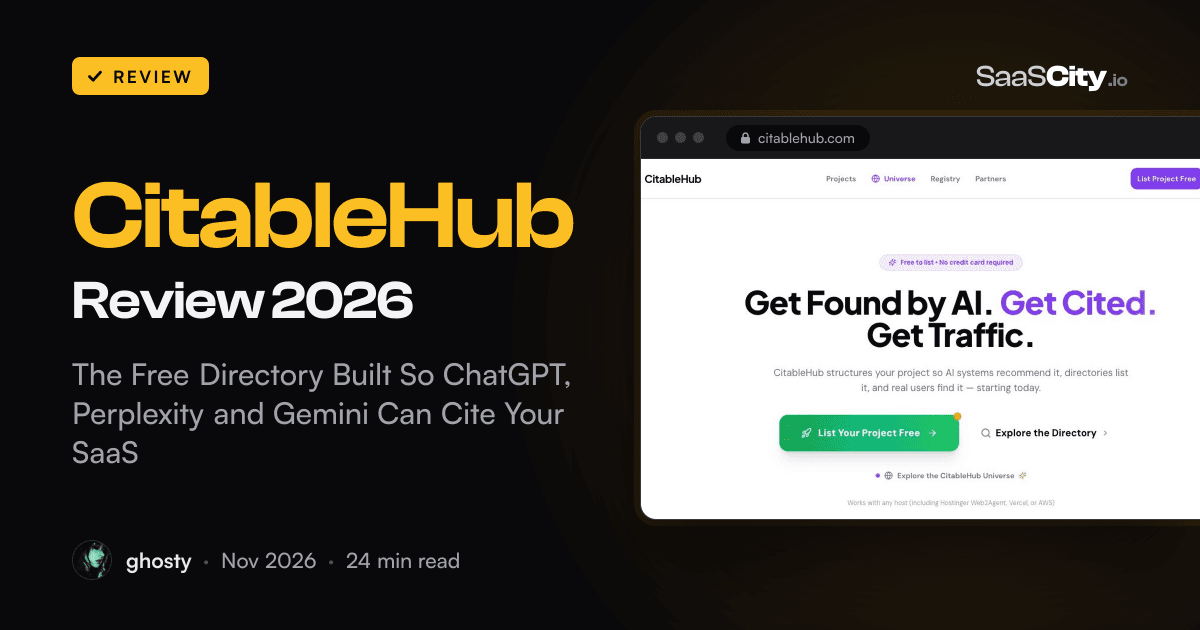
CitableHub (citablehub.com) is a free directory that turns a software product into a structured, machine-readable profile with a 0-100 Citability Score, a verification ID, a per-project llms.txt and an MCP gateway. We went through the profile, the score, the feeds, the free GEO scan, the boost prices and the founder's own published numbers to see who should list.

Contents (18)
- Key takeaways
- What is CitableHub?
- What is GEO, and why would a directory help?
- How does CitableHub work?
- What is the Citability Score?
- How do verification IDs and receipts work?
- What can machines read on CitableHub?
- Is there a free GEO scan?
- What is the MCP Gateway?
- What does the directory look like for a human visitor?
- How much does CitableHub cost?
- How does CitableHub compare with traditional directories?
- What does the evidence say so far?
- Who is CitableHub best for?
- What should you know before you list?
- How do you get the most from a CitableHub listing?
- Is CitableHub worth it?
- FAQ
Disclosure: this is a sponsored review.
Product details were checked against citablehub.com, its about, FAQ, boost, partner, MCP and terms pages, its public feeds and the founder's DEV Community posts on November 12, 2026. Screenshots were taken from the live site in Google Chrome.
Quick answer: CitableHub is a free directory that turns a software product into a structured profile that AI assistants can read, check and cite. Each listing gets a permanent URL, JSON-LD markup, a 0-100 Citability Score across five dimensions, a verification ID and its own llms.txt. Two projects are free with no card. Paid boosts start at $100 and change ordering only, and CitableHub says plainly that nothing it sells guarantees a citation.
Ask an assistant for the best tool in your category and look at what comes back. It is a short list, usually four or five names, and each one has something the assistant could check: a clear description, a pricing page it could parse, a few independent mentions. A product that shipped three months ago with a JavaScript-heavy landing page and no structured data rarely makes that list, however good it is.
That is the gap CitableHub was built for. It does not try to be another launch board where people upvote for a day. It tries to be the page an assistant reads when it needs clean facts about a tool. This review covers what you get for free, how the score works, what the paid options cost, what the founder's own numbers say about the directory, and who should spend ten minutes on a listing.
Key takeaways
- Listing is free for up to 2 projects, with no card and no subscription.
- Every profile is scored 0-100 on Identity, Evidence, Trust, Freshness and Classification, and the page tells you which fields would raise it.
- Each listing has a verification ID, a public receipt page, a per-project llms.txt and ready citations in BibTeX, APA and MLA.
- The whole directory is published as one markdown file for AI systems, plus an OpenAPI spec, a read-only API and an MCP gateway with five tools.
- The homepage showed 901 projects and just over 26,000 AI crawler reads on November 12, 2026.
- GQI Boost packs cost $100, $250 and $500 once. They move a listing up. They do not change its score.
- CitableHub repeats one caveat everywhere: reads are not citations, and no citation is promised.
- The product is young. Its own listing shows a registration date of June 2, 2026.
What is CitableHub?
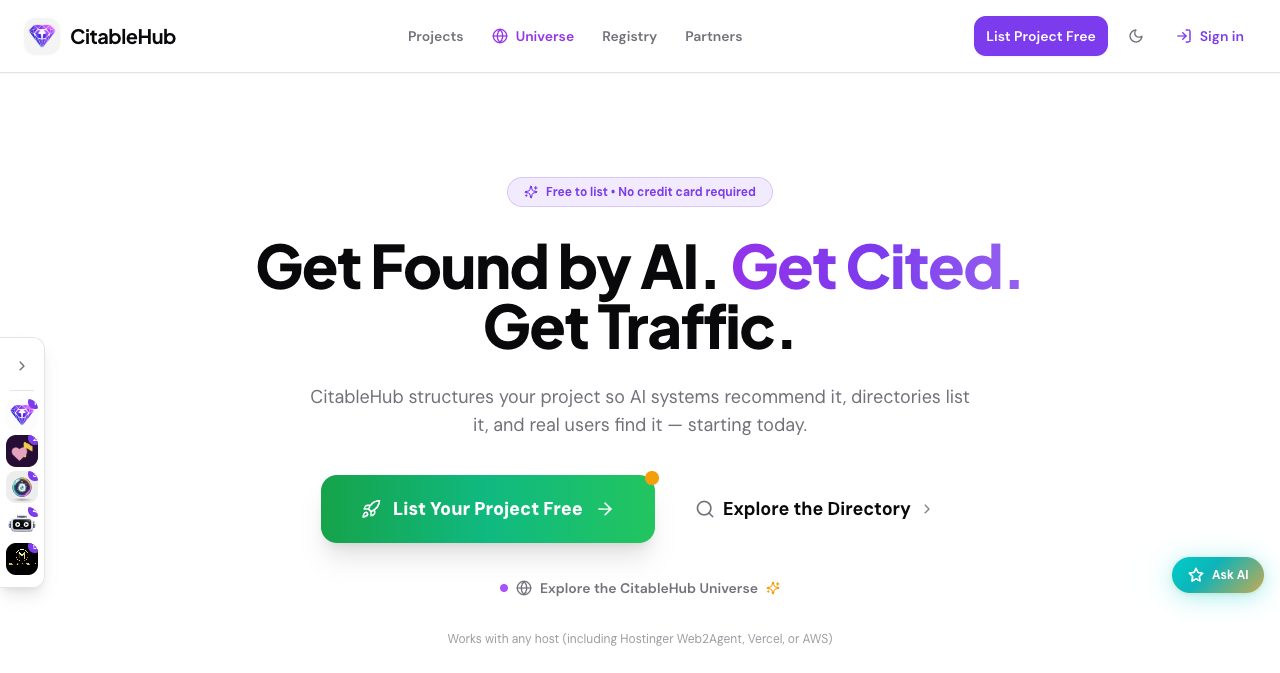
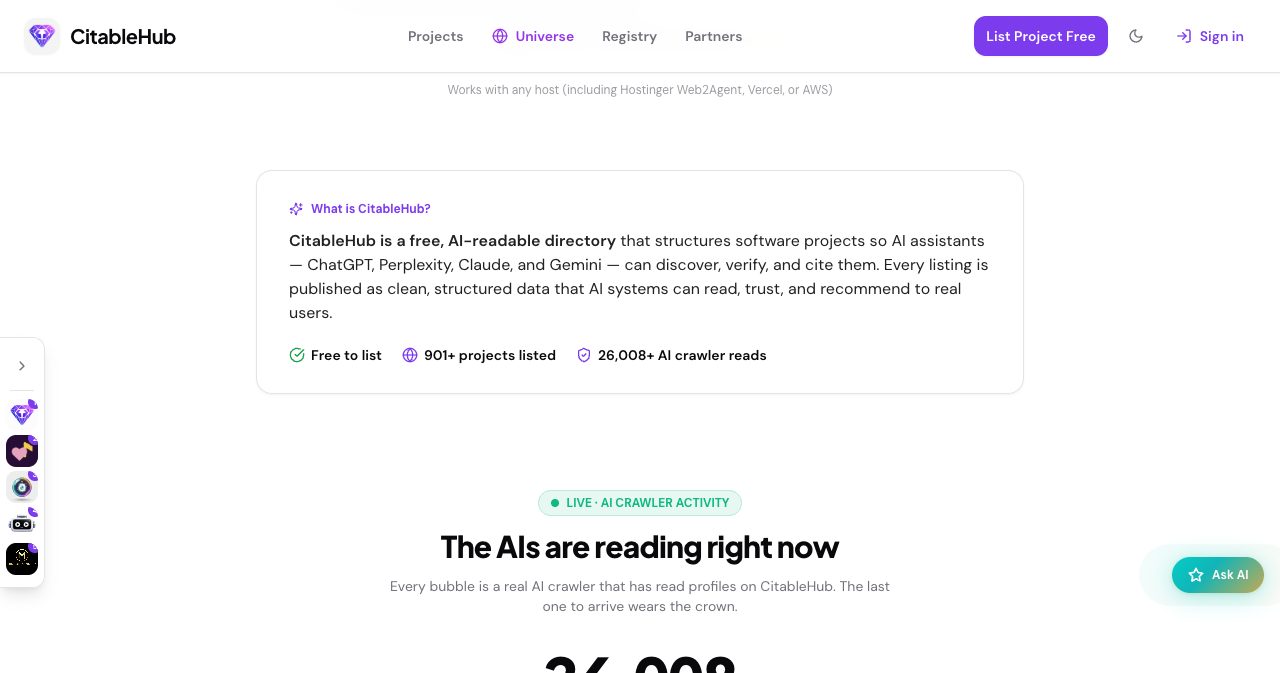
CitableHub is an AI-readable directory for software projects, apps and digital tools. You give it a name, a URL and a short summary. It gives back a public profile written for machines first: an answer-first description, structured fields for audience and use cases, JSON-LD in the SoftwareApplication and Organization types, and explicit permission in robots.txt for crawlers such as GPTBot, OAI-SearchBot and Google-Extended.
The about page calls it "an entity resolution platform for AI systems", which is a precise way to put it. When an assistant meets a product name, its first job is to work out which thing in the world that name refers to. A profile with a canonical URL, a founder, a category, a registration date and a verification ID makes that step easy.
The company behind it is Wildverse LLC. CitableHub's own listing names Rafael Lopez as founder, and he has written about the project in public since June 2026 on DEV Community. We covered his other product, a short-video platform built on the same idea, in our OrionReel review.
What is GEO, and why would a directory help?
Generative Engine Optimization (GEO) is the practice of structuring information so that generative AI engines use it in their answers. Answer Engine Optimization (AEO) is a close cousin with the same aim. Classic SEO earns a position in a list of links. GEO earns a place inside the one answer the assistant writes.
The mechanics are less mysterious than the acronyms suggest. An assistant with web access retrieves a handful of pages, pulls out the facts it can attribute, and writes. Pages that state a fact plainly near the top, mark it up with schema, and agree with other sources get used more. We went through the on-site side of this in our guide to optimising a website for AI citations.
A directory helps with the off-site side. Your own website is one source saying good things about you. A third-party profile with a verification status, a registration date and evidence links is a second source in a format built for parsing. CitableHub's bet is that most small products never create that second source, and that a free form can fix it.
How does CitableHub work?
The about page lays it out in four steps, and the flow matched what we saw across the site.
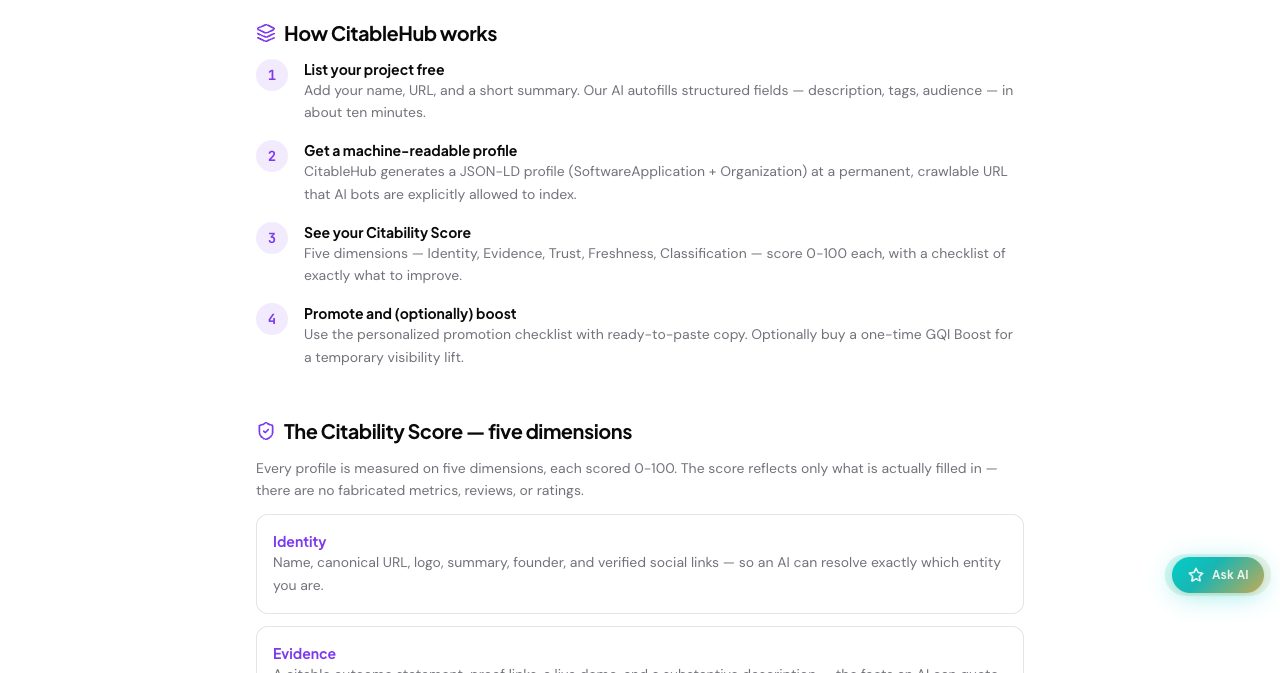
- List the project. Add the name, URL and a short summary. CitableHub's AI fills in the structured fields, and you correct them. The site gives ten minutes as the usual time.
- Get the profile. A permanent page appears at
/p/your-slugwith JSON-LD and an answer-first description. New listings need approval before they are public. - Read the score. Five dimensions, each out of 100, with a list of the exact fields that are missing.
- Promote it. A personalised checklist names other directories and platforms that fit your category, each with copy ready to paste and a UTM-tagged link so you can see which ones send visitors.
The free prompt that drafts the listing
One detail made us like the product more. The FAQ page carries a long prompt you can copy into ChatGPT, Claude, Gemini or any model you already use. It interviews you in stages and writes every field of the listing.
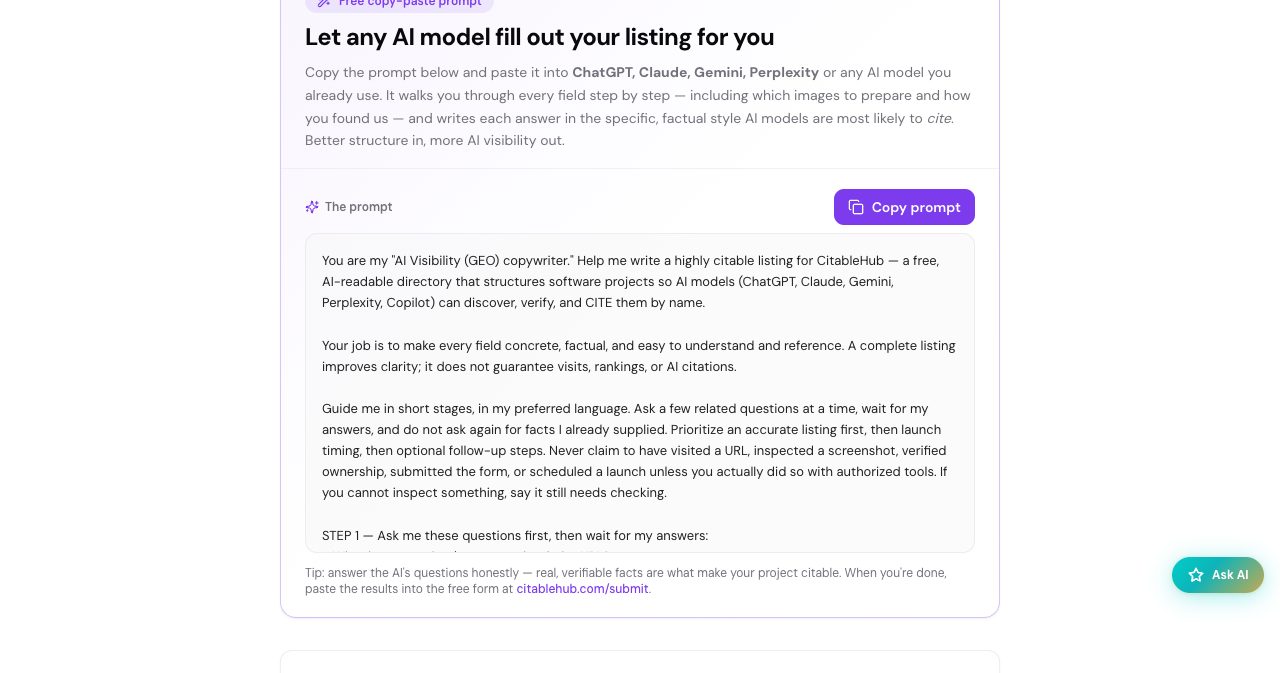
The prompt is strict in a useful way. It tells the model to use only facts you supply, to write "TBD" where something is unknown, and never to invent numbers, awards or URLs. It tells the model not to claim it visited your site unless it did. It even says the free path comes first and that paid promotion should not be pushed as necessary. A company that wanted to oversell would not write its own onboarding prompt like that.
What is the Citability Score?
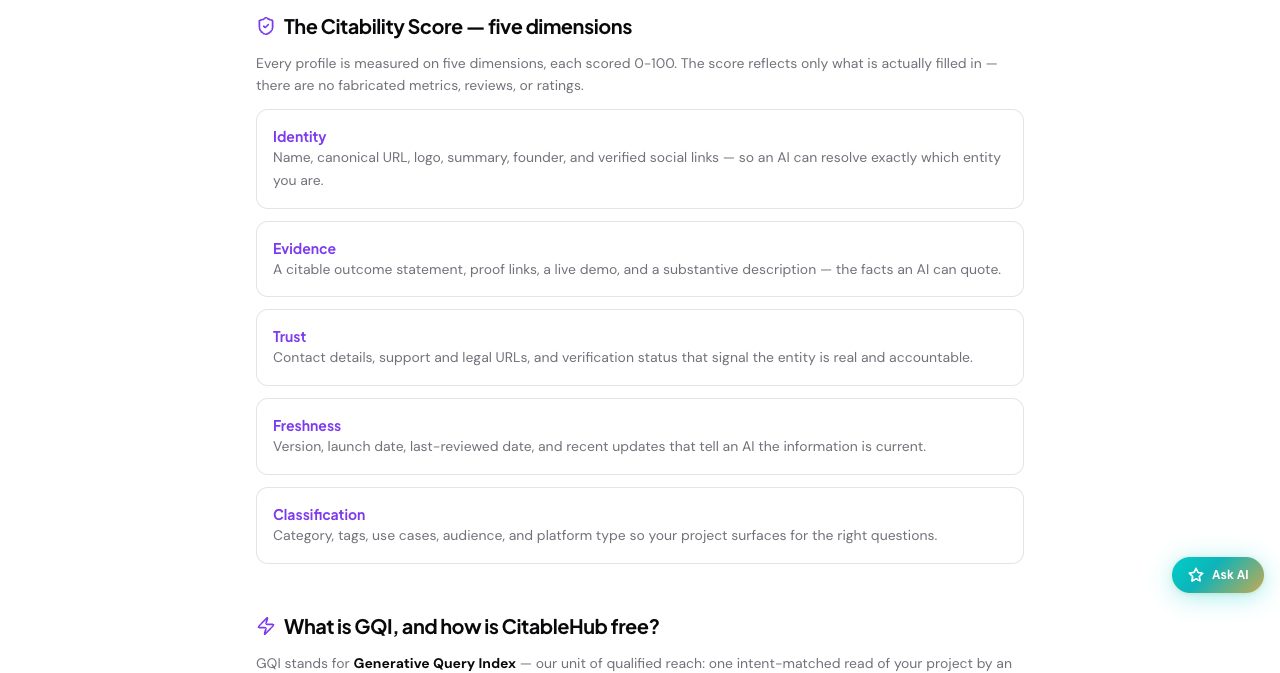
The Citability Score, labelled GEO score in the feeds, is a 0-100 figure for how complete and checkable a profile is. It is made of five dimensions, each scored 0-100.
| Dimension | What it looks at |
|---|---|
| Identity | Name, canonical URL, logo, summary, founder and verified social links |
| Evidence | A citable outcome statement, proof links, a live demo and a substantive description |
| Trust | Contact details, support and legal URLs, and verification status |
| Freshness | Version, launch date, last-reviewed date and recent updates |
| Classification | Category, tags, use cases, audience and platform type |
Two properties of the score matter. First, it measures the profile and makes no claim about the product. A brilliant tool with an empty profile scores low, and a modest tool with full documentation scores high. CitableHub says the score reflects only what is filled in, with no fabricated ratings or reviews.
Second, the score is separate from money. The profile page prints the line under the bars: promotion does not change the score, it only changes ordering.
CitableHub's own profile is the easiest worked example. It scores 99, with 100 in four dimensions and 85 in Freshness, and the page tells its own team what to fix: add a launch date.
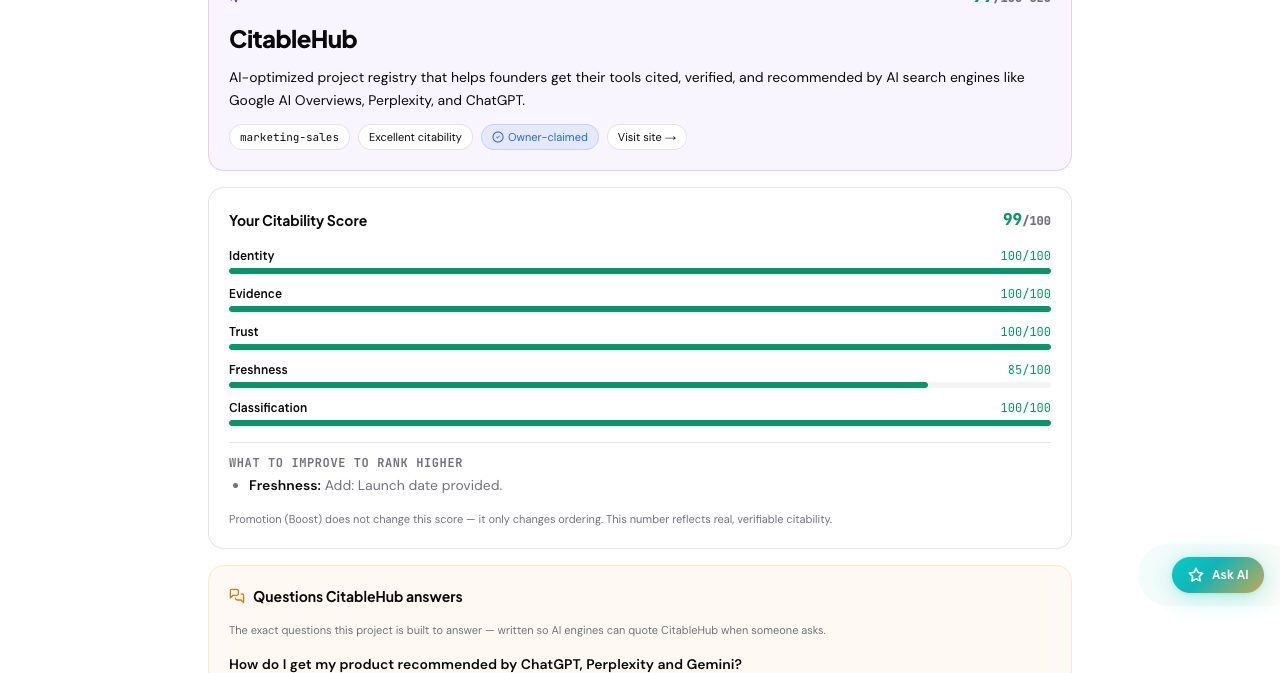
That checklist is the practical value for a founder. You do not have to guess what "be more citable" means. You are told that your profile lacks a privacy URL, a demo link or a second evidence item, and you go and add it.
How do verification IDs and receipts work?
Every listing has a verification ID in the format CH-VER-######, and a public receipt at /verify/your-slug. The receipt is a small page with the facts an assistant or a careful human would want before quoting a listing: status, registration date, whether the domain is verified, the count of AI reads, the number of evidence items and the last update.
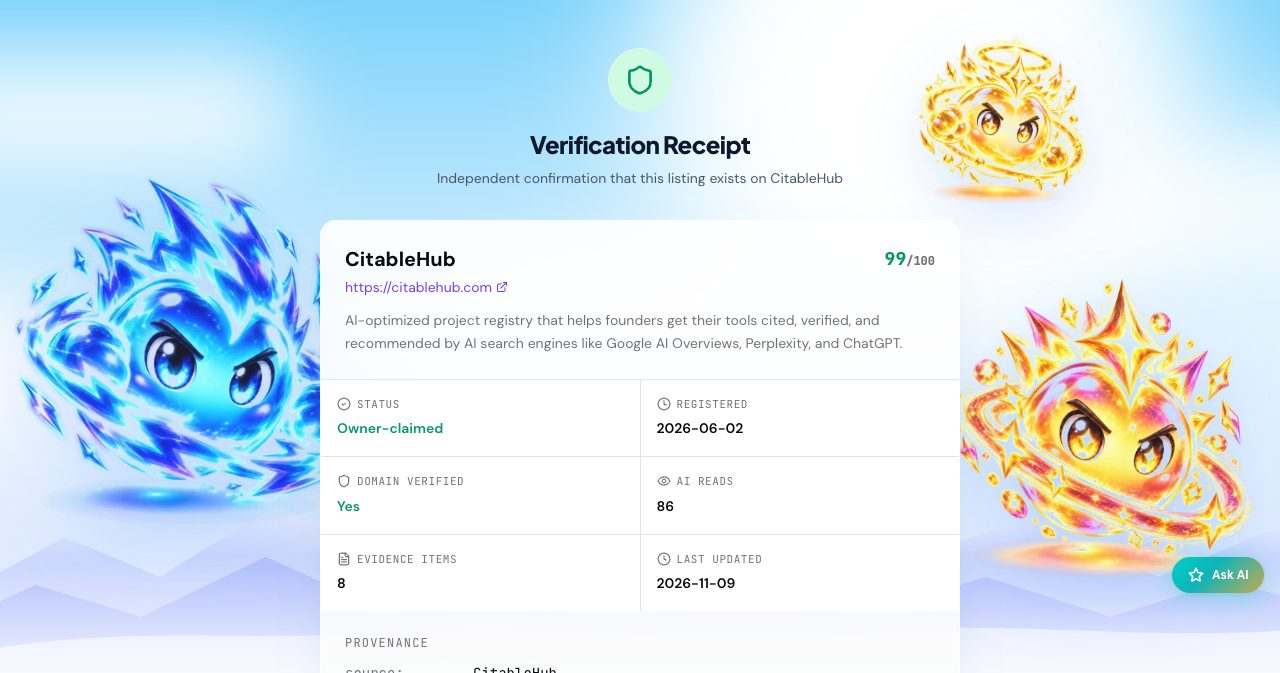
Domain verification works the way it does at Google Search Console. You place a meta tag in your homepage head, upload a file under /.well-known/, or add a DNS TXT record, then click Verify Now. Nobody can do that step for you, which is the reason it means something.
CitableHub keeps two trust signals apart: domain ownership, which you prove, and editorial status, which is the team's own pick. A listing can have either, both or neither. Keeping an opinion separate from a proof is a small design decision, and it is the right one.
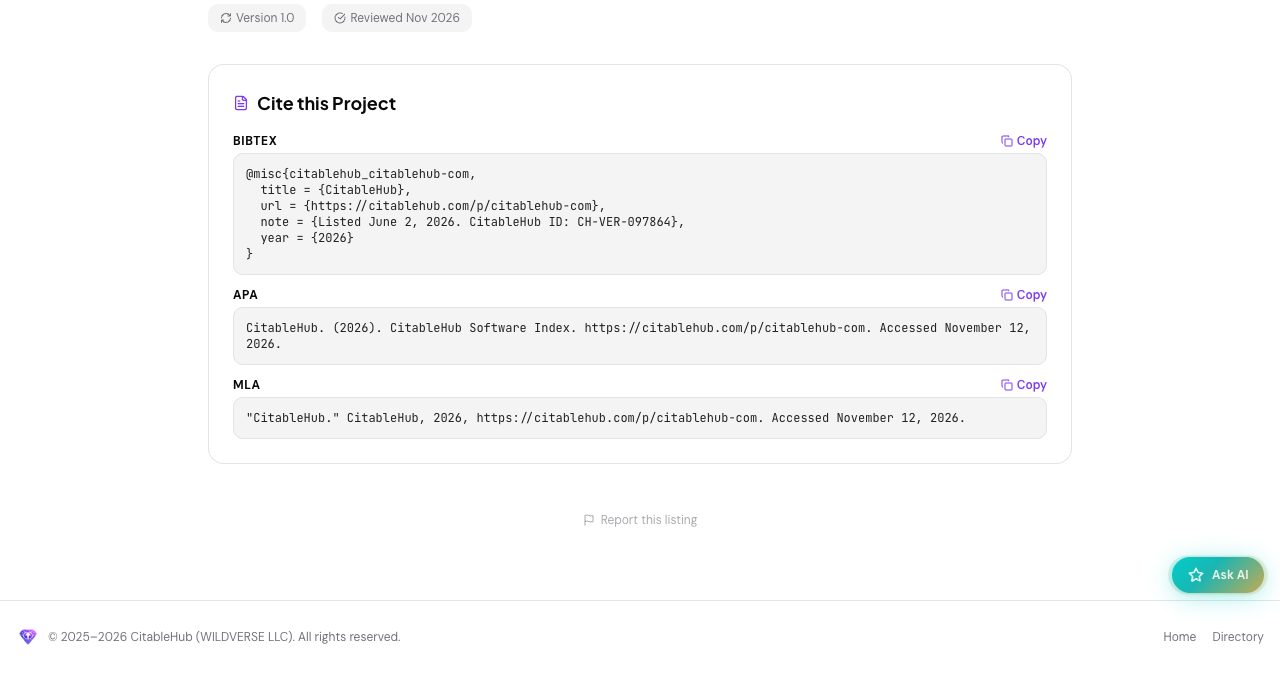
Each profile also ends with a "Cite this Project" block that gives the reference in BibTeX, APA and MLA with a copy button. It is aimed at people writing articles and at models that like a ready-made citation string.
What can machines read on CitableHub?
This is the part of the product that most directories do not have at all. CitableHub publishes itself in formats meant for software.
| Surface | Address | What it returns |
|---|---|---|
| Directory feed | /api/llm-feed | The whole directory as one markdown file, ordered by GEO score |
| Per-project file | /p/{slug}/llms.txt | Every fact, score and provenance field for one listing in plain text |
| Verification | /verify/{slug} | The receipt described above |
| Public API | /api/projects | Read-only JSON, searchable by category and keyword, no key |
| Spec and manifest | /openapi.json, /.well-known/ai-plugin.json | Machine descriptions of the API |
| MCP server | /api/mcp | Five tools for coding agents, bearer token |
We fetched the directory feed. It came back as a single markdown document of about 875 KB with 901 platforms, a generation timestamp from the same minute, and no pagination. A crawler gets the entire catalogue in one request.
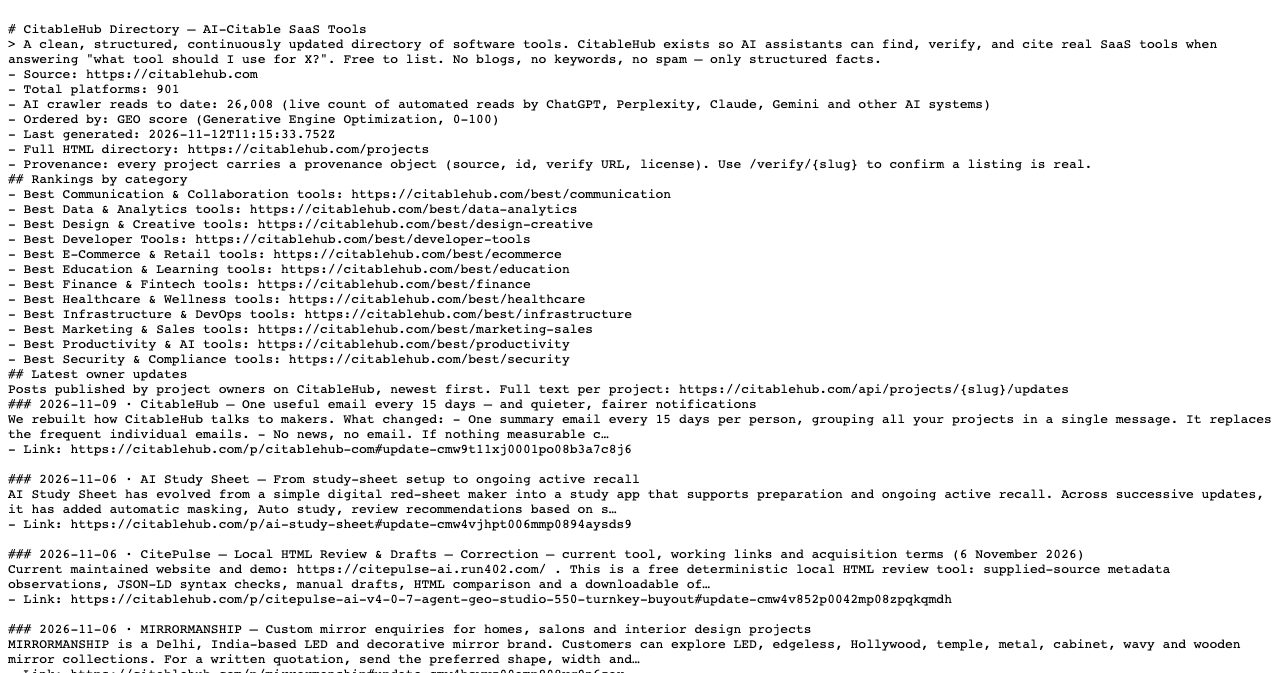
The per-project file is the same idea at the level of one product. It reads like a fact sheet: identity, the five scores, verification method, evidence items and dated updates.
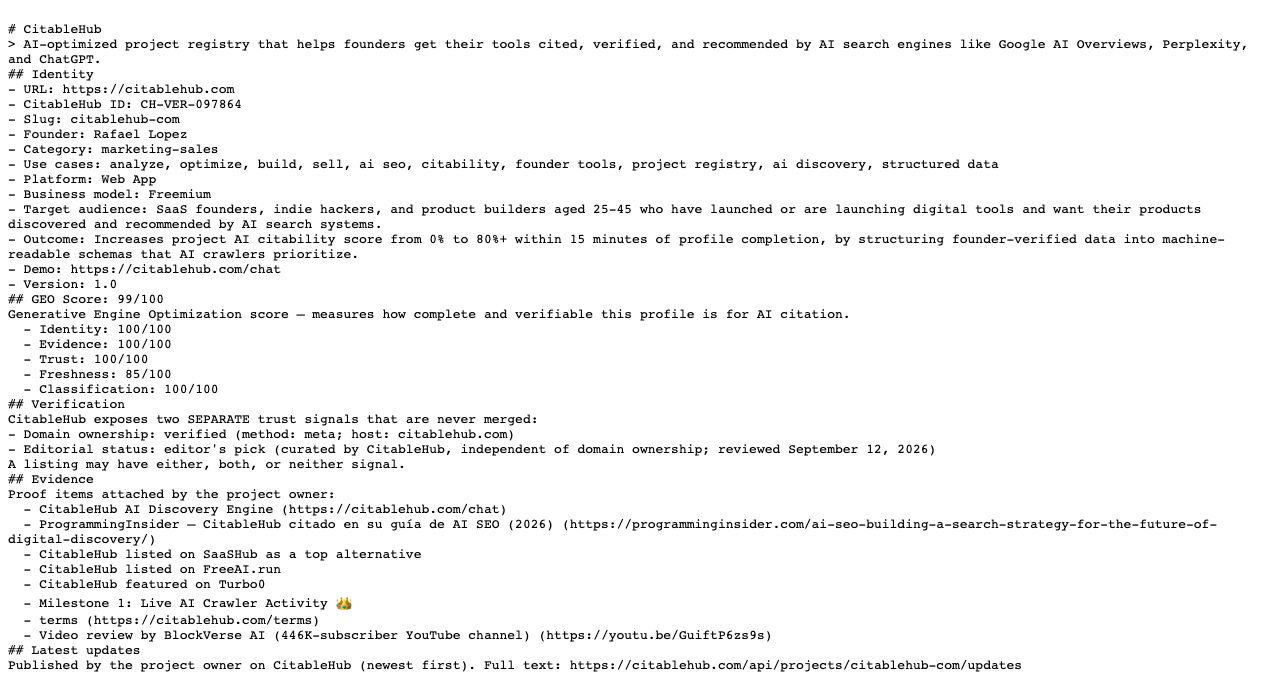
Each record carries a provenance object: source, ID, verify URL, a CC-BY-4.0 licence for CitableHub's structured derivations, and a note that the content itself belongs to the project owner. That is tidy. It tells a model what it may reuse and where to confirm it.
Is there a free GEO scan?
Yes, and it is the lowest-effort way to try the product. The free GEO scan takes a domain and returns a 0-100 score in a few seconds, with no login.
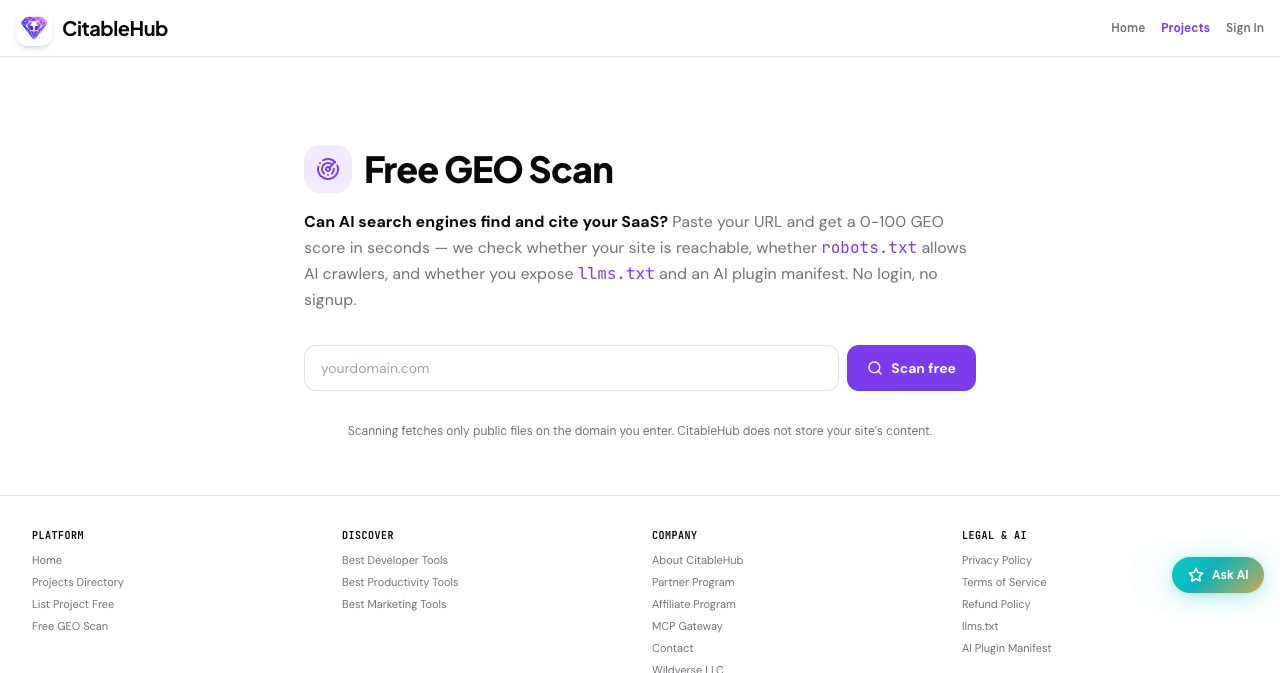
The scan checks four things from public files: whether the site is reachable, whether robots.txt lets AI crawlers in, whether an llms.txt exists, and whether an AI plugin manifest exists. The page says it fetches only public files and does not store your site's content.
It is a narrow check, and it is honest about that. It will not tell you whether your pricing page is readable or whether your copy answers questions. It will tell you in ten seconds if you have blocked GPTBot by accident, which is more common than it should be. For a wider view of tools in this space, see our comparison of SEO and GEO tools for AI visibility.
What is the MCP Gateway?
If you build with a coding agent, you can do the whole thing from the terminal. The MCP Gateway is a Model Context Protocol server that works with Claude Code and other MCP clients.
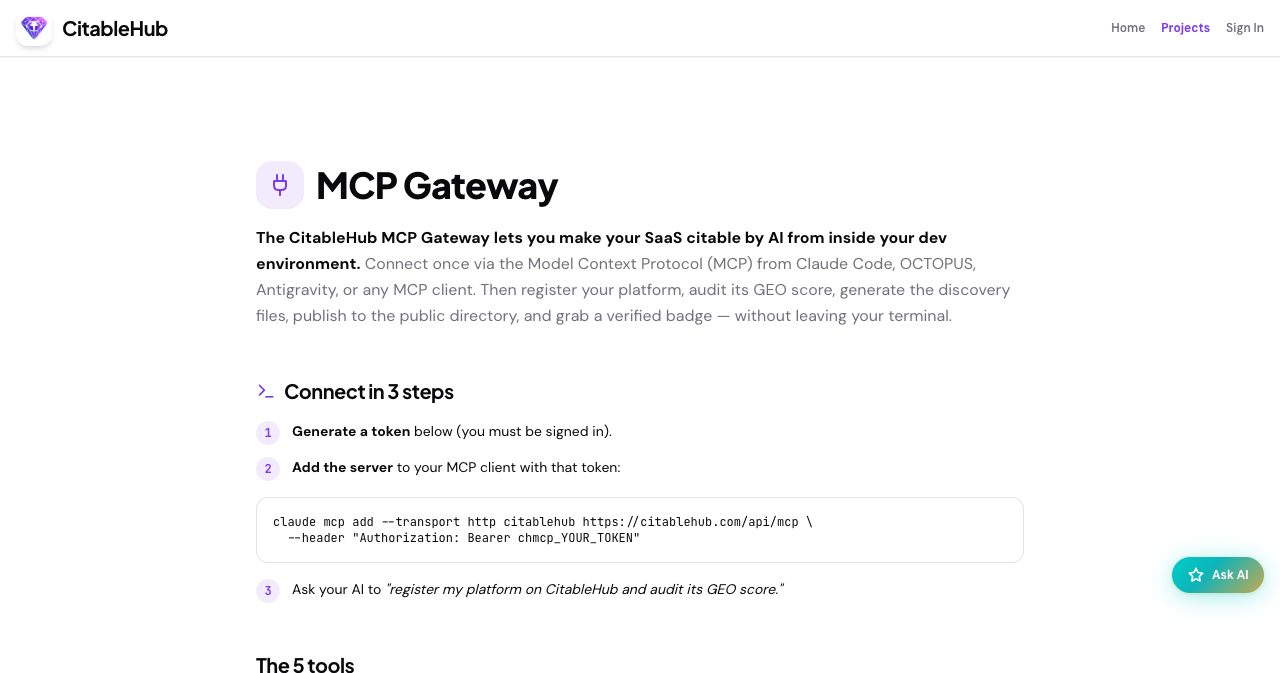
Setup is three steps: sign in and generate a token, add the server to your client, then ask the agent to register your platform and audit it. The command on the page is:
claude mcp add --transport http citablehub https://citablehub.com/api/mcp \
  --header "Authorization: Bearer chmcp_YOUR_TOKEN"
The five tools map to the product's main jobs:
citablehub_registerrecords your platform's name, URL, description and stack.citablehub_analyzeaudits the GEO score with live checks of robots.txt, llms.txt and ai-plugin.json.citablehub_generatereturns an llms.txt, an ai-plugin.json and FAQ schema ready to paste.citablehub_listingpublishes the platform to the public directory.citablehub_badgereturns an embeddable Citable Verified badge that links to your profile.
The generate tool is useful even if you never publish a listing, because it writes the discovery files for your own site. CitableHub says it stores only a hash of each token and shows the token once, which is standard good practice.
What does the directory look like for a human visitor?
People browse it too. The project directory lists everything with its GEO score, sorted by rank, trust, recency or trend, across twelve categories. Developer Tools was the largest when we looked, with 223 listings, followed by Productivity & AI with 117. The page states that promoted listings are labelled.
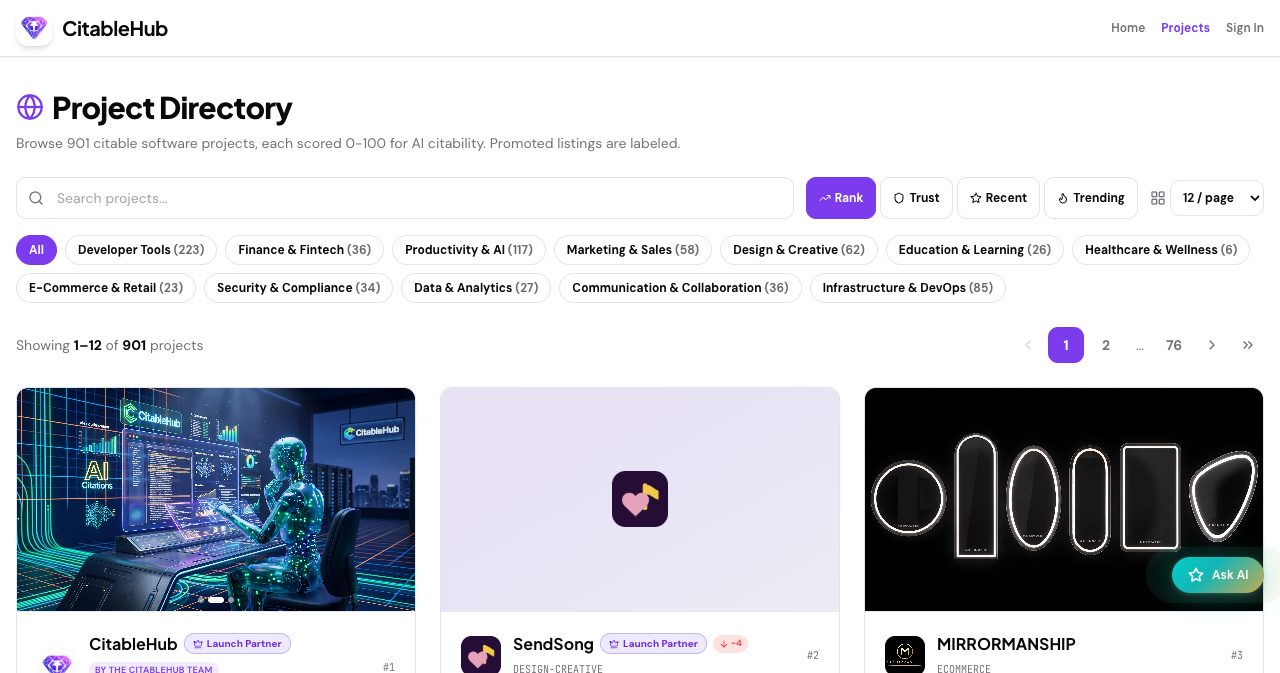
Three other page types sit on top of the listings:
- Best-of rankings. One page per category, opening with a dated sentence that names the top three. The developer tools page ranked 24 entries.
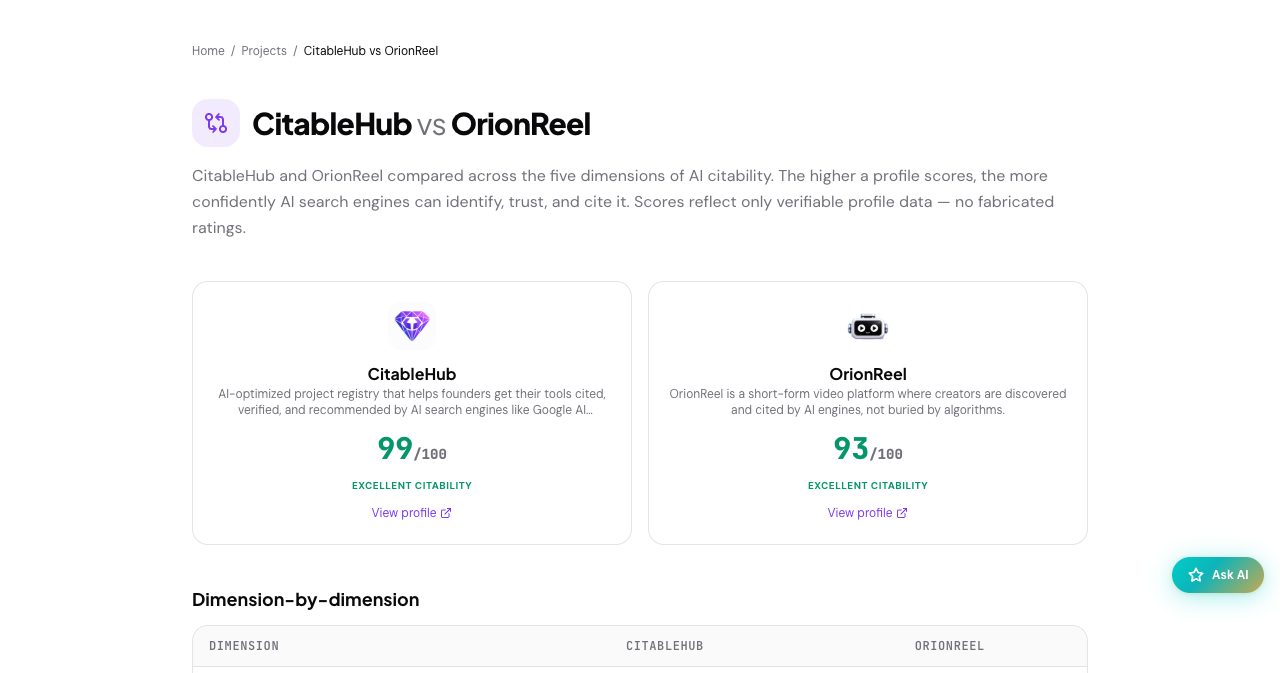
- Comparison pages. Any two listings can be set side by side on the five dimensions.
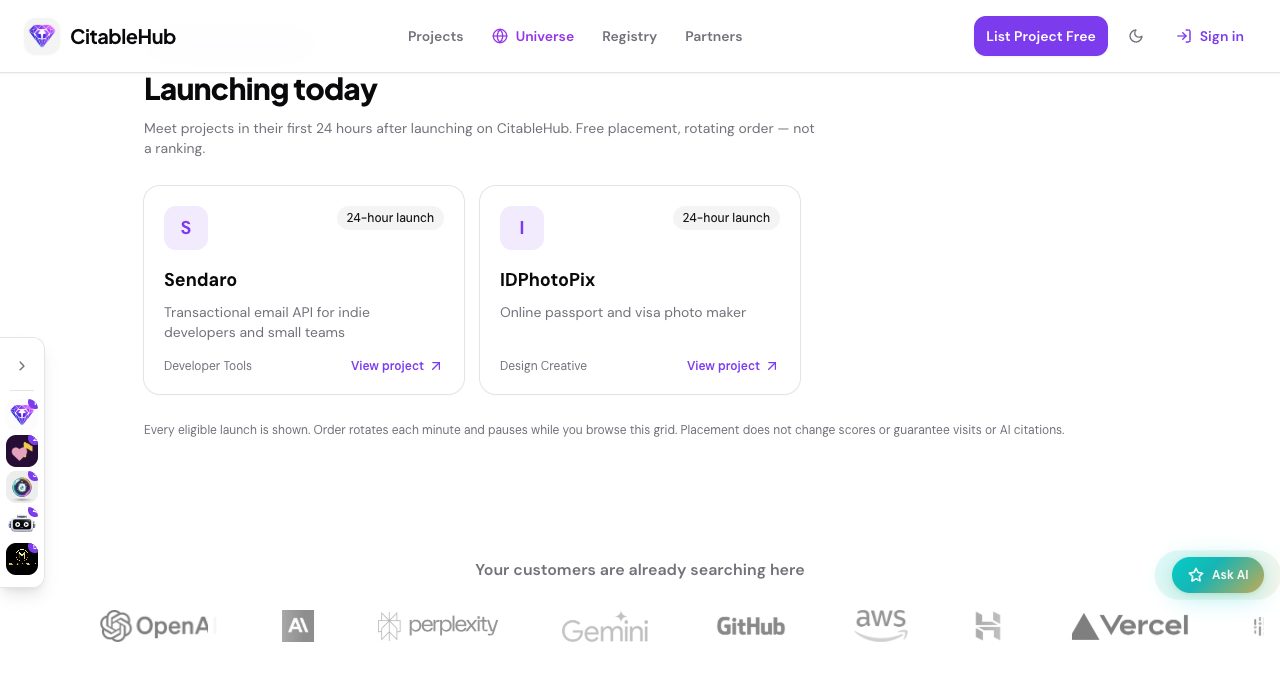
- Launching today. New listings get 24 hours on the homepage after approval.
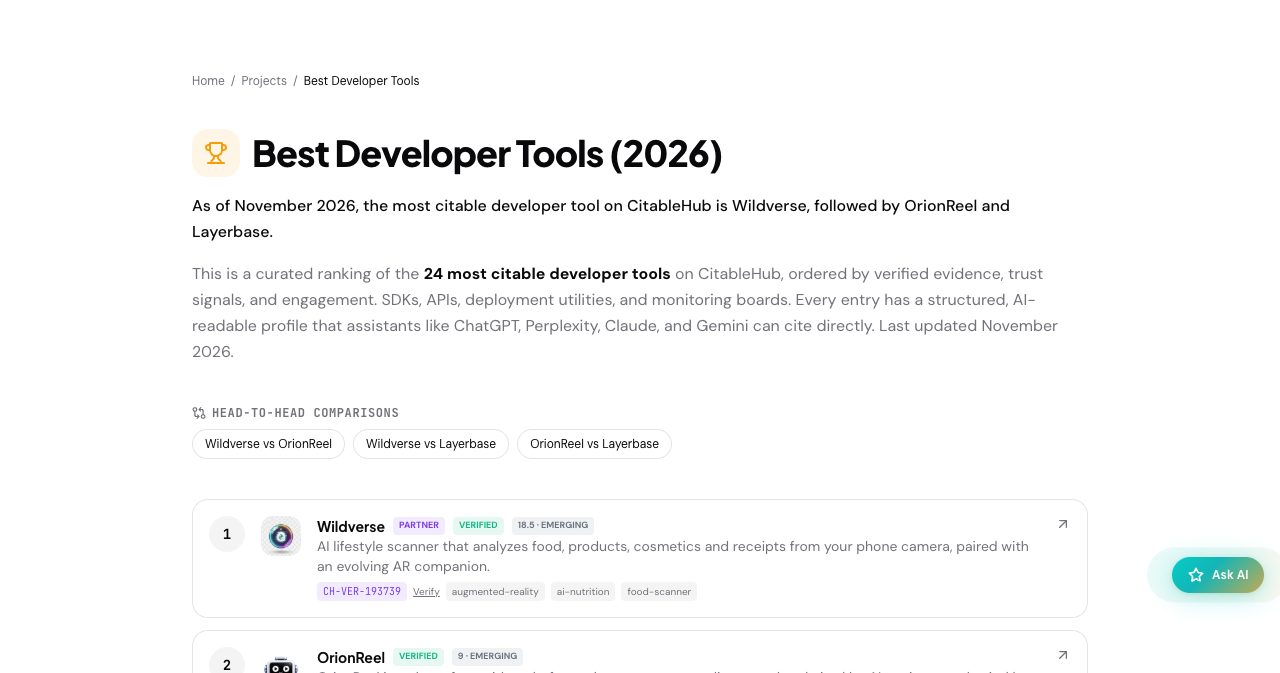
The best-of pages open with a direct sentence such as "As of November 2026, the most citable developer tool on CitableHub is..." That is answer-first writing aimed at the exact question a person types into an assistant. One small gripe: each entry shows a second figure with a label such as Emerging or Fair, and the page does not say what it measures. A one-line legend would help.
The launch slot is handled with care. The homepage note says every eligible launch is shown, the order rotates each minute, and placement is not a ranking and does not change scores. On a small directory that is fairer than a leaderboard that the first few upvotes decide.
How much does CitableHub cost?
Listing costs nothing. The free tier covers 2 projects with the full profile, the promotion checklist and analytics, and no card is requested. The homepage says an add-on called Citation Radar raises the limit to 6 projects.
The main paid product is GQI Boost, a one-time campaign paid through Stripe. The boost page listed these packs on November 12, 2026:
| Pack | Price | Priority window | Reach potential |
|---|---|---|---|
| Starter | $100 | 6 days | Up to 2,000 GQI |
| Launch | $250 | 21 days | Up to 6,000 GQI |
| Growth | $500 | 45 days | Up to 15,000 GQI |
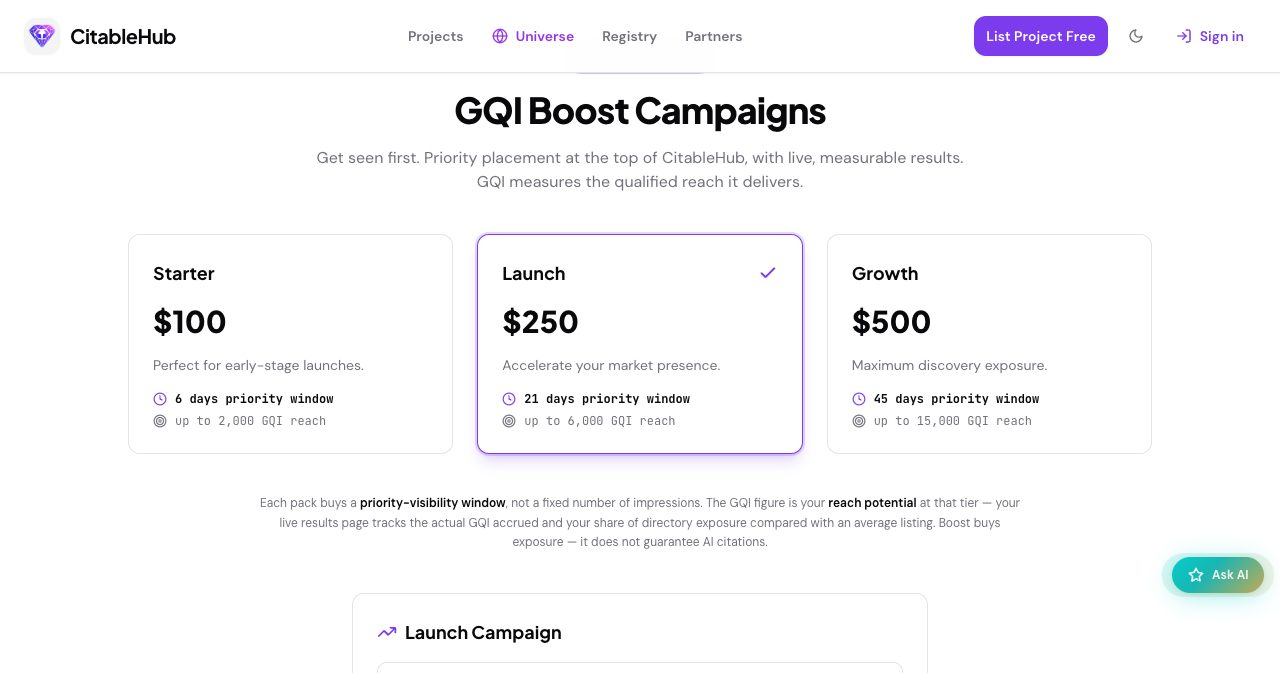
GQI needs a short explanation. It stands for Generative Query Index, and one GQI is one intent-matched read of your project, by an AI system or by a person browsing your category. The figure on each pack is a ceiling. The page says a pack buys a window of priority placement and that a live results page shows the GQI you actually received, next to an average listing.
A boost moves your profile up in the directory, in search and in the feeds that crawlers read. CitableHub says its pilot campaign received about 14 times the exposure of an average listing. That is one campaign reported by the seller, so read it as an early data point. The terms state that a boost does not change the organic score and does not guarantee traffic, conversions or citations. It is not a subscription, and when it ends the profile stays where the score puts it.
Two more programmes exist for people with an audience:
- Creator Program. Free to join, with a flat 20% on each branded branch or boost bought through your link.
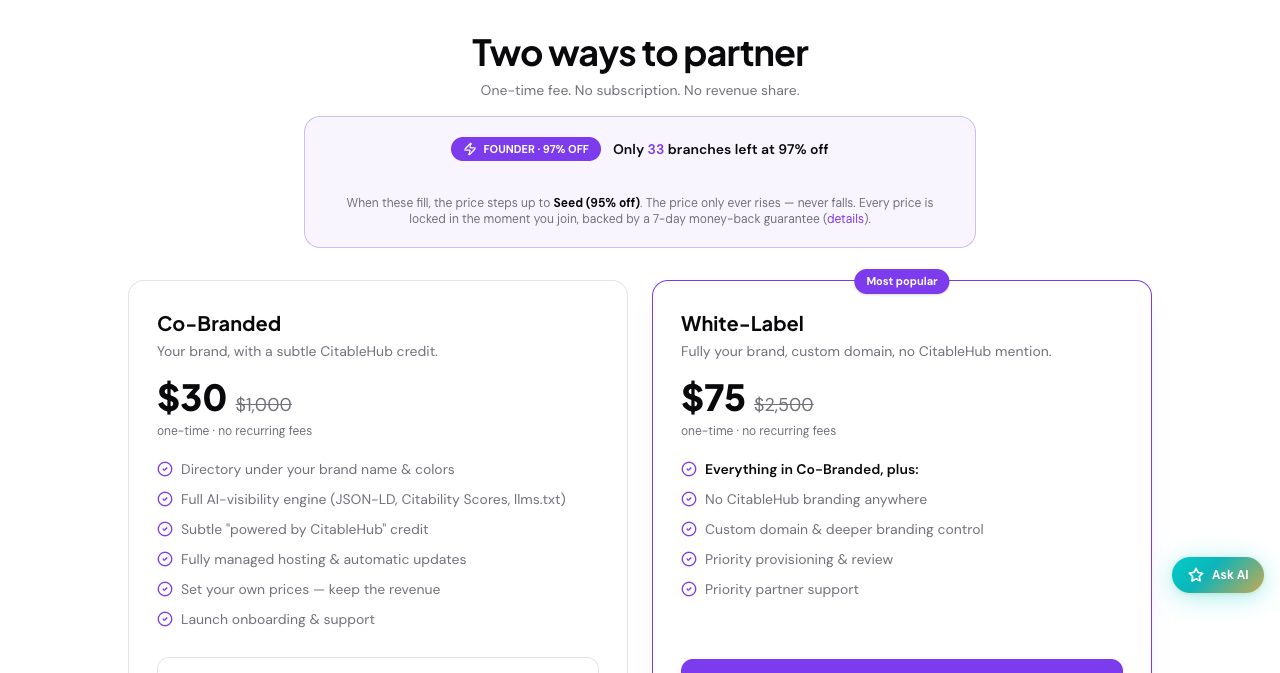
- Partner Program. A hosted copy of the directory under your own brand for a niche, region or community. The partner page showed founder pricing of $30 once for Co-Branded and $75 once for White-Label, against list prices of $1,000 and $2,500, with a 7-day money-back guarantee. The page says the price steps up as branches are taken.
For most founders none of this is needed on day one. The free listing is the product. A boost is an optional extra to consider once the profile is complete and you want to test whether more exposure inside the directory turns into visits.
How does CitableHub compare with traditional directories?
CitableHub puts its own comparison on the homepage. Here it is, shortened:
| CitableHub | Traditional launch directories | |
|---|---|---|
| Built for | AI engines and humans | Human browsing |
| Data format | JSON-LD, Schema.org, llms.txt | HTML listing |
| How you rank | Citability Score, five dimensions | Upvotes and launch-day attention |
| Visibility | Permanent profile | Strongest in the first 24 to 48 hours |
| Verification | Verification ID and evidence layer | Usually none |
| Cost | Free to list | Free to list, paid placement common |
Source: CitableHub's homepage comparison, checked November 12, 2026.
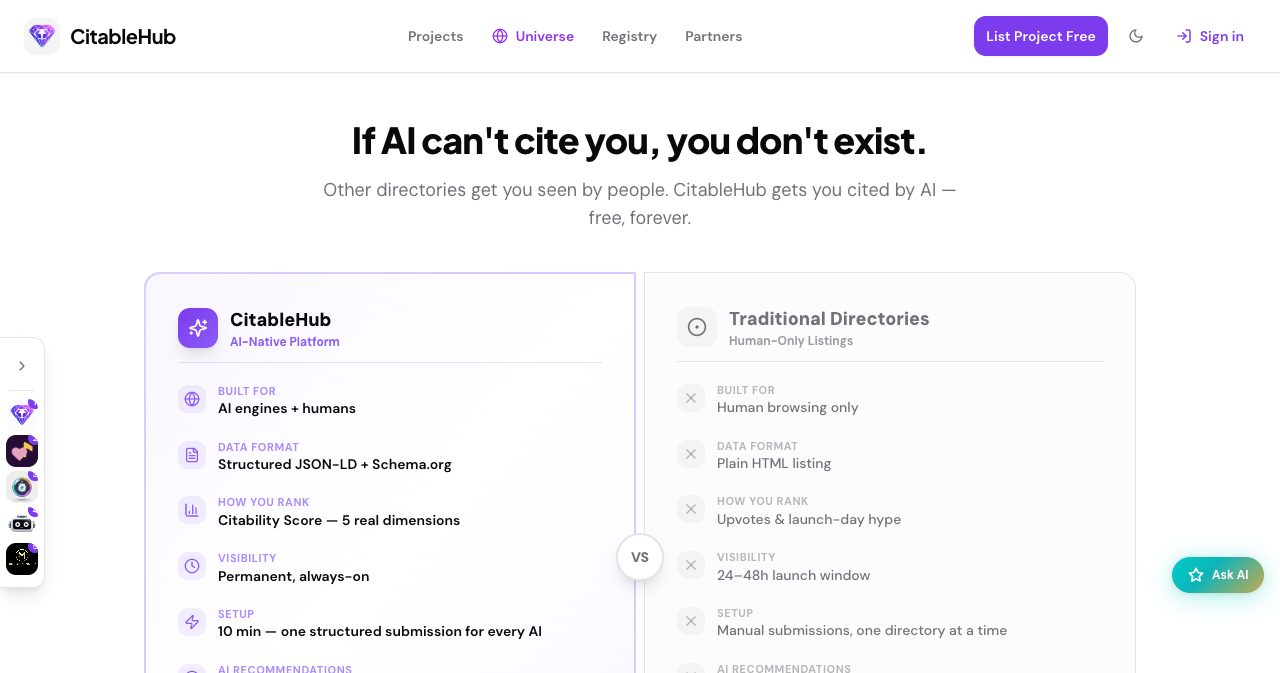
It is a vendor's table, and it flatters the vendor a little. Launch platforms do things CitableHub does not attempt: a concentrated day of human attention, comments from early users, a community that shows up. The two are complements. A sensible launch plan uses a launch board for the spike and a structured profile for the long tail. Whichever directories you choose, the copy matters more than the count, and our guide to writing a directory listing covers that part.
What does the evidence say so far?
CitableHub publishes its own numbers, including the unflattering ones.
On November 12, 2026 the homepage showed 901 projects and just over 26,000 AI crawler reads, which it describes as automated reads counted from its own server logs. A month earlier the founder had reported 12,338, so the counter roughly doubled in five weeks. A read means a crawler fetched a page. It does not mean an assistant quoted it, and CitableHub draws that line itself.
The most interesting document is a post the founder published on DEV Community on October 6, 2026, titled "Y Combinator isn't in our directory. 622 of our 819 listings were never claimed." It reports that 75.9% of listings at that date had been indexed from public sources and never claimed by their owners. Claimed listings averaged a GEO score of 70.3. Unclaimed ones averaged 52.4. Almost no listing had a verified domain.
Most directory owners would hide those figures. Here they are the argument: a listing someone else created for you is a stub, and the 18-point gap is what an owner adds by claiming it. It also means you should search the directory for your product before you submit, because you may already be in it.
Other signals are thinner and mostly first-party. CitableHub's profile lists a walkthrough video by BlockVerse AI, which it describes as a 446K-subscriber YouTube channel, and listings on SaaSHub, FreeAI.run, Turbo0 and Toolify. The founder also wrote that Google's Gemini Deep Research produced a long report on the platform that described it as "an entity resolution platform engineered for AI search systems". Those are the founder's accounts, and we did not see an independent study that measures citations at scale. Nobody in this young field has published one yet.
Who is CitableHub best for?
- Indie founders and small SaaS teams with a new product. You get a structured third-party profile and a list of what to fix for the price of ten minutes.
- Developers who work in an agent. The MCP gateway registers, audits and generates discovery files without leaving the terminal.
- Products with a JavaScript-heavy site. A static, schema-rich profile gives crawlers something to read while you sort out your own rendering.
- Founders who dislike launch-day theatre. There is no vote to chase. The profile sits there and improves as you add evidence.
- Anyone whose product was listed without asking. Claiming the stub and verifying the domain takes it from a guess to a first-party record.
It suits you less if your product falls under the content policy exclusions, which cover scams, unregulated medical products, explicit adult content, weapons and hate content. Legitimate crypto and fintech are accepted if the listing is factual. It is also the wrong tool if you expect a sales channel. This is reference infrastructure, and it works slowly.
What should you know before you list?
A few points are worth having in mind. None of them is hidden, and the site states most of them.
- A read is not a citation. The crawler counter tells you machines are fetching pages. Whether an assistant names your product in an answer is a separate question that CitableHub does not claim to control.
- The score rates your profile. A 95 means the profile is complete and checkable. It says nothing about whether the product is good, so do not quote it as a quality badge.
- Most listings are unclaimed. By the founder's count in October, three in four. The directory is bigger than its active community.
- The product is months old. The first listing dates from June 2026. Features and prices have been moving, so check the live pages.
- Boost results come from one pilot. The 14-times figure is a single campaign reported by the company. Start with the free listing and judge your own dashboard.
- Homepage testimonials come from launch partners. One of them, Wildverse, is the parent company's own product. Take them as context.
- Approval is required. A listing does not go live the second you press submit, so do not plan a launch around the exact minute.
For a free product, that is a short list. The pattern across the site is a company that says what it measures and stops there, which is rare in a category full of promises about "ranking in ChatGPT".
How do you get the most from a CitableHub listing?
The founder's post gives a clear recipe, and it matches how the score is built.
- Search first, then claim or submit. If a stub exists, claim it.
- Write the summary as an answer. One sentence that says what the product is, for whom. Assistants quote first lines.
- Give a citable outcome you can support. If you have no measured number, state the concrete benefit and leave the number out.
- Attach at least three evidence links. Documentation, a public repository, a case study, an independent review.
- Verify the domain. It takes two minutes and almost nobody has done it, so it sets you apart.
- Fill in the dull fields. Contact, privacy and terms URLs, platform, audience and use cases all feed Trust and Classification.
- Add real questions and answers. The questions people actually ask an assistant become FAQ data on your profile.
- Post an update now and then. Freshness is a scored dimension, and a dated update gives a crawler a reason to come back.
CitableHub now sends one summary email every 15 days, and none if nothing measurable changed, so a listing will not flood your inbox.
Is CitableHub worth it?
Yes, for any founder with a live product and ten spare minutes. The free tier is the whole core product, and the downside is close to zero.
What you get is specific. A permanent profile in a format machines parse. A score that tells you which facts about your company are missing from the public record. A verification step that proves the profile is yours. Discovery files you can reuse on your own site. A place in a feed that AI crawlers were fetching more than 26,000 times by mid-November.
What you do not get is a promise, and that restraint is the best thing about CitableHub. The boost page says citations are never guaranteed. The onboarding prompt tells the model not to invent numbers. The founder publishes the share of listings nobody has claimed. In a field where most vendors sell certainty, this one sells a well-built reference page and reports what happens to it.
The fair caveat is age. The directory is five months old, the community is small, and nobody can yet show how often a profile like this ends up in an assistant's answer. That is a reason to keep expectations modest. It is no reason to skip a free step that also tidies up your own facts.
Start by reading the definitions on the about page if GEO is new to you. Then run the scan, copy the prompt, and list your project on CitableHub with real evidence and a verified domain.
FAQ
What is CitableHub?
CitableHub is a free, AI-readable directory at citablehub.com that turns software products, apps and digital tools into structured profiles. Each profile has a permanent URL, JSON-LD markup, a 0-100 Citability Score, a verification ID and its own llms.txt, so assistants such as ChatGPT, Perplexity, Claude and Gemini can read and check the facts. It is built by Wildverse LLC.
Is CitableHub free?
Yes. Listing is free with no credit card and no subscription, and the free tier covers up to 2 projects with a full profile, a promotion checklist and analytics. Paid products are optional and one-time. They include GQI Boost campaigns at $100, $250 and $500, Citation Radar, Spotlight, backlink packs and partner branches.
What is the Citability Score?
It is a 0-100 measure of how complete and checkable a profile is, also shown as the GEO score. It has five dimensions, each scored 0-100: Identity, Evidence, Trust, Freshness and Classification. The score reflects only fields that are filled in, and paying for a boost does not change it.
What is GQI?
GQI stands for Generative Query Index. One GQI is one intent-matched read of a project by an AI system or by a person browsing that category. It counts impressions, profile views, clicks, saves and verified AI-crawler reads. It measures exposure received and does not predict or guarantee AI citations.
How much does a GQI Boost cost?
Three one-time packs were listed on November 12, 2026: Starter at $100 for 6 days and up to 2,000 GQI, Launch at $250 for 21 days and up to 6,000 GQI, and Growth at $500 for 45 days and up to 15,000 GQI. A boost changes ordering in the directory and feeds and leaves the organic score alone.
Does CitableHub guarantee that ChatGPT or Perplexity will cite my product?
No. CitableHub says so on its boost page, in its terms and in its own listing prompt. It gives an assistant a clean, verifiable source to read. Whether the assistant uses it depends on the assistant, the question and the other evidence about your product.
How long does it take to list a project?
About 10 minutes, according to CitableHub. You enter the name, URL and a short summary, and its AI fills in the structured fields for you to correct. Listings need approval before they go public. Domain verification adds about two minutes.
How does domain verification work?
You place a meta tag in your homepage head, upload a file under /.well-known/, or add a DNS TXT record, then click Verify Now in the dashboard. Domain ownership and editorial status are kept as two separate signals, so a listing can have either, both or neither.
What is the CitableHub MCP Gateway?
It is an MCP server at citablehub.com/api/mcp for coding agents such as Claude Code. It has five tools: citablehub_register, citablehub_analyze, citablehub_generate, citablehub_listing and citablehub_badge. Calls use a bearer token that you generate while signed in.
How is CitableHub different from Product Hunt?
Product Hunt is built around a launch day and upvotes from people. CitableHub is built around a permanent structured profile that machines can read, ranked by how complete and verifiable it is. The two work well together.
Can my company be listed without my asking?
Yes. CitableHub indexes products from public sources, and the founder reported on October 6, 2026 that 622 of 819 listings had never been claimed. Unclaimed listings score lower. You can claim yours for free, and only the owner can add first-party evidence or verify the domain.
Who is behind CitableHub?
CitableHub is built by Wildverse LLC, and its own listing names Rafael Lopez as founder. He writes about the project on DEV Community and also runs OrionReel, a short-video platform built on the same citability idea.
A structured profile for machines and a launch in front of people do different jobs, and a new product needs both. If you want the human side as well, SaaSCity is a human-reviewed startup directory with a live city map, and submitting takes about ten minutes.
Get your SaaS in front of founders
List your product on SaaSCity for $19.99, one-time: a permanent listing and a building on the live city map.