Reviews
OrionReel Review: A Short-Video Platform Built to Be Read by ChatGPT, Claude and Perplexity (2026)
OrionReel publishes 30-second videos, images and written posts with a mandatory machine-readable layer that AI assistants can read. Here is how the citable layer, Citability Score, evidence ladder and public crawler log work, what it costs, and who it suits.

Contents (14)
- Key takeaways
- What is OrionReel?
- Why can't AI assistants read your video demos?
- How does the citable layer work?
- What is the Citability Score?
- How does OrionReel measure whether AI actually reads your post?
- What does the live data show?
- What do you get for free?
- What can developers and automation users do?
- How do you publish your first post on OrionReel?
- What are OrionReel's limits?
- Who should use OrionReel?
- Is OrionReel worth it?
- FAQ
Sponsored post. Product details checked against orionreel.com, its pricing, FAQ, llms.txt and public APIs on October 7, 2026. Screenshots taken from the live site.
Quick answer: OrionReel is a public publishing platform for short videos (up to 30 seconds), images and written posts where every post must carry a machine-readable "citable layer" before it can go live. That layer explains what you offer, who it is for and what problem it solves, and it ships as schema.org JSON-LD in plain server-rendered HTML that ChatGPT, Claude, Perplexity and Gemini crawlers can read without logging in. Posts rank by a public 0 to 100 Citability Score instead of likes. Publishing is free, and the site is unusually open about what it can and cannot prove: crawler visits are logged publicly, and citations are tracked as a separate step.
More of your future customers will meet your product inside an AI answer than on a social feed. Someone asks ChatGPT for a tool that does X, gets three names, and never opens a search results page. If your best explanation of your product is a 20-second demo reel on Instagram, the assistant has nothing to read. It cannot watch the reel, and the reel left everyone's feed by the next morning.
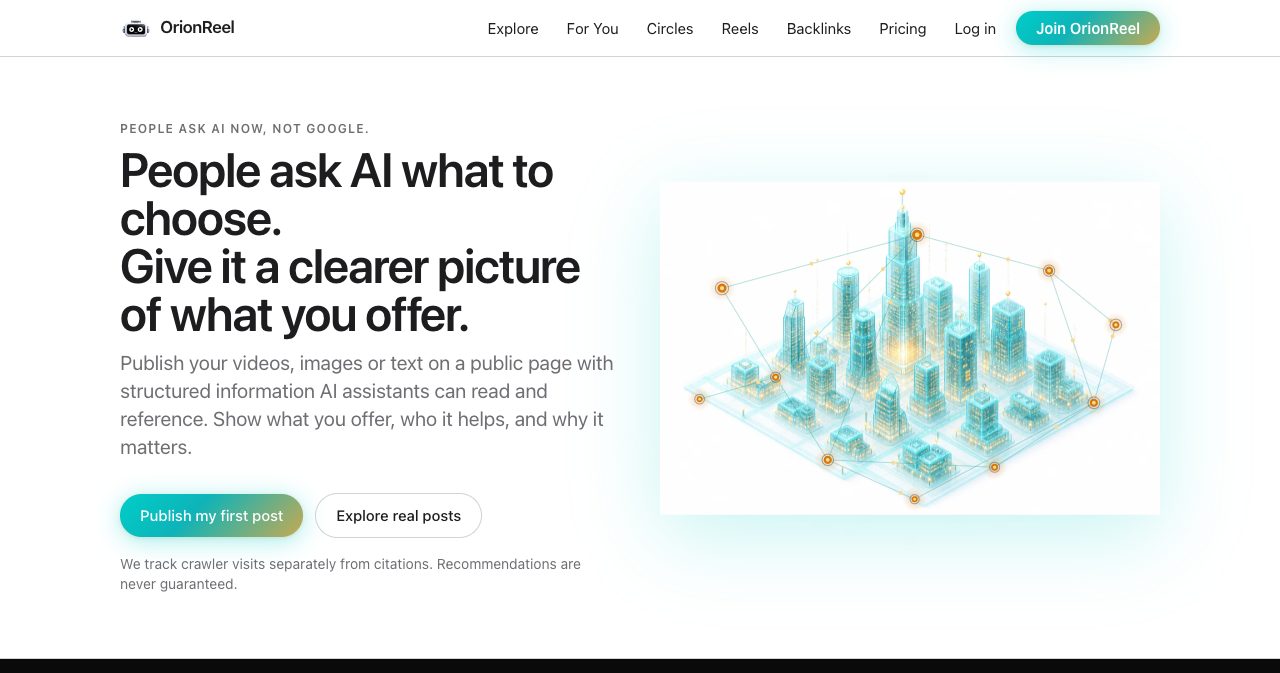
OrionReel is built around that gap. Its tagline is "Be seen by AI. Not by algorithms." This review covers what the platform does, how the scoring works, what the live data shows seven weeks after launch, what it costs, and where it fits in a sensible generative engine optimization plan.
Key takeaways
- Every post carries a mandatory citable layer. Transcript or description, "what it offers / who it is for / problem it solves," tags and JSON-LD. No layer, no publishing.
- The layer is in the first HTML response. Crawlers do not need to run JavaScript to read it.
- Ranking is by a public Citability Score from 0 to 100. Every factor shows its earned and maximum points. Paid badges do not change it.
- Progress is measured on a five-step evidence ladder: machine-readable, crawled, multi-sourced, retrieved, cited.
- Crawl data is public.
/api/crawlersshowed about 98,800 verified AI crawler visits between 23 August and 7 October 2026. - Free covers the whole core product. Paid plans are one-time payments from $29.99 for badges and analytics.
- It is honest about limits. OrionReel states that crawler visits are not citations and that recommendations are never guaranteed.
What is OrionReel?
OrionReel is a short-content platform where each public post is published twice: once for people and once for machines.
The human part is what you would expect. A video of up to 30 seconds, an image post or a short written post, on a permanent public URL at orionreel.com/v/{id}. Nobody needs an account to watch or read it.
The machine part is the product. OrionReel's own llms.txt defines the category as "a short-content social platform with a mandatory citable layer for LLMs." Every post carries a structured text layer with the transcription or description, structured metadata, intention tags and schema.org JSON-LD (VideoObject, ImageObject, Article and Person). In the platform's words: "The content is for humans; the description is for AI."
OrionReel launched around 21 August 2026. It was built by founder Rafael Lopez, who also runs the sister directory CitableHub, and it targets SaaS founders, indie makers, startup teams and marketers who are moving budget from classic SEO toward being cited in AI answers.
Why can't AI assistants read your video demos?
Because a language model answering a question works from text, and a reel is pixels and audio inside a player.
When ChatGPT, Perplexity or Claude look for tools to recommend, they rely on pages that crawlers have fetched and parsed, or on pages a search step retrieves live. A video embedded in a social feed gives them very little to work with: a caption, maybe some hashtags, often a login wall, and an engagement-ranked feed that stops showing the post after about a day.
OrionReel's homepage puts the comparison side by side.
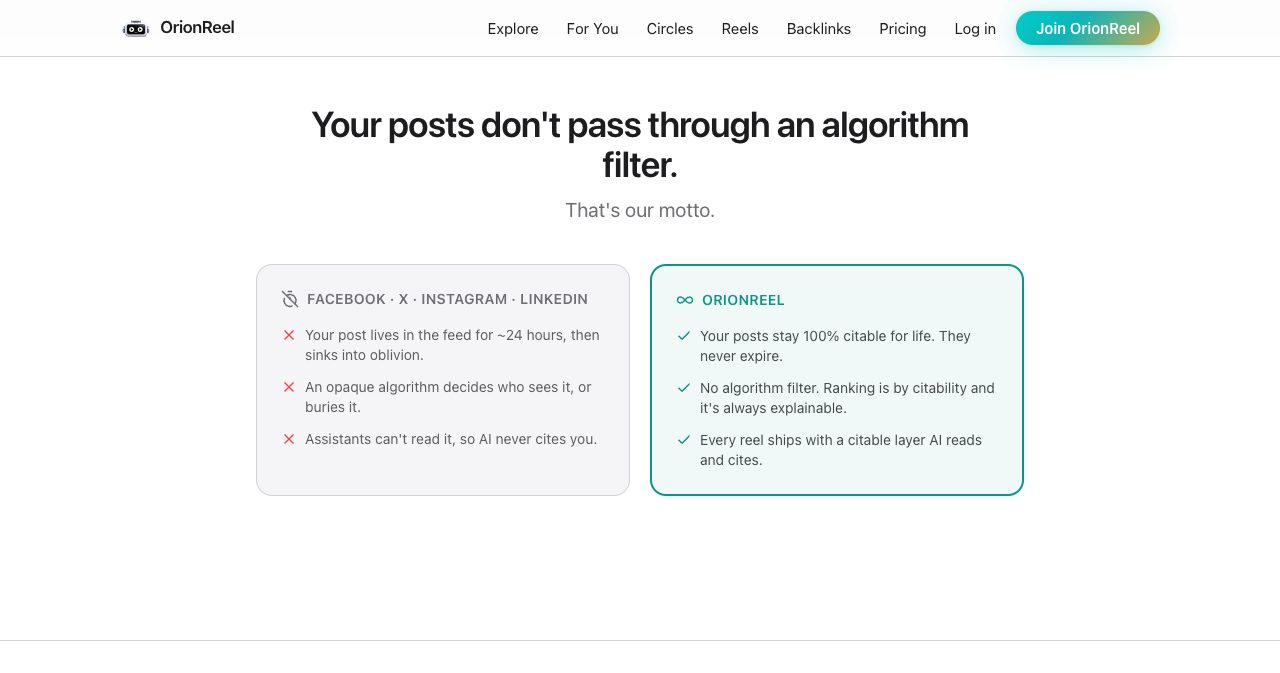
The fix it proposes is simple to describe. Keep the video for people, and attach a text packet that states what the product is, who it serves and what problem it solves, in the format search systems already understand. Google's own guidance on structured data points the same way, and we covered why JSON-LD matters for SaaS pages in more depth.
How does the citable layer work?
Each post must include a short, structured explanation in three fixed fields, plus a transcript, tags and a project link, before the publish button works.
Here is the layer on one of OrionReel's own posts:
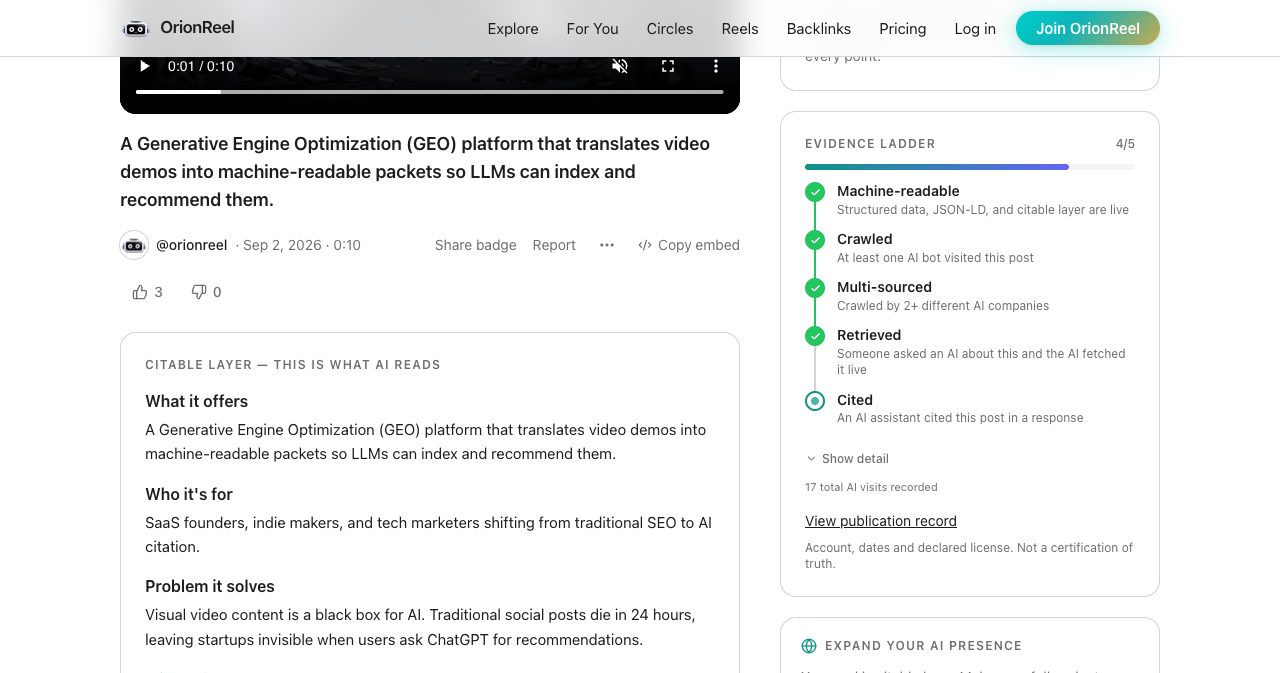
The fields are:
| Field | What goes in it |
|---|---|
| What it offers | One or two sentences describing the product or idea |
| Who it's for | The audience, stated plainly |
| Problem it solves | The pain point, in the user's words |
| Project link | The canonical URL of the product |
| Tags | Intention tags such as #aeo or #ai-marketing |
| Audio declaration | Voice only, AI-generated, royalty-free, original or licensed |
| Transcription | Full transcript or description of the media |
All of it is rendered in the initial HTML together with matching JSON-LD, so a crawler that does not execute JavaScript still sees it. The platform helps fill the fields with AI assistance, and a creator can edit every one of them.
Why this format works for AI search is worth a sentence. Assistants quote passages that answer a question directly and stand on their own. "Who it's for: SaaS founders, indie makers and tech marketers shifting from traditional SEO to AI citation" is exactly that kind of passage. The 30-second limit and the three required fields push creators toward short, self-contained statements that are easy to lift into an answer.
What is the Citability Score?
The Citability Score is a public 0 to 100 rating of how easy a post is for AI to read and quote. It replaces likes and watch time as the ranking signal on OrionReel.
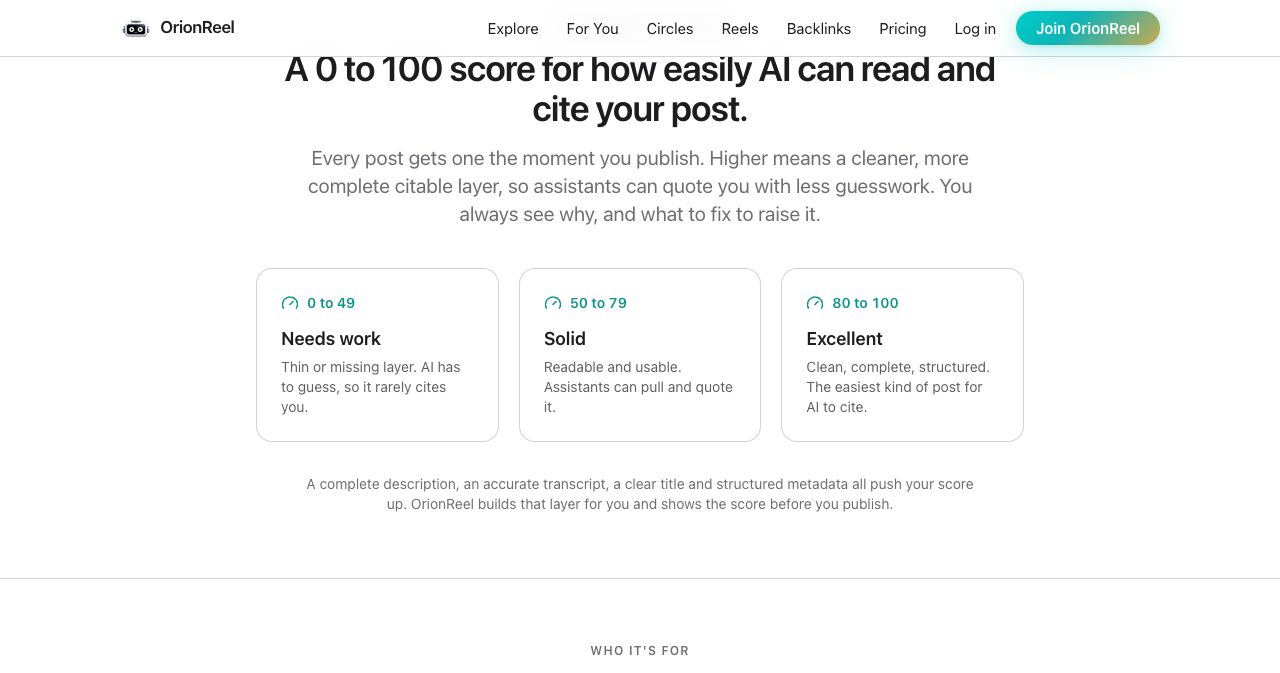
The factors are listed in llms.txt, and every post shows its earned and maximum points under a "see why" link:
- transcription coverage
- the structured description (offers, audience, problem)
- intention tags
- a project link
- profile completeness
- unique Ask AI clicks
- detected citations
A profile has its own score: 60% from the average of that creator's published posts and 40% from profile completeness (bio, niche, links). OrionReel states that every score comes from this formula and that nothing is hand-edited. The FAQ adds that paid badges do not change the score or the ranking.
The bands are practical. Below 50 the layer is thin and an assistant has to guess. From 50 to 79 the post is readable and quotable. Above 80 it is clean and complete. Because you see the score before you publish, the score works as a checklist as much as a ranking.
The ranking also resets daily, with a "today's top" countdown on the homepage, so a new creator is not buried under months of accumulated engagement.
How does OrionReel measure whether AI actually reads your post?
With a five-step evidence ladder on every post, backed by public logs you can check yourself.
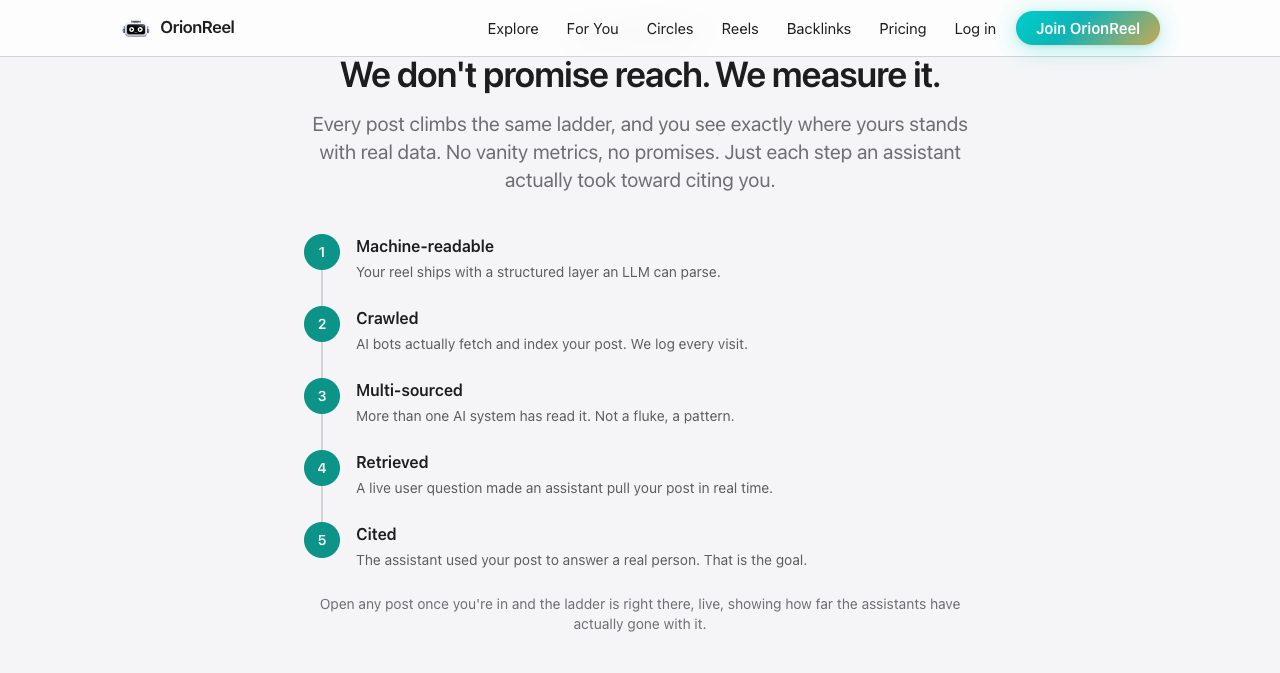
| Step | What it means |
|---|---|
| 1. Machine-readable | Structured data, JSON-LD and the citable layer are live |
| 2. Crawled | At least one AI bot fetched the post |
| 3. Multi-sourced | Bots from two or more AI companies fetched it |
| 4. Retrieved | Someone asked an assistant about the post and it was fetched live |
| 5. Cited | An assistant used the post in an answer |
This is the most useful idea on the platform, and the clearest sign the team understands AI search. Most generative engine optimization tools blur "a bot visited" into "you were recommended." OrionReel keeps them apart. The homepage says it directly: "Reads measure that assistants fetched the page, not that they quoted it." The sample post above sits at 4 of 5, with 17 recorded AI visits, crawls from more than one AI company and a live retrieval.
The underlying data is public. The crawler log lists visits from recognized AI user-agents, built from first-party server logs, and can be filtered by provider, path and date. Detected citation events live in their own endpoint at /api/citations.
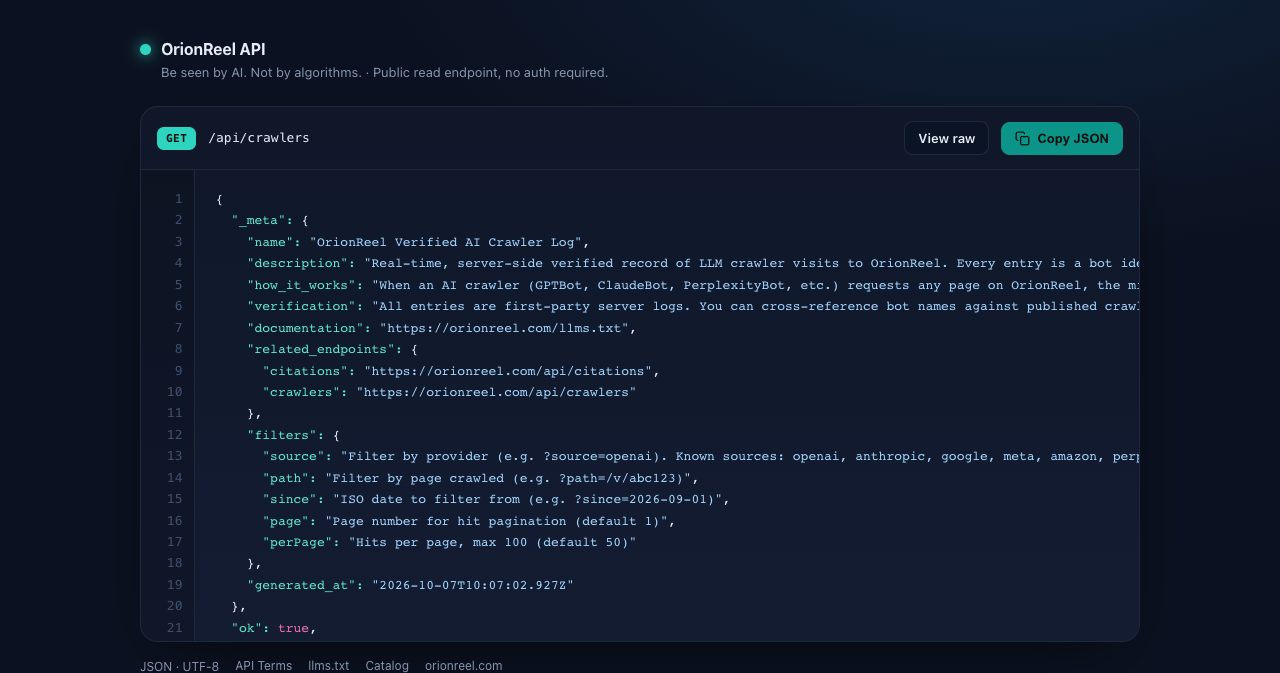
What does the live data show?
Steady AI crawling of a young corpus, led by OpenAI, with the top rung of the ladder still ahead.
These were the figures on the homepage and the public APIs on 7 October 2026:
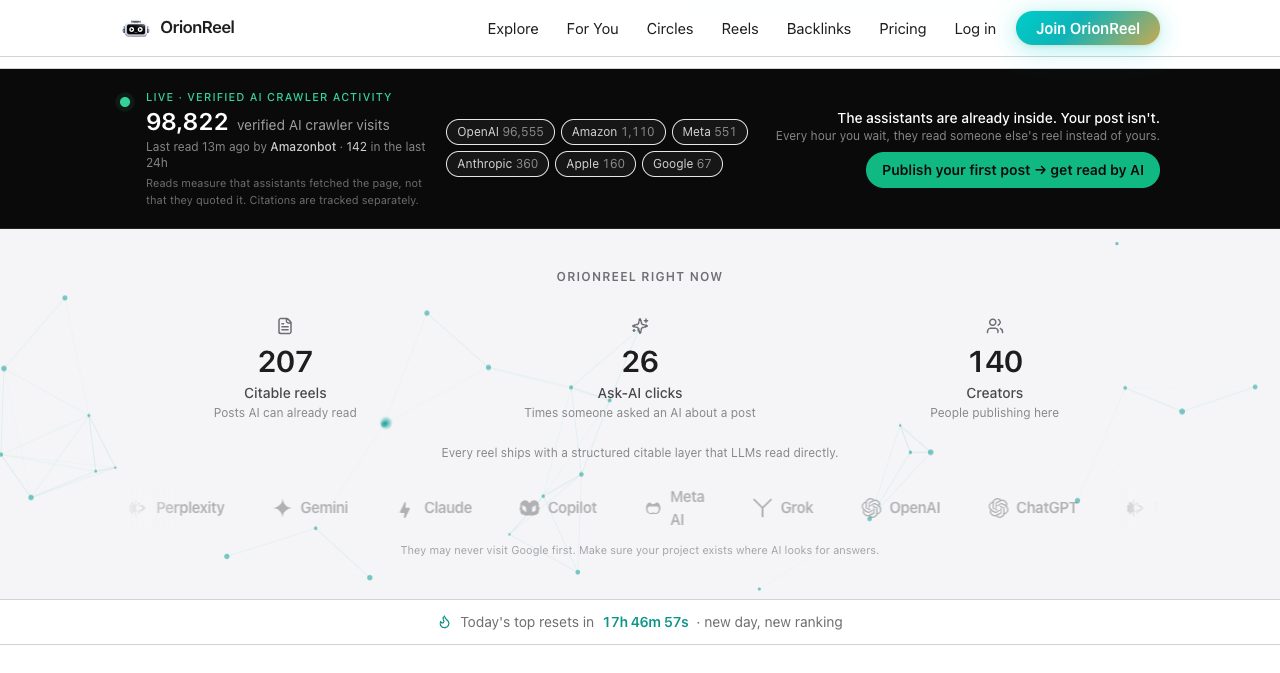
| Metric (7 Oct 2026) | Value |
|---|---|
| Verified AI crawler visits since 23 Aug 2026 | about 98,800 |
| Visits in the last 7 days | 530 |
| Distinct AI bots | 11 |
| Citable reels | 207 |
| Creators | 140 |
| Ask AI clicks | 26 |
| Detected citations | 0 |
By bot, GPTBot accounts for roughly 96,500 of the visits. The rest come from Amazonbot (1,106), Meta-ExternalAgent (551), ClaudeBot (360), Applebot (160), GoogleOther (67), OAI-SearchBot (47), PerplexityBot (15), ChatGPT-User (14) and a few others.
Three honest readings of these numbers:
- The plumbing works. Eleven different AI crawlers from at least seven companies are fetching OrionReel pages, including the bots that feed ChatGPT search and Claude. For a site that launched in August, that is real coverage.
- OpenAI dominates. About 98% of fetches are GPTBot, much of it early in the life of the site. Weekly crawling is now lower and steadier.
- Citation is the next milestone. The citation log was empty at the time of writing. That is normal for a corpus this young, and it is to OrionReel's credit that the counter is public and reads zero instead of being hidden.
If you want a single sentence for your notes: OrionReel reliably gets short posts read by AI crawlers, and it gives you the tools to see whether that turns into answers over time.
What do you get for free?
The whole core product. OrionReel's pricing headline is "Everything that makes you citable is free. Paid plans add credibility signals."
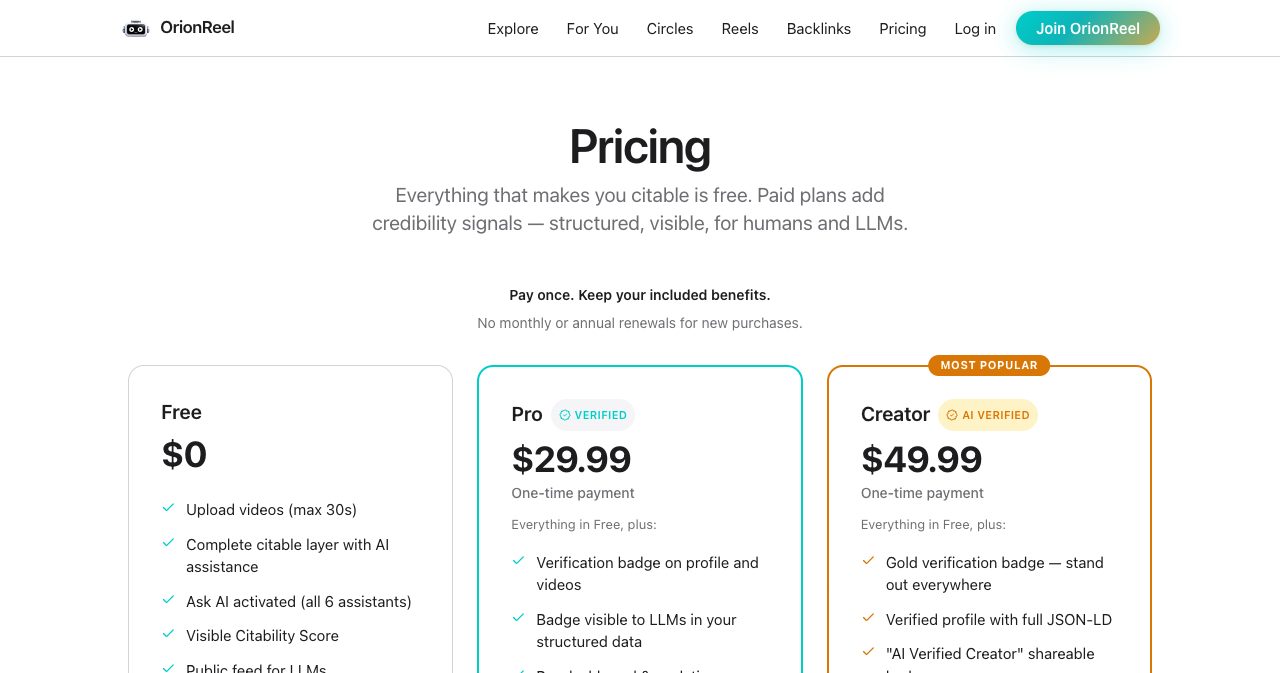
| Plan | Price | What it adds |
|---|---|---|
| Free | $0 | Publishing (video up to 30s, images, written posts), complete citable layer with AI assistance, Ask AI on six assistants, visible Citability Score, public feed for LLMs, public read API |
| Pro (Verified) | $29.99 one-time | Verification badge on profile and posts, badge visible to LLMs in structured data, Pro dashboard and analytics, early access |
| Creator (AI Verified) | $49.99 one-time | Gold verification badge, verified profile with full JSON-LD, shareable "AI Verified Creator" badge, boost-ready for paid campaigns, advanced analytics |
New purchases have no monthly or annual renewal. You pay once and keep the benefits.
There is also a per-post add-on.
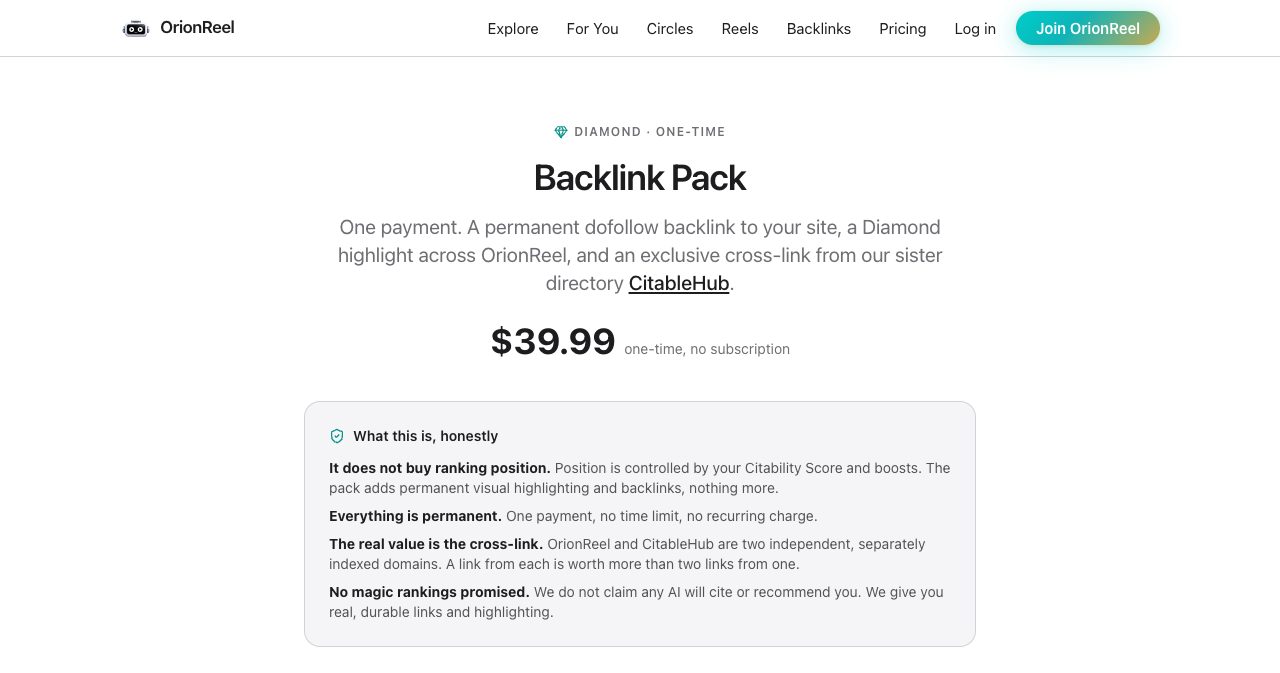
The Backlink Pack costs $39.99 once per post. It adds a permanent dofollow link from the OrionReel post to your site, a cross-link from CitableHub, and a Diamond highlight across OrionReel. The page includes a box titled "What this is, honestly" that states the pack does not buy ranking position and that no AI citation is promised. The value is two links from two separately indexed domains.
Our take on spend: start free. The free plan already includes everything that affects the Citability Score. Buy Pro or Creator if a visible verification badge and analytics matter for your brand. Buy the Backlink Pack for the posts that represent your main product.
What can developers and automation users do?
Read everything without a key, and publish programmatically with a creator token.
OrionReel is built to be consumed by machines, so it exposes more than most platforms its size. The read API needs no authentication:
/api/videosand/api/feedfor published posts with full citable layers and transcripts/api/videos/{id}/citation.txtandcitation.json(schema.orgCreativeWork) for each post/api/profiles/{username}/citable-layerand a per-creatorllms.txt/api/catalog, a schema.orgDatasetof the whole corpus under CC-BY 4.0/api/freshnessfor the 20 most recently updated items/api/crawlersand/api/citationsfor the logs/rss.xml,/sitemap.xmland/llms.txt
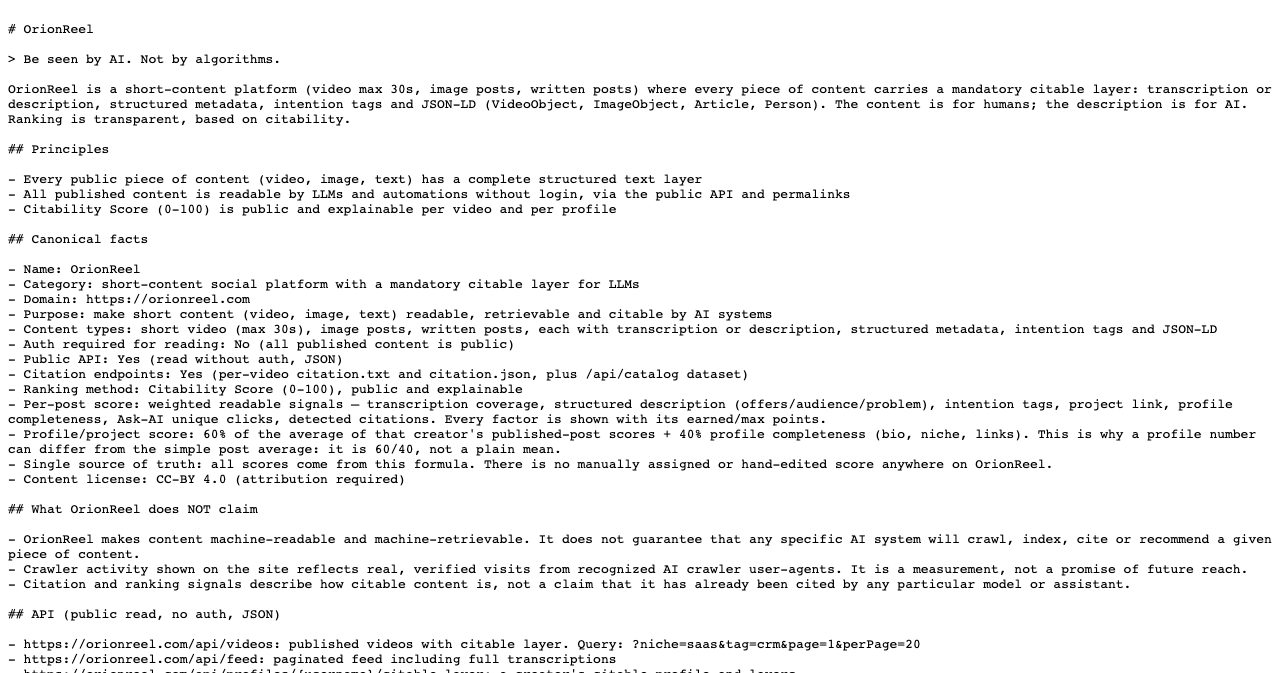
Publishing works through POST /api/publish with an Authorization: Bearer <creator token> header and a body that includes the media plus a complete citable layer. The homepage also advertises publishing from Make, Zapier or your own agent. Its robots.txt allows the major AI user-agents, including GPTBot, ClaudeBot, PerplexityBot and Google-Extended.
On rights: creators keep ownership of their content and grant OrionReel a license to host, transcode, serve and expose the citable layer. The public corpus dataset is offered under CC-BY 4.0 with attribution required. If you plan to reuse other creators' posts, read both the terms and the dataset license.
How do you publish your first post on OrionReel?
Five steps, and the score tells you when the post is ready.
- Pick one product claim. One post, one idea. "Turns support tickets into a weekly churn report" beats a feature tour.
- Record or write it short. Video must be 30 seconds or less. A clean screen recording with a voice-over works well. You must declare the audio source, and OrionReel does not clear music for you, so voice-only or royalty-free audio is safest.
- Fill the three fields like an answer. Write "What it offers," "Who it's for" and "Problem it solves" as sentences an assistant could quote unchanged. Name the audience and the problem in the words your customers use.
- Add the transcript, tags and your project link. These carry most of the score. Use intention tags a buyer would search, not brand names.
- Check the score, then publish. Aim for 80 or more. Complete your profile bio, niche and links too, because profile completeness is 40% of your profile score.
After that, watch the evidence ladder on the post. The first two rungs usually come from crawling. The Ask AI button on each post lets you, or a visitor, open the post in an assistant with the layer attached, which is also how the "retrieved" rung gets tested.
What are OrionReel's limits?
It is a young platform, and it is clear about that.
- No guaranteed citations. OrionReel says so in its llms.txt, on the homepage and in its terms. Treat it as a way to be readable, not as a promise of recommendation.
- Early network. Around 140 creators and 207 posts in its first seven weeks. Your post is more visible in a small catalog, but the audience of human viewers is also small.
- One crawler leads. Most fetches come from OpenAI's GPTBot. Coverage from other assistants is present and smaller.
- Short-form only. 30-second video, images and short written posts. It complements your docs and website, it does not replace them.
- Automations untested here. We did not test the Make, Zapier or agent connectors for this review.
None of these is a reason to skip it. They are reasons to use it as one surface among several, which is how AI visibility tools work best anyway.
Who should use OrionReel?
Founders and marketers who already have a product to explain and want one more public, machine-readable statement of it that costs nothing to publish.
It is a good fit for:
- SaaS founders and indie makers who have a short demo and no structured page that tells assistants who the product is for.
- Launch teams adding a fast, permanent, crawlable artifact to their launch checklist, next to directory listings and the product site.
- GEO and AEO practitioners who want a test bed with a public crawler log and an explainable score, instead of a black-box dashboard.
- Builders of agents and automations who want an open API to publish to and read from.
It is a weaker fit if you need large human reach today, or if your offer cannot be stated in three short sentences.
Is OrionReel worth it?
Yes, as a free and well-instrumented addition to your AI visibility work.
The core idea holds up. AI assistants read text, so give every short demo a structured text layer that states the offer, the audience and the problem. OrionReel enforces that layer at publish time, renders it where crawlers can see it, scores it in the open and logs every AI fetch in public. Then it does something rare in this category and refuses to oversell the result: crawler visits and citations are counted separately, and the citation counter is visible even while it is still at zero.
Seven weeks in, the platform has proven the first rungs of its own ladder. AI crawlers from OpenAI, Anthropic, Amazon, Meta, Apple, Google and Perplexity are reading it. Whether those reads turn into citations for your product is the question the evidence ladder is built to answer, and you can watch it happen on your own post.
The cost of finding out is a 30-second recording and ten minutes of writing. Publish your first post on OrionReel for free, then check its pricing if a verification badge or a dofollow Backlink Pack makes sense for your main product.
FAQ
What is OrionReel?
OrionReel is a public short-content platform at orionreel.com where every post ships with a mandatory machine-readable layer for AI assistants. Creators publish videos of up to 30 seconds, image posts or written posts. Each one must include a transcription or description, a structured summary of what it offers, who it is for and the problem it solves, intention tags, and schema.org JSON-LD in the server-rendered HTML. Posts are ranked by a public Citability Score from 0 to 100, not by likes or watch time.
What is the OrionReel citable layer?
The citable layer is the text that AI systems read alongside a post. It holds the transcription or description, three structured fields (what it offers, who it is for, problem it solves), a project link, intention tags, an audio rights declaration and schema.org JSON-LD such as VideoObject, ImageObject, Article and Person. It is in the initial HTML, so crawlers do not need to run JavaScript. OrionReel blocks publishing until the layer is complete.
Is OrionReel free?
Yes. The core product is free: publishing, the complete citable layer with AI assistance, Ask AI on six assistants, a visible Citability Score, the public feed and the public read API. Paid plans are one-time payments that add credibility signals: Pro at $29.99 adds a verification badge and analytics, and Creator at $49.99 adds a gold AI Verified badge and a full JSON-LD profile. A separate $39.99 Backlink Pack adds a dofollow link and a CitableHub cross-link to one post.
Does OrionReel guarantee that ChatGPT will cite my post?
No, and it says so plainly. OrionReel's llms.txt, homepage and terms state that it makes content machine-readable and retrievable but does not guarantee that any AI system will crawl, cite or recommend a given post. It measures progress on a public evidence ladder with five steps: machine-readable, crawled, multi-sourced, retrieved and cited.
How does the OrionReel Citability Score work?
Each post gets a score from 0 to 100 based on visible factors: transcription coverage, the structured description, intention tags, a project link, profile completeness, unique Ask AI clicks and detected citations. Every factor shows earned and maximum points. A profile score is 60% of the creator's average post score plus 40% profile completeness. Paid badges do not change the score, and there is no hand-edited score anywhere on the platform.
Which AI crawlers visit OrionReel?
OrionReel publishes a live crawler log at /api/crawlers built from first-party server logs matched on user-agent. As of 7 October 2026 it showed about 98,800 visits since 23 August 2026 from OpenAI's GPTBot and OAI-SearchBot, Amazonbot, Meta-ExternalAgent, ClaudeBot, Applebot, GoogleOther, PerplexityBot and others. Most of the volume comes from GPTBot. Detected citations are logged separately at /api/citations.
How is OrionReel different from TikTok, Instagram or LinkedIn?
Social feeds rank posts by engagement and most posts stop getting reach within about a day. Their content is also hard for AI assistants to read, because a model cannot watch a video. OrionReel keeps every post public at a permanent URL, ranks by how readable the post is for AI, and attaches a structured text layer that crawlers can parse without logging in.
What is CitableHub?
CitableHub is OrionReel's sister product, a structured directory of projects built to be read by AI assistants. Both were built by the same founder. Completing an OrionReel profile can create a matching CitableHub profile, and the Backlink Pack adds a cross-link from CitableHub to the buyer's site.
Who should use OrionReel?
SaaS founders, indie makers, startup teams and marketers who want a short, structured public page that explains what their product does in a form AI assistants can read. It works best as one extra, low-cost surface in a wider generative engine optimization plan, next to your own site, documentation and directory listings.
If you are building in the AI search space yourself, SaaSCity is a free, human-reviewed startup directory with a live city map where a listing is a permanent page other founders actually see. Submitting takes about ten minutes.
Get your SaaS in front of founders
List your product on the SaaSCity live city map - a permanent listing, real discovery, and a backlink from a high-DR directory. Free to start; upgrade for a dofollow link and a building on the map.