News
Anthropic Just Bet $100M That the AI Money Is in Deployment, Not Models (2026)
Anthropic put $100 million behind people instead of another model release: a Claude Frontier Academy built to train 10,000 forward deployed engineers by the end of 2027. For SaaS founders and indie hackers, the money and the competition are moving to the deployment layer, the unglamorous work of getting AI to run a real business process. SaaSCity is a startup directory, so the go-independent advice here comes with a disclosure attached.

Contents (10)
- What Anthropic launched, step by step
- The talent gap is the product
- What a forward deployed engineer actually does
- The hard numbers, and how much to trust them
- The land grab is bigger than Anthropic
- The risk nobody puts in the press release
- Three moves for SaaS founders and indie hackers
- Going independent: visibility is the first bottleneck
- Questions founders are asking
- The closer
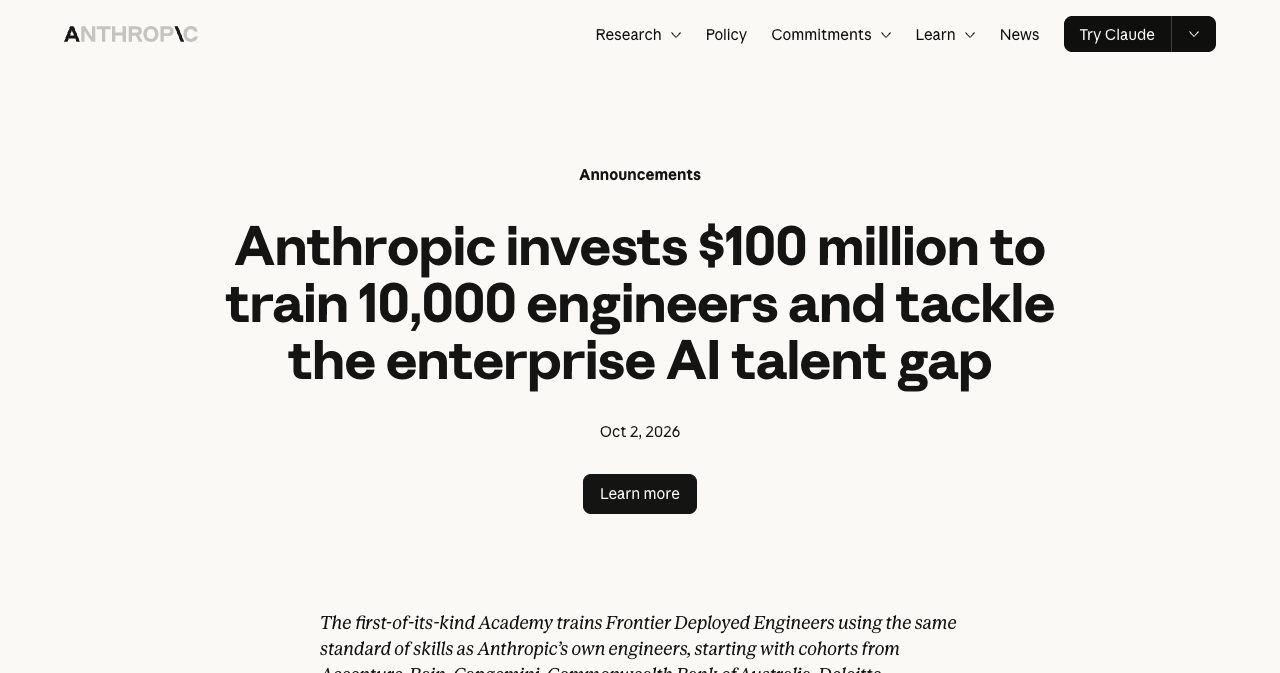
On Friday, Anthropic put $100 million behind people instead of another model release.
Quick answer: On 2 October 2026, Anthropic launched the Claude Frontier Academy with a $100 million commitment to train 10,000 "Frontier Deployed Engineers" (FDEs) by the end of 2027. The first program, the Frontier Deployed Engineer Residency, borrows its structure from medical training: supervised practice, graded exams, then a 12-week residency inside a real company. Anthropic's stated problem is not model quality. Too few people can take enterprise AI from a demo to a governed production system. For SaaS founders and indie hackers, the signal is that the scarce asset is no longer the model. It is the person who can make the model run a business process.
You're reading this on a startup directory's blog. SaaSCity is one of those directories, so I'll flag where the advice below points toward us and where it doesn't. The core argument stands without us.
What Anthropic launched, step by step
Anthropic's announcement describes the Academy as a program that trains FDEs "using the same standard of skills as Anthropic's own engineers." That is a sales line. The structure underneath it is more useful, because it tells you what Anthropic thinks the job requires.
The residency has five stages:
| Stage | What happens | What it produces |
|---|---|---|
| 1. Bootcamp | Multi-day, in person, with Anthropic engineers and licensed instructors | Working knowledge and access to the graded practical |
| 2. Simulated deployment | A full enterprise rollout, from picking the use case through security review to handover | Practice on a governed system, not a toy demo |
| 3. Graded practical | A brand-new scenario, pass or fail | "Claude Resident Engineer" badge |
| 4. Residency | 12 weeks leading a real Claude use case inside your own organisation, with Anthropic engineers and your cohort | Production experience you can point to |
| 5. Final assessment | Pass or fail | "Claude Frontier Deployed Engineer" badge |
Stage four is the one that matters. Courses teach concepts. A residency puts someone inside their employer, on a live use case, with a deadline. First full credentials are expected in early 2027.
Early cohorts draw from Accenture, Bain, Capgemini, Commonwealth Bank of Australia, Deloitte, McKinsey, Morgan Stanley and Novo Nordisk, and run in San Francisco, New York and London. Participation is by nomination. Organisations put forward their strongest software engineers, the ones with LLM-building experience and a record of driving adoption, through their Anthropic account team or Partner Account Manager. You cannot simply sign up.
The talent gap is the product
Anthropic's argument is that the bottleneck is people. The announcement says "a small group of deeply skilled people drives an outsized share of what AI delivers." Most of us have watched a pilot stall after the demo. The model worked. The data was messy, the security review dragged, and nobody owned the workflow once it went live. That gap between "it works in the demo" and "it runs on Monday morning" is what the Academy is selling a fix for.
The Academy sits on top of an existing funnel. According to the announcement, professionals across 46,000 firms have earned more than 175,000 Claude certifications through the Claude Partner Network, and nearly 4,000 people have completed Basecamp. Certifications build a large pool of Claude-literate consultants. The Academy picks the people who can run the hard part.
Here is the part the press release does not say outright. Anthropic is heading toward a public listing and a large enterprise push, as we covered in our analysis of the IPO prospectus. Enterprise revenue depends on someone inside the customer's building who knows how to deploy. A badge-carrying FDE works as a sales engineer, an integrator and a reference customer at once. The Academy is a training program, and it is also a distribution channel that Anthropic does not have to pay a sales force to run.
What a forward deployed engineer actually does
The role sits between two jobs. The consultant's job is finding and framing the real problem: which process, which team, what success looks like, and what the risk office will sign. The engineer's job is building and running the system that solves it. An FDE does both inside the client's business, and stays long enough to see the thing run.
Palantir built much of its reputation on this model for data platforms, well before the current AI wave. Its engineers embedded with customers to turn messy data into decisions people would act on. The AI version looks similar in shape but differs in the parts you have to get right: model choice, evaluation sets, retrieval, tool permissions, and the governance story that gets approved before anything reaches production.
That list is the job. It is also a list of things that most software teams underinvest in, because they sit between the product and the customer.
The hard numbers, and how much to trust them
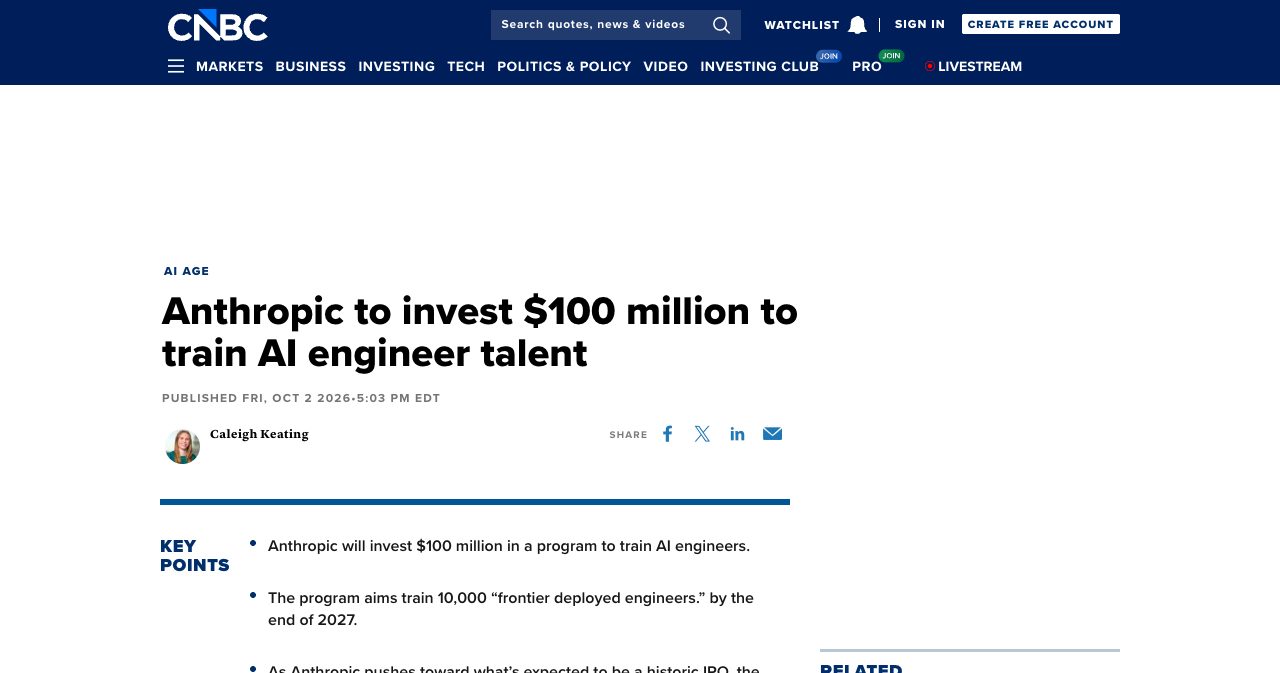
The headline figures are simple. $100 million. 10,000 engineers. End of 2027. CNBC's report on the launch carries the same key points, and CRN covered the launch the same day. CNBC also reported, citing data from Draup, that job postings for forward-deployed engineers and other AI roles surged in finance this year. I could not open the CNBC article in full to check the exact figures, so I won't put a number on that surge. The direction is the useful part.
Other numbers come from the wider market. CX Network's report on AWS covers a dedicated forward deployed engineering organisation at AWS, backed by $1 billion and designed to make customers self-sufficient once a deployment ends. The same piece says EY, Anthropic, OpenAI and Google each run a comparable role, and it cites a rise of 800 percent in FDE job listings between January and September 2025. That is one reported figure with a lot of room for definition, so read it as a direction, not a measured growth rate.
Salary is the number everyone wants. The most detailed public estimates I could open come from fde.academy, a training provider, which published its ranges on 26 February 2026. These are market estimates, not Anthropic figures, and the provider says so:
| Market (fde.academy estimates, Feb 2026) | Entry | Mid | Senior / lead |
|---|---|---|---|
| United States (base) | $110k to $140k | $140k to $180k | $180k to $230k |
| United Kingdom | £65k to £110k |
Treat any single number with care, and pull live postings for your market before you negotiate.
The land grab is bigger than Anthropic
Anthropic is not alone in this. OpenAI, Google and EY run FDE-style roles, and AWS turned the idea into a dedicated unit with a $1 billion budget. The reason is simple. Model vendors have the capability. Enterprises have the problems. The gap in between is people who can translate one into the other, and every platform company now wants to own that translation.
For you, this means the category is validated and getting crowded. Buyers will soon expect a deployment partner the way they expect a support team. The question is whether that partner is a consultancy with a vendor badge, a cloud provider's internal unit, or someone like you.
The risk nobody puts in the press release
The fair criticism is talent lock-in. Suppose a generation of enterprise AI architects is trained on one vendor's architecture, safety stack, evaluation habits and deployment patterns. They will tend to recommend what they know. If a competitor's model turns out better for a specific workflow, switching costs are not just an API change. They involve retraining people, rebuilding evaluations, re-running governance reviews, and taking career risk for the person who suggested the switch.
This is not a conspiracy. Enterprise software has always worked this way: the people who installed a system defend it. Anthropic has a clear commercial reason to make the Claude way the default way, and that is a rational strategy. It is also the reason buyers should insist on model-agnostic evaluation harnesses and a written plan for moving off any single model. If you want the broader jobs question behind this, our piece on whether AI is coming for your job works through it.
Three moves for SaaS founders and indie hackers
1. Sell the boring last mile
Model knowledge spreads fast. The shortage is in integration, data access, evaluation, security review and handover. Those skills were hard in every software wave, and they now decide whether an AI project pays off at all.
An indie hacker with two or three real deployments can package this as a productised service. Sell a fixed-scope sprint for one process, with a named outcome, a written runbook, an evaluation set the client owns, and a handover date. That is a service business, not a wrapper around someone else's API. The margin comes from choosing which processes to take on and which to refuse.
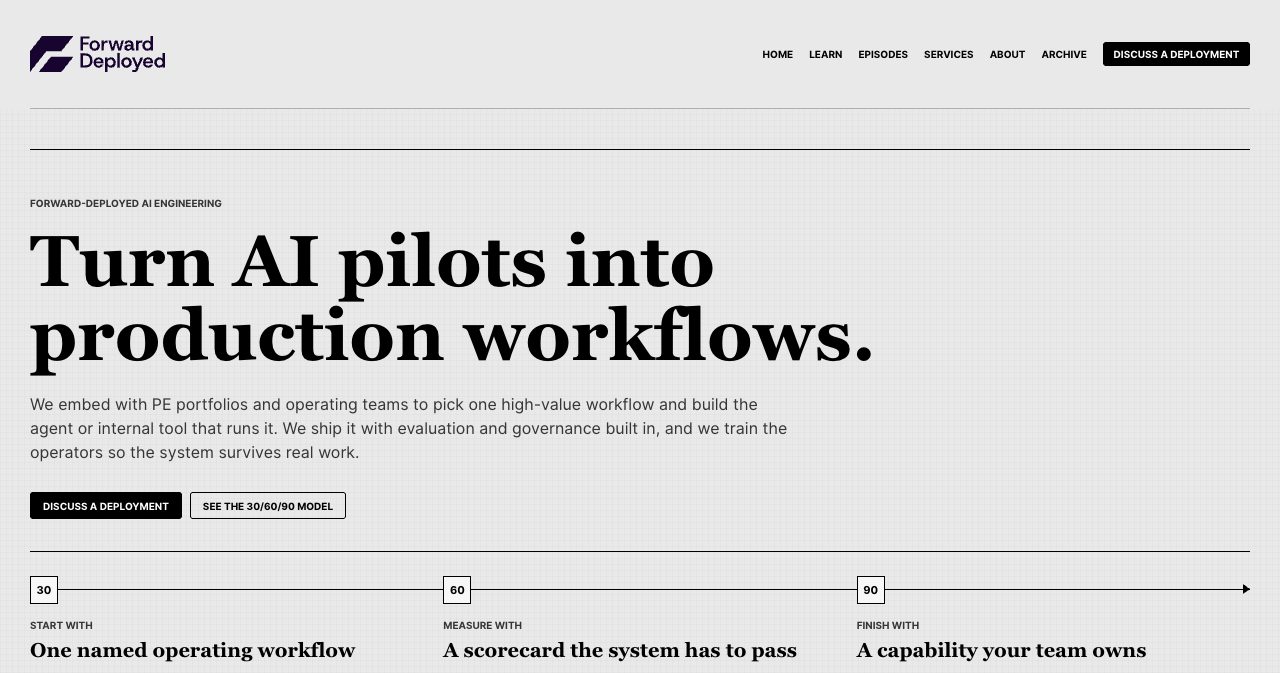
The consultancy above shows the shape. It sells one workflow, not "AI transformation." Its 30/60/90 structure is the template worth copying: start with one named workflow, measure it against a scorecard the system has to pass, and finish with something the client's own team can run. Copy the offer structure, not the brand.
2. If you sell to enterprises, decide: rival or channel
An FDE inside a large consultancy with a Claude badge is now a competitor for your deal and a potential integrator for your product. Pick a position per account. You can make your product the default the FDE reaches for: publish a deployment guide, a sample integration and a clear evaluation path that someone with a badge can follow in a week. Or you can compete on price and speed, which only works if your product removes the need for a consultancy engagement at all. Sitting in the middle, with a product that needs a consultant but doesn't say so, is the worst option.
3. If you build a product, own the deployment
Features that stick are features that get deployed and owned. Onboarding that sets up the actual workflow, evaluations that show the customer it works, and a handover that makes the customer self-sufficient all come from the same discipline the FDE is trained in. An AI feature that ships without that work tends to get switched off after the first quarter. The same logic runs through how to get your first 100 users: acquisition matters less than whether the people you bring in reach the moment the product pays off.
Going independent: visibility is the first bottleneck
If you leave a company to sell a deployment service or a product, delivery is rarely the first problem. Being found is. Nobody searches for "forward deployed engineer for my accounting firm" on the first day, and your first clients often come from a listing, a referral or a comparison page they stumbled onto.
We run SaaSCity, a gamified startup directory with a live city map and human editorial review. A free listing gets you a page and a building on the map, and a free submission books a Monday launch slot. Adding the SaaSCity badge to your site earns a dofollow backlink. If you want it live faster, Quick Pass is $19.99 and goes live within 24 hours, and Premium is $39.99 and adds a launch post the team writes and publishes. Our Domain Rating sits between 47 and 56 at the last Ahrefs refresh. Check the current details on the pricing page before you decide.
Where SaaSCity does not help: if your buyers are enterprise procurement teams who trust only analyst reports, a directory listing will not get you a CIO. For a deployment practice, the stronger assets are named case studies with real outcomes and the referrals from people you have shipped for. A listing makes those easier to find, and it does not replace them.
Questions founders are asking
What is the Claude Frontier Academy? Anthropic's training program for Frontier Deployed Engineers, launched 2 October 2026 with $100 million behind it. It aims to train 10,000 FDEs by the end of 2027, starting with a residency that ends in a credentialed assessment.
How do I become a forward deployed engineer through it? You get nominated. Your organisation asks its Anthropic account team or Partner Account Manager. For a visible starting point, the Claude Partner Network certifications are the public route.
Is a forward deployed engineer the same as a software engineer? No. A software engineer usually builds to a spec. An FDE sits inside the customer's business, finds the process worth automating, builds the system and stays through handover.
Does this lock enterprises into Claude? It can, indirectly, through the people who learn one vendor's stack. Nothing in the announcement rules out other models. Buyers should still demand model-agnostic evaluation and a documented exit.
The closer
Anthropic did not spend $100 million to make Claude smarter this week. It spent it to make Claude stick inside companies that will still be running it after the next model ships. Every founder reading this should ask the same question about their own product. When the next model arrives, cheaper and better, will it replace the part of your stack that does the work, or the part that already runs inside a customer's business? The second one is harder to build and much harder to switch away from. That's the layer worth building.
TOPIC: Anthropic's Claude Frontier Academy and the rise of the "forward deployed engineer" - what it means for SaaS founders and indie hackers.
WHAT HAPPENED (verified, cite these):
- On Friday 2 October 2026, Anthropic launched the Claude Frontier Academy with a $100 million commitment to train 10,000 "Frontier Deployed Engineers" (FDEs) by the end of 2027. Source: https://www.anthropic.com/news/claude-frontier-academy (Anthropic, 2 Oct 2026). CNBC, 2 Oct 2026: https://www.cnbc.com/2026/10/02/anthropic-to-invest-100-million-to-train-ai-engineer-talent.html . CRN, 2 Oct 2026: https://www.crn.com/news/ai/2026/anthropic-invests-100-million-into-frontier-deployed-engineer-residency .
- The first program is the Frontier Deployed Engineer Residency, modelled on medical training. Steps: (1) a multi-day in-person program with Anthropic engineers and licensed instructors; (2) a simulated enterprise deployment, from picking the right use case through security review to handover; (3) a graded practical on a brand-new scenario - pass and you earn the "Claude Resident Engineer" badge; (4) a 12-week residency leading a real Claude use case inside your own organisation, supported by Anthropic engineers and your cohort; (5) a final assessment - pass and you earn the "Claude Frontier Deployed Engineer" badge. First full credentials expected early 2027.
- First cohorts draw engineers from: Accenture, Bain, Capgemini, Commonwealth Bank of Australia, Deloitte, McKinsey, Morgan Stanley and Novo Nordisk. Cohorts are running in San Francisco, New York and London. Participation is by nomination - organisations ask their Anthropic account team or Partner Account Manager.
- It builds on the Claude Partner Network: professionals across 46,000 firms have earned more than 175,000 Claude certifications and nearly 4,000 people have completed Basecamp.
- Anthropic frames the gap as talent, not model quality: too few people can take enterprise AI from a demo to a governed production system.
CONTEXT (why it matters, use these to argue):
- The "forward deployed engineer" (FDE) is the role that sits inside a client's business and does two jobs at once: the consultant's job of finding and framing the real problem, and the engineer's job of building and running the system that solves it. Palantir pioneered the model for data platforms long before the AI wave.
- This is now a land grab beyond Anthropic: AWS launched a dedicated forward deployed engineering organisation backed by a $1B investment (announced at the AWS Summit in Washington DC; see https://www.cxnetwork.com/artificial-intelligence/news/forward-deployed-engineers-awss-us1bn-play-to-embed-ai-experts "nofollow"). EY, OpenAI and Google also run FDE-style roles.
- Demand signal: job postings for forward-deployed engineers and other AI roles have surged in finance this year (Draup data, reported via CNBC, 2 Oct 2026). Wall Street Journal reporting cited by the FDE training market puts the growth in forward-deployed-engineer postings at more than 800% in 2025. Treat the exact % as reported, attribute it.
- Indicative global FDE salary ranges quoted by one training provider (fde.academy): roughly $220k-$380k for a forward deployed engineer, $350k-$600k+ for senior. Label these as indicative market ranges, not Anthropic figures.
- The hidden risk worth naming: talent lock-in. If a generation of enterprise AI architects is trained on Claude's specific architecture and safety stack, they may be slow to adopt a competitor's model even when it is technically better. Say it plainly but fairly.
- Anthropic context (link internally to /blog/anthropic-ipo-prospectus-saas-founders-2026): the company is heading toward a large-scale IPO and a big enterprise push; the academy is a distribution play dressed as a training program.
ARTICLE ANGLE (the thesis): The money in AI is moving from the model to the deployment layer - the unglamorous last mile of getting AI to actually run a business process. Anthropic is buying that layer with people. For SaaS founders and indie hackers, three takeaways: (1) "boring" deployment/integration skills are now scarcer and better paid than model know-how, so an indie hacker can build a services or productised-service business around them, not just another wrapper; (2) if you sell to enterprises, an army of vendor-trained, badge-carrying FDEs inside consultancies is your new competition and your new integration channel - decide which; (3) if you build a product, the same "deploy and own it" discipline is what makes AI features stick. Bring in SaaSCity honestly at the end: when you go independent, visibility is the first bottleneck - listing your product or service on a directory is the cheap first move.
SUGGESTED WORKING TITLE: Anthropic Just Bet $100M That the AI Money Is in Deployment, Not Models (2026) SUGGESTED SLUG: claude-frontier-academy-forward-deployed-engineers-2026 SUGGESTED CATEGORY: News SUGGESTED KEYWORDS: claude frontier academy, forward deployed engineer, anthropic 100 million engineers, how to become a forward deployed engineer, forward deployed engineer salary, claude partner network certification, ai deployment engineer 2026, forward deployed engineer vs software engineer, enterprise ai talent gap, anthropic frontier deployed engineer
Get your SaaS in front of founders
List your product on the SaaSCity live city map - a permanent listing, real discovery, and a backlink from a high-DR directory. Free to start; upgrade for a dofollow link and a building on the map.
Founder resources
Related articles
Anthropic's IPO Filing: $518 Billion in Commitments, 80 Pages of Risk, and What It Actually Means for SaaS Founders (2026)
UpGuard Found 16,326 Wide-Open Supabase Databases. The Fix Is Two Lines of SQL the AI Never Wrote (2026)