SaaS Business
Apollo Says AI Delivered Zero Payoff. For AI SaaS Founders, That's a Pricing Problem (2026)
An Apollo economist just told Wall Street that AI has delivered zero financial payoff outside the tech sector, and the counter-studies on productivity and burnout make the picture messier, not better. If you sell AI software, the real story isn't the bubble headline, it's that your buyer's CFO now treats your invoice as a cost center until you can prove otherwise, which is also why we built SaaSCity to help founders prove traction with something other than a vibe.

Contents (8)
- What Slok's note actually says
- The caveats the headline skipped
- The study that should scare every AI coding tool founder
- The buyer changed: AI spend moved to Finance
- Why "we switched to cheaper models" isn't a selling point
- What actually survives a CFO review
- Where directories fit in a trust-starved market
- The uncomfortable part founders should sit with
Nobody at Apollo Global Management expected a Friday research note to become the thing every SaaS Slack channel was arguing about by Monday.
Quick answer: On October 24, 2026, Apollo Global Management chief economist Torsten Slok published a Daily Spark note arguing artificial intelligence has delivered zero financial payoff to corporate America outside the technology sector, based on charts splitting the Magnificent Seven's revenue and margins from the rest of the S&P 500, which Slok calls the "S&P 493."
For AI SaaS founders, the real story isn't whether the note is right. It's that the buyer evaluating your product changed, and your pricing page hasn't caught up.
You're reading this on a directory's blog. SaaSCity is a gamified startup directory with a live city map and human editorial review, and we make money partly by selling directory submissions and launch placements to the same AI SaaS founders this post is about. That doesn't make the numbers below less true. It's exactly why we're writing about proof instead of hype: we spend our day watching founders try to get buyers to believe a claim, and the ones who win stopped asking buyers to trust them.
What Slok's note actually says
Slok's argument, in one line: the Magnificent Seven (Alphabet, Amazon, Apple, Meta, Microsoft, Nvidia, Tesla) are the only companies showing a measurable AI dividend, and everyone else is still waiting.
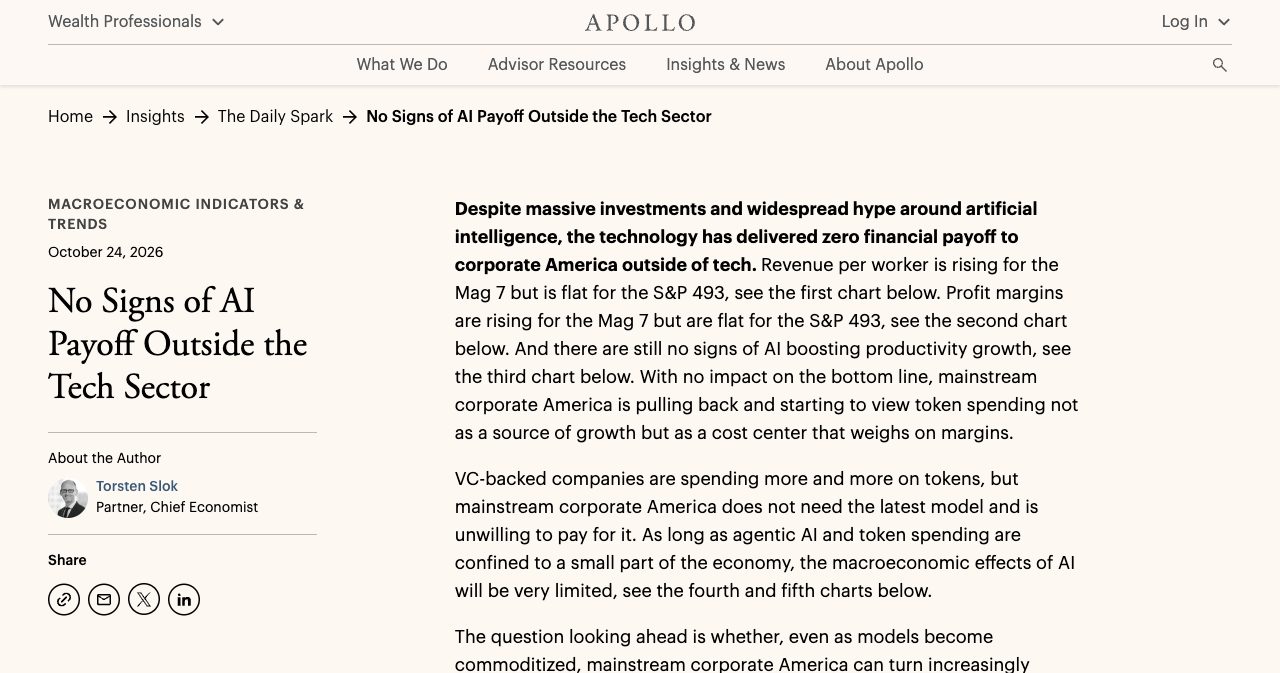
The note splits the S&P 500 into the Mag 7 and the "S&P 493" across five charts. Revenue per worker at the Mag 7 climbed from roughly $550,000 in 2022 toward nearly $800,000 today. The S&P 493 has sat flat near $550,000 since 2019. Profit margins tell the same story twice: Mag 7 margins pushing toward 30%, S&P 493 margins stuck near 9-10% since 2023. A San Francisco Fed utilization-adjusted productivity series, which Slok also cites, shows no AI-driven step change in output per hour or total factor productivity growth. Slok's own words: "the technology has delivered zero financial payoff to corporate America outside of tech," and "with no impact on the bottom line, mainstream corporate America is pulling back and starting to view token spending not as a source of growth but as a cost center that weighs on margins." His closing line is the one worth sitting with: "The AI story will be decided in the S&P 493, not the Mag 7."
TechCrunch covered the note on October 25, and Bloomberg and Benzinga picked it up the next day, which is how a chart deck for bond investors ended up in founder group chats within 48 hours.
The caveats the headline skipped
The clean "zero payoff" headline skips a methodology gap and two contradicting surveys, and both change how much weight the finding deserves.
The trade publication ppc.land read the underlying charts and flagged a real gap: Apollo published no underlying numbers behind the five charts, and the claim that companies are "pulling back" on AI spending isn't backed by a specific data series in the note itself. "Zero payoff" is a chart reading. "Pulling back" is closer to a prediction dressed as an observation.
The counter-data complicates things further instead of settling them. McKinsey's 2026 global AI survey found 37% of respondents attributed at least some EBIT impact to AI, and 80% said it improved individual productivity. Deloitte's research found two-thirds of respondents reporting efficiency gains, but only 20% saying AI lifted revenue. Put those two studies next to Slok's note and you get a coherent, boring answer: AI is making individuals feel faster and trimming some costs, and almost none of that is showing up in company-level profit yet. Call it a measurement problem rather than proof the technology is useless.
Then there's the study that should worry you more than Slok's note does. UC Berkeley and Harvard Business Review researchers spent eight months embedded in a 200-person tech company, running 40-plus interviews, and found AI tools were intensifying work rather than freeing up time, with the earliest signs of burnout showing up in the employees who adopted AI most enthusiastically. If your product's pitch is "give your team back hours," and the lived experience inside companies using AI heavily is burnout, you have a positioning problem before you have an ROI problem.
The study that should scare every AI coding tool founder
A 2025 randomized controlled trial found that developers using AI coding tools were measurably slower while believing they were faster, which undercuts the kind of self-reported ROI claim most AI SaaS case studies run on.
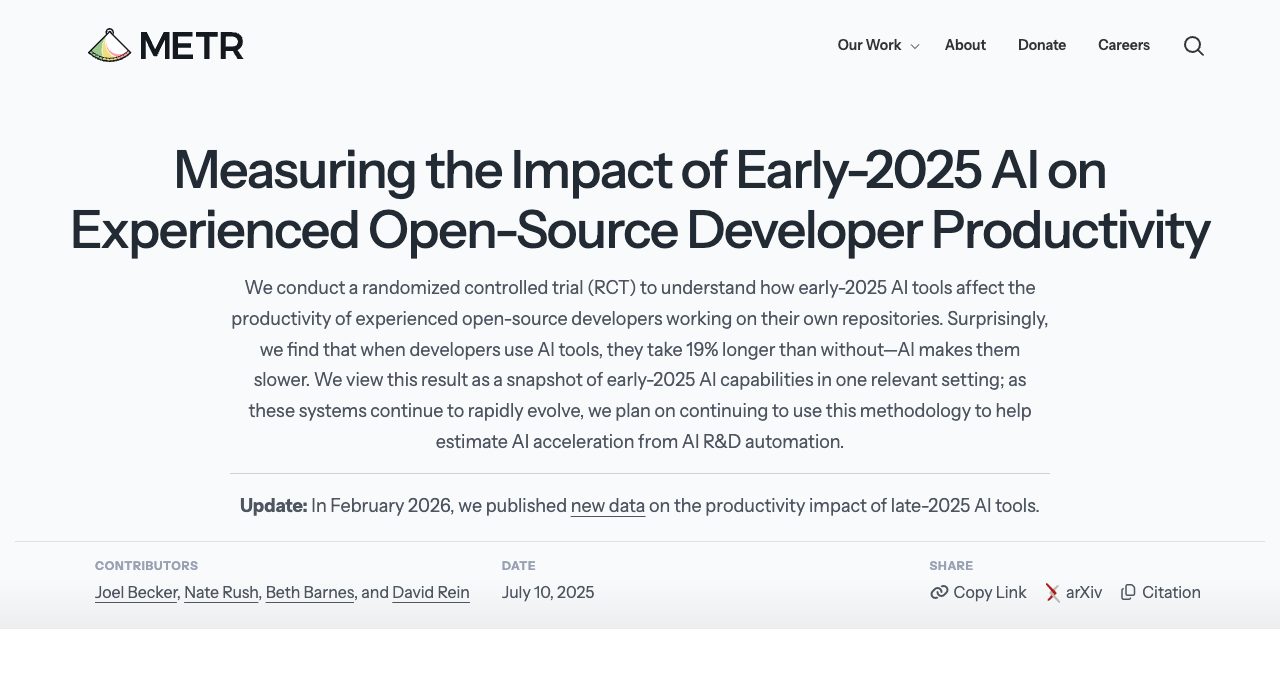
METR ran a randomized controlled trial in early 2025 (published July 10, 2025, authors Joel Becker, Nate Rush, Beth Barnes, and David Rein) on experienced open-source developers working in codebases they already knew well. Allowing AI tool use made these developers 19% slower at completing real issues, not faster. After finishing, the same developers estimated AI had sped them up by about 20%. Perceived speed and measured speed pointed in opposite directions, by nearly the same margin.
A separate National Bureau of Economic Research (NBER) working paper, w33777, looked at the same question at a broader scale and found time savings around 3%, with no significant effect on earnings or hours worked. Neither study claims AI tools are worthless. Both studies say the same uncomfortable thing: self-reported productivity gains are a terrible way to price a product, because the person reporting the gain is the least reliable measurement instrument in the building.
If your product's ROI claim rests on "developers say they feel faster," you're one METR-style study away from a buyer's procurement team citing it back at you in a renewal call.
The buyer changed: AI spend moved to Finance
What shifted in 2026 isn't sentiment about AI, it's who signs the check: AI budget moved from IT, which funds experiments, to Finance, which audits line items.
Boston Consulting Group's (BCG) 2026 survey of more than 1,300 CxOs found corporate AI spending doubled in a year to 3.3% of revenue, and 80% of that spending now sits outside the formal enterprise IT budget. A September 2026 IBM Institute for Business Value study with Oxford Economics, covering 1,500 CFOs, found 62% had taken on AI decision rights that used to belong to IT. That's the mechanism behind Slok's "cost center" line, whether or not his specific chart proves it: the budget owner changed from someone who funds experiments to someone who audits line items every quarter.
The buyer-side pullback is already visible in specific numbers, not vibes. According to a TechCrunch report from June 2, 2026, Uber burned through its entire 2026 AI coding budget by April and now caps spend at $1,500 per employee per month. The Information reported on October 5, 2026 that Microsoft cut internal Claude spending by more than a third from an estimated $1 billion run rate, and that Meta halved its internal Claude Code user count from roughly 60,000 to 30,000. These aren't companies rejecting AI. They're companies that funded a pilot with IT-budget logic and then re-evaluated it with Finance-budget logic, and the product didn't survive the re-evaluation.
The actual lesson for AI SaaS founders is about definition, not capability: these products never had an agreed number for what winning looked like before the CFO went looking for one.
Why "we switched to cheaper models" isn't a selling point
Cutting your model bill is good business. It is not a reason for anyone to buy from you.
Falling per-token prices lower your cost of goods sold, which is great for your margin and irrelevant to your buyer's decision. We've written before about how a model generation like Claude Haiku 5.5's pricing cut changes AI SaaS gross margins by routing cheap subagents to handle classification and extraction instead of running everything through a frontier model. That's a real lever for your P&L, but it belongs in your cost model, not your pricing page, because the customer doesn't care what you pay OpenAI or Anthropic. They care what they get for what they pay you.
Worse, cheap tokens don't even shrink your actual bill the way the sticker price suggests. Agentic workflows, where a model plans, calls tools, checks its own output, and loops, burn far more tokens per completed task than a single prompt-response pair ever did. The Tokenomics research on agentic software engineering found that code review alone consumes 59.4% of total tokens in a typical multi-agent coding run, with actual code generation at just 8.6%. Gartner expects inference cost per agentic workflow to rise more than fivefold through 2028, even as the per-token sticker price keeps dropping, because agentic loops multiply calls faster than price cuts shrink them. If your margin story depends on "tokens keep getting cheaper," you're betting against your own product's architecture.
Per-seat pricing stacked on top of a line a CFO already flagged as a cost center is the easiest thing in the budget to cut. It looks like software. It gets reviewed like software. And when nobody can point to what the seat earned last quarter, it goes.
What actually survives a CFO review
The products renewing through 2026's budget tightening share one trait: they ship a receipt inside the product, not just inside the sales deck.
Put these three numbers somewhere the customer can see them without asking you for a report:
| Metric | What it answers | Why Finance believes it |
|---|---|---|
| Cost per completed task | What did this actually cost, end to end, including retries | Comparable to a headcount-hour cost, which Finance already knows how to evaluate |
| Cache hit rate | How much of the spend was redundant work the system already knew the answer to | Shows engineering discipline, not just raw usage |
| Human override rate | How often a person had to step in and redo the output | Direct proxy for trust and real time saved, not time theoretically saved |
None of these numbers requires your customer to trust your sales deck. All three can be pulled from logs you already have. A pilot structured around a fixed evaluation window, a named success metric agreed before the trial starts, and a dashboard showing these three numbers turns a renewal conversation from "do we still like this" into "did we hit the number we agreed on in month one." That second conversation survives a budget cut because the customer already has proof the contract was fulfilled, rather than a feeling they're asked to take on faith again.
This is also where a weak case study backfires. "40% faster" with no methodology reads, to a 2026 CFO who has read the Apollo note and the McKinsey survey in the same week, as marketing. "Cost per completed support ticket dropped from $4.10 to $1.60 across 11,000 tickets in Q3, measured against the same ticket-complexity mix" reads as audit-ready. Write your pricing page like the second sentence, not the first.
Where directories fit in a trust-starved market
When buyers stop believing vendor claims, they start triangulating against structure instead: comparable listings, verified usage, third-party description.
This already shows up in how AI search engines pick sources. We covered the mechanics of that shift in our breakdown of why directory listings and third-party sources are what AI answer engines cite when buyers ask for recommendations, and the same logic that makes a directory listing useful to ChatGPT applies to a skeptical CFO doing vendor diligence: consistent, specific descriptions of what a product does, hosted somewhere you don't control, are worth more right now than another slide in your deck. On SaaSCity, every free listing gets a permanent page and a building on the city map; adding the SaaSCity badge to your own site earns a dofollow backlink and books you into the next Monday launch slot. Quick Pass ($19.99) skips the badge requirement and goes live within 24 hours. Premium ($99.99) adds a launch post our team writes, with three dofollow links baked in. The domain currently sits around DR 47-56 at our last Ahrefs refresh, which for a new AI SaaS product is a real, indexed backlink, not a bookmark.
None of that replaces the receipt. It gives you a second, independent surface saying the same specific thing your pricing page says, which is exactly the kind of consistency that survives both an AI citation check and a human due-diligence pass.
The uncomfortable part founders should sit with
Slok is right that most companies can't point to AI showing up in their profit margin yet, and wrong to call that proof the technology doesn't work. The more useful read is narrower: most deployments never defined what "working" would look like before they started paying for it, so eighteen months later nobody can produce the number that would prove it either way. That's a product and pricing failure, and it's the one gap in this whole debate that a founder can actually close this quarter.
If your renewal conversations this year sound like "do you still like us" instead of "did we hit the number," that's not a market problem. That's your pricing page's problem, and you already have the logs to fix it.
Here's a deeper look at the same budget shift from the enterprise-software side, including why the $285 billion SaaS selloff after Claude's plugin launch priced in seat-replacement risk faster than most vendors priced in proof of value. And if you want more channels for getting your product in front of buyers who are actively comparing instead of cold, our guide to where SaaS founders get real visibility in 2026 and the SaaSCity homepage are good next stops.
Get your SaaS in front of founders
List your product on the SaaSCity live city map - a permanent listing, real discovery, and a backlink from a high-DR directory. Free to start; upgrade for a dofollow link and a building on the map.