Industry News
Google Home Just Added MCP: What It Means for SaaS Builders (2026)
Google launched early access to Home MCP on September 16, 2026, letting third-party AI agents read smart home state and run physical device actions. The move turns agent protocols into distribution channels and establishes a two-tier API pattern every software company will borrow. Here is what shipped, how the permission model works, and why SaaSCity launched its own MCP server to keep founders visible.

Contents (8)
- Key Takeaways
- What shipped on September 16
- The two-server split as a SaaS architecture blueprint
- Tool design is product design: permissions, safety gates, and multi-tenancy
- Distribution is moving inside agent clients
- Pricing, packaging, and the smart home infrastructure play
- A practical MCP checklist for SaaS founders
- Your next customer is an agent
Quick answer: On September 16, 2026, Google opened early access to Home MCP, an official Model Context Protocol server that lets third-party AI agents (including Google Antigravity, Claude, Hermes, OpenClaw, and ChatGPT) read device states, query event histories, and execute physical commands across connected hardware. Access is gated to US English accounts on the $20 per month Google Home Premium Advanced tier. Beside it, Google launched Home Developer MCP, a free server feeding official documentation to coding agents. For software founders, this dual release creates the blueprint for distributing software directly into agent runtimes.
Last updated: September 18, 2026. Architecture specifications, tool schemas, and subscription pricing verified against Google Home Developer documentation and official community announcements.
Google gave outside AI agents direct control over millions of living rooms on Tuesday, and its announcement named Claude, Antigravity, Hermes, and OpenClaw before mentioning Gemini.
When a platform managing billions of connected devices invites outside models into its runtime, that is a distribution shift. For eight years, smart home platforms locked users inside mobile apps, kept automations inside closed voice assistants, and treated APIs as an afterthought. Home MCP reverses that pattern. User execution is congregating inside personal agents. When a customer instructs Claude Code or Antigravity to audit household power, dim lamps, and summarize doorbell video clips, software lacking an agent-callable interface ceases to exist during daily workflows.
Quick disclosure, since you are reading this on a startup directory's blog: I write for SaaSCity, a gamified directory with a live city map and human editorial review. We run our own free MCP server at /mcp so an agent can submit a listing and check its status, so we have direct skin in this protocol. Here is the unvarnished breakdown of what Google shipped, how its permission architecture works, and why every software founder needs an agent-callable surface before 2027.
Key Takeaways
- Third-party agents took the wheel on September 16, 2026: Google Home launched an official MCP server supporting Antigravity, Claude, Hermes, OpenClaw, and ChatGPT to inspect telemetry and trigger hardware actions.
- Early access carries an enterprise gate: Access requires a US English account with an active Google Home Premium Advanced plan ($20 per month or $200 per year), rolling out over several weeks.
- Five capability groups expose the smart home: The server exposes
list_homes,list_home_resources,list_home_states,run_home_actions, andlist_home_history. - Safety boundaries block critical actions: Home MCP enforces rate limits and blocks door unlocking entirely. Automations remain unsupported, and Google warns that agents can still produce unpredictable commands.
- The two-server split is a SaaS blueprint: Google shipped two servers: a paid hardware server (Home MCP) and a free documentation server (Home Developer MCP) grounded in Matter 1.5.1 and Thread 1.4.1 specifications.
- Integration is the new premium packaging tier: Gating Home MCP behind a $20 monthly subscription proves that agent interoperability commands direct subscription revenue.
- Distribution is moving into agent runtimes: SaaS products without an MCP endpoint risk total invisibility when buyers use coding agents and personal assistants to evaluate and operate tools.
- SaaSCity provides an agent-native directory path: SaaSCity operates a free MCP server at
/mcpalongside human-reviewed directory listings (DR in the 47-56 range) with permanent pages, city map buildings, and dofollow backlinks.
What shipped on September 16
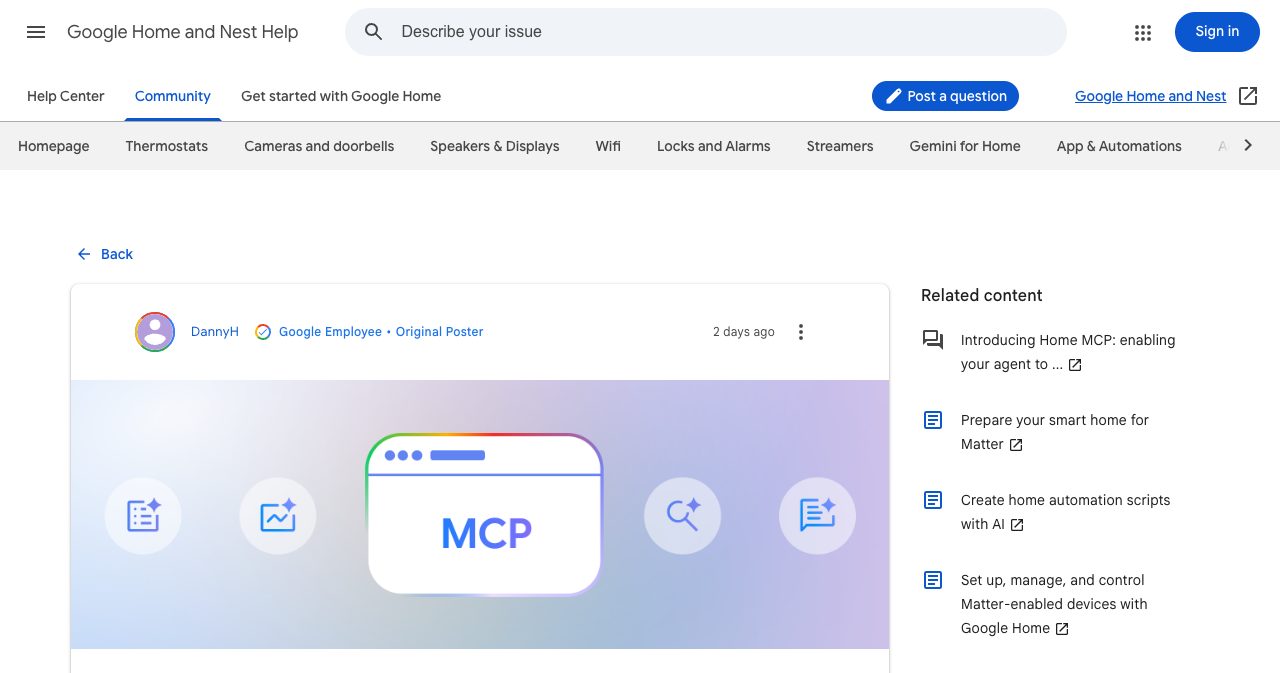
On Tuesday, September 16, 2026, Google opened early access to Home MCP. As TechCrunch reported on launch day, the server links third-party autonomous agents directly to the Google Home ecosystem. Google confirmed the rollout in a post on the Google Home & Nest help community, inviting external models: "any agent that supports calling MCP tools, such as Google Antigravity, Claude, Hermes, OpenClaw or others." TechCrunch and The Verge confirmed ChatGPT can connect through the same standard.
Access is narrow. Early access is restricted to users in the United States using English on Google Home Premium Advanced, priced at $20 per month or $200 per year. Google noted that access will expand over coming weeks, but declined to give dates for lower tiers or international territories.
The onboarding process is engineered for technical operators. Instead of clicking a toggle in the mobile app, you create a project in Google Cloud, enable the Google Home API, configure an OAuth consent screen, generate an OAuth client ID, and supply those credentials to your MCP client. Your agent walks you through an in-browser OAuth sign-in flow to obtain tokens. Access tokens expire roughly hourly, requiring automated refresh handling. Google documented each requirement in the Google Home Developer Center step-by-step setup guide.
Home MCP provides five capability groups across supported hardware, including Nest doorbells, cameras, and thermostats, third-party products certified under "Works with Google Home", and Matter-certified accessories like smart plugs and bulbs:
| Tool Name | Capability Group | Primary Inputs | Returned Data or Action |
|---|---|---|---|
list_homes | Structure discovery | None | List of configured homes, structure identifiers, and assigned rooms |
list_home_resources | Device enumeration | Structure ID, optional room filter | Inventory of physical devices, hardware types, and model metadata |
list_home_states | Telemetry reading | Device IDs, trait filters | Real-time device values: temperatures, brightness, switches, motion sensors |
run_home_actions | Hardware control | Device ID, trait command, parameters | Direct hardware commands: adjust heat, dim bulbs, toggle switches |
list_home_history | Event logging | Time window, camera or sensor IDs | Chronological event logs, motion triggers, and doorbell camera clip links |
The workflows Google and reporting outlets describe show how agentic execution differs from voice commands. A user prompts their agent to inspect camera logs after school hours, pulling motion triggers via list_home_history to summarize arrival times with clips. An agent can track appliance duty cycles over a week to count completed laundry loads. A developer running automated test suites in a coding agent can have the model call run_home_actions on a Nest speaker to play a notification when tests pass. Operators can also prompt agents to generate custom HTML dashboards tracking server rack temperatures against room climate sensors.
Safety boundaries are strict. Home MCP enforces backend rate limits and prohibits safety-critical operations, such as unlocking smart deadbolts. Routine and automation creation remains unsupported. Google added a direct warning in its community post that "depending on your agent, connecting it to Home MCP can result in unexpected or even undesired behavior." If an agent misbehaves, owners can revoke OAuth credentials immediately through the Google Home mobile app or the Google Account third-party connections dashboard.
The two-server split as a SaaS architecture blueprint
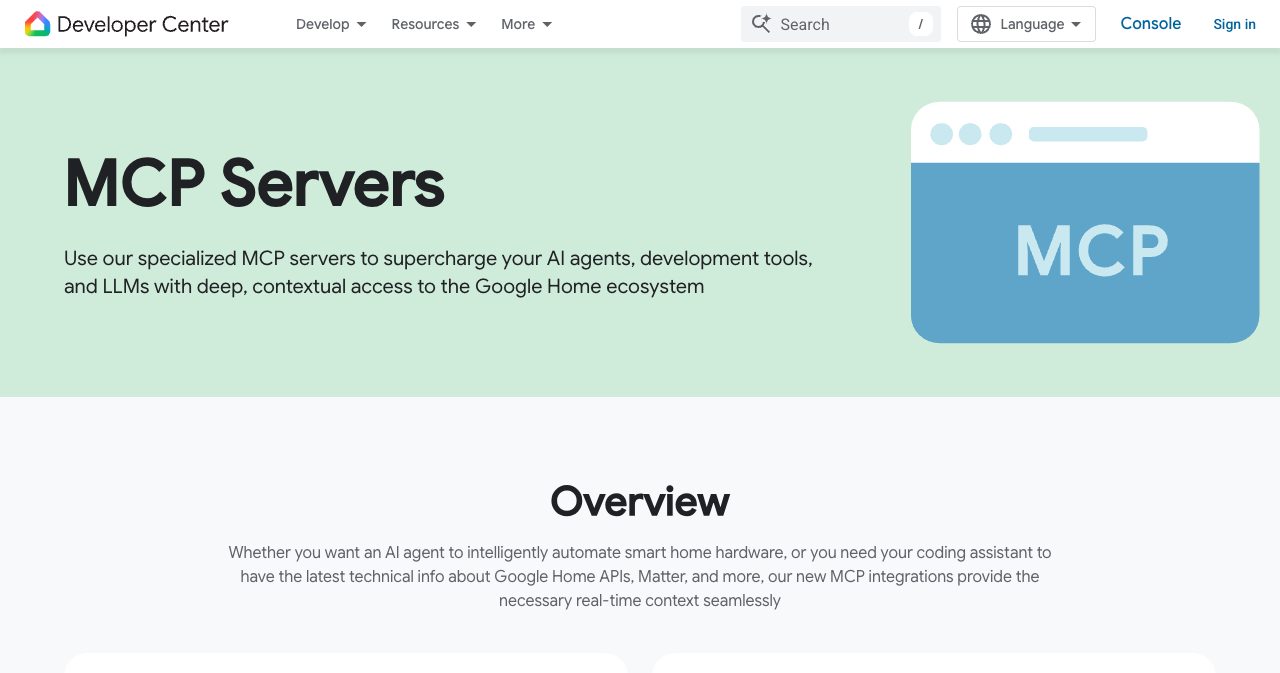
The subtle move in Google's release was shipping two distinct servers side by side, as documented in the Google Home developer documentation.
The first is Home MCP, the authenticated, subscription-gated server that reads telemetry and manipulates physical devices. The second is Home Developer MCP. Home Developer MCP is completely free, requires no Google Cloud project, and offers an unauthenticated trial path on a shared public quota. It exposes a single tool, search_documents, grounded in three technical corpora: the official Google Home API reference, the Matter 1.5.1 specification, and the Thread 1.4.1 specification. It connects directly with Google Antigravity, Claude Code, Cursor, and GitHub Copilot in VS Code.
When software engineers write integrations against complex APIs, coding assistants often hallucinate obsolete endpoints, deprecated parameter names, and invalid authentication headers scraped from stale documentation sites. By publishing a free documentation server, Google feeds exact, version-controlled technical context directly into the agent prompt window. The model reads verified schema definitions before writing code, eliminating hallucination loops.
Once the developer understands the API structure, they connect to the authenticated server to execute operations against real user accounts. If you want to see how top developer teams configure these tools, our breakdown of the best MCP servers for Claude Code in 2026 explores server setups across major software platforms.
| Dimension | Documentation Server (Home Developer MCP) | Data & Execution Server (Home MCP) |
|---|---|---|
| Target User | Developers, coding agents | End users, personal assistants |
| Authentication | None (Public trial) or basic API key | Google Cloud OAuth 2.0 with hourly refresh tokens |
| Setup Friction | Instant configuration in MCP client JSON | Multi-step cloud project setup and verification |
| Data Mutability | Read-only static technical references | Read telemetry and write state to physical devices |
| Pricing Model | 100% Free on shared public rate limits | Gated behind $20/month Premium Advanced subscription |
| Function | Eliminates agent hallucination in development | Executes tasks across private user infrastructure |
Every SaaS product can adopt this two-server pattern: one free documentation server so coding models ingest current API schemas without scraping, and one authenticated server so customers run operations through their preferred agents.
Tool design is product design: permissions, safety gates, and multi-tenancy
In an agentic interface, input parameter validation, read-write separation, and permission boundaries are the only barriers preventing autonomous models from making destructive mistakes.
Google's choice to block door unlocking illustrates this principle. An autonomous agent parsing a malicious email or prompt injection attack could be tricked into issuing an unlock command while the homeowner sleeps. Omitting an unlock tool from run_home_actions removed the attack vector at the protocol level.
A smart home is also a shared, multi-user environment. Multiple family members share rooms, climate controls, and security cameras. If one resident connects an experimental agent to the home, should that agent have unilateral authority to disable security cameras or adjust heating zones? This dilemma matches the multi-tenant permissions challenge every B2B SaaS company solves with workspace roles and resource segregation:
{
  "name": "run_home_actions",
  "description": "Executes physical device state changes. Requires confirmation.",
  "parameters": {
    "type": "object",
    "properties": {
      "device_id": { "type": "string", "description": "Target hardware ID" },
      "action_type": { "type": "string", "enum": ["set_temperature", "set_brightness", "toggle_power"] },
      "parameters": { "type": "object", "description": "Payload values" },
      "confirm": { "type": "boolean", "description": "Mandatory safety verification flag" }
    },
    "required": ["device_id", "action_type", "parameters", "confirm"]
  }
}
Community developers encountered these safety challenges long before Google's release. Home Assistant users built community servers like ha-mcp to power early home automation agents, establishing the "vibe-coded smart home" trend that gained traction throughout 2026.
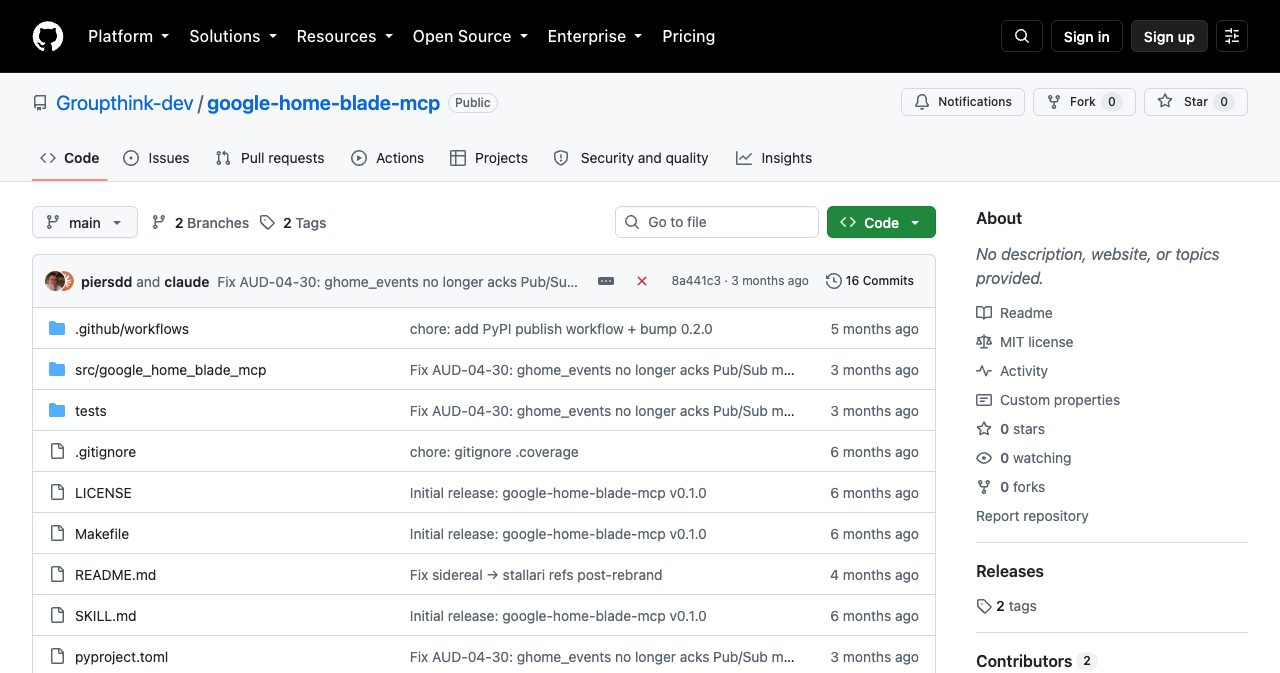
A notable community counterpoint to Google's corporate server is the groupthink-dev/google-home-blade-mcp repository on GitHub. Released under an open-source MIT license, this community project implements safety mechanisms that enterprise builders can learn from:
- The write gate: Every device write command remains disabled by default unless an explicit environment variable (
GOOGLE_HOME_WRITE_ENABLED=true) is configured on the host machine. - Explicit confirmation parameters: Raw command executions require an explicit
confirm: trueparameter in the tool payload, forcing the agent to verify its intent before dispatching commands. - Credential scrubbing: The server actively filters sensitive OAuth refresh tokens and client secrets from diagnostic logs, preventing credential leakage into LLM context histories.
For SaaS builders, tool design means separating query tools from mutation tools. A safe product exposes list_invoices and get_invoice_status without restriction, while isolating send_invoice or cancel_subscription behind secondary authentication checks or mandatory confirmation flags.
Distribution is moving inside agent clients
Software distribution is undergoing a platform shift. When developers and operators spend their days inside environments like Claude Code, Antigravity, Cursor, and OpenClaw, the primary discovery surface is no longer a search engine results page.
Consider how buying decisions happen in an agent-first workflow. A software engineer does not open Google Search to read five affiliate listicles comparing database backup services. They ask their agent: "Audit our PostgreSQL disaster recovery setup and provision an automated daily snapshot tool that integrates with our Slack alerts."
The agent evaluates available tools. If your backup service provides an official MCP server, the agent inspects the tool definitions, verifies the authentication flow, and offers to complete the integration immediately. If your service requires navigating a manual web portal, filling out lead capture forms, and copying API keys, the agent skips your tool in favor of a callable competitor.
This evolution extends Generative Engine Optimization (GEO) and Answer Engine Optimization (AEO). In our guide on how to optimize websites for AI citations, we documented how answer engines like ChatGPT and Perplexity prioritize structured, verifiable sources. In an agent runtime, discovery requires direct execution. If an agent cannot interact with your product programmatically, your product remains invisible at the point of intent. Founders looking to stay visible should explore modern platforms for SaaS founders to get visibility, combining directory listings, search optimization, and agent protocols.
Connecting these systems is becoming standard practice. For builders experimenting with next-generation agent workflows, our guide on how to connect Google Antigravity with Google Stitch demonstrates how agent environments link directly into production tooling.
This shift explains why we built an official MCP server for SaaSCity at /mcp. Instead of forcing founders to open a browser tab, paste company descriptions, and upload media assets by hand, an agent running inside Antigravity or Claude Code calls our MCP server directly to inspect directory categories, verify submission guidelines, submit company details for editorial review, and track listing publication status without human intervention.
Pricing, packaging, and the smart home infrastructure play
As The Verge reported on September 17, 2026, Taylor Lehman, group product manager for Google Home & Nest, described the launch in those terms. Google is positioning its smart home ecosystem as an underlying infrastructure layer, mirroring how Amazon Web Services established computing infrastructure for online software. Gemini for Home remains the consumer assistant on Nest speakers and inside mobile apps, but MCP establishes Google as the hardware driver for external models. Whether an end user prefers Claude, ChatGPT, or open-source models, Google bills for access to physical endpoints.
Notice how Google packaged this feature. Home MCP is not a free developer perk. It is gated behind Google Home Premium Advanced at $20 per month or $200 per year. For SaaS founders, this validates a packaging transformation:
| Packaging Generation | Primary Metric | Integration Access | Billing Structure |
|---|---|---|---|
| SaaS 1.0 (2010-2020) | Human seat count | Included in all plans or basic webhooks | Fixed monthly fee per employee |
| SaaS 2.0 (2020-2025) | Usage consumption | API access gated behind enterprise plans | Base subscription plus tiered metered overages |
| Agentic SaaS (2026+) | Machine tool calls | MCP server access gated to premium tiers | Premium subscription floor plus compute usage |
Agent interoperability is a premium software tier. Power users and corporate operators will pay premium subscription prices for software that interacts cleanly with their autonomous agents. An agent that saves an executive five hours of manual data entry each week easily justifies a $20 or $50 monthly subscription.
A practical MCP checklist for SaaS founders
If you run an existing SaaS product or are developing a new application, preparing your product for the agent economy does not require rewriting your entire codebase. Follow this architectural checklist:
| Implementation Area | Primary Risk Factor | Recommended Mitigation Strategy |
|---|---|---|
| Scope & Isolation | Privilege escalation via prompts | Separate read tools from write tools; enforce per-user OAuth tokens matching RBAC rules |
| Mutation Safety | Unintended data destruction | Mandatory confirm: true parameters and explicit parameter validation schemas |
| Authentication | Token leakage in context windows | Issue 60-minute expiring tokens, automated refresh cycles, and instant dashboard revocation |
| Log Sanitization | Secret leakage in diagnostics | Server-side regex scrubbing for API keys, session headers, and customer identity data |
| Operational Stability | Agent retry loops exhausting limits | Strict IP rate limiting, circuit breakers, and exponential backoff handling |
| Developer Grounding | Coding models hallucinating endpoints | Free public documentation MCP server grounded in live versioned schema specs |
| Blacklist Controls | Catastrophic operational overrides | Immutable hard blocks on destructive tasks (e.g. workspace deletion, bulk fund transfers) |
Your next customer is an agent
The history of software is a progression of interfaces: command lines gave way to graphic windows, graphic windows gave way to mobile screens, and mobile screens are yielding to agentic runtimes. Google's launch of Home MCP confirms that this transition has reached the physical world. Model Context Protocol is rapidly establishing itself as the standard communication layer between intelligence engines and software infrastructure.
Founders who build for this reality will capture distribution while competitors remain trapped behind manual dashboards. That means building software that serves human users through web applications while offering callable MCP servers for autonomous agents working on their behalf.
If you are launching a product, visibility remains the first hurdle. SaaSCity provides an established launchpad: a permanent, indexed page and a physical building on our interactive live city map, reviewed by human editors. The free plan requires adding the SaaSCity badge to your website, turning your backlink dofollow and booking your product into the next Monday launch queue. To bypass the badge, Quick Pass costs $19.99 as a one-time fee and takes your listing live within 24 hours. The Premium package ($39.99 one-time) includes an editorial launch post written by our team with three dofollow backlinks, leveraging a domain in the DR 47-56 range at the last Ahrefs refresh.
To see how directory backlink profiles and indexation drive authority, read our guide on the SEO benefits of listing SaaS products in directories. If you prefer having an agent manage the submission, connect to our free MCP server at /mcp and let your assistant submit your startup while you focus on shipping code.
Your software will soon interact with more autonomous agents than human eyes. Build the interfaces they need to get the job done.
TOPIC: Google opened early access to Home MCP on September 16, 2026 - a Model Context Protocol server for the Google Home ecosystem that any MCP-capable agent (Google Antigravity, Claude, Hermes, OpenClaw, ChatGPT) can call to enumerate rooms and devices, read state, run device actions and pull event and camera history. Gated at launch to US, English, Google Home Premium Advanced subscribers ($20/month or $200/year), rolling out over weeks. Setup needs a Google Cloud project, the Home API enabled, an OAuth consent screen and client, then agent-driven sign-in; tokens expire about hourly. Five capability groups: list_homes, list_home_resources, list_home_states, run_home_actions, list_home_history. Safety: rate limits, door unlocking blocked, automations not supported yet, Google warns agents may behave unexpectedly, access revocable from the Home app or Google Account connections. A second free server, Home Developer MCP, answers coding assistants (Antigravity, Claude Code, Cursor, Copilot) with docs grounded in the Home API reference plus Matter 1.5.1 and Thread 1.4.1 specs, no Cloud project needed. The Verge frames it as Google becoming the smart home infrastructure layer, the way AWS became internet infrastructure. Why it matters to SaaS founders: an agent-callable surface is now a distribution surface, the two-server split is a repeatable packaging pattern, tool design (read vs write, gating, confirmations, per-user scoping) is the new API design, and discovery is shifting into agent clients where your product is invisible unless it is callable. SaaSCity tie-in: SaaSCity runs its own free MCP server at /mcp that lets an agent submit a listing and check its status, plus the free directory listing with a badge-gated dofollow backlink and Monday launch slot, Quick Pass at $19.99 and Premium at $39.99.
Get your SaaS in front of founders
List your product on the SaaSCity live city map - a permanent listing, real discovery, and a backlink from a high-DR directory. Free to start; upgrade for a dofollow link and a building on the map.