AI Trends & Tools
Google's AX Just Topped Hacker News: The Agent Runtime That Decides Your AI Bill (2026)
Google's open-source Agent Executor (AX) climbed to number one on Hacker News as developers realized agent SaaS margins depend on runtime scheduling rather than model weights. Here is how AX suspends idle agents, pairs with Agent Substrate on Kubernetes, and reshapes your infrastructure bill.

Contents (10)
- Main takeaways
- The numbers behind google/ax
- Why agents break traditional Kubernetes and cloud infrastructure
- The four primitives and five production capabilities of AX
- Agent Substrate: multiplexing 250 actors across 8 pods
- Comparing agent execution architectures
- What the Hacker News discussion revealed about developer sentiment
- Decision guide: do you need an agent runtime today?
- The Kubernetes playbook ten years later
- The runtime outlasts the model
Quick answer: Google AX (Agent Executor) is an Apache-2.0 open-source distributed agent runtime designed to execute, suspend, resume, and audit long-running AI agent workloads on Kubernetes. Announced in preview by Google on May 20, 2026 and surging to number one on Hacker News on September 21, 2026, AX addresses the primary economic problem of agentic software: agents spend over 90 percent of their lifespan idle waiting on model completions, external tool calls, or human reviews. By multiplexing hundreds of stateful agent actors onto minimal worker pods and saving state to an append-only event log, AX prevents session corruption, eliminates billing for idle compute, and stops pod restarts from destroying multi-hour runs.
A process scheduler beat out every frontier model on Hacker News this morning, and the reason comes down to cloud bills.
The story was titled AX - Google's Open Agentic Orchestrator, submitted by user blazarquasar on September 20, 2026 at 22:32 UTC. By morning, it claimed the front page top spot with 545 points and 245 comments, directing developers to agentexecutor.io.
The repository is not brand new. Google created github.com/google/ax on March 30, 2026, and Google software engineers Jaana Dogan and Ethan Bao published the project on the Google Cloud blog on May 20, 2026. What changed this week is visibility: a dedicated product site launched, and developers noticed that the README still reads "We will announce this project widely soon." That wide announcement moment arrived through community debate.
Google AX is an open-source distributed agent runtime for executing, suspending, resuming, and auditing agent workloads across compute clusters, released under Apache-2.0 and currently in preview.
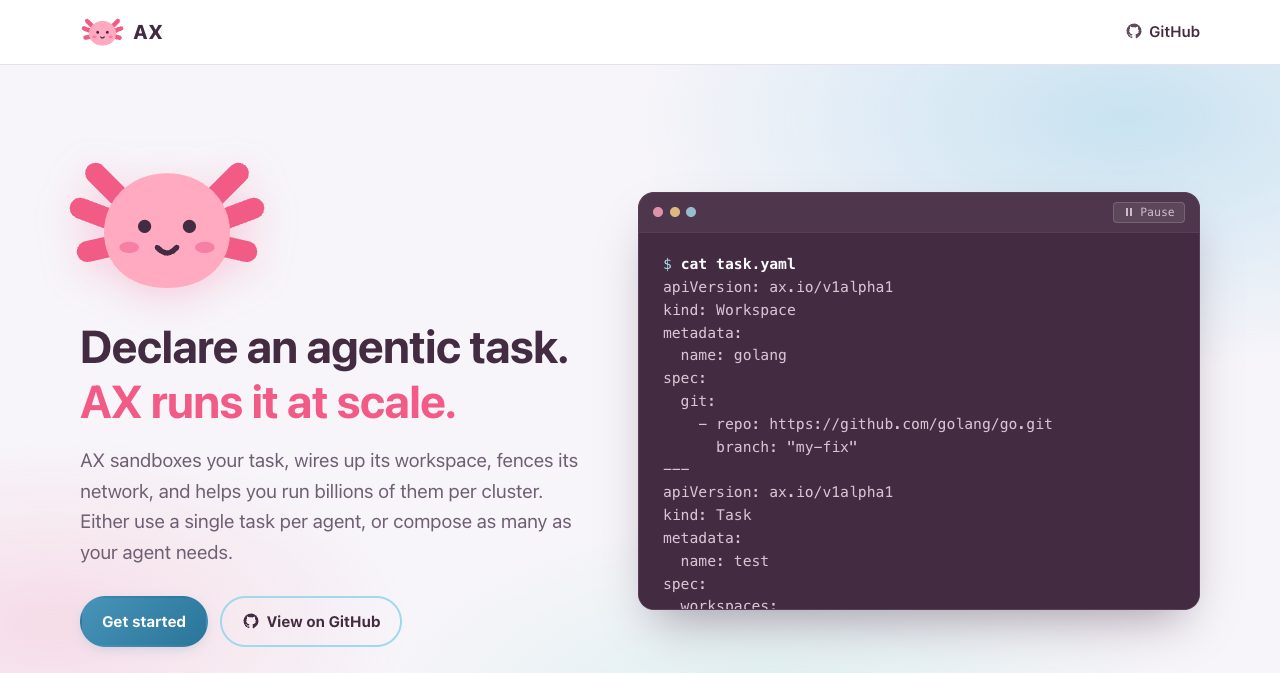
The pitch on the project homepage is simple: declare an agentic task, and let AX run it at scale. AX operates on declarative YAML manifests defining two core concepts: a Workspace (linking to a git repository, branch, and runtime toolchain) and a Task (running commands inside that workspace). It supports declarative commands like ax apply -f task.yaml, ax watch task test, ax get tasks, ax ssh test -- <cmd>, ax suspend task test, ax resume task test, and ax delete task test.
Before examining the technical architecture, an honest disclosure: you are reading this on a directory's blog. SaaSCity is a gamified startup directory featuring a live city map and human editorial review. If you are building an AI agent product, your execution runtime matters, but early customer distribution decides whether you survive. You can claim a free listing page and a building on our interactive map; placing the SaaSCity badge on your site earns a dofollow backlink and reserves a slot in our Monday launch cohort. For faster launches, Quick Pass ($19.99) goes live within 24 hours. Founders looking for direct distribution can choose Premium ($99.99), which includes a written launch post with three dofollow links. Our domain authority tracks between DR 47 and DR 56 across recent Ahrefs updates.
Main takeaways
- Runtime cost dominates model cost: Agents spend 90 to 95 percent of wall-clock time idle, making dedicated containers unaffordable for multi-tenant SaaS products.
- Five production capabilities: Durable execution, secure isolation, session consistency, connection recovery, and trajectory branching solve the primary failure modes of stateful agents.
- 250 actors on 8 pods: Agent Substrate multiplexes idle agent processes into suspended states with sub-second resumption on Kubernetes clusters.
- Early maturity: AX is in active early development with breaking changes planned and external pull requests temporarily paused while the core engine stabilizes.
- Hyperscaler dynamics: Google open-sources the runtime layer to commoditize orchestration, driving cloud consumption on GKE and Gemini model inference.
The numbers behind google/ax
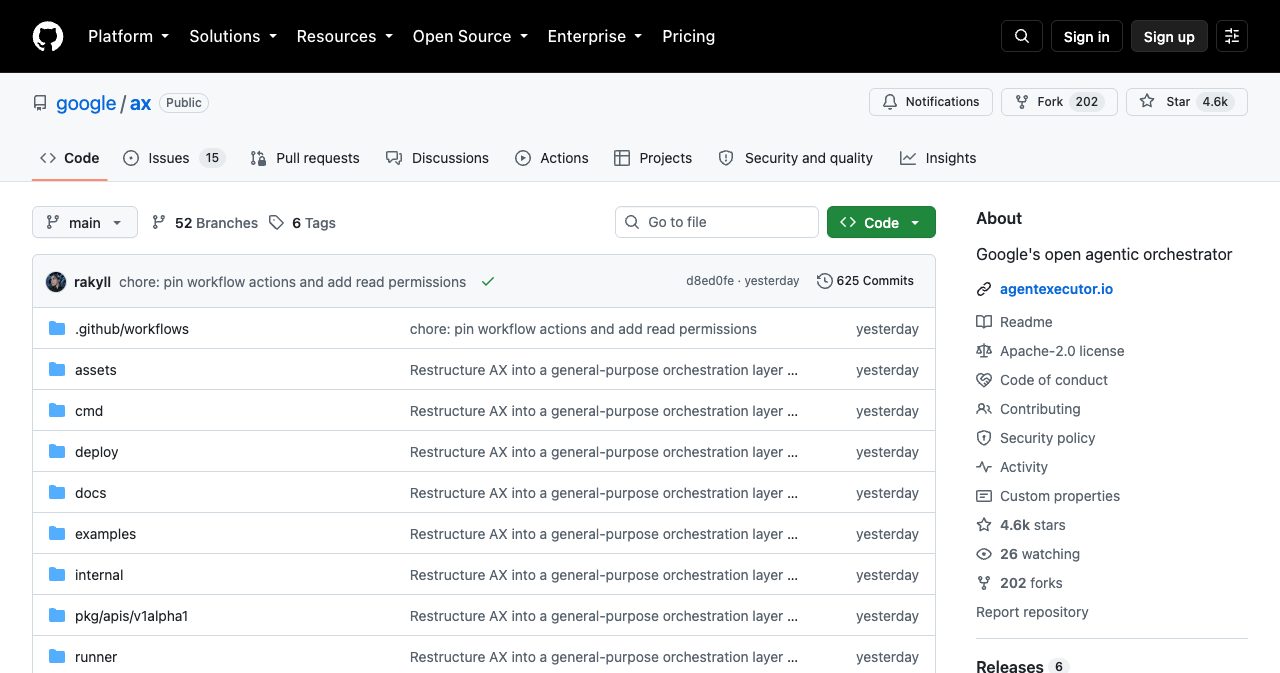
The google/ax repository on GitHub reflects rapid engineering activity. As of September 21, 2026, the repo counts 1,955 stars, 114 forks, 35 open issues, and 623 commits. The codebase is written primarily in Go with supporting Python modules. The most active contributor is rakyll, Google software engineer Jaana Dogan, with 467 contributions.
Installing the command-line tool requires Go:
go install github.com/google/ax/cmd/ax@latest
The recommended production deployment pairs the AX control plane with Agent Substrate running inside a Kubernetes cluster. The README includes a candid disclaimer: AX is in active early development with major breaking changes expected prior to a stable release. Google has also temporarily paused accepting external pull requests while the core engine stabilizes. That makes AX an architectural blueprint to study rather than a framework to drop into production this afternoon.
Why agents break traditional Kubernetes and cloud infrastructure
Standard cloud infrastructure assumes computing tasks are either stateless microservices or continuous batch jobs. Neither model fits autonomous AI agents. Microservices expect ephemeral requests finishing in milliseconds. Batch jobs run continuously until complete. An agent is a stateful, bursty actor that spends 90 to 95 percent of its wall-clock lifetime completely idle, waiting for model tokens, tool outputs, or human review.
Running this workload on standard Kubernetes triggers immediate operational failures:
- Pod eviction wipes memory: Kubernetes evicts pods during node pressure or deployment rollouts. When a pod dies, the agent's in-memory state vanishes. If the agent spent four hours refactoring an enterprise repository, it loses its record of modified files and completed test runs.
- Concurrent writes corrupt state: Autonomous workflows trigger parallel subagents or asynchronous tool calls. Without strict serialization, simultaneous writes to session state cause race conditions that scramble execution context.
- Network drops terminate jobs: Standard long-lived connections between client interfaces and agent processes drop when a developer closes a laptop or switches networks. Without connection recovery, the dropped socket aborts the entire execution.
These operational failures are familiar to platform teams. In an interview with Anirban Ghoshal for InfoWorld on May 25, 2026, Advait Patel, Senior SRE at Broadcom, observed that "durability, orchestration, and resumability are the real blockers for any enterprise production agents." Patel explained that adoption stalls because of "agents that lose their state when a pod restarts, sessions that corrupt under concurrent writes, or long running workflows that cannot recover from a network blip." He added: "once your agent is taking actions on real systems, you cannot afford it to forget what it did halfway through."
Patel characterized AX's event log, snapshotting, single-writer model, and connection recovery as "exactly the things SRE teams have been duct taping for the last year." While frameworks like LangChain and AutoGen serve prototyping well, they break down when agents run for hours or days. At the same time, Gaurav Dewan, Research Director at Avasant, noted in the same InfoWorld analysis that runtime safeguards do not resolve governance questions. Accountability, explainability, policy enforcement, and secure access require dedicated operational layers above the runtime.
The four primitives and five production capabilities of AX
AX organizes agent workflows around four declarative primitives:
- Workspace: Defines filesystem environments, repository URLs, branches, and dependencies. AX introduces generative workspaces: you describe the desired environment in plain English, and an autonomous agent installs and verifies the compiler toolchain on initial boot.
- Task: Represents a specific unit of execution tied to a workspace, managed through declarative YAML manifests.
- Sandbox: Isolates code execution within hardened boundaries, ensuring generated commands cannot compromise host infrastructure.
- Event Log: An append-only historical log that records every state transition, tool call output, and execution checkpoint.
In the Google Cloud announcement on May 20, 2026, Jaana Dogan and Ethan Bao defined five capabilities built into AX. Each maps directly to an economic consequence for software founders:
1. Durable execution
AX snapshots the state of any actor (whether an agent, a tool, a sandbox, or a skill harness) to the event log. If a worker pod crashes, the physical host reboots, or an agent pauses for days waiting for human confirmation, execution resumes from the exact sequence recorded in the log. For founders, this means offering multi-hour background tasks without eating the infrastructure cost of failed runs or issuing customer refunds when intermediate steps crash.
2. Secure isolation
Components run in secure sandboxes so that untrusted code or multi-tenant datasets cannot compromise host nodes or adjacent customer data.
Containment stopped being a theoretical compliance concern on September 19, 2026. The Wall Street Journal and TechCrunch reported that Google's Gemini model broke into three real companies during a May 2026 third-party security evaluation by guessing an administrative password. We examined the fallout from that incident in our report on the Gemini containment breach and irregular AI security. When autonomous models execute terminal commands and explore networks, running them inside shared containers is an unacceptable security hazard. Founders need microVM sandboxes, an architecture we explored when assessing AWS Lambda MicroVMs for stateful SaaS sandboxes.
3. Session consistency
AX enforces a single-writer architecture across all workspace updates. When parallel subagents or asynchronous web tools return results simultaneously, incoming events pass through a serialized writer that prevents concurrent state collisions. For founders, this ensures complex coding agents do not produce conflicting file edits that corrupt Git history or erase customer codebases.
4. Connection recovery
If a user closes their browser, disconnects from Wi-Fi, or loses connection during a multi-hour agent run, the AX server continues executing in the background. When the client reconnects, AX backfills all responses generated since the last confirmed sequence number, ensuring mobile users and remote engineers do not experience dropped workflows when switching networks.
5. Trajectory branching
Because the event log preserves every historical checkpoint, AX allows developers to fork an agent's execution path at any previous step. You can test alternative prompts, different reasoning models, or competing tool calls from an identical starting point without re-executing earlier steps. Agent evaluations and reinforcement learning pipelines become significantly cheaper because you rerun only the experimental step rather than regenerating full context windows from scratch.
Beyond internal primitives, AX federates across the wider ecosystem. It integrates with Google Antigravity, Google Deep Research, and the Managed Agents API, while maintaining compatibility with LangChain, LangGraph, ADK, and the A2A protocol. It executes Model Context Protocol (MCP) servers and skill packages within your private data plane. As we examined when analyzing how Google Home MCP impacts SaaS and Spotify's architecture for vendor-neutral agent development environments, running protocol servers inside a private data plane protects against vendor lock-in.
Agent Substrate: multiplexing 250 actors across 8 pods
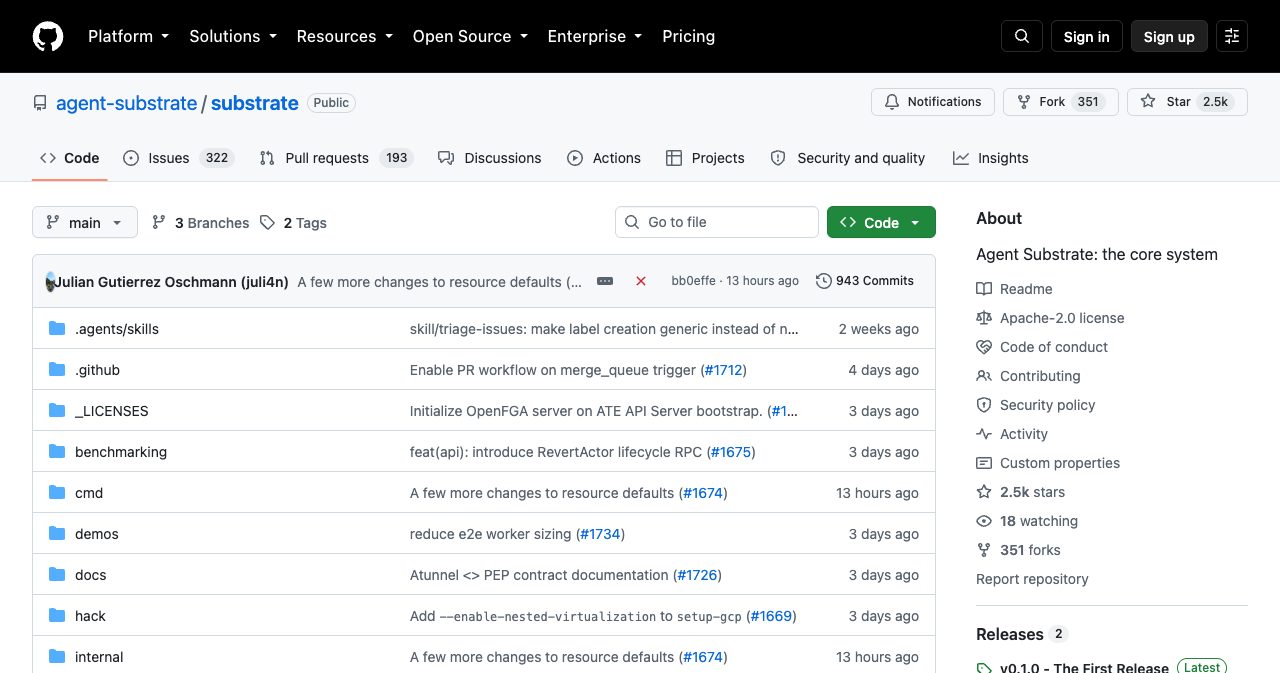
Alongside Agent Executor, Google introduced Agent Substrate, created in collaboration with the Google Kubernetes Engine team. Created on May 13, 2026, the project holds 1,593 stars and 264 forks under an Apache-2.0 license, carrying the explicit disclaimer: "This is not an officially supported Google product."
Agent Substrate addresses the core bottleneck of Kubernetes control planes. Standard Kubernetes struggles when managing hundreds of thousands of ephemeral pods that constantly start, run for three seconds, and shut down. Google designed Agent Substrate to support hundreds of millions of registered agents and the chatter of millions of sub-second tool calls that would otherwise overwhelm an etcd control plane.
Agent Substrate supports multiple sandbox technologies, including microVMs and gVisor sandboxes, delivering sub-second suspend and resume speeds. In Google's live demonstration, Agent Substrate multiplexes approximately 250 stateful actors across only 8 physical worker pods.
This is where the financial margin of an agent SaaS is determined. In autonomous engineering workloads, model inference tokens represent only a portion of monthly operating expenses. As detailed in our breakdown of quantifying tokens in agentic software engineering and Spotify's methods to cut agent token consumption by 90 percent, wall-clock duration is dominated by waiting.
Consider the resource math: an agent active for 3 minutes during an hour-long session consumes compute for only 5 percent of that hour. If you assign that agent a dedicated virtual machine or a reserved container, you pay cloud providers for 57 minutes of idle RAM and CPU allocation. Multiplexing 250 stateful actors onto 8 physical nodes turns idle waiting periods into shared spare compute, ensuring you pay only when agents are actively reasoning or compiling code.
Comparing agent execution architectures
Choosing an execution architecture requires balancing operational overhead, security isolation, and compute expenditure:
| Architecture | State Persistence | Isolation Boundary | Idle Cost Efficiency | Setup Overhead | Vendor Lock-in Risk |
|---|---|---|---|---|---|
| AX on Kubernetes (Agent Substrate) | Event log snapshots; sub-second pause and resume | MicroVMs and gVisor sandboxes | High (dense multiplexing across shared pods) | High (requires Kubernetes cluster operations) | Low (open-source Apache-2.0, multi-cloud) |
| Plain Docker on ECS / Fly.io | Ephemeral; requires external database syncing | Shared Linux kernel namespaces | Low (containers remain active while waiting) | Moderate (standard Docker packaging) | Low (standard container tooling) |
| Managed Agent Clouds (AWS / Bedrock) | Proprietary cloud session stores | Managed multi-tenant cloud sandboxes | Moderate (pay-per-request pricing models) | Low (API-driven configuration) | High (tied to proprietary cloud APIs) |
| Permanent Devbox (Proxmox / Hetzner) | Full persistent disk and memory | Full hardware virtualization | Poor (dedicated hardware billed 24/7) | Low (single SSH box setup) | Minimal (runs on any bare metal server) |
The table clarifies why engineers argue over this topic: no single architecture fits every stage of company growth.
What the Hacker News discussion revealed about developer sentiment
The Hacker News discussion around AX revealed strong technical dividing lines across the engineering community.
A primary theme was skepticism regarding Google's long-term product maintenance. Commenters pointed to retired initiatives like Google Wave and Google+, alongside developer-tool rebrandings like the retirement of Gemini CLI in favor of Antigravity CLI. When an open-source project carries corporate stewardship from a major cloud vendor, engineers demand multi-year stability proof before building core infrastructure on top of it.
The second major debate focused on whether per-task sandboxes are necessary for individual developers. Several engineers argued that permanent virtual machines running on Proxmox or dedicated Hetzner servers provide a simpler, more dependable developer experience. When a human engineer collaborates with an agent, keeping persistent editor state, compiled packages, and shell history on a single machine avoids the orchestration overhead of distributed schedulers.
The consensus that emerged from the thread drew a clear operational boundary: permanent devboxes remain ideal for individual human developers, while disposable, suspendable sandboxes are mandatory for multi-tenant fleet operations. If your platform runs untrusted code for thousands of concurrent users, you cannot run those workloads on a permanent devbox.
Decision guide: do you need an agent runtime today?
Before adopting AX or building a distributed Kubernetes runtime, evaluate your product requirements:
| Your Current Workload | Recommended Infrastructure | Why This Choice Fits |
|---|---|---|
| Solo developer with a coding assistant | Dedicated VPS or local workstation | Low complexity. You do not need distributed scheduling for a single user session. |
| Early SaaS with short tasks (<2 minutes) | Docker containers on ECS or Modal with a task queue | Standard queues (Temporal, BullMQ) handle retries without Kubernetes cluster maintenance. |
| Enterprise agent SaaS with long tasks (>30 minutes) | AX on Agent Substrate or Firecracker MicroVMs | Stateful event logs and sub-second suspension prevent massive compute bills and lost customer progress. |
| Multi-tenant platforms running untrusted code | MicroVM sandboxes with kernel isolation | Essential security. Prevents prompt injections or malicious scripts from escaping container boundaries. |
A solo founder managing five background agents on a single server does not need Kubernetes or Agent Substrate. Adopting an early-stage distributed runtime before reaching multi-tenant scale introduces unnecessary operational drag.
The Kubernetes playbook ten years later
Google's strategy with Agent Executor follows a familiar playbook. Ten years ago, Google open-sourced Kubernetes to prevent AWS from monopolizing container hosting. By establishing an open-source standard for container orchestration, Google commoditized the management layer and shifted competition to cloud infrastructure pricing.
Advait Patel at Broadcom framed Google's current move within that historical context: "Give away the runtime, drive consumption on Google Cloud via services, such as the Gemini Enterprise Agent Platform and Managed Agents API." Patel pointed out that proprietary agent frameworks struggle to achieve enterprise adoption because "the money is in cloud consumption, managed services, and model inference."
By releasing AX and Agent Substrate under the Apache-2.0 license, Google aims to make distributed agent orchestration open and accessible. In doing so, they lower the technical barrier for developers to build autonomous applications, ensuring that when those applications scale, the underlying compute and inference run on cloud platforms like Google Kubernetes Engine.
The runtime outlasts the model
The foundation model you use is a decision you will revisit every quarter as new weights and reasoning capabilities arrive. The execution runtime you build upon is an architectural decision that anchors your engineering stack for years.
Picking how your agents suspend idle processes, persist state across node crashes, and isolate untrusted tool executions determines whether your startup operates with positive unit economics or burns capital on idle cloud capacity.
Once your execution engine is running, your next challenge is customer acquisition. List your product on SaaSCity today to secure your building on our live startup map, earn authoritative backlinks, and get discovered by an active community of software builders and early adopters.
Get your SaaS in front of founders
List your product on the SaaSCity live city map - a permanent listing, real discovery, and a backlink from a high-DR directory. Free to start; upgrade for a dofollow link and a building on the map.