News
Modal Raised $750M at $15.75B on $1B ARR - and $300M of It Comes From Letting Agents Run Code (2026)
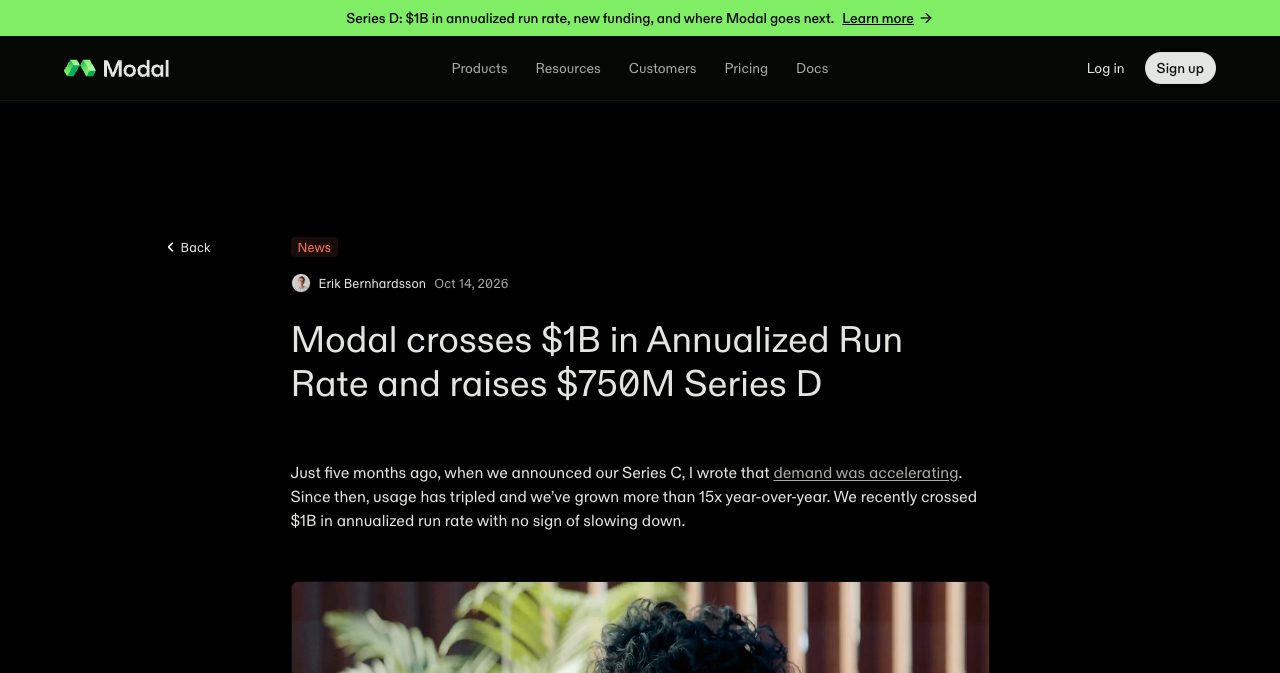
On October 14, 2026, Modal announced it crossed $1 billion in annualized run rate and raised a $750 million Series D at a $15.75 billion valuation. The part worth stealing isn't the headline number - it's that $300 million a year of it comes from one product, Sandboxes, built for exactly one job: giving AI agents somewhere safe to run the code they write. We run a startup directory, so you'll know where we sit before we get into it.

Contents (8)
- The number nobody led with: $300 million from letting agents run code
- The growth curve: $60M to $300M to $1B+ in thirteen months
- Why the money is in the primitive, not the wrapper
- The pricing lesson: bill for what's actually used
- How the market read it
- What this means for your roadmap, not just your reading list
- Getting found matters as much as getting built
- The takeaway, one more time
Somebody, somewhere, just let an AI agent run code it wrote five seconds ago, with no human checking it first. That happened almost 3 billion times on one company's infrastructure. It's happening again right now, probably inside a product you use.
That company is Modal, and on October 14, 2026, it told the world two things in the same breath: it had crossed $1 billion in annualized run rate, and it had just closed a $750 million Series D at a $15.75 billion post-money valuation. Modal's own announcement, written by CEO Erik Bernhardsson, is the primary source for both numbers. Accel led the round, Kleiner Perkins came in as a new investor, and every existing backer - Menlo Ventures, General Catalyst, Redpoint, Lux Capital, Amplify Partners and Bain Capital Ventures - wrote another check.
Quick disclosure before we go further: you're reading this on the blog of a startup directory. We list software products, including developer tools that compete loosely in Modal's orbit, and we're not pretending to be a neutral research desk. We just think this round is a better lesson in where AI money actually goes than most of what got written about it last week.
The number nobody led with: $300 million from letting agents run code
Here's the detail buried three paragraphs into most of the coverage, and the one that should matter most if you're building anything with an AI agent in it. Modal's Sandboxes product - isolated, disposable environments where an agent can execute whatever code it just generated - now runs at roughly $300 million in annualized revenue by itself. Modal launched Sandboxes back in 2023, before "agent" was the word everyone used for this. Three years later it's not a feature. It's a third of the company.
SiliconANGLE's October 14, 2026 report puts it plainly: nearly a third of Modal's total revenue now comes from Sandboxes alone. Close to 3 billion of them have been spun up to date, and the system is built to scale to a million running concurrently - a figure Modal says it hit in a recent internal test. Background agents, reinforcement learning loops, and vibecoding platforms are the three use cases Modal names as driving that volume.
Think about what that number is actually measuring. Nobody paid Modal $300 million a year for a chatbot, a dashboard, or a slicker UI. They paid for a place to put code an AI just wrote and let it run without blowing up anything important. That's infrastructure in the most literal sense - the stuff everyone building an agent product eventually needs and almost nobody wants to build themselves. We wrote about this exact gap when AWS shipped Lambda MicroVMs for stateful, isolated execution; our piece on AWS's microVM sandboxes covers the same underlying problem from the hyperscaler's side. Modal got there first, at a much bigger scale, and it's now a public proof point that the market will pay real money for isolation done well.
SiliconANGLE's reporting adds two specifics worth knowing if you're evaluating this category yourself. Sidecars - auxiliary containers that support a sandbox, like a hallucination filter - run on the same physical server as the containers they're attached to, cutting latency. And a feature called Secret Injection lets an agent log into an external app using credentials it never actually sees, which matters a lot once you're letting an autonomous process touch your production accounts.
The growth curve: $60M to $300M to $1B+ in thirteen months
The headline valuation is easy to screenshot. The curve underneath it is the part that should change how you think about your own compute line item.
| Milestone | When | Annualized revenue | Valuation |
|---|---|---|---|
| Baseline | September 2025 | ~$60 million | not disclosed |
| Series C | May 2026 | ~$300 million | $4.65 billion |
| Series D | October 14, 2026 | Over $1 billion | $15.75 billion |
That table is built from ARR Club's October 2026 signal page and Modal's own announcement. Five times revenue in five months from the Series C alone, which is the "usage tripled" figure Modal cites directly - and more than 15x year-over-year growth by its own account. Dealroom's coverage calls the $750 million round "among the largest US enterprise-software Series D rounds on record," and notes Modal now runs 200-plus staff across New York, San Francisco and Stockholm.
One more data point from that same ARR Club writeup, because it tells you how fast this compounds once a model catches on: TypeSafe AI's model Jev served 1 trillion tokens on Modal in its first three days live. We covered Jev's launch in detail in our piece on System One models and startup decision-making - the speed at which that volume arrived is a preview of what your own infrastructure bill looks like the week your product actually works.
Why the money is in the primitive, not the wrapper
There's a pattern in this round that's easy to miss if you only skim the valuation number: Modal doesn't sell an app. It sells seconds of compute, metered precisely, with nothing else in between. That's the picks-and-shovels argument in its cleanest form - the closer you are to the thing that actually runs, the more durable your revenue tends to be, because every layer built on top of you has to pay you first.
We made a version of this argument when we looked at what agent harnesses actually cost to run - the same workload, the same model, costing $56.29 in one harness and $248.05 in another on identical benchmark tasks. Our breakdown of AWS Strands versus a metered DigitalOcean runtime found that the wrapper around a model decides your gross margin far more than the model weights do. Modal's growth says the same thing one layer down: the execution environment itself is a business, and a $300 million one at that, built entirely on top of other people's models doing other people's agentic work.
If you're building an AI SaaS right now, this is the uncomfortable mirror. Your product probably isn't the execution layer - you're a customer of one, whether that's Modal, AWS, or something you've duct-taped together from Docker and a cron job. Modal's curve is a preview of your own compute line item once your product's usage actually takes off the way Jev's did. The companies compounding fastest right now aren't the ones with the slickest agent UI. They're the ones billing, and being billed, per second of real work done.
The pricing lesson: bill for what's actually used
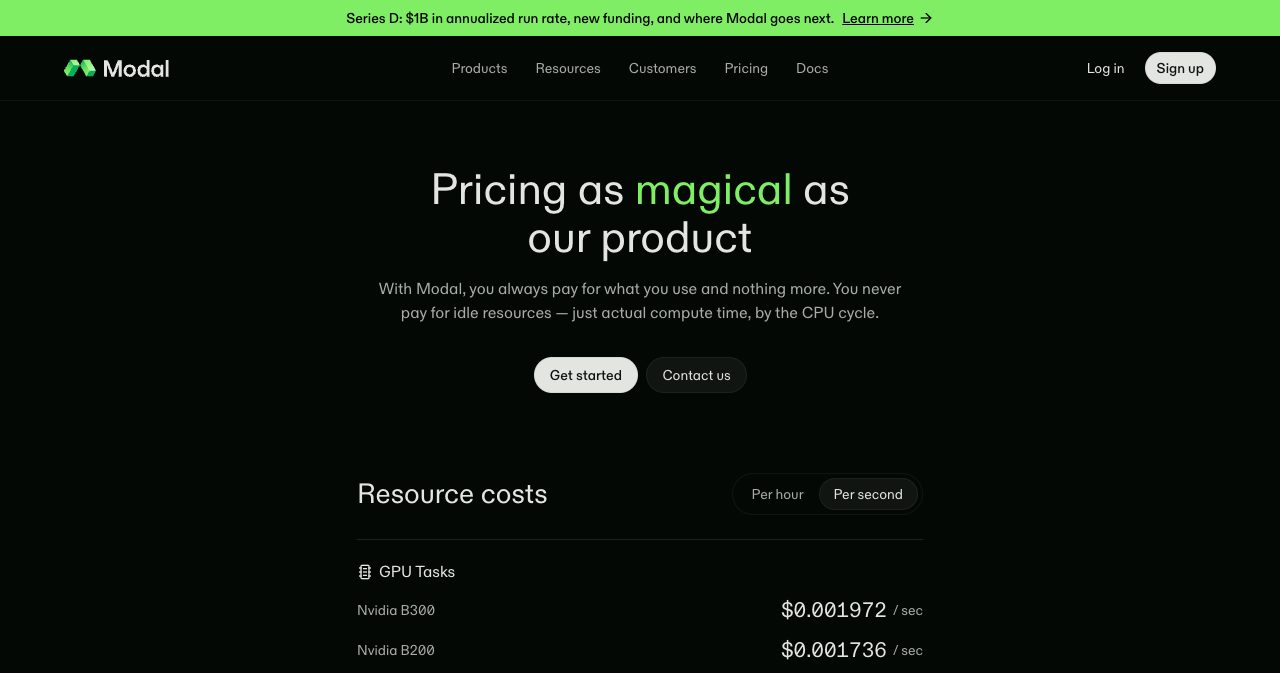
Modal's pricing page spells out the model in one line: you pay per second for GPUs and CPUs, and nothing while a container sits idle. No reserved blocks, no minimum commitment to unlock a reasonable rate, no "contact sales" wall in front of the number. Memory, storage volumes and network egress get billed on top, but the core unit - a second of actual compute - is the one that tracks value delivered almost exactly.
That's not a minor implementation detail. It's plausibly why revenue tripled in five months while plenty of the market wobbled on funding and demand elsewhere: when a customer's usage spikes, Modal's revenue spikes with it automatically, with no renegotiation needed on either side. Compare that to the flat-seat or flat-tier pricing a lot of AI SaaS still defaults to, where a power user and a light user pay the same amount and one of them is quietly subsidizing the other's compute. If you're pricing an AI feature inside your own product, Modal's model is the one worth copying before you lock in a flat monthly number you'll regret the day one customer's agent decides to run in a loop for six hours.
How the market read it
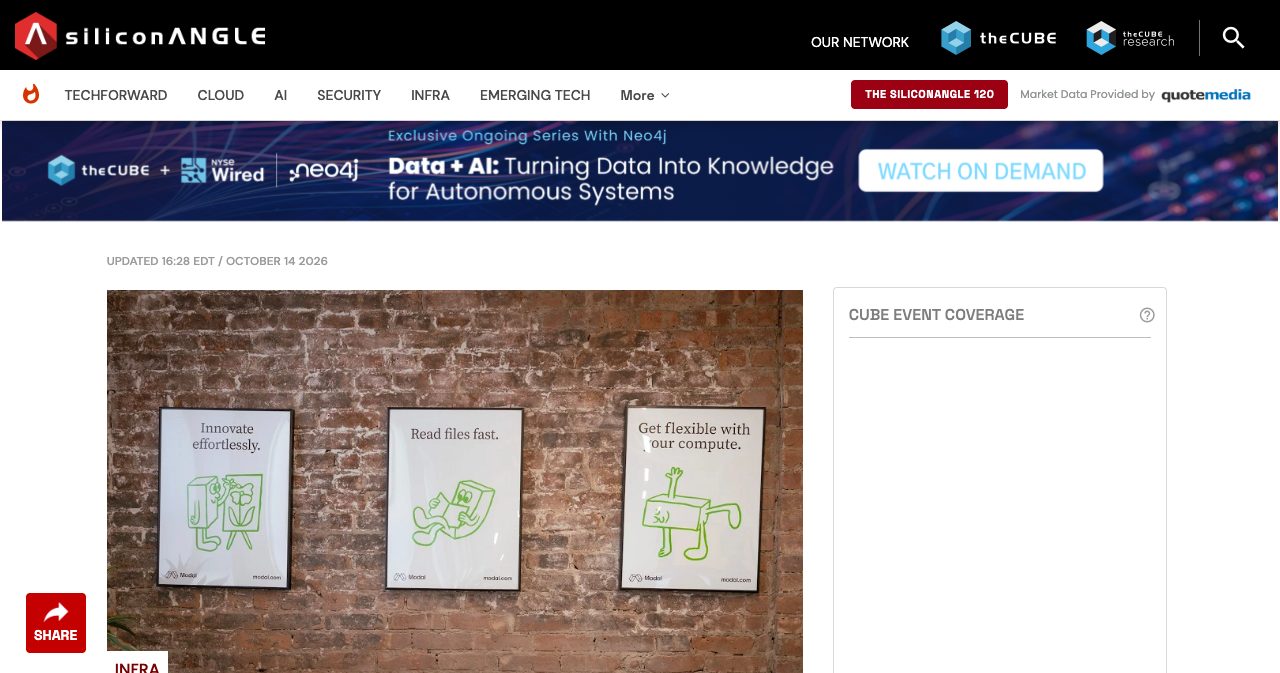
The trade press treated this as a genuinely large round, not a routine AI-infrastructure markup. SiliconANGLE framed the new valuation as more than triple what Modal was worth after its May 2026 round, on revenue that more than tripled over the same stretch. The Next Web's coverage named DoorDash, Ramp, Linear, Cognition and Runway as customers, plus robotics firms Physical Intelligence and 1X, which use Modal to train robots - a reminder that "AI infrastructure" now stretches well past chatbots and into physical systems that need training compute on demand.
Both outlets pointed to the same underlying architecture decision: Modal built its own file system, container runtime and scheduler, then rented the actual hardware from more than 20 cloud providers rather than committing to one. That spread means a workload can keep running if a single cloud has a bad day - an unglamorous engineering choice that turns out to matter a lot once you're the execution layer for other people's production agents.
What this means for your roadmap, not just your reading list
Strip away the valuation and the round size, and three things are true that should change what you build next.
First, the category of "somewhere safe for an agent to run code" is now proven at scale, with a price tag attached. If your product is gluing together containers and a prayer right now, you have real data on what buyers will pay for someone else to solve that properly. Second, usage-based pricing tracking real consumption isn't a nice-to-have anymore - it's plausibly why Modal's revenue curve looks the way it does, growing with customer usage instead of against it. Third, and this is the one founders skip: the demand curve for agent-driven compute is still accelerating, not leveling off. Usage tripling in five months isn't a one-time spike from a single big customer landing. It's broad-based growth across background agents, reinforcement learning and vibecoding tools that are all still early.
None of that requires you to use Modal specifically. It requires you to take seriously that your AI product's compute bill is about to look a lot more like a real line item than a rounding error, and that the pricing model you pick for your own AI features should probably track usage the same honest way.
Getting found matters as much as getting built
Modal didn't win by being the loudest. It won by being the place builders already pointed their agents at - word of mouth among the exact people shipping agent products, long before the funding headlines. That's distribution by reputation, and it compounds the same way revenue does.
Getting discovered works on a smaller scale the same way. We built SaaSCity as a gamified startup directory with a live city map and actual human editorial review, not an auto-approve queue - every accepted product gets a free listing page. Add the SaaSCity badge to your site and that listing becomes a dofollow backlink, which is the cheapest piece of SEO most early-stage founders skip. If you'd rather not wait in the free queue, there's a paid quick-path tier to get live fast, and a premium tier that adds a written launch post with followed links for products that want the fuller treatment. None of that replaces building something people pay for. It just means the people searching for what you built have a better chance of finding it.
The takeaway, one more time
Modal didn't get to $1 billion in annualized revenue by building a better front end. It got there by being the thing underneath the thing, priced by the second, scaled across more than 20 clouds, and trusted by agents running billions of times a month. If you're building an AI product in 2026, the question this round actually asks you isn't "should I use Modal." It's "does my pricing track what my customers actually use, and have I planned for the compute bill that's coming the week my product works as well as Jev's did." Answer that honestly before the invoice answers it for you.
Get your SaaS in front of founders
List your product on the SaaSCity live city map - a permanent listing, real discovery, and a backlink from a high-DR directory. Free to start; upgrade for a dofollow link and a building on the map.