SaaS Business
OpenAI's Revenue Landed $20 Billion Short. What It Actually Means for SaaS Founders (2026)
OpenAI confirmed an annualized revenue run-rate of roughly $50 billion in October 2026, landing $20 billion below September expectations and triggering a selloff in artificial intelligence stocks. The gap reflects an accounting divergence against Anthropic rather than evaporating software demand. Here is how foundational lab unit economics alter your SaaS margins, why gross partner receipts distort valuation multiples, and how building on SaaSCity protects your distribution.

Contents (11)
- What Happened on October 8: The $20 Billion Gap and the Market Selloff
- The Twist: Cloud Accounting and the Anthropic Comparison
- The Operating Ledgers: Growth Rates, Losses, and IPO Timelines
- Why Foundation Lab Economics Dictate Your SaaS Cost Curve
- The Accounting Lesson: Pass-Through Revenue vs True Software Margins
- Vendor Concentration Risk: The Shifting Foundation Hierarchy
- The Multiples Reality Check: Calibrating Software Valuations
- Owned Distribution Outlasts Platform Volatility
- What to Change This Quarter: A Three-Step Execution Plan
- Questions Founders Ask About the OpenAI Revenue Adjustment
- Practical Discipline for Software Builders
On Thursday afternoon, Wall Street erased tens of billions of dollars in equity value because financial analysts spent two weeks comparing direct software subscriptions to wholesale cloud invoices.
Quick answer: On October 8, 2026, financial reports confirmed that OpenAI informed investors its annualized revenue reached roughly $50 billion at the end of September 2026. That figure landed $20 billion below the $68 billion to $70 billion range widely reported in late September. Major artificial intelligence stocks fell immediately, including Nvidia, Oracle, Micron, and CoreWeave. Yet OpenAI experienced steady expansion rather than a collapse in customer demand. The revision occurred because outside investment models attempted to benchmark OpenAI against Anthropic, whose published run-rate includes gross receipts collected by cloud distribution partners like Amazon Web Services and Google Cloud. OpenAI reports direct customer billings and excludes partner turnover. On a matched accounting basis, Anthropic's $65 billion forecast exceeds OpenAI's $50 billion run-rate, marking the first time the revenue lead has changed hands. For software founders, the takeaway reaches far beyond financial trivia: your future token expenses, model deprecation schedules, and valuation multiples depend directly on foundation lab unit economics.
An early disclosure before dissecting the ledgers: you are reading this on a directory's blog. SaaSCity is a gamified startup directory with a live city map and human editorial review. Every accepted product gets a free listing page and a building on the map. Add the SaaSCity badge to your site to get a dofollow backlink and a Monday launch slot. Quick Pass ($19.99) goes live within 24 hours. Premium ($99.99) adds a written launch post with three dofollow links. Our domain rating sits between 47 and 56 at the last Ahrefs refresh. We monitor foundational model finances because software founders cannot protect their profit margins if their core compute suppliers miscalculate their costs.
What Happened on October 8: The $20 Billion Gap and the Market Selloff
On Thursday, October 8, 2026, the Financial Times broke the news that OpenAI reported an annualized revenue run-rate of approximately $50 billion to its investment group at the end of September. Financial newsrooms including CNBC, Reuters, Bloomberg, and TechCrunch verified the numbers with participating venture sources.
The disclosure unsettled public markets because financial analysts had spent late September circulating projections of $68 billion to $70 billion. Seeing the actual baseline land $20 billion lower prompted an instant selloff across companies tied to artificial intelligence datacenter capital expenditures.
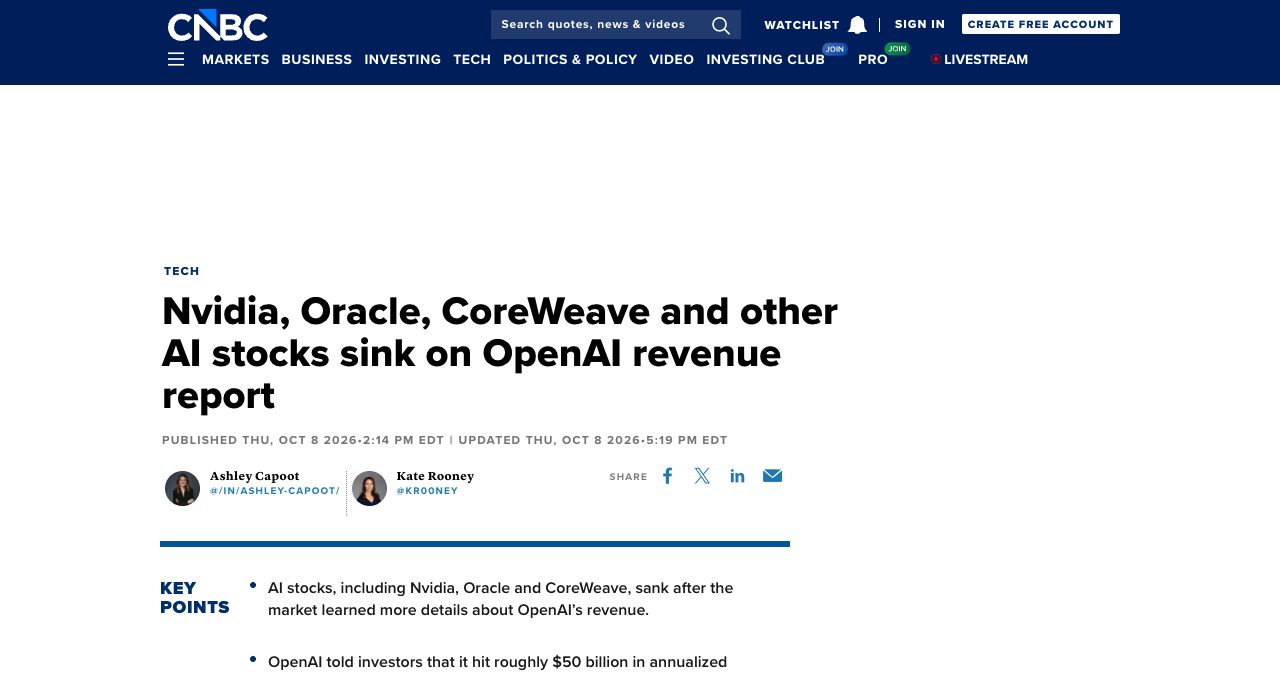
The market reaction hit the infrastructure sector broadly:
- The Nasdaq Composite index dropped 1.4 percent by the closing bell.
- Nvidia shares fell 2.9 percent as traders repriced accelerator delivery schedules.
- Oracle fell 5.5 percent, reflecting market sensitivity to debt-funded cloud expansions.
- Micron declined 4.8 percent over questions about memory module contract volumes.
- CoreWeave sank as debt investors evaluated server cluster utilization rates.
Financial publications framed the pullback as evidence of an artificial intelligence demand crisis. Investor's Business Daily noted on October 8 that cloud providers depend on software subscription growth to service heavy infrastructure financing. However, the selloff occurred because of how analysts framed the data rather than a slowdown in end-user adoption.
| Asset or Index | October 8, 2026 Movement | Infrastructure Role |
|---|---|---|
| Nasdaq Composite | -1.4% | Broad technology sector benchmark |
| Oracle (ORCL) | -5.5% | Cloud datacenter capacity contracts |
| Micron (MU) | -4.8% | High-bandwidth memory for accelerator racks |
| Nvidia (NVDA) | -2.9% | AI server processors and systems |
| CoreWeave | Down sharply | Specialized private GPU hosting |
The Twist: Cloud Accounting and the Anthropic Comparison
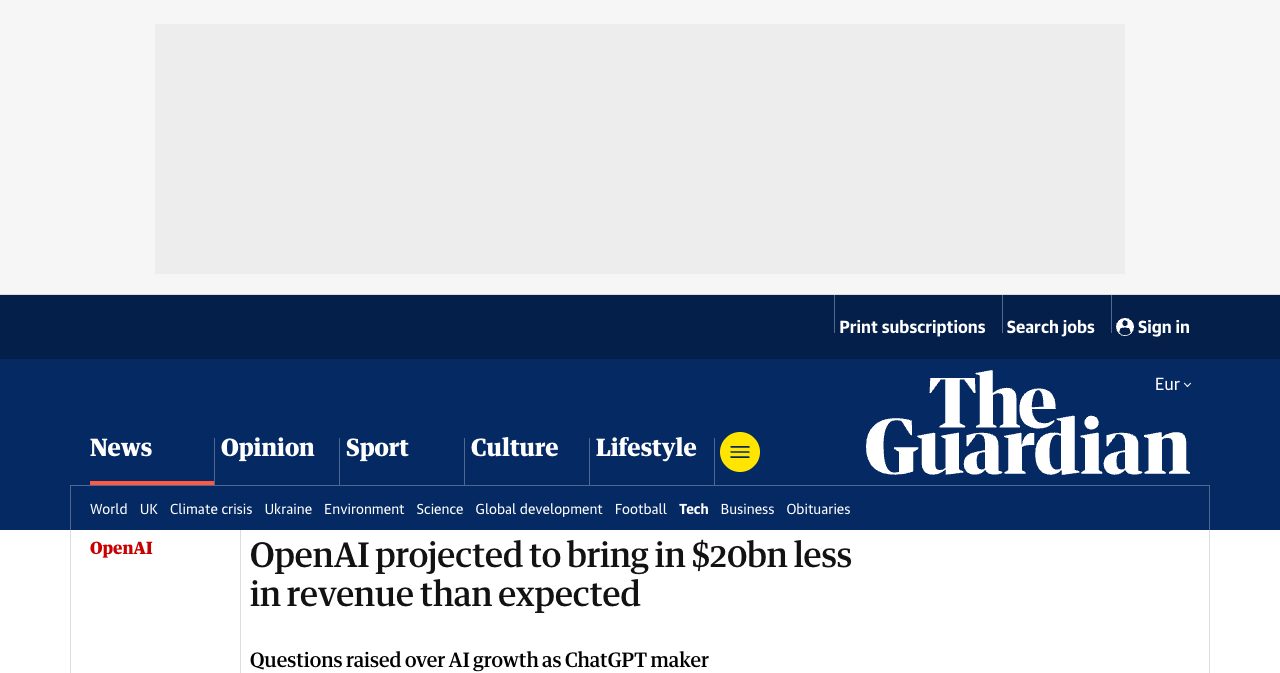
OpenAI never claimed a $70 billion run-rate on its official documentation. The $20 billion gap emerged from external models created by investment analysts attempting to benchmark OpenAI directly against Anthropic.
As The Guardian reported on October 9 and Mashable confirmed on October 10, Anthropic includes gross revenue collected by third-party cloud distributors. When a corporation accesses Claude models via Amazon Web Services Bedrock or Google Cloud Vertex AI, Anthropic counts the total gross customer spend as top-line run-rate before cloud operator margins are deducted.
OpenAI uses net direct reporting. Its communicated metrics include direct consumer ChatGPT subscriptions, team workspaces, and its proprietary developer API platform. The figure excludes the billions of dollars flowing through Microsoft Azure OpenAI Service.
When investment banks assembled comparative rankings in late September, they applied Anthropic's gross partner method to OpenAI's ecosystem, estimating an imputed gross run-rate between $68 billion and $70 billion. When OpenAI executives met with backers and presented their direct books, they stated their actual baseline: roughly $50 billion.
This accounting divergence reveals an important shift. Anthropic projected roughly $65 billion in annualized run-rate by late July 2026 under its gross partner methodology. When evaluated using the reporting standard common among institutional investors, Anthropic now records a larger top-line run-rate than OpenAI.
The revenue title changed hands because of how partner sales are counted. For software founders who selected infrastructure vendors under the belief that OpenAI retained an untouchable commercial lead, this shift requires a fresh look at vendor dependencies.
The Operating Ledgers: Growth Rates, Losses, and IPO Timelines
Setting aside the accounting debate, OpenAI continues to expand at a rapid pace for a technology company generating tens of billions in annual receipts.
OpenAI shared specific operating figures with its investor syndicate for the third quarter of 2026:
- Total annualized run-rate expanded 77 percent year-over-year.
- Enterprise platform run-rate expanded 107 percent year-over-year.
- The company's private valuation stands at $852 billion following a $122 billion equity round closed in March 2026.
- Management is conducting preliminary talks to secure roughly $30 billion at a valuation near $1.4 trillion, with terms remaining open.
- The company filed a confidential registration statement with the SEC in June 2026.
Despite submitting draft paperwork, a public listing remains months away. In September 2026, CEO Sam Altman announced that OpenAI will not launch an initial public offering during 2026, citing model safety evaluations and corporate restructuring. A public listing is expected in mid-2027.
Anthropic is proceeding on an accelerated schedule. Having submitted its confidential draft in June 2026, Anthropic intends to proceed with an initial public offering as soon as November 2026. Anthropic carried a private valuation of $965 billion after its May 2026 financing round.
Yet Anthropic's financial disclosures reveal heavy operational cash burn. As examined in our analysis of Anthropic's IPO prospectus and compute commitments, Anthropic recorded a net loss of $42 billion in 2025 on roughly $4.6 billion in recognized revenue. The company holds $518 billion in compute commitments, with eighty percent structured as non-cancelable take-or-pay obligations.
| Operating Metric | OpenAI | Anthropic |
|---|---|---|
| Annualized Run-Rate (Sept/Oct 2026) | ~$50B (direct billings) | ~$65B (gross partner run-rate) |
| Enterprise Growth Rate (Q3 YoY) | 107% | Undisclosed in headline data |
| Private Valuation | $852B (March 2026) | $965B (May 2026) |
| Next Expected Financing | ~$30B at ~$1.4T valuation | Public S-1 listing (Nov 2026) |
| Target IPO Window | Postponed to 2027 | Expected November 2026 |
| 2025 Net Financial Loss | Undisclosed direct loss | $42 billion |
| Cloud Compute Commitments | Hundreds of billions (Azure/Oracle) | $518 billion |
The broader technology sector is engaged in an unprecedented infrastructure investment cycle. Trillions of dollars are committed to datacenters, cooling systems, and electrical substations. Public markets scrutinize monthly revenue run-rates because customer demand represents the sole signal justifying that capital deployment. When headline projections adjust downward by $20 billion, equity markets react quickly.
Why Foundation Lab Economics Dictate Your SaaS Cost Curve
Founders who develop software applications often treat model pricing like utility electricity, assuming that token rates drop automatically every six months while capabilities expand.
That assumption holds only while frontier laboratories remain subsidized by venture capital and private equity.
When public equity markets question revenue trajectories, lab executives face pressure to protect unit economics:
Subsidized Token Deflation Will Slow Down
Foundation models have traded below their full training and inference costs for several years. When providers introduced compact checkpoints, such as the trends reviewed in our evaluation of Claude Haiku 5.5 and software profit margins, token fees fell steeply. Those price cuts served to secure market share before planned public offerings.
If OpenAI must defend a $50 billion revenue baseline against a proposed $1.4 trillion valuation, artificial token price reductions will moderate. Future price drops will require genuine algorithmic efficiencies rather than subsidized balance sheets. If your software relies on thin margins by reselling raw inference, stagnant token prices will squeeze your margins.
Checkpoint Deprecation Cycles Will Accelerate
Maintaining older model checkpoints across distributed server clusters consumes valuable hardware. When providers need to maximize revenue per megawatt, they cannot maintain low-volume legacy checkpoints indefinitely.
Engineering teams that hardcode prompt logic against specific versions regularly receive short deprecation notices. Managing model migrations creates unexpected engineering work. When suppliers prioritize server efficiency, your product roadmap absorbs the cost.
Enterprise Allocation Will Take Precedence
OpenAI's 107 percent enterprise run-rate expansion demonstrates where foundation labs focus their resources. For bootstrapped and seed-stage startups, this prioritization causes practical operational friction. Labs reserve dedicated server clusters and stable rate limits for Fortune 500 contracts, leaving self-serve developer accounts exposed to occasional throttling during peak hours.
To protect application performance, teams budget token consumption across multiple suppliers. Our breakdown of the best token plans for autonomous coding agents outlines how engineering teams manage endpoint budgets across competing providers.
The Accounting Lesson: Pass-Through Revenue vs True Software Margins
The most important operational insight from OpenAI's revised run-rate centers on internal financial hygiene.
The number that disrupted markets on October 8 was an external comparative estimate rather than an audited operational reality. Outside observers created metrics that mixed direct software subscriptions with wholesale partner traffic.
Software founders frequently make an identical mistake on their internal financial reports:
- Blending raw API token re-billing directly into subscription Annual Recurring Revenue.
- Counting promotional cloud credits consumed by trial users as paying customer volume.
- Grouping one-time onboarding fees into recurring software subscriptions.
When investors perform financial due diligence during a financing process, pass-through numbers collapse quickly. A business with $400,000 in true software subscriptions commanding an 80 percent gross margin represents a healthy enterprise. If the founder presented the company as a $1.2 million business by including $800,000 in pass-through model billing carrying a 3 percent margin, due diligence will break the deal.
Auditing your billing metrics provides immediate clarity:
- Segregate compute consumption: When you charge users for tokens consumed inside your product, record that billing on a dedicated line item. Keep it separate from your recurring subscription revenue.
- Exclude promotional usage: Usage fueled by free trial credits represents a customer acquisition expense rather than genuine software demand.
- Isolate integration fees: Professional service charges represent non-recurring income that trades at significantly lower valuation multiples than recurring software subscriptions.
Vendor Concentration Risk: The Shifting Foundation Hierarchy
Building an artificial intelligence startup used to involve a simple default: use OpenAI for reasoning tasks, and consider alternatives only if rate limits intervened.
The financial data released in October proves that balance of power has shifted. On a like-for-like gross volume basis, Anthropic generates roughly $65 billion in annualized run-rate compared to OpenAI's $50 billion. Meanwhile, Google continues to adjust its developer pricing, as explored in our report on the OpenAI, Microsoft, and Google competitive dynamics.
Relying entirely on a single proprietary provider introduces significant business risks:
Prompt Syntax Lock-In
Writing prompts tailored to proprietary schema or vendor-specific structured outputs limits your operational flexibility. If that vendor increases pricing or experiences service interruptions, migrating your application requires rewriting application code.
Rapid Performance Cycles
Model performance advantages shift frequently across different tasks. Benchmark research from independent organizations shows that performance leads fluctuate between providers on a monthly cadence. Our examination of Arena's $3.1 billion valuation and agent benchmarks explains how developer evaluations change between Claude, GPT, and open-weights releases.
Platform Feature Encroachment
Foundation labs continue to expand into application-level workflows. Companies that build simple interface wrappers face competition from native platform features. We detailed this dynamic when reviewing the launch of Sign in with ChatGPT and OpenAI's application ecosystem.
A resilient strategy treats model endpoints as swappable components. Route calls through an abstraction interface, test outputs across providers, and maintain the ability to redirect workloads within an hour.
The Multiples Reality Check: Calibrating Software Valuations
The valuation multiples revealed in the October 8 data offer a helpful reference point for software founders planning future financing.
OpenAI's $852 billion valuation on roughly $50 billion in annualized run-rate reflects a 17x multiple. If management completes its target $1.4 trillion round, that multiple reaches 28x. Anthropic commands a $965 billion valuation on roughly $65 billion in gross run-rate, representing a 15x gross multiple despite a $42 billion loss in 2025.
Frontier laboratories command these valuations because institutional investors treat them as fundamental compute utilities competing to power global software infrastructure.
Application software companies do not receive utility multiples.
Early-stage software businesses trade on traditional operating metrics. A B2B software company generating $2 million in recurring revenue with high gross margins, disciplined customer acquisition costs, and strong retention commands a durable valuation. Demanding extreme multiples simply because an application integrates an external artificial intelligence API key fails in modern venture markets.
Sustainable unit economics create durable value, whereas relying on speculative market multiples creates vulnerability when market conditions adjust.
Owned Distribution Outlasts Platform Volatility
The most practical conclusion from recent market fluctuations concerns customer acquisition.
When infrastructure providers alter pricing structures or introduce competing native tools, companies that depend entirely on external discovery channels face immediate disruption. Building on rented platforms leaves a startup vulnerable to external policy shifts.
Durable software companies invest in owned, compounding acquisition channels:
- Direct Search Optimization: Publishing comprehensive technical solutions that address specific user problems attracts consistent inbound search traffic.
- Generative Engine Presence: Structuring technical documentation and public profiles so that artificial intelligence search tools cite your software when answering buyer questions.
- Verified Directory Placement: Maintaining crawlable, indexed listings on authoritative third-party directories that search crawlers trust.
This approach forms a core part of sustainable growth. When software founders evaluate how to get their first 100 SaaS users, they often spend heavily on short-term paid advertising without establishing enduring search visibility.
SaaSCity offers an independent foundation for product discovery. Every startup submitted to our directory receives human editorial review. Approved products secure a permanent listing page and an interactive building on our live city map.
The platform provides straightforward options:
- Free Community Plan: Submit your product, claim your building on the live map, and place the SaaSCity badge on your website to earn an indexed dofollow backlink and a scheduled spot in our Monday launch cohort.
- Quick Pass ($19.99): Bypasses the editorial waiting queue, publishing your verified profile within 24 hours.
- Premium Plan ($99.99): Includes an editorial launch article written by our team, featuring three permanent dofollow backlinks to your domain.
Our domain rating sits between 47 and 56 across recent Ahrefs checks. Because search engines index our listings regularly, a verified profile establishes durable third-party credibility that external platform adjustments cannot erase.
What to Change This Quarter: A Three-Step Execution Plan
OpenAI's revenue revision provides an ideal opportunity to review your technical architecture and operational assumptions.
Here are three concrete actions to take this quarter:
1. Abstract External Model Connections
Review your codebase to remove hardcoded API calls tied to a single vendor. Implement a unified routing layer that supports fallback models if your primary provider encounters downtime, elevated latency, or pricing adjustments.
Maintain a suite of standard task evaluations. Test candidate models regularly against this benchmark so your engineering team understands your exact switching costs.
2. Audit Customer Margins and Billing Tiers
Analyze your billing records to separate recurring software subscriptions from pass-through token expenses. Calculate your true gross margins without compute re-billing.
If upstream API costs compress your gross margins, restructure your pricing tiers:
- Introduce usage limits on resource-intensive reasoning tools.
- Implement semantic response caching to avoid re-running identical prompts.
- Route simple classification and formatting tasks to compact, cost-effective models.
3. Build Long-Term Owned Acquisition Channels
Evaluate your marketing pipeline across recent quarters. If the majority of your qualified leads rely on a single advertising network or third-party marketplace, diversify your acquisition channels.
Create detailed technical guides, maintain clear comparison resources, and establish verified profiles across established startup directories. Securing permanent listings on directories like SaaSCity generates compounding referral traffic and search equity that benefit your business over the long term.
Questions Founders Ask About the OpenAI Revenue Adjustment
Did OpenAI actually lose $20 billion in revenue?
No. OpenAI told investors its annualized revenue run-rate reached roughly $50 billion at the end of September 2026. The widely reported $68 billion to $70 billion projection came from outside investor models that applied Anthropic's reporting methodology to OpenAI. OpenAI's direct sales grew with 77 percent total run-rate growth and 107 percent enterprise run-rate growth in the third quarter of 2026.
Why did AI stocks drop after the OpenAI revenue report?
Public equity markets priced chipmakers and data center operators on rapid demand expansion to justify massive capital investments. When OpenAI confirmed $50 billion instead of the expected $70 billion run-rate, investors sold off supply chain equities. On October 8, 2026, the Nasdaq fell 1.4 percent, Nvidia slid 2.9 percent, Oracle dropped 5.5 percent, Micron declined 4.8 percent, and CoreWeave sank.
How does Anthropic report higher revenue than OpenAI in 2026?
Anthropic includes gross partner billing from cloud platforms such as Amazon Web Services Bedrock and Google Cloud Vertex AI, projecting roughly $65 billion in annualized run-rate by late July 2026. OpenAI's reported $50 billion counts direct sales and excludes third-party partner turnover like Microsoft Azure OpenAI Service. When compared on identical terms, Anthropic currently sits above OpenAI in headline run-rate.
When are OpenAI and Anthropic expected to go public?
Anthropic filed a confidential S-1 draft with the SEC in June 2026 and aims for an initial public offering as early as November 2026. OpenAI also filed confidentially in June 2026, but CEO Sam Altman stated in September 2026 that OpenAI will not go public in 2026, pointing to safety evaluations. A public debut in 2027 is now expected.
How does the OpenAI revenue adjustment affect early-stage SaaS founders?
Application software margins sit downstream of foundation lab balance sheets. If lab growth cools, providers face pressure to reduce token subsidies, retire older endpoints, and prioritize high-value enterprise accounts. Founders should build model-agnostic routing to prevent vendor lock-in, maintain unit economic discipline, and establish independent distribution.
What is SaaSCity and how does it help software founders?
SaaSCity is a gamified startup directory featuring a live city map and human editorial review. Every accepted product receives a free listing page and a building on the map. Adding the SaaSCity badge earns a dofollow backlink and a Monday launch slot. Paid tiers include Quick Pass at $19.99 for 24-hour review and Premium at $99.99 for a written launch post with three dofollow links, backed by a domain rating between 47 and 56 at the last Ahrefs refresh.
Practical Discipline for Software Builders
OpenAI's revenue revision demonstrates that markets eventually look past headline narratives to verify basic arithmetic.
For three years, the technology industry assumed that foundation model capabilities would compound indefinitely while compute prices dropped toward zero. The October 8 financial disclosures show that server clusters require electrical power, datacenters carry capital costs, and gross partner volume differs from retained software profit.
Founders who build resilient software companies over the coming years will not rely on speculative valuation multiples or bet their entire roadmap on a single external endpoint. They will maintain disciplined accounting, construct adaptable software architectures, and build owned distribution channels that remain secure through changing market cycles.
Audit your product architecture and financial ledgers this quarter. Abstract your application logic from single-vendor endpoints, price your software to defend healthy gross margins, and secure lasting distribution for your company by claiming your building on SaaSCity today.
Get your SaaS in front of founders
List your product on the SaaSCity live city map - a permanent listing, real discovery, and a backlink from a high-DR directory. Free to start; upgrade for a dofollow link and a building on the map.