SaaS Business
20 Years, £1,000 and No VC: What Zamzar's 766 Million Files Teach Bootstrapped Founders (2026)
Zamzar launched in 2006 with £1,000 and a £10 marketing budget, and has converted 766 million files without a penny of venture capital. Here is the arithmetic behind its twenty years: two price ladders, a steady 1.55x second decade, and AI products turning into customers. We run a launch directory, so we wanted to see what week 1,040 looks like.

Contents (13)
- Key takeaways
- Zamzar at 20: the numbers that shipped
- How does Zamzar make money?
- Zamzar's growth curve: 300 million files, then 466 million
- Why Zamzar's own numbers don't match
- Can you run a SaaS for 20 years without venture capital?
- Zamzar vs CloudConvert vs ConvertAPI: what 10,000 conversions a month costs
- Why do file converters still exist now that AI can read any file?
- What a 20-year-old SaaS has that a 20-month-old one doesn't
- How to build a boring utility SaaS that lasts: 8 steps
- What are the real risks in a twenty-year single-category SaaS?
- What to copy from Zamzar this month
- FAQ
Zamzar's entire marketing budget in October 2006 was £10.
Twenty years later the counter reads 766,615,348 files, which works out to about 76 million conversions per pound of marketing. It's a silly number and also the most useful one in this story, because it means the product did its own marketing.
Quick answer: Zamzar is a UK online file converter founded in October 2006 by brothers Chris and Mike Whyley with £1,000 of seed money. It turned 20 on 30 October 2026 with no venture capital, a team of eight, more than 550 million users and 766,615,348 files converted, paid for by $12 to $39 web plans and $25 to $299 API plans.
A quick disclosure: you're reading this on a directory's blog. SaaSCity is a gamified startup directory with a live city map and human editorial review, and most of the products we review are a few months old. A launch directory sees a product's first week. Zamzar shows what week 1,040 can look like when nobody is pushing the company to become something else, which is why this story caught our eye.
What follows is the arithmetic, so skip it if you came for cake: how money moves through Zamzar's two price ladders, what the growth curve looks like decade by decade, what 10,000 conversions a month costs at Zamzar and three rivals, why a converter still has a job when a frontier model can read your PDF, and what a founder shipping this month should copy. Every number comes from a page we opened on 1 November 2026 and is linked where it appears. Every screenshot was captured in Chrome the same day.
Key takeaways
- Zamzar, founded in October 2006 by brothers Chris and Mike Whyley with £1,000 and a £10 marketing budget, turned 20 on 30 October 2026 with no venture capital and a team of eight.
- It converted about 300 million files in its first decade and about 466.6 million in its second. That's 1.55 times as many, or roughly 4.5% volume growth a year (our calculation from Zamzar's own milestones).
- It runs two price ladders: web plans at $12, $19 and $39 a month with unlimited website conversions, and API plans at $25, $99 and $299 a month, which work out to $0.05 to $0.03 per credit.
- At 10,000 simple conversions a month, Zamzar's API ($299) costs about four times CloudConvert's 10,000-credit subscription (about $74 before VAT, per sitepdf.com on 22 September 2026).
- AI turned into a customer. Zamzar added AI transcription in September 2024, and consumer AI document tools started running on its API in September 2025.
- In SaaS Capital's June 2026 survey of more than 1,000 private B2B SaaS companies, 17% of bootstrapped companies were operating at a loss, against 48% of equity-backed ones.
Zamzar at 20: the numbers that shipped
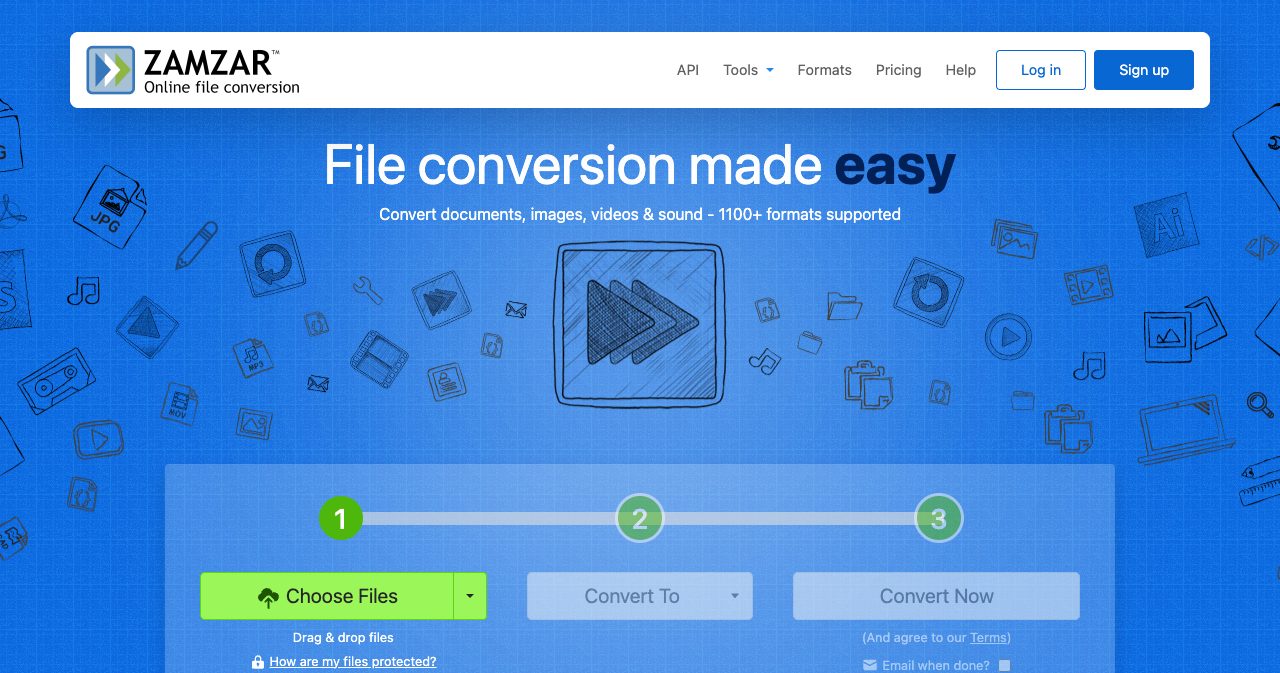
The headline figure comes from Zamzar's twentieth-anniversary post, published on 30 October 2026 and signed by both founders: 766,615,348 conversions for more than 550 million people. The brothers launched the site "using dial-up modems and a battered book on writing HTML4," and two decades on they write: "Twenty years on, we're still a small, proudly independent UK company." In the same post they sum up the funding history as "No venture capital, no unicorn valuations." The rest of the record comes from the company's about page, its pricing pages and Companies House.
| Metric | Figure | Source (date) |
|---|---|---|
| Launched | October 2006, on dial-up, from a book on HTML4 | Anniversary post (30 Oct 2026) |
| Starting capital | £1,000 seed money, £10 marketing budget | About page (read 1 Nov 2026) |
| First paying customer | November 2007, 13 months after launch | About page |
| Incorporated | 3 January 2008, Zamzar Limited, no. 06463494 | Companies House |
| Conversion types | About 150 at launch, 2,128 in 2026 | Anniversary post |
| Files converted | 300 million by Oct 2016, 766,615,348 by Oct 2026 | 2016 post, anniversary post |
| Users | More than 550 million since launch | Anniversary post |
| API | Launched Jan 2015; 50 million files and 1 million+ requests a day by Mar 2026 | About page |
| Team | Eight people; first contractor hired in 2012 | About page |
| Outside money | No venture capital, no acquisition | About page |
| Giving | 2% of monthly profits to charity since Nov 2011 | About page |
The anniversary post also has the kind of detail you only get from twenty years of server logs. In the past year Zamzar had one visitor from Tokelau (population 1,499), three from Svalbard, 38 from Antarctica and 41 from the Vatican. It helped the inventor of PowerPoint recover long-lost presentations, supported Vint Cerf's work on preserving digital history, partnered with Xerox, appeared on BBC Click, sponsored a team of Scottish curling champions, and received a cease-and-desist from Google (more on that in the risks section).
The founders' CVs explain the product. Chris Whyley was a web developer and software test engineer at IBM. Mike Whyley worked in project management and software engineering for EMI, Universal Music and Marks & Spencer. So you had a tester and someone who delivers projects, which covers most of what a utility needs: the file has to come out right, and the thing has to ship.
The name comes from Kafka. Chris read The Metamorphosis at school, and the team took the surname of its hero, Gregor Samsa, changed a few letters and ended up with a word that had no dictionary meaning and a free .com, according to a 2019 post on how they chose it. The names that lost were Konvertieren, Khamailen (a nod to the chameleon mascot) and Obrogo.
How does Zamzar make money?
Zamzar makes money from two separate price ladders: flat monthly subscriptions for people who convert files by hand, and metered API credits for software that converts files automatically. A free tier capped at two files every 24 hours feeds both. Zamzar doesn't publish revenue, so all anyone outside can examine is how the pricing is built.
Ladder one: subscriptions for people
These are the web plans as listed on Zamzar's signup page and FAQ on 1 November 2026, in US dollars:
| Plan | Per month | Max file size | Storage | Website conversions | Desktop conversions a day |
|---|---|---|---|---|---|
| Free | $0 | 50 MB | Files kept 24 hours | 2 per 24 hours | 25 files in total |
| Basic | $12 | 200 MB | 5 GB | Unlimited | 50 |
| Pro | $19 | 400 MB | 20 GB | Unlimited | 100 |
| Business | $39 | 2 GB | 100 GB | Unlimited | 500 |
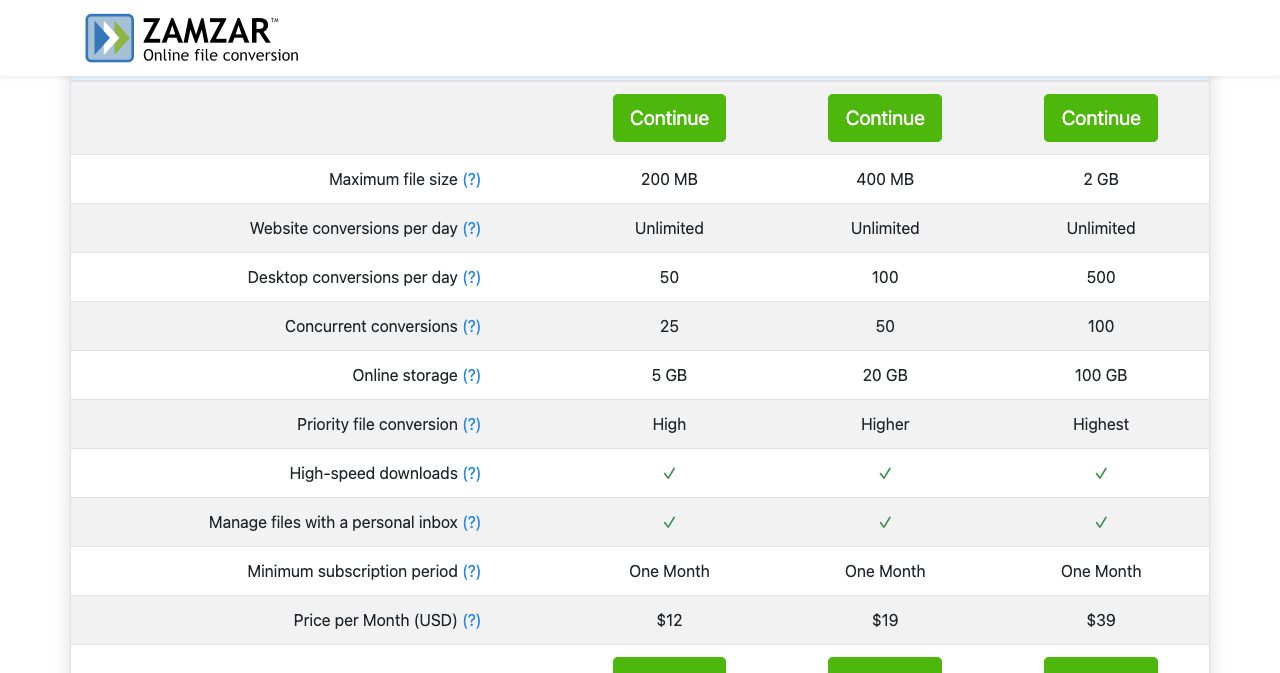
Every paid plan includes unlimited website conversions, so nobody moves from Basic to Business because they ran out. People upgrade when a file is too big (200 MB against 2 GB), when they need to run more at once (25 concurrent conversions against 100), or when they need somewhere to keep the results. In other words, the price follows the size of the job. The minimum term is one month, and new paid accounts get a 7-day money-back guarantee, or 30 days on annual plans.
Ladder two: credits for software
The API figures come from the developer pricing page on 1 November 2026:
| Plan | Per month | Credits | Per credit, and overage | Max file size |
|---|---|---|---|---|
| Test | Free, no card | 100 | n/a | 1 MB |
| Startup | $25 | 500 | $0.05 | 50 MB |
| Growth | $99 | 2,500 | $0.04 | Unlimited |
| Scale | $299 | 10,000 | $0.03 | Unlimited |
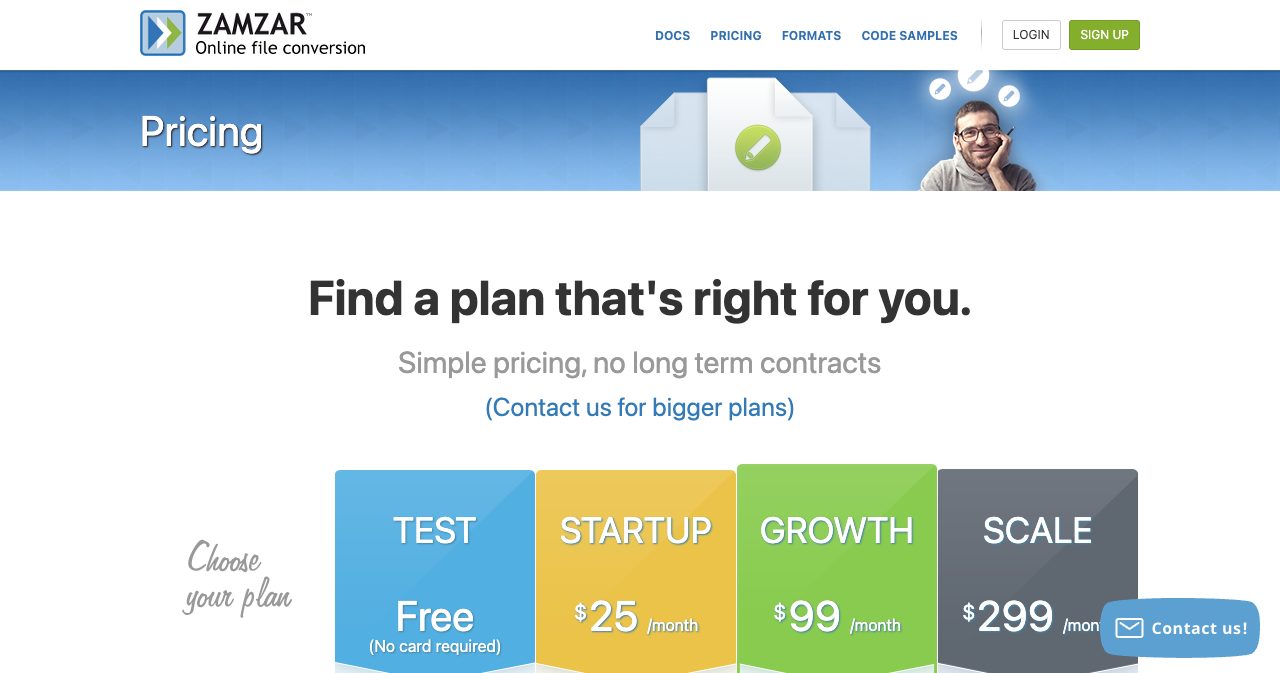
A credit isn't the same as a file. Every successful conversion costs at least one credit, and heavier ones cost more: DOCX to PDF and PDF to DOCX are 2 credits each and MP4 to MP3 is 1, per the formats list. Each extra 50 MB of input past the first 50 MB adds credits on top. Overage is billed at the plan's own rate, so going over your allowance costs the same per credit as staying inside it.
Why two ladders beat one
The same engine sells at very different prices depending on who's buying. A Business subscriber paying $39 a month can run 500 desktop conversions a day, roughly 15,000 a month. A developer who wants 10,000 conversions through the API pays $299. The developer is paying for automation, and Zamzar charges a pipeline far more than a person clicking through a desktop app. The split holds because the two buyers want different things. Developers expect metering and will pay for uptime and support, while people at a desk want a flat fee they can stop thinking about.
Zamzar's growth curve: 300 million files, then 466 million
Zamzar's growth has been slow and steady: about 300 million files in its first ten years and about 466 million in its second, so the second decade came in at roughly 1.55 times the first. That's single-digit compounding, far from the hockey stick a venture-backed pitch deck needs.
Both data points are Zamzar's own. Its ten-year post on 30 October 2016 reported more than 300 million files converted and called Zamzar "a bootstrapped and profitable web business for 10 years now." The anniversary post on 30 October 2026 reported 766,615,348. Take one from the other and you get 466,615,348 files for 2016 to 2026.
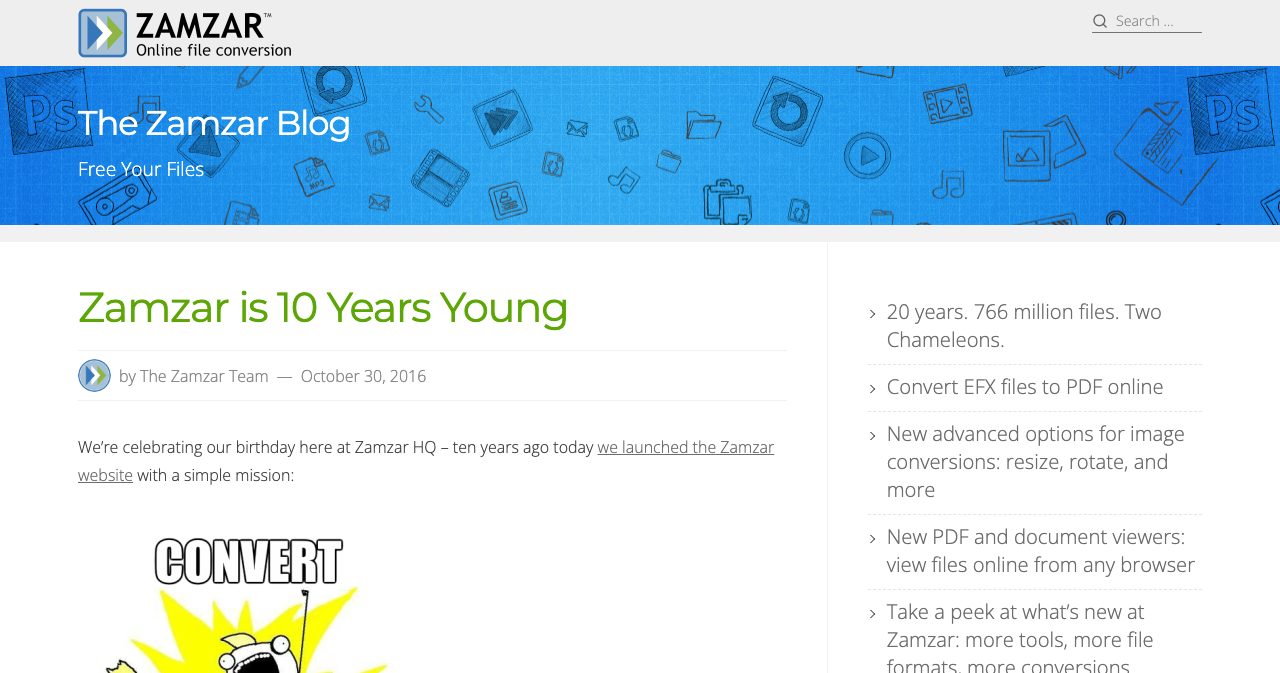
Here are our calculations from those two milestones:
| Period | Files converted | Average per day | Average per second |
|---|---|---|---|
| Oct 2006 to Oct 2016 | About 300 million | About 82,100 | 0.95 |
| Oct 2016 to Oct 2026 | About 466.6 million | About 127,800 | 1.48 |
| All 20 years | 766.6 million | About 104,900 | 1.21 |
If yearly volume grew at a steady rate, a second decade 1.555 times the size of the first works out to about 4.5% growth a year. Treat that as a rough figure. Real years are lumpy, and the API (2015) and the desktop app (2021) both arrived in the second decade. Still, the shape is clear, and nobody raising a Series A would put this chart on a slide. Keep in mind that these are file counts. Revenue could have grown faster or slower than volume, and outsiders can't tell which.
Two other ratios tell you more than the curve does. The first is time to revenue, which was 13 months. Zamzar launched in October 2006 and signed its first paying customer in November 2007. Companies House shows Zamzar Limited was incorporated on 3 January 2008, about two months after that first payment, with both brothers appointed directors a week later.
The second is the size of the catalog. Zamzar supported about 150 conversion types at launch and 2,128 in 2026, about 14 times as many (the company rounds it to "almost 15x"). File volume grew 1.55x from one decade to the next while the menu grew 14x over twenty years, and each new conversion type is one more thing someone can search for. Counting all those things is where the record gets messy.
Why Zamzar's own numbers don't match
Zamzar's public numbers differ from page to page because a twenty-year-old site gathers its stats at different times, in different units, on pages written years apart. Nothing here points to anything worse than that, but you should know it before you quote any of them.
| Page (read 1 Nov 2026) | Files converted | Formats or conversion types | Other |
|---|---|---|---|
| Anniversary post | 766,615,348 | 2,128 conversion types | More than 60 charities |
| About page, numbers block | 760+ million | 200+ formats, 2,500 file tools | 80 charities |
| About page, timeline entry for 30 Oct 2026 | 762 million | ||
| Homepage | 1,100+ formats in the header, 1,200+ lower down | ||
| Developer about page | 510 million, from 250 million users | "1000's" of formats | |
| PDF to DOCX page | 760 million | Free file cap of 3 MB (50 MB elsewhere) |
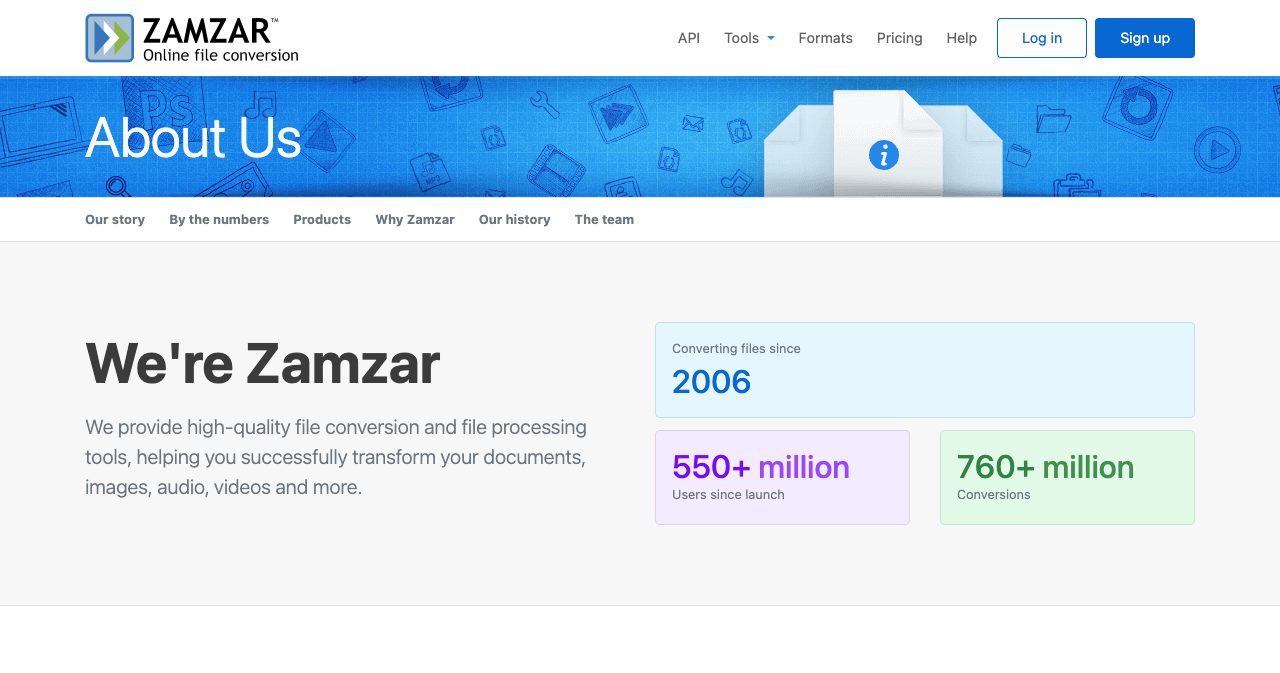
Formats and conversion types are different units, since 200 formats can combine into thousands of from-to pairs, and "tools" adds things like compression and transcription. The file counts are snapshots from different dates, and the 3 MB cap may be a rule for that one conversion. Big headline numbers still drew doubt on launch weekend.
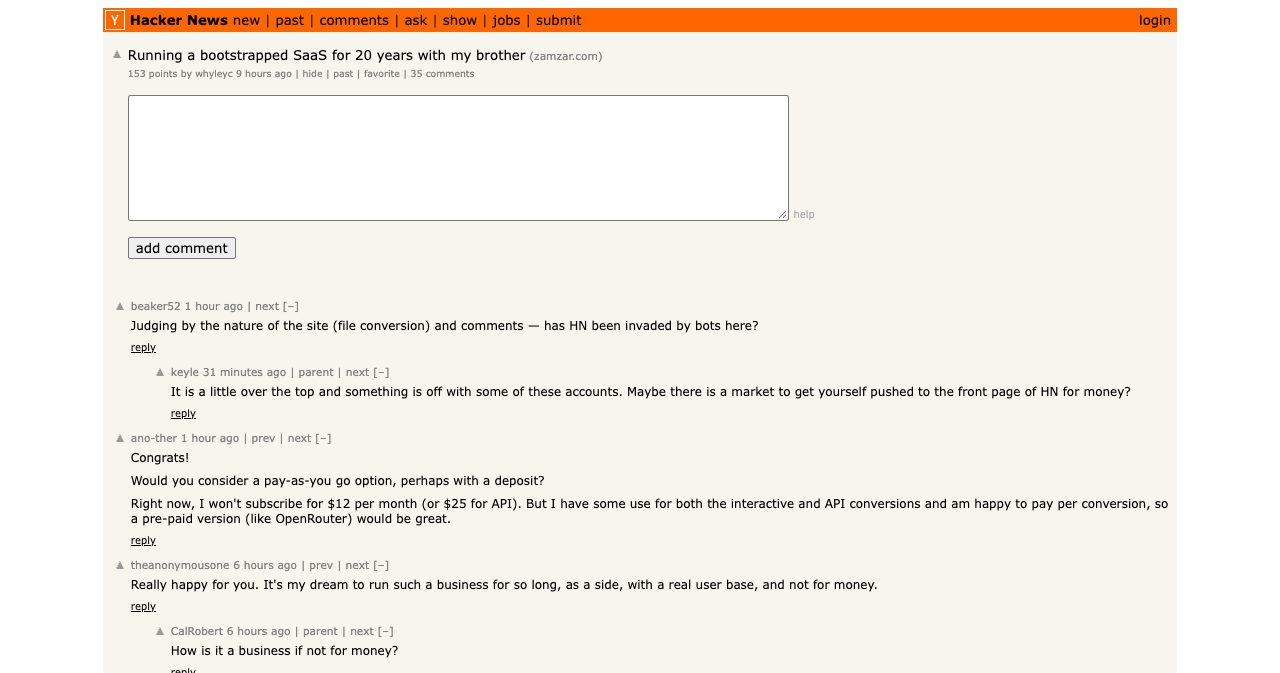
The Hacker News thread for the anniversary post, "Running a bootstrapped SaaS for 20 years with my brother", was submitted on 30 October 2026 and reached 153 points and 35 comments. One of the first skeptical comments questioned the 550 million users against a $12 minimum price. Another reader replied that a free tier plus a paid API explains a big user count with a small paying share. A third pointed out that each API file can generate several requests (upload, status checks, download), which is why request counts run far ahead of file counts. Someone else asked whether HN had been "invaded by bots," and a reply agreed that some of the accounts seemed off.
The lesson for younger companies is cheap to act on: keep one source of truth for your public metrics and update every page from it. AI assistants quote whichever number they find first, and if your pages disagree with each other, the answers about you will disagree too.
Can you run a SaaS for 20 years without venture capital?
Yes, and Zamzar is the proof: twenty years bootstrapped, meaning funded only by its own revenue, with no venture capital, no acquisition and eight people, still run by its founders. Wider survey data says bootstrapped SaaS companies grow a little slower than funded ones and are far more likely to make money.
SaaS Capital's spending benchmarks, published on 10 June 2026, come from its 15th annual survey of more than 1,000 private B2B SaaS companies, completed in March 2026. They found:
- 17% of bootstrapped companies operate at a loss, against 48% of equity-backed ones.
- 83% of bootstrapped companies are profitable or within two points of breakeven, against 52%.
- Equity-backed companies spend 70% more on sales and 100% more on marketing.
The same survey's growth benchmarks put median growth at 20% for bootstrapped companies, down from 23% in 2024, and 25% for equity-backed ones.
So outside money buys about five points of median growth, and the funded group is nearly three times as likely to be losing money (48% against 17%). A company that launched on a £10 marketing budget had little obvious use for a big sales and marketing line. Zamzar's 2016 post says investors courted the company several times and it never took their money, and the about page today says it's "saying no to outside funding."
As far as the public record shows, it worked because everything stayed small. The company started on £1,000 of seed money, and a first product today can cost even less (our $0 developer toolkit lists the free tiers that cover hosting, auth and email). The founders waited 13 months for the first payment. They hired their first contractor in 2012, six years in, and still had only eight people in 2026. And from November 2011 the company was making enough to give 2% of its monthly profits to charity.
The trade-off came up in the HN thread too. One reader wrote that it was their dream "to run such a business for so long, as a side, with a real user base, and not for money." The reply came straight back: "How is it a business if not for money?" Both have a point. A bootstrapped utility has to make money every month, but nobody expects it to return ten times that money to an investor.
Zamzar vs CloudConvert vs ConvertAPI: what 10,000 conversions a month costs
At 10,000 simple conversions a month, Zamzar's API costs $299, about four times CloudConvert's roughly $74 before VAT and fifteen times the $19.99 a third-party listing gives for Cloudmersive. Only ConvertAPI costs more, at around $390, and only if you stretch its 5,000-conversion plan with overage. A twenty-year-old company charging near the top of the market tells you a lot about how it competes.
| Service | 10,000 simple conversions a month | 10,000 Office-to-PDF a month | What you pay for | Source (date) |
|---|---|---|---|---|
| Zamzar API | $299 (Scale, 10,000 credits) | About $599 (2 credits each: $299 plus 10,000 overage credits at $0.03) | Credit, plus extra per 50 MB over the first 50 MB | Zamzar pricing and formats pages (1 Nov 2026) |
| CloudConvert | About $74 before VAT (10,000-credit subscription) | $131 to $168 before VAT (20,000 credits sits between the 19,000 and 25,000 tiers) | Credit, plus one per extra minute of processing | sitepdf.com (read 22 Sep 2026); CloudConvert pricing (1 Nov 2026) |
| ConvertAPI | About $390 on Startup (about $90 for 5,000, plus about $0.06 for each of 5,000 more), or the 15,000-conversion Growth plan | Same, if each counts as one conversion | Conversion | DEV Community (22 Jun 2025); ConvertAPI prices page (1 Nov 2026) |
| Cloudmersive | $19.99 (Basic, 10,000 calls) | $49.99 to $99.99, if each PDF takes 2 to 5 calls | API call | apis.io (generated 5 May 2026); DEV Community (22 Jun 2025) |
Where each number comes from:
- CloudConvert's pricing page uses a slider and shows prices with local VAT. From our location on 1 November 2026, 1,000 subscription credits cost $11.07 a month including 23% VAT (about $9 before VAT), and one-time packages started at $20.91. sitepdf.com's read of the page on 22 September 2026 listed 10,000 subscription credits at $74 a month before VAT, with 19,000 at $131 and 25,000 at $168. CloudConvert charges 1 credit for a general conversion, 2 for Office to PDF and 4 for PDF to Office, and free accounts get 10 credits a day.
- ConvertAPI's prices page lists Developer, Startup, Growth and Business plans at 1,000, 5,000, 15,000 and 50,000 conversions a month, 250 free conversions at signup and two months free on yearly billing, but it only showed us prices in local currency. A DEV Community comparison from 22 June 2025 put Developer at about $35 and Startup at about $90, with extra conversions at about $0.06 each.
- Cloudmersive's own pricing page lists plan types without prices. apis.io lists Basic at $19.99 a month for 10,000 calls, Business at $49.99 for 25,000 and Business Premier at $99.99 for 50,000, and marks its own figures as not verified against the provider. The DEV Community author estimated one PDF conversion at 2 to 5 Cloudmersive calls.
So why would anyone pay Zamzar $0.03 a credit when CloudConvert's large subscription comes in under a cent? You get 2,128 conversion types, a vendor that has been around for twenty years, support response times written into the plan (one day on Scale) and custom conversions on Scale. Zamzar prices near the top of the market, and twenty years of independence is its case for doing so.
The weak spot shows up in the HN thread, where one reader wrote: "Right now, I won't subscribe for $12 per month (or $25 for API)." They asked for a prepaid option "like OpenRouter" instead. CloudConvert already sells exactly that, as one-time packages whose credits never expire.
Why do file converters still exist now that AI can read any file?
File converters still exist because reading a file and converting one are different jobs. A frontier model reads a PDF to answer questions about it. A converter takes a file in and hands back a different file, the same way every time, at a fixed price per file. Zamzar's own timeline shows AI products turning into its customers.
Anthropic's PDF support documentation says each PDF page typically uses 1,500 to 3,000 tokens, and a request can hold up to 600 pages (100 when the context window is under a million tokens). So a 100-page contract costs 150,000 to 300,000 input tokens before the model writes a word back. That's worth paying if you want a summary. If you want the same contract as a DOCX, Zamzar's API charges 2 credits, or 6 to 10 cents depending on your plan. Plenty of conversions have nothing to do with text anyway: a 2 GB video into another container, an EPUB into a PDF, a CAD drawing into something a client can open.
Zamzar's timeline shows it moving toward AI rather than away from it:
- September 2024: AI transcription for audio and video. A post from 6 September 2024 explains that the speech-to-text tool uses automatic speech recognition improved with AI and machine learning.
- September 2025: consumer AI document-generation tools start running on Zamzar's API.
- March 2026: the API passes 50 million customer files processed and more than a million requests a day.
Our reading is that the conversion layer ended up underneath AI products instead of being replaced by them. An AI tool that writes a slide deck or a report still has to hand the user a real PPTX or PDF at the end, and buying that step for a few cents is cheaper than building and maintaining it.
The HN thread shows the same thing from the user's side. One commenter had used Zamzar that day for an MP3-to-text conversion, which is transcription, an AI feature sold under a converter's name. Another said they use it often for EPUB to PDF and find it better than Pandoc. Someone asked how revenue had changed in the AI era, and nobody from the company answered in the thread. Others argued over whether most Zamzar users have even heard of Claude.
From outside you can see usage and pricing but not revenue. Zamzar Limited files small-company "total exemption full accounts" at Companies House, the latest made up to 30 June 2026 and filed on 6 October 2026, and the company doesn't publish revenue anywhere we could find.
What a 20-year-old SaaS has that a 20-month-old one doesn't
A twenty-year-old utility owns things money can't buy in a hurry: thousands of indexed pages for exact searches, a huge pile of reviews, press from another era and a short brand name on a .com. The conversion engine is the easy part to copy. The surface around it took two decades to build.
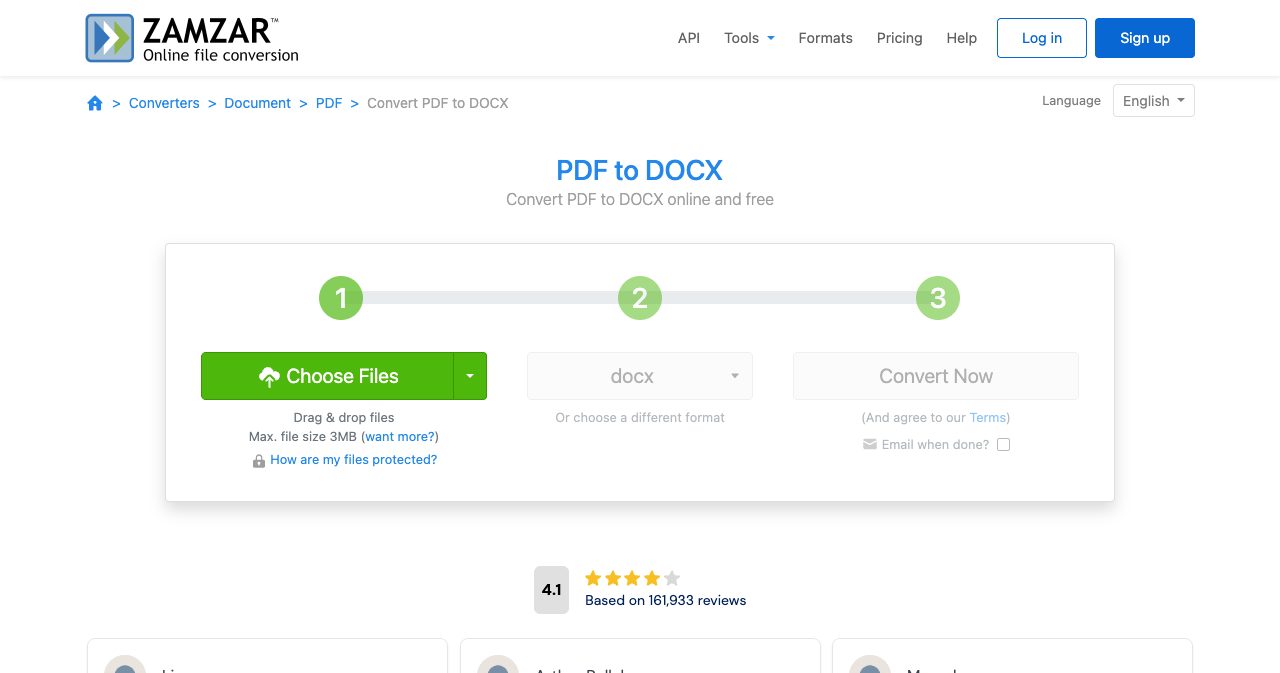
Take the PDF to DOCX page. The breadcrumb runs Converters, Document, PDF, Convert PDF to DOCX. A working three-step converter sits at the top, and further down there are about 50 links to other "convert from PDF" pages and about 50 to other "convert to DOCX" pages. When we opened it on 1 November 2026 it showed a 4.1 rating from 161,933 reviews. The converters index lists 158 format pages across seven categories: document, image, audio, video, eBook, archive and 3D. Repeat that pattern across 2,128 conversion types and you have a site that answers thousands of exact searches, each with a page built for it.
Then there's trust you can't backfill. Zamzar was named in the Guardian's top 100 sites on the internet two years running, in 2008 and 2009. It has appeared on BBC Click. Its plans page quotes Lifehacker and WIRED, its homepage shows BBC, Princeton, Netflix and Discovery logos, and its developer site carries a testimonial from Robert Gaskins, the inventor of PowerPoint.
Here's where a directory like SaaSCity fits, and where it doesn't. We give a new product its first week of attention: a listing page, a building on the map, a launch slot. That first week matters, since Zamzar's first visitors had to come from somewhere too. A decade of pages that people found on their own is something no directory can sell you, and that includes us.
How to build a boring utility SaaS that lasts: 8 steps
To build a boring utility SaaS that lasts, pick one repeated job people search for by name, give a capped free version away early, build a page for every variant of the job, and sell it two ways: flat plans for people and metered credits for software. Here's the full sequence, taken from Zamzar's record.
- Pick a job people repeat and search for by name. PDF to DOCX is a search query, a landing page and a product at once. If people can't type the problem into a search box, every customer has to be found some other way, and you pay for that every time.
- Ship the free tool before you build the business. Zamzar launched in October 2006, signed its first paying customer in November 2007 and incorporated in January 2008. Thirteen months of free use showed what people would pay for before there was a company to bill them.
- Give every variant of the job its own page. Zamzar went from about 150 conversion types to 2,128. Each pair gets a page with a working tool, three short steps and links to its neighbors, so each new pair is one more search the site can answer.
- Cap the free tier where heavy users feel it. Two free files every 24 hours and a 50 MB limit cost a casual visitor nothing and stop a daily user quickly, and the daily user is the one who should pay.
- Charge people for convenience and software for volume. People get flat plans with unlimited web conversions at $12, $19 and $39 a month. Developers get metered credits from $0.05 down to $0.03. It is one engine, priced for two kinds of buyer.
- Expand into the next job over, not a new market. Compression (February 2021), a desktop app (November 2021) and AI transcription (September 2024) all sell to someone who already came to convert a file.
- Sell the engine to whoever builds on top. The API launched in January 2015, Xerox picked it in December 2018, and consumer AI document tools started running on it in September 2025. Other companies' products turned into a sales channel.
- Hire late and keep the team as small as the work. Zamzar's first contractor arrived in 2012, six years after launch, and the team is eight people in 2026. The smaller the team, the less revenue it takes to stay profitable without outside money.
If you're still choosing the job, our guide to telling whether a SaaS niche is too small does the customer math before you write code. For another file-heavy corner where this playbook fits, see our look at micro SaaS in video production, where subtitle and frame-extraction tools sell the same kind of repeated job.
What are the real risks in a twenty-year single-category SaaS?
The real risks come from concentration: one job, platforms that can change the rules overnight, AI customers who could build the step themselves, and a price ladder with gaps a competitor can fill. Zamzar's history shows the platform risk has already bitten once.
On 12 June 2012, Zamzar posted that Google had asked it to stop letting users download video files from YouTube, a feature that, as Zamzar put it, appeared to breach YouTube's terms of service. Zamzar stopped immediately and wrote that the decision had been "taken out of our control." Everything else kept running. Any business whose customers arrive through pages a search engine ranks carries the same exposure in a quieter form.
| Risk | Early warning in Zamzar's record | What to do about it |
|---|---|---|
| Platform rules | June 2012: Google's notice ended YouTube downloads overnight | Never make one platform's goodwill a core feature |
| One category | Every product transforms a file in some way | Add adjacent jobs early, as compression and transcription did |
| AI customers going in-house | AI document tools have run on the API since Sept 2025 | Price and support the API so building it in-house isn't worth the effort |
| Gaps in the price ladder | HN reader won't pay $12 a month or $25 for the API; CloudConvert sells credits that never expire | Offer a prepaid or pay-as-you-go option |
| Trust in uploads | An HN commenter called free converters a potential honeypot for private documents | Publish retention rules: Zamzar deletes originals after conversion and keeps free files up to 24 hours |
| Credibility of numbers | The 550 million figure was questioned on HN, and pages disagree | Keep one source of truth for public metrics |
| Key people | Two founder-directors and a team of eight | Write things down, and decide early whether you'd ever sell |
The last row describes a choice Zamzar has made. The company says there's been no acquisition, and two brothers running a company they like for twenty years is a fine outcome. If you want the option to sell, though, it shapes how you build from day one, and our guide to buying and selling codebases covers what buyers look for in a small software business.
What to copy from Zamzar this month
The parts of Zamzar worth copying this month are its habits: a job people search for by name, a free tier with a ceiling, a second price ladder for software, and a team that stayed small for two decades. Its scale, an average of 1.2 files a second for twenty years, is out of reach for most products, and they don't need it.
You can write three of those down this week. What's the one repeated job, in the words your customer types into a search box? Where does your free tier stop? And what's the price per unit when software, not a person, is the buyer? If you can answer all three, you have the outline of something that could still be running in 2046.
When it's ready for its first week, put it where people browse new launches. A free SaaSCity listing gets a page and a building on our live city map, after human editorial review. Add the SaaSCity badge to your site and you get a dofollow backlink from a domain rated DR 70 at our latest Ahrefs refresh (November 1, 2026), plus a Monday launch slot. Quick Pass ($19.99) goes live within 24 hours, Premium ($39.99) adds a written launch post with three dofollow links, and Max ($99.99) adds 30 days of billboard, ticker and homepage pin. After that, the hard part is the same one Zamzar faced in 2006, and our guide to getting your first 100 users is where we'd start.
Zamzar's first decade produced 300 million files and a growth curve no investor would have funded, and the second decade beat it anyway. If you can picture someone in 2036 still typing your product's job into a search box, you're probably building the right kind of boring.
FAQ
How does Zamzar make money?
Zamzar sells two kinds of plans. People who convert files on the website pay $12 (Basic), $19 (Pro) or $39 (Business) a month for unlimited web conversions, bigger file limits and storage, according to its pricing page on 1 November 2026. Developers buy API credits: a free Test plan with 100 credits, then $25 for 500, $99 for 2,500 and $299 for 10,000 credits a month. The website is also free to use for two files every 24 hours, up to 50 MB each. Zamzar does not publish revenue figures.
Who founded Zamzar, and when?
Brothers Chris and Mike Whyley launched Zamzar in October 2006 with £1,000 of seed money and a £10 marketing budget, according to Zamzar's about page. Chris worked as a web developer and software test engineer at IBM. Mike worked in project management and software engineering for EMI, Universal Music and Marks & Spencer. Companies House shows Zamzar Limited (company number 06463494) was incorporated on 3 January 2008, and the company is based in Steyning, West Sussex, UK.
Has Zamzar ever raised venture capital?
No. Zamzar's twentieth-anniversary post of 30 October 2026 describes it as a small, independent UK company with no venture capital, and its about page says there has been no venture capital and no acquisition. The company's ten-year post of 30 October 2016 said it had been bootstrapped and profitable for its whole first decade and had turned down investors several times. It runs on subscription and API revenue with a team of eight.
How many files has Zamzar converted?
Zamzar reported 766,615,348 conversions for more than 550 million users in its anniversary post of 30 October 2026. It reported 300 million files at its tenth anniversary in October 2016, so about 466.6 million came in the second decade, roughly 1.55 times the first. Other Zamzar pages show rounded or older totals, such as 760+ million on the about page and 510 million on the developer site.
How much does the Zamzar API cost?
Zamzar's developer pricing page, checked on 1 November 2026, lists four monthly plans. Test is free with 100 credits and no card required, Startup is $25 for 500 credits, Growth is $99 for 2,500 and Scale is $299 for 10,000. That works out to $0.05, $0.04 and $0.03 per credit, and overage is billed at the same rate. A simple conversion costs one credit, DOCX to PDF costs two, and files over 50 MB cost extra.
Is Zamzar cheaper than CloudConvert or ConvertAPI for 10,000 conversions a month?
No. For simple conversions Zamzar's API costs about four times CloudConvert's: 10,000 credits on its Scale plan cost $299 a month on 1 November 2026. CloudConvert's 10,000-credit subscription cost about $74 a month before VAT in sitepdf.com's 22 September 2026 read. A June 2025 DEV Community comparison put ConvertAPI's 5,000-conversion plan at about $90 plus about $0.06 per extra conversion, and apis.io lists Cloudmersive at $19.99 for 10,000 calls.
Why do file converters still exist if AI models can read PDFs?
Because reading a file and converting it are different jobs. Anthropic's PDF support documentation says a page typically uses 1,500 to 3,000 tokens, so a 100-page PDF costs 150,000 to 300,000 input tokens just to read. A converter returns a new file in another format at a fixed price per file, such as $0.03 to $0.05 per Zamzar API credit. Zamzar says consumer AI document tools started running on its API in September 2025.
Can you run a SaaS for 20 years without venture capital?
Yes. Zamzar reached its twentieth year on 30 October 2026 with no outside funding and a team of eight. Survey data supports the model: SaaS Capital's June 2026 benchmarks, drawn from more than 1,000 private B2B SaaS companies, found 17% of bootstrapped companies operate at a loss against 48% of equity-backed ones. Bootstrapped companies grew at a 20% median against 25% for funded ones, so they trade a little growth for much better odds of profit.
What are the risks of a single-category SaaS like Zamzar?
The main risks are platform rules, concentration and pricing gaps. In June 2012 Google asked Zamzar to stop offering YouTube video downloads, and Zamzar ended the feature immediately. A converter relies on search for traffic and, since September 2025, partly on AI products that use its API and could build the step themselves. On Hacker News on 1 November 2026, one reader said they would not pay $12 a month and asked for prepaid credits, which CloudConvert already sells.
Why do Zamzar's statistics differ between its pages?
Because the pages were written at different times and count different things. On 1 November 2026, Zamzar's anniversary post said 766,615,348 conversions and 2,128 conversion types, the about page said 760+ million conversions, 200+ formats and 2,500 tools, the homepage said 1,100+ formats, and the developer site still said 510 million files. Formats, conversion pairs and tools are separate units, and the totals are snapshots taken years apart.
Where does the name Zamzar come from?
From Franz Kafka's novella The Metamorphosis. A Zamzar blog post from 12 July 2019 explains that co-founder Chris Whyley read it at school, and the team took the surname of its main character, Gregor Samsa, because it stands for change and transformation. They altered a few letters to get Zamzar, a new word that made the .com domain easy to register. The other shortlisted names were Konvertieren, Khamailen and Obrogo.
What can a new SaaS founder copy from Zamzar?
Four habits. Pick one job people search for by name, like PDF to DOCX, and build a page for every variant of it. Give a capped free version away early: Zamzar launched in October 2006 and signed its first paying customer in November 2007. Sell the same engine two ways, with flat plans for people ($12 to $39 a month) and metered credits for software ($0.03 to $0.05). And hire late: Zamzar's first contractor came in 2012.
Get your SaaS in front of founders
List your product on SaaSCity - a permanent listing, real discovery, and a dofollow backlink from a high-DR directory. Free with a badge; upgrade for a building on the live city map.