News
Google Search Just Fell Below Half of Alphabet's Revenue (2026)
For the first time since Alphabet started breaking the number out, Google Search just slipped under half the company's revenue. Search didn't shrink, it grew 12%, but Cloud grew 103% and ate the spotlight. If you're a SaaS founder who still treats organic Google traffic as a free, stable channel, this is your reminder to build somewhere that can't change its mind about you in one earnings call, which is exactly the kind of insurance SaaSCity sells for free.

Contents (5)
Here's the sentence that should make you put your coffee down: the company whose ten blue links probably send you more customers than any other channel just told Wall Street, on the record, that those links are no longer its growth story.
Quick answer: Alphabet's Q3 2026 earnings, reported October 28, 2026, show Google Search and other revenue at $63.350 billion, 49.7% of total revenue of $127.577 billion. That's the first quarter on record below half. Search still grew 12% year over year; Google Cloud grew 103%, to $30.709 billion, which is why the mix flipped.
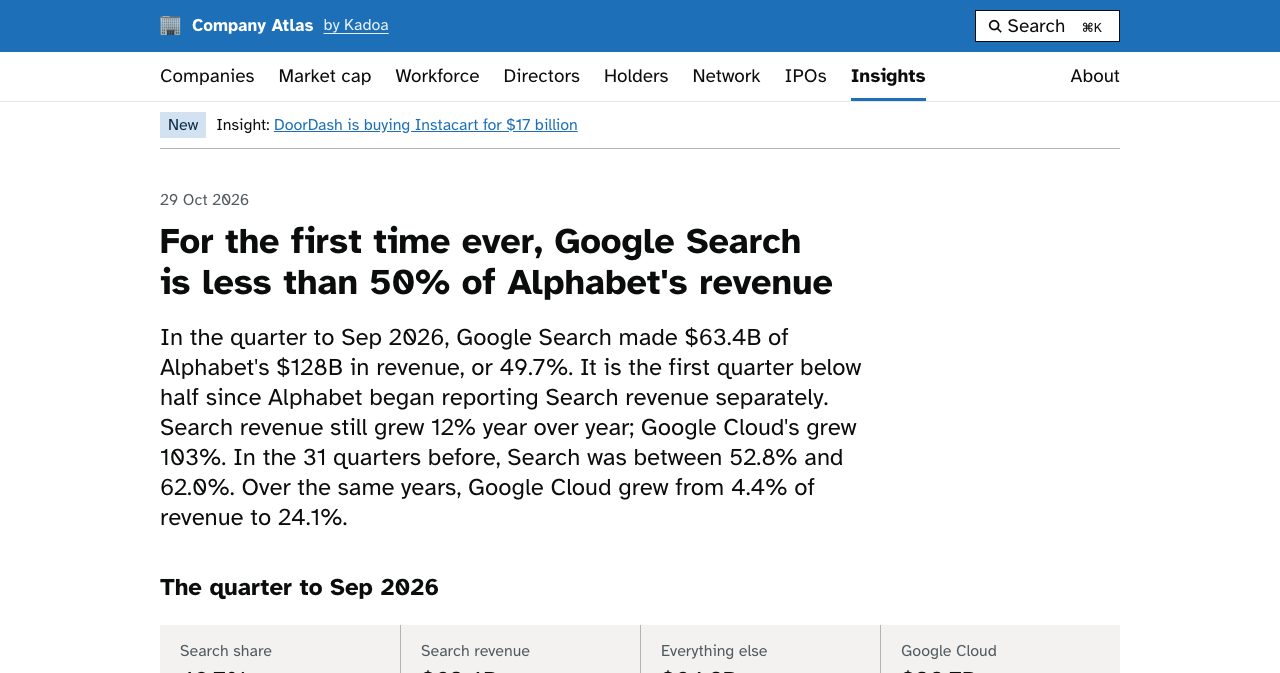
Alphabet's Q3 2026 earnings, filed with the SEC as Exhibit 99.1 on October 28, 2026, put "Google Search & other" at $63.350 billion against total revenue of $127.577 billion. Do the division and you get 49.7%. That's the first time since Alphabet started disclosing Search revenue as its own line that the segment has dropped under half the company. For 31 straight quarters before this one, Search sat somewhere between 52.8% and 62.0% of revenue, according to the Company Atlas analysis published October 29, 2026, which first flagged how unusual the 49.7% print is against that run.
You are reading this on a directory's blog. SaaSCity runs a gamified startup directory with a live city map and human editorial review, and we have an obvious stake in anyone whose growth plan depends on one channel outgrowing that dependency. That doesn't make the numbers below less real. It just means you should know who's talking before you decide how much weight to give the argument.
What actually happened to Search
Search didn't fall. Search revenue rose from $56.567 billion to $63.350 billion year over year, a 12% increase, and Sundar Pichai said in the same earnings release that year-over-year query growth is running at its highest rate in five years. Nobody at Alphabet described Search as struggling.
What's slowing is the rate of growth, not the number. Search grew 19% in Q1 2026, 17% in Q2, and 12% in Q3: a clean deceleration across three quarters. And the Q3 figure landed under the roughly $65 billion analysts had modeled, per StockTitan's October 28, 2026 write-up. A segment can grow by double digits and still disappoint the market, if the market had priced in more. That's exactly what happened here.
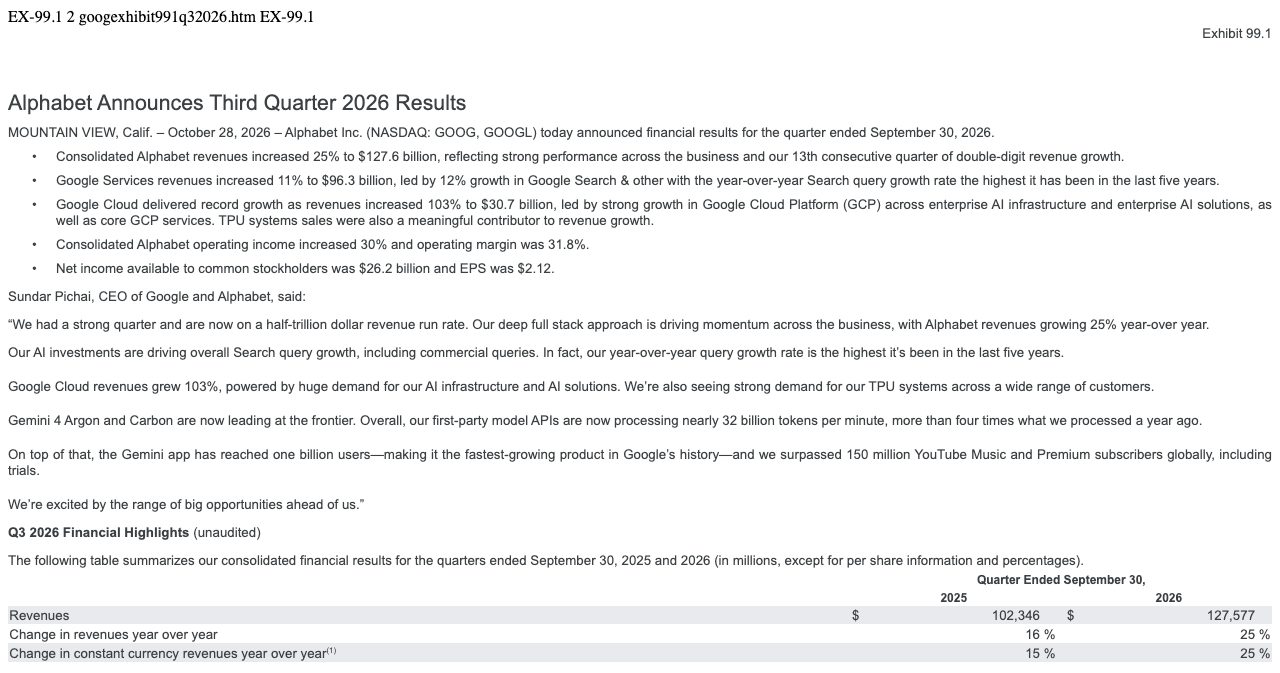
Meanwhile Cloud did the opposite of decelerate. Google Cloud revenue went from $15.157 billion to $30.709 billion, up 103% year over year, with operating income around $11.1 billion and a backlog Alphabet disclosed at roughly $561 billion. StockTitan's analysis calculated that Cloud alone accounted for about 62% of every new dollar Alphabet added in the quarter. Search is still the biggest single segment in absolute terms. It just isn't where the growth is coming from anymore, and growth is what a stock price actually trades on.
The rest of the quarter, in one table
Alphabet's Q3 2026 quarter, ended September 30, 2026, posted 25% total revenue growth, a 103% jump in Cloud, and a miss on adjusted earnings per share, all in the same release. Reading a single ratio out of that release without the surrounding numbers is how misleading headlines get made, so here's the full picture from the SEC filing and CNBC's coverage of the same release, October 28, 2026.
| Metric | Q3 2026 | Change YoY |
|---|---|---|
| Total revenue | $127.577B | +25% (13th straight quarter of double-digit growth) |
| Google Search & other | $63.350B | +12% |
| Google Cloud | $30.709B | +103% |
| YouTube ads | $11.207B | +9% |
| Google Network | $7.455B | +1% |
| Subscriptions, platforms, devices | $14.290B | +11% |
| Operating income | $40.58B | +30% (31.8% margin) |
| Net income | $26.2B | GAAP diluted EPS $2.12 vs $2.87 a year earlier |
| Adjusted EPS | $2.67 | vs $3.02 expected |
| Capex | $51.36B | vs $23.95B a year earlier |
| Free cash flow | -$9.1B | — |
Pichai's own framing on the call was that Alphabet is now running at a "half-trillion dollar revenue run rate." That's true, and it's also the kind of line a CEO reaches for when the quarter's internals are messier than the headline growth number suggests. Full-year 2026 capex guidance sits at $195-205 billion, long-term debt went from $21.6 billion to $125.1 billion year over year, and the company is sitting on $265.1 billion in cash and marketable securities while still paying a $0.22 quarterly dividend. An $8.2-8.7 billion hit to other income, mostly an unrealized markdown on Alphabet's stake in SpaceX, didn't help the net income line either.
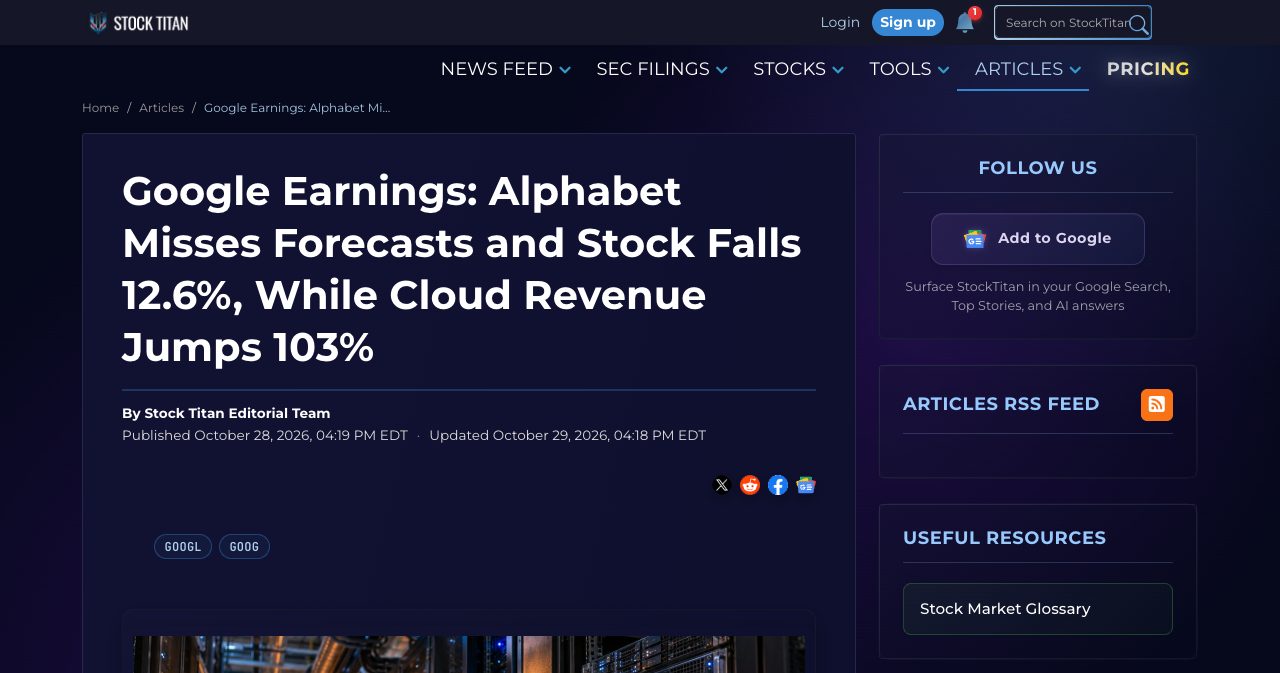
On the AI side: Gemini's app passed 1 billion monthly active users, first-party models now process close to 32 billion tokens per minute (up roughly 40% quarter over quarter), and Alphabet is positioning Gemini 4 Argon and Gemini 4 Carbon as frontier models. That's a lot of infrastructure spend chasing a lot of usage growth, and Wall Street's verdict on October 29 was that the spend is outrunning the proof. The stock fell about 12.6-13%, per both CNBC and Fortune's October 28, 2026 piece on cash flow staying deep red. That's Alphabet's worst single trading day since its 2004 IPO, erasing close to $500 billion in market value in one session, a drop Motley Fool detailed via Yahoo Finance on October 29, 2026.
Why this matters if your growth plan starts with "rank on Google"
It matters because Alphabet just told its own shareholders where its growth is coming from, and it isn't the search results page your SaaS depends on. That should change how you plan the next two quarters, not just how you feel about one earnings call.
Alphabet just told its shareholders, in the clearest way a public company can, where its engineering and product attention is going: Cloud, Gemini, AI infrastructure. Search is the mature, cash-generating base that funds the bet, not the bet itself. That's a completely rational allocation of capital for Alphabet. It also means the surface most SaaS founders built their entire top of funnel on is, by the company's own numbers, no longer getting the marginal dollar.
The practical version: an under-invested channel doesn't get worse overnight, it gets more crowded and more monetized, one quarter at a time.
Three concrete consequences follow from that, and none of them require you to believe search is dying.
The ten blue links get less love, not more competition for your attention. When a product team's growth is coming from Cloud and AI surfaces, the search results page itself becomes a mature asset to be optimized for monetization, not reinvented for user delight. That's consistent with what founders have already been reporting: AI Overviews and assistant answers sitting on top of organic results, eating clicks before a user ever scrolls to position one. We've covered the mechanics of that shift and the September 2026 antitrust filings that touch on it in the OpenAI, Microsoft and Google-zero problem for SaaS, which is the other half of this story.
A $195-205 billion capex year and negative $9.1 billion free cash flow mean monetization pressure goes up, not down. Alphabet isn't going to spend that much on Cloud and AI infrastructure and then leave Search revenue flat out of politeness. Expect more ad density, more AI-answer real estate, more surfaces where a paid placement sits between a searcher and your organic listing. None of that is new behavior from Google. It's just a company under more financial pressure to lean into it.
The click is migrating, and migration is a distribution problem, not an SEO problem. You can't out-optimize a platform's decision to answer the query itself instead of sending the user to you. That's why founders are spending more time thinking about where SaaS products get discovered outside Google entirely: communities, directories, integrations, newsletters, anything that doesn't route every single new customer through one company's results page.
None of this means stop doing SEO. Search queries are at a five-year growth high, per Pichai's own comment in the release, so people are searching more, not less. It means stop treating Google as a free, stable, infinite channel that needs no backup plan. It's a mature, brutally competitive channel owned by a company that just told you, in a legally mandated public filing, where its growth priorities actually are.
What to actually do about it, this quarter
Diversify your acquisition so organic Google traffic is one leg of several, not the only one holding up the business. That's the arithmetic, not a guru take. If organic traffic is one leg of a three- or four-legged distribution stool, a quarter like this one doesn't break your business. If it's the only leg, a quarter like this one should scare you a little, and it should move you to action faster than a blog post ever will.
Start with backlinks and directories you don't have to re-earn every algorithm update. A link on a page you don't own still beats a ranking you don't own, because the link persists independently of how any single search engine decides to weight your domain this month. Our guide to actually increasing Domain Rating walks through which links move that number and which don't.
Build an audience channel Google can't touch. Email list, a community, a Discord, anything where you hold the relationship directly instead of renting it from a results page. And pay attention to the platforms that are consolidating as distribution surfaces in their own right. We covered how that's playing out with Reddit's RSS and public API shutdown and with Google's own connected-apps platform push, both of which are the same story from different angles: the open web is getting fenced, one API at a time, and owned channels are the fence you build yourself.
And if you're listing your product anywhere for backlinks and discovery, do it on indexed pages with real dofollow links, not volume spam. That's the whole premise of our piece on the actual SEO benefits of directory listings: a handful of indexed, dofollow, trafficked listings beat two hundred submissions to directories nobody crawls. SaaSCity itself is one of those listings. Free tier gets you a page and a spot on the city map; add our badge to your site and the backlink goes dofollow, plus you're booked into the next Monday launch slot. Quick Pass at $19.99 skips the badge requirement and goes live within 24 hours. Premium at $34.99 adds a written launch post with three dofollow links of its own. Our domain sits around DR 47-56 as of the last Ahrefs refresh. Not a DR 92 link, but a real one, and one more brick in a distribution plan that doesn't live or die on a single company's quarterly earnings call.
The honest takeaway
Search isn't dying. Alphabet's own numbers prove that: 12% revenue growth, the highest query growth in five years, a half-trillion-dollar run rate for the whole company. What changed is simpler and arguably more useful for you to know. Search stopped being Alphabet's growth story; Cloud is. And a company that stops treating a channel as its growth engine treats that channel differently: more monetized, less invested in, more crowded with everything that isn't your organic listing.
You don't control Alphabet's capital allocation. You do control how many of your eggs sit in that one basket. Go count them, then go build a channel that's yours.
Get your SaaS in front of founders
List your product on SaaSCity - a permanent listing, real discovery, and a dofollow backlink from a high-DR directory. Free with a badge; upgrade for a building on the live city map.