News
Google Just Put a Submission Form in Front of Search. For SaaS Founders, That's the New SEO (2026)
Google just opened Search and the Gemini app to third-party developers with a form, a review queue, and a category you can't change your mind about later. This is the first real submission funnel into the answer layer, and it works a lot like listing on a directory, except Google is the directory now. We run one of those directories too, so here's the honest read on what it means for a SaaS founder's week.

Contents (9)
- What Google Actually Launched on 28 October 2026
- What a Connected App Actually Is, Underneath the Marketing
- The Category You Pick Once and Can't Undo
- One Global Endpoint, an IP Allowlist, and No 2am Hotfixes
- Being Live Isn't the Same as Being Found
- Four Ways to Get Found, Side by Side
- What This Actually Costs a Small Team
- What to Do This Week
- The Real Shift Here
A search result just grew a button that says "open in app," and if your product isn't registered with Google, that button will never point at you.
Quick answer: The Connected Apps Platform is Google's preview program, launched 28 October 2026, that lets third-party developers plug their products directly into Google Search and the Gemini app through a reviewed developer integration registered in the Google Connected Console. For SaaS founders, it's the first real submission funnel into the answer layer itself, not just the ranking next to it.
Before anything else: this is published on SaaSCity's blog, and SaaSCity is a directory, not Google, so we have no vote in who Google approves. We're flagging this anyway because the instinct behind both products is identical: get your SaaS in front of someone who's already looking, with as little friction between them and "connect" as possible. We'll get to where the two overlap and where they don't.
What Google Actually Launched on 28 October 2026
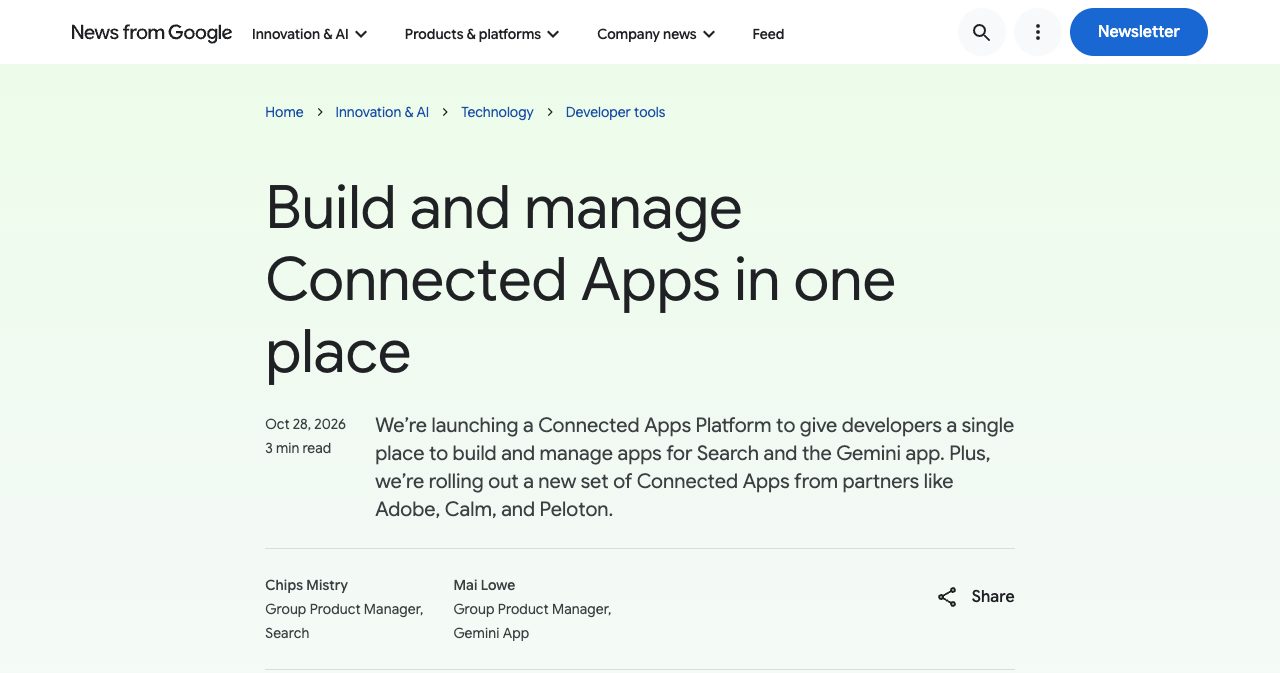
Google's launch gives developers a form, a console, and a review queue for getting a product called from inside Search and Gemini. The announcement came from a Google blog post titled "Build and manage Connected Apps in one place" (28 October 2026), co-written by Chips Mistry, Group Product Manager for Search, and Mai Lowe, Group Product Manager for the Gemini app.
The mechanics: you build a cloud-hosted MCP server, or an Android integration on the AppFunctions APIs, then register, test, and submit it through the new Google Connected Console. Before review, you choose whether the app goes live in Search, the Gemini app, or both. Once it's live, you get a dashboard for traffic, latency, and error rates, plus control over brand identity (verified logos, authenticated accounts) so Google isn't guessing at your logo from a favicon anymore.
Access is opening in phases, aimed at US developers first, with sign-ups through an "Apply for the preview" link at developers.google.com/connected-apps. Scale already exists on one side of this: 9to5Google reported on 28 October 2026 that more than 50 third-party Connected Apps are live inside the Gemini app, naming Adobe, Dropbox, Instacart, OpenTable, and Ticketmaster among them. New partners announced alongside the platform include Calm, launching in both Search and Gemini, with Adobe, Experian, Localiza, and Peloton lined up to reach Search in the coming weeks, per TechCrunch's 28 October 2026 report.
Search tells a much thinner story right now. Google's own help page on Connected Apps in Search lists only a handful of apps (Instacart, Canva, and YouTube Music among them) available in AI Mode, and only in the US in English, with availability varying further by location, language, and device. Fifty-plus in Gemini against a short list in Search tells you exactly where today's demand actually sits: Gemini is the live surface, Search is the one everyone's betting on next.
What a Connected App Actually Is, Underneath the Marketing
A Connected App is, mechanically, your product wearing a Model Context Protocol server that Google's models are allowed to call. MCP is the open standard Anthropic introduced in November 2024 for letting a model call tools over a defined interface, and it's become the plumbing every major assistant platform is standardizing on. Our own guide to the best MCP servers for Claude Code covers the same protocol from the coding-assistant side.
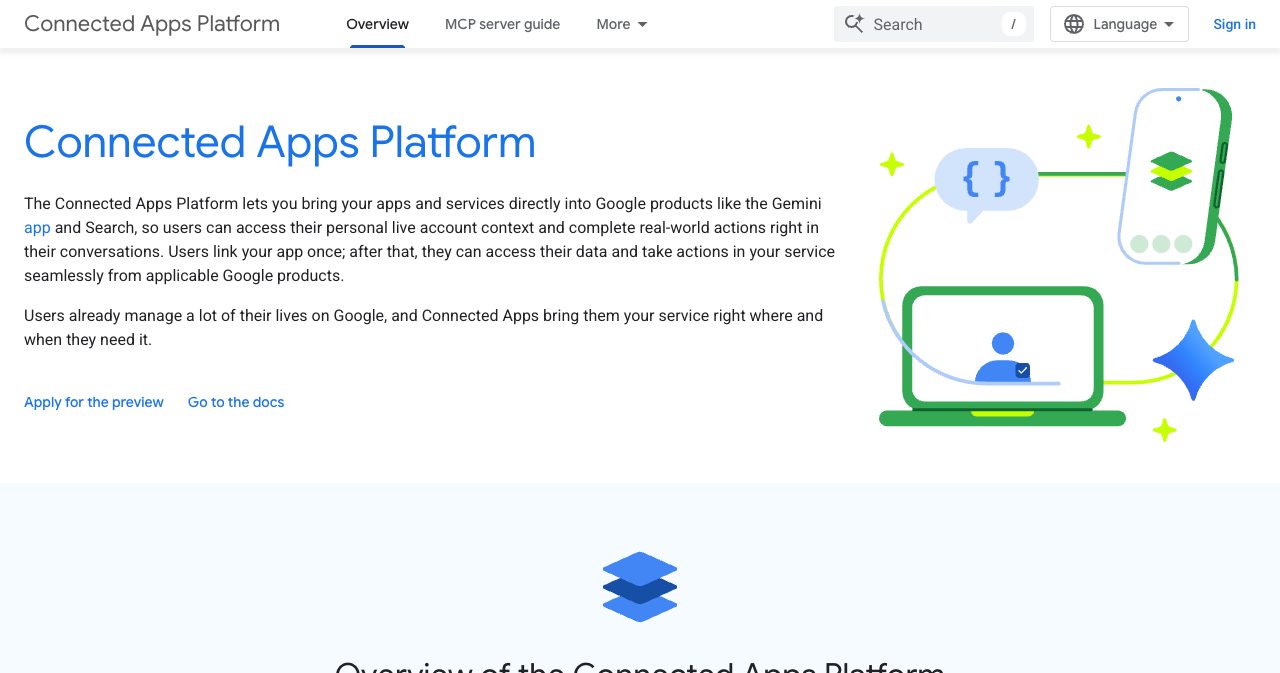
Google isn't the first to run this play. OpenAI already ships connected apps and an apps marketplace inside ChatGPT, which we broke down in our piece on signing in with ChatGPT and the OpenAI app marketplace. The difference is reach: Google's version isn't scoped to one chat window. A single registered server can answer calls from Search and from Gemini at once, which means one engineering decision now feeds two distribution surfaces instead of one.
Before you can submit anything, you test it. Google's developer guide for the MCP server walks through running the server locally with the MCP Inspector first, then deploying it to a public HTTPS endpoint, then testing live tool execution inside Gemini Apps Developer Mode, which comes with an event log, tool-schema viewer, an environment simulator for date, time, and location, and authentication settings. Only after that do you request final review and publishing. It's a staged engineering rollout with a human review gate at the end, not a form you fill in once and forget.
The Category You Pick Once and Can't Undo
The riskiest line item in the Google Connected Console is the category dropdown, because that choice is permanent. Google's own prerequisites documentation, last updated 27 October 2026, spells out what the console asks for: a display name (also used for @mentions inside Gemini), a description under 30 words, a 512x512 icon in JPEG or PNG up to 1MB, at least three high-value capabilities, at least three example prompts (two of which must start with your app name, one of which must mention it naturally), a Terms of Service URL, a Privacy Policy URL, and an optional website.
Your category sets the baseline capability requirements the review process holds you to, and the documentation is blunt about what happens if you guess wrong: a different category means building an entirely new connected app, not editing the existing one. Pick "productivity" when you meant "shopping" and there's no warning before launch, just a rebuild after it.
One Global Endpoint, an IP Allowlist, and No 2am Hotfixes
The engineering catch in all of this is that Google expects exactly one MCP endpoint to represent your product everywhere it operates. The prerequisites page, last updated 27 October 2026, is explicit: your MCP server must be deployed on a secure, publicly reachable HTTPS endpoint using the Streamable HTTP transport (an example given is https://api.yourdomain.com/v1/mcp), and each connected app supports a single global endpoint, so separate data-centre URLs aren't supported. A country-code domain only works if you're genuinely launching in just that one region.
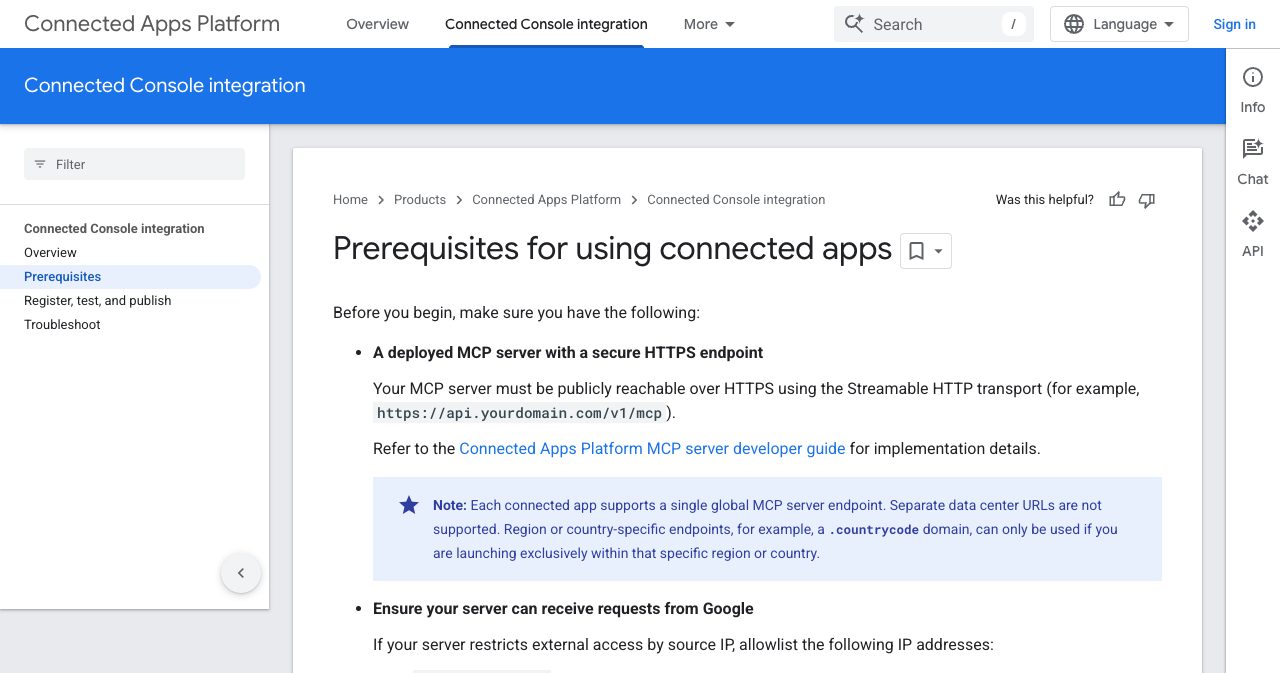
If your server filters traffic by source IP, you need to allowlist Google's published ranges, including blocks like 108.177.64.0/20, 142.250.88.0/22, and 172.217.80.0/20, plus Google's separately published JSON lists for user-triggered fetchers and agents, which change over time. You also have to serve a verification file at https://<your-domain>/.well-known/google-connected-apps that returns a plain HTTP 200 with no redirects, and someone with Connected Console permissions ("View Connected Apps," "Create and manage Connected Apps") has to accept the program's Terms of Service as an account owner.
None of that is unreasonable for a reviewed platform. But it means your brand assets, your example prompts, and your category all sit behind a review queue, the same queue that approved them in the first place. You can't swap a logo at 2am the way you'd push a hotfix to your own site. Review cadence is now part of your release calendar, whether you planned for that or not. If you're already thinking in terms of agent-callable infrastructure rather than static pages, it's worth reading how Google is building the same muscle on the agent-execution side in our coverage of Google's Agent Executor and the open agent runtime.
Being Live Isn't the Same as Being Found
Almost nobody covering this launch mentions that approval doesn't make Google start recommending you. Discovery still runs through the user, not through the model. Users connect apps themselves at myaccount.google.com/connections, and Search only calls an app the user has already linked, so your product doesn't get surfaced to someone who's never heard of it just because you passed review. Search Engine Roundtable, reporting on 28 October 2026, quotes SEO consultant Marie Haynes calling the platform "something even bigger for Search Marketers." Bigger is not the same as automatic.
That reframes the whole marketing job. Getting approved is the engineering project. Getting a stranger to tap "connect" on your app, specifically, inside their Google account settings, is the actual distribution problem, and it's a cold-start problem with no existing playbook. It's the same gap we cover from the content side in our guide to optimizing a site for AI citations, GEO and AEO: being technically eligible to be cited and actually getting cited are two different projects, and the second one is the harder, slower one.
Four Ways to Get Found, Side by Side
Search connected apps, Gemini connected apps, classic SEO, and a directory listing each get your SaaS found through a different gate, with a different payoff on the other side.
| Search Connected Apps | Gemini Connected Apps | Classic SEO | Directory listing | |
|---|---|---|---|---|
| Who can submit | US developers in preview, phased access | US developers in preview, phased access | Anyone with a public site | Anyone, usually same day |
| Review before you're visible | Yes, Google Connected Console review | Yes, Google Connected Console review | None, but ranking is earned, not granted | Light editorial check on most directories |
| Where the user sees you | Inside AI Mode, after they've linked your app | Inside the Gemini app, after they've linked your app | A results page link they click | A listing page, plus any citation an AI model pulls from it |
| What you get back | A traffic, latency, and error-rate dashboard | A traffic, latency, and error-rate dashboard | Rankings and organic clicks, over months | A dofollow backlink, referral clicks, and a citable description |
The last row is the honest comparison. A Connected App gets you operational telemetry, because you're now running infrastructure Google calls directly. A directory listing gets you a link and a description an AI system can cite without ever calling your server, which is exactly the mechanism behind the SEO benefits of listing SaaS products in directories we've written about before. Neither replaces the other. Most founders will end up doing some of both.
What This Actually Costs a Small Team
Saying yes to a Connected App means saying yes to being monitored infrastructure, not just a described product. A dashboard tracking your traffic, latency, and error rates sounds like a feature until you remember who's watching it and why: a spike in errors on your MCP endpoint doesn't just annoy a user, it risks your standing with the platform that's now calling you directly. A solo founder who's used to "my site was down for twenty minutes, nobody noticed" needs a different mental model for "my MCP server was down for twenty minutes while Gemini was trying to call it on a stranger's behalf."
That's a real cost, and it's worth weighing against the alternative distribution move available to every SaaS founder right now, reviewed or not: getting listed somewhere a human or an AI model can already find and cite you, today, without standing up a production MCP endpoint first. That's the whole premise behind submitting your SaaS to directories as a parallel track while you figure out whether the Connected Apps Platform preview is worth your engineering week.
What to Do This Week
If you're a US-based developer with time to spend, apply for the preview at developers.google.com/connected-apps, but write your category choice down and sanity-check it against your actual product before you submit, because approval locks it in. Stand up your MCP server somewhere boring and reliable, test it in Gemini Apps Developer Mode before you request review, and make sure whoever owns that endpoint knows it's now a monitored service, not a side project.
While that's in review, which could take a while given the phased rollout, you don't have to sit still. SaaSCity is a gamified startup directory with a live city map and human editorial review, and it's a same-day way to get a description of your product in front of real buyers and AI systems that already crawl directory pages for citations. The free plan gives you a listing page and a building on the map; add the SaaSCity badge to your own site and you get a dofollow backlink plus a slot in the next Monday launch. Quick Pass, at $19.99, goes live within 24 hours. Premium, at $39.99, adds a written launch post with three dofollow links. The domain sits at roughly DR 70 as of our last refresh, which is a reasonable link for a new product's profile while you wait on Google's review queue.
The Real Shift Here
Strip away the MCP server and the IP allowlist and what's left is a submission form with a reviewer behind it, standing between your product and the place people go to ask questions. That used to be Google's crawler deciding you existed, with nobody asking your permission. Now it's a human-reviewed queue deciding whether your server is good enough to be called by name. Being crawlable got you into the ten blue links. Being callable is what gets you into the answer, and the form for that just opened. Treat it like the directory submission it actually is, down to the part where you only get one shot at the category.
Get your SaaS in front of founders
List your product on the SaaSCity live city map - a permanent listing, real discovery, and a backlink from a high-DR directory. Free to start; upgrade for a dofollow link and a building on the map.