News
Claude Fable 5.1 and Mythos 5.1 Are Live: Specs, Benchmarks, Price, and Who Should Actually Switch
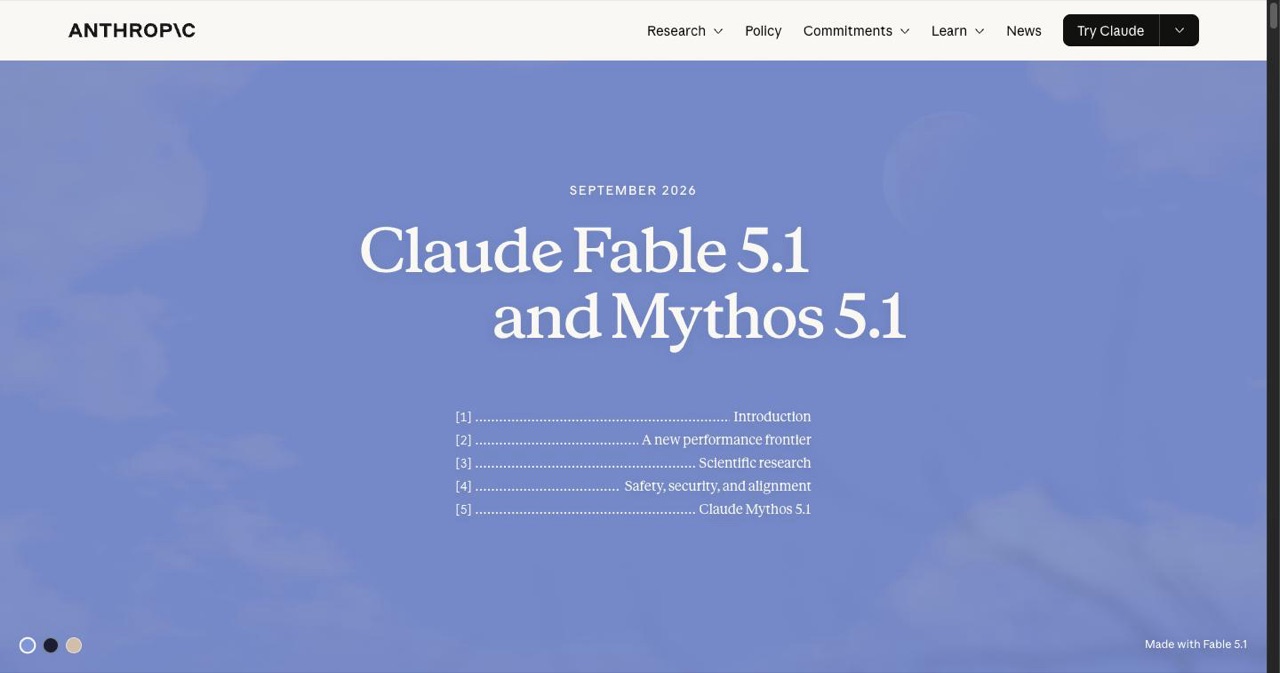
Anthropic launched Claude Fable 5.1 and Claude Mythos 5.1 on September 1, 2026. Same $10/$50 list price, cache reads cut 75% to $0.25, 1M context, Terminal-Bench-Science more than doubled, and three breaking API changes that will bite agent builders on day one.

Contents (16)
- Key takeaways
- What Anthropic announced
- Fable 5.1 vs Mythos 5.1
- Specs
- What actually improved
- Benchmarks
- Pricing: what your bill actually does
- The science demos
- Safeguards, retention, and watermarks
- Breaking changes for developers
- Where you can get it today
- Who should switch, and who should not
- Launch-day reaction
- Questions people are asking about Claude Fable 5.1
- What this means if you are shipping a product
- Sources
Quick answer: Claude Fable 5.1 and Claude Mythos 5.1 are Anthropic models released on September 1, 2026. They share weights, a 1M token context window, 128K max output, a June 2026 knowledge cutoff, and $10/$50 per million input/output tokens. Fable 5.1 is generally available with safety classifiers on; Mythos 5.1 is trusted-access only through Project Glasswing, CVP, and LSVP. Cache reads fell from $1.00 to $0.25 per million tokens, and forced tool use now returns a 400.
Anthropic shipped its most capable generally available model this morning, and the headline number is not a benchmark. It is $0.25.
That is the new cache-read price per million tokens on Claude Fable 5.1, down from $1.00 on Fable 5. List price did not move. Input is still $10 per million tokens, output is still $50. But if you run agents that replay a big prompt prefix on every turn, and almost every serious agent does, your bill just dropped by roughly a quarter, and Anthropic says up to about 45% on the most agentic workloads.
Released alongside it: Claude Mythos 5.1, the same underlying model with cybersecurity and life-sciences safeguards retuned for vetted organizations. Not two training runs. One model, two doors.
Here is what actually changed, what the scores say, what breaks in your code, and the honest answer to whether you should switch.
Key takeaways
- Released September 1, 2026. Model IDs:
claude-fable-5-1andclaude-mythos-5-1. - 1M token context, 128K max output, knowledge cutoff June 2026, retirement no sooner than September 1, 2027.
- Same list price as Fable 5. Cache reads $0.25/MTok, a 75% cut.
- Biggest reported jumps: Terminal-Bench-Science 52.6% vs 24.7%, Terminal-Bench 4.0 55.8% vs 42.0% (Mythos 5.1 hits 60.9%).
- Safeguards loosened where they were wrong: cyber false positives down 60%, benign-biology false positives down 85%. Fable 5.1 may find vulnerabilities but not write exploits.
- Three breaking API changes. Forced tool use now returns a 400.
- Anthropic's own docs still say: start with Opus 5.
What Anthropic announced
The official announcement calls Fable 5.1 and Mythos 5.1 "the world's most advanced models for coding and knowledge work" and says their research capabilities "offer an early glimpse of how AI models will contribute to scientific progress." The page itself carries a "Made with Fable 5.1" mark, which is either a flex or a soft demo depending on your mood.
The two-door structure is the part people keep getting wrong. Fable 5.1 is generally available on the Claude API and partner platforms. Mythos 5.1 is the same capabilities with different classifiers, reachable only through trusted-access programs: Project Glasswing, the Cybersecurity Verification Program, and the new Life Sciences Verification Program. Anthropic's Claude Security product now runs on Mythos 5.1, scanning codebases and proposing patches for human review.
If you are new to the Mythos line, the short version: Mythos Preview landed in April 2026 under heavy restriction, Fable 5 went public on June 9, and then the US government ordered both models pulled on June 12 over a reported safeguard bypass. Fable 5 came back July 1. Anthropic kept training through the ban, which is how Mythos 6 existed while Fable 5 was still dark. Fable 5.1 arrives with that whole saga behind it.
Fable 5.1 vs Mythos 5.1
| Fable 5.1 | Mythos 5.1 | |
|---|---|---|
| API ID | claude-fable-5-1 | claude-mythos-5-1 |
| Who can call it | All Claude API customers and partner platforms | Trusted access only (Glasswing, CVP, LSVP) |
| Safeguards | Classifiers on; high-risk cyber and bio routed or refused | Retuned for vetted cyber and life-sciences work |
| Terminal-Bench 4.0 | 55.8% | 60.9% |
| Predecessor | Fable 5 (June 9, 2026) | Mythos 5 / Mythos Preview |
Same weights, same price, same context window. The only real differences are the classifier layer and who holds the key.
Specs
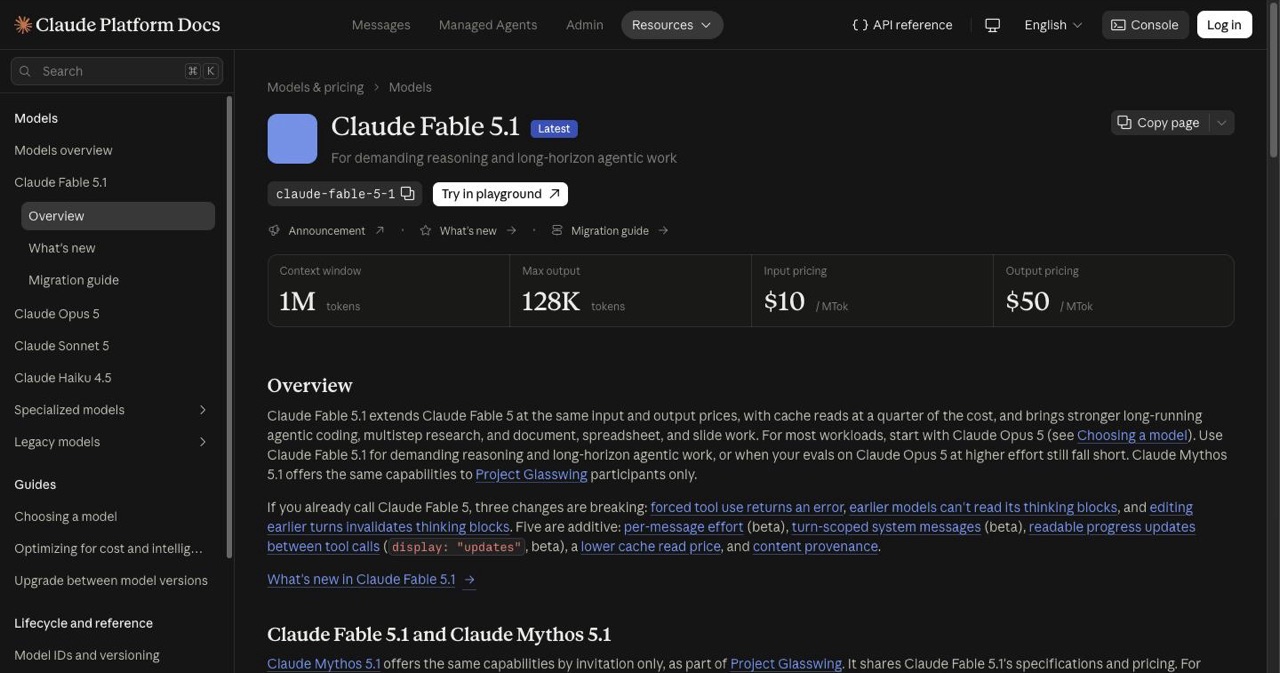
| Spec | Fable 5.1 / Mythos 5.1 |
|---|---|
| Released | September 1, 2026 |
| Retirement, not sooner than | September 1, 2027 |
| Context window | 1M tokens (default and max, standard price across the window) |
| Max output | 128K tokens |
| Input / output | $10 / $50 per MTok |
| Cache write, 5 min | $12.50 / MTok |
| Cache write, 1 hour | $20 / MTok |
| Cache read | $0.25 / MTok |
| Batch API | $5 in / $25 out |
| Thinking | Adaptive, always on |
| Default effort | high on API and in Claude Code, Medium in Cowork and Claude.ai |
| Modalities | Text and images in, text out |
| Knowledge cutoff | June 2026 |
| Min cacheable prompt | 512 tokens |
| Latency | Slower than Opus 5 and Sonnet 5 |
For context on where that sits in the lineup: Opus 5 is $5/$25, Sonnet 5 is $2/$10, Haiku 4.5 is $1/$5. Fable is the long-horizon tier. It is not supposed to be your default.
One tokenizer note that bites people: Fable 5.1 uses the same tokenizer as Fable 5 and Opus 4.7, which produces roughly 30% more tokens than pre-4.7 models on the same text. If you are migrating from anything older than 4.7, re-baseline your token counts before you trust your cost model. We went deep on why that matters in our piece on quantifying tokens in agentic engineering.
What actually improved
Anthropic's documentation concentrates the gains in six areas:
- Long-session agentic coding. Multi-file features, large refactors and migrations, debugging and code review sustained over hours.
- Knowledge work artifacts. Analysis turned into a finished document, a live-formula spreadsheet, or a slide deck from a blank page.
- Research and search. Multistep web research that actually follows up on what it finds.
- Vision. Dense charts, filings, nested PDF tables, with crop-and-zoom behavior on charts.
- Full 1M-token long context. Connecting details across the whole window, not just the ends.
- Computer use. Browser and desktop apps, with recovery from failed steps.
Multilingual performance is roughly flat against Fable 5. Anthropic's framing is that 5.1 takes fewer shortcuts, fixes root causes instead of symptoms, and verifies its own work.
Five additive product changes ship with it: per-message effort (beta), turn-scoped system messages that clear after one turn (beta), readable progress updates between tool calls via display: "updates" (beta), the lower cache-read price, and content provenance watermarking.
That third one deserves a beat. Agent harnesses have spent two years faking progress indicators because the model's reasoning was either hidden or a firehose. Now the model emits short between-tool-call notes you can render directly. If you have ever watched a user stare at a spinner for four minutes, you know why that matters.
Benchmarks
All figures are Anthropic-reported. Independent evaluations are not in yet on day one, and you should hold every number here at arm's length until they are. The competitor column is GPT-5.6 Sol as published by Anthropic, not as measured by OpenAI.
| Benchmark | Fable 5.1 | Mythos 5.1 | Fable 5 | Opus 5 | GPT-5.6 Sol |
|---|---|---|---|---|---|
| Terminal-Bench-Science 0.1 | 52.6% | — | 24.7% | 29.0% | 22.4% |
| Terminal-Bench 4.0 | 55.8% | 60.9% | 42.0% | 52.3% | 37.3% |
| GDPval-AA v2 (knowledge work) | 1853 | — | 1723 | 1824 | 1711 |
| OSWorld 2.0 partial / strict | 77.9% / 41.7% | — | 72.9% / 36.1% | 75.4% / 39.6% | — |
| Humanity's Last Exam, no tools / tools | 60.9% / 65.0% | — | 57.8% / 63.8% | 56.6% / 63.6% | — |
| AutomationBench | 31.4% | — | 17.1% | 26.9% | 19.6% |
| CursorBench 3.2.0 | 73.4% | — | 70.5% | 70.0% | 67.2% |
Science more than doubled. Agentic coding jumped 13.8 points. AutomationBench nearly doubled.
The most interesting cell is the one nobody will quote: Mythos 5.1 beats Fable 5.1 by 5.1 points on Terminal-Bench 4.0. Same model, same weights, different classifiers. That gap is the cleanest public measurement we have of what safety filtering costs on agentic coding evals, and it is not zero. It is also not catastrophic, which is the actual news.
Anthropic also says Low and Medium effort on 5.1 can match or beat Fable 5 at default effort, for less money. If you are cost-sensitive, sweep effort before you sweep models. That is the same lesson from why newer models keep breaking agent tool calls: the model changed, so your assumptions about how to drive it changed too.
One trap for writers and analysts: do not recycle the June Fable 5 numbers (SWE-Bench Pro 80.3%, FrontierCode Diamond 29.3%) as if they are 5.1 figures. They are Fable 5 history.
Pricing: what your bill actually does
List price is identical to Fable 5. The lever is the cache.
Cache reads drop from $1.00 to $0.25 per million tokens, which is 0.025x the base input rate rather than the 0.1x that other Claude models charge. Anthropic's estimates: about 25% cheaper on typical token-billed workloads, up to about 45% cheaper on highly agentic ones.
Who benefits most? Anyone replaying a large stable prefix. A coding agent that reloads a repo map and a long system prompt on every turn. A support bot with a 200K-token knowledge base. A research loop carrying accumulated findings forward. If your cache_read_input_tokens is large and your uncached input_tokens is small, this release is a straight discount with no code change beyond swapping the model ID.
If that ratio is inverted, you get very little. Check your usage numbers before you write the celebratory Slack message.
Plan access, per the Help Center as updated today:
- Available on Pro, Max, Team, and Enterprise. Not on Free.
- Max seats and premium Team or legacy Enterprise seats get it as a standard plan model.
- Pro and standard Team seats pay with usage credits. It is not inside plan usage limits.
- The July 2026 free-credit promotion was Fable 5 only and ended July 19. Fable 5.1 was never in it.
- Surfaces: Claude web, mobile, desktop, Cowork, Code, Design, Microsoft 365, and Tag.
Claude Code needs v2.1.250 or later for 5.1. Changelog 2.1.257, shipped today, adds claude-fable-5-1 and makes it the default Fable alias for /model fable unless ANTHROPIC_DEFAULT_FABLE_MODEL says otherwise. Gateways that have not been reconfigured may still reject 5.1, so select it explicitly if you hit a wall. Our Claude Code pricing breakdown covers how plan credits and API billing interact once you start mixing tiers.
Worth flagging honestly: several users on X are saying Max still caps Fable usage at roughly half the plan allowance and that Fable 5 chewed through weekly limits fast. That is user sentiment, not documented policy, and I could not confirm a 50% cap in the live Help Center article. Treat it as a thing to watch, not a spec.
The science demos
Anthropic leads with three case studies. They are demos, not peer-reviewed results, and I am repeating them as claims rather than facts.
Protein design (Mythos 5.1). High-affinity binders with affinities reported at 10x the best designs from the Adaptyv Bio competition on EGFR, Nipah G, and 15-PGDH, with roughly a 50% hit rate across 12 targets against a typical 10-15%.
Venus elevation mapping (Fable 5.1). High-resolution elevation for about one third of Venus reconstructed from Magellan radar data, resolving detail at 2-3 km versus a prior 10-20 km, with heights up to 25% more accurate.
Biology compute optimization (Mythos 5.1). Seven open-source deep-learning models optimized for up to 2.5x faster inference on H100s with identical outputs, cutting GPU cost 30-60% on genome-wide jobs. On Evo 2 40B the reported speedup was 2.3x on whole jobs versus 1.4x per forward pass. Done in days, from public source.
That last one is the one I would actually bet on generalizing. Kernel and pipeline optimization is a closed-loop task with a hard correctness check and a fast reward signal, which is exactly the shape of problem these models have been getting good at. Protein binders and planetary radar are harder to verify from the outside.
Safeguards, retention, and watermarks
Fable 5.1 keeps its classifiers. The interesting change is that they got more precise rather than more permissive: cyber false positives down 60%, benign biology false positives down 85%. Anyone who has had a legitimate security question refused knows why that number matters more than a benchmark.
The line Anthropic draws: Fable 5.1 may discover software vulnerabilities but may not develop exploits. Mythos 5.1 is the variant where that line moves, and only for vetted organizations.
On safety evaluations, Anthropic places Mythos 5.1 below its high-risk chemical and biological tier, describes strong cyber capability as low risk within its own framing, and reports better alignment than Mythos 5, with less reward hacking and fewer resource-acquisition attempts, plus improved robustness to prompt injection in agentic settings.
Data retention matters for procurement. Fable and Mythos 5 and 5.1 are Covered Models with 30-day retention for safety review, and they are not available under zero data retention unless Anthropic expressly authorizes it. Anthropic is phasing in Enterprise Frontier Safeguards from fall 2026, which stores that data in customer-controlled cloud storage to match ZDR privacy while preserving safety review. Until then, eligible customers can use Fable 5.1 with ZDR by arrangement.
Watermarks are new to this generation. Both models launched after the August 2, 2026 EU marking deadline and apply a statistical text watermark on every platform. It adds no tokens, uses no hidden characters, carries no user or organization identifier, and Anthropic says it does not change output quality. Generated images and video retrieved through the Files API get signed C2PA Content Credentials. A detection API is in private preview for regulators, law enforcement, media, fact-checkers, researchers, educators, and EU civil society. Marking is applied worldwide, not only in the EU, which is worth understanding if you are working through what the EU AI Act means for a SaaS product.
Breaking changes for developers
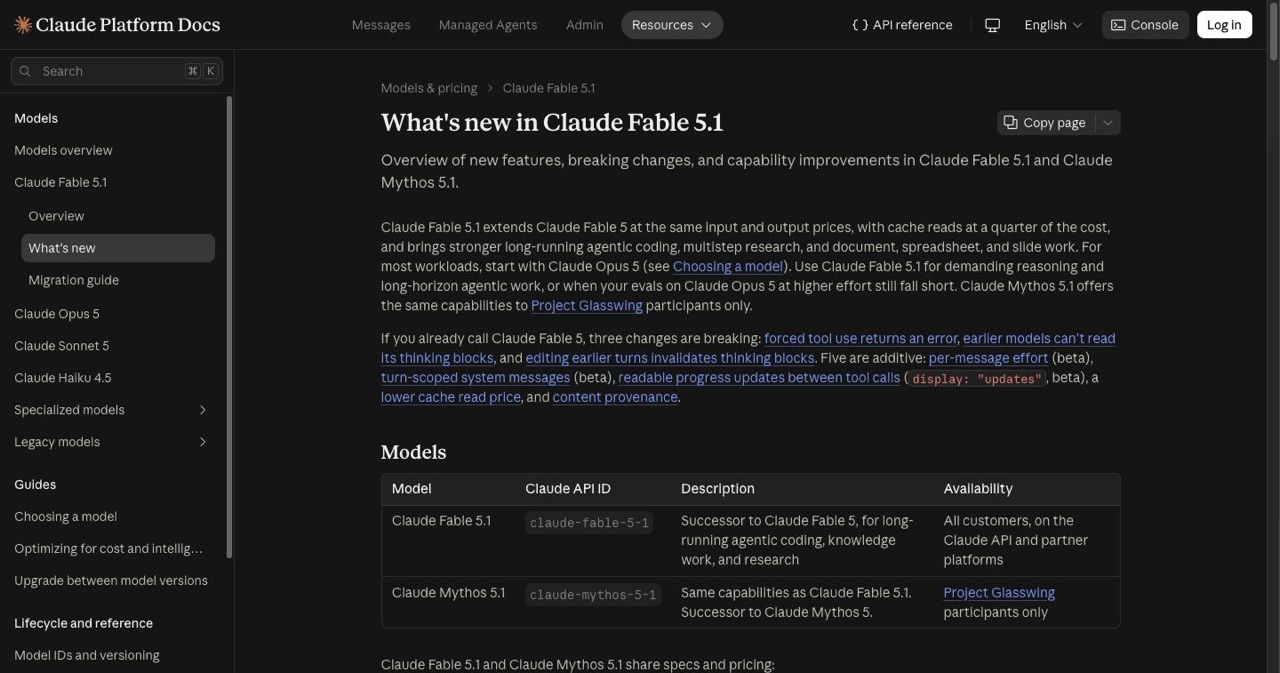
This is the section to read before you swap the model string. From Anthropic's what's new page:
1. Forced tool use is gone. tool_choice: {"type": "any"} and {"type": "tool", "name": ...} now return a 400, including on token counting and Batches. Use auto plus an explicit instruction naming the tool, set strict: true on the tool for schema-valid arguments, or use structured outputs if the forced call only existed to get JSON back. {"type": "none"} still works.
2. Thinking blocks are bound to the producing model. Older models cannot read Fable 5.1 thinking blocks and drop them silently, unbilled. Fable 5.1 can read older models' thinking. If you route a conversation across models, expect reasoning continuity to vanish in one direction.
3. Editing earlier turns invalidates later thinking. Changing the system prompt, the tool list, prior messages, or URL bytes can error or drop blocks. This is enforced for accounts created on or after August 31, 2026, and later models will enforce it for everyone. The escape hatch is the beta header thinking-binding-controls-2026-08-01 with prefix_mismatch_behavior: "drop_block". The real fix is making your harness append-only.
4. Thinking is adaptive or nothing. Both {"type": "enabled", "budget_tokens": N} and {"type": "disabled"} return a 400. Omit the parameter or send {"type": "adaptive"}. Raw chain of thought is never returned. display defaults to "omitted", with "summarized" and the new "updates" available.
5. Swap the ID. claude-fable-5 becomes claude-fable-5-1.
Number three is the one that will produce the confusing bug reports. Plenty of agent frameworks quietly rewrite history: they compact old turns, dedupe reminders, or patch a system prompt mid-run. All of that is now a correctness issue rather than a style choice. If you are running subagents or agent teams in Claude Code, audit how your orchestrator mutates transcripts before you flip the model.
Where you can get it today
- Claude API and partner platforms. Fable 5 shipped on AWS Bedrock, Google Vertex AI, and Microsoft Foundry; verify each cloud's model ID before asserting 5.1 general availability there.
- Claude.ai model picker, listed as Fable 5.1.
- Claude Code v2.1.250+, with 2.1.257 making it the default Fable alias.
- Cursor, live on launch day. Cursor reports 73.4% on CursorBench 3.2 at max effort and calls it "especially skilled at verifying its own work."
- GitHub Copilot had Fable 5 generally available. Do not assume 5.1 is there without checking today's changelog.
If you are wiring it into a tool-using setup, our roundup of the best MCP servers for Claude Code still applies unchanged. The model got better; the plumbing did not move.
Who should switch, and who should not
Anthropic's own routing guidance is blunt, and I agree with it: start with Opus 5. It costs half as much, it is faster, and for most work it finishes the job.
Reach for Fable 5.1 when your evals show Opus 5 at high effort still failing. In practice that means:
- Multi-hour unattended agent runs
- Repository-wide migrations and refactors
- Multi-day research with follow-up
- Spreadsheet and slide production from raw analysis
- Deep PDF and chart vision work
- Computer-use loops that must recover from their own mistakes
Three tactics before you commit:
- Try Low or Medium effort on 5.1 first. Anthropic says it can match Fable 5 at default effort for less. That is the cheapest experiment available.
- Check your cache ratio. The $0.25 read price is the whole economic story of this release. If you are not cache-heavy, the upgrade is capability-only.
- A/B one hard internal eval. Fable 5.1 at Medium against Opus 5 at High, on a task you actually care about, before any fleet-wide switch.
Regulated buyers have one more section to read: 30-day Covered Model retention plus the upcoming Enterprise Frontier Safeguards phase-in is your procurement conversation, and it needs to happen before your first production call, not after.
Launch-day reaction
Hours-old sentiment, not fact. The official @claudeai thread went live around 18:03 UTC with the announcement video and benchmark cards, and the first post cleared roughly 250,000 views within minutes. Cursor's integration post landed almost immediately. Developers are latching onto two things: the cache-read cut, and the claim that Low effort on 5.1 behaves like High effort on the old model.
The skeptics are consistent too. Max weekly caps, Fable 5's appetite for plan quota, and a general "a new picker entry is not a rebound" mood. Both reactions are reasonable on day one, and neither is data.
Customer quotes Anthropic published are more concrete. Millennium says Fable 5.1 found a rare crash cause that engineers and other models missed. Ramp reports an unattended 38-hour machine-learning run that diagnosed a label artifact and launched six overnight experiments. Browserbase reports 82% of its hardest browser-agent tasks completed in about ten minutes, against 74% for Opus 5 and 57% for Fable 5, using fewer tokens. Glean says judges preferred 5.1 over Fable 5 about two to one. Rogo reports matching Fable 5's accuracy on its internal finance benchmark with 20% fewer tokens.
Those are vendor-selected quotes from a launch page. They are still the most specific signal available today.
Questions people are asking about Claude Fable 5.1
What is Claude Fable 5.1? Anthropic's September 1, 2026 Mythos-class model for long-horizon coding, knowledge work, and research. It is the public version of the same model as Mythos 5.1, with safety classifiers on. 1M context, 128K output, June 2026 cutoff, $10/$50 per million tokens.
What is the difference between Fable 5.1 and Mythos 5.1? Same weights, same specs, same price. Fable is generally available with classifiers on. Mythos has cyber and bio safeguards retuned for vetted organizations through Project Glasswing, CVP, and LSVP. Mythos scores 60.9% on Terminal-Bench 4.0 to Fable's 55.8%.
How much does it cost? $10 per million input tokens and $50 per million output. Cache reads are $0.25. Anthropic estimates roughly 25% lower typical bills than Fable 5, up to 45% on agentic work. Batch is half price.
Is it better than Opus 5? On Anthropic's benchmarks, yes. In practice, Anthropic still tells you to start with Opus 5 at half the price and reach for 5.1 only when Opus 5 at high effort falls short.
What breaks when I migrate? Forced tool use returns a 400. Thinking blocks are model-bound. Editing earlier turns invalidates later thinking for accounts created on or after August 31, 2026. And swap claude-fable-5 for claude-fable-5-1.
Is it free on Pro? No. Pro and standard Team seats spend usage credits. Max and premium seats get it as a plan model. Free plans do not have it.
Can it write exploits? Officially no on Fable 5.1. Vulnerability discovery is allowed; exploit development is not. Mythos 5.1 is where that boundary moves, for vetted organizations only.
Does it watermark output? Yes, a statistical text watermark on every platform, plus C2PA credentials on supported files. No extra tokens, no identifiers, no quality change.
Which Claude Code version do I need? 2.1.250 or later. 2.1.257 makes fable resolve to 5.1 on the Anthropic API.
What this means if you are shipping a product
Two practical consequences, and then I will get out of the way.
First, the cheap-cache era changes what an agent can afford to remember. A year ago, carrying 200K tokens of context on every turn was a line item you engineered around. At $0.25 per million read, it is closer to a rounding error on most workloads. Expect a wave of products that simply stop compacting and just carry everything, which will feel like a capability jump to users even though nothing about the model's intelligence caused it.
Second, the science demos are a preview of where the pricing pressure goes next. A model that optimizes inference kernels and cuts GPU cost 30-60% is a model that erodes the moat of every company selling "we made your model faster" as a product. If that is your wedge, look at what happened to SaaS categories Claude absorbed and plan accordingly.
Full disclosure before the last paragraph: I run SaaSCity, a directory and launch map for SaaS and AI tools, so weigh what follows however you like. If you are building on Fable 5.1 or Opus 5 and you want your product in front of people who care about exactly this, submitting it to SaaSCity takes a few minutes and gives you a permanent indexed listing with a dofollow backlink, plus a spot on the AI tools category that a lot of builders browse when a model launch sends them shopping. We also run a free MCP server so your agent can submit and check its own listing without a human in the loop, which felt like the right thing to build in a week where models started doing the shopping.
For the wider picture of how model releases keep reshaping build costs, our guide to building an AI SaaS in 2026 covers the architecture side, and the GEO playbook covers getting cited by the models themselves.
Sources
Primary sources for everything above: Anthropic's Claude Fable 5.1 and Mythos 5.1 announcement, the platform documentation overview, the what's new and breaking changes page, the Help Center article on plan availability, the text watermark explainer, the Cybersecurity Verification Program portal, and Claude Security. Launch-day reaction is from the official @claudeai thread and public posts, and is labeled as sentiment rather than fact throughout.
Every benchmark figure on this page is reported by Anthropic. Independent evaluations were not published at the time of writing. When they land, treat them as the tiebreaker.
Get your SaaS in front of founders
List your product on the SaaSCity live city map - a permanent listing, real discovery, and a backlink from a high-DR directory. Free to start; upgrade for a dofollow link and a building on the map.