News
Microsoft Says MAI Code 2 Costs 5% of Opus 5.5. The Footnote Says 10% (2026)
Microsoft says MAI Code 2 delivers 96% of Claude Opus 5.5 at 5% of the cost, and a footnote on the same page says that cost is a 50% promotional price. Here is GitHub's real rate card, the arithmetic for May 17, 2027 when the price doubles, and a seven-step test to run on your own repo before you switch. SaaSCity, the startup directory publishing this, has no stake in Microsoft, OpenAI or Anthropic.
Contents (15)
- The short version
- What did Microsoft announce at Ignite 2026?
- How much does MAI Code 2 actually cost per million tokens?
- Is MAI Code 2 really 5% of the cost of Claude Opus 5.5?
- MAI Code 2 vs Claude Opus 5.5 vs GPT-6.1 Sol: what changes on May 17, 2027?
- How much of Microsoft's benchmark claim should you believe?
- Where can you actually call MAI Code 2?
- How do you test MAI Code 2 on your own repo before switching?
- What is Microsoft-Decision-1.1, and why is routing the cheaper win?
- What does this do to an AI SaaS gross margin?
- What should you not use MAI Code 2 for?
- What about the rest of the Ignite lineup?
- FAQ
- The bet behind the 5%
- Sources
Microsoft's most quoted number from Ignite 2026 comes with a footnote, and the footnote doubles it.
Quick answer: Microsoft says MAI Code 2, the coding model it launched at Ignite on November 17, 2026, scores 96% of Anthropic's Claude Opus 5.5 at 5% of the cost. That 5% is cost per benchmark task at a 50% promotional price ending May 17, 2027. At list price, on Microsoft's own token counts, it works out to about 10%.
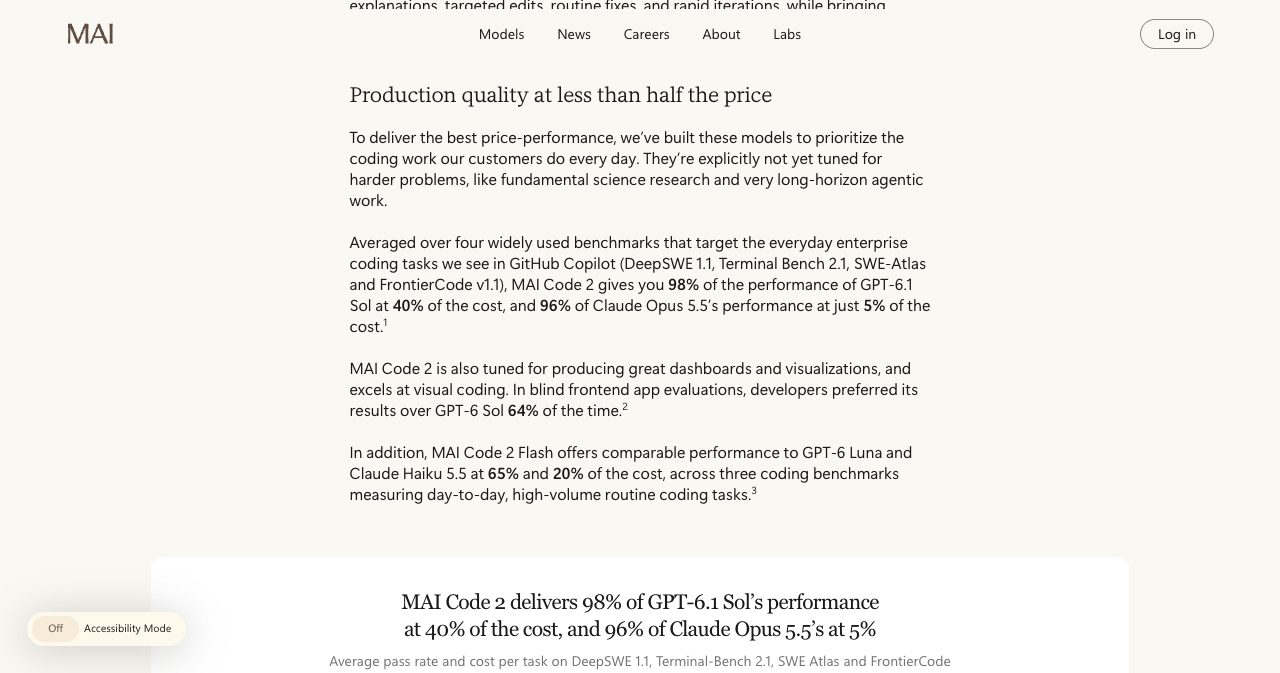
The claim comes from Microsoft AI's MAI Code 2 launch post: averaged over four coding benchmarks, MAI Code 2 "gives you 98% of the performance of GPT-6.1 Sol at 40% of the cost, and 96% of Claude Opus 5.5's performance at just 5% of the cost." Footnote 1 ends with the sentence most coverage skipped: "MAI Code 2 cost is shown at its 50% promotional price."
Microsoft shipped a cheap, capable model for everyday coding and quoted it at a price that makes its lead look twice as large as it will be after May 17, 2027. If you pay for tokens, or resell them inside a product, that second part changes your math.
Prices checked on November 19, 2026 against GitHub's Copilot models and pricing page, where MAI Code 2 is sold. Arithmetic marked as ours shows its inputs. SaaSCity is a startup directory with no commercial tie to Microsoft, OpenAI or Anthropic.
The short version
- MAI Code 2 costs $0.50 input, $0.025 cached input and $2.50 output per million tokens on GitHub Copilot until May 17, 2027, then twice that.
- The "5% of Claude Opus 5.5" is cost per benchmark task at the promotional price ($0.309 against $6.306). Per token it is 12.5%, and 25% after the promotion.
- At list price and Microsoft's own token counts, MAI Code 2 costs about 10% of Opus 5.5 per task and about 81% of GPT-6.1 Sol.
- The quality gap is small on Microsoft's numbers (63.2% average pass rate against 64.1% and 65.3%), measured mostly on Microsoft's internal platform.
- You can only call it through paid GitHub Copilot plans for now, and routing with Microsoft-Decision-1.1 ($0.042 per million input tokens, free output) saves more than switching.
What did Microsoft announce at Ignite 2026?
On November 17, 2026, Microsoft AI (MAI) announced seven models sold on price-performance, plus a chip milestone and a weights-licensing program. The Ignite announcement states the pitch plainly: "as token spend skyrockets, we know that you also want models at a price point that lets you run agents 24/7 doing real engineering work."
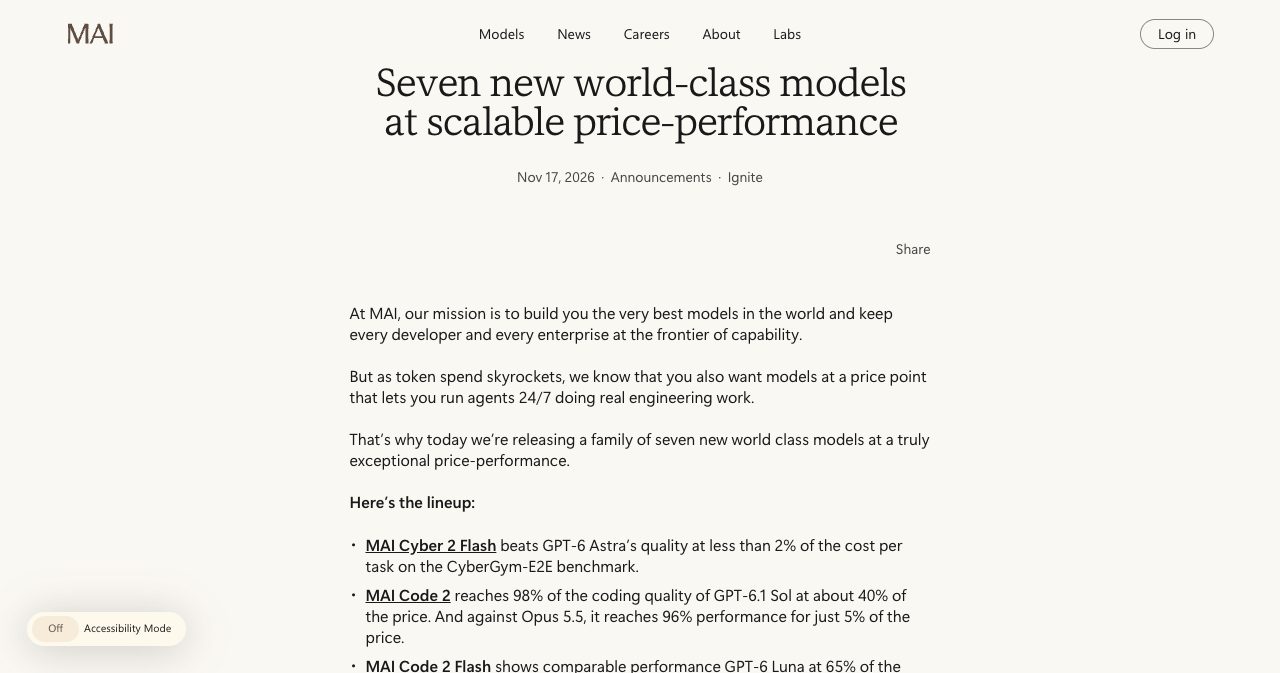
The lineup, with Microsoft's own one-line claims:
- MAI Code 2: 98% of OpenAI's GPT-6.1 Sol coding quality at "about 40% of the price," and 96% of Anthropic's Claude Opus 5.5 for "5% of the price."
- MAI Code 2 Flash: comparable to GPT-6 Luna at 65% of the price and to Claude Haiku 5.5 at 20%.
- MAI Cyber 2 Flash: beats GPT-6 Astra on CyberGym-E2E at less than 2% of the cost per task.
- MAI Image 2.7: first on Artificial Analysis image editing at one-fifth of the price of GPT Image 2.6 Sunburst (max).
- MAI Realtime 1: speech-to-speech from $0.01 per audio minute.
- Dragon Copilot Transcribe on MAI Transcribe 2: 10 million patient encounters a month, with multilingual error rates halved.
- Microsoft-Decision-1.1: routing and classification, "50x faster and 79x cheaper than GPT-6.1 Sol."
The same post introduces MAI Licensed Weights, for adapting MAI models inside your own Azure environment, and says the Maia 200 accelerator is now in production. Note its wording: the Ignite summary says "price," while the MAI Code 2 post says "cost" and its footnote defines that as cost per benchmark task. Most of the confusion about the 5% started with that one-word swap.
How much does MAI Code 2 actually cost per million tokens?
MAI Code 2 costs $0.50 per million input tokens, $0.025 per million cached input tokens and $2.50 per million output tokens until May 17, 2027, then $1.00, $0.05 and $5.00, according to GitHub's Copilot models and pricing page. MAI Code 2 Flash costs a tenth of that: $0.05, $0.005 and $0.25, rising to $0.10, $0.01 and $0.50.
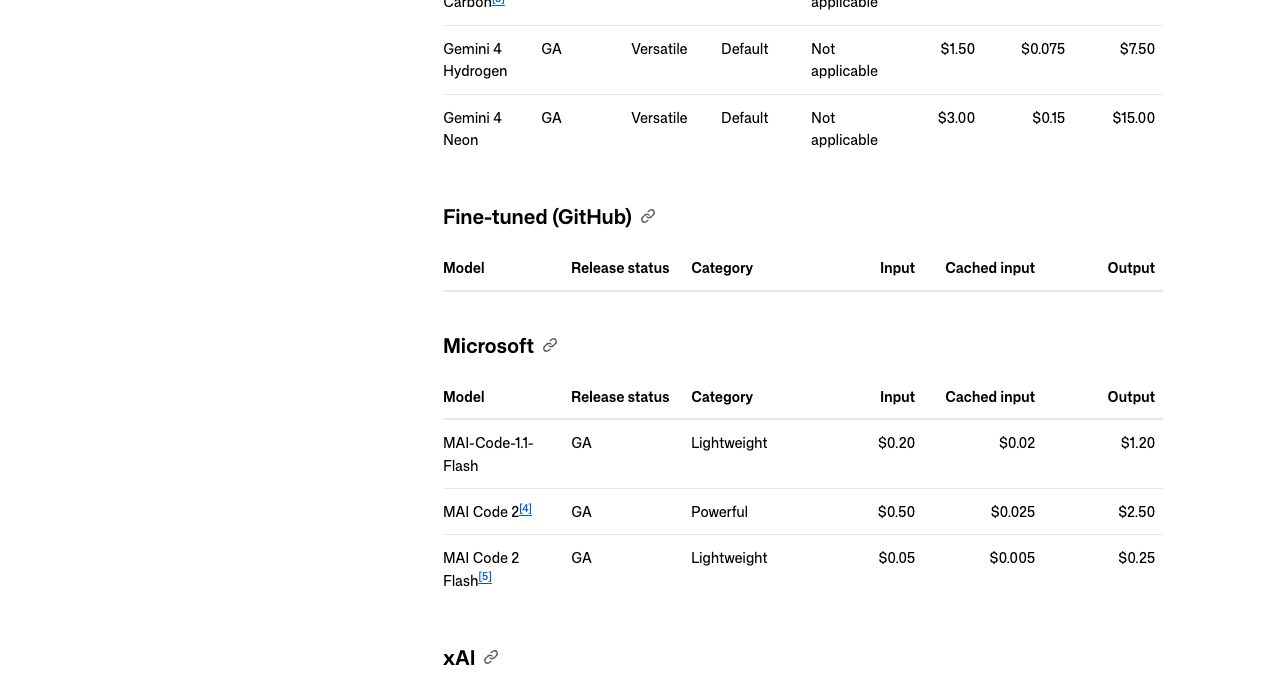
| Model | Input / 1M | Cached input / 1M | Output / 1M | From May 17, 2027 | Context and long-context pricing | Where you can call it |
|---|---|---|---|---|---|---|
| MAI Code 2 | $0.50 | $0.025 | $2.50 | $1.00 / $0.05 / $5.00 | 1,050,000 tokens, one flat rate, no cache-write charge | GitHub Copilot paid plans only |
| MAI Code 2 Flash | $0.05 | $0.005 | $0.25 | $0.10 / $0.01 / $0.50 | 1,050,000 tokens, one flat rate, no cache-write charge | GitHub Copilot (all plans), Microsoft Foundry limited-access preview |
| GPT-6.1 Sol | $2.00 | $0.10 | $10.00 | No change announced | $4.00 / $0.20 / $15.00 above 272K tokens | GitHub Copilot, OpenAI API |
| Claude Opus 5.5 | $4.00 | $0.20 | $20.00 | No change announced | One flat rate on GitHub's list | GitHub Copilot, Claude API, Amazon Bedrock |
| Claude Haiku 5.5 | $0.10 | $0.01 | $0.50 | No change announced | $0.50 / $0.05 / $2.50 above 100K tokens | GitHub Copilot, Claude API |
| GPT-6 Luna | $0.10 | $0.01 | $0.50 | No change announced | $0.20 / $0.02 / $0.75 above 272K tokens | GitHub Copilot, OpenAI API |
The MAI rows carry one flat rate, with no long-context tier and no cache-write charge, and eesel, quoting Microsoft's model card, puts the context window at 1,050,000 tokens. GPT-6.1 Sol doubles its input price above 272,000 tokens and Claude Haiku 5.5 charges five times more above 100,000, so an agent that loads half a repo into context gains more from that flat rate than from the headline price. At list price, MAI Code 2 Flash costs exactly what GPT-6 Luna and Claude Haiku 5.5 cost per token in their default tiers. All of the small model's discount is promotional.
Copilot bills these tokens as GitHub AI Credits worth $0.01 each, since GitHub moved Copilot to usage-based billing on June 1, 2026. Copilot Pro includes 1,500 credits a month, per GitHub's billing docs, which at Microsoft's benchmark costs covers about 48 MAI Code 2 tasks at the promotional price, 24 at list price, or two Claude Opus 5.5 tasks at maximum effort. Benchmark tasks are heavier than "rename this function," so read those counts as scale.
Is MAI Code 2 really 5% of the cost of Claude Opus 5.5?
Only when three conditions hold together: you measure cost per benchmark task instead of price per token, you use the 50% promotional price, and your work resembles Microsoft's benchmark run at maximum reasoning effort. Drop any one of them and the figure changes.
Take price per token first. MAI Code 2's promotional rates are $0.50 input and $2.50 output, against $4.00 and $20.00 for Claude Opus 5.5, which is 12.5% on both. After May 17, 2027, it becomes 25%. Against GPT-6.1 Sol it is 25% now and 50% later.
Cost per task is the total spend of a benchmark run divided by the tasks in it, so it counts how many tokens each model burned, which price per token leaves out. InfoWorld's Nidhi Singal reported Microsoft's figures on November 18, 2026; the last column is our division of cost by pass rate.
| Model | Average pass rate, four benchmarks | Cost per task (Microsoft) | Cost per passed task (our arithmetic) |
|---|---|---|---|
| MAI Code 2, promotional price | 63.2% | $0.309 | $0.49 |
| GPT-6.1 Sol | 64.1% | $0.761 | $1.19 |
| Claude Opus 5.5 | 65.3% | $6.306 | $9.66 |
| MAI Code 2 Flash, promotional price | n/a | $0.052 | n/a |
| GPT-6 Luna | n/a | $0.080 | n/a |
| Claude Haiku 5.5 | n/a | $0.319 | n/a |
Divide the cost ratio by the price ratio and you get a token ratio. Alan West ran that arithmetic on DEV Community on November 18, assuming a similar input and output mix, and our numbers agree with his. MAI Code 2 used about 1.6 times GPT-6.1 Sol's tokens per task (a 41% bill at 25% of the price) and about 40% of Opus 5.5's (a 4.9% bill at 12.5% of the price). By the same method, Opus 5.5 at maximum effort used about four times Sol's tokens, which explains much of how a 12.5% price turns into a 5% bill.
Sanchit Vir Gogia, chief analyst at Greyhound Research, told InfoWorld: "Microsoft's own savings are measured at a 50% promotional price, so the gap narrows sharply once the promotion ends." He added that "the cost it compares is the spend of a benchmark run, not a published price per token." In the same launch, Microsoft priced its MAI Cyber 2 Flash comparison at list price and said so in a footnote, while the coding comparison got the promotional rate that flatters the headline.
MAI Code 2 vs Claude Opus 5.5 vs GPT-6.1 Sol: what changes on May 17, 2027?
On May 17, 2027, MAI Code 2's price doubles. If each model burns the tokens it did in Microsoft's run, MAI Code 2 goes from about 41% to about 81% of GPT-6.1 Sol's cost per task, and from about 5% to about 10% of Claude Opus 5.5's. XenoSpectrum reached the same 10% and 80% on November 18, and eesel's table shows 9.8%.
| Our arithmetic on Microsoft's figures | Promotional price (now) | List price (from May 17, 2027) |
|---|---|---|
| MAI Code 2 cost per task | $0.309 | $0.618 |
| Share of GPT-6.1 Sol's $0.761 | 41% | 81% |
| Share of Claude Opus 5.5's $6.306 | 4.9% | 9.8% |
| MAI Code 2 cost per passed task | $0.49 | $0.98 |
| MAI Code 2 Flash cost per task | $0.052 | $0.104 |
| Flash share of GPT-6 Luna's $0.080 | 65% | 130% |
| Flash share of Claude Haiku 5.5's $0.319 | 16% | 33% |
MAI Code 2 Flash takes the bigger hit. Microsoft's 65%-of-Luna claim also uses the promotional price, and at list price Flash and GPT-6 Luna cost the same per token. Flash used about 1.3 times Luna's tokens in Microsoft's run, so after the promotion the same work costs about 130% of Luna's. Against Claude Haiku 5.5 it stays cheap: Microsoft says 20% of the cost, and InfoWorld's figures give about 16%.
We take GitHub's dated rate card as fact, since it is what you will be billed, and Microsoft's per-task figures as a direction, too narrow to budget from.
How much of Microsoft's benchmark claim should you believe?
Enough to take the model seriously, and no more. On Microsoft's numbers MAI Code 2 trails GPT-6.1 Sol by about one point and Claude Opus 5.5 by about two on average, but three of the four benchmarks ran on Microsoft's own platform and no independent leaderboard has scored the model yet.
Footnote 1 says DeepSWE 1.1, Terminal Bench 2.1 and SWE-Atlas ran on MSBench, Microsoft's internal eval platform, through GitHub Copilot CLI with subagents off, while FrontierCode v1.1 results came from Artificial Analysis, all at maximum reasoning effort. OrcaRouter, which sells Opus 5.5 access, cites Microsoft's model card for MAI Code 2's raw scores: 73.2% on DeepSWE 1.1, 84.6% on Terminal Bench 2.1 and 43.1% on SWE-Atlas. With InfoWorld's 52% FrontierCode score, they average exactly 63.2%. Artificial Analysis itself had published no MAI Code 2 row as of November 19, 2026.
Maximum effort is the most expensive setting for every model in the chart, and few teams run Opus 5.5 that way on routine tickets, so the cost gap in your own setup may be narrower. Microsoft's blind frontend test, in which 258 annotators preferred MAI Code 2 over GPT-6 Sol 64% of the time on interfaces, games, charts, 3D scenes and SVGs, used the previous Sol model where the rest of the launch used GPT-6.1 Sol. We'd like to see someone who isn't selling the model repeat it. Michael Heath, principal architect for cloud and AI at Myriad360, summed up the pitch to TechTarget on November 18: "Microsoft is competing on price performance more than on raw intelligence."
Where can you actually call MAI Code 2?
Only inside GitHub Copilot, as of November 19, 2026. GitHub's changelog entry from November 17 lists MAI Code 2 on Copilot Pro, Pro+, Max, Business and Enterprise, and MAI Code 2 Flash on those plans plus Free and Student.
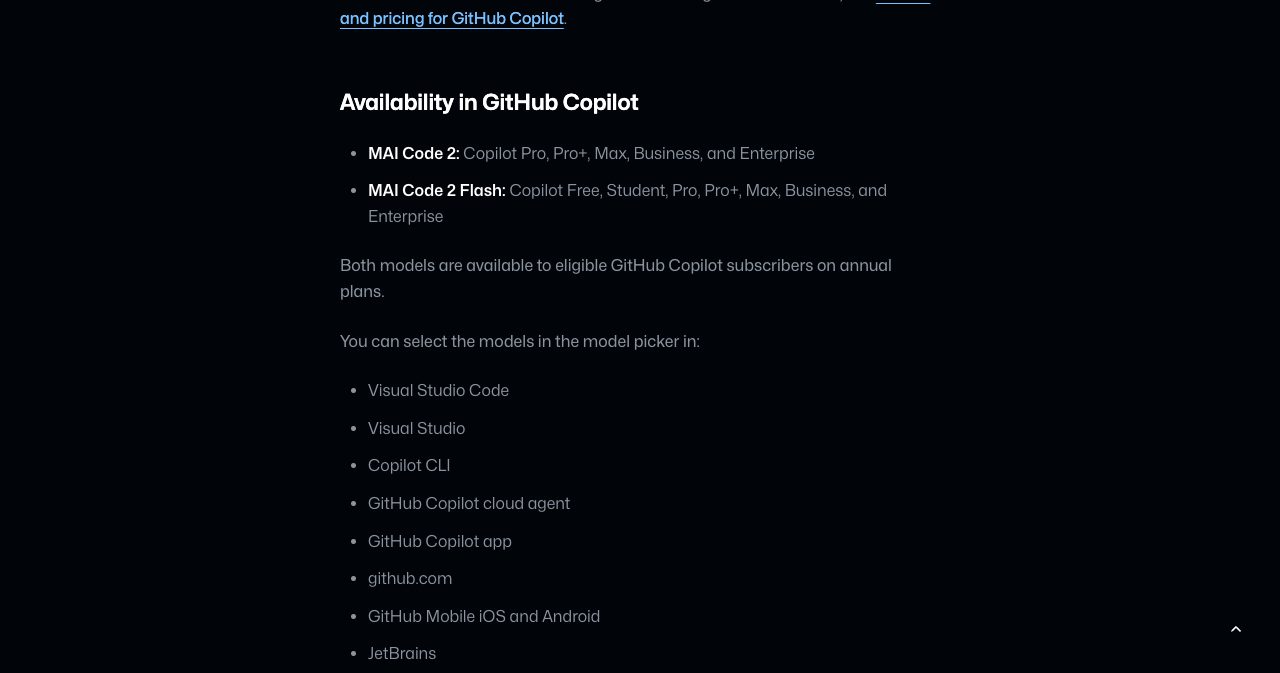
Inside Copilot it sits in the model picker across VS Code, Visual Studio, Copilot CLI, github.com, JetBrains, Xcode and other surfaces, and Business and Enterprise admins control it through the model policy.
Outside Copilot there is little. MAI Code 2 Flash is in a limited-access preview in Microsoft Foundry, and MAI Code 2 isn't. Microsoft says "Soon, we'll be releasing them on OpenRouter, Vercel, Hermes, OpenCode, and Kilo," without a date, and Kilo's post says the models will reach it in private preview through Foundry. The weights aren't distributed, per the model card as quoted by eesel, and MAI Licensed Weights is "coming soon through our Frontier Company engagements," through your Microsoft account team.
For a developer on Copilot, switching is one click in the model picker. A founder whose product calls a coding model through an API can't use MAI Code 2 yet, because it can't sit behind your own agent, router or billing until it reaches Foundry or OpenRouter.
How do you test MAI Code 2 on your own repo before switching?
Run it on tasks your team already solved, count dollars per merged patch, and decide by task type. Microsoft's 96% is an average over someone else's tasks. This routine fits in an afternoon:
- Pick 10 to 15 real tasks from your own tracker. Use closed issues that a teammate fixed in under a day, so the merged fix doubles as the answer key. Mix bug fixes, small features and at least one refactor.
- Freeze the commit and the prompt. Check out the commit each task started from and write one prompt per task. Every model gets the same commit, the same prompt and the same repository instructions.
- Run each model in Copilot CLI with identical settings. Run MAI Code 2, the model you use today and one cheaper option at the same reasoning effort, with the same tools switched on. Microsoft benchmarked at maximum effort with subagents off; test the settings you will actually ship.
- Record dollars per finished task. Log input, cached and output tokens and the AI credits each run consumed. Divide total spend by the number of tasks that ended in a patch you would merge, not by the number attempted.
- Have a maintainer grade the diffs blind. Hand the patches, with model names removed, to whoever would review them in real life. Score each one as merge as-is, merge after edits, or reject.
- Rerun with your normal caching setup. Repeat the batch with the system prompt, repo context and tool definitions you usually cache. Caching can change the ranking: GitHub lists no cache-write charge for MAI Code 2, while Claude Opus 5.5 is billed $5.00 and GPT-6.1 Sol $2.50 per million tokens written to cache.
- Set a routing rule and a reminder for May 17, 2027. Send the task types MAI Code 2 merged cleanly to it, keep the rest on your stronger model, and put the same batch back on the calendar for May 17, 2027, when the price doubles.
If MAI Code 2 matches your current model on 12 of 15 tasks, the three it missed tell you what to route elsewhere. Watch the token column as well: a model that uses 1.6 times the tokens at a quarter of the price looks great until the price doubles. To compare against flat-rate plans, see our Claude Code pricing and AI coding token plans breakdowns.
What is Microsoft-Decision-1.1, and why is routing the cheaper win?
Microsoft-Decision-1.1 is a small decision model that picks between options, such as which model should handle a request, and returns a calibrated confidence score with each answer. It has been generally available since November 17, 2026 in Microsoft Foundry and through OpenRouter and Vercel, and Foundry charges $0.042 per million input tokens with free output.
According to Microsoft's Command Line post by Achint Srivastava, VP of Software Engineering in the Office of the CTO, it is built on Gemma 4 26B A4B, Google DeepMind's open-weight mixture-of-experts model, which TechTarget also reported. It is trained to "know when to answer vs. abstain," accepts images, and drew more than 4,000 customers in just over five weeks of preview. Inside Copilot it routes requests as accurately as a large language model, 2.2 times faster and at 4.4 times lower cost.
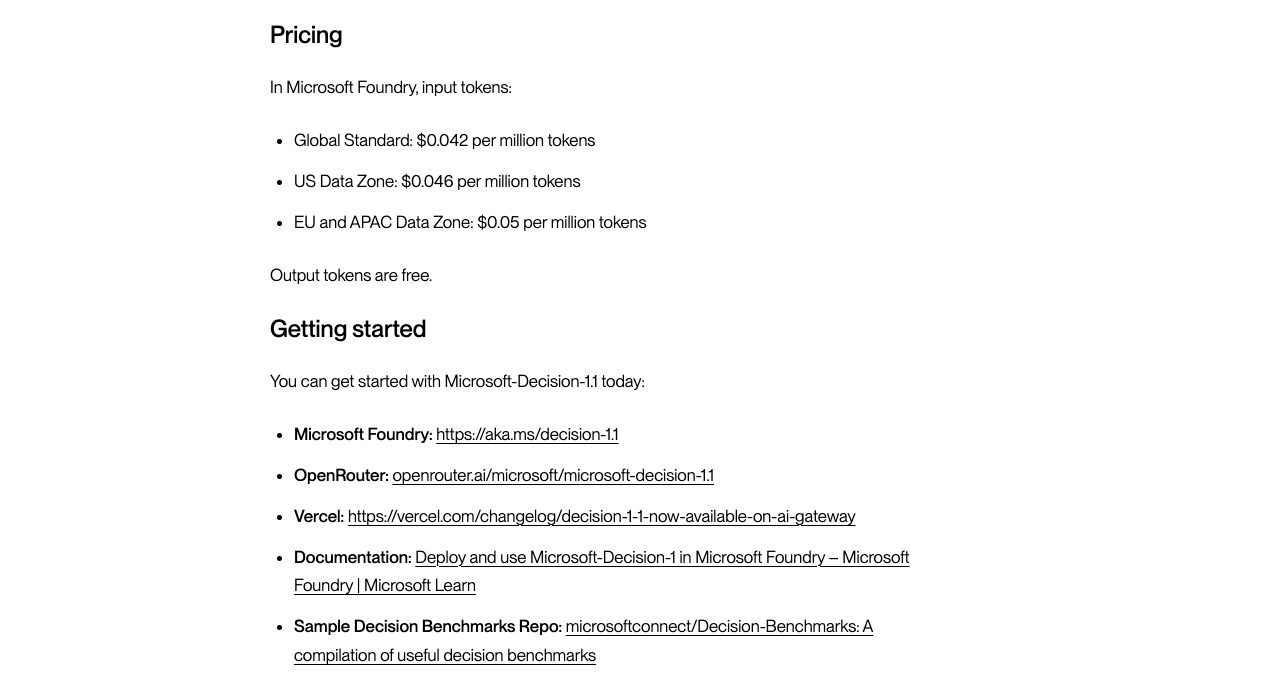
The US Data Zone costs $0.046 and the EU and APAC Data Zone $0.05 per million input tokens. On Global Standard, a routing call with a 2,000-token prompt costs $0.000084, or $84 per million calls.
Because the router costs almost nothing, the fallback model decides the bill. At Microsoft's list-price benchmark costs, sending every task to MAI Code 2 costs $0.618 a task. Each percentage point of tasks routed to Claude Opus 5.5 at maximum effort adds about $0.057, roughly 9%. At 2.5% the blend costs as much as running everything on GPT-6.1 Sol ($0.761), and routing the "missing 4%" to Opus 5.5 brings it to about $0.85. At today's promotional price, the break-even is 7.5%.
Pick the fallback as carefully as the default. Two working versions of the pattern: Amazon swapping Claude Sonnet 4.6 for a small decision model in ticket labelling, and Spotify's two-model router for Claude Code. After routing, the next lever is trimming the context you send.
What does this do to an AI SaaS gross margin?
If your product resells agent runs, the end of the promotion alone can cut about 18 points from inference-only gross margin. Model spend is the cost line you can change fastest, with a config edit, so a 2x error in your cost-per-task estimate becomes a double-digit swing in margin.
Take an illustrative product at $50 per customer per month and 30 agent tasks per customer per month, priced at Microsoft's benchmark cost per task. Your numbers will differ, and the gaps between rows are what to plan around.
| Model behind the feature | Inference cost per customer per month | Share of $50 revenue | Inference-only gross margin |
|---|---|---|---|
| MAI Code 2, promotional price | $9.27 | 18.5% | 81.5% |
| MAI Code 2, list price from May 17, 2027 | $18.54 | 37.1% | 62.9% |
| MAI Code 2 at list, 4% of tasks routed to Claude Opus 5.5 | $25.37 | 50.7% | 49.3% |
| GPT-6.1 Sol | $22.83 | 45.7% | 54.3% |
| Claude Opus 5.5 at maximum effort | $189.18 | 378% | Negative |
The first two rows are the promotion ending: an 18.6-point drop on a date GitHub has already printed. Price your plan on the list rate now, or plan a mid-2027 price change and tell customers early. The routing row is the trap from the previous section.
Pareekh Jain, CEO of EIIRTrend & Pareekh Consulting, made the case for internal teams in InfoWorld: if models are 10% of development cost, a 60% cut in model costs saves 6% overall, and "Enterprises must also pay for integration, testing, security, human reviews and fixing AI-generated errors." For an engineering team on Copilot, MAI Code 2 is a modest discount. For a product that sells agent runs, it decides the margin, as our pieces on Claude Haiku 5.5 and SaaS margins and the AI payoff gap show from both sides.
Once the unit economics work, put the product where people compare tools. SaaSCity is a gamified startup directory with a live city map and human editorial review, on a domain rated DR 71 at our latest Ahrefs refresh (November 19, 2026). A free listing gives you a page, and with the SaaSCity badge on your homepage you can book an open launch week. Quick Pass ($19.99) goes live within 24 hours, Premium ($39.99) adds a written launch post, and Max ($99.99) adds 30 days of billboard, ticker and homepage pin. Early buyers will tell you quickly whether your pricing survives May 2027.
What should you not use MAI Code 2 for?
Microsoft says it in the launch post: the MAI coding models are "explicitly not yet tuned for harder problems, like fundamental science research and very long-horizon agentic work." The sentence sits under the heading "Production quality at less than half the price," right above the 96% claim.
Until your own tests say otherwise, keep these on a stronger model:
- Multi-hour autonomous agent runs that plan, edit and test across dozens of steps, the "very long-horizon agentic work" Microsoft named.
- Large migrations and cross-cutting refactors, where one wrong early assumption costs a day of cleanup.
- Research-grade work such as numerical methods or new algorithms, where checking the answer is slow.
- Security-sensitive changes. Mitch Ashley of Futurum Group told TechTarget, speaking about the cyber model: "In security, cheaper is not a better answer if it misses an attack or triggers the wrong remediation."
A 4% quality gap costs one extra prompt on a routine fix and a broken release on a migration, so route by which of those a miss would cost you.
What about the rest of the Ignite lineup?
The other launches pair low prices with vendor-run benchmarks, and most sit in previews or inside Microsoft's own products. The cyber model carries the best disclosure of the week.
MAI Cyber 2 Flash scored 92.3% on CyberGym-E2E against 91.5% for GPT-6 Astra, with half the reasoning budget, at less than 2% of the cost per task. Its list price is $0.10 / $0.01 / $0.50 per million tokens against $10 / $1 / $50 for GPT-6 Astra, and it is "coming exclusively to Microsoft security products," including Codename MDASH, from mid-December.
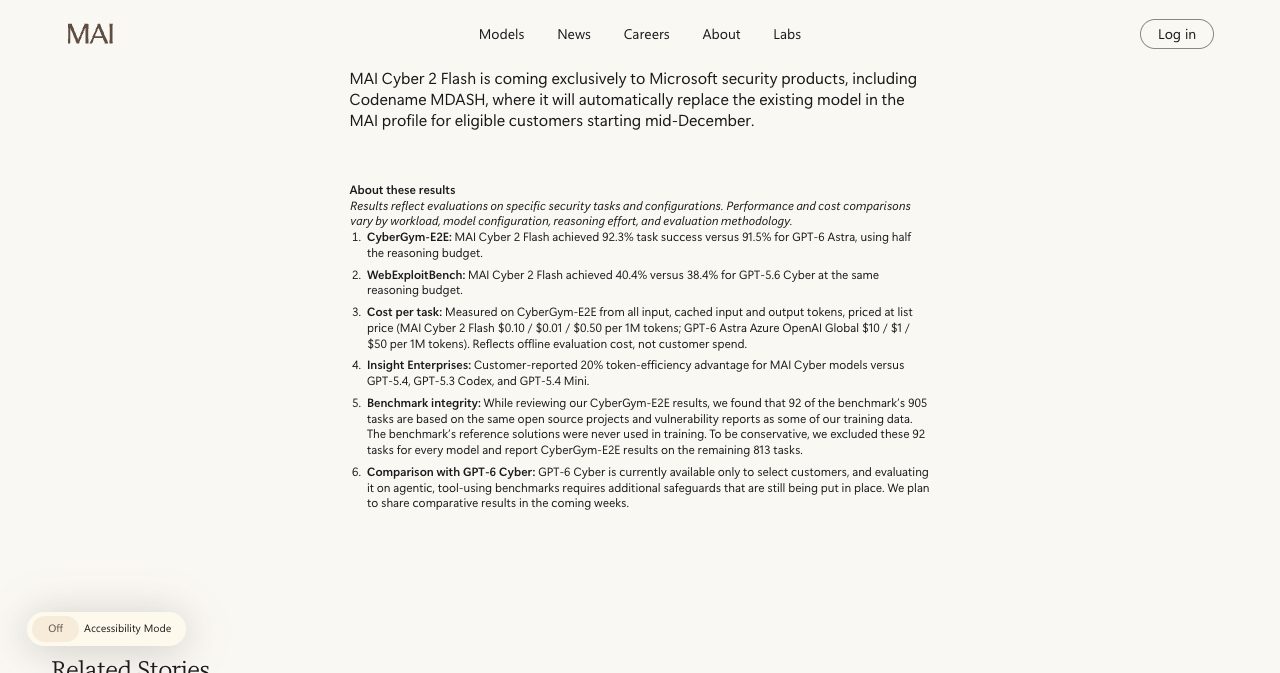
Microsoft found that 92 of the benchmark's 905 tasks drew on the same open-source projects and vulnerability reports as some of its training data, excluded them for every model, and reported on the remaining 813. That footnote makes the number less flattering and more believable, the reverse of what the promotional-price footnote does.
The rest, briefly. MAI Realtime 1 charges $0.01 per audio minute, plus $1 and $5 per million input and output tokens for reasoning, and works with the OpenAI Realtime API. MAI Image 2.7 leads Artificial Analysis image editing by four Elo points at about $35 per 1,000 images, against roughly $211 for GPT Image 2.6 Sunburst at maximum quality, per Decrypt. For MAI Licensed Weights, Microsoft cites Woven by Toyota getting ready-to-merge fixes in 44% of cases where its frontier models needed a human. And Scott Guthrie's October 12 post credits Maia 200 with "up to 1.7x more tokens per watt" for built-in AI in Teams, Copilot and Cowork, the kind of efficiency that would keep list prices low after the promotions run out.
FAQ
What did Microsoft announce at Ignite 2026?
On November 17, 2026, Microsoft AI announced seven models: MAI Code 2 and MAI Code 2 Flash for coding, MAI Cyber 2 Flash for security, MAI Image 2.7, the speech-to-speech model MAI Realtime 1, Dragon Copilot Transcribe on MAI Transcribe 2, and the routing model Microsoft-Decision-1.1. It also said its Maia 200 chip is in production at 1.7x more tokens per watt and launched MAI Licensed Weights.
How much does MAI Code 2 cost per million tokens?
GitHub's Copilot price list, checked on November 19, 2026, puts MAI Code 2 at $0.50 per million input tokens, $0.025 per million cached input tokens and $2.50 per million output tokens. That promotional rate ends on May 17, 2027, when it becomes $1.00, $0.05 and $5.00. There is no long-context surcharge or cache-write charge, and Microsoft's model card gives a 1,050,000-token context window.
Is MAI Code 2 really 5% of the cost of Claude Opus 5.5?
Only on Microsoft's terms. The 5% in its November 17, 2026 launch post is cost per benchmark task with MAI Code 2 at a 50% promotional price: $0.309 per task against $6.306 for Claude Opus 5.5, as reported by InfoWorld. Per token, MAI Code 2 is 12.5% of Opus 5.5's price now and 25% after May 17, 2027. At list price, the per-task figure is about 10%.
What happens to MAI Code 2 pricing on May 17, 2027?
GitHub's listed price doubles to $1.00 input, $0.05 cached input and $5.00 output per million tokens, and MAI Code 2 Flash goes to $0.10, $0.01 and $0.50. With the token counts from Microsoft's own benchmark run held constant, MAI Code 2 moves from about 41% to about 81% of GPT-6.1 Sol's cost per task and from about 5% to about 10% of Claude Opus 5.5's.
How does MAI Code 2 compare with GPT-6.1 Sol and Claude Opus 5.5 on benchmarks?
Closely, on Microsoft's numbers. InfoWorld reported on November 18, 2026 average pass rates of 63.2% for MAI Code 2, 64.1% for OpenAI's GPT-6.1 Sol and 65.3% for Anthropic's Claude Opus 5.5 across DeepSWE 1.1, Terminal Bench 2.1, SWE-Atlas and FrontierCode v1.1, with every model at maximum reasoning effort. Three of the four benchmarks ran on MSBench, Microsoft's internal evaluation platform.
Where can I use MAI Code 2?
Only in GitHub Copilot as of November 19, 2026: on the Pro, Pro+, Max, Business and Enterprise plans, in VS Code, Visual Studio, Copilot CLI, github.com, JetBrains, Xcode and other Copilot surfaces. MAI Code 2 Flash is also in a limited-access preview in Microsoft Foundry. Microsoft promises OpenRouter, Vercel, Hermes, OpenCode and Kilo without a date, and it does not distribute the weights.
Can I use MAI Code 2 on GitHub Copilot Free?
No. GitHub's November 17, 2026 changelog lists MAI Code 2 for Copilot Pro, Pro+, Max, Business and Enterprise only. The smaller MAI Code 2 Flash is listed for Copilot Free and Copilot Student as well as every paid plan, and GitHub's billing docs say Free and Student users reach models through auto model selection with a monthly allowance of AI credits.
What is Microsoft-Decision-1.1 and how much does it cost?
Microsoft-Decision-1.1 is a routing and classification model, generally available since November 17, 2026 in Microsoft Foundry and through OpenRouter and Vercel. It is built on Google DeepMind's Gemma 4 26B A4B, returns calibrated confidence scores and can abstain. Foundry input costs $0.042 per million tokens on Global Standard, $0.046 in the US Data Zone and $0.05 in the EU and APAC Data Zone, and output is free.
How do I test MAI Code 2 on my own codebase before switching?
Pick 10 to 15 closed issues from your tracker, freeze each starting commit and prompt, and run MAI Code 2 and your current model in GitHub Copilot CLI at the same reasoning effort. Count dollars per task that ended in a mergeable patch, have a maintainer grade the diffs blind, rerun with your usual prompt caching, and repeat the test when the price doubles on May 17, 2027.
What should you not use MAI Code 2 for?
Microsoft's own November 17, 2026 launch post says the MAI coding models are explicitly not yet tuned for fundamental science research or very long-horizon agentic work. Keep multi-hour autonomous agent runs, large migrations, security-sensitive changes and anything where a bad patch costs a day of cleanup on a stronger model until tests on your own repo show MAI Code 2 handles them.
Why would MAI Code 2 Flash cost more than GPT-6 Luna after the promotion?
At list price they cost the same per token: from May 17, 2027, GitHub lists MAI Code 2 Flash at $0.10 input and $0.50 output per million tokens, the same as GPT-6 Luna's default tier. Microsoft's claim that Flash runs at 65% of Luna's cost uses Flash's 50% promotional price, which implies Flash used about 1.3 times Luna's tokens. At list price that run costs roughly 130% of Luna's.
Are Microsoft's MAI Code 2 benchmark results independent?
Partly. Microsoft ran DeepSWE 1.1, Terminal Bench 2.1 and SWE-Atlas on MSBench, its internal evaluation platform, through GitHub Copilot CLI with subagents off. FrontierCode v1.1 scores and costs came from Artificial Analysis, which had published no separate MAI Code 2 row by November 19, 2026. Microsoft also ran the blind frontend test in which 258 annotators preferred MAI Code 2 over GPT-6 Sol 64% of the time.
The bet behind the 5%
Microsoft is betting that most coding work is routine, that routine work should cost a fraction of frontier prices, and that a router can tell the difference. On its own numbers it is mostly right about the first two. You prove the third on your own repo.
Run the seven steps this week, while the promotion makes testing cheap, and put May 17, 2027 in your calendar. Then work out the number that decides your bill: what share of your tasks truly needs the expensive model, to the percentage point?
Sources
- MAI Code 2 and Code 2 Flash: Everyday coding at scalable prices (Microsoft AI, November 17, 2026)
- Seven new world-class models at scalable price-performance (Microsoft AI, November 17, 2026)
- Models and pricing for GitHub Copilot (GitHub Docs, checked November 19, 2026)
- MAI Code 2 and MAI Code 2 Flash in GitHub Copilot (GitHub Changelog, November 17, 2026)
- GitHub Copilot is moving to usage-based billing (GitHub Blog, Mario Rodriguez, April 27, 2026)
- Billing for individual Copilot plans (GitHub Docs, checked November 19, 2026)
- Microsoft launches MAI Code 2 models to challenge OpenAI and Anthropic in AI coding (InfoWorld, Nidhi Singal, November 18, 2026)
- Microsoft unveils AI models to compete on cost and performance (TechTarget, Esther Shittu, November 18, 2026)
- MAI Code 2 pricing: $0.50/$2.50 until May 2027, then double (eesel, Rama Adi, November 18, 2026)
- MAI Code 2 pricing analysis (XenoSpectrum, Y Kobayashi, November 18, 2026)
- MAI Code 2 vs Claude Opus 5.5 vs GPT-6.1 Sol: 5% of the Cost Is a Promo Price (DEV Community, Alan West, November 18, 2026)
- MAI Code 2 vs Claude Opus 5.5 (OrcaRouter, November 18, 2026)
- Microsoft-Decision-1.1 is now generally available for fast, low-cost decision making (Microsoft Command Line, Achint Srivastava, November 17, 2026)
- MAI Cyber 2 Flash: Leading security. Lower cost (Microsoft AI, November 17, 2026)
- MAI Realtime 1: Leading voice AI at $0.01 per audio minute (Microsoft AI, November 17, 2026)
- MAI Image 2.7 (Microsoft AI, November 17, 2026)
- MAI Licensed Weights (Microsoft AI, November 17, 2026)
- Why Microsoft thinks smaller, cheaper AI can beat Claude and GPT (Decrypt, Jose Antonio Lanz, November 17, 2026)
- Microsoft's new MAI coding models are coming to Kilo (Kilo Blog, Brian Reed, November 17, 2026)
- Microsoft to expand Azure Maia system to multi-gigawatt deployments (Microsoft, Scott Guthrie, October 12, 2026)
- Artificial Analysis model leaderboards (checked November 19, 2026)
Get your SaaS in front of founders
List your product on SaaSCity for $19.99, one-time: a permanent listing and a building on the live city map.