AI Trends & Tools
Reply Argus Review: AI App Review Desk with Context Drift Detection and MCP (2026)
Reply Argus syncs App Store and Google Play reviews into a single inbox, drafts grounded replies in 100+ languages using store listings and docs, flags marketing contradictions with Context Drift Detection, and exposes 21 MCP tools for Claude and Cursor. Here is an honest review of its features, pricing, architecture, and limitations.

Contents (12)
- Key Takeaways
- Why Mobile App Reviews Still Break Developer Workflows
- The Origin: Who Is Behind Reply Argus?
- How the Core Engine Works
- Standout Features: Context Drift Detection and Signal
- Hands-On Testing: The Free Surface Area
- Plans and Pricing: September 2026 Breakdown
- Technical Architecture: 21 MCP Tools and REST API
- Competitive Comparison: Reply Argus vs Incumbents
- Security, Privacy, and Data Architecture
- The Verdict: Should You Use Reply Argus?
- Related Guides & Deep Dives
Editorial note: This review is based on hands-on testing of replyargus.com, analysis of its published technical documentation, Terms (July 1, 2026), Privacy Policy (August 25, 2026), Product Hunt launch records, and independent telemetry from the Glama MCP registry during the week of September 14, 2026. Claims originating solely from first-party marketing copy are explicitly identified.
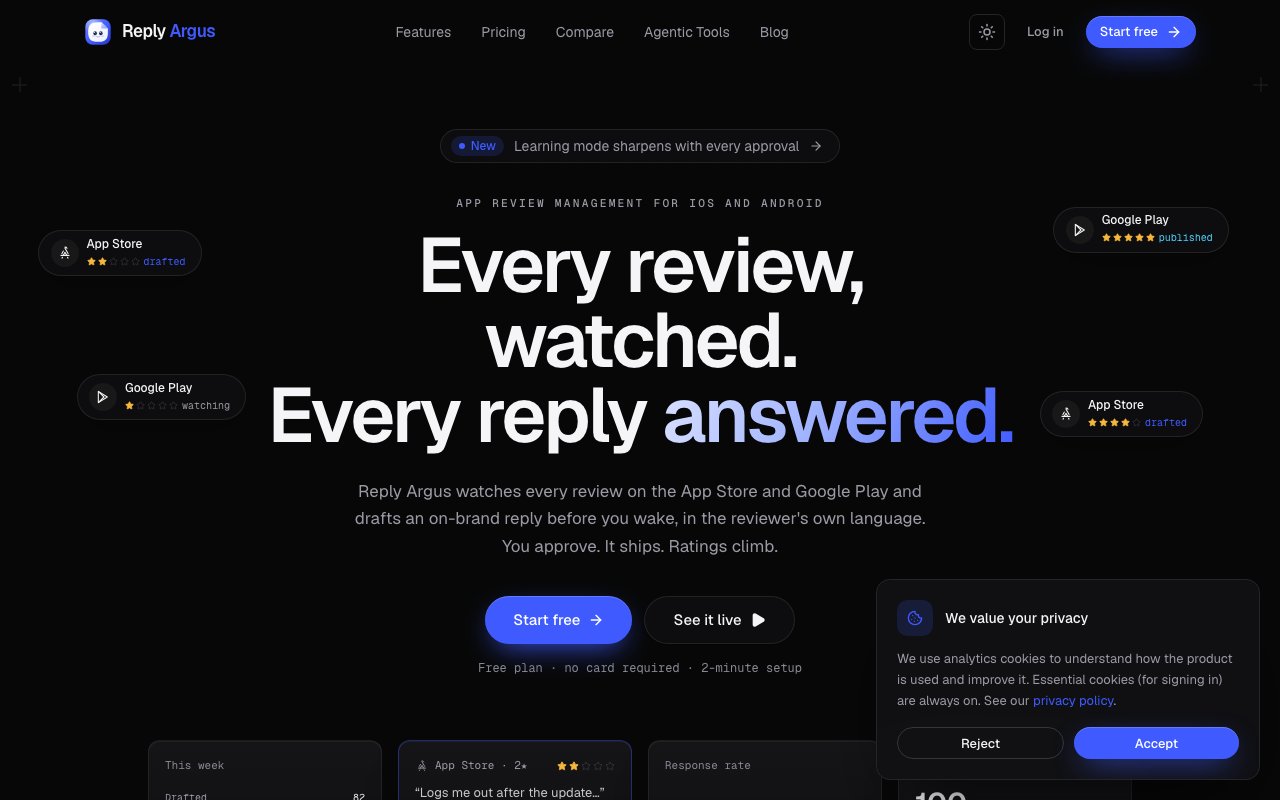
Quick answer: Reply Argus is an AI-powered app review management desk designed specifically for indie developers and mobile agencies juggling Apple App Store and Google Play reviews. Instead of treating review replies as generic LLM completions, it grounds drafts in your live store descriptions, help documentation, brand constraints, and historical approvals while enforcing platform constraints like Google Play's strict 350-character limit. It features an automated Context Drift Detection engine to catch documentation conflicts, a feedback clustering module called Signal, and a 21-tool remote MCP server allowing Claude, Cursor, and Codex agents to manage the review queue directly. Pricing ranges from a genuinely usable Free tier ($0/mo for 1 app and 100 replies) to $29/mo (Indie), $79/mo (Pro), and $299/mo (Studio).
Key Takeaways
- Grounding beats generic prompting: Drafts cite specific lines from your store listing and help docs, automatically sizing text to store constraints (such as Google Play's 350-character ceiling).
- Context Drift Detection prevents hallucinations: The engine flags contradictions between your landing pages, store listings, and custom notes before an incorrect draft reaches a user.
- Approval-first safety defaults: Auto-publishing is strictly opt-in and rule-scoped. The Free tier restricts auto-publish to 5-star reviews, keeping 1-star complaints under human supervision.
- Signal turns complaint noise into backlog priorities: Clusters recurring feedback into ranked cards (High, Medium, Low) with review evidence, exportable to Notion, Google Sheets, CSV, Markdown, and JSON.
- 21 remote MCP tools for AI agents: Exposes a Streamable HTTP Model Context Protocol server (
/api/mcp) so agents in Cursor or Claude Code can search reviews, draft replies, and query analytics. - Verified pricing structure: Free ($0/mo, 1 app, 100 replies), Indie ($29/mo, 4 apps, 300 replies), Pro ($79/mo, 10 apps, 2,000 replies), and Studio ($299/mo, 30 apps, 8,000 replies) with bundled team seats.
- Early solo-founder reality: Built by solo developer Joel Jaimon. As of September 2026, it carries minimal third-party social proof (6 Product Hunt followers, 0 PH reviews, 0 Twitter/X presence).
- Glama connector alert: The public MCP connector on Glama was registered as Unhealthy during testing on September 7, 2026, meaning developers should audit API connectivity during setup.
- Missing enterprise compliance: No published SOC 2 Type II certification, ISO 27001 audit, or formal GDPR Data Processing Agreement (DPA) language is available yet.
Why Mobile App Reviews Still Break Developer Workflows
Every developer who has shipped an iOS or Android app knows the review trap. You push an update on Friday evening, an edge case crashes an older device configuration, and by Sunday morning your App Store and Google Play listings have collected a dozen furious 1-star ratings.
The damage is not just emotional; it directly depresses organic acquisition:
- Store algorithms index customer sentiment: Both Apple's App Store search algorithms and Google Play's ranking engine actively index review text, ratings velocity, and developer responsiveness. Unanswered negative reviews pull down category visibility.
- Replies drive demonstrable rating recovery: In a widely cited empirical research study on mobile app stores (Hassan et al., IEEE Transactions on Software Engineering), researchers discovered that developers who actively reply to customer feedback are approximately 6× more likely to see a user upgrade their negative rating compared to developers who stay silent.
- Google's official benchmark confirms a +0.7 star lift: Internal Google Play data revealed that developers who respond to negative reviews see an average rating increase of +0.7 stars once users receive a helpful follow-up.
- Third-party ASO benchmarks show a massive gap: Across vendor benchmarks analyzed by AppFollow, apps maintaining consistent developer reply cadences average a 3.77★ rating, compared to 3.25★ for unmanaged app portfolios.
Despite this evidence, developer reply rates across the mobile ecosystem remain abysmal.
In an original benchmark study published by Reply Argus analyzing 36 major consumer Android apps across 10,800 qualifying reviews (collected on July 26, 2026; 300 most recent text reviews per app, older than 7 days), the median developer reply rate was a shocking 1.2%. In fact, 42% of the surveyed apps (15 out of 36) had answered exactly zero reviews in the sample. The overall pooled reply rate of 18.3% was heavily skewed by a tiny handful of aggressive corporate operators like Booking.com (97.7%), MyFitnessPal (96.7%), and Todoist (93.3%).
Why don't most teams reply? Because the native tooling is agonizing. App Store Connect and Google Play Console require separate authenticated logins, different permission structures, and completely divergent character caps. Switching between console tabs to copy-paste template apologies into translation tools burns hours of developer time that could be spent fixing actual bugs.
The Origin: Who Is Behind Reply Argus?
Reply Argus takes its name from Argus Panoptes, the all-seeing giant of Greek mythology endowed with one hundred eyes, who never slept with all his eyes closed simultaneously. The metaphor fits the problem: a vigilant watchman monitoring customer sentiment across multiple storefronts around the clock.
The Maker
On Product Hunt, Reply Argus lists Joel Jaimon as its solo maker. Jaimon's maker statement details an experience common to indie founders: he neglected user reviews on his own mobile application, 1-star ratings mounted, organic algorithmic store reach plummeted, and existing AI writing assistants produced generic, sycophantic "AI slop" that failed to address technical complaints.
Public professional records identify Jaimon as a Bengaluru-based frontend engineer who previously worked at fintech unicorn Razorpay, Immigreat, and Uptone (graduating with a B.Tech in Electronics and Communication Engineering from SRM Institute of Science and Technology, Chennai).
(Important journalistic boundary: His engineering background is relevant professional context, but Reply Argus is an independent indie project with no corporate affiliation to Razorpay).
Current Footprint and Traction
Reply Argus launched publicly on Product Hunt on July 28, 2026. While the website copy uses an agency-style plural ("Built by people who answered too many reviews by hand"), the public corporate footprint is unmistakably that of an early-stage, bootstrapped indie project:
| Traction Signal | Verified Status (September 2026) |
|---|---|
| Product Hunt Launch Date | July 28, 2026 |
| Product Hunt Category Tags | Customer Success, Developer Tools, Artificial Intelligence |
| Product Hunt Community Signals | 6 followers, 3 upvotes on maker comment, 0 reviews |
| Social Footprint | No active official X/Twitter account found (@replyargus) |
| Corporate Legal Entity | No registered company entity, physical office, or governing jurisdiction stated in Terms |
| Support Channel | Direct founder email ([email protected]) |
| Terms & Privacy Revisions | Terms updated July 1, 2026; Privacy updated August 25, 2026 |
If you are evaluating Reply Argus, understand what it is today: a polished, thoughtfully architected indie product with negligible third-party social proof. There are no venture capital press releases, no hundreds of G2 badges, and no public enterprise case studies. Its value rests squarely on whether the software works for your desk.
How the Core Engine Works
Reply Argus replaces disconnected console tabs with a unified six-stage operational loop:
App Store Connect ──┐
                    ├─► Unified Inbox ─► Grounded AI Draft ─► Context Drift Check ─► Human Approval / Rule ─► Published Reply
Google Play Console ┘         ▲                   │
                              │                   ▼
                              └──────── Signal Feedback Clustering
- Store Connection & Ingestion: You authenticate your Apple App Store Connect API keys and Google Play Developer Service Account credentials. Inbound customer reviews sync into one real-time chronological stream.
- Categorization & Sentiment Triage: Every review is automatically tagged by star rating (1★ to 5★), language detected (covering 100+ locales), user sentiment score, and app version.
- Grounded Multilingual Drafting: When drafting a reply, the model does not generate unconstrained text. It injects four distinct context boundaries:
- Your live store listing description and release notes.
- External documentation, FAQs, and help center URLs (processed via Jina AI).
- Custom Brand Facts (e.g., your designated support email, refund policy URLs, explicit "never promise" terms).
- Past approved and edited replies from your workspace history.
- Context Drift Scanning: The engine checks whether facts cited in the draft contradict recent changes across your marketing website, store metadata, or internal notes.
- Approval Workflow or Scoped Auto-Publish: Drafts sit in an approval queue where a human reviewer can approve, edit, or discard them with one click. Teams can optionally enable automated publishing scoped by specific parameters (e.g., auto-publish only 5-star reviews without body text).
- Native Store Sync & Deduplication: If an engineer replies to a review directly inside the Apple App Store Connect web portal, Reply Argus detects the live response and clears the draft from the queue to prevent embarrassing duplicate replies.
Standout Features: Context Drift Detection and Signal
Two specific features elevate Reply Argus above a bare-bones wrapper on the OpenAI or Anthropic API: Context Drift Detection and Signal.
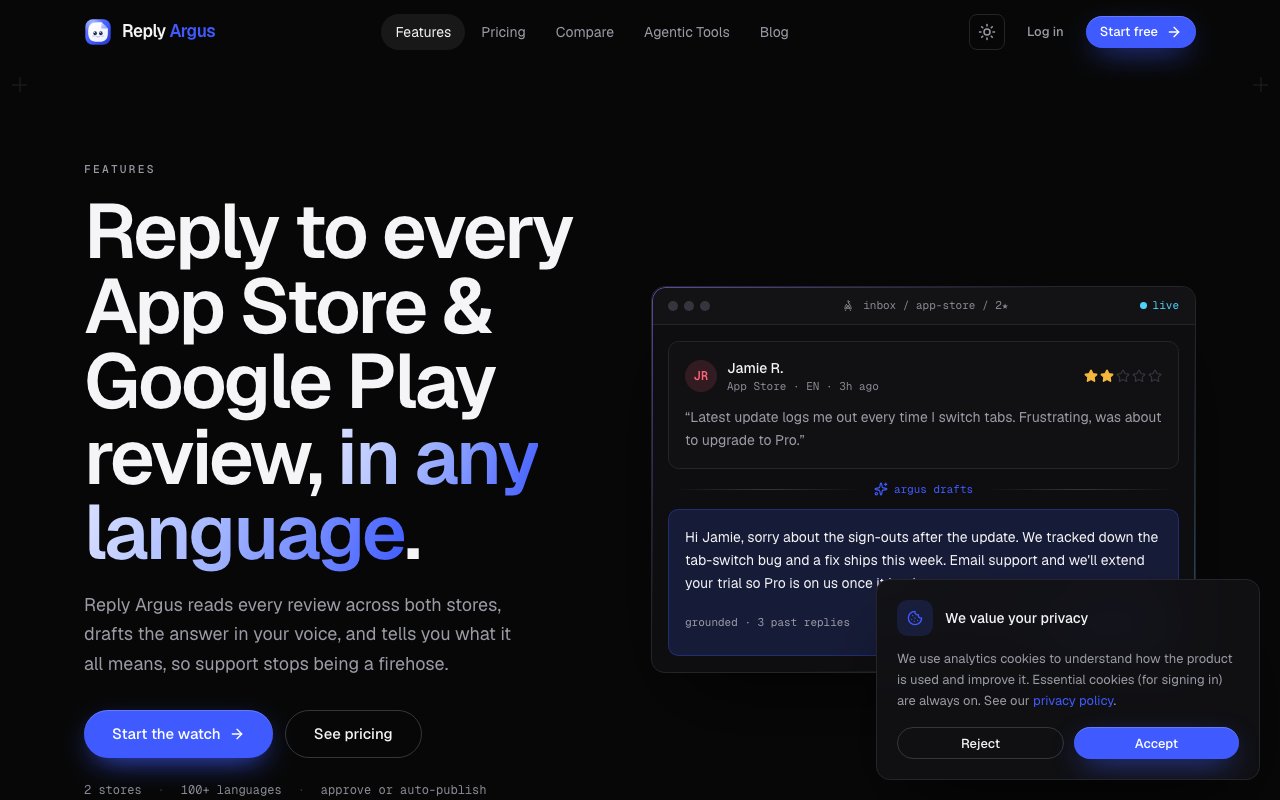
1. Context Drift Detection
In his launch notes, Jaimon highlighted Context Drift Detection as an architecture requirement he "didn't expect to build until the first production apps broke."
Mobile products evolve rapidly. A developer might change their subscription pricing model on their landing page, sunset a free cloud sync tier, or alter a refund guarantee. If the App Store description or internal prompt guidelines aren't synchronized instantly, a generic AI bot will happily hallucinate promises that contradict actual company policy (e.g., telling an angry customer to "visit settings for a full refund" when Apple handles all iOS transactions directly).
Reply Argus cross-references three independent knowledge artifacts:
- The public app listing text in the store.
- Crawled marketing and support URLs.
- Internal text notes uploaded by the developer.
If a customer complains about subscription costs, and your marketing site lists $9.99/mo while your custom notes state $14.99/mo, the system flags a Context Drift Alert directly inside the reply card before the message can be published.
2. Signal: Turning Complaints into Product Backlog
Most review tools treat customer feedback as a customer-support ticket to be answered and forgotten. Reply Argus treats customer feedback as unstructured telemetry for the engineering roadmap.
The Signal module clusters incoming reviews into semantic themes and ranks them into High, Medium, and Low severity cards based on review volume and rating trajectory.
For example, marketing materials show Signal identifying:
"Dark mode for the reader" — 23 reviews · ★ 2.1 rising sentiment impact
Each cluster card surfaces the exact supporting quotes from real user reviews, the app versions affected, and the estimated rating drag. More importantly for modern developer teams, Signal provides one-click exports into Notion databases, Google Sheets, raw CSV, Markdown tables, and structured JSON (with Jira and DevRev connectors listed on the roadmap as "coming soon"). If you run weekly sprint planning, Signal provides your product manager with pre-clustered evidence without manual tagging.
3. Store Constraint Enforcement
Writing a response for Google Play is fundamentally different from writing for iOS. Google Play enforces a hard limit of 350 characters (including spaces).
Generic AI tools routinely output 150-word corporate dissertations that fail Google's API validation. Reply Argus natively tokenizes and trims Google Play drafts to fit comfortably within the 350-character ceiling, while allowing more expansive, formatted troubleshooting steps on Apple's App Store.
Hands-On Testing: The Free Surface Area
Before committing API keys or credit cards, developers can test the Reply Argus drafting engine through three public surfaces:
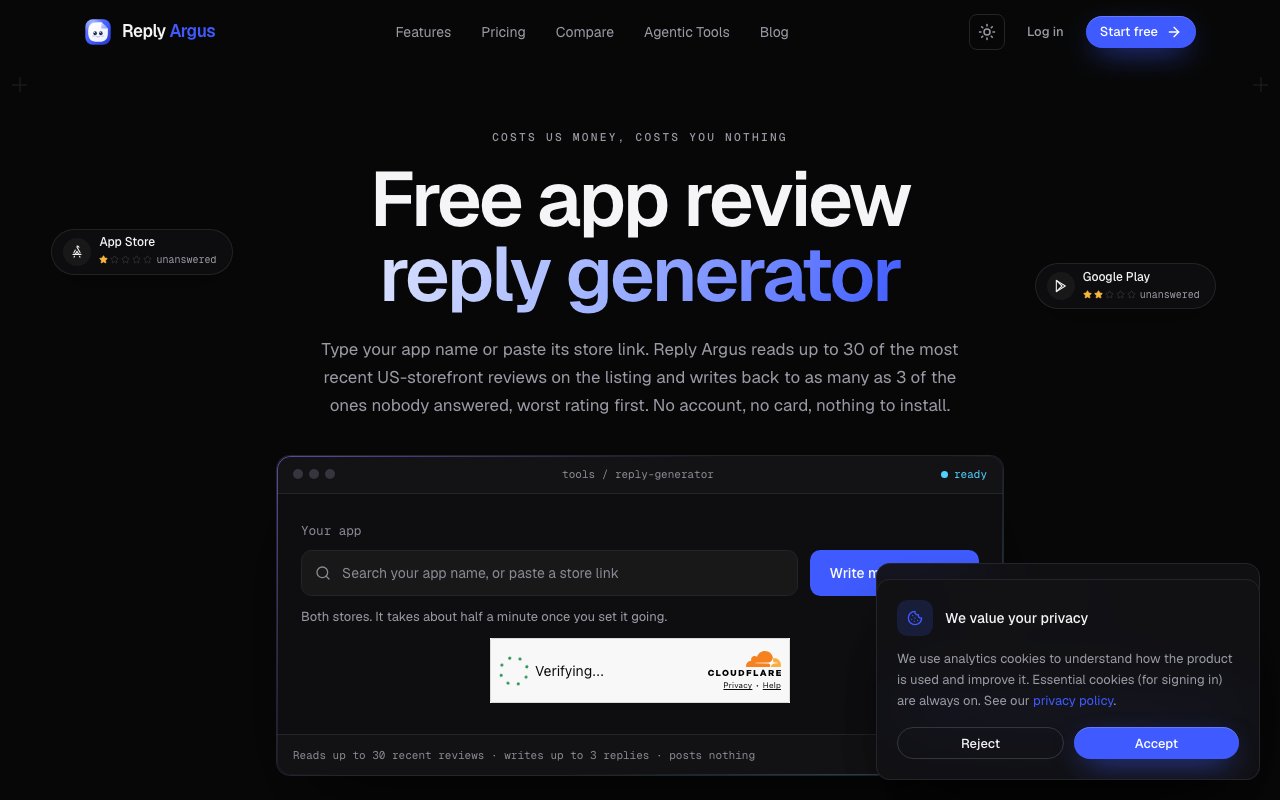
1. Unauthenticated Review Reply Generator
Located at replyargus.com/tools/review-reply-generator, this free tool allows anyone to paste a public App Store or Google Play URL to test output quality.
How the free generator operates:
- Fetches up to 30 recent reviews from the US storefront.
- Drafts up to 3 proposed replies in real time.
- Limits drafted responses to under 60 words for concise mobile readability.
- Does not publish to the stores (read-and-draft simulation only).
- Enforces guardrails: 1 connection per session, 12 runs per day per IP, Cloudflare turnstile verification, and a 6-hour caching layer.
Testing the generator on complex 1-star reviews revealed that the model avoids empty pleasantries ("We are deeply sorry for your frustration...") in favor of actionable, technical triage questions ("Could you confirm if you are on iOS 18.2? An issue affecting iCloud sync was patched in version 2.4.1").
2. The Permanent Free Tier
Unlike legacy suites that gate real functionality behind 7-day trials, Reply Argus provides a legitimate Free plan:
- Price: $0/month (No credit card required).
- Allowance: 1 active connected app, 100 replies/month.
- Capabilities: Both App Store and Google Play, 100+ languages, manual approval desk.
- Automation limit: Automated publishing is restricted strictly to 5-star ratings.
For an indie developer with a single side-project app receiving 20 to 50 reviews a month, the Free tier provides a complete, ongoing review management desk at zero financial cost.
3. Interactive Web Calculators
The site also hosts free utility calculators for mobile product managers:
- 1-Star Review Cost Calculator: Estimates customer acquisition cost (CAC) inflation caused by rating drops.
- Unanswered Reviews Revenue Calculator: Models conversion leakage based on unanswered bug reports.
- Live Google Play 350-Character Counter: An interactive sandbox for testing concise mobile reply templates.
Plans and Pricing: September 2026 Breakdown
Reply Argus prices its software on active apps and monthly reply volume, explicitly rejecting the seat-based pricing tax common among enterprise SaaS vendors. Free "Viewer" seats can be assigned to product managers, designers, or interns without consuming paid licenses.
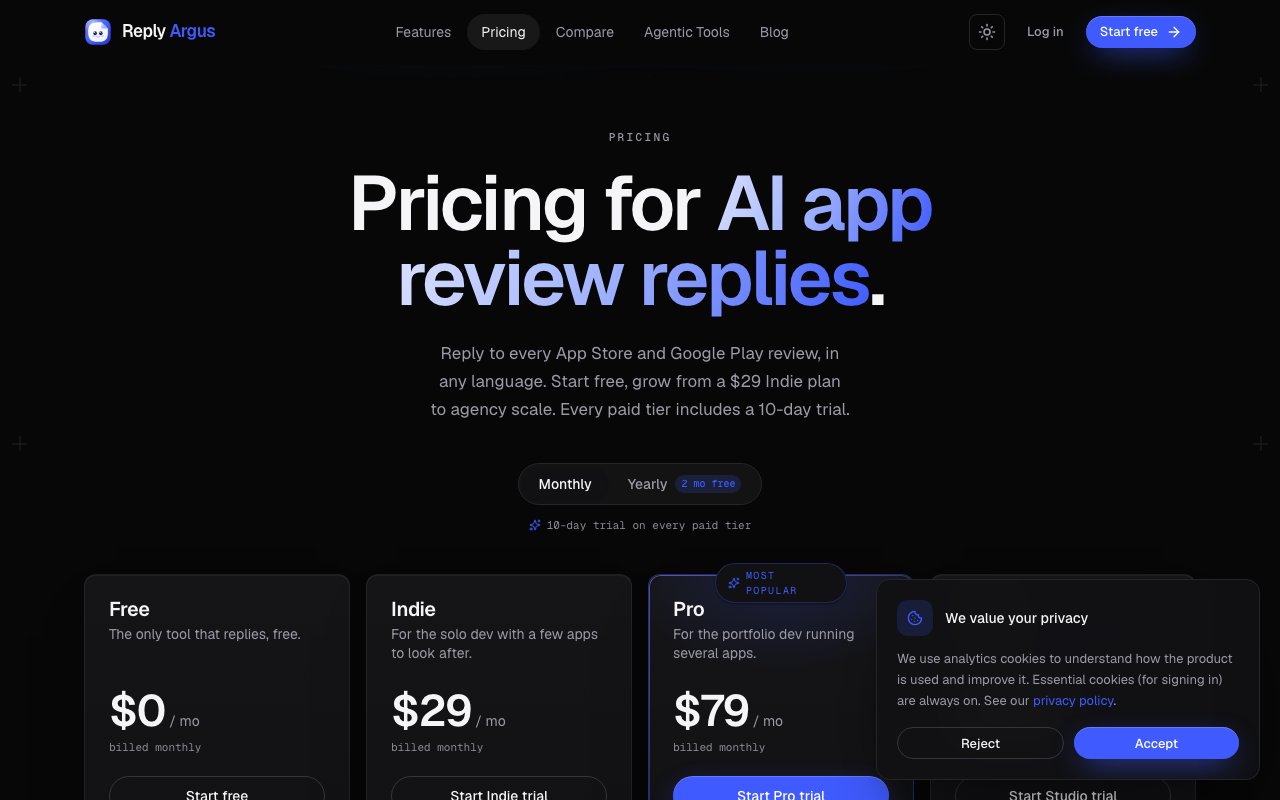
Paid subscriptions include a 10-day free trial and 2 months free on annual plans.
Plan Comparison Table
| Plan Tier | Price (Monthly) | Active Apps | Replies / Month | Included Seats | Distinct Features & Capabilities |
|---|---|---|---|---|---|
| Free | $0 | 1 | 100 | 1 | Manual review queue, 5★ auto-publish, 100+ languages, both stores |
| Indie | $29 | 4 | 300 | Included | Knowledge base syncing, custom brand voice, brand facts, Signal clustering, instant alerts |
| Pro | $79 | 10 | 2,000 | 10 | Remote MCP server, REST API + webhooks, analytics, learning mode, team scoping |
| Studio | $299 | 30 | 8,000 | 25 | Full white-labeling (custom logo/domain), multi-app roll-up analytics, priority support |
| Enterprise | Custom | Unlimited | Custom | Unlimited | Dedicated Slack channel, custom SLAs, custom security review; SSO/SAML planned |
(Note on scalability: Teams that exceed their limits can purchase prepaid reply top-up packs that roll over indefinitely, or add individual active app slots for approximately ~$12/app/month without being forced to jump an entire tier).
Technical Architecture: 21 MCP Tools and REST API
For technical readers and developers building autonomous workflows in Claude Code, Cursor, Windsurf, or Codex, the defining feature of Reply Argus is its native Model Context Protocol (MCP) implementation.
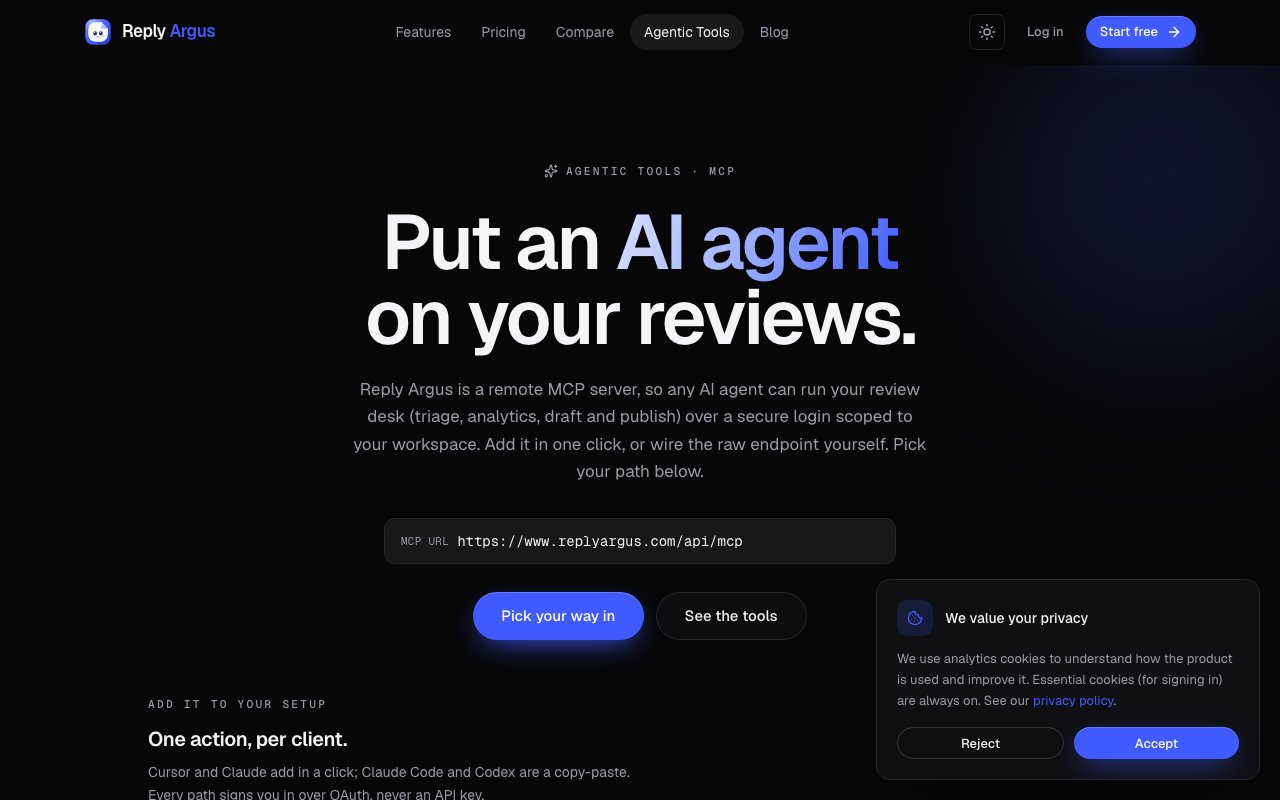
Instead of confining review management to a browser dashboard, Reply Argus exposes a remote MCP server accessible at:
https://www.replyargus.com/api/mcp
The server runs over Streamable HTTP and authenticates using OAuth 2.1 with PKCE.
The 21 MCP Tools Breakdown
The MCP server exposes 21 granular tools organized across four operational domains:
                                  Reply Argus MCP Server (21 Tools)
                                                  │
         ┌───────────────────┬────────────────────┴───────────────────┬──────────────────┐
         ▼                   ▼                                        ▼                  ▼
     Read Tools       Insights Tools                           Draft/Publish        Automate Tools
     (7 tools)          (3 tools)                                (4 tools)            (7 tools)
  search_reviews     analytics_overview                        draft_reply          sync_reviews
  list_reviews       theme_breakdown                           translate_review     toggle_agent
  get_review         weekly_report                             open_reply_card      set_draft_cadence
  list_apps                                                    publish_reply*       set_auto_publish
  list_knowledge                                               (*requires confirm)  list_rules
  usage_and_limits                                                                  create_rule
  whoami                                                                            delete_rule
-
Read & Inspection (7 tools):
search_reviews: Full-text and semantic search across app reviews by keywords, store, or version.list_reviews: Paginated retrieval with filters for star rating, locale, and published status.get_review: Fetch the complete metadata, author history, and thread for a single review ID.list_apps: Inspect all connected App Store and Google Play application IDs.list_knowledge: List connected documentation, FAQs, and brand fact guidelines.usage_and_limits: Real-time audit of monthly reply quotas and active app consumption.whoami: Verify caller identity, workspace permissions, and token scope.
-
Insights & Telemetry (3 tools):
analytics_overview: Retrieve rating trajectories, rolling averages, and response rates.theme_breakdown: Query Signal's clustered feedback topics and sentiment severity scores.weekly_report: Pull synthesized weekly performance summaries and executive readouts.
-
Drafting & Publishing (4 tools):
draft_reply: Generate a grounded response in the reviewer's native language.translate_review: Translate incoming foreign-language reviews into English (or developer locale).open_reply_card: Retrieve full draft context, source citations, and drift warnings.publish_reply: Commit and submit a reply to the store. (Crucial safety feature: this tool strictly requires explicit human tool-call confirmation before execution).
-
Automation & Governance (7 tools):
sync_reviews: Force an immediate pull from App Store Connect and Google Play Console.toggle_agent: Enable or disable autonomous background drafting.set_draft_cadence: Configure batching frequency and operational polling intervals.set_auto_publish: Programmatic control over rating and keyword auto-publish thresholds.list_rules/create_rule/delete_rule: Manage deterministic routing and tone policies.
External Telemetry Check: The Glama MCP Registry
While the architectural design of the MCP server is exemplary, external telemetry warrants transparency.
On the independent MCP registry Glama, the Reply Argus connector (com.replyargus/reply-argus) was audited on September 7, 2026, with a status of Unhealthy. In MCP registry health checks, an "Unhealthy" flag typically indicates an authentication handshake failure, a transient timeout during automated endpoint health pings, or strict CSRF/CORS blocking against generic synthetic probes.
Recommendation for developers: When setting up Reply Argus in Cursor or Claude Code, do not rely on zero-config auto-discovery. Provide your scoped Bearer token manually in your configuration file, test a simple read tool (whoami or list_apps) first, and verify that your workspace is on a Pro tier or higher (which unlocks developer API and MCP endpoints).
Developer REST API and Webhooks
For traditional CI/CD pipelines, Reply Argus provides a read-only REST API with cursor-based pagination:
GET /api/v1/apps: Returns connected application credentials and sync health.GET /api/v1/reviews?next_cursor=...: Keyset cursor pagination for high-volume review exports.
Outbound notifications are delivered via HMAC-signed webhooks with six distinct event types:
review.created, draft.created, reply.published, digest.weekly, anomaly.detected, and test.
The anomaly detection engine calculates rating trends against a rolling 28-day baseline. If an unstable app update causes an abnormal spike in 1-star ratings or review volume, webhooks fire instantly to your alerting infrastructure (supporting Slack, Discord, Telegram, or custom endpoints) with built-in cooldown periods to prevent notification floods.
Competitive Comparison: Reply Argus vs Incumbents
Reply Argus positions itself directly against heavyweight App Store Optimization (ASO) suites like AppFollow, Appbot, and Appfigures.
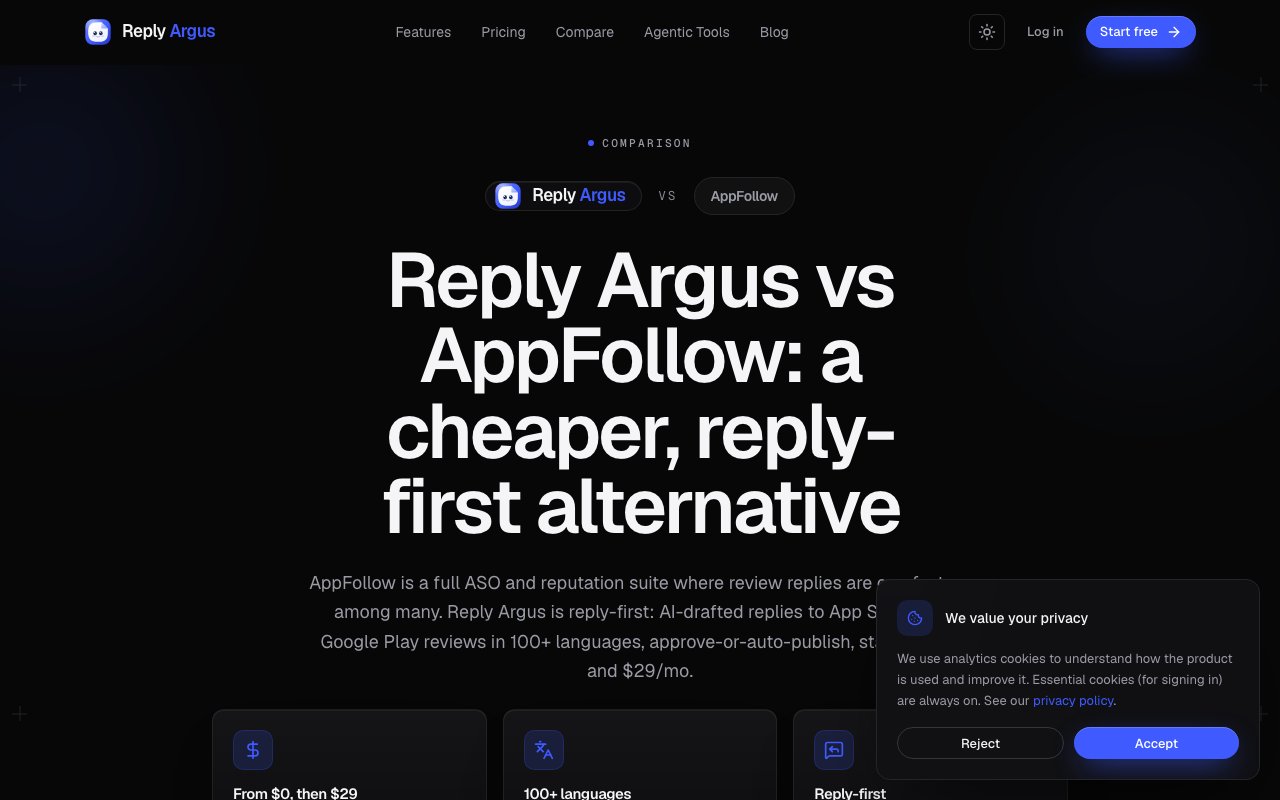
Head-to-Head Comparison Table
| Evaluation Criterion | Reply Argus | AppFollow | Appbot | Native Consoles (Apple/Google) | Dedicated AI Wrappers (AppReply, etc.) |
|---|---|---|---|---|---|
| Entry Price | $0 (Free) / $29/mo | ~$140–$250+/mo | ~$39–$89+/mo | $0 (Store account fee only) | ~$19–$49/mo |
| Pricing Model | By apps & replies | Per seat + app limits | Per app & seat | Included | Per reply / per seat |
| Unified Inbox | Yes (iOS + Android) | Yes (Comprehensive) | Yes | No (Two distinct consoles) | Yes |
| Draft Grounding | Store listing, docs, custom brand facts | Templates + generic AI | Static rules + basic AI | No AI (Apple) / Generic AI (Google) | Basic prompt templates |
| Context Drift Detection | Yes (Built-in) | No | No | No | No |
| Feedback Clustering | Yes (Signal) | Yes (Tagging & ASO) | Yes (Sentiment words) | Basic Play Console topics | Rare |
| Developer MCP Server | Yes (21 tools) | No | No | No | No |
| ASO Keyword Tracking | No | Yes (Industry standard) | Limited | Basic search query data | No |
| Competitor Ad Intel | No | Yes (Deep analytics) | No | No | No |
| Google Play 350-Char Cap | Automatic strict trim | Variable | Manual | Enforced by UI | Often errors on length |
The Honest Trade-Off
Reply Argus admits its own boundary openly: it is not an ASO suite.
If your marketing department requires keyword rank tracking across 50 countries, competitor Apple Search Ads intelligence, and organic search volume estimates, AppFollow or AppTweak remains the necessary tool.
However, if you are an engineering team or indie developer who already understands your keyword positioning and simply needs to stop hemorrhaging star ratings due to an abandoned review desk, paying enterprise seat licenses for an ASO suite is overkill. Reply Argus delivers a superior, grounded reply workflow at a fraction of the cost.
Security, Privacy, and Data Architecture
Connecting third-party software to your Apple App Store Connect and Google Play Developer Console requires rigorous scrutiny. A compromised credential can allow an attacker to alter app metadata or leak customer communications.
Here is what Reply Argus publishes regarding its data practices (Privacy Policy dated August 25, 2026):
Disclosed Subprocessors
| Subprocessor | Operational Function |
|---|---|
| Supabase | Primary relational database storage, authentication, and claimed Row-Level Security (RLS) data isolation |
| Vercel | Edge hosting, frontend application delivery, and serverless compute |
| Jina AI | Converting store listings, marketing URLs, and help documentation into clean, searchable embeddings |
| Resend | Transactional email delivery and notification alerts |
| Dodo Payments | Merchant of record and billing infrastructure (Reply Argus never stores raw credit card data) |
| PostHog | Opt-in product analytics and UI session telemetry |
| Google Ads | Marketing attribution and conversion tracking |
| Unnamed AI Providers | Foundation model inference for drafting and sentiment clustering |
Security Guarantees and Known Gaps
What they claim:
- TLS encryption for all data in transit; AES-256 encryption for data at rest.
- Store API credentials (App Store Connect API keys and Google Play Service Account JSON keys) are encrypted in the database; the team claims "we never see your raw keys."
- Multi-tenant data isolation enforced at the database layer via PostgreSQL Row-Level Security.
- Customer review text and brand documentation are explicitly not sold or used to train shared foundation models.
- A standard security vulnerability reporting protocol is published at
/.well-known/security.txt.
What is missing (The Critical Audit):
- No SOC 2 Type II or ISO 27001 certifications: As an early-stage bootstrapped project, Reply Argus has not undergone independent third-party SOC 2 auditing.
- No published Data Processing Agreement (DPA): Enterprise teams requiring standard contractual clauses (SCCs) under GDPR will not find an automated DPA workflow.
- Undisclosed AI foundation model vendor: The security documentation does not disclose whether inference runs through OpenAI, Anthropic, AWS Bedrock, or self-hosted models.
- No explicit data residency controls: Data is processed in standard US cloud regions with no option for EU-only data isolation.
For indie developers and standard consumer mobile apps, these practices match the standard baseline for modern SaaS. For healthcare, banking, or enterprise software subject to strict HIPAA or financial compliance regimes, the absence of a SOC 2 audit will be a procurement blocker.
The Verdict: Should You Use Reply Argus?
Reply Argus is one of the clearest examples of a "wedge SaaS" launched in 2026: it takes a tedious, neglected corner of mobile development—app store review management—and builds a focused, technically elegant system around it.
                                      DECISION MATRIX
                                             │
                       Is ASO keyword tracking & competitor
                       ad intelligence your primary goal?
                                    │
                   ┌────────────────┴────────────────┐
                  YES                                NO
                   │                                 │
                   ▼                                 ▼
         Choose an ASO Suite                Do you have SOC 2 /
        (AppFollow, AppTweak)               strict DPA mandates?
                                                     │
                                    ┌────────────────┴────────────────┐
                                   YES                                NO
                                    │                                 │
                                    ▼                                 ▼
                           Enterprise Console                Choose Reply Argus
                           (Native Apple/Google)             ($0 Free / $29 Indie)
Who It Is Built For
- Indie iOS and Android Developers: The Free ($0) and Indie ($29/mo) plans eliminate the review desk headache without eating your margins.
- Small Mobile Studios & Agencies: Managing 10 to 30 apps across clients with bundled seats, white-labeling on Studio ($299/mo), and isolated brand guidelines.
- Agentic Developers: Engineers using Claude Code, Cursor, or custom sidecars who want to automate their triage queue over MCP.
Who Should Pass
- Enterprise mobile teams requiring SOC 2 Type II compliance, SAML SSO, or custom legal DPAs.
- ASO marketing specialists who need daily keyword rank tracking, Apple Search Ads automation, and competitor conversion benchmarking.
Related Guides & Deep Dives
- Best MCP Servers for Claude Code and Cursor (2026) — Explore the top Model Context Protocol tools for developer agents.
- Postfleet Review: Email Infrastructure for AI Agents — How to give AI agents secure, prompt-injection-proof mailboxes.
- 7 Must-Have Tools for iOS Developers in 2026 — The essential modern stack for independent Apple ecosystem builders.
- How to Optimize Your Website for AI Citations: The Complete GEO Playbook — Research-backed strategies for winning citations in ChatGPT, Perplexity, and Claude.
- App Store Connect Missing In-App Purchases Bug: Fix Guide — Step-by-step troubleshooting for common Apple developer portal errors.
Get your SaaS in front of founders
List your product on the SaaSCity live city map - a permanent listing, real discovery, and a backlink from a high-DR directory. Free to start; upgrade for a dofollow link and a building on the map.