News
Grok Bot vs Meta Muse: xAI's AI Teammates vs Meta's Personal Agent, Every Difference That Matters (2026)
Grok Bot and Meta Muse both give an AI its own cloud computer, a real browser, and your app logins. One is a paid work teammate bundled with SuperGrok and Cursor. The other is a free consumer life agent in WhatsApp. Here is the side-by-side on architecture, safety, pricing, models, and who should use which.

Contents (18)
- Key Takeaways
- The 30-second verdict
- Side-by-side
- What each product actually is
- Why each lab built it
- Architecture: same primitive, different bets
- Features and UX
- The models underneath
- Pricing and availability
- Safety, privacy and trust
- Where each one wins
- Ecosystem and lock-in
- Limitations and open questions
- What X is saying on launch day
- Decision guide
- Where SaaSCity fits
- Common questions
- The category, not a winner
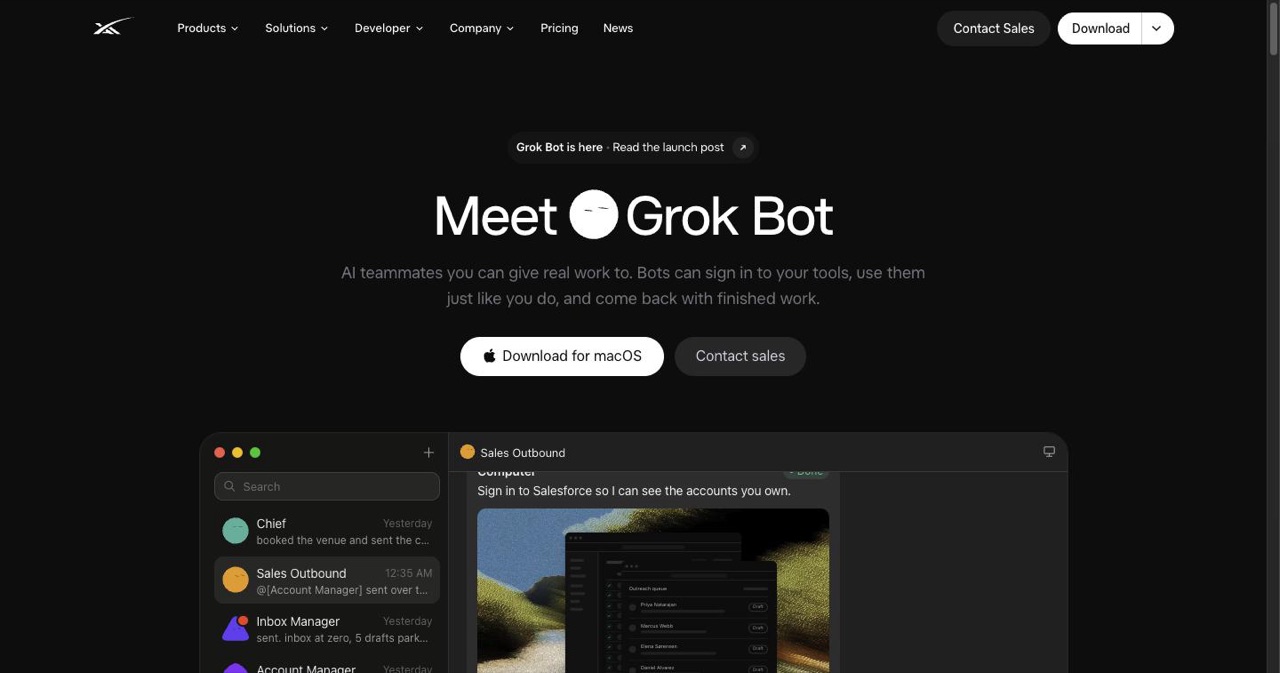
Quick answer: Grok Bot and Meta Muse both give an AI a dedicated cloud computer with a real browser and your app logins, but they are built for different people. Grok Bot, from xAI, is a set of named work teammates bundled into SuperGrok and Cursor paid plans, with routines, group chat between Bots, and an Auto Review model gating risky actions. Muse, from Meta Superintelligence Labs, is a free US-only consumer life agent in WhatsApp and the Muse app, running on Muse Spark behind a Sentinel gatekeeper, with Stripe Link one-time cards for purchases.
Facts below are as of September 8, 2026, the day Muse launched. Plan names, prices, country lists and model versions in this category change monthly. Where a claim is a company's claim rather than something independently tested, it is labeled that way.
Two frontier labs shipped "an AI with its own computer" four weeks apart, and people on X are already calling them the same product with different logos. They are not, and the differences are the whole story.
Quick disclosure, since you are reading this on a startup directory's blog: SaaSCity is a free, human-reviewed directory with a live city map where founders list what they built. We cover agent launches because founders are deciding right now which of these things to build on, sell into, or get listed next to. Nobody at xAI or Meta paid for this.
Key Takeaways
- Grok Bot shipped first: xAI opened the beta on August 11, 2026 and widened it on August 26; Meta launched Muse to US consumers on September 8, four weeks later.
- Pricing is structurally different: Muse is free for most use with Power at $20/month and Maximum at $100/month, while Grok Bot is not sold standalone and comes bundled with SuperGrok and Cursor paid tiers on a separate usage meter.
- One agent versus a staff: Muse is a single agent with hidden subagents and a Sentinel you never chat with; Grok Bot is many named Bots that group-chat and pass work to each other.
- Two different supervisors: Muse's Sentinel is an egress gate with sole authority over network traffic and real credentials; Grok Bot's Auto Review is an action gate on shell commands, plugin calls and automation writes.
- Only Muse spends money: It uses Stripe Link's agent wallet with one-time-use cards and asks before buying, while Grok Bot hands payment and two-factor steps back to the human.
- Credentials stay off the model in both: Grok Bot keeps connector tokens on Cursor's backend; Muse gives the agent surrogate tokens and splices real ones in at the network edge.
- Different models, but the harness matters more: Grok Bot runs Grok 4.5 and 4.6; Muse runs Muse Spark, which went 1.0 in April 2026 and 1.2 in August.
- Enterprise is a Grok Bot feature: SAML SSO, SCIM, audit logs, 90-day action recording and network allowlists ship on Enterprise through Cursor, US-hosted with no VPC option.
- Muse is US-only at launch: iOS, Android and muse.ai, with AI glasses announced as coming soon and no published international timeline.
The 30-second verdict
- Choose Muse if you want a free consumer agent in WhatsApp and the Muse app for shopping, travel, email, bills, grocery lists and party planning, and you are in the US.
- Choose Grok Bot if you want several specialized work agents (sales, inbox, engineering, ops) with routines, group-chat coordination, and you already pay for SuperGrok or Cursor.
- Serious users will end up running both: Muse for life admin, Grok Bot for the job. Keeping those two credential blobs apart is a feature, not a hassle.
The one-line thesis, which this article will keep returning to: Muse is designed so a non-technical person can hand off life admin. Grok Bot is designed so a knowledge worker can stand up a team that works inside real tools 24/7.
Side-by-side
| Grok Bot (xAI) | Muse (Meta) | |
|---|---|---|
| Lab | xAI, appearing as SpaceXAI on some 2026 pages | Meta Superintelligence Labs |
| Launch | Beta August 11, 2026; wider plans August 26 | US consumer launch September 8, 2026 |
| Stated category | AI teammates that finish work | Personal AI agent "built for everyone" |
| Metaphor | Coworker, or a small team | Life assistant, an extra pair of hands |
| Model | Grok 4.5 / 4.6 family | Muse Spark (1.1, 1.2, launch copy cites 1.3) |
| Runtime | Hosted cloud computer per member, browser and terminal | Muse Secure VM, dedicated Linux box with browser |
| Multi-agent | Many named Bots, group chat between them | One Muse with hidden subagents, plus a separate Sentinel |
| Interface | Thread UX on desktop and iOS, inside Grok and Cursor plans | Muse app, muse.ai, WhatsApp, AI glasses coming |
| Payments | Hands payment and 2FA to the human | Stripe Link agent wallet with one-time cards; Shop Pay and 1Password announced |
| Pricing | Bundled with SuperGrok / Cursor paid tiers, separate Bot usage meter | Free for most use; Power $20/mo; Maximum $100/mo |
| Availability | Paid Grok and Cursor subscribers, Enterprise via waitlist | US only, iOS, Android, web |
| Safety supervisor | Auto Review, independent model on risky actions | Sentinel, separate agent with sole egress authority |
| Credentials | Connector tokens stay on Cursor's backend, never on the VM | Surrogate tokens in the agent cell, real ones spliced in at the network edge |
| Training opt-out | Privacy Mode, ZDR through Cursor agreements | Settings toggle; no ad-system sharing; forget-on-command |
| Vendor-blind mode | Not offered | Confidential VM promised later in 2026 |
| Best fit | Sales, ops, engineering, inbox, CRM, overnight jobs | Shopping, travel, bills, forms, family logistics |
| Weak fit | Consumers who want zero setup | Teams needing SSO, audit trails, multi-agent orgs |
What each product actually is
Grok Bot
xAI's own definition, from the launch post: "Bots are AI teammates that do real work for you. They sign in to your tools, use them just like you do, and come back with finished work."
The concrete facts:
- Every Bot has its own cloud computer with a browser and terminal, so it can sign into apps and websites, including ones with no API or MCP server.
- Work continues after you close the laptop. You message a Bot like a colleague, in a thread, on desktop or iOS.
- A Bot learns a workflow by following along once, then saves it as a routine that runs on a schedule or a trigger.
- You can run many Bots, put them in a group chat, and let them pass work between themselves so you are not the middleman.
- Predefined roles ship for sales outbound, talent scouting, paid media, expenses, product performance, bug reproduction, account health and chief of staff.
- Bot usage is a separate pool from your Grok and Cursor chat quotas.
It was dogfooded inside xAI for sales outbound, marketing, office ops and bug fixes before the public beta. The line the company keeps repeating: "There is a huge difference between 90% done and 100% done."
A naming point that trips people up every day. Grok is the chat assistant. Grok Bot is the @bot product at x.ai/bot. If you want the hands-on version of what a Bot can do this week, we already published ten things you can do with Grok Bot, plus the skill packs worth installing. This post is the comparison, not the tutorial.
Meta Muse
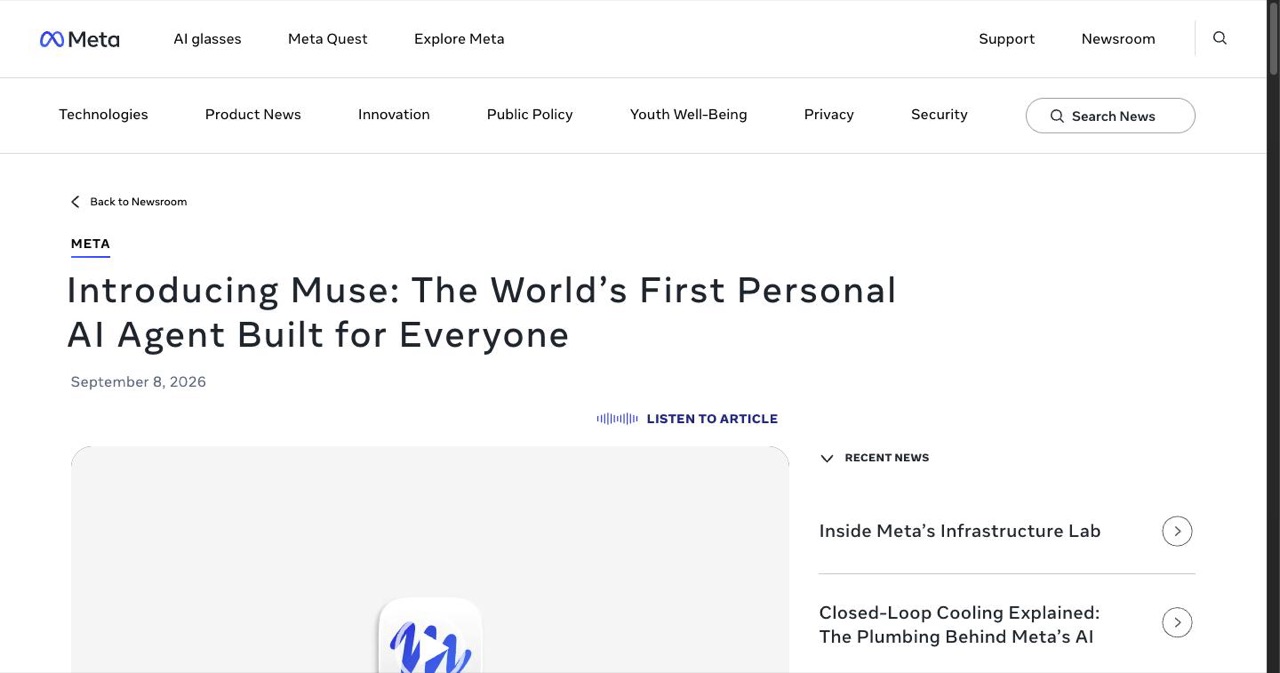
Meta's definition, from the launch announcement: "Muse is a personal AI agent. It doesn't just answer questions, it actually does the work."
The concrete facts:
- Powered by Muse Spark, the Meta Superintelligence Labs model family.
- Runs on the Muse Secure VM, a dedicated Linux computer in the cloud with its own browser, storage and the ability to compile code and run scheduled jobs.
- You talk to it in the Muse app or in WhatsApp, in one long-running conversation rather than turn by turn.
- It is proactive: it suggests ideas from your goals and patterns and only notifies you when something is meaningfully new.
- It keeps working after you close the app and comes back for approval before sending an email or buying something.
- Built-in connectors, the ability to author its own API connections when a public API exists, and a browser fallback for everything else.
- Payments through Link by Stripe, whose wallet for agents issues a one-time-use card so your real card details stay hidden. Shop Pay and 1Password are announced.
- US only at launch, on iOS, Android and muse.ai. AI glasses "coming soon."
Meta calls it "the world's first personal AI agent built for everyone" and says there is "no learning curve." Attribute both to Meta. The Verge is blunt that it is not first of its kind, and files it next to Grok Bot, Claude Cowork and ChatGPT Work, with ease of use as the wedge Meta is betting on.
Things not to mix up
| Name | What it is |
|---|---|
| Grok | xAI's chat assistant on grok.com, X and the apps |
| Grok Bot | Persistent cloud-computer teammates, the subject of this post |
| Grok Build / Muse Code | Terminal coding agents, separate products |
| Muse Spark | Meta's foundation model family |
| Muse Image / Muse Video | Meta's media generation models |
| Muse Glimmer | Meta's 30B open-weight agent model, Apache 2.0 |
| Meta AI | The older assistant inside FB, IG and WhatsApp, not the Muse agent |
Why each lab built it
xAI built Grok Bot as a teammate first and a product second. The product language is all about finishing, the distribution is through Cursor and SuperGrok subscribers, and the multi-Bot team metaphor maps onto how sales, ops and engineering orgs already work. Its competitive set is Claude Cowork, ChatGPT Work, Hermes Bot Mode and the enterprise agent vendors. If you want the background on how this category formed, we walked through it in the "claw" era of agentic AI systems.
Meta built Muse as the consumer expression of Zuckerberg's "personal superintelligence" pitch after the multi-billion-dollar rebuild of its AI org into Meta Superintelligence Labs. The model line went Spark in April 2026, Image and Video in July, Muse Code in August, and now the consumer agent in September. The distribution advantage is obvious: WhatsApp, Instagram, Facebook, and the Ray-Ban glasses line. The design problem Meta admits to is instructive. Early testers did not know where to start because the agent could do too much, so Muse now generates unprompted suggestions.
The market context is that 2026 is the year agents left the demo and got a computer. Nearly every lab now sells some mix of persistent VM, browser use, connectors, background jobs and approval gates. Differentiation has moved to who it is for, how hard it is to start, how credentials are isolated from the model, and which apps it already lives inside.
Architecture: same primitive, different bets
Both products implement the same new pattern:
- An isolated cloud computer per user
- An agent process that can browse and call tools
- Stored credentials the model is not supposed to see
- A policy or approval layer between the agent and the internet
- Persistent memory and background execution
- A human in the loop for irreversible actions
Where they diverge is instructive.
Grok Bot under the hood
From the security documentation:
- Isolation. Each member gets a dedicated hosted computer. Members cannot reach each other's machines.
- One computer per member, shared by that member's Bots. All of your Bots share files and logins. If a workload needs separate credentials, the guidance is to use a separate Cursor user.
- No Bot identity. A Bot "has no identity or credentials of its own." It acts as the signed-in member, cannot exceed that member's access, and every action is attributable to a named person. Team connectors can use service accounts as the exception.
- Credentials off the VM. Connector tokens stay on Cursor's backend. Bots invoke tools without receiving OAuth tokens. Login, two-factor and payment steps are handed to the human.
- Auto Review. An independent review model evaluates risky actions before they run: shell commands, plugin calls, computer use, automation writes, subagent launches. It can allow, require approval, or deny, and each member controls their own setting.
- Network. Enterprise destination allowlists for domains and IP ranges. Teams without a policy default to allow-all. Computers run in the United States. No on-prem, no customer VPC.
- Privacy. Privacy Mode keeps customer data out of training. Zero Data Retention follows Cursor's existing provider agreements.
- Enterprise. SAML SSO, SCIM, audit logs, and action recording retained 90 days, all Enterprise-only.
The thing to notice is that Grok Bot is operationally a Cursor-hosted product as much as an xAI model product. That matters if your security team is the one signing off.
Muse under the hood
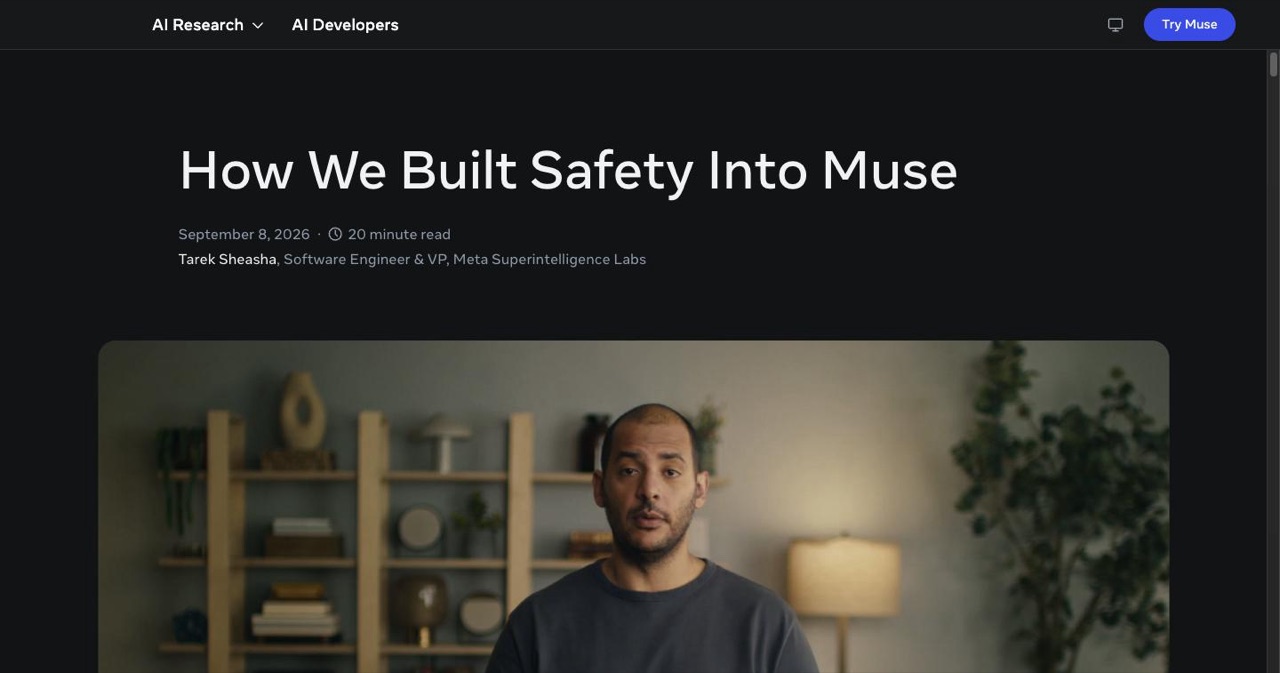
From Meta's safety and security post:
- Secure VM. A dedicated cloud Linux machine per user, holding data, credentials and the agent.
- Runtime cell. The Muse harness runs in a
systemd-nspawncontainer with unprivileged root, a separate Debian root filesystem, filtered syscalls and limited capabilities. - Services outside the cell. Safety classifiers, privilege-separated workers, the credential store, Postgres, proxies, and Sentinel all sit on the host, not inside the agent's container. Communication is over Unix sockets with peer-credential access control, so no secrets live in the agent cell.
- Sentinel. A separate host-side agent that is the sole permission authority for connector actions and network egress. Muse proposes, Sentinel allows, denies or asks you. Meta's line: "Nothing Muse does reaches the internet unless the Sentinel approves it." Approvals go to the client UI rather than through the Muse chat, which makes it harder for a compromised main agent to social-engineer the approval path.
- Taint tracking. eBPF monitoring marks any process that has read user data, and its outbound requests are treated as higher risk and routed to explicit consent.
- Surrogate credentials. The agent gets temporary surrogate tokens. Sentinel substitutes real ones only at the network boundary. Browser passwords are captured in the client UI and go to the credential store, never into model context.
- Browser sub-agent. Sees an accessibility tree, not the raw DOM. No JavaScript execution, no devtools, no access to stored credentials, and it pauses when you take over.
- Email connector. Deterministic filters plus classifiers strip password-reset links, magic links and one-time codes, so the agent cannot be walked into an account-takeover chain.
- Confidential VM. Promised later in 2026: the whole VM encrypted with a key only you hold, so Meta says even Meta cannot read it.
- Bug bounty. Up to $130,000 for a successful prompt injection against an individual user, with program maximums up to $300,000.
- Ads. Conversations and VM data are not shared with Meta's ad systems, per Meta. The same post admits Muse's browsing looks like your browsing to the open web and can influence targeting indirectly.
What the two designs say
- Both isolate users on dedicated VMs.
- Muse publishes a far more detailed public threat model: Sentinel, taint tracking, privilege separation, and a roadmap to cryptographic vendor-blindness.
- Grok Bot publishes the more enterprise-shaped governance model: SSO, audit export, Auto Review policies, admin termination of computers.
- Grok Bot runs many Bots on one shared computer per user. Muse runs one agent with a hard-separated gatekeeper on the same machine.
- Muse is building toward "the vendor cannot see it." Grok Bot is building toward "the admin can see everything."
Features and UX
Interaction model. Grok Bot is "message a teammate." Several named Bots, a group chat so you are not the relay, routines learned by demonstration, and work-shaped jobs like overnight pipeline generation, CRM hygiene and invoice processing. Muse is "message a person" in one long conversation you can interrupt or load up with several tasks at once, with persistent memory across chats and optional separate project contexts, and life-shaped jobs like turning a saved recipe reel into a grocery order or planning a dinner party around friends' dietary restrictions.
Proactivity. Muse is explicitly proactive. It generates ideas from your goals and patterns and notifies you only when the result is worth surfacing. Grok Bot is described as growing more proactive over time, following up dropped threads and nudging stalled handoffs, but the launch emphasis is handoff and routines, not unsolicited suggestions.
Learning. Grok Bot: watch me do it once, save it as a routine, run it forever. Early users quote two to three times efficiency and "trust it to run forever." Muse: learns from conversation, acts on details you mentioned once, and forgets on command.
Connectors and computer use. Both have first-party connectors and a browser fallback when no API exists. Muse's launch coverage names Google Workspace, Ticketmaster, OpenTable, Spotify, Apple Health, the Meta apps and Stripe Link, and Meta says it can author its own connection when a public API exists. Grok Bot's examples are Gmail, Salesforce, Google Sheets, LinkedIn, Zendesk, Slack, ServiceTitan, domain registrars, support portals, and anything a human can click.
Multi-bot versus subagents. This is a real product difference, not marketing. Grok Bot's multi-agent model is a user-visible org chart: you hire a researcher, a writer and a chief of staff and they message each other. Muse's multi-agent model is an internal swarm: Spark was trained to be both a planner and an obedient subagent, you still talk to one Muse, and Sentinel is a second agent you never chat with. If you want to see the same fork inside a coding tool, our guide to Claude Code subagents and agent teams covers how the visible-team model works when the "teammates" are all yours.
Coding. Grok Bot sits next to Cursor and Grok Build, so its engineering story is natural: a bug-reproduction Bot, a website builder that buys the domain and deploys. Consumer Muse is not positioned as an IDE agent. Meta's coding product is Muse Code, a separate terminal agent co-trained with Spark 1.2. Do not expect the consumer Muse app to replace it.
Real-time data. The Grok stack's historical edge is live web plus X search, which is useful for research, sentiment and market-monitoring Bots. Muse has web search and actions but is not sold as a real-time social firehose.
The models underneath
Keep this dated. Benchmarks move weekly.
Muse Spark. April 8, 2026: Spark, the first MSL public model. July 9: Spark 1.1 with agentic tool use, a 1M-token context and the public Meta Model API. August: Spark 1.2, coding-first and co-trained with Muse Code, priced around $1.25 in and $4.25 out per million tokens on the standard tier. Launch-week Muse copy references Spark 1.3. The open counterpart is Muse Glimmer, a 30B Apache 2.0 model released August 10.
Grok 4.x. Grok 4.5 went public around July 8, 2026, pitched as Opus-class, faster and cheaper. Grok 4.6 is referenced in Bot launch week and later plan copy. API pricing sat around $2 in and $6 out per million below the long-context threshold.
Third-party comparison blogs tend to give Spark the edge on tool orchestration and agentic harness scores and Grok 4.5 the edge on speed, with at least one August 2026 writeup putting Grok 4.5's hallucination rate far above Spark 1.2's on a specific eval. Treat that as one lab's number. More to the point, none of those posts tested the Muse product or the Grok Bot harness. Spark is not the Muse app. Grok 4.5 is not Grok Bot.
The honest conclusion: do not declare a smarter model. Consumer Muse quality is Spark plus the Secure VM plus Sentinel plus Meta's connectors. Grok Bot quality is Grok 4.x plus the Cursor computer plus Auto Review plus the multi-Bot UX. For agent products, harness and permissions matter at least as much as raw capability, which is a point we keep coming back to in why newer models keep breaking agent tool calls.
Pricing and availability
Grok Bot is not sold standalone. On August 11 it shipped with SuperGrok, Plus and Heavy, Cursor Pro, Pro+ and Ultra, and Cursor Teams Standard and Premium, with Enterprise on a waitlist. The August 26 update confirmed it is "included with more plans" and that "Grok Bot comes with its own usage, separate from your Grok and Cursor plans." Check live plan pricing on x.ai/bot before you budget; the plan list has already changed once.
Muse is free for most of what people need. Paid tiers are Power at $20 a month and Maximum at $100 a month, per TechCrunch, with a usage meter and a warning before overage. US only at launch. Do not confuse these with Meta Model API token pricing or Muse Code subscriptions, which are separate products with separate bills.
The positioning is the point. Meta is playing distribution plus a free tier. xAI is playing high-willingness-to-pay knowledge workers who already pay for Cursor or Grok. A heavy Grok Bot user may already spend two orders of magnitude more per month than a Muse Power subscriber, and that is a statement about who each agent was hired for, not a simple "which is cheaper."
Safety, privacy and trust
An agent with your inbox, calendar, browser and payment method is a new category of risk: prompt injection, data exfiltration, unauthorized purchases, account takeover, and silent training on intimate data. Trust dominates this comparison for good reason.
Muse's trust story
Meta's claims: a first-of-its-kind Secure VM, a Sentinel Muse cannot override, a model that never sees passwords or card numbers, approval before send or buy, a full audit trail, per-connector least privilege, no sharing with ads systems, a training opt-out, a forget command, and the Confidential VM later this year. Spark is trained for injection awareness, and the classifiers live outside the runtime cell.
The due-diligence context, not as a smear: Meta has a long privacy enforcement history, and Muse launched less than two weeks after Meta's reported $18 billion multistate settlement over social-media harms. TechCrunch's framing is that the agent requires more personal data than social media ever did. Browser activity still looks like yours to the open web. Confidential VM is roadmap, not launch-day default. "World's first" is marketing.
Grok Bot's trust story
xAI's claims: per-member isolation, no Bot-owned identity, tokens off the VM, humans complete 2FA and payments, Auto Review independent of the acting model, Privacy Mode and ZDR through Cursor, enterprise audit and export, and untrusted-content labeling.
The context: all of a user's Bots share one computer, which means lateral movement between Bots inside one VM is possible by design. There is no customer VPC. The wider Grok family had prompt-injection research published against Grok chat in August, a Grok Build repo-upload incident in July where marketing had said code stayed local, and prior-year controversies about training on X data. Expert commentary in late August argued that some of the controls that would make Bot enterprise-safe live on a tier that cannot yet run Bots. Mention, do not treat as fact.
Head-to-head
| Grok Bot | Muse | |
|---|---|---|
| Isolation unit | One hosted computer per member | One Secure VM per user |
| Supervisor | Auto Review, action gate | Sentinel, egress gate |
| Model sees real credentials | No, tokens stay on Cursor backend | No, surrogate tokens only |
| Payment path | Human completes it | Stripe Link one-time card, with approval |
| Training default | Privacy Mode available | Sanitized data by default, opt-out in settings |
| User-facing audit | Action recording, Enterprise | Audit trail of what it did and plans to do |
| Enterprise SSO / audit | SAML, SCIM, logs on Enterprise | Not a consumer feature |
| Vendor-blind mode | None | Confidential VM, later 2026 |
| Public threat model essay | Security docs | Full architecture post |
Neither vendor has a long production track record for personal agents with payment and email. Architecture papers are necessary, not sufficient. Start with read-only connectors, require approval on every send and every payment, and read the audit log for the first few weeks. If you ship in the EU, note that Muse is US-only and that anything you build on either agent inherits the obligations in the EU AI Act.
Where each one wins
Muse-shaped jobs. Turning saved Instagram reels into a grocery list, comparing prices and ordering. Booking travel, tennis lessons, movie tickets. Sending party invites with remembered dietary restrictions. Filling school permission forms. Selling a car for more or getting a bill lowered, both Meta's own examples. Keeping a long personal goal on track when life shifts. Texting it from WhatsApp, and eventually from glasses.
Grok Bot-shaped jobs. From xAI's own list of jobs Bots do today: a sales prospector that researches, enriches and drafts outreach and leaves sends for approval. A website builder that builds, buys the domain, deploys, and wires redirects. A digital declutterer that audits email, Drive and subscriptions and acts only on approval. Customer support handling routine refunds within policy. An office manager working across Gmail, Slack, ServiceTitan and vendor portals. An inbox manager leaving only the human-needed messages. A meeting stand-in that joins, takes notes and summarizes. Inside xAI: CRM updates from call transcripts, onboarding hires with invoices, reproducing a UI bug and handing it to a debugging Bot.
The overlap. Email, calendar, research, travel, shopping and form-filling exist on both. The difference is tone and orchestration. Muse is one helper for your life. Grok Bot is a staff.
Ecosystem and lock-in
Meta's gravity is WhatsApp, Instagram memory, Facebook Marketplace, the glasses, Stripe Link and your Meta account. Easiest on-ramp for anyone already living in Meta's apps. Hardest if you refuse to deepen Meta's data access.
xAI's gravity is X's real-time data, the Grok apps, the Cursor IDE, SuperGrok billing and enterprise through the Cursor dashboard. Easiest on-ramp for developers, operators and teams already paying for either.
Both store memory, routines and credentials in a vendor VM. Moving an agent's accumulated "how I like things done" to a competitor will hurt. Treat early connector grants as a relationship, not a chatbot trial.
Limitations and open questions
Grok Bot. Still framed as beta. Paid-gated. Bots share one computer. No on-prem. Consumer simplicity is not the design center, and the safety docs are less "personal life plus payments" shaped than Muse's.
Muse. US-only on day one. No reliability data. "No learning curve" is a claim. Trust overhang from Meta's history. Confidential VM not shipping at launch. Team and coding workflows live in other Meta products. Free-tier limits are unpublished beyond "most people stay free."
Both. Prompt injection is an unsolved class of bug. Browser agents break when sites change. Approval fatigue turns humans into rubber stamps. And no independent head-to-head product evaluation exists as of September 8, 2026, so anyone announcing a winner today is guessing.
What X is saying on launch day
Voice of customer, not fact. The framing that keeps repeating: "Muse = personal assistant. Grok Bot = AI coworker." The fatigue post listing Poke, Instinct, Manus, Grok Bot, Hermes, OpenClaw and Muse under "how many agents are you guys building?" And the neologism of the week, "AaaS, agent as a service." Grok's own account summarized the split the same way this article does: same VM idea, different focus and access.
Decision guide
Choose Muse if you want the lowest-friction consumer setup, WhatsApp is already how you message, your tasks are life admin and shopping, you want a free tier to experiment, you value the published Sentinel and Confidential VM roadmap, and you are in the US.
Choose Grok Bot if you want several specialized agents collaborating, your work happens in a CRM, a codebase, an inbox and internal tools, you already pay for SuperGrok or Cursor, you need team admin, SSO and audit trails, you care about X and live research loops, and you think in routines and overnight jobs.
Use both if life admin and job admin should not share one memory and credential blob, and you can afford the Grok or Cursor plan while still wanting Muse's consumer connectors.
Use neither yet if you are in a regulated industry without a finished security review, you are unwilling to grant email or payment access, or you need on-prem or vendor-blind compute today.
Where SaaSCity fits
If you are building on either of these, or building the thing that competes with them, the distribution problem is the same one every agent startup has this month: buyers cannot tell your product from the eight others in the fatigue tweet. A second source that says plainly what your agent does, who it is for and what it will not do is worth more than another page on your own domain saying the same thing, and it is the kind of passage AI assistants pull from when someone asks "what is X." SaaSCity reviews every submission by hand, and the listing is free. If the answer-engine side of that matters to you, the GEO playbook covers the rest.
Common questions
Is Meta Muse the same as Meta AI? No. Meta AI is the older assistant inside Facebook, Instagram and WhatsApp. Muse is a separate personal agent on its own cloud computer, on the Muse Spark model, that can sign into your accounts and act. It happens to be reachable from WhatsApp.
Is Grok Bot the same as Grok? No. Grok is the chat assistant. Grok Bot is named teammates on a persistent cloud computer with a browser and terminal, with its own usage meter.
Which launched first? Grok Bot, in beta on August 11, 2026. Muse followed on September 8.
Do both have their own computer? Yes. A hosted computer per member for Grok Bot, shared by that member's Bots. A Muse Secure VM per user for Muse, with Sentinel gating all traffic.
Can they spend money? Muse can, through Stripe Link's one-time agent cards, with approval. Grok Bot hands payments and 2FA back to you.
Can they send email without asking? Both default to asking before a send. Keep it that way.
Which is cheaper? Muse: free, then $20 or $100 a month. Grok Bot: no extra cost if you already pay for a qualifying SuperGrok or Cursor plan, and not available otherwise.
Which is safer? Neither has a track record. Muse publishes the deeper threat model and a vendor-blind roadmap. Grok Bot publishes the stronger enterprise governance set. Start read-only on both.
Does Muse work outside the US? Not at launch.
Can enterprises get Grok Bot? Yes, through Cursor Teams and an Enterprise waitlist, with SSO, SCIM, audit logs and allowlists. US-hosted, no VPC.
What model powers each? Grok 4.5 / 4.6 for Grok Bot. Muse Spark for Muse.
What is Sentinel versus Auto Review? Sentinel is Muse's separate egress and credential gatekeeper. Auto Review is Grok Bot's independent reviewer of risky actions. One gates the network, the other gates actions.
Will they train on my data? Both offer opt-outs: Privacy Mode on Grok Bot, a settings toggle on Muse. Muse also promises no ad-system sharing and a forget command.
How is this different from ChatGPT or Claude agents? Same primitive, different distribution. Claude Cowork and ChatGPT Work are work-shaped like Grok Bot. Muse's difference is the consumer free tier, WhatsApp and Stripe wallet.
Should I connect my bank? Not in the first month. Use Muse's one-time cards with a spending cap if you must, and let Grok Bot hand payments back to you, which it does anyway.
The category, not a winner
Personal agents with their own computers are no longer a research demo. In four weeks the market got a work-native multi-Bot product from xAI and a consumer-native life agent from Meta. The differences that matter are audience, orchestration (a team versus one helper), distribution (Cursor and Grok versus WhatsApp and glasses), the price gate, and how each lab keeps credentials away from the model. Capability will leapfrog month to month. Trust architecture and where the agent already lives will decide which one actually gets used.
Get your SaaS in front of founders
List your product on the SaaSCity live city map - a permanent listing, real discovery, and a backlink from a high-DR directory. Free to start; upgrade for a dofollow link and a building on the map.