SaaS Business
Your Startup Idea Already Has Competitors. Only 6% of Failed Startups Were Outcompeted (2026)
You searched for your idea and found five companies already doing it. Before you shelve it: in CB Insights' 2026 study of 385 failed startups, only 6% died because a rival beat them, while 43% never found product-market fit. Here's a seven-day teardown for deciding whether to build, narrow or walk, with the review-mining method we use, the wedges incumbents won't copy, and the mistakes that make competition actually dangerous.

Contents (15)
- At a Glance: What Competitors Usually Mean
- Why Finding Competitors Is Usually Good News
- When "No Competitors" Is the Real Red Flag
- The Four Kinds of Competitor (and the One Founders Forget)
- Is the Market Beatable? Read the Shape of the Crowd
- The 7-Day Competitor Teardown
- How to Mine Competitor Reviews for Your Roadmap
- Write Your Wedge Sentence
- Choose a Wedge the Incumbent Won't Follow
- Founders Who Walked Into Crowded Markets
- Measure Whether Your Wedge Is Working
- Mistakes That Make Competition Actually Dangerous
- Get Found Where People Compare Alternatives
- Build, Narrow or Walk: Making the Call
- FAQ
You had the idea in the shower. By lunch you'd named it. That night you typed it into Google, and there it was: a polished landing page, a pricing table, a customer logo bar and a "Trusted by 10,000 teams" banner. Then a second one. Then a G2 category page with forty more.
Most founders hit this moment, and a lot of them quietly close the notes app. That's usually the wrong move.
Quick answer: If your startup idea already has competitors, treat it as proof that people want the problem solved, then find out why they're still unhappy. Only 6% of the failed startups in CB Insights' 2026 study were outcompeted by rivals, while 43% never found product-market fit. Map direct rivals, indirect rivals and the workaround people use today, read the leaders' worst reviews, talk to ten users, and build only if you can name a specific segment the incumbents serve badly.
We run SaaSCity, a launch directory, so we see this from the other side. Most products that reach our review queue are a new take on something that already exists, and that's normal. The ones that get traction tend to have a listing that tells you, in one line, who they're for and what they do differently from the products next to them. This guide is about getting to that line.
At a Glance: What Competitors Usually Mean
| What you found | What it usually means | What to do next |
|---|---|---|
| A few small players, thin reviews, slow updates | Demand exists and nobody has won | Build, and compete on execution in a sharp segment |
| One or two strong leaders with good reviews | Real market, high bar for "better" | Don't go head-on. Pick a segment the leader serves badly |
| A leader with heavy lock-in (data, network, contracts) | Unhappy users still can't leave | Target new buyers only, or build the migration path |
| Nobody, but people use spreadsheets or freelancers | The workaround is your competitor | Promising. Position against the status quo |
| Nobody, and no workaround either | No pain, or you've framed it wrong | Talk to users before writing a line of code |
Why Finding Competitors Is Usually Good News
Competitors are evidence. Somebody already spent money finding out that people will pay for this, and you got that research for free.
Paul Graham made this argument in his November 2012 essay "How to Get Startup Ideas", and it still holds up better than most of what's been written since. His line on the risk: "It's exceptionally rare for startups to be killed by competitors." His advice on what to do about it is blunter: "Err on the side of doing things where you'll face competitors."
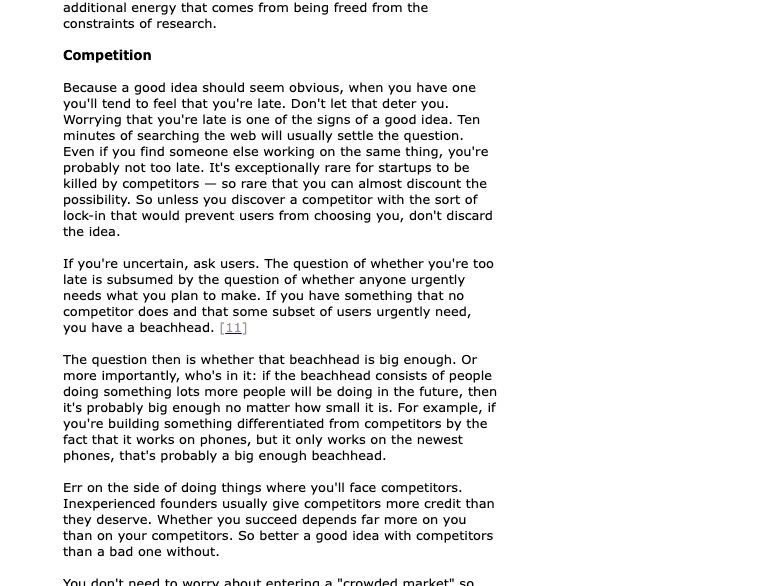
He goes further. A crowded market, he writes, is a good sign because it means there's demand and none of the existing solutions are good enough. The condition is that you need a thesis about what everyone in that market is overlooking, and it has to be more precise than "we're going to make an x that doesn't suck." Keep that phrase in mind. It's the bar every section below is trying to clear.
What the 2026 failure data says
The numbers back him up. CB Insights published its updated "top reasons startups fail" report on 5 March 2026, built on post-mortems, founder interviews and shutdown announcements from 431 VC-backed companies that closed since 2023. It could identify failure reasons for 385 of them.
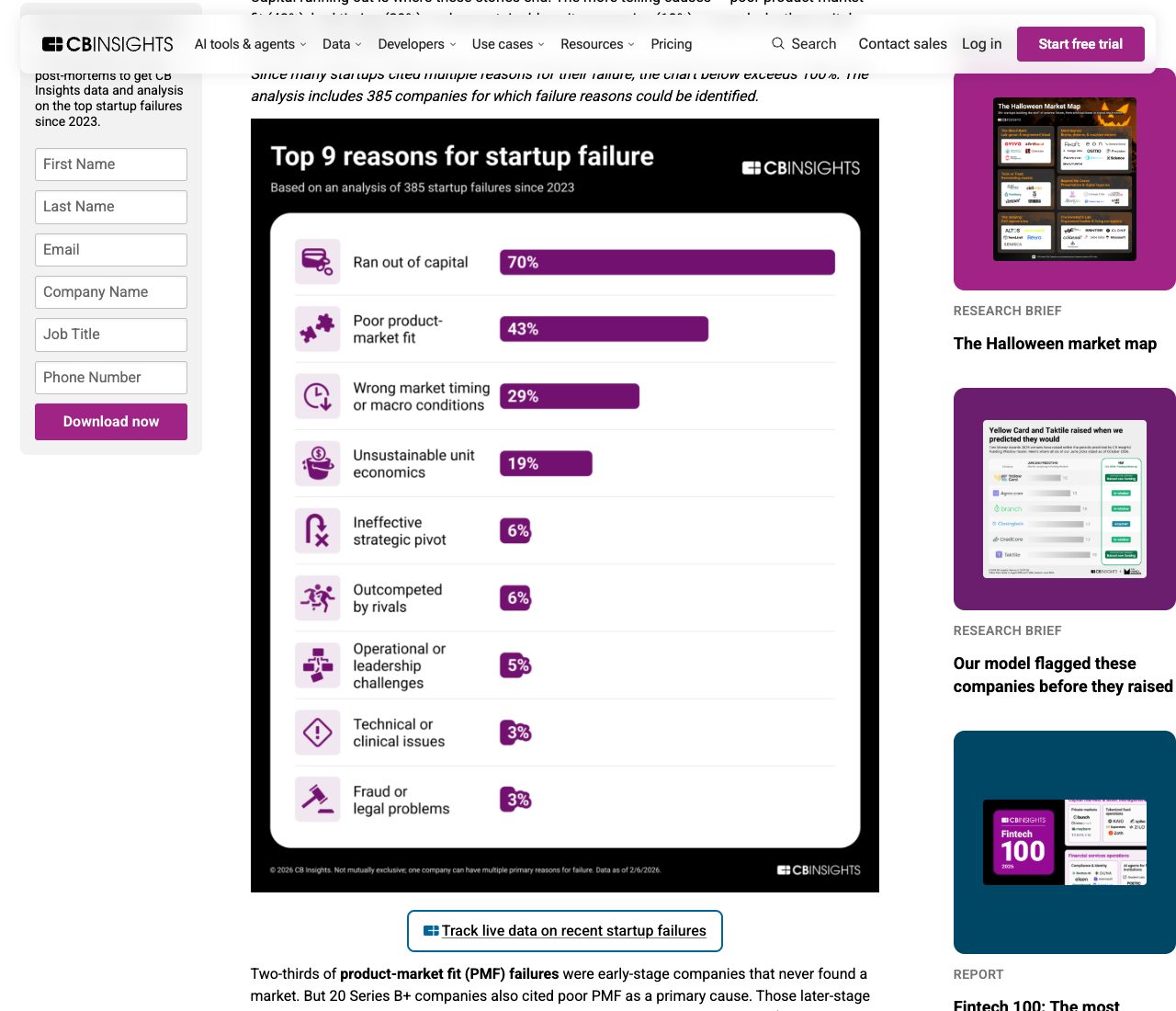
| Reason for failure (CB Insights, 2026) | Share of 385 failed startups |
|---|---|
| Ran out of capital | 70% |
| Poor product-market fit | 43% |
| Wrong market timing or macro conditions | 29% |
| Unsustainable unit economics | 19% |
| Ineffective strategic pivot | 6% |
| Outcompeted by rivals | 6% |
| Operational or leadership challenges | 5% |
| Technical or clinical issues | 3% |
| Fraud or legal problems | 3% |
Companies could cite more than one reason, so the column adds up to more than 100%. Read it this way: for every startup that a rival beat, roughly seven built something the market didn't want badly enough. CB Insights itself notes that running out of capital is almost always the final cause of death, not the root problem. The thing worth fearing is building a product nobody urgently needs. A competitor proves somebody needs it.
When "No Competitors" Is the Real Red Flag
An empty search result feels like a gift. It usually isn't. If nobody sells a solution and nobody hacks together a workaround either, the likeliest explanations are that the pain isn't strong enough to pay for, or that you've described the problem in words no customer uses.
The most useful correction here comes from positioning consultant April Dunford. In her quickstart guide to positioning, she defines competitive alternatives by asking what a customer would do if your product didn't exist. Often the honest answer is "do nothing", which really means keep using a spreadsheet, a manual process or an intern. She adds that enterprise software typically loses 25% of deals to "no decision".
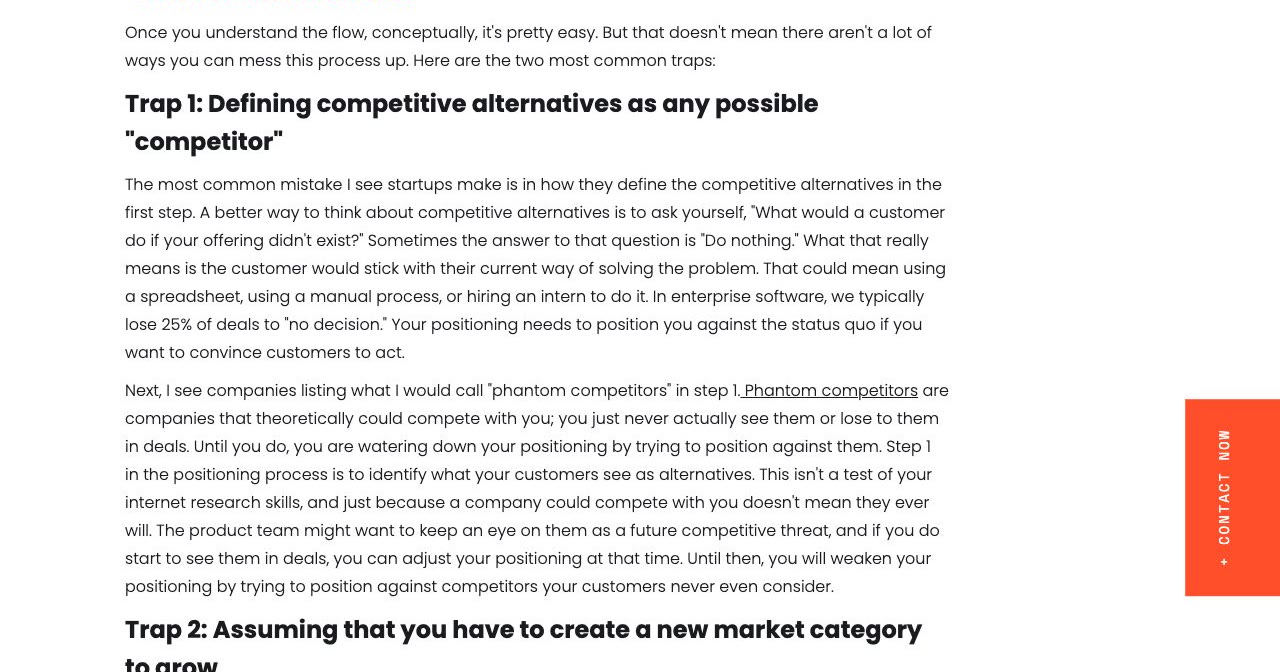
That reframes the empty search result. If you can't find a software competitor but you can find people doing the job in a spreadsheet every Friday afternoon, you have a market, and the spreadsheet is the thing you're replacing. If you can't find either, go and talk to people before you build anything. Our startup idea validation checklist covers how to run those conversations.
Why "we have no competitors" hurts with investors
Investors ask about competition because the answer shows whether you've looked. Sequoia's guide to writing a business plan gives competition its own section, titled "Competition / alternatives", and asks founders to name direct and indirect competitors and show a plan to win.
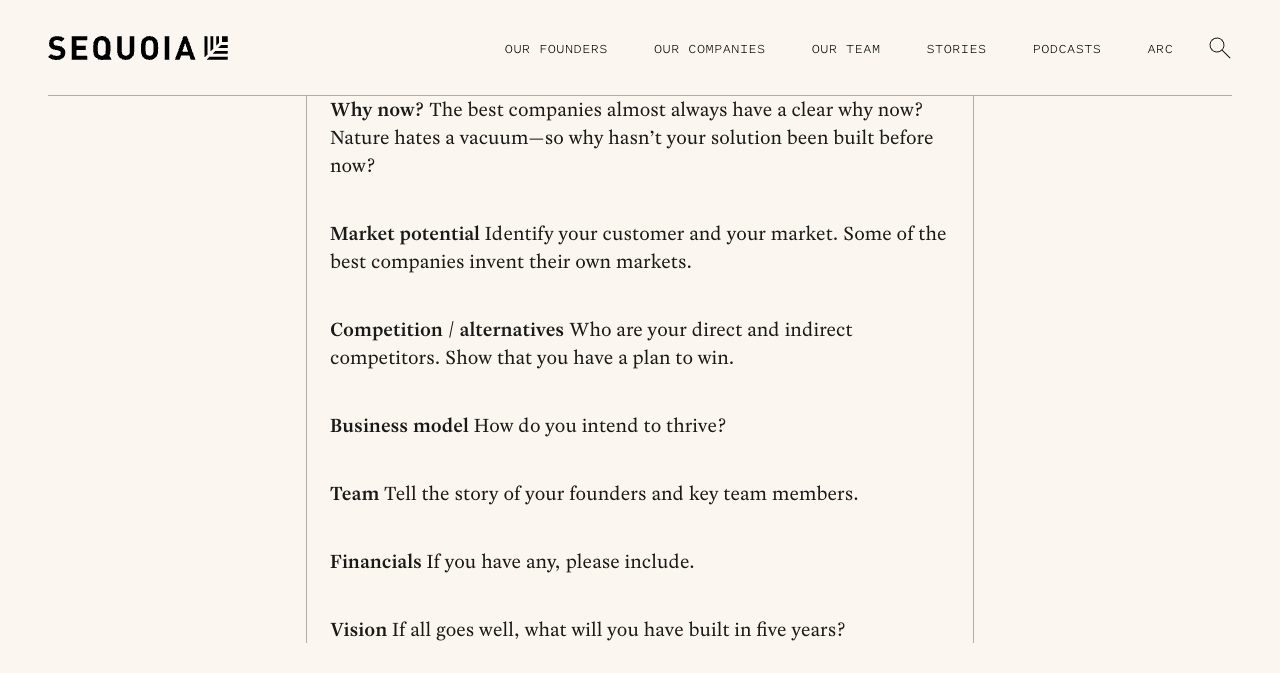
Note the word "alternatives". A slide that says "no competitors" tells an investor you haven't counted the status quo, which is the competitor that wins most deals.
The Four Kinds of Competitor (and the One Founders Forget)
Before you can judge a market, sort what you find. A plain list of logos hides the difference between a rival you'll meet in every deal and one that just happens to share your keywords.
| Type | What it is | Example for a freelance invoicing tool | How much it matters |
|---|---|---|---|
| Direct | Same job, same buyer, same category | Another invoicing app for freelancers | High. You'll be compared side by side |
| Indirect | Same job, different approach | Accounting suites with invoicing built in, payment links | Medium. Often the default buyers drift into |
| Status quo | The workaround people use today | A Word template and a calendar reminder to chase payments | Highest. It wins whenever nobody switches |
| Phantom | Could compete in theory, never shows up in practice | An enterprise ERP with an invoicing module | Low. Don't shape your positioning around it |
The phantom row is Dunford's idea too. Phantom competitors are companies that could compete with you in theory, but that your buyers never actually consider. Founders spend weeks building comparison tables against them, and the result is positioning that's aimed at nobody.
Is the Market Beatable? Read the Shape of the Crowd
The number of competitors tells you surprisingly little. Forty competitors can mean a wide-open market or a locked one. What matters is their shape.
Start with the traction check. Search Product Hunt for "invoicing" and the first results are a run of small invoice generators carrying two or three reviews each. Plenty of what looks like competition is a weekend project that launched once and stopped there.
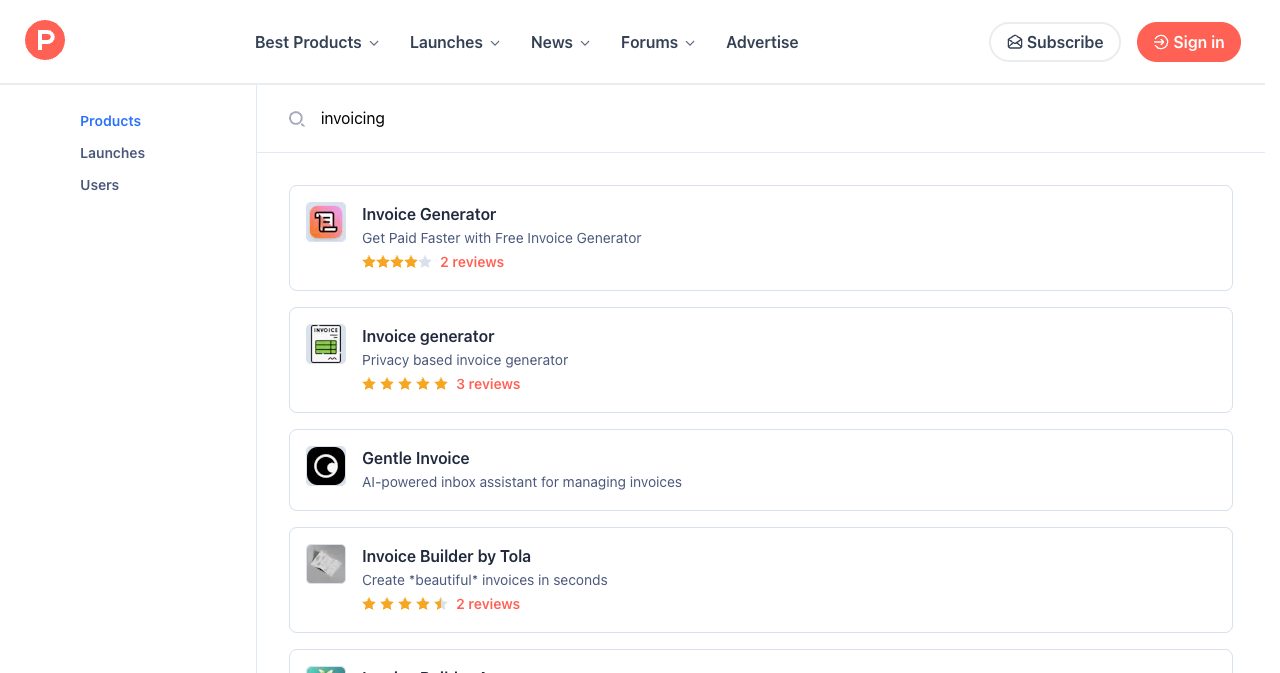
For each competitor, check five signals. None needs a paid tool:
- Reviews in the last 90 days. Recent reviews mean active users. A product whose newest review is from 2024 is coasting or dead.
- The changelog or release notes. Monthly updates mean a team is shipping. A changelog that stops eight months ago means it isn't.
- Pricing changes. A price hike or a removed free plan often creates a wave of unhappy users looking for a way out.
- Job posts. Hiring engineers means investment. Hiring only sales means the product has stopped moving.
- Launches and listings. New entrants show up on launch platforms long before review sites. If three founders launched your idea this year, you want to know who they are and what they're betting on.
Then place the market in one of the rows of the table at the top of this post. Paul Graham's one exception is worth repeating here: unless you discover a competitor with the sort of lock-in that would prevent users from choosing you, don't discard the idea. Lock-in looks like years of stored data that's painful to export, a network everyone's already on, deep integrations into the rest of the stack, or annual contracts. If the leader has it and its users like the product, enter only where switching is cheap, such as brand-new businesses that have nothing to migrate.
The 7-Day Competitor Teardown
This is the process we'd run before committing a quarter of our lives to an idea in a crowded category. It takes one week and ends in a decision, not a slide deck.
- Search the problem, not your solution (day 1). Type the pain the way a customer would describe it, such as "chase late invoices automatically" rather than "AI accounts receivable platform". Run it on Google, Reddit and the review sites, and note every product, service and workaround that comes up.
- Sort what you find into four buckets (day 1). Direct, indirect, status quo and phantom, as in the table above. Most people stop at direct. The status quo row is the one that will tell you how hard switching is.
- Mine the 1 to 3 star reviews (day 2). Filter the leaders' reviews to the lowest ratings and tag every complaint by theme. More on how in the next section.
- Check whether each competitor is alive and growing (days 2 and 3). Run the five traction signals above. Drop the dead ones from your list and flag anyone who launched in the last year.
- Talk to ten people who use or quit the incumbents (days 3 to 6). Ask what they use today, what they hate about it, what they tried before and what it would take to switch. Ask about the last time they hit the problem, not about your idea.
- Write your wedge sentence (day 6). The template is further down. If you can't fill it in with specifics, you need more conversations, not more desk research.
- Make the call: build, narrow or walk (day 7). The rules for each are at the end of this post.
On step 1, a practical tip: review sites like G2 and Capterra mostly show companies that have been around long enough to collect reviews. The founders who started on your idea last quarter show up first on launch platforms. Search Product Hunt, then browse the category pages of newer directories, such as the SaaSCity launch directory, where new products are filed by category as they launch. If you want to cast a wider net, our hub of startup directories lists where else new products get listed.
How to Mine Competitor Reviews for Your Roadmap
A competitor's 1-star reviews are the closest thing you'll get to a free customer interview with their unhappiest users. They tell you what's broken, for whom, and how strongly people feel about it.
Here's a real example. Yoast SEO, one of the most popular WordPress plugins, had a 4.8 out of 5 average across 27,821 reviews on WordPress.org when we checked on 30 October 2026. That looks unassailable until you filter to 1 star: 846 people.
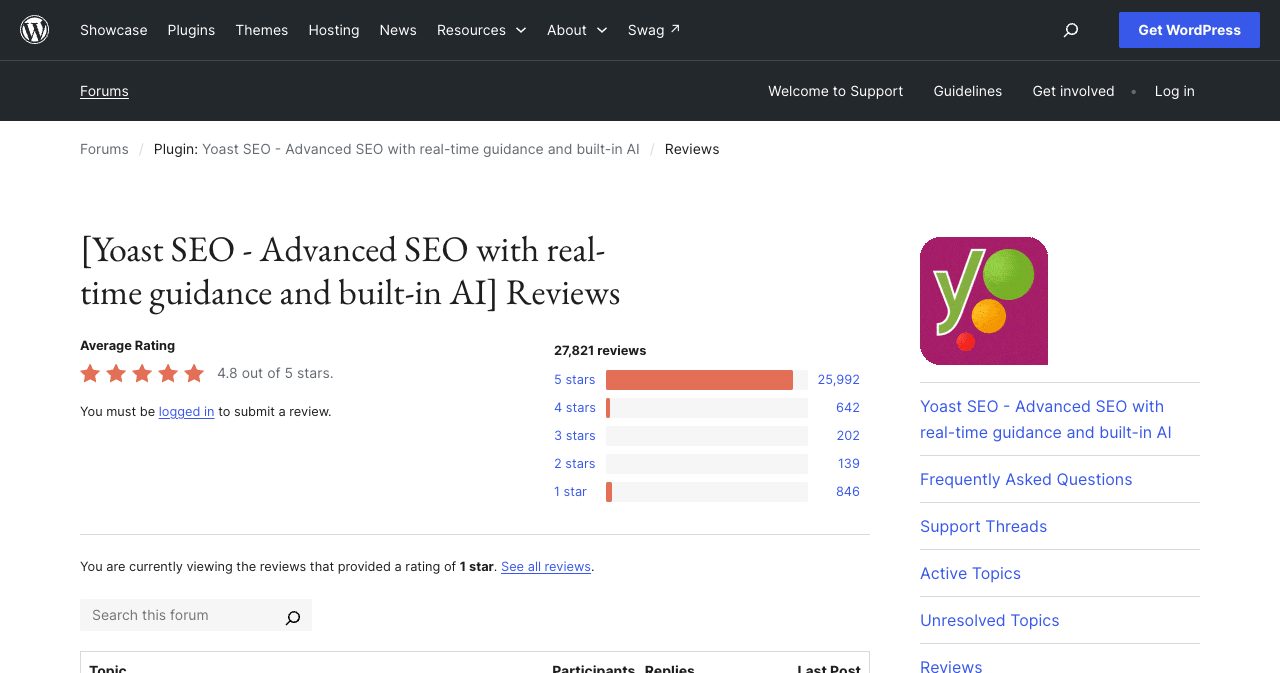
This isn't a takedown of Yoast. 25,992 people gave it five stars, and a plugin that size will always collect complaints. The point is that even a category leader with a near-perfect average has hundreds of users telling you, in their own words, what they wish were different. Read the titles on the 1-star page and the complaints cluster quickly.
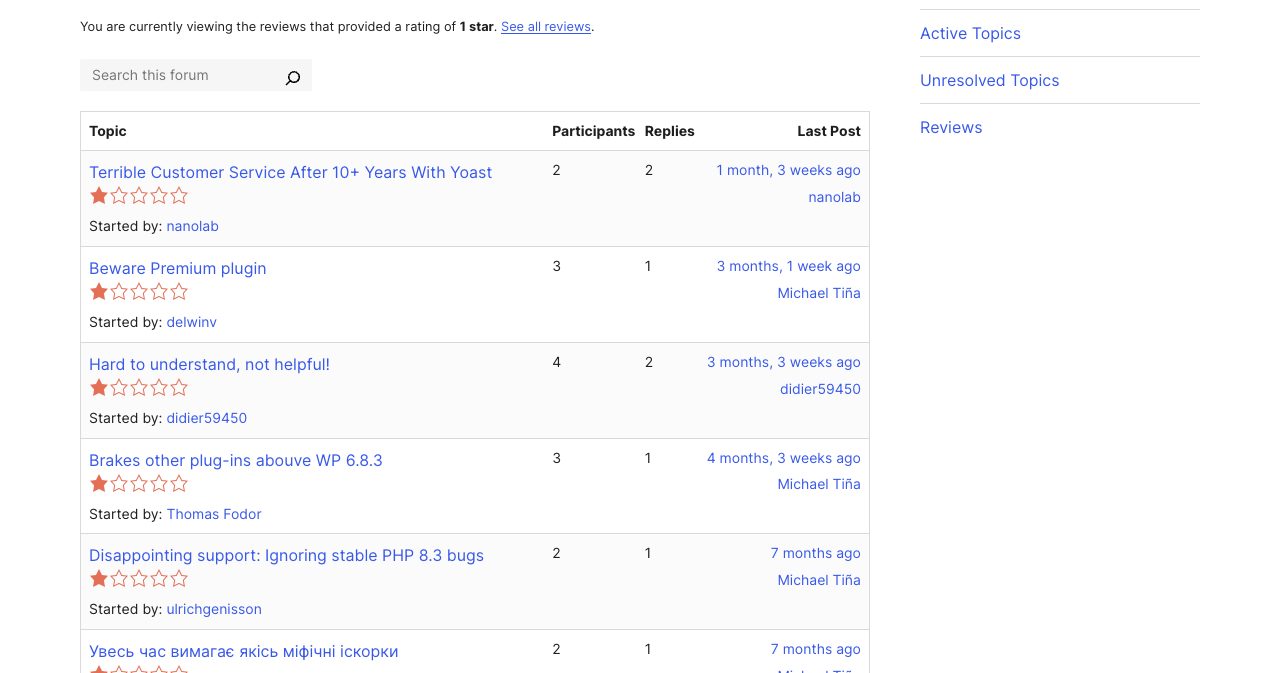
Tag each review with one theme and count. Here's what that looks like using real review titles from the page:
| Complaint theme | Real 1-star review titles | The wedge it suggests |
|---|---|---|
| Support | "Terrible Customer Service After 10+ Years With Yoast", "Paid support non existent" | Fast human support for a narrow group of users |
| Bloat and speed | "This plugin is redundant and bloated", "Slow performance, blocking other plugins" | A lightweight tool for people who only need one part of it |
| Updates that break things | "Plugin throwing critical error on latest version 25.3", "DO NOT USE with ELEMENTOR PRO" | A product built and tested for one specific site builder |
| Upsell pressure | "Beware Premium plugin", "It's unfortunate, they're updating so you have to pay for it." | Simpler, more predictable pricing |
Three habits make review mining useful instead of depressing:
- Count, don't skim. One furious review is an anecdote. Forty reviews about the same missing integration is a segment.
- Look for who is complaining, not just what. "Too complex" from agencies and "too complex" from solo bloggers point to different products.
- Check the 3-star reviews too. They're written by people who stayed but are unhappy, which is exactly who will switch when something better shows up.
Where to find reviews depends on what you're building: G2 and Capterra for B2B software, the App Store and Google Play for mobile, WordPress.org and the Chrome Web Store for plugins and extensions, and Reddit for everything. On Reddit, search the competitor's name with words like "alternative to", "switched from", "cancelled" or "sucks". Those threads tend to include the reason people left, which is the part you need.
Write Your Wedge Sentence
Everything so far feeds one sentence. Fill in every bracket with something specific:
[Product] is for [specific customer] who is frustrated with [specific competitor or workaround] because [specific pain]. Unlike them, we [specific difference].
A weak version: "InvoiceBot is for freelancers who are frustrated with existing tools because they're complicated. Unlike them, we're simple and AI-powered."
A strong version: "InvoiceBot is for freelance designers billing three to ten clients a month who are frustrated with full accounting suites because they pay for payroll and inventory features they'll never touch, and still chase late payments by hand. Unlike them, we do invoicing and automatic payment reminders only, for a flat price."
The weak sentence is Paul Graham's "x that doesn't suck". The strong one names who, what they leave behind, and what you do instead, and every part of it can be checked in a customer conversation. If your sentence still sounds like the weak one after a week, don't build yet. Narrow the "specific customer" until the complaints you heard actually line up.
Choose a Wedge the Incumbent Won't Follow
A good wedge isn't just something you do better. It's something the leader can't or won't copy, because copying it would cost them more than it's worth.
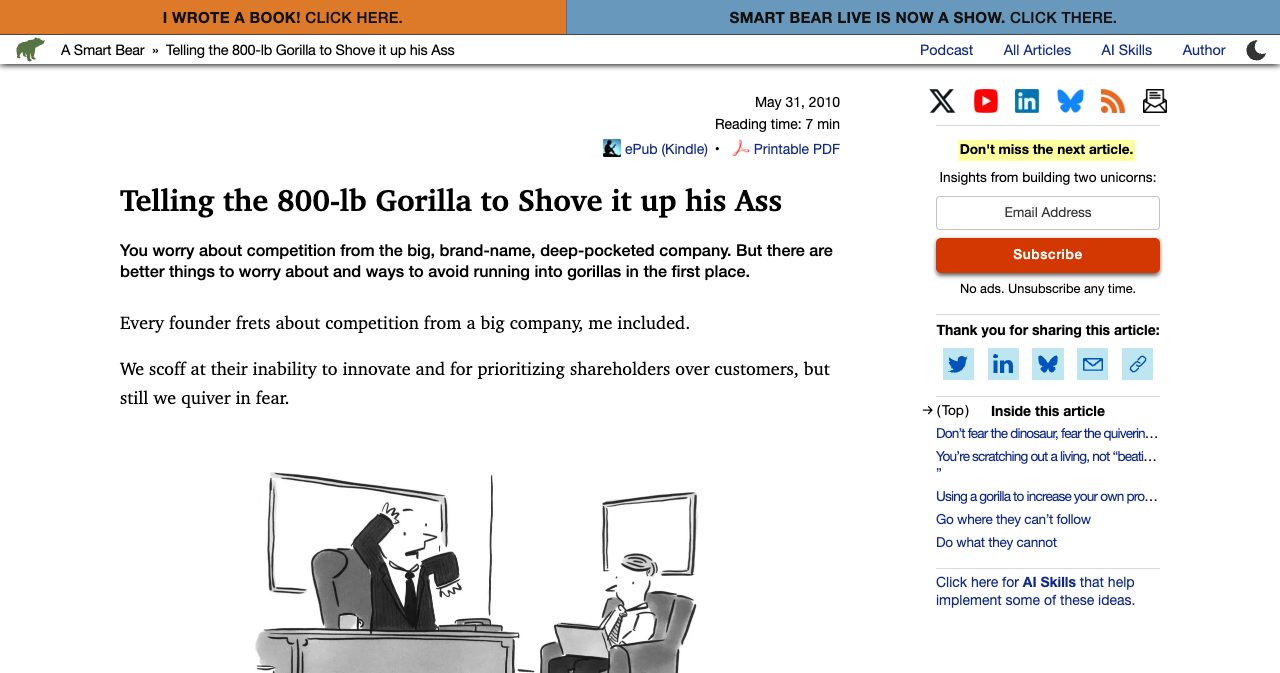
Jason Cohen, who founded Smart Bear Software and later WP Engine, wrote the clearest version of this in a May 2010 essay on competing with "the 800-lb gorilla" on A Smart Bear. His two headings are the whole strategy: go where they can't follow, and do what they cannot. On the first: "Big companies play only in big markets." On the second, he points out that a big company can't listen to a customer and ship a change a week later, and you can.
In practice, wedges come in six shapes:
| Wedge | What it means | Why the incumbent won't follow |
|---|---|---|
| Segment | One industry, role or company size | Too small to move their revenue targets |
| Workflow | One job done end to end, very well | Their product is built to be broad |
| Packaging and price | A different unit: flat fee, one-time, per location | It would cut into their existing revenue |
| Business model | A different way to make money altogether | Copying it would damage the core business |
| Service | Human onboarding, fast fixes, direct access to the founder | It doesn't scale at their size |
| Platform shift | Built for a new surface: mobile, AI agents, a new marketplace | Their architecture and roadmap are committed elsewhere |
The business model row has a name. Hamilton Helmer calls it counter-positioning in his 2016 book 7 Powers: a newcomer adopts a better business model that the incumbent doesn't copy because doing so would hurt its existing business. Netflix is the standard example. Its flat subscription with no late fees was hard for Blockbuster to match, because Blockbuster's store model depended on rental and late-fee income. You don't need to be Netflix to use this. A one-time price in a category where everyone charges monthly, or a free core product in a category where everyone charges per seat, can be enough to make the leader hesitate.
Founders Who Walked Into Crowded Markets
These examples get repeated a lot, usually without dates. The dates are the interesting part, because they show how late the winners arrived.
Slack and HipChat. HipChat opened to the public on 25 January 2010, and Atlassian, a large and successful software company, bought it in March 2012. Slack didn't launch publicly until August 2013, after it started as an internal tool at Tiny Speck, a company building an online game. On 26 July 2018, Atlassian announced it would discontinue HipChat and its successor Stride and sell their intellectual property to Slack, with customers moved across by February 2019.
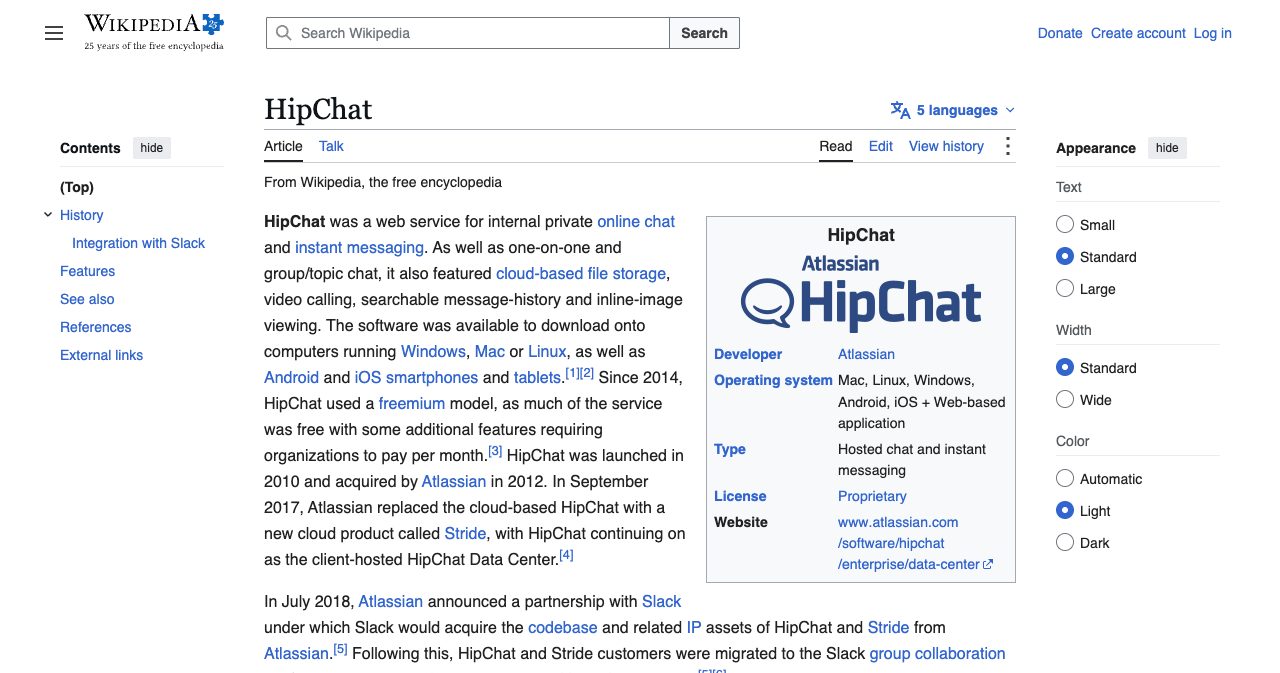
Being three and a half years early, and owned by a big company, didn't protect HipChat. For anyone who searched "team chat" in early 2013 and found HipChat, Campfire and IRC, the market looked taken.
Zoom and Webex. Eric Yuan was a corporate vice president at Cisco Webex. He left in April 2011 with about 40 engineers and founded the company that became Zoom, which launched version 1.0 in January 2013. He entered a market led by the product he'd helped run. That's Paul Graham's thesis rule in its purest form: nobody knew better what the incumbent was overlooking.
Superhuman and email. Nobody needed a new email client. Gmail and Outlook were free or bundled, and Superhuman charged a premium anyway. How it found its footing is the most practical case study on this list, so it gets its own section.
Measure Whether Your Wedge Is Working
Once you've picked a wedge, you need a way to tell whether it's real before you run out of money. The best-known test comes from growth marketer Sean Ellis, and Superhuman founder Rahul Vohra described how they used it in a First Round Review article.
The test is one question: "How would you feel if you could no longer use [product]?" with three answers: very disappointed, somewhat disappointed, not disappointed. After benchmarking nearly a hundred startups, Ellis found that companies with strong traction almost always had more than 40% of users answer "very disappointed".
Superhuman started at 22%. Instead of adding features for everyone, the team looked only at the users who'd be very disappointed and narrowed to the personas in that group: founders, managers, executives and business development. Within three quarters of working on the product for them, the score reached 58%.
That's a wedge working in numbers. Superhuman didn't beat Gmail for everyone. It made a small group of heavy email users unwilling to go back. In a crowded market, that's the only kind of win available early on, and it's enough.
You can run this survey with your first 30 to 40 active users. Below 40% isn't a death sentence, but it means the segment is still too broad or the difference isn't sharp enough yet. Superhuman's fix was to stop building for the people who were lukewarm about the product.
Mistakes That Make Competition Actually Dangerous
Competitors rarely kill startups on their own. These habits are what turn an ordinary competitor into a real threat:
- Matching the feature list. A 40-row comparison matrix is a promise to rebuild the incumbent's roadmap with a fraction of its team. Pick the three rows your segment cares about and win those.
- Leading with "cheaper". Price is a wedge only if you have a structural cost advantage or a different model. Otherwise the leader can drop prices for a quarter and you can't.
- Positioning against phantoms. If your buyers never mention a competitor, stop comparing yourself to it.
- Going broad on day one. "For teams" is a segment the leader already owns. "For dental clinics with two to five chairs" is one they've never thought about.
- Watching rivals instead of their customers. Reading a competitor's changelog every morning teaches you nothing. Talking to their unhappy users teaches you everything.
- Quitting in the first month. Graham observed that inexperienced founders give competitors more credit than they deserve. The CB Insights numbers suggest it's more likely you'll run out of runway than be beaten.
- Ignoring where buyers compare. The people most ready to switch are searching for "[competitor] alternatives" right now. If you aren't on the pages they read, a rival who is will get the click.
Get Found Where People Compare Alternatives
That last mistake is worth its own section, because it's where having competitors actually helps you. Every unhappy user of a big product is a potential customer who's already looking. They type "[competitor] alternative" into Google, ask ChatGPT or Perplexity for options, open a comparison article, or browse a directory category. AI answers in particular lean on pages that list and describe products side by side, which is why our guide to optimizing for AI citations spends so much time on being described consistently across the web.
Three moves cover most of it:
- Publish an honest comparison page for each direct competitor your interviewees named, written for their unhappy users, using the complaint themes from your review mining.
- Get listed where alternatives are compared: review sites, launch platforms and startup directories, with your wedge sentence as the description instead of a generic tagline. Our breakdown of the SEO benefits of listing SaaS products explains why these pages keep sending traffic long after launch day.
- Show up in the threads. When someone on Reddit asks for an alternative and your product genuinely fits, say so and say you built it. Our guide to getting your first 100 users covers how to do that without getting banned.
SaaSCity is one of those directories (it's the site you're reading), so weigh this accordingly. A listing puts your product on a category page next to the alternatives people are already comparing, and the free plan is enough to start. Whatever directory you use, write the description as your wedge sentence. "Invoicing for freelance designers who chase late payments by hand" will beat "the all-in-one platform for modern businesses" every time somebody is comparing.
Build, Narrow or Walk: Making the Call
At the end of the week, one of three decisions should be obvious.
Build if all of these are true:
- You can fill in the wedge sentence with specifics, and a stranger could check every part of it.
- At least three of your ten interviewees described the same pain without being prompted.
- At least one asked when they could use it, or offered to pay.
- The leader in your segment has no lock-in your target customers would struggle to escape.
Narrow if the pain is real but the complaints are generic ("too expensive", "too complicated") or spread across very different kinds of users. Pick the smallest group whose complaints line up, and run steps 5 and 6 again with only them. Narrowing feels like shrinking the opportunity. In practice it's how you find the first customers who care enough to switch, and you can widen the market once you've won them. Our list of boring SaaS ideas that print $5K MRR is mostly a list of narrow wedges in crowded categories.
Walk if nobody has the pain badly enough to change what they do, if the leader has strong lock-in and its users are happy, or if your only advantage is a lower price without a cheaper way to deliver the product. Walking away after one week is a good outcome. It's a lot cheaper than walking away after one year.
If you're building, the next stage is the launch itself, and the same principle applies: a sharp wedge makes every launch channel work harder. The SaaS launch playbook picks up from here.
Your idea already having competitors means you're not crazy. Somebody else saw the same problem and people are paying to solve it. What decides the next two years is whether you can say, more precisely than they can, who's still being failed and why.
FAQ
What should I do if my startup idea already exists?
Treat it as evidence that people want the problem solved, then find out why they're still unhappy. Spend a week mapping the direct competitors, the indirect ones and the workaround people use today, read the 1 to 3 star reviews of the leaders, and talk to ten people who use or quit those tools. If you can then write one specific sentence about who you serve better and why they'd switch, build it. If you can't, narrow the segment or walk away.
Is it bad if my startup idea has competitors?
Usually not. In CB Insights' study of 385 failed VC-backed startups, published 5 March 2026, only 6% listed being outcompeted by rivals as a cause, while 43% cited poor product-market fit and 70% ran out of capital. Paul Graham made the same point in 2012: it is exceptionally rare for startups to be killed by competitors. Competitors become a real problem only when the leader has lock-in that stops unhappy users from switching.
How do I know if a market is too crowded to enter?
Look at the shape of the crowd, not its size. Many small competitors with few reviews and slow product updates means demand exists and nobody has won yet. One or two well-funded leaders with strong reviews means you need a segment they serve badly. A leader with heavy lock-in, such as stored data, network effects or long contracts, is the case to avoid unless you only target new buyers who have nothing to migrate.
Should I tell investors my startup has no competitors?
No. Investors expect a competition slide: Sequoia's own business plan guide asks founders to name their direct and indirect competitors and show a plan to win. Saying you have none usually reads as not having looked, and every product competes at least with the way customers solve the problem today, such as spreadsheets, a freelancer or doing nothing.
How do I find all of my startup's competitors?
Search for the problem in the words a customer would use, not for your solution. Then check review sites such as G2, Capterra and the App Store for established players, launch platforms such as Product Hunt and newer startup directories for recent entrants, and Reddit or niche forums for threads like "alternative to" or "switched from". Finally ask potential customers what they use today, because the workaround they name is often the competitor you missed.
How can a small startup compete with an established company?
Do the things the incumbent can't or won't do. That usually means serving a segment too small for its growth targets, giving fast human support, shipping changes customers ask for within days, packaging or pricing the product in a way that would cut into the incumbent's own revenue, or building for a new platform it can't adopt quickly. Pick one of these as your wedge instead of trying to match the full feature list.
What is counter-positioning in business strategy?
Counter-positioning is when a newcomer adopts a business model that the incumbent won't copy, because copying it would damage the incumbent's existing business. Hamilton Helmer lists it as one of the seven sources of durable advantage in his 2016 book 7 Powers. The classic example is Netflix's flat subscription with no late fees against Blockbuster, whose store model depended on rental and late-fee income.
What is the Sean Ellis 40% test?
It's a survey question that measures product-market fit: ask users how they would feel if they could no longer use the product, and count the share who answer "very disappointed". Sean Ellis found that companies above 40% tended to have strong traction. Superhuman used it to find its wedge in email, starting at 22% and reaching 58% within three quarters by focusing on the users who loved the product most.
How long should competitor research take before building?
About a week for a first decision. One or two days of desk research is enough to map the market and read reviews, and the rest of the week should go to customer conversations, because those decide whether your wedge is real. Spending months on competitor analysis before talking to users is a common way to delay building without learning anything new.
Can I build a successful product in a crowded SaaS category?
Yes, if you enter through a narrow, specific door. Slack launched in August 2013, more than three years after HipChat, and in July 2018 Atlassian announced it would discontinue HipChat and sell the product's intellectual property to Slack. Zoom launched in 2013 into a video conferencing market led by Webex, the product its founder had helped run. Both arrived late with a precise thesis about what the incumbents were getting wrong.
Get your SaaS in front of founders
List your product on SaaSCity - a permanent listing, real discovery, and a dofollow backlink from a high-DR directory. Free with a badge; upgrade for a building on the live city map.