SaaS Business
Stripe Atlas for Developers: Incorporate a US Startup in Days and Start Charging Customers
A practical breakdown of Stripe Atlas for technical founders: what the $500 actually buys, how fast the Delaware entity and EIN arrive, what it costs every year after, where it falls short, and how it compares to Clerky, Firstbase, doola and doing it yourself.

Contents (11)
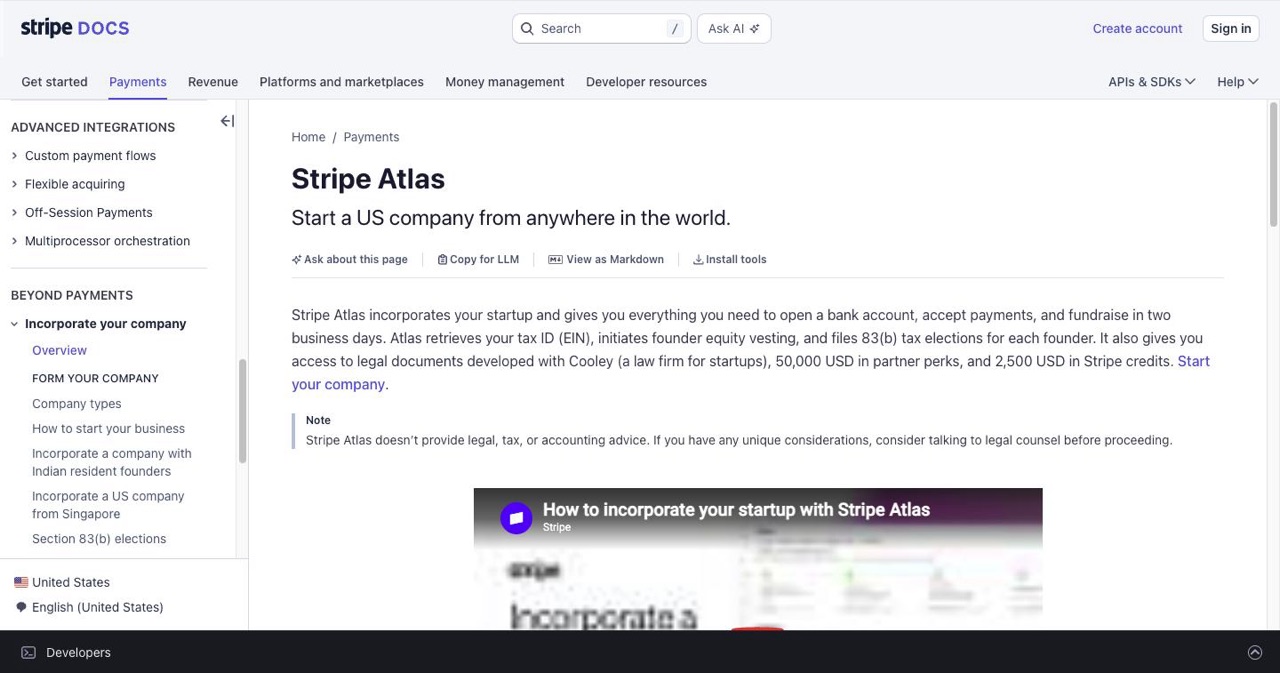
Quick answer: Stripe Atlas is Stripe's company formation service. For a one-time $500 it incorporates a Delaware C-Corp, LLC or subsidiary from anywhere in the world, files Form SS-4 for your EIN, issues founder equity, files 83(b) elections automatically, and opens a banking and Stripe Payments path, typically in one to two business days. Over 100,000 companies have used it, including Linear, Anysphere, Lovable and Supabase. Documents were built with Cooley LLP, and year two costs $100 for the registered agent plus Delaware franchise tax.
You have a working product. Payments are the last mile, and the last mile turns out to be a legal one: you need an entity, a tax ID, a bank account and a payment processor that will accept you. If you live outside the US, which describes most people reading this, that chain has historically taken weeks of forms, a notary, a bank that does not want your business, and at least one dead end.
Stripe Atlas exists to collapse that chain into a form you fill in once. Over 100,000 companies have used it, including names most developers recognize (Linear, Anysphere, Lovable, Supabase). The pitch is simple: a Delaware entity, founder equity, an EIN application, a banking path and live Stripe payments in roughly two business days, for $500.
This is the practical version of what you get, what it really costs over time, where it does not fit, and what the alternatives do better.
Key Takeaways
- $500 covers formation, not the whole year: The fee includes the Delaware state filing and year one registered agent; year two onward is $100 a year plus franchise tax.
- Franchise tax is the trap: Delaware's default authorized shares method can produce an absurd bill, while the assumed par value method usually lands far lower, and you must choose it when you file.
- EIN speed depends on an SSN: Roughly 1 to 3 business days with a US SSN, address and phone, commonly 15 to 45 business days without one.
- Automatic 83(b) filing is the quiet value: Miss the 30-day window and there is no retroactive fix, so Atlas prepares, mails and stores proof for every founder.
- You can charge before the EIN arrives: A financial account and Stripe Payments activate right after incorporation, with US card payments first and $2,500 in Stripe credits for year one.
- Delaware only, templates only: No Wyoming, no home state, and no custom documents for unusual IP contributions or a foreign parent.
- Formable is not always payable: Adult content, some debt services, crypto trading and gambling can get an entity but not Stripe Payments, which removes most of the reason to use Atlas.
What Stripe Atlas actually is
Atlas is Stripe's company formation service. It incorporates a US company from anywhere in the world, handles the state filing, applies for your EIN with the IRS, issues founder equity, files your 83(b) elections, and then hands you a dashboard with banking, payments, fundraising templates and partner credits attached.
It launched in 2016 as a slow, invite-flavored thing and has changed a lot since. The current version supports three entity types, files in one to two business days in most cases, files 83(b) automatically, lets you open a financial account and start taking payments before your EIN arrives, and generates YC-standard SAFEs from the dashboard.
The legal documents were developed with Cooley LLP, which is the firm behind a large share of standard US startup paperwork. Worth being precise about what that means: Atlas is a technology service supplying templates and filing logistics. It is not a law firm and it does not give you legal, tax or accounting advice. That distinction matters the moment your situation stops being standard.
Who it fits best:
- Non-US founders who need a US entity, EIN, bank account and Stripe access without moving or hiring a US lawyer.
- Solo developers turning a side project into an actual company.
- Technical teams shipping SaaS, APIs, digital products or marketplaces that need to charge globally, fast.
- Anyone who expects to raise, where a Delaware C-Corp is the default the whole investor stack is built around.
Who it does not fit: local businesses with no US customers or investors, anything needing formation outside Delaware, restricted industries, and companies contributing significant existing IP or assets where you want custom documents rather than templates.
What the $500 buys
Formation
You pick one of three structures:
| Structure | Best for | Trade-off |
|---|---|---|
| Delaware C-Corporation | Raising venture capital, issuing stock and option pools, multiple founders | Double taxation, more formalities, franchise tax |
| Delaware LLC | Bootstrapped, solo, self-funded products | Investors generally will not buy into it; conversion later costs money |
| Subsidiary | An existing foreign company that needs a US arm | Parent-level tax questions you should not answer alone |
The fee includes the Delaware state filing fee and next-day expedited processing, a name availability check, and the standard document set: certificate of incorporation or formation, bylaws or an operating agreement, founder stock purchase agreements, and IP assignment. That last one is quietly one of the most valuable pieces of paper in the pack, because it puts the code you already wrote inside the company rather than in a grey zone.
Tax ID and equity
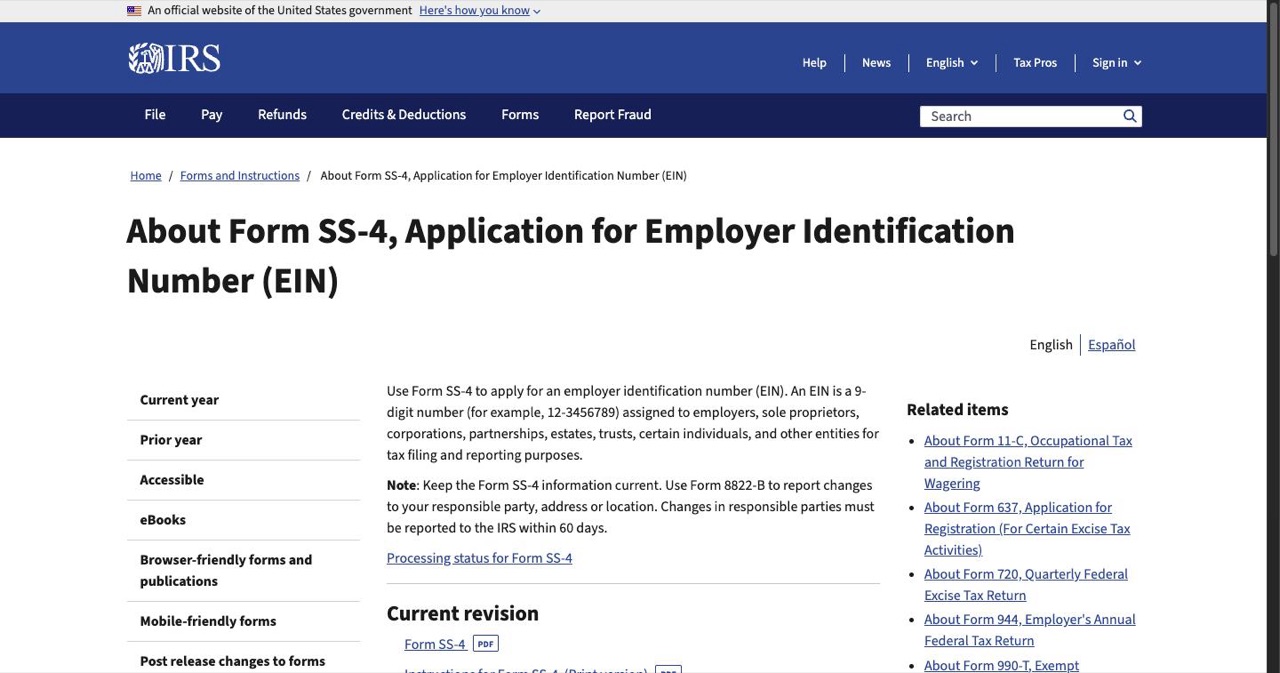
Atlas files Form SS-4 with the IRS on your behalf. Timelines split sharply:
- With a US SSN, US address and US phone: roughly 1 to 3 business days.
- Without an SSN: commonly 15 to 45 business days. This is the IRS being the IRS, not Stripe being slow.
Founder equity is issued as part of the flow, typically purchased with the IP you contribute. You choose the vesting period, cliff and start date, and you can carve out an employee equity pool (10% is the common default) at formation instead of doing it awkwardly later.
Then the part that quietly earns the fee: automatic 83(b) filing for every founder. If your shares vest and you do not file an 83(b) election within 30 days, you have signed up to be taxed on the value of each vesting tranche at whatever the company is worth on that date. For a company that works, that bill can be catastrophic, and there is no retroactive fix. It is the single most common expensive mistake in DIY incorporation. Atlas prepares, mails and stores proof of the filing.
If you specifically do not want an automatic 83(b), or you are excluding prior inventions, or you are thinking about QSBS treatment, stop and talk to a lawyer before you start the application.
Banking and payments
After incorporation, and before the EIN in many cases, you can open a financial account (Stripe Treasury, or a partner such as Mercury, Brex or Rho) and activate Stripe Payments. The Stripe application prefills from your Atlas data, so activation is minutes rather than another onboarding.
US card payments come first; broader payment methods unlock once the EIN is in. Payment Links, Checkout and Invoicing are all no-code, which means you can be charging before you have written a line of billing code. Atlas also includes $2,500 in Stripe credits for the first year, applied against processing fees.
If you have not settled on Stripe yet, we compared it against the field in how to choose the best payment processor for your SaaS. Atlas obviously tilts you toward Stripe, and that is a real lock-in consideration, not a neutral one.
Fundraising and perks
The dashboard generates, sends and tracks YC-standard SAFEs, which covers the mechanics of most pre-seed rounds without a lawyer per document. There is a template library for hiring and selling, built with Cooley.
Partner perks are advertised at roughly $50,000+ in credits and discounts across cloud, banking, cap table, accounting and productivity tools (AWS, Mercury, Carta, Google, Xero, Notion and others rotate through the list). Treat the headline number as theoretical: it is only worth what you would have spent anyway. For an infra-heavy AI product, the cloud credits alone can dwarf the $500. For a small SaaS on a $20 VPS, they will not. Our zero-cost developer toolkit covers the free tier of the same stack if you would rather not need the credits at all.
Registered agent
Delaware requires one. The first year is included; after that it is $100 a year, cancelable.
The real cost, year one and every year after
The $500 is the number everyone quotes. Here is the whole picture.
| Cost | Amount | When |
|---|---|---|
| Atlas setup fee | $500 one time | At formation. Includes state filing + year one registered agent |
| Registered agent renewal | $100/year | From year two |
| Delaware franchise tax (C-Corp) | ~$450 minimum, commonly $400 to $1,500+ | Annually, due March 1 |
| Delaware LLC annual tax | $300 flat | Annually, due June 1 |
| Tax preparation | Varies, budget several hundred up | Annually |
| Stripe processing fees | Standard rates, offset by $2,500 credit in year one | Ongoing |
Two things bite founders here.
Franchise tax is yours, not Stripe's. Delaware offers two calculation methods, and the default one (authorized shares) can produce an absurd bill if you authorized 10 million shares. The assumed par value method almost always produces a much smaller number for an early-stage company with few assets. You have to actively choose it when you file. This is the most common "why do I owe $75,000" panic post on founder forums, and it is a calculation error, not a real bill.
Franchise tax is not prorated. Incorporate on December 20 and you owe a full year for those eleven days. If you are near year end and not in a hurry, wait until January.
Atlas will also refund the fee if it cannot support your business, which mostly matters if you are near the edge of the restricted list.
The process, step by step
- Application (about 20 minutes). Stripe account, entity type, company name, description, website or social, address (home or a virtual partner address is fine), US phone (virtual is fine), founder details, ownership split, equity pool, officer roles.
- Sign the documents electronically. Atlas sequences them so you do not have to know which order they go in.
- Delaware files, typically in 1 to 2 business days. Equity is issued, 83(b) elections go out.
- Open banking and activate Stripe. Possible immediately after incorporation for most founders, before the EIN.
- EIN arrives by email. Full capabilities unlock.
- Claim perks, generate SAFEs, get back to work.
You need identity verification as a founder or director, and you should have your equity split decided before you start rather than negotiating it inside the form.
Eligibility and the edge cases
Atlas serves founders in 140 to 150+ countries with no US residency requirement. The limits worth knowing:
- Sanctioned countries and regions are out. Cuba, Iran, North Korea, Syria, Russia, Belarus and certain Ukrainian regions, per the current list.
- Atlas will not form companies for illegal drugs (marijuana included, regardless of state law), certain products marketed to minors, unauthorized financial services, dangerous materials, discriminatory content, unregulated health services, or IP-infringing businesses.
- Formable but not Stripe-payable: adult content, some debt services, crypto trading, wallets, mining and ICOs, and gambling. You can get the entity and then find you cannot use the payments half of the bundle, which removes most of the reason to use Atlas in the first place. Check before you pay.
- Indian residents face ODI (Overseas Direct Investment) rules under FEMA that govern how much you can invest in a foreign entity and how it must be reported. Atlas publishes dedicated guidance and sometimes points founders at an Indian LLP structure first. This is a genuinely talk-to-local-counsel situation, not a read-a-blog-post one.
If you are building anything AI-facing and selling into Europe, the compliance layer is a separate project: see the EU AI Act guide for SaaS founders and the broader SaaS compliance checklist.
Honest pros and cons for technical founders
What it does well
- Speed. Days, not weeks. For a solo developer, the calendar cost of DIY incorporation is the actual cost.
- Bundling. Entity, EIN, equity, 83(b), banking, payments, credits and templates in one flow, with no handoffs between four vendors who each blame the others.
- Investor readiness. Delaware C-Corp with Cooley-derived documents and a clean cap table is what accelerators and investors expect to see. No cleanup round later.
- It handles the high-stakes automatic stuff (83(b), IP assignment) that people doing it themselves forget.
- Flat, published pricing. No upsell ladder.
Where it falls short
- Delaware only. If you want Wyoming for privacy or your home state for a local business, Atlas is not the tool.
- Templates, not custom documents. Fine for the standard case, insufficient the moment you have unusual IP contributions, non-standard vesting or a foreign parent with real tax exposure.
- Ongoing compliance is on you. Franchise tax, federal and state filings, bookkeeping, payroll. Atlas gives you a registered agent and guidance, not an accountant.
- EIN latency without an SSN. Weeks, sometimes over a month. Plan around it rather than being surprised.
- Support is ticket-based. No phone number when the IRS does something strange.
- Not the cheapest. If entity formation is the entire job, it is not the cheapest way to do the entire job.
- The company directory is opt-out, so if you want your formation invisible, uncheck it.
What founders actually say: the recurring theme in reviews and founder threads is the same across Nairobi, Santiago and Bangalore, that a laptop plus $500 now produces a US company with a bank account and live payments, which was a lawyer-and-a-plane-ticket problem a decade ago. The recurring complaint is equally consistent: franchise tax surprises and the assumption that Atlas is handling ongoing compliance when it is not. Aggregate 2026 review scores land around 7.5 to 8.7 out of 10, strong on speed and bundling, weaker if your only requirement is cheap formation or a non-Delaware state.
Alternatives, briefly
| Option | Year-one cost | Best for | Difference from Atlas |
|---|---|---|---|
| Stripe Atlas | $500 | Speed, payments, global founders | Banking + Stripe + credits bundled in |
| Clerky | ~$427 to $819 | VC-grade legal documents | Deeper document library, no banking or payments |
| Firstbase | ~$399+ | Non-US founders wanting back-office add-ons | More state options, operations bundle |
| doola | ~$297+ | Budget non-US founders | Cheaper, multi-state, thinner on equity docs |
| Northwest / DIY | ~$100 to $300 | Privacy or lowest cost | You assemble EIN, banking and documents yourself |
| Gust Launch | Subscription | Ongoing all-in-one | Recurring cost, ongoing tooling |
Short version: Atlas if speed and getting paid are the constraint. Clerky if you are heading into a priced round and want the deepest legal document set. Firstbase or doola if cost or state flexibility matters more. DIY if you genuinely enjoy this and your time is free, which for most developers shipping a product it is not.
Practical tips before you apply
- Decide C-Corp vs LLC first. Raising or issuing options means C-Corp. Bootstrapping a product you will own forever means LLC. Do not pick C-Corp because it sounds more serious; it comes with franchise tax and formalities.
- Settle the equity split before you open the form. Renegotiating cap tables after issuance is a legal expense, not an edit.
- Choose the assumed par value method for franchise tax and check the math annually.
- Watch the calendar in December. Formation in early January saves you a full year of tax for a few weeks of waiting.
- Claim perks in week one. Several are time-limited from approval and quietly expire.
- Set up bookkeeping immediately. Reconstructing year one from Stripe exports in March is a bad afternoon.
- Get local advice on your home-country tax position. A US company does not make you invisible to your own tax authority, and this is the part Atlas explicitly does not cover.
And a domain note, since it is the other thing founders rush: your entity name and your domain are separate decisions with separate consequences. We wrote about how a cheap domain quietly damages your SaaS if you want that argument in full before you lock a name into a state filing.
The entity is not the hard part
Here is the thing nobody tells you while you are staring at incorporation options: forming the company is the easy, buyable step. Two days and $500 removes it permanently. What remains after it is gone is the actual problem, which is that nobody knows your product exists.
That part has no checkout button. It looks like launch platforms, directories, communities, search visibility and the slow accumulation of referring domains that makes a new domain rank at all. If you want the sequencing, our launch checklist and first 100 users guide are the honest versions, and the free directory list plus the submission guide cover the structural links that compound.
SaaSCity is one of those platforms, and it is free. You get a listing page, a dofollow link once your listing is verified, and a slot in the weekly launch cycle where your product appears on the city map alongside everything else launching that week. No pay-to-be-seen wall on the free path. If you want the launch to move faster than the queue, the paid options exist, but the free lane is a real lane, not bait.
Submit your product to SaaSCity. It takes about two minutes, which is roughly 0.1% of the time you just spent thinking about Delaware.
Verdict
Stripe Atlas is worth the $500 for most developers building internet businesses, and it is close to a no-brainer if you are outside the US. The bundle of formation, EIN, equity, automatic 83(b), banking and live payments in two business days is not something you can assemble yourself for less without spending days you would rather spend shipping.
It is not magic. Delaware franchise tax is your responsibility, the documents are templates, the ongoing compliance is yours, and a lawyer is still the right answer for anything non-standard. But as a way to convert "I have a product" into "I have a company that can legally take money from customers," it remains the shortest path available.
Check the current terms on stripe.com/atlas and the Atlas documentation before applying, since pricing, perks and timelines move.
Then go back to the product. That is the part nobody can do for you.
Get your SaaS in front of founders
List your product on the SaaSCity live city map - a permanent listing, real discovery, and a backlink from a high-DR directory. Free to start; upgrade for a dofollow link and a building on the map.