SaaS Business
What to Do When Your Startup Gets Cloned: Playbook and 17-Clone Wall of Shame (2026)
AI coding agents cut the time to clone a SaaS homepage or 3D web app to a single weekend. Here is what copyright, DMCA takedowns, and UDRP disputes cover in 2026, a six-step founder response playbook, and our forensic Wall of Shame documenting 17 copycats that cloned SaaSCity.io.

Contents (8)
You ship something original. It gets traction, earns backlinks, and starts showing up in Google and AI answers. A few weeks later, someone sends you a link to a site wearing your layout, your pitch, or your exact name on a .org or .lol domain.
Legal fee schedules, case citations, and live clone records checked on November 27, 2026.
Quick answer: When someone clones your startup, start by preserving timestamped evidence (Wayback Machine snapshots, ICANN RDAP dates, HTML diffs, and git commits) before tipping off the operator. Ignore concept-only ghost towns and out-ship them. Use DMCA takedowns to the true origin host and Google Search strictly for literal text, code, or image theft, use ICANN UDRP ($1,330 to $1,500) for bad-faith exact-brand domain squats, and never give a copycat a clickable link.
We run SaaSCity, an interactive 3D SaaS launch directory, so we have lived through this firsthand. Between February and November 2026, 17 separate clones and derivative copycats spun up after saascity.io launched. The first part of this guide covers the real data, 2026 legal rules, and step-by-step playbook every founder needs when a copycat shows up. The second half opens our receipts in a full Wall of Shame naming the 17 clones, their publicly attributed makers, and what happens when someone copies your front page without copying the work behind it.
Why weekend cloning exploded in 2026
Prompt-to-app builders like Lovable, Bolt.new, v0, and Replit Agent, alongside coding agents like Claude Code and Cursor, collapsed the time needed to copy a working web app from three months to a single weekend. Anyone can paste a landing page into a chat window on Friday night, wire up Supabase and Stripe by Saturday afternoon, register a $2 .lol domain, and post a launch thread on Sunday.
Pieter Levels, who built Nomad List and Photo AI, described the same problem when talking about AI-era defensibility: "you make something and immediately you have a lot of clones because everybody's working with the same stuff... everybody can figure this out within I would say if you're smart within three months." His own products survived waves of copycats because the clones copied the weekend interface while missing the personal brand, search footprint, and years of community data underneath.
Two completely different species of clone show up in 2026, and confusing them leads to bad decisions:
- Opportunistic weekend clones. A solo builder spots a viral launch, copies the premise or brand name onto a cheap TLD, and hopes launch-week curiosity sends traffic. Our 2026 indie SaaS mortality study found that promo TLDs like
.loland.xyzgo dead at 5.26x the rate of.comdomains, and DR 0 sites die at 14.38x the rate of DR 25+ sites. We watched the same pattern play out during the August 2026 .lol bidding directory frenzy, where dozens of pay-to-rank clones launched in a single week and went empty within a month. - Distribution-backed clones. An incumbent or well-funded operator with an existing user base ships your core mechanic inside a product people already open every day. These are the only clones capable of killing a healthy startup, and legal letters rarely stop them because they copy the concept while writing their own code.
What happens when a startup gets cloned
Founders tend to overestimate how lethal a clone is and underestimate how much damage an emotional overreaction does. Three well-documented cases show where copycats win and where they collapse.
Airbnb vs. Wimdu: $90 million in clone funding still lost
In March 2011, Rocket Internet launched Wimdu as an explicit European clone of Airbnb. Three months later, in June 2011, investors poured $90 million into Wimdu, one of the largest early-stage rounds in Europe at the time. Rocket Internet's playbook was straightforward: hire hundreds of local reps, clone the marketplace, and force the American original to buy them out.
Airbnb CEO Brian Chesky walked away from buyout talks, raised matching capital, and focused on global host trust, brand consistency, and cross-border liquidity. Wimdu was sold to Novasol in 2016 and officially shut down in September 2018, citing "significant business challenges." Even $90 million and a massive sales team could not beat an original that kept shipping and compounding network liquidity.
Groupon vs. CityDeal: panic buyouts reward clones
One year earlier, Rocket Internet ran the exact same play against Groupon. CityDeal launched in January 2010, hired roughly 600 people across 16 countries, and Groupon bought CityDeal in May 2010, less than five months after launch, for total consideration later reported around $204 million in Groupon's SEC filings. CityDeal succeeded financially because it raced ahead on local sales distribution and because Groupon panicked and paid up.
Snapchat vs. Instagram Stories: distribution beats first-mover novelty
On August 2, 2016, Instagram launched Stories, a near pixel-for-pixel clone of Snapchat's core format, placed directly at the top of a feed with more than 300 million daily users. Snap's IPO S-1 filing, analyzed by TechCrunch in February 2017, showed the immediate impact on Snapchat's quarterly daily active user growth:
| Quarter (2016) | Snapchat DAUs | Quarter-over-quarter growth | Context |
|---|---|---|---|
| Q1 2016 | 122M | +14.0% | Pre-Instagram Stories |
| Q2 2016 | 143M | +17.2% | Peak quarterly growth rate |
| Q3 2016 | 153M | +7.0% | Instagram Stories launches Aug 2 |
| Q4 2016 | 158M | +3.2% | Growth rate drops ~82% from Q2 peak as Stories hits 150M DAUs |
Snapchat did not die, because it had a distinct messaging graph, yet a single distribution-backed clone cut its quarterly growth rate from 17.2% to 3.2% in two quarters.
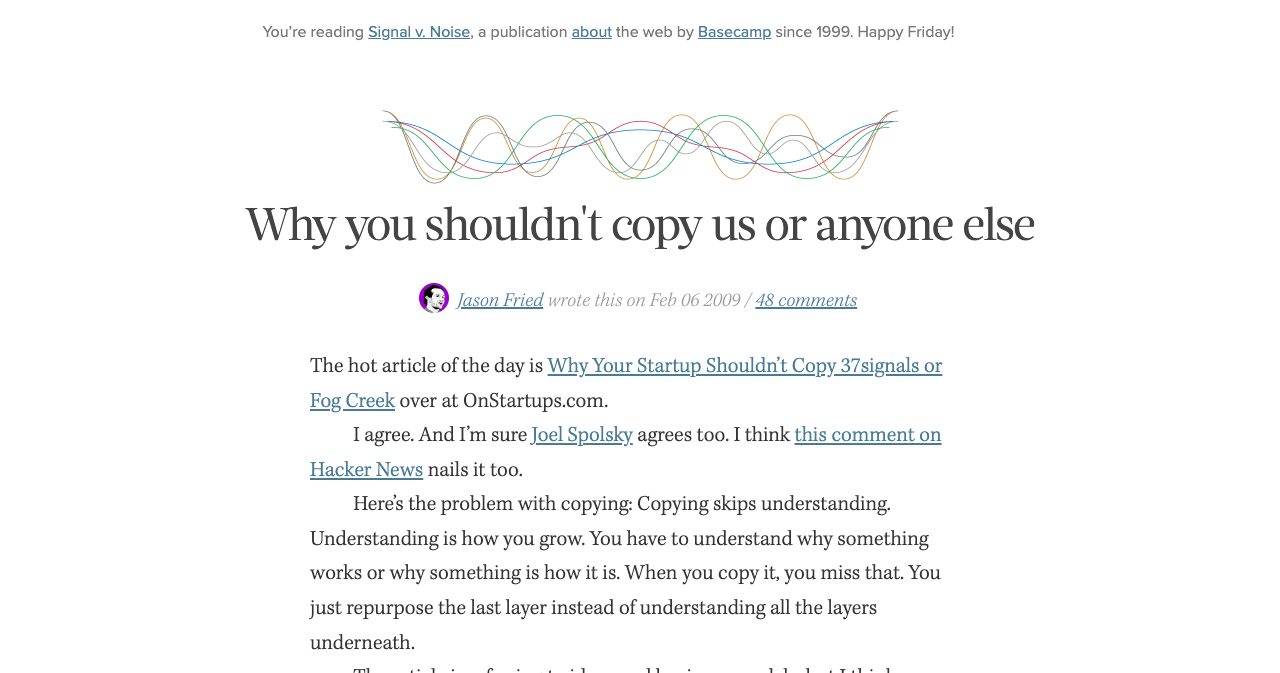
Contrast that with how experienced operators view ordinary copycats. In his Signal v. Noise essay "Why you shouldn't copy us or anyone else" and in It Doesn't Have to Be Crazy at Work, 37signals co-founder Jason Fried put it plainly: "When someone copies you, they are copying a moment in time, and they don't know the thinking that'll help you have a million more moments in time. They're stuck with what you left behind." Y Combinator managing director Michael Seibel echoed the point in his essential startup advice: "spending any time worrying about your competitors is nearly always a very bad idea. We like to say that startup companies always die of suicide not murder."
In CB Insights' 2026 failure study (which we broke down in our guide on what to do when your startup idea already has competitors), only 6% of failed startups died because rivals beat them. Most copycats fade out on their own while the original founder wastes two weeks refreshing their homepage.
Clone triage matrix
Before you email a lawyer, draft a furious post on X, or rebuild your roadmap, classify the copycat. Every tier calls for a different response.
| Clone tier | What they copied | Legal viability | Recommended action | Typical cost and timeline |
|---|---|---|---|---|
| Tier 1: Idea-only ghost town | General concept, pricing angle, or similar workflow written from scratch | Almost none under copyright law | Log the URL privately, ignore them, and keep shipping | $0, 10 minutes |
| Tier 2: Verbatim copy, code, or asset theft | Literal landing-page copy, blog text, source code, icons, or stolen site images | High under DMCA (17 U.S.C. section 512) | Capture evidence, email a 48-72 hour takedown request, then file DMCA with origin host and Google Search | $0 (self-filed); 10 to 14 business days if counter-noticed |
| Tier 3: Exact-brand or domain squatting | Your product name on .org, .lol, .app, or phishing lookalike pages | Moderate to high under ICANN UDRP or ACPA if bad faith is documented | Capture evidence, file registrar abuse report, file UDRP if brand confusion diverts real traffic | $1,330 to $4,000 filing fee, 30 to 60 days |
| Tier 4: Distribution-backed incumbent | Your core feature rebuilt inside a platform with existing users | Very low unless patents or literal code theft apply | Narrow to a defensible wedge, build lock-in, and double down on owned distribution | Product roadmap investment, ongoing |
What the law protects and what it costs in 2026
Founders lose weeks and thousands of dollars confusing moral outrage with legal remedies. U.S. intellectual property law draws a hard line between copying an idea and stealing concrete expression or identity.
Copyright: ideas vs. literal expression
Under 17 U.S.C. section 102(b), copyright protection never extends to "any idea, procedure, process, system, method of operation, concept, principle, or discovery." Someone can copy your business model, your pricing tiers, your directory structure, and your standard UI navigation without breaking copyright law. Courts routinely exclude functional layouts and standard industry patterns under the merger doctrine and scenes a faire.
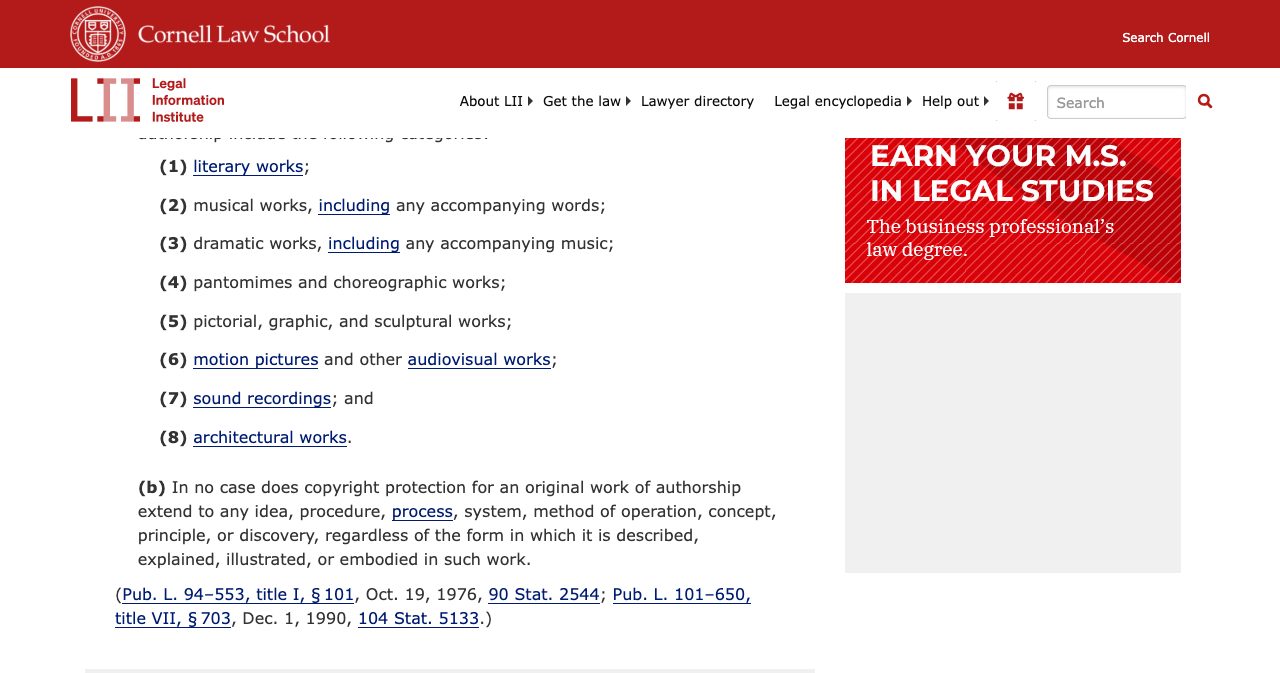
What copyright does protect is literal expression: your exact source code, verbatim landing-page copy, blog articles, custom illustrations, 3D models, logos, and full-page captures ripped straight from your site.
You hold copyright automatically upon creation, and you do not need registration to send a DMCA notice. Under 17 U.S.C. section 411(a) and the Supreme Court's Fourth Estate v. Wall-Street.com ruling, you cannot file a federal copyright infringement lawsuit for a U.S. work until the U.S. Copyright Office issues (or refuses) a registration. According to the U.S. Copyright Office fee schedule, electronic filing in 2026 costs $45 for a Single Application and $65 for a Standard Application, with both fees scheduled to rise to $55 and $85 on January 5, 2027. Expedited special handling adds a $1,100 surcharge. Registering your core code and visual assets early is cheap insurance if a high-stakes fight ever lands in court.
DMCA takedowns and the Cloudflare trap
When a clone lifts your literal text, code, or images, 17 U.S.C. section 512 lets you demand removal from hosting providers and search engines without hiring a litigator. Two statutory rules trip up founders who fire off notices hastily:
- Bad-faith takedown liability under section 512(f). Knowingly misrepresenting that material infringes copyright exposes the sender to damages and attorney's fees. In Lenz v. Universal Music Corp., the Ninth Circuit ruled that senders must consider fair use before issuing a notice. Never send a DMCA takedown over an unprotectable idea.
- The 10 to 14 business day counter-notice rule under section 512(g). If the clone submits a sworn counter-notice consenting to U.S. federal court jurisdiction, the host must put the site back up in 10 to 14 business days unless you file a federal lawsuit and notify the host. If you lack an issued registration under section 411(a), you will have to pay the $1,100 special handling surcharge on top of federal litigation costs to keep the content down.
The biggest operational surprise for first-time filers is where to send the notice. Many copycats sit behind Cloudflare, which acts as a reverse proxy and cannot delete files hosted elsewhere. As Cloudflare's abuse policy explains, copyright notices submitted there are forwarded to the site operator and hosting provider. To get stolen assets removed, trace the origin host through historical DNS records (SecurityTrails), certificate transparency logs (crt.sh), or unproxied subdomains, then serve the DMCA directly to the real host.
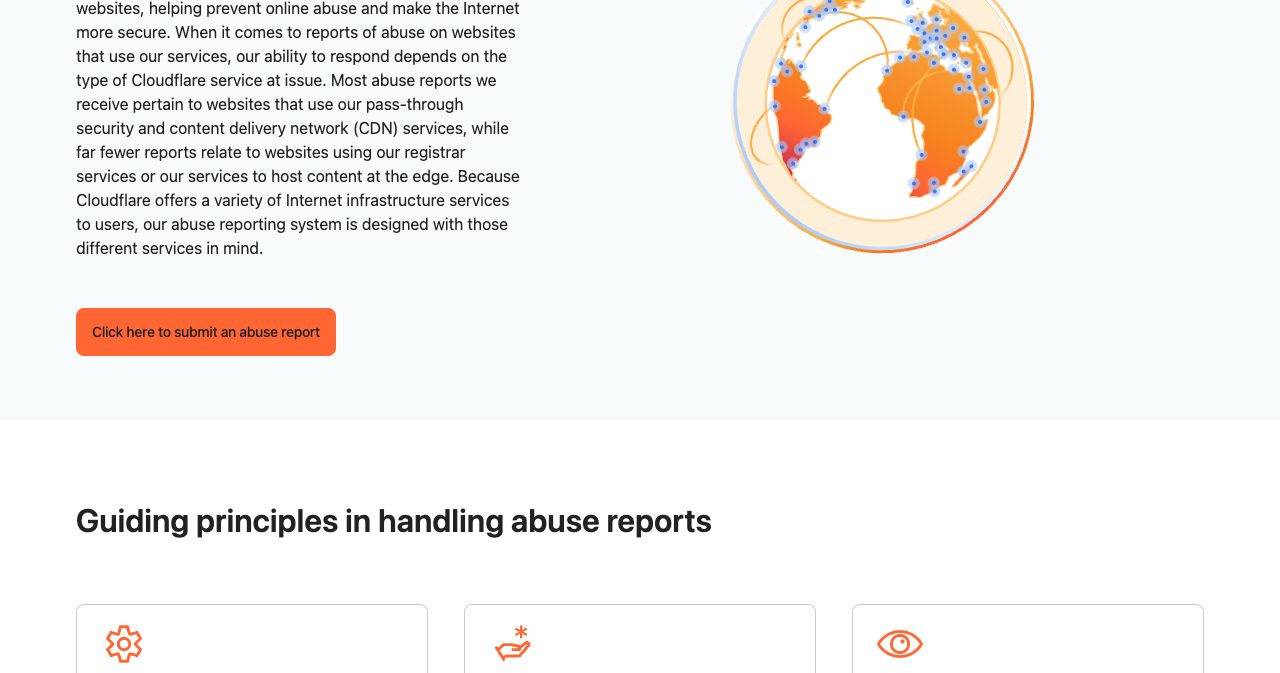
| Platform | Action taken on valid notice | Deletes files at origin? | Publicly logged? | Official policy |
|---|---|---|---|---|
| GitHub | Disables or locks infringing repositories | Yes | Yes (published in GitHub DMCA repo) | GitHub DMCA Policy |
| Vercel | Suspends or removes infringing deployments | Yes | No | Vercel DMCA Policy |
| Netlify | Removes or suspends hosted sites | Yes | No | Netlify DMCA Policy |
| Cloudflare | Forwards abuse report to operator and origin host | No (reverse proxy only) | No | Cloudflare Abuse Approach |
| Google Search | Delists infringing URLs from Google results | No (search index only) | Yes (archived in Lumen Database) | Google Legal Removal Tool |
Google Search delisting is worth doing in parallel when a clone scrapes your pages verbatim. According to the Google Transparency Report, Google has processed more than 17.9 billion copyright URL delisting requests since March 2011. Keep one detail in mind: Google routinely forwards removal notices to Harvard's Lumen Database, which publishes the claimant's name and notice text publicly.
Trademarks, UDRP domain disputes, and the Streisand Effect
When a copycat squats your exact brand name on .org, .lol, or .app, copyright rarely covers a two-word brand name. Trademark and domain-dispute law do.
Effective January 18, 2025, the USPTO trademark fee schedule replaced the old TEAS Plus and TEAS Standard tiers with a unified base electronic filing fee of $350 per class of goods or services (with surcharges of $200 per class for custom free-form descriptions or $100 per class for incomplete filings). Filing a wordmark for your core brand name once you have real revenue makes every downstream takedown faster.
For lookalike domains, the ICANN Uniform Domain-Name Dispute-Resolution Policy (UDRP) lets you recover or cancel a domain without going to federal court if you prove all three elements under Paragraph 4(a): the domain is identical or confusingly similar to a trademark or service mark in which you hold rights (registered or established common-law rights), the registrant has no rights or legitimate interests in the domain, and the domain was both registered and used in bad faith.
UDRP filings hit an all-time high at WIPO with 6,282 domain disputes filed in 2025, up from 6,168 in 2024. On March 9, 2026, WIPO launched Expedited Case Processing, cutting the decision target to 30 calendar days for a higher fee.
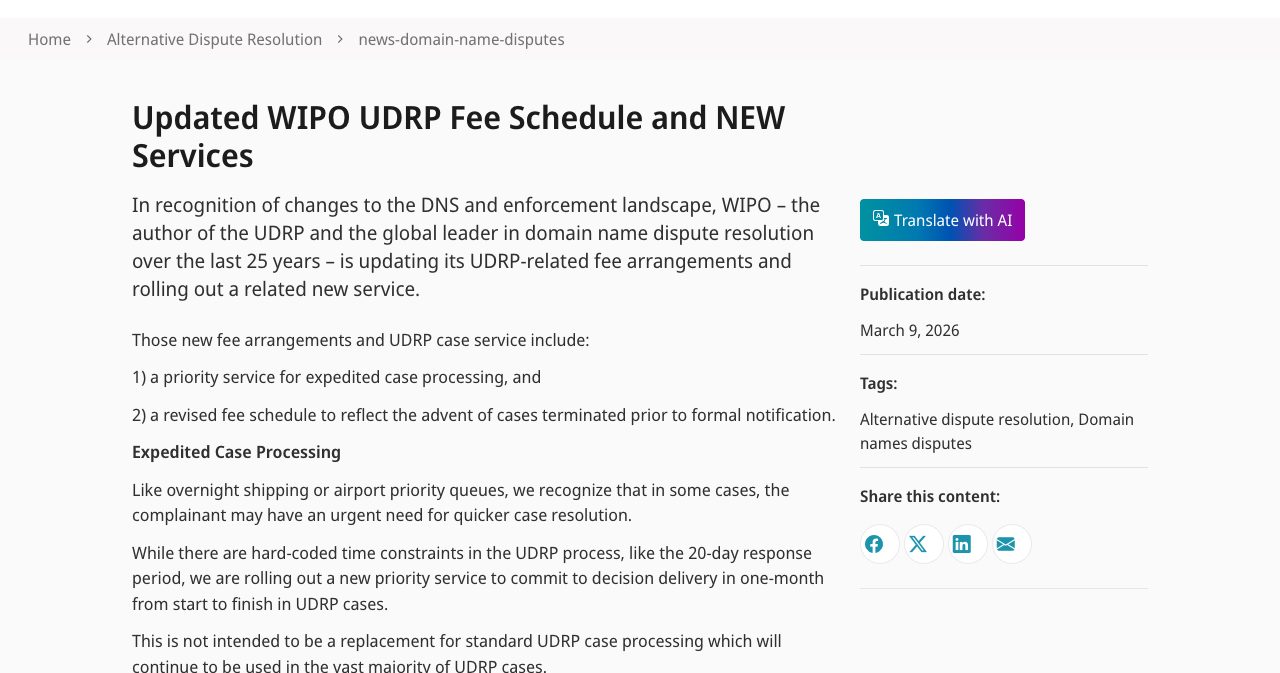
| Enforcement option | Statute or policy | 2026 official fee | Typical timeline | Best use case |
|---|---|---|---|---|
| Host DMCA takedown | 17 U.S.C. section 512 | $0 (self-filed) | Varies by host (10 to 14 business days if counter-noticed) | Stolen images, verbatim copy, or ripped code |
| Google Search delisting | 17 U.S.C. section 512 | $0 (self-filed) | Varies by review queue | Removing verbatim clone pages from search results |
| U.S. Copyright registration | 17 U.S.C. section 411(a) | $45 single / $65 standard ($1,100 expedited) | Standard examination (expedited via special handling) | Prerequisite to filing federal copyright litigation |
| USPTO federal trademark | Lanham Act | $350 per class (base electronic) | Standard USPTO examination | Protecting brand name and strengthening UDRP claims |
| FORUM UDRP complaint | ICANN UDRP | $1,330 (1-2 domains) / $1,480 (3-5 domains) | Standard UDRP proceeding | Recovering bad-faith lookalike domains on a budget |
| WIPO standard UDRP | ICANN UDRP | $1,500 (1-5 domains, 1 panelist) | ~50 to 60 days (+10 business day transfer lock) | Recovering exact-brand squats with broad precedent |
| WIPO expedited UDRP | ICANN UDRP (March 2026) | $4,000 (1-5 domains, 1 panelist) | ~30 calendar days | Urgent brand impersonation or active phishing |
| Federal ACPA lawsuit | 15 U.S.C. section 1125(d) and 1117(d) | Federal court + counsel | Federal litigation | Bad-faith cybersquatting with $1,000 to $100,000 statutory damages per domain |
Links to official fee schedules for FORUM UDRP, WIPO UDRP, and the federal ACPA statute (15 U.S.C. section 1125) and statutory damages section (15 U.S.C. section 1117) are worth bookmarking before hiring counsel. Federal website trade dress claims under Lanham Act section 43(a) (also under 15 U.S.C. section 1125(a)) exist in theory for distinctive, non-functional visual design, yet proving non-functionality and consumer confusion in federal court is expensive and slow for an early-stage team.
One final legal trap has nothing to do with statutes: the Streisand Effect. In 2003, Barbra Streisand sued photographer Kenneth Adelman for $50 million to remove an aerial photo of her Malibu home (Image 3850). Before the lawsuit, the image had been downloaded six times, twice by her own lawyers. In the month after she sued, more than 420,000 visitors viewed the site. In 2008, Monster Cable sent an aggressive trademark cease-and-desist letter to small competitor Blue Jeans Cable; founder Kurt Denke, a former federal litigator, published a line-by-line legal dismantling online that turned into a permanent PR disaster for Monster. Overreaching legal threats against weak claims hand free press to people who had zero traffic an hour earlier.
Step-by-step response playbook
Follow these six steps in order so you do not tip off an infringing operator or sink two weeks into a clone that was already dying.
- Capture forensic evidence before contacting the operator. Submit both your original pages and the clone's pages to the Wayback Machine (
web.archive.org) andperma.ccso third-party timestamps exist before the copycat edits or deletes anything. Look up the clone's exact domain creation date and registrar through ICANN RDAP Lookup. Export full-page captures, save raw HTML and stolen asset URLs (including SHA-256 hashes), and export your own git commit history and sitemap dates proving prior creation. - Classify the clone into one of four threat tiers. Use the triage matrix above to separate an empty concept clone from verbatim asset theft, exact-brand squatting, or a distribution-backed incumbent. If it sits in Tier 1 with zero traffic and no stolen assets, close the tab and get back to your customers.
- Send a short removal request and file surgical takedowns. For Tier 2 asset theft or Tier 3 brand squatting, email the operator a calm, factual note giving them 48 to 72 hours to remove the stolen assets or take down the brand squat. Many weekend copycats fold on the spot. If they ignore you, serve DMCA notices directly to the true origin host (since Cloudflare only forwards complaints) and Google Search for literal copyright theft, or file a FORUM ($1,330) or WIPO ($1,500) UDRP complaint when an exact-brand squat diverts real buyers.
- Lock down your brand search results and authority. Make sure your homepage, docs, blog, social profiles, and trusted third-party listings own every slot on page one for your brand name. Strong SaaS directory listings, consistent AI citation signals, and steady Domain Rating growth bury copycat domains before users ever click them. When writing about a clone publicly, never give it a clickable link (not even
nofollow), since links pass referral visits and help search engines discover and index the copycat. - Out-ship the clone and deepen marketplace liquidity. Put your engineering hours into things a weekend prompt cannot replicate: live verified data, API integrations, security hardening (see our pre-launch security checklist for vibe-coded startups), faster support, and active user participation. Copycats only know what you shipped last month.
- Apply strict rules before any public callout. Publish a public callout only when you hold dated, verifiable receipts of literal theft, brand squatting, or fake numbers. Stick to public attributions from the site itself, never publish private personal data, avoid profanity or guesswork, and write every clone domain in plain bold text with zero links.
If you are choosing a domain for a new product before copycats ever arrive, our guide on why cheap promo domains hurt SaaS trust covers which TLDs defend brand search cleanly.
What AI can clone in a weekend vs. what compounds over years
Copycats obsess over the visible layer because it is the only layer a coding agent can read from a browser. The table below separates what disappears in 48 hours from what protects a SaaS business over time.
| Layer | Can AI clone it in a weekend? | Why it dies or compounds |
|---|---|---|
| Landing page copy and layout | Yes | Commodity HTML; any prompt clones it in minutes |
| Isometric UI or 3D canvas shell | Yes | Three.js and WebGL templates are trivial to regenerate |
| Basic Stripe checkout and CRUD | Yes | Boilerplates wire up payments in an hour |
| Domain authority (DR) and earned backlinks | No | Earned editorial links compound over months and survive clone waves |
| Active users and two-sided liquidity | No | A 3D city with 0 startups or 1 online visitor has zero utility |
| Curated, live-maintained datasets | No | Scraping a snapshot goes stale the week after launch |
| Brand search volume and AI citations | No | Search engines and LLMs tie brand entities to consistent web authority |
| Shipping velocity and product intuition | No | Copycats chase yesterday's changelog while you ship the next iteration |
You can see the authority gap instantly by running any startup domain and its copycats through a free Domain Rating checker. On SaaSCity, the product moat is the live launch directory, our curated startup directories database of 1,667 DR-scored SaaS directories and 371 AI directories, our AI agent directory submission skill, and our DR 71 search authority. None of those transfer when someone copies a city grid.
Wall of Shame: every clone of SaaSCity.io we found
Everything above is the calm, textbook founder playbook. Now look at what cloning looks like up close when a crowd of unoriginal copycats decides to rip off your work without having one original thought of their own.
First, the public timeline for saascity.io: our first git commit (e814bdf1) landed on December 22, 2025, saascity.io was registered on January 17, 2026, and the Wayback Machine captured our live homepage on January 29, 2026. Today saascity.io sits at Ahrefs DR 71, runs an interactive 3D isometric city where startups earn taller buildings through real community upvotes and views, reviews every submission by hand, and powers 1,667 DR-scored SaaS directories plus 371 AI directories.
Between February and November 2026, 17 separate clones and derivative sites launched after us to ride the exact same 3D startup city concept. Most of them could not even bother inventing a new name, a working privacy email, or a single paying customer. Below are the receipts, pulled directly from ICANN RDAP records, DNS nameservers, public API responses, and the sites' own live pages on November 27, 2026. Every single clone domain is written in plain bold text with zero backlinks.
The crown jewel of shamelessness: saascity.org
If there were a trophy for zero creativity, zero ethics, and getting caught red-handed by your own database IDs, saascity.org would sweep every category.
Registered on August 22, 2026 (seven months after saascity.io) by an anonymous operator hiding behind a blank footer and a lone [email protected] address, saascity.org squatted our exact "SaaS City" name on .org. Worse, the operator did not even build a 3D city map. Instead, they stole an uncropped 1800x934 screen capture of saascity.io's live city, saved it as saascity-city-bg.jpg, and slapped it behind a flat HTML $2 bidding table as both their site wallpaper and their og:image.
They were too lazy to crop our own branding out of the stolen image. Looking at saascity-city-bg.jpg, you can still see saascity.io's glowing cyan SAASCITY central monolith tower, our PRIME SPOT · 30 Days Display billboard, our bottom-right Top 5 · THIS MONTH and Map buttons, and even a live hover tooltip from our city reading MiNonna: Senior Video Calls · Taken · Level 1 at (39, 14) - Click for details. Stealing a competitor's live UI to pretend you have a 3D city while shipping a plain HTML table is embarrassing enough. Then we checked their API and DNS records, and it got hilarious.
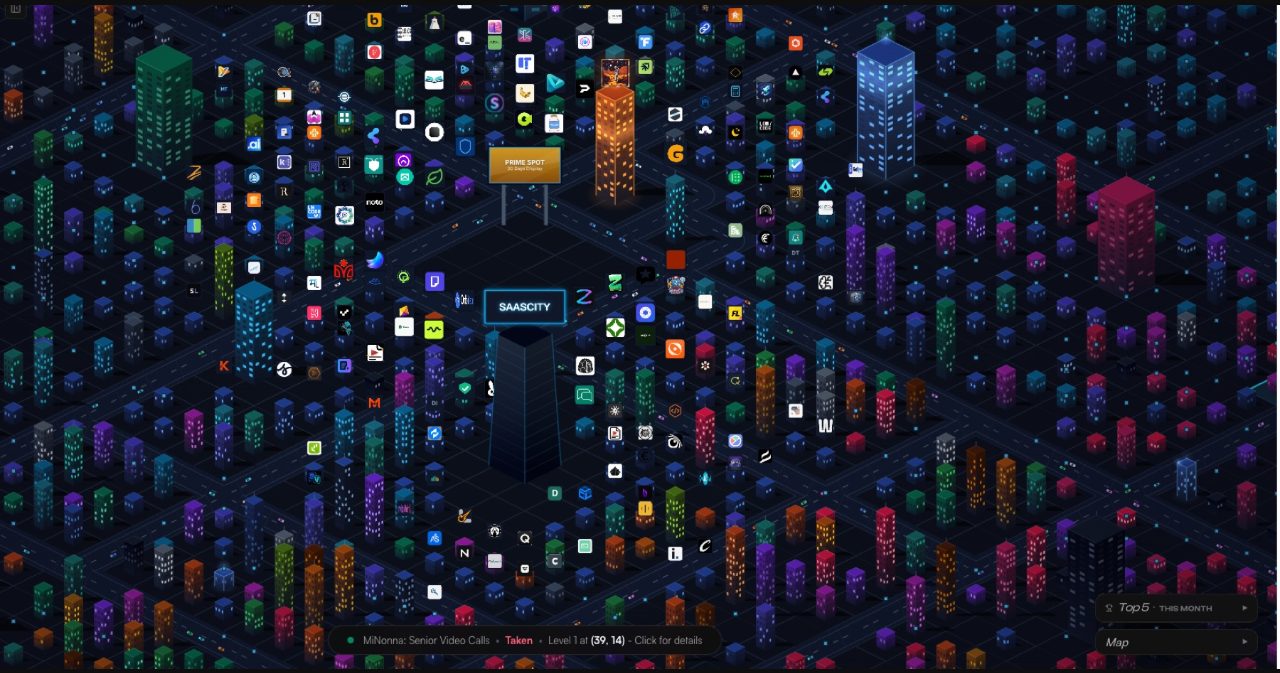
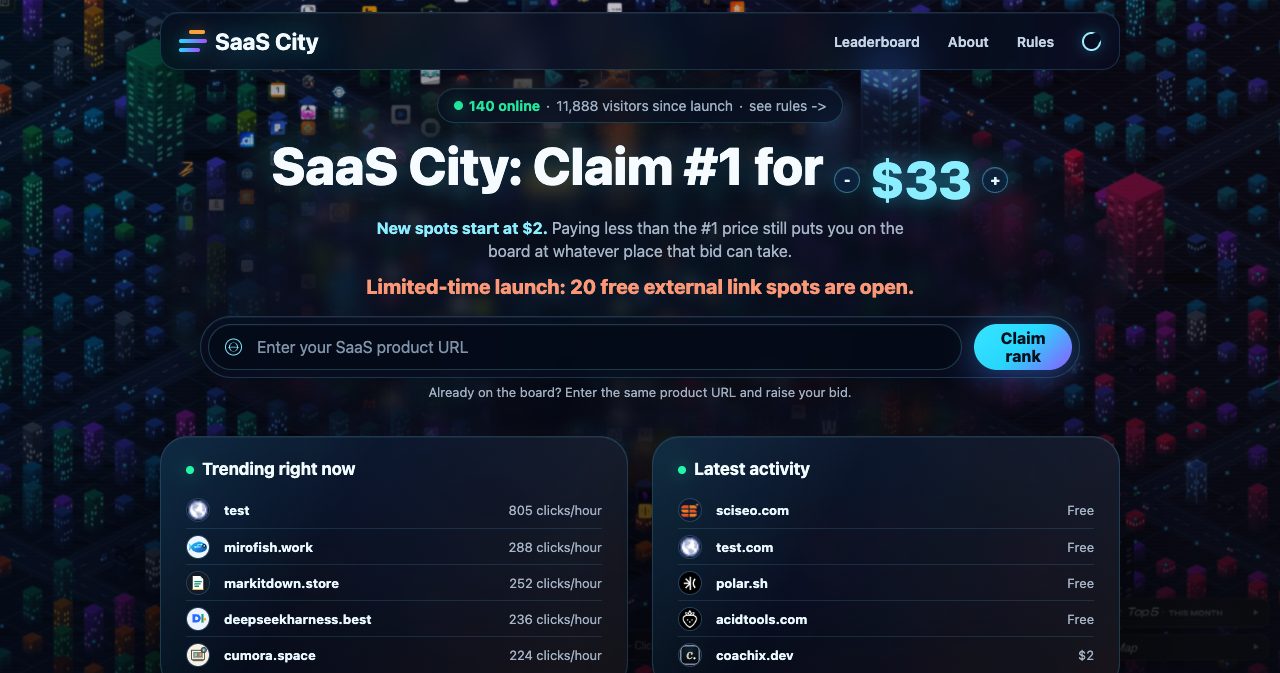
All 10 "paid" listings on saascity.org (supposedly totaling $111, from #1 mirofish.work at $28 down to #10 coachix.dev at $2) share the exact same Cloudflare account nameserver pair as saascity.org itself: archer.ns.cloudflare.com and sydney.ns.cloudflare.com. Every single "paying customer" is the operator's own domain farm. Their public /api/leaderboard endpoint even exposes the batch-seed database IDs: listing_patrol_2026_08_21_top9_1 through listing_patrol_2026_08_21_top9_9, with backdated createdAt timestamps running from August 17 to August 22, 2026, all ending in the identical millisecond :32.568Z, up to five days before saascity.org was even registered. Outside the operator's own 10 domains, 16 of 20 free slots sit completely unclaimed after three months. Only four free slots were ever touched, including their own payment processor (polar.sh) and test.com.
And the traffic counter? Pure fiction. /api/leaderboard claims 11,886 total visitors since launch and 139 to 140 users online at once, while the 14 listings' totalVisitCount fields add up to 6,940,268 visits. Leading the pack is rank #13, a $0 free link to test.com, supposedly pulling 1,570,999 visits at 805 clicks per hour. Polling /api/leaderboard over roughly six minutes showed test.com ticking upward from 1,570,906 to 1,570,952 to 1,570,999 (+93 fake clicks in six minutes), generating 132 times more "visits" for test.com alone than the entire site claims to have received in its lifetime. That is what happens when someone tries to fake a business from top to bottom.
The exact name squatters and copy-paste ghost towns
The rest of the direct copycats skipped the fake-click math and went straight to shipping half-baked ghost towns.
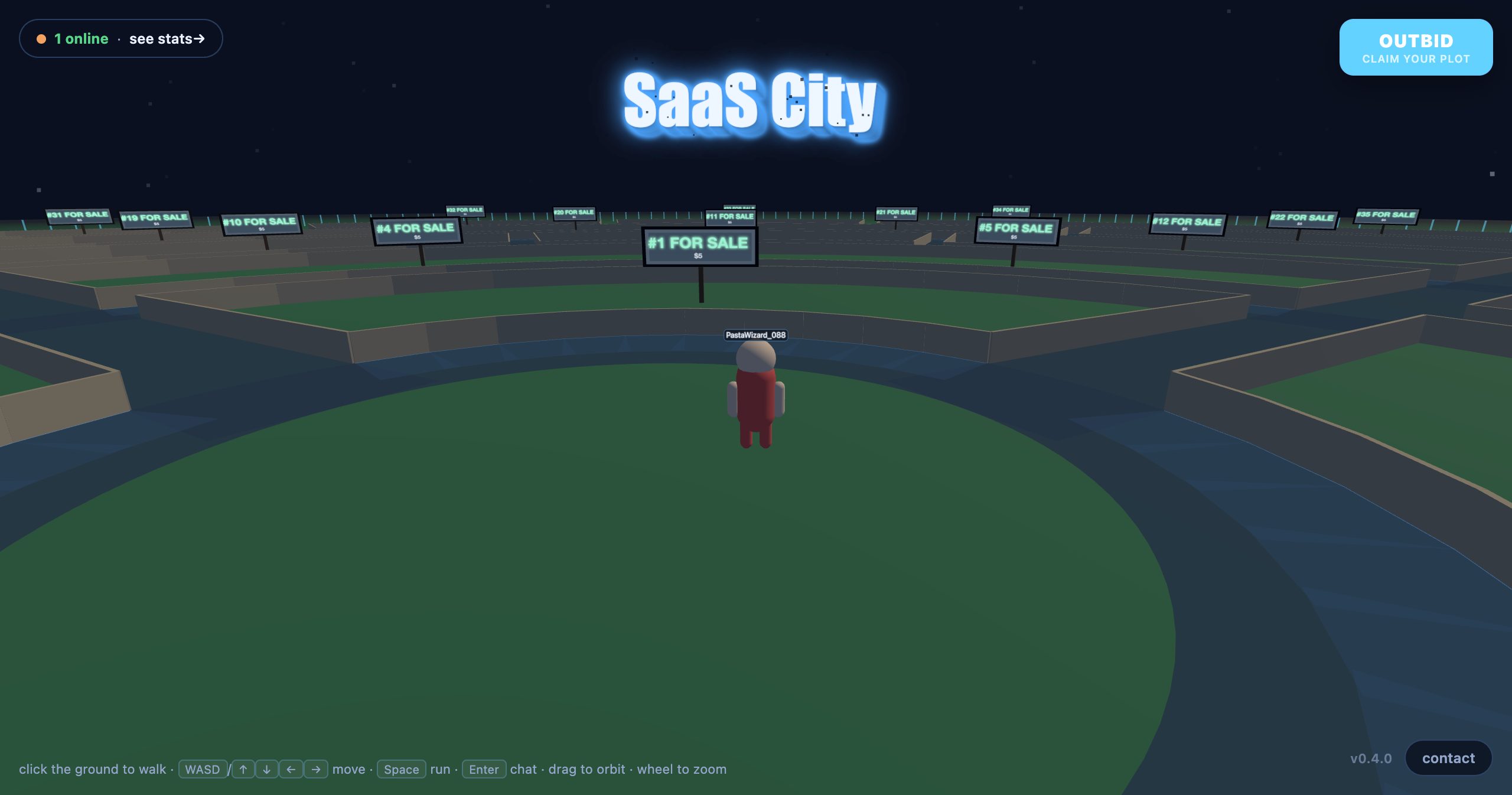
saascity.lol (registered August 21, 2026, publicly tracked on outbidwatch.lol to @mben_dev) jumped into the August 2026 .lol bidding craze two days after outbid.lol went viral, squatting our exact "SaaS City" brand name and bolting a pay-to-build-closer-to-center mechanic onto our 3D city premise. Open the site today and a giant neon "SaaS City" sign floats over a completely empty green grid where #1 FOR SALE ($5), #4 FOR SALE, #5 FOR SALE, and dozens of surrounding lots sit unsold with 1 online (our own browser). saascity.app did not even make it past registration: squatted on February 12, 2026, just 26 days after saascity.io went live, it issued four TLS certificates three days later and now sits completely dead on a timeout.
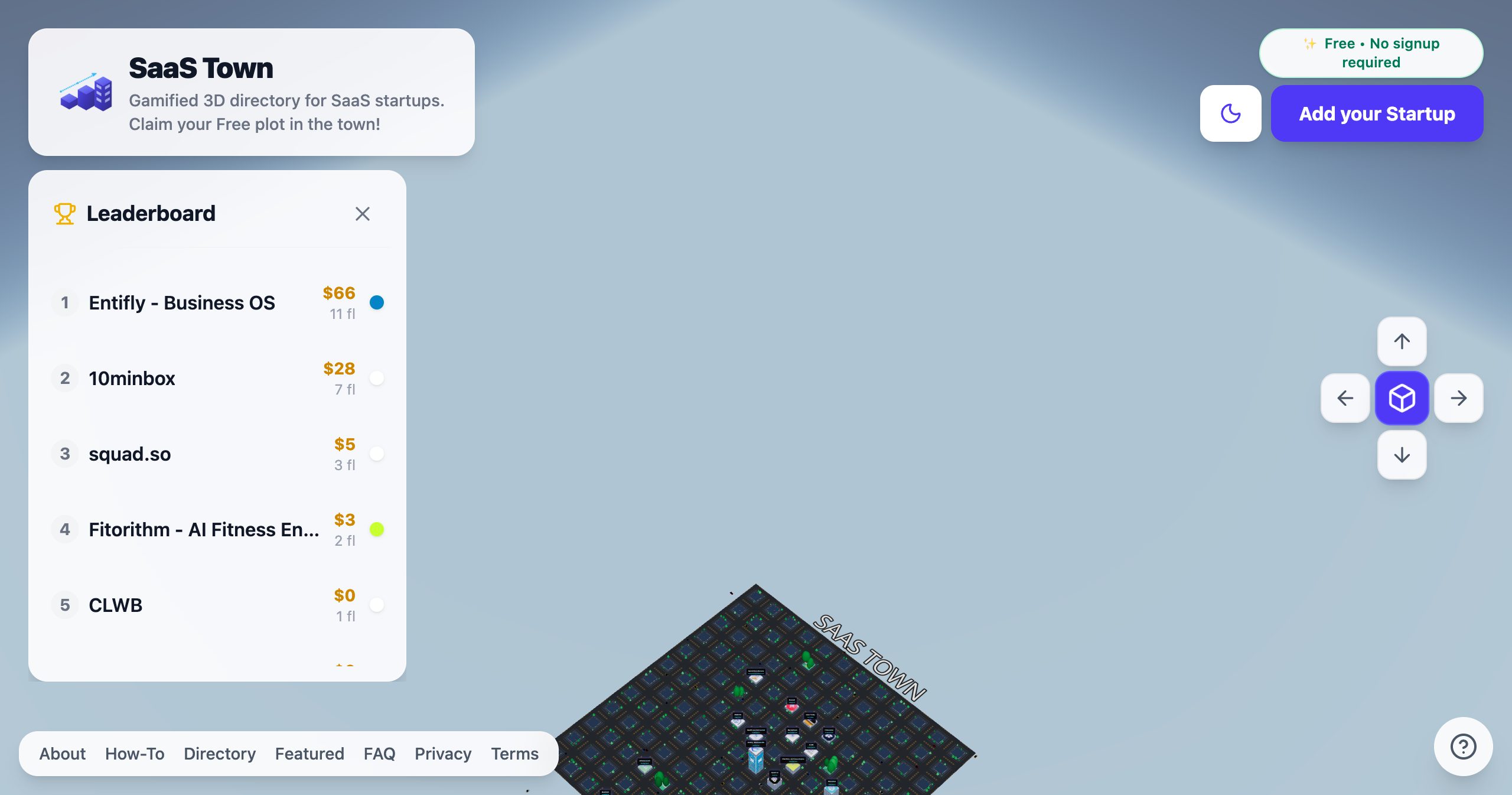
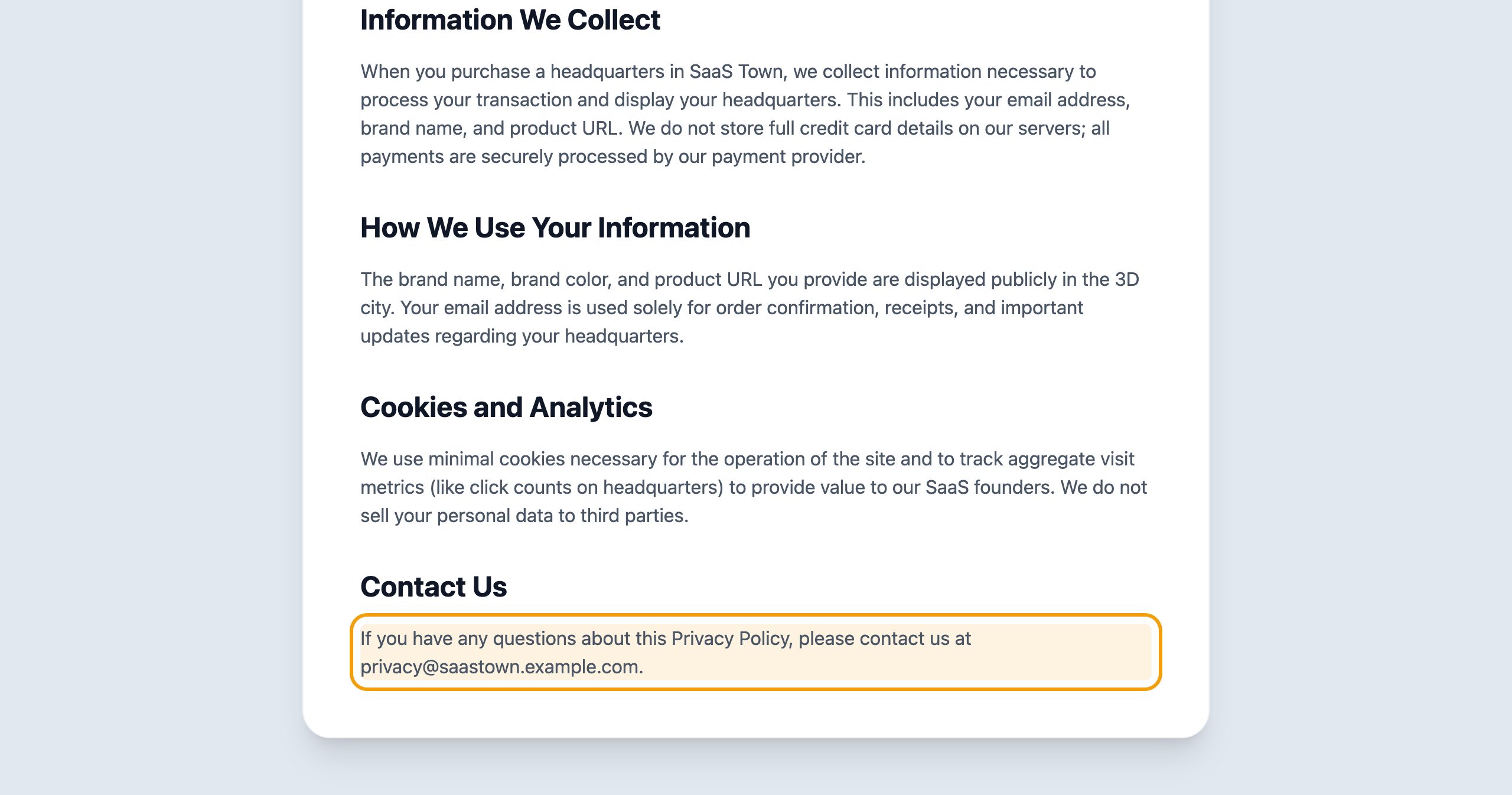
saastown.lol (registered August 31, 2026, publicly listed on bidindex.dev under maker Devansh, @devansh_sj) swapped "City" for "Town", copied the gamified 3D SaaS headquarters pitch verbatim ("Claim your free plot and build your digital headquarters, add floors to stand out"), and added a triangular floor-pricing gimmick (1+2+3 = $6). The level of craft shows in its live Privacy Policy, which still tells users to email [email protected] if they have questions. Nothing says "trust us with your SaaS launch" like shipping an AI-generated example.com placeholder straight into production.
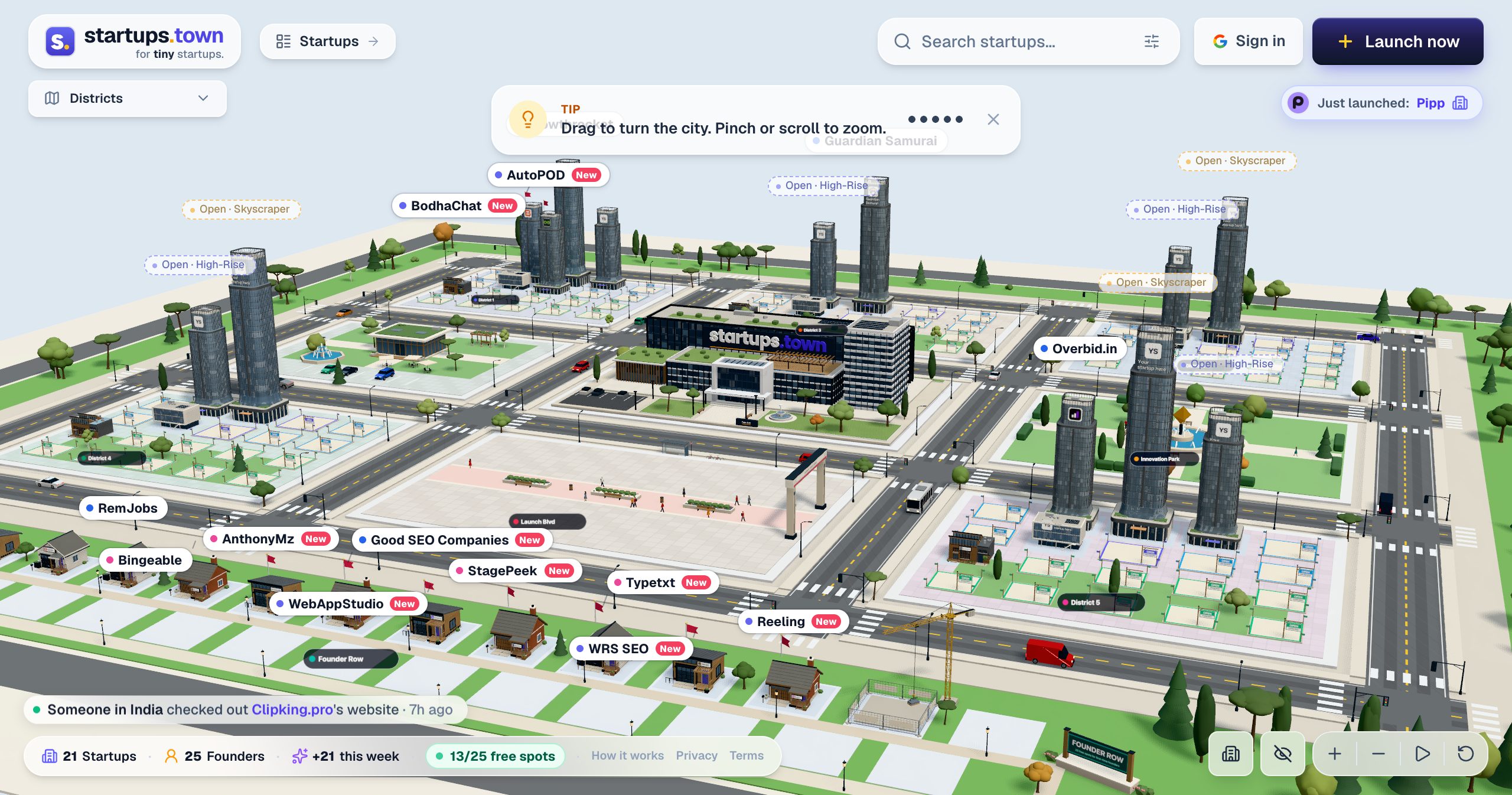
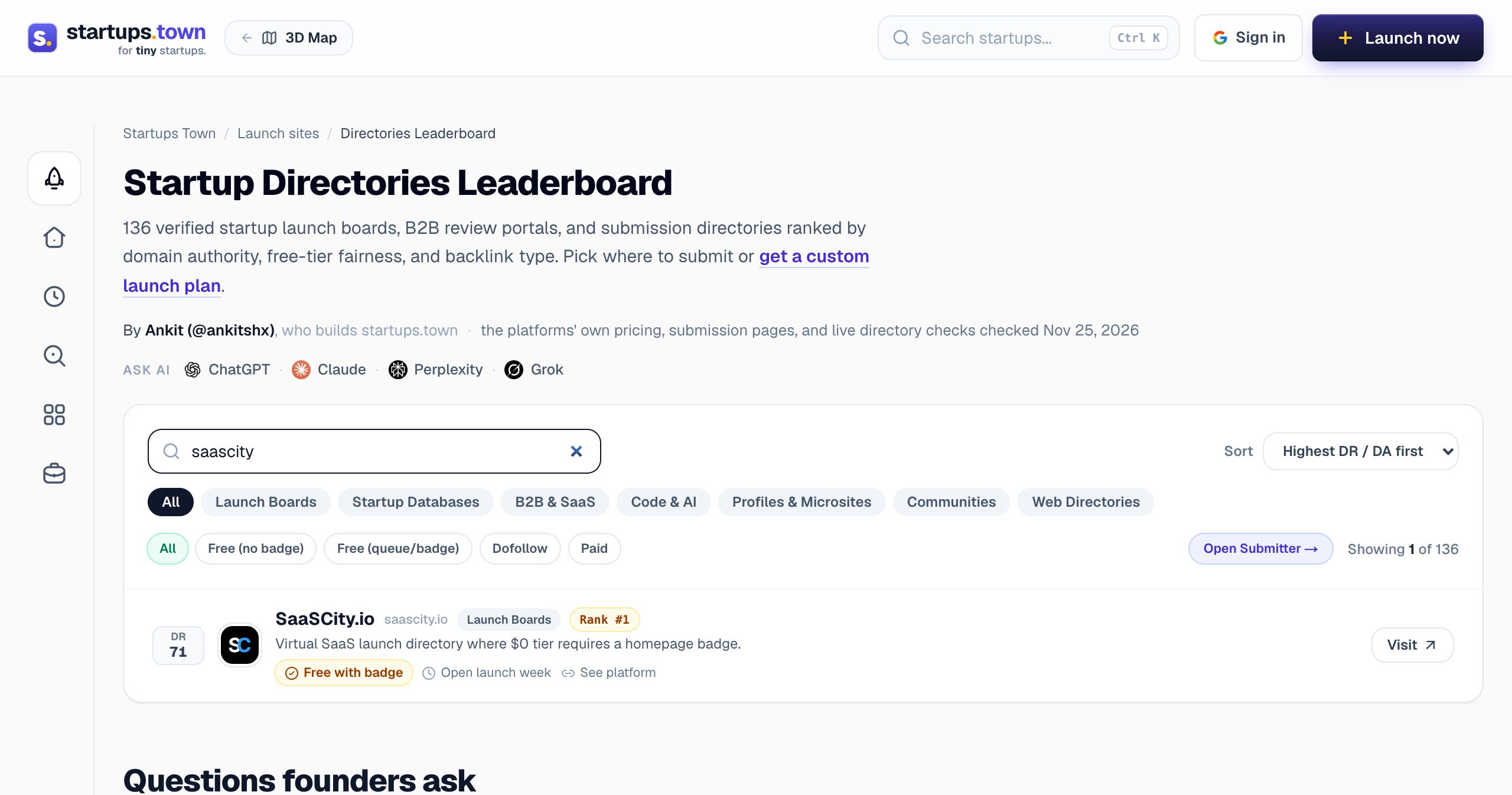
startups.town (freshly registered November 19, 2026, ten months after saascity.io, publicly self-attributed on its homepage to Ankit, @ankitshx) copied our entire product stack: interactive 3D startup city, tiered buildings from Garage Pod to Skyscraper, districts, upvote launchpad, permanent profile pages, dofollow links, a DR-ranked startup directories leaderboard, and free SEO tools. The funniest receipt sits right on their own /directories/leaderboard page, which explicitly lists SaaSCity.io at DR 71. Cloning a site while actively indexing that exact site's authority on your own leaderboard is a bold choice, especially while your own sitemap sits at 18 startup pages.
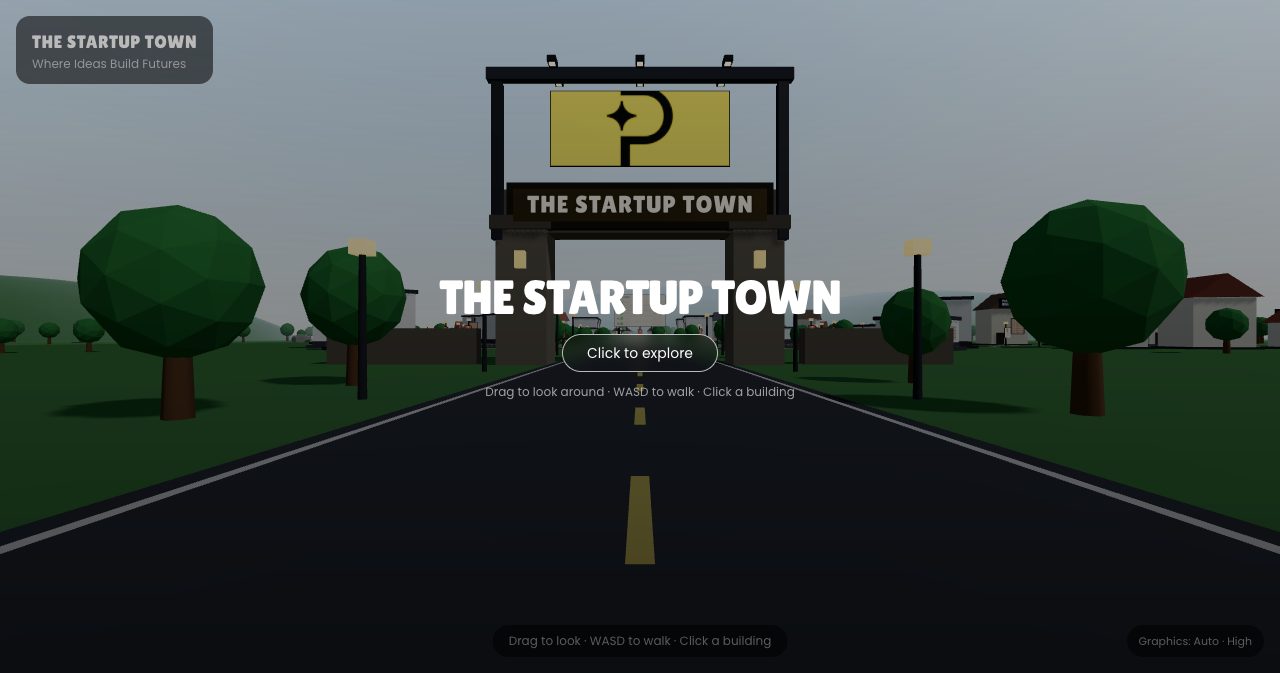
startuptown.world (registered September 24, 2026, legal terms naming "The Startup Town" in Kathmandu, Nepal, with no personal founder handle listed) copied the 3D town, branded startup houses, gate billboard, and daily ranking format ("A 3D Town Where Every Startup Gets an Address"). Its live /api/town endpoint tells the whole story: 0 startup houses, 2 ad-board records (ad-gate and ad-park, both displaying the same name, "Pushpa Kamal Sharma"), and a homepage where all five Daily Ranks slots sit completely empty, reading "Rank #1 is open" straight down the list.
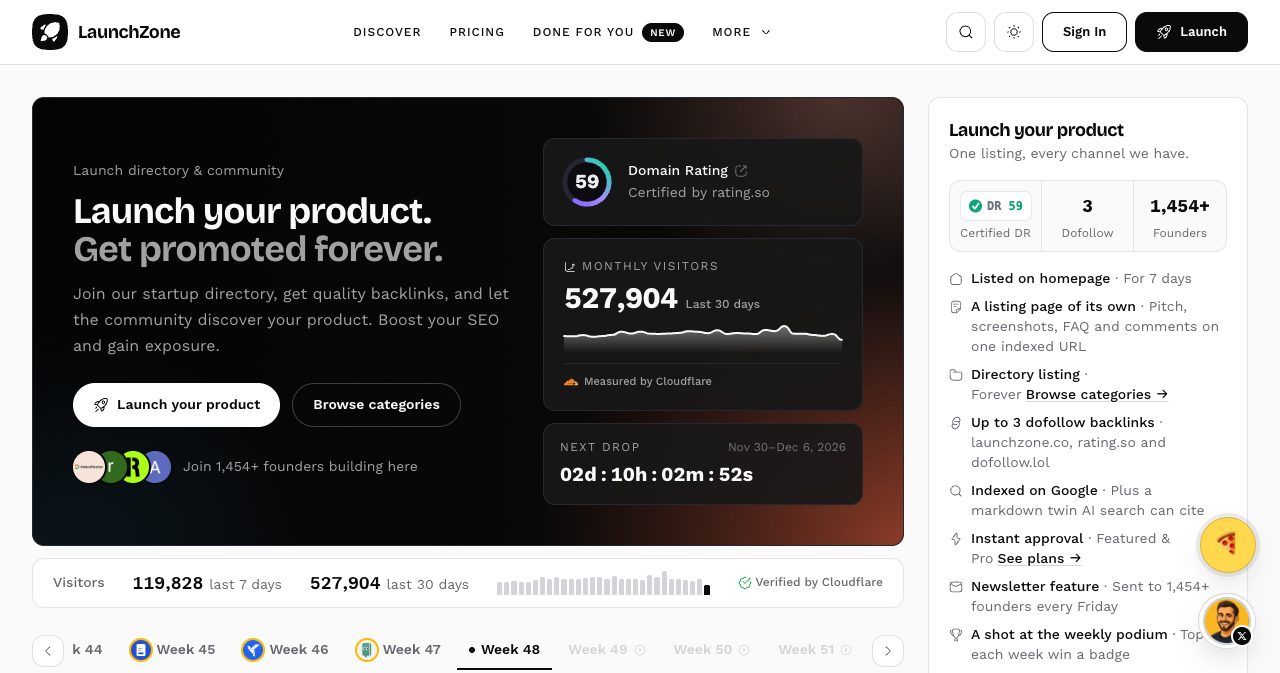
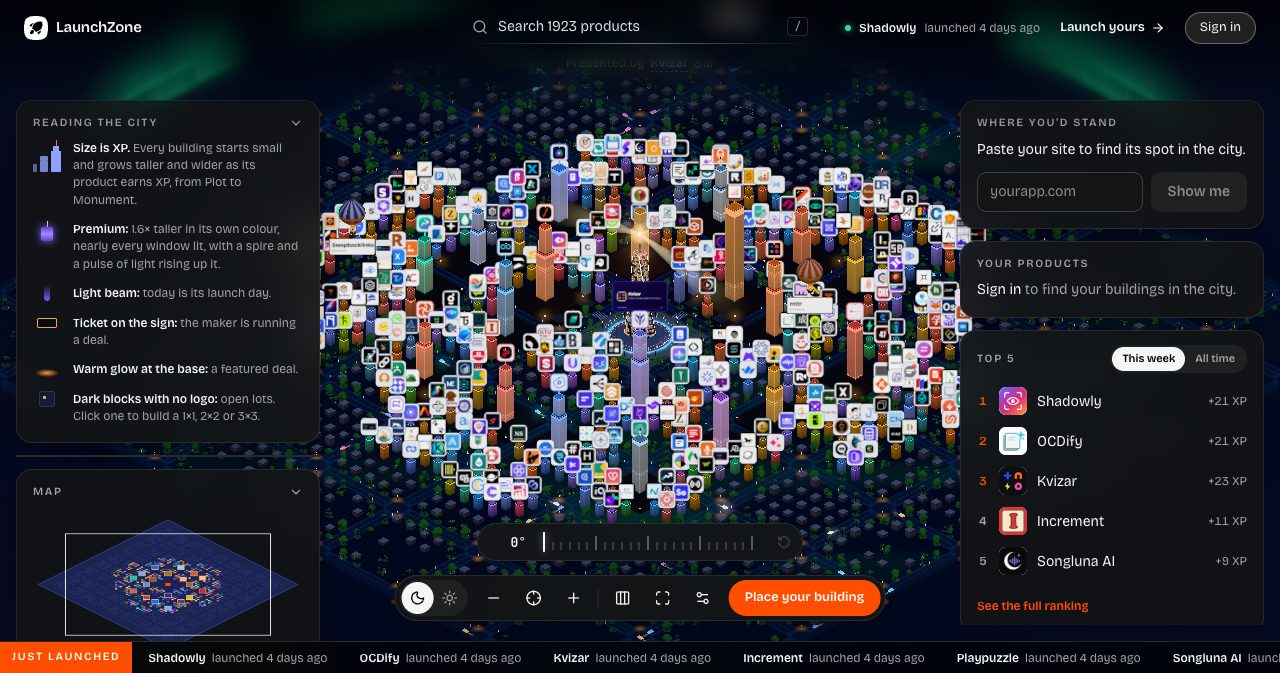
launchzone.co (founded by Dmytro Andrusenko, @0xDMA / @launchzonehq, per its own JSON-LD schema) took copying a step further: it did not stop at grafting a 1:1 isometric startup city (launchzone.co/launchcity, backed by launchcity.co, registered July 19, 2026, six months after saascity.io) with the pitch "every building is a real product launch. Claim a plot, build your HQ, and get featured." It also lifted our homepage hero layout piece by piece. On saascity.io, we shipped our two-column hero (eyebrow, headline, dual CTA buttons, and overlapping founder avatars on the left, paired with a three-card stat stack on the right: Domain Rating, Monthly visitors measured by Cloudflare in commit 9b82c55d on August 17, 2026, and the "Next drop" Monday countdown in commit fc4b79a0 on June 27, 2026). Open launchzone.co today and you will find the exact same blueprint staring back: dual hero CTAs, "Join 1,454+ founders building here", and the exact same right-hand stat stack featuring a Domain Rating card, a "Monthly visitors / Last 30 days / Measured by Cloudflare" card, and a "Next drop" weekly countdown timer. Copying a competitor's isometric city AND lifting their homepage hero widget-for-widget is total creative bankruptcy.
The late-wave spin-off: vibefeud.com
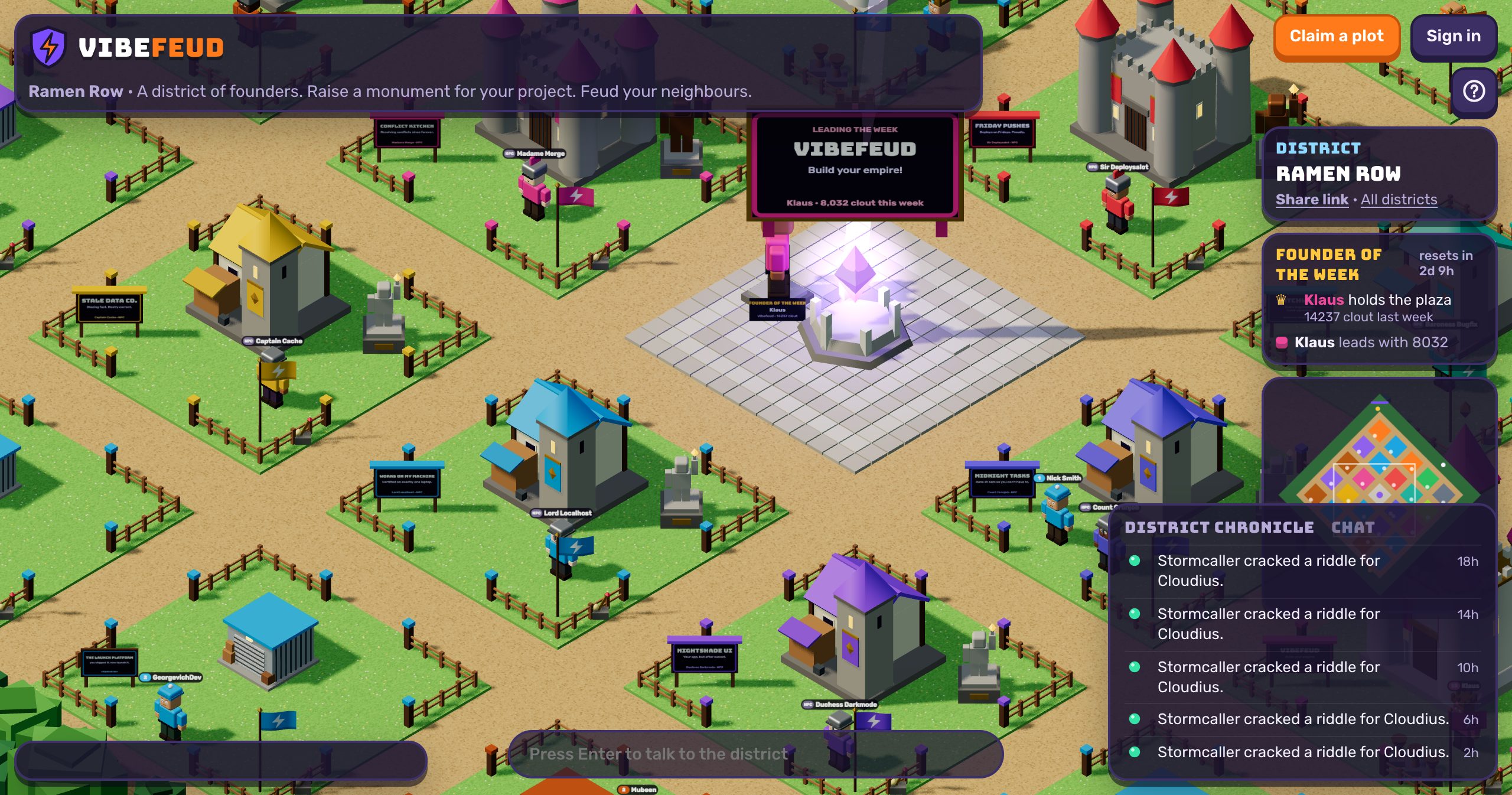
vibefeud.com (registered October 8, 2026, roughly nine months after saascity.io, openly self-attributed to Klaus Byskov Pedersen, @klausbyskov, Uneven Bits ApS in Copenhagen) deserves a slightly different bucket. It clearly borrowed the post-SaaSCity 3D startup-monument district premise ("Raise a monument for your project, grow it from a garage to a citadel"), then bolted on multiplayer neighbor-feuding, monument health, and MCP AI companions. At least the maker tried to add original game mechanics and avoided stealing site images or shipping example.com privacy policies. Even with that extra effort, its live /api/world feed on November 27, 2026 shows a single district (Ramen Row), 12 founders total, 1 online, the founder's own listing (Klaus / Vibefeud) sitting as weekly champion, and a notice admitting "Promoted boards aren't open yet. Soon."
Full 17-clone Wall of Shame table
Every single entry below was registered after saascity.io (2026-01-17) and copied the 3D or isometric startup-city directory concept. All statuses and public attributions were checked on November 27, 2026.
| Clone domain (no links) | Registered (RDAP/WHOIS) | Status | Publicly attributed maker | What they copied and live state |
|---|---|---|---|---|
| saascity.org | 2026-08-22 | Live | Unattributed ([email protected]) | Exact name squat; stole uncropped 1800x934 SaaSCity.io image with our HUD intact; all 10 paid bids self-seeded from same Cloudflare account and backdated up to 5 days pre-registration; 6.94M fake visits with test.com at 1.57M |
| saascity.lol | 2026-08-21 | Live | @mben_dev (per outbidwatch.lol) | Exact "SaaS City" brand squat on .lol; 3D bidding city mashup where plot #1 ($5) and every surrounding plot sit FOR SALE with 1 online |
| saascity.app | 2026-02-12 | Dead | Unattributed | Exact brand squat registered 26 days after saascity.io; never launched a live product, times out |
| saastown.lol | 2026-08-31 | Live | Devansh (@devansh_sj, per bidindex.dev) | "SaaSTown" 3D SaaS directory clone with paid floors; shipped literal [email protected] placeholder in live Privacy Policy |
| startups.town | 2026-11-19 | Live | Ankit (@ankitshx, on homepage) | Cloned full 3D city + DR directory + tools stack 10 months later while literally listing SaaSCity.io (DR 71) on its own leaderboard; 18 startup pages in sitemap |
| startuptown.world | 2026-09-24 | Live | Unattributed ("The Startup Town", Kathmandu, per /terms) | 3D startup town + gate billboard + daily ranks clone; 0 startup houses, 2 ad boards, all 5 Daily Ranks wide open |
| vibefeud.com | 2026-10-08 | Live | Klaus Byskov Pedersen (@klausbyskov, on site) | Late-wave gamified spin-off borrowing the 3D startup-monument district with neighbor feuding and MCP companions; 12 founders, 1 online, founder's own project as weekly champion |
| launchzone.co / launchzone.co/launchcity | 2026-07-19 (launchcity.co) | Live | Dmytro Andrusenko (@0xDMA / @launchzonehq, in site JSON-LD) | Grafted a 1:1 isometric "LaunchCity" building map onto LaunchZone 6 months after saascity.io AND copied our homepage hero layout widget-for-widget (dual CTAs + founder count beside the exact Domain Rating, Cloudflare Monthly visitors, and "Next drop" countdown stack) |
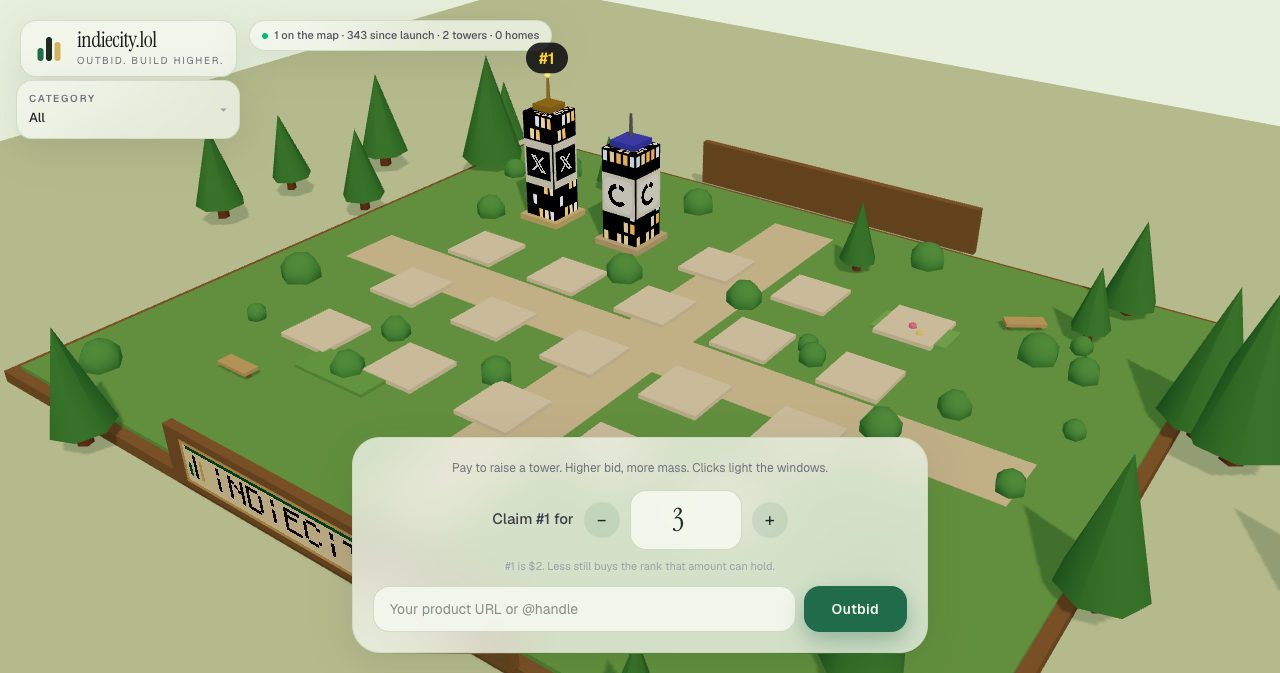
| indiecity.lol | 2026-08-21 | Live | Szymon (@sNotSune, per trustmrr.com / outbidwatch.lol) | 3D bidding skyline clone ("OUTBID. BUILD HIGHER."); live map holds just 2 towers, 0 homes, and a field of empty concrete plots |
| startupcity.lol | 2026-08-22 | Parked / dead | Unattributed | Registered during the August 22 .lol rush; already reduced to a generic domain parking page |
| startupcity.live | 2026-08-22 | Live | Unattributed | Startup billboard city clone whose live homepage reads "Billboard #2 is next, for $2" (one billboard sold) |
| indietown.lol | 2026-08-24 | Live | @SudJourney ([email protected], in JS bundle) | 3D React-Three-Fiber town ("Book an interactive home in fictional Indie Town") |
| indie.town | 2026-08-27 | Live | Semih Özsoy ([email protected], per /terms) | Walkable 3D town of 60 weekly-rented plots where higher-tier buildings displace lower ones |
| startupcity.online | 2026-09-05 | Live | Unattributed | Skyline directory clone ("Build Higher. Own the Skyline. Buy a plot, add $1 floors") |
| founderscity.org / founderscity.ai | 2026-10-12 & 2026-10-14 | Live | Unattributed | "A 3D campus where real businesses get their own buildings" running with a Demo events: on placeholder feed |
| founderstown.app | 2026-11-04 | Live | Unattributed | 3D indie builder town ("Start in the forest, grow into the city"); only 3 sample projects on homepage |
| launchcity.lol | 2026-11-17 | Live | @rokantech (on /contact) | Walkable 3D SaaS/AI city charging $9/mo per storefront; 1 user exploring now, 210 visitors, and a frozen 00d · 00h · 00m · 00s countdown |
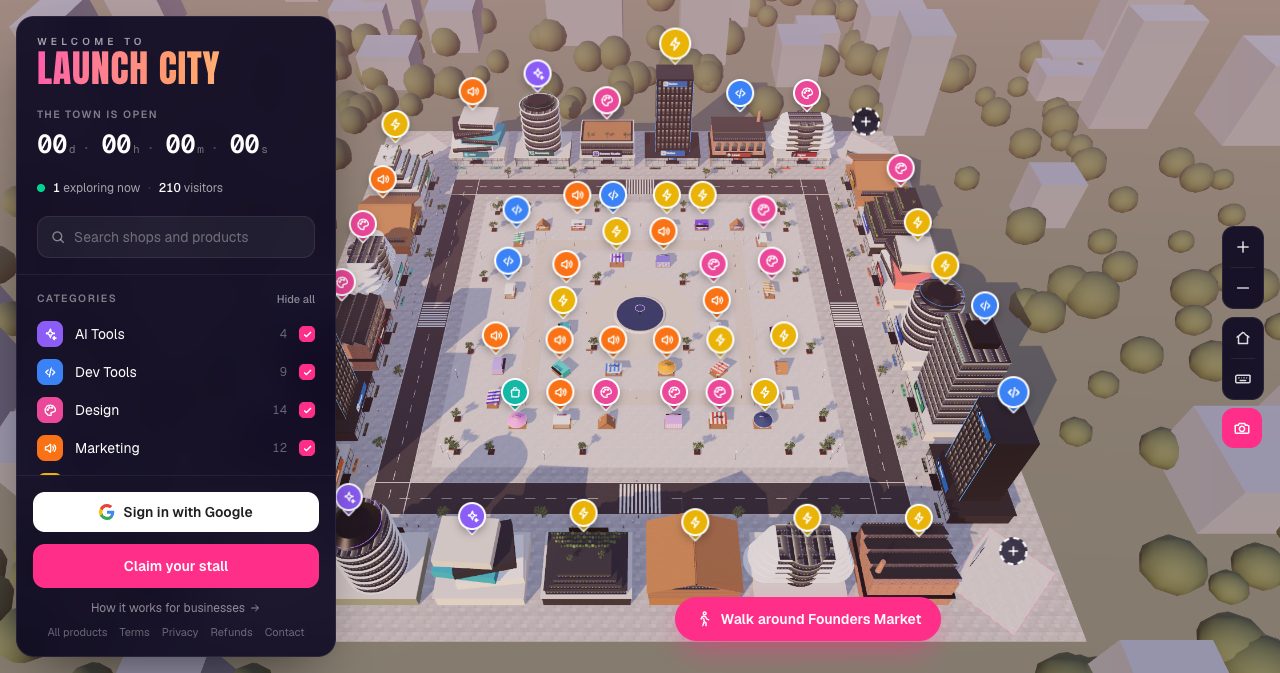
Look down that final column and the lesson from the first half of this post proves itself in real time. Seventeen copycats burned domain fees, coding weekends, and launch tweets trying to clone a product they did not invent. Half of them are empty parks, broken countdowns, parked pages, and example.com placeholders; the loudest brand squatter had to fake 6.94 million visits and buy its own listings from its own Cloudflare account just to make the leaderboard look alive. Copying a frontend takes 48 hours in 2026. Building an original product with real users, curated data, and DR 71 authority is the part copycats never manage to steal.
Inspiration vs. 1:1 fraud: why saascity.org and launchzone.co cross the line
Inspiration and creative twists are completely fair game whenever a builder adds genuine value. Software moves forward because makers see a working premise, invent a fresh angle, design their own interface, and ship something worth using. We are genuinely happy when saascity.io inspires another founder to build, which is why we noted above when a spin-off actually tried original game mechanics instead of ripping assets.
Pure fraudsters who have nothing of their own to offer sit at the opposite end of the table. Copying another company's artwork, visual styling, or page sections 1:1 goes way past healthy competition and straight into commercial fraud. Operators who pull these tricks mislead their own users at checkout, game search engines with mirrored layouts, stolen media, and squatted brand terms, and splash reputational damage straight back onto the original creator. Every time a founder gets burned by fake click counters or dead placements on a site wearing our name or our UI, saascity.io's reputation absorbs the hit for someone else's scam.
For anyone holding a company card, the common-sense test fits on a napkin. If someone cannot come up with a single idea or one shred of originality on their own, do you really think you can trust them with your money? An operator with nothing original to offer, who has to trace a stranger's live website pixel for pixel just to look legitimate, is showing you upfront how they treat paying customers. When the storefront you can see is lifted 1:1, expecting honest traffic numbers or clean billing behind the curtain is pure wishful thinking.
Two active sites from our audit above earn that fraud label outright, and we are happy to spare both founders and search engines the confusion.
saascity.org is straight-up fraud. With nothing of their own to offer, the operator squatted our exact brand name seven months late to hijack branded search queries, served an uncropped saascity.io city capture as both their wallpaper and og:image with our tower and live tooltip still stuck inside the JPEG, self-dealt all 10 paid slots from their own Cloudflare account with backdated timestamps, and ran a script ticking test.com past 1.57 million fake visits while charging real founders $33 to bid. Baiting search engines with our name and baiting buyers with our stolen artwork to run a rigged leaderboard is an impersonation scam built directly at the expense of saascity.io's reputation.
launchzone.co (@0xDMA / @launchzonehq) runs the dressed-up version of the same zero-originality playbook. Apparently finding original product design too exhausting, they lifted saascity.io's two-column hero styling and right-hand stat-and-countdown section 1:1, bolted a replica isometric city (launchzone.co/launchcity) onto the back, and opened the register for paid founder placements. Passing off a competitor's traced storefront and cloned sections as your own launch platform misleads founders and search crawlers alike into mistaking a photocopy for an original business, and billing startups on top of it is straight-up fraud with extra CSS padding.
FAQ
Is it illegal for someone to clone my startup idea or SaaS?
Copying a business idea, pricing model, or general feature set is legal in the United States under 17 U.S.C. section 102(b), which excludes ideas, processes, and methods of operation from copyright. Copying your literal source code, verbatim website text, custom graphics, product images, trademarked name, or registering a confusingly similar domain in bad faith crosses into unlawful infringement.
What is the first thing I should do if someone clones my website?
Preserve timestamped evidence before contacting the operator. Save both your original pages and the clone on the Wayback Machine and Perma.cc, record the clone's domain creation date through ICANN RDAP Lookup, export HTML and asset hashes, and pull your own git commit history showing prior authorship.
Can I file a DMCA takedown against a SaaS clone?
Yes, when the clone copies copyrightable expression such as verbatim copy, source code, illustrations, or stolen images from your site. Send the notice to the clone's actual origin host (such as Vercel, Netlify, or GitHub) and submit a separate copyright removal request to Google Search. Filing a DMCA notice over an unprotectable idea creates legal risk under 17 U.S.C. section 512(f).
Why did Cloudflare not take down a cloned site after my DMCA report?
Cloudflare is a reverse proxy and content delivery network, so it cannot delete files stored on a third-party server. When you submit an abuse report, Cloudflare forwards it to the site operator and hosting provider. To remove stolen assets, trace the true origin host through historical DNS records, certificate logs, or unproxied subdomains and serve the notice directly there.
What happens if a clone files a DMCA counter-notice?
Under 17 U.S.C. section 512(g), once the operator submits a sworn counter-notice consenting to U.S. federal court jurisdiction, the host must restore the material in 10 to 14 business days unless you file a federal copyright lawsuit seeking a court order. For U.S. works, 17 U.S.C. section 411(a) requires an issued Copyright Office registration before you can file that suit.
How do I stop someone using my exact startup name on a .org or .lol domain?
Gather dated proof of your prior use and trademark rights, report impersonation to the registrar if the site misleads visitors, and evaluate an ICANN UDRP complaint. A UDRP panel can transfer or cancel the domain if you show it is identical or confusingly similar to your mark, the registrant has no legitimate interest, and the domain was registered and used in bad faith.
How much does a UDRP domain dispute cost in 2026?
FORUM charges $1,330 for a single-panelist UDRP dispute covering 1 to 2 domains, or $1,480 for 3 to 5 domains. WIPO charges $1,500 for 1 to 5 domains on its standard roughly 60-day track, or $4,000 for its Expedited Case Processing option launched in March 2026, which targets a decision within 30 calendar days.
Should I publicly call out a startup clone on X or Reddit?
Only when you have timestamped proof of brand squatting, asset theft, or fabricated metrics, and you can present the receipts without doxxing private information or linking to the clone. Calling out an ordinary independent competitor or sending aggressive threats over an unprotectable idea can trigger the Streisand Effect and hand them free attention.
Why do most weekend AI-coded SaaS clones fail?
AI coding tools replicate a frontend layout or simple backend in 48 hours, while distribution, domain authority, search rankings, community liquidity, and customer trust take months or years to build. Once a copycat's launch post fades, an empty clone has no traffic source and no reason for users to switch.
How do I protect my startup from copycats before getting cloned?
File a USPTO federal trademark application ($350 per class) once a name proves traction, register core original code and visual assets with the U.S. Copyright Office ($45 single or $65 standard application in 2026), secure obvious defensive TLDs if they cost little, and invest early in search authority, directory listings, and direct user relationships.
Ready to put your product on the map?
Claim a permanent building on SaaSCity so founders and software buyers can discover your product on the live map. Pay once from $19.99, live within 24 hours.