News
Gemini 4 Carbon vs Claude Fable 5.2 vs MiniMax H3-Image: Three AI Launches in Two Days, and What Each One Costs You (2026)
Anthropic cut Claude Fable 5.2 to $8 and $40 per million tokens on November 9, 2026. A day later Google opened Gemini 4 Carbon to every paid API key at $2 and $10 until November 30, and MiniMax released H3-Image, a 16-megapixel open-weight image model whose licence leaves out the US, UK, EU and South Korea. Here is what each one costs per task, what independent leaderboards say, and which one a SaaS founder should build on. SaaSCity, the launch directory publishing this, sells none of them.

Contents (16)
- The short version
- Three launches at a glance
- What is Claude Fable 5.2, and what changed from Fable 5.1?
- What changed when Gemini 4 Carbon became generally available?
- Gemini 4 Carbon vs Claude Fable 5.2: which is better?
- What does each model cost per task?
- What is MiniMax H3-Image?
- Can you use MiniMax H3-Image commercially?
- How much does H3-Image cost, and what does it take to run it?
- What each launch post leaves out
- What developers said in the first 24 hours
- Which one should you build on?
- How to test a new model before you switch
- FAQ
- Your move
- Sources
On Monday, Anthropic cut the price of its most capable public model by 20%. On Tuesday, Google opened its own flagship to anyone with a paid API key, and MiniMax released an open-weight image model under a licence that leaves out the United States.
Quick answer: Claude Fable 5.2 (November 9, 2026) tops the Artificial Analysis Intelligence Index and costs $8 and $40 per million tokens. Gemini 4 Carbon became generally available on November 10 at $2 and $10 until November 30, then $4 and $20. MiniMax H3-Image, also November 10, is an open-weight 16-megapixel image model whose licence excludes the US, UK, EU and South Korea.
Anthropic and Google each present numbers that put their own model first, and MiniMax published no benchmark at all. That makes the launch posts poor guides to what you should pay for. This post reads the three announcements next to the pricing pages, the licence text and an independent leaderboard, and works out what each launch changes for a small team shipping a product.
You're reading this on a directory's blog. SaaSCity is a gamified startup directory with a live city map and human editorial review. We don't sell models, tokens or GPUs, and nobody paid for this post. We care because most of the products that launch with us now sit on one of these models, and the choice shows up in their margins a quarter later.
Last updated: November 10, 2026. We have not benchmarked any of the three models ourselves. Every figure comes from a page we opened on November 10 and links to it. Where we did the arithmetic, we say so and show the inputs. Screenshots were captured in Chrome the same day.
The short version
- Claude Fable 5.2 costs $8 input and $40 output per million tokens, down from $10 and $50 for Fable 5.1, and Anthropic says it writes output up to 30% faster.
- On the Artificial Analysis Intelligence Index, Fable 5.2 scored 65 at max effort on November 10 and Gemini 4 Carbon scored 60 at high effort. Carbon took first place on October 28 and lost it on November 9.
- That 65 costs $26.54 per index task. Fable 5.2 at high effort scores 62 for $9.08, which is the setting most teams should look at first.
- Gemini 4 Carbon is $2 and $10 per million tokens through November 30, 2026 and exactly double from December 1. Budget on the December price.
- Anthropic itself tells most users to start with Claude Opus 5.5 at $4 and $20, and reach for Fable only on the hardest work.
- MiniMax H3-Image generates 4096 x 4096 images in six steps and costs about $0.069 per 4K image through the API. The weights licence does not cover the US, UK, EU or South Korea, and it requires written authorisation above $1 million in annualised revenue.
Three launches at a glance
| Claude Fable 5.2 | Gemini 4 Carbon | MiniMax H3-Image | |
|---|---|---|---|
| Maker | Anthropic | Google DeepMind | MiniMax |
| Date | November 9, 2026 | Announced October 28, generally available November 10, 2026 | Weights and licence dated November 10, blog post dated November 11, 2026 |
| What it is | Mythos-class language model with safeguards | Google's strongest Gemini 4 model | Open-weight text-to-image and image editing model |
| API ID | claude-fable-5-2 | gemini-4-carbon | MiniMax-H3-Image |
| Price | $8 input, $40 output per 1M tokens | $2 and $10 through November 30, then $4 and $20 | About $0.022 per 1K image, $0.069 per 4K image |
| Context or resolution | 1M tokens in, 128K out | 1M tokens, per Artificial Analysis | About 16 megapixels, up to 16 reference images |
| Weights | Closed | Closed | Open, 68.65 GB plus a 66.7 GB text encoder |
| Where | Claude apps and API, AWS, Google Cloud, Microsoft Azure | Gemini API paid tier, Gemini for business, Ultra plan in consumer apps | Hugging Face, MiniMax API, Hailuo AI, MiniMax Code |
| Main limit | Blocks most cybersecurity and research biology tasks | No free API tier, price doubles December 1 | Licence excludes US, UK, EU and South Korea |
Sources: Anthropic's launch post, Google's availability post, the Gemini API pricing page, the H3-Image model card and MiniMax's pricing page.
What is Claude Fable 5.2, and what changed from Fable 5.1?
Claude Fable 5.2 is the safeguarded, public version of Anthropic's largest model, and it is cheaper, faster and much stronger on agentic benchmarks than the Fable 5.1 it replaces. Anthropic released it on November 9, 2026, ten weeks after Fable 5.1 and Mythos 5.1 on September 1.
Fable and Mythos are one underlying model. Fable carries classifiers that block risky cybersecurity and biology work, which is what lets Anthropic sell it to everyone. Mythos 5.2 has those safeguards lifted and goes only to organisations approved through the company's Cyber Verification and Life Sciences Verification Programs.
The specs on Anthropic's models overview are the same as before: a 1 million token context window, 128K maximum output, a June 2026 knowledge cutoff and adaptive thinking that is always on. The API default effort is high, while the launch post says Claude apps and Claude Code default to medium. Anthropic commits to keeping the model available until at least November 9, 2027.
What changed is the price and the scores.
| Fable 5.1 | Fable 5.2 | |
|---|---|---|
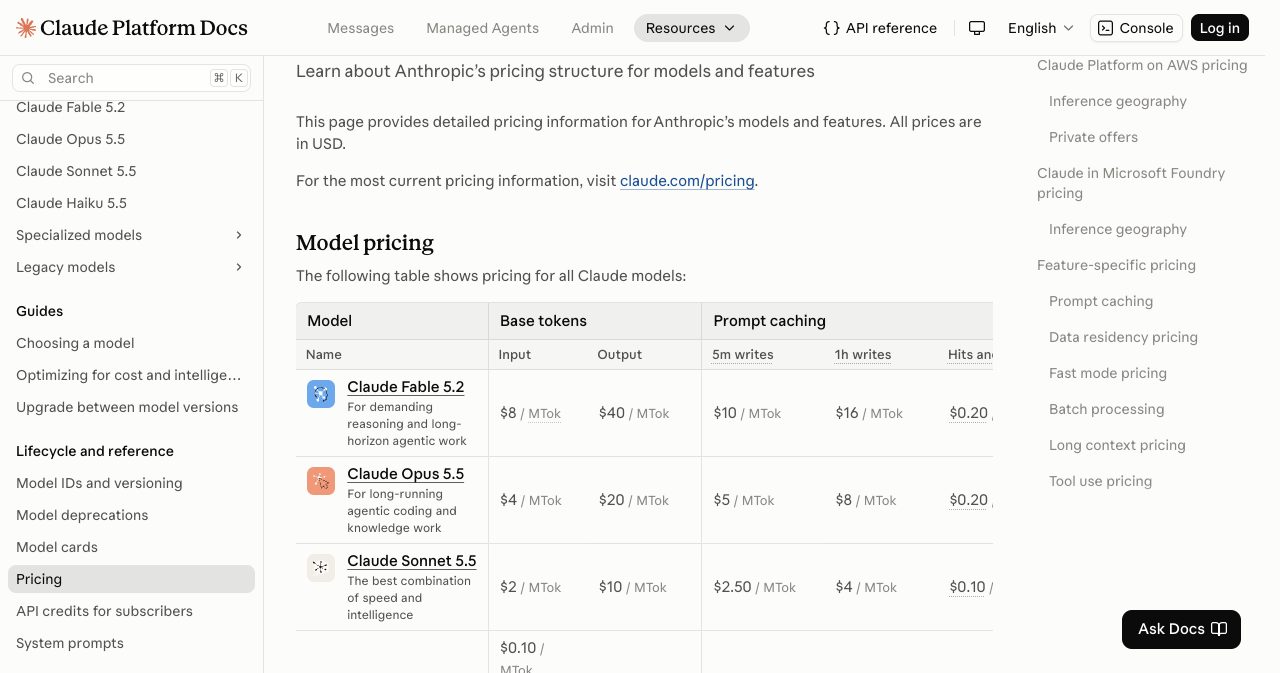
| Input, per 1M tokens | $10 | $8 |
| Output, per 1M tokens | $50 | $40 |
| Cache reads, per 1M tokens | $0.25 | $0.20 |
| FrontierCode 2.0 (xhigh effort) | 32.4% | 49.1% |
| FrontierSWE v2 | 56.3% | 69.9% |
| Terminal-Bench-Science 0.1 | 52.6% | 74.6% |
| OSWorld 2.1 (offline set, partial) | 83.5% | 89.3% |
| RoboDojo Sim | 27.6% | 64.9% |
| Remote Labor Index | 17.9% | 41.3% |
Prices are from Anthropic's pricing page. Benchmark rows are Anthropic's own numbers from its launch post, so read them as a vendor's claims. Fable 5.2 also has an optional fast mode at $16 input and $80 output, which Anthropic says generates tokens up to 2.5 times faster.
The demos in the post are large. Anthropic says a team of about 1,000 Fable 5.2 agents formalised the proof of Fermat's Last Theorem in Lean in 30 hours, where its first attempt with an unreleased research model took 11 days. One engineer had the model coordinate more than 1,000 subagents for eight days to build a prototype operating system that boots on a laptop. Working with the circuit board company Diode, it designed three electronic devices that worked without electrical modifications.
Few SaaS teams will run a thousand agents for a week. The part of the post that applies to everyone is a single paragraph where Anthropic recommends Claude Opus 5.5 as the starting point for most coding and knowledge work, with Fable reserved for the most ambitious technical jobs. The models overview repeats it: use Fable 5.2 when your evaluations on Opus 5.5 at higher effort still fall short. A vendor telling you to buy its cheaper model first is worth taking at its word.
What changed when Gemini 4 Carbon became generally available?
On November 10, 2026, Gemini 4 Carbon went from a model that only vetted cyber defenders could use to one that any paying developer can call. When we covered the Carbon announcement on October 28, there was no model ID and no date. Now there is a line in the Gemini API release notes and a price with an end date.
Access splits four ways, according to Google's post:
- Developers get
gemini-4-carbonon the paid tier of the Gemini API in Google AI Studio and Android Studio. The pricing page states that Carbon is not on the free tier. - Enterprises get it in Gemini for business, Google Antigravity and CodeMender.
- Consumers get it in the Gemini app and AI Mode in Search only on the Google AI Ultra plan.
- Scientists accepted into Google's research programme get Carbon and Argon free for six months through Antigravity.
The cybersecurity results that made headlines in October belong to a separate configuration. Google's post says Carbon leads on SEC-bench Pro, ExploitGym and CWE-bench only when it is accessed through the Fairwind Program, and it calls that variant Carbon for cyber. The Carbon on your API key has stronger misuse safeguards on top.
Google is also clear about where Carbon sits next to Gemini 4 Argon. Argon stays the recommended model for most engineering and knowledge work. Carbon is for tasks at the limit, and Google says it uses more tokens than Argon to explore, reason and verify. Both cost the same per token, so a Carbon task costs more than the same task on Argon because it writes and thinks more.
The post adds a preview of /swarm in Google Antigravity, which turns one prompt into a team of agents with Carbon in the planning and auditing roles. It also adds new safety numbers. On a 375-task agentic honesty benchmark, Google reports Carbon passed 92% of tasks against 70% for Argon, and its safeguards cut the automated cyberattack query success rate in Gray Swan's testing to 2.17% from Argon's 9.86%.
Gemini 4 Carbon vs Claude Fable 5.2: which is better?
Fable 5.2 scores higher on the one independent index that has tested both, and Carbon costs less per task. Which of those matters depends on whether your tasks are hard enough to need the extra points.
Start with the vendor numbers, since both companies published them. Anthropic's table includes Carbon:
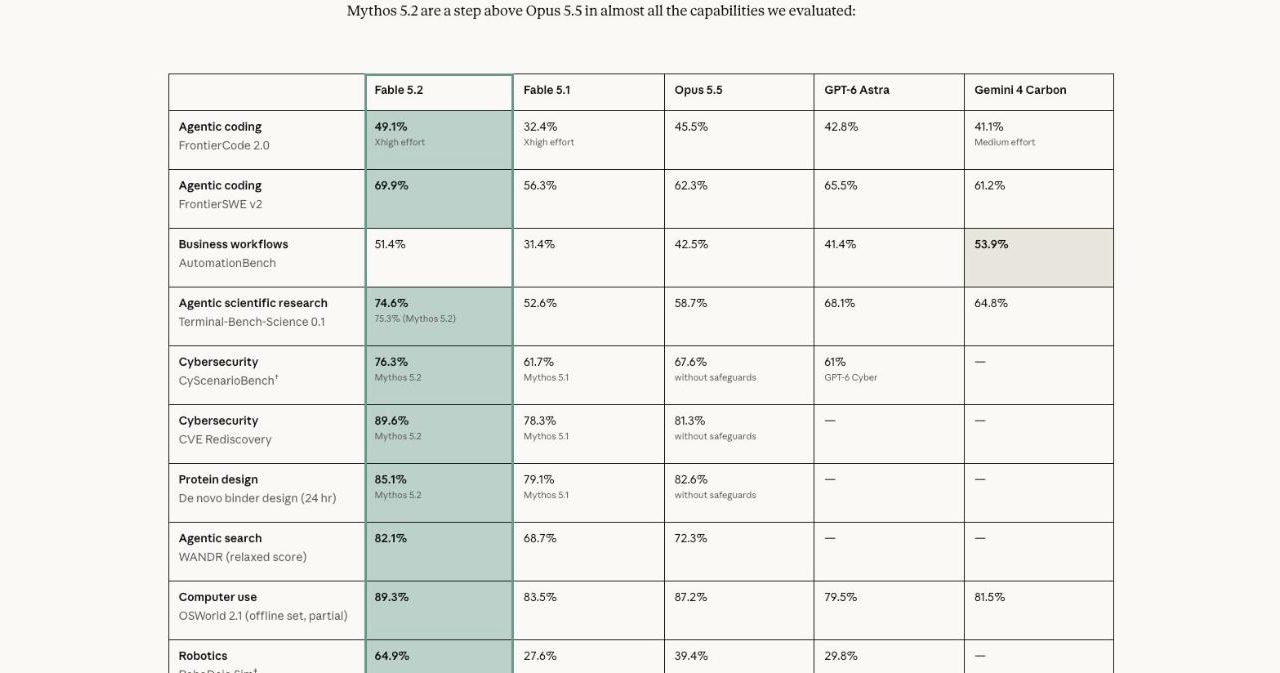
| Benchmark (Anthropic's table) | Claude Fable 5.2 | Gemini 4 Carbon | Claude Opus 5.5 |
|---|---|---|---|
| FrontierCode 2.0 | 49.1% (xhigh effort) | 41.1% (medium effort) | 45.5% |
| FrontierSWE v2 | 69.9% | 61.2% | 62.3% |
| AutomationBench | 51.4% | 53.9% | 42.5% |
| Terminal-Bench-Science 0.1 | 74.6% | 64.8% | 58.7% |
| OSWorld 2.1 (offline set, partial) | 89.3% | 81.5% | 87.2% |
| AA-Briefcase v1.1 (rubric) | 66.1% | 61.8% | 61.2% |
| Chartography (no tools) | 73.4% | 72.5% | 64.4% |
Three details in that table deserve a second look. The FrontierCode row compares Fable at xhigh effort with Carbon at medium effort. The table leaves Carbon blank on both cybersecurity rows, the area where Google says Carbon is strongest. And on the Elo version of AA-Briefcase, Opus 5.5 beats Fable 5.2, 1800 to 1785.
Google's post answers with its own firsts. It says Carbon ranks first on CursorBench 4.0, Perplexity's WANDR and Zapier's AutomationBench at more than two times lower cost per task than the next best external model. Anthropic's table gives Fable 5.2 a WANDR score of 82.1% and shows no Carbon number. Both companies claim that benchmark, and neither post gives enough detail to settle it.
An independent index helps here. Artificial Analysis runs every model through the same set of evaluations and reports the cost and time of doing so.
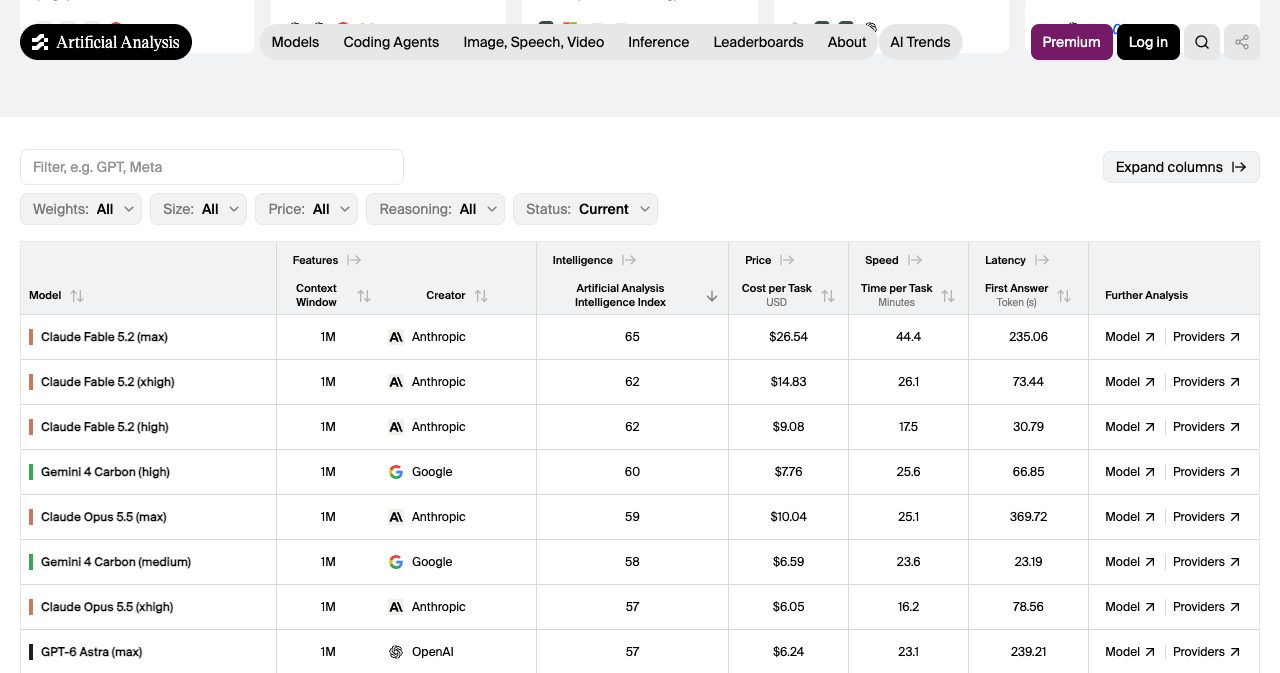
| Model and effort | AA Intelligence Index | Cost per index task | Time per task |
|---|---|---|---|
| Claude Fable 5.2 (max) | 65 | $26.54 | 44.4 min |
| Claude Fable 5.2 (xhigh) | 62 | $14.83 | 26.1 min |
| Claude Fable 5.2 (high) | 62 | $9.08 | 17.5 min |
| Gemini 4 Carbon (high) | 60 | $7.76 | 25.6 min |
| Claude Opus 5.5 (max) | 59 | $10.04 | 25.1 min |
| Gemini 4 Carbon (medium) | 58 | $6.59 | 23.6 min |
| Claude Opus 5.5 (xhigh) | 57 | $6.05 | 16.2 min |
| GPT-6 Astra (max) | 57 | $6.24 | 23.1 min |
| Claude Fable 5.2 (medium) | 56 | $3.80 | 8.1 min |
| GPT-6.1 Sol (max) | 55 | $1.27 | 20.1 min |
Read from the Artificial Analysis leaderboard on November 10, 2026.
By SaaSCity's reading of that table, the last three points of Fable 5.2 are the expensive ones. Max effort scores 65 for $26.54 a task, and high effort scores 62 for $9.08, so the top setting costs 2.9 times as much for three more points and takes two and a half times as long.
Fable 5.2 at high effort is the row to study. It beats Opus 5.5 at max effort by three points, costs about 10% less per task and finishes in 17.5 minutes instead of 25.1. That matches Anthropic's claim that Fable at high effort equals Opus at max on FrontierCode for roughly half the cost.
Against Carbon the picture is closer. Fable 5.2 at high effort is two points ahead for 17% more money and takes about a third less time. The $7.76 for Carbon is the same figure Artificial Analysis showed on October 28, when it priced Carbon at the standard $4 and $20, so during November the real cost is about half of that, near $3.88 by our arithmetic. Until December 1, Carbon at high effort delivers 60 index points for less than half the cost of Fable's 62.
Further down the table, GPT-6.1 Sol scores 55 for $1.27 a task. If your product's tasks are solved at 55, every model above it is a cost you don't need. Our piece on model fatigue covers how to find that line without re-testing every release.
What does each model cost per task?
At list price, the same task costs four times as much on Fable 5.2 as on Gemini 4 Carbon in November, and twice as much from December 1. Token prices on the three pricing pages:
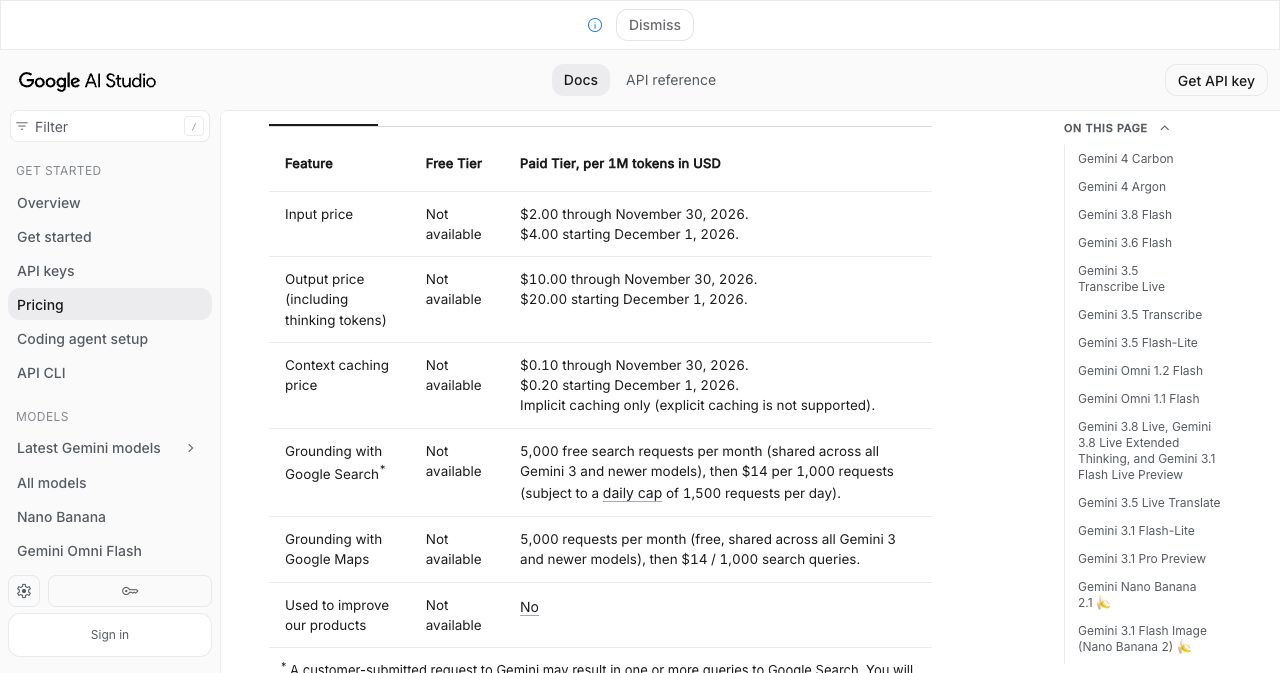
| Model | Input per 1M | Output per 1M | Cached input per 1M |
|---|---|---|---|
| Claude Fable 5.2 | $8 | $40 | $0.20 |
| Claude Fable 5.2, fast mode | $16 | $80 | Not checked |
| Claude Opus 5.5 | $4 | $20 | $0.20 |
| Gemini 4 Carbon, through November 30, 2026 | $2 | $10 | $0.10 |
| Gemini 4 Carbon, from December 1, 2026 | $4 | $20 | $0.20 |
| Gemini 4 Carbon, Batch or Flex, from December 1 | $2 | $10 | $0.10 |
Here is what that does to one agent task. Take a hypothetical job that reads 1 million input tokens and writes 100,000 output tokens, thinking included. The figures below are our arithmetic on the list prices above and assume every model uses the same number of tokens, which they don't.
| Model | No caching | 90% of input read from cache |
|---|---|---|
| Claude Fable 5.2, fast mode | $24.00 | Not calculated |
| Claude Fable 5.2 | $12.00 | $4.98 |
| Claude Opus 5.5 | $6.00 | $2.58 |
| Gemini 4 Carbon, from December 1 | $6.00 | $2.58 |
| Gemini 4 Carbon, through November 30 | $3.00 | $1.29 |
The cache column ignores cache write charges. It shows that the gap narrows for agents that re-read the same context, because Fable 5.2, Opus 5.5 and Carbon at its December price all charge $0.20 per million cached tokens. With heavy caching, output tokens make up most of the bill, and Fable's output costs twice as much as Opus 5.5's.
Two billing details from Google's page matter. Carbon's output price includes thinking tokens, and Carbon supports only implicit caching, so you can't pin a cache entry yourself. From December 1, Carbon at $4 and $20 costs exactly what Claude Opus 5.5 costs, which makes the December comparison easy: same price per token, so the cheaper model is the one that uses fewer tokens and scores higher on your tasks.
What is MiniMax H3-Image?
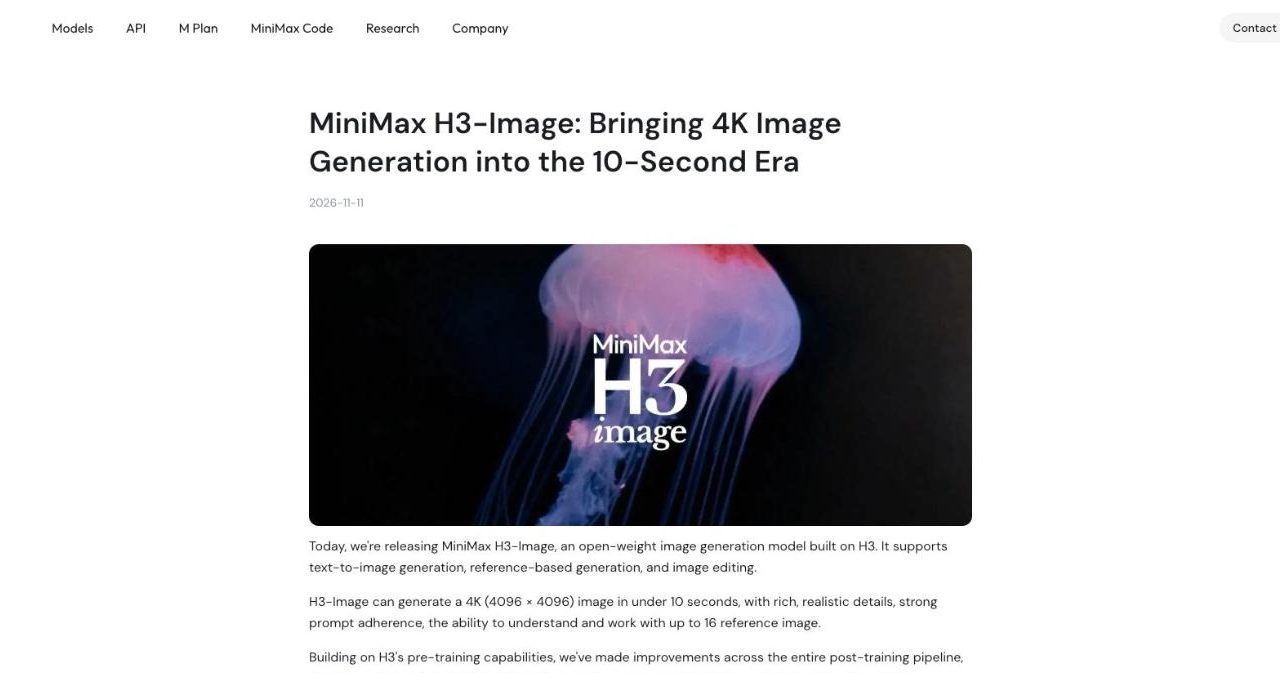
MiniMax H3-Image is an open-weight image model that generates and edits images at about 16 megapixels in six sampling steps, and its weights went up on Hugging Face on November 10, 2026. It comes from the same family as MiniMax H3, the video model released in July, with the audio layers removed.
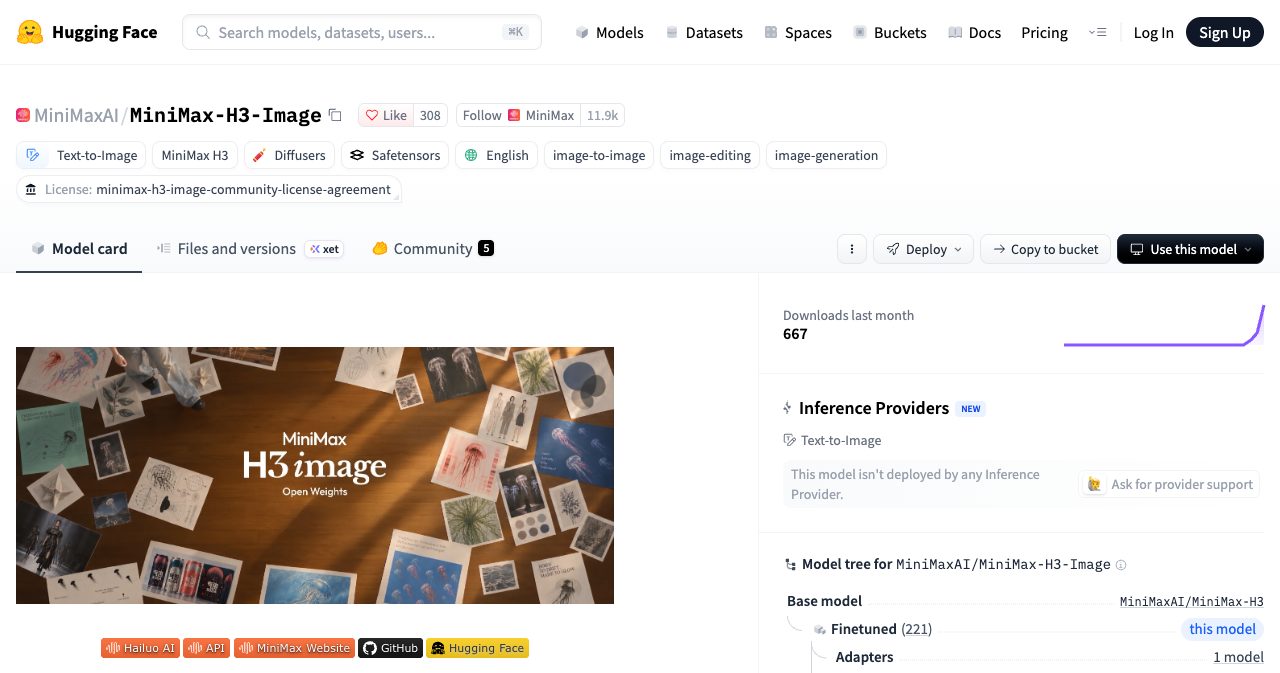
The model card has the specifics that MiniMax's blog post leaves out:
| Spec | MiniMax H3-Image |
|---|---|
| Tasks | Text-to-image and image editing in one checkpoint |
| Diffusion transformer | 33.1 billion parameters, 50 layers, single stream |
| Text encoder | The Qwen3-VL encoder from MiniMax-H3, unchanged |
| Image VAE | CNN encoder and 2D ViT decoder, 16x downsampling, 24 latent channels |
| Sampling | Distilled to 6 steps, no classifier-free guidance, no negative prompts |
| Native sizes | 4096 x 4096 (1:1) up to 6272 x 2688 (21:9), about 16 MP |
| Working range | About 4 MP to 20 MP |
| Reference images | Up to 16 for editing |
| Weights | 68.65 GB, plus a separate 66.7 GB text encoder |
| Serving | SGLang, vLLM-Omni, diffusers, ComfyUI |
Most image models people use today output between 1 and 4 megapixels and rely on an upscaler for anything bigger. H3-Image generates the full 16 megapixels directly, and MiniMax's headline claim is a 4096 x 4096 image in under 10 seconds. MiniMax's post doesn't say what hardware produced that time, so treat it as a figure for MiniMax's own API until someone reproduces it.
The model card adds one usage note that will catch people out. H3-Image expects a detailed English description of the whole image. MiniMax's API rewrites short prompts in any language into that form before generating, and for local use MiniMax ships a separate 17.9 GB prompt expander, which the licence says is derived from Qwen3.8-27B.
Quality is unranked for now. MiniMax claims the strongest prompt adherence among open-weight models. When we checked the Artificial Analysis text-to-image leaderboard on November 10, H3-Image wasn't on it, and the top of that board was GPT Image 2.6 Sunburst at 1259 Elo, with Nano Banana 2.1 at 1176. Until an arena has votes on H3-Image, the claim is MiniMax's alone. For another recent open image release, see our look at Ideogram 4.
Can you use MiniMax H3-Image commercially?
Only if you operate outside the European Union, the United Kingdom, South Korea and the United States, and even then the licence adds conditions once you make money. The weights are free to download from anywhere. Whether you may use them is set by the MiniMax-H3-Image Community License Agreement, which is 18.2 kB of terms that the launch post never mentions.
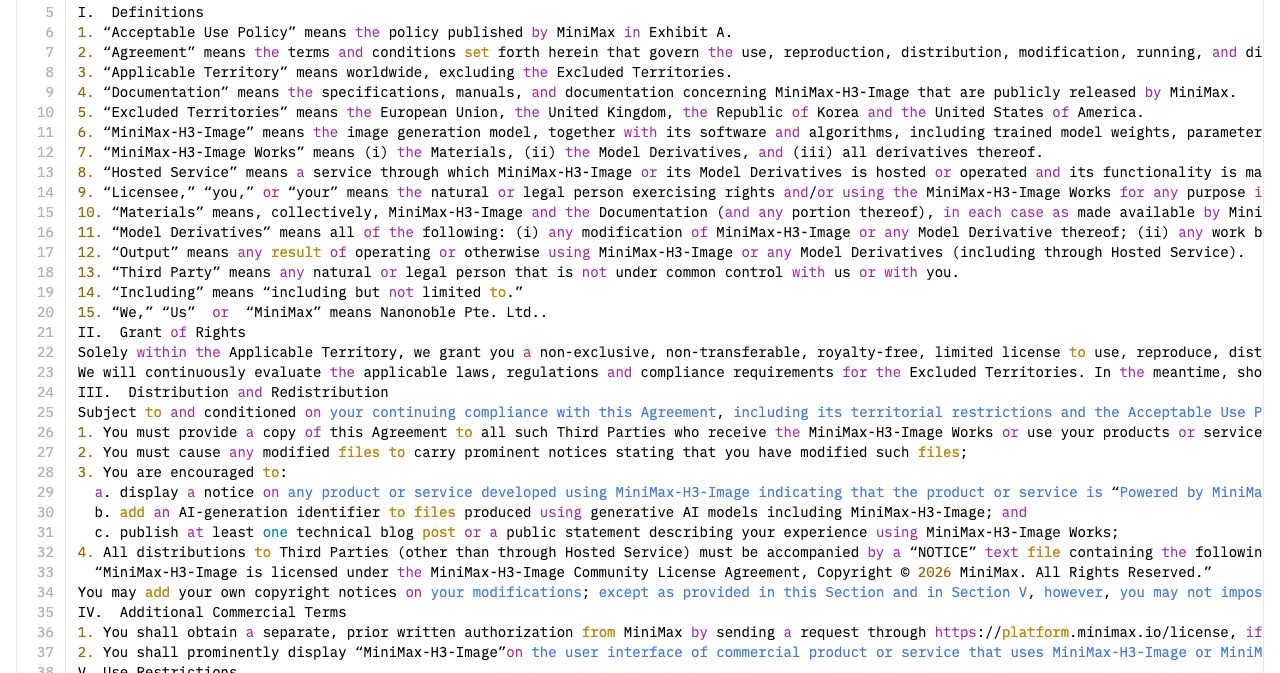
We read the licence on November 10, 2026. The terms a founder should know:
- The grant applies only inside what the licence calls the Applicable Territory, defined as worldwide minus the four excluded territories. The licensor says it is still evaluating the law in those places and invites people there to contact it about a separate licence.
- Section V extends the territory limit to outputs. You may not use the model's outputs outside the covered territory under this agreement.
- You need prior written authorisation from MiniMax if your annualised revenue, or your affiliates', exceeds $1 million, or if you provide the model to third parties as a hosted service at any size.
- A commercial product that uses the model must display "MiniMax-H3-Image" prominently in its interface.
- You may not use the model or its outputs to improve any other AI model.
- If you offer generation to third parties, you must build and maintain safeguards against misuse and a way to report violations.
- The agreement is governed by Hong Kong law, and the licensor is Nanonoble Pte. Ltd.
The files are public, but a startup in Austin, London, Berlin or Seoul has no right under this licence to put the model behind a product. A team in one of those places has two routes: ask MiniMax for a separate licence, or call MiniMax's hosted API. The API runs under MiniMax's platform terms, which we did not review for this post, so check them before you ship.
Teams inside the covered territory should read the hosted service clause closely. A SaaS product that lets customers generate images through your interface or API fits the licence's definition of a hosted service, so it needs MiniMax's written authorisation whatever your revenue. Generating images for your own use, such as marketing assets, doesn't.
This is a narrower grant than the one MiniMax described for the H3 video model. In July we reported that MiniMax had promised commercial use for organisations under $20 million in revenue. The H3-Image threshold is $1 million, and the territory exclusion is new to us. Read the file before you plan around the word open. This post is a founder's reading of a licence, and a lawyer should check it before you rely on it.
How much does H3-Image cost, and what does it take to run it?
Through MiniMax's API, a 4K image costs about $0.069 and a 1K image about $0.022. Running it yourself means about 135 GB of downloads and a data centre GPU.
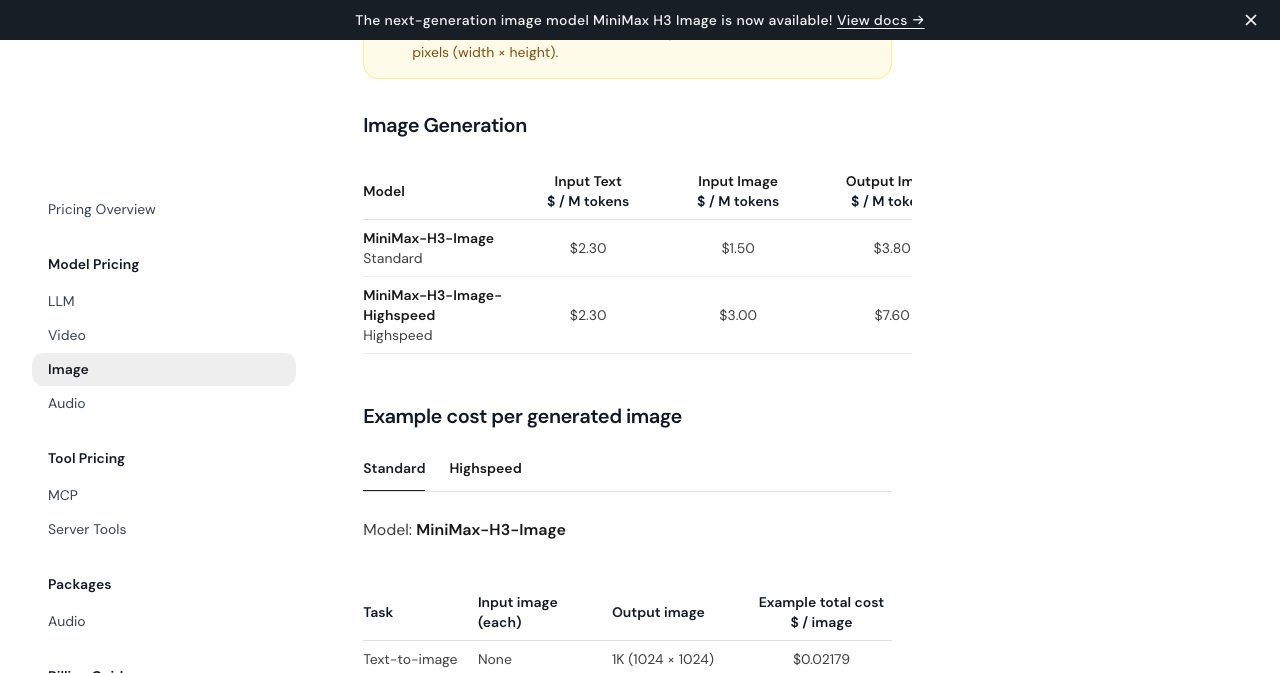
MiniMax bills H3-Image by token, which is unusual for an image API. Its pricing page gives worked examples for Standard mode:
| Task | Output size | Example cost per image | Per 1,000 images (our math) |
|---|---|---|---|
| Text-to-image | 1K (1024 x 1024) | $0.02179 | $21.79 |
| Text-to-image | 2K (2048 x 2048) | $0.02333 | $23.33 |
| Text-to-image | 4K (4096 x 4096) | $0.06879 | $68.79 |
| Text-to-image, 4K, launch offer | 4K | $0.03439 | $34.39 |
| Edit with 1 reference image | 4K | $0.07312 | $73.12 |
| Edit with 3 reference images | 4K | $0.07914 | $79.14 |
The launch offer takes 50% off any request whose delivered image has at least 16.6 million pixels, and it ends on November 17, 2026 at 16:00 UTC. MiniMax notes that the example amounts are for reference and that real charges follow token usage. Highspeed mode uses the same parameters at double the image token prices.
For context, Artificial Analysis lists GPT Image 2.6 Sunburst at $210.72 per 1,000 images and Nano Banana 2.1 at $33.60. Those figures come from Artificial Analysis's own test settings and may be at a different resolution, so they aren't a like-for-like comparison with a 4K H3-Image price.
The API also has limits the weights don't. MiniMax's image generation guide lists one to ten images per request, JPEG, PNG or WebP output, and no support for masked edits, preview images or transparent backgrounds.
Self-hosting is a hardware question. The repository is 68.65 GB, most of it a 66.28 GB transformer in BF16, and the text encoder adds 66.7 GB. The model card names NVIDIA H200, RTX PRO 6000 Blackwell and AMD Instinct MI350X accelerators and shows how to split one request across four GPUs for lower latency. Hugging Face already listed two community quantisations on November 10, and smaller cards will depend on those.
What each launch post leaves out
Each launch has a few details that sit in the footnotes or the pricing page and change the calculation for a product team.
Claude Fable 5.2
Fable 5.2 blocks high-risk cybersecurity work, including penetration testing and exploit generation, and most research biology tasks. A blocked request doesn't fail. It is answered by Claude Opus 4.8 for cybersecurity or Claude Opus 5 for biology, so a security product can get weaker answers with no error to alert you. Anthropic says the classifiers now block about 55% less often than they did on Fable 5.1.
Anthropic also says it limited the model during training in a few AI research areas, including accelerator kernel optimisation and improving language model architectures, where it performs at about the level of Opus 5.5. For most customers Anthropic keeps prompts and responses for 30 days for safety monitoring. Preserved thinking, a feature against distillation, now applies to every account and may need an integration change. An AI infrastructure company or a team with strict data retention rules should read those two paragraphs of the launch post before it reads the benchmark table.
Gemini 4 Carbon
The $2 and $10 price lasts 20 more days. Every budget built on it doubles on December 1. Carbon bills thinking tokens as output and is built to use more tokens than Argon, so the cost per task rises faster than the price per token suggests. Subscribers below the Ultra plan don't get Carbon in the Gemini app. And Google's post concedes that prompt injection robustness still needs work, even after Carbon's 0% result on the Gray Swan benchmark.
MiniMax H3-Image
The licence is the big one, covered above. The others are practical: six fixed sampling steps and no negative prompts mean less control than older diffusion workflows offer, prompts need the expander to work well, and nobody outside MiniMax has ranked the output yet.
What developers said in the first 24 hours
The Hacker News thread on Fable 5.2 had 857 points and 978 comments when we captured it on November 10, and the most upvoted reactions asked whether ordinary teams need the model at all.
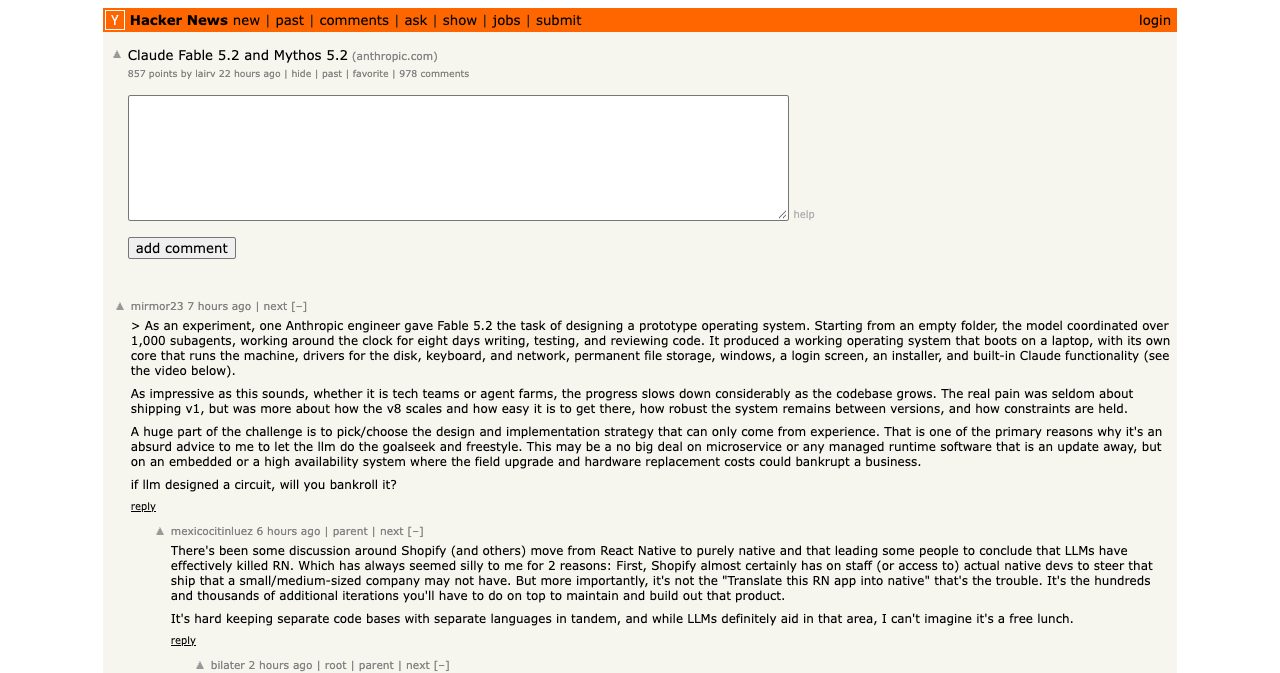
In the Fable 5.2 thread, the commenter postalcoder, who had used the model, wrote that Opus 5.5 is now good enough to remove the urge to upgrade, and that with Fable "you really have to push the ambition of your prompt" to see it pull away. Another commenter, dualvariable, asked whether ordinary development work needs Fable at all, having found Opus 5.5 at xhigh fine on a project of about 125,000 lines.
The benchmark table drew criticism. breakwaterlabs asked why Fable at xhigh was set against Carbon at medium, and why Carbon was missing from the cybersecurity rows. Others repeated the claim that Opus 5.5 had been made worse ahead of the release, a recurring suspicion we looked at in our piece on model drift. The commenter simonw reported that at max effort the model spent its whole 128,000-token budget reasoning before it drew anything, which fits the cost table above.
The Carbon thread was smaller, at 252 points, and more about access. Subscribers on Google's cheaper plans found they still couldn't select Carbon in the Gemini app. One developer, dom96, said Carbon matched Fable 5.2 on a private benchmark but ran slower and cost more there, the opposite of the Artificial Analysis cost ranking. Results vary that much by workload, and your own tasks are the only test that counts.
H3-Image barely registered. Its Hacker News submission had four points on launch day, while the model card collected about 300 likes.
Which one should you build on?
Pick by the job, and by where your company is registered.
| If your product mostly does | Start with | Why |
|---|---|---|
| Everyday coding and knowledge work | Claude Opus 5.5 or Gemini 4 Argon | Both vendors recommend their cheaper model first |
| Long agent runs that Opus 5.5 fails | Claude Fable 5.2 at high effort | 62 on the AA index for $9.08 a task |
| Hard reasoning on a tight budget, this month | Gemini 4 Carbon | 60 on the AA index at half price until November 30 |
| Business workflow automation | Test Carbon and Fable 5.2 side by side | Carbon leads AutomationBench 53.9% to 51.4% in Anthropic's own table |
| Desktop computer use | Claude Fable 5.2 | 89.3% on OSWorld 2.1 against 81.5% for Carbon |
| Security research | Mythos 5.2 or Carbon for cyber, by application | Both public models restrict this work |
| 4K images for your own use, company outside the US, UK, EU and South Korea, under $1M revenue | H3-Image weights | The licence covers you, and you can fine-tune |
| 4K images generated for your customers, same territory | H3-Image weights with MiniMax's written authorisation, or its API | Offering generation to third parties counts as a hosted service |
| 4K images, company inside those territories | MiniMax's hosted API, after reading its terms | The weights licence doesn't cover you |
| Lowest cost near the top | GPT-6.1 Sol | 55 on the AA index at $1.27 a task |
Our read: for most SaaS teams, nothing changes this week except one decision in December. If you run on Opus 5.5 and it passes your evaluations, Fable 5.2 is a tool for the few tasks that fail. If you want to try Carbon, November is the cheap month to run the experiment, as long as the business case still works at $4 and $20. Image products should read the licence before any image quality test.
How to test a new model before you switch
Run the new model against the one in production on your own failed tasks, at the effort level and price you would really pay, and keep a way back. Six steps:
- Pick the tasks your current model fails. Pull 20 to 50 real tasks from your logs where the model in production gave a wrong answer, needed a retry or was corrected by a person. A new model earns its price on those tasks, so leave out the ones that already work.
- Fix the effort setting and write it down. Run each model at the effort level you would pay for in production, and record it next to every result. Vendor tables mix effort levels, and a score at max effort tells you little about a product that will run at medium.
- Price every run at the standard rate. Log input, cached and output tokens per task, then multiply by the price that applies after the launch discount ends. For Gemini 4 Carbon that is $4 and $20 per million tokens from December 1, 2026.
- Measure wall-clock time per task. Record how long each task takes from request to final answer. Higher effort settings on reasoning models can add minutes before the first visible token, which matters for anything a user waits on.
- Check for silent fallbacks and blocks. Send the security, biology and infrastructure prompts your product really handles and read the response metadata. Claude Fable 5.2 answers blocked cybersecurity requests with Claude Opus 4.8, which changes quality without raising an error.
- Ship behind a config value you can flip back. Keep the model ID in configuration, route a small share of traffic to the new model, compare the outcomes with production and keep the old model one setting away until a full billing cycle has passed.
If your agents run through Claude Code, our guide to subagents and agent teams covers the orchestration pattern Anthropic describes, where Fable plans and cheaper models do the routine work.
FAQ
What is Claude Fable 5.2?
Claude Fable 5.2 is Anthropic's top generally available model, released on November 9, 2026 with the API ID claude-fable-5-2. It shares one underlying model with Claude Mythos 5.2 and adds cybersecurity and biology safeguards. It has a 1 million token context window, a 128K maximum output and a June 2026 knowledge cutoff, and it costs $8 per million input tokens and $40 per million output tokens, per Anthropic's pricing page on November 10, 2026.
How much does Claude Fable 5.2 cost?
Claude Fable 5.2 costs $8 per million input tokens and $40 per million output tokens, 20% less than Fable 5.1's $10 and $50. Cache reads cost $0.20 per million tokens, five-minute cache writes $10 and one-hour cache writes $16. Fast mode, which Anthropic says generates tokens up to 2.5 times faster, costs $16 input and $80 output. Prices are from Anthropic's launch post of November 9, 2026 and its pricing page on November 10.
Is Gemini 4 Carbon available now?
Yes. Google made Gemini 4 Carbon generally available on November 10, 2026, two weeks after announcing it. Any developer on the paid tier of the Gemini API can call it as gemini-4-carbon in Google AI Studio, and enterprises get it in Gemini for business. In the Gemini app, AI Mode in Search and Google Antigravity it is rolling out to Google AI Ultra subscribers only. There is no free API tier, and the cybersecurity variant still requires the Fairwind Program.
How much does Gemini 4 Carbon cost?
Through November 30, 2026, Gemini 4 Carbon costs $2 per million input tokens and $10 per million output tokens. From December 1, 2026 it costs $4 and $20. Cached input is $0.10 per million tokens now and $0.20 from December 1, and only implicit caching is supported. Batch and Flex calls are half price, and Priority calls cost $3.60 and $18 now. Thinking tokens are billed as output. The figures are from Google's Gemini API pricing page on November 10, 2026.
Is Claude Fable 5.2 better than Gemini 4 Carbon?
On the independent Artificial Analysis Intelligence Index, yes, by a small margin that costs more. On November 10, 2026, Fable 5.2 scored 65 at max effort and 62 at high effort, against 60 for Gemini 4 Carbon at high effort. Fable 5.2 at high effort cost $9.08 per index task and Carbon $7.76 at its standard price. In Anthropic's own table Fable 5.2 leads Carbon on six shared benchmarks and Carbon leads on AutomationBench, 53.9% to 51.4%.
What is the difference between Claude Fable 5.2 and Claude Mythos 5.2?
They are the same underlying model with different safeguards. Fable 5.2 is open to everyone and uses classifiers that block high-risk cybersecurity work, such as penetration testing and exploit generation, and most research biology tasks. A blocked request is answered by Claude Opus 4.8 for cybersecurity or Claude Opus 5 for biology. Mythos 5.2 has those safeguards lifted and is limited to organisations approved through Anthropic's Cyber Verification and Life Sciences Verification Programs. Both cost $8 and $40 per million tokens.
Should I use Claude Fable 5.2 or Claude Opus 5.5?
Start with Claude Opus 5.5. Anthropic's own launch post of November 9, 2026 recommends Opus 5.5 as the daily driver for most coding and knowledge work, and Fable 5.2 only for the most ambitious, open-ended technical tasks. Opus 5.5 costs $4 and $20 per million tokens, half of Fable 5.2. Move a task up to Fable 5.2 when Opus 5.5 at a higher effort setting still fails your own evaluation, or when a job runs for hours across many subagents.
What is MiniMax H3-Image?
MiniMax H3-Image is an open-weight image model released on November 10, 2026. One checkpoint does text-to-image and image editing with up to 16 reference images. It generates about 16 megapixels natively, from 4096 x 4096 up to 6272 x 2688, in six sampling steps. Its diffusion transformer has 33.1 billion parameters and reuses the architecture of the MiniMax H3 video model with the audio layers removed. Weights are on Hugging Face, and MiniMax also sells it through its API.
Is MiniMax H3-Image open source, and can I use it commercially?
It is open weight, not open source. The MiniMax-H3-Image Community License Agreement, dated November 10, 2026, grants rights worldwide except in the European Union, the United Kingdom, South Korea and the United States. Inside the covered territory, commercial use is allowed, but you need written authorisation from MiniMax if your annualised revenue exceeds $1 million or if you offer the model to third parties as a hosted service. Commercial products must display the name MiniMax-H3-Image in their interface.
How much does MiniMax H3-Image cost per image?
Through MiniMax's API, H3-Image is billed by token at $2.30 per million input text tokens, $1.50 per million input image tokens and $3.80 per million output image tokens. MiniMax's own examples put a 1K text-to-image at about $0.022, a 2K image at about $0.023 and a 4K image at about $0.069. Until November 17, 2026 at 16:00 UTC, requests that deliver at least 16.6 million pixels are half price, about $0.034 per 4K image. Highspeed mode doubles the image token prices.
What hardware do you need to run MiniMax H3-Image locally?
A data centre class GPU. The repository holds 68.65 GB of weights and needs the 66.7 GB MiniMax-H3 text encoder as well, about 135 GB in total. The model card, read on November 10, 2026, names NVIDIA H200, RTX PRO 6000 Blackwell and AMD Instinct MI350X accelerators and recommends SGLang, vLLM-Omni, diffusers or ComfyUI to serve it. Two community quantisations were already listed on Hugging Face that day for smaller cards.
What is Fable 5.2 fast mode?
Fast mode is an optional setting for Claude Fable 5.2 and Claude Mythos 5.2 that Anthropic says speeds up token generation by up to 2.5 times. It costs double the standard rate: $16 per million input tokens and $80 per million output tokens. On November 9, 2026 it was available in Claude Code, on the Claude Platform, on Claude Models on Google Cloud and on Microsoft Foundry. Mythos fast mode is limited to organisations in Anthropic's Verification Programs.
Which model tops the Artificial Analysis Intelligence Index in November 2026?
Claude Fable 5.2. On November 10, 2026 the Artificial Analysis leaderboard listed Fable 5.2 at max effort first with 65, followed by Fable 5.2 at xhigh and high effort with 62 each, Gemini 4 Carbon at high effort with 60 and Claude Opus 5.5 at max effort with 59. Gemini 4 Carbon held first place with 59 when Google announced it on October 28. Leaderboards move daily, so check the page before quoting a rank.
Your move
Open your logs and find the tasks your current model gets wrong. If there are few, this week's launches change nothing for you, and you've saved a migration. If there are many, run them through Fable 5.2 at high effort and Gemini 4 Carbon, price both at December rates and let the results choose. If you ship images, read 18.2 kB of licence before you download 135 GB of model.
Whichever model sits behind your product next month, people still have to find the product. SaaSCity gives every reviewed product a listing page and a building on the live city map, and you can submit yours here. Add the SaaSCity badge to your site and you get a dofollow backlink from a domain rated DR 71 at our latest Ahrefs refresh (November 11, 2026), plus a Monday launch slot. Quick Pass ($19.99) goes live within 24 hours, Premium ($39.99) adds a written launch post with three dofollow links, and Max ($99.99) adds 30 days on the billboard, the ticker and a homepage pin.
Sources
- Introducing Claude Fable 5.2 and Claude Mythos 5.2 (Anthropic, November 9, 2026)
- Claude pricing (Claude Platform Docs)
- Claude models overview (Claude Platform Docs)
- Gemini 4 Carbon is now available (Google, November 10, 2026)
- Gemini API pricing (Google AI for Developers)
- Gemini API release notes, November 10, 2026 entry (Google AI for Developers)
- MiniMax H3-Image: Bringing 4K Image Generation into the 10-Second Era (MiniMax)
- MiniMaxAI/MiniMax-H3-Image model card (Hugging Face)
- MiniMax-H3-Image Community License Agreement (Hugging Face)
- MiniMax API pricing overview and image generation guide
- LLM leaderboard (Artificial Analysis) and Claude Fable 5.2 model page
- Text-to-image leaderboard (Artificial Analysis)
- Claude Fable 5.2 and Mythos 5.2 (Hacker News) and Gemini 4 Carbon is now available (Hacker News)
Screenshots were taken in Chrome on November 10, 2026 from Anthropic's launch post and pricing page, Google's blog and Gemini API pricing page, Artificial Analysis, MiniMax's blog and pricing page, Hugging Face and Hacker News. Prices and leaderboard positions change, so check the linked page before you quote one.
Get your SaaS in front of founders
List your product on SaaSCity for $19.99, one-time: a permanent listing, a dofollow backlink and a building on the live city map.