Launch & Growth
Google November and December 2026 Core Updates: SaaS and Directory Recovery Guide
Google's November 2026 Core Update finished on November 24 after 13 days and 20 hours, and 59 minutes later Google pre-announced the December 2026 Core Update targeting longer complex questions and personalization. Here is the confirmed timeline, diagnostic workflow, and recovery playbook for SaaS teams and startup directories.

Contents (9)
- What happened in the November 2026 Google Core Update
- What to expect in the December 2026 Google Core Update
- Anatomy of late-2026 ranking shifts: core signals, AI Overviews, and GEO
- Startup and SaaS founder recovery: diagnosis and 90-day playbook
- Startup directories and aggregators: surviving the 2026 quality purge
- How SaaS founders should use startup directories after the 2026 updates
- Step-by-step core update recovery playbook for SaaS and directories
- Recovery timelines and leading indicators to track before traffic rebounds
- FAQ
Rollout status, Search Status Dashboard logs, third-party studies, and first-party directory datasets checked on November 27, 2026.
Google finished rolling out the November 2026 Core Update on Tuesday, November 24, after 13 days and 20 hours of global ranking churn. Fifty-nine minutes later, Google did something it had never done before in the history of the Search Status Dashboard: it formally pre-announced the December 2026 Core Update, explicitly naming longer complex questions and personalized search results as its targets.
Quick answer: The Google November 2026 Core Update ran from November 10 to November 24, 2026 (13 days, 20 hours), hitting templated SaaS subfolders and thin directories hardest after four earlier 2026 spam updates. The December 2026 Core Update was pre-announced on November 24 under UK CMA Fair Ranking rules and is not live yet; it targets longer complex questions and personalization. Wait until December 1 to benchmark Search Console, separate holiday and December 1 Ahrefs DR4 noise, prune thin subfolders, enforce outbound link attributes, and rebuild priority pages for Query Fan-Out.
SaaSCity operates a startup directory and competes with several directories discussed in this analysis. Every dataset cited below from SaaSCity is published openly in CSV format so founders and SEO teams can inspect the raw numbers directly.
What happened in the November 2026 Google Core Update
The November 2026 Core Update launched on November 10, 2026 at 18:06 UTC and completed on November 24, 2026 at 14:03 UTC, lasting 13 days and 20 hours globally across all languages and surfaces including Web Search, Discover, featured snippets, and AI features. It landed immediately after an unprecedented four-update SpamBrain streak earlier in 2026.
According to Google's official November 2026 core update incident log, Google posted its standard notice at launch:
"Released the November 2026 core update, which applies globally and to all languages. The rollout may take up to 2 weeks to complete."
In its accompanying Search Central announcement reported by Barry Schwartz at Search Engine Roundtable, Google described the release as "a regular update designed to better surface relevant, satisfying content for searchers from all types of sites." Standard wording aside, three operational details made November 2026 unusually tricky to read in real time.
First, the initial ranking impact arrived late. Although Google pushed the button on Tuesday, November 10, Search Engine Roundtable's volatility tracking and Search Console audits published by Glenn Gabe (GSQI) showed that real rank movement did not touch down until Friday, November 13 and Saturday, November 14, three to four days after launch. Teams that glanced at their dashboards on November 12 and assumed they escaped untouched woke up on Monday, November 16 to completely reshaped traffic curves.
Second, unlike several prior 14-day core updates that delivered a second volatility jolt around day nine or ten, Barry Schwartz noted in his November 24 completion report that November 2026 showed no distinct second wave before wrapping up. Most of the damage or recovery locked in during that November 13 to 20 window.
Third, third-party rank trackers were unusually noisy and partially muted relative to real Google Search Console charts. Both Barry Schwartz and Glenn Gabe reported that Google's anti-bot restrictions disrupted automated rank-tracking probes at the exact same time Search Console experienced performance reporting lag. Even with muted probes, Semrush Sensor and peer trackers still logged Very High volatility readings reaching 8.6 to 9.1 out of 10 across competitive categories like Retail, Finance, Legal, and Health between November 10 and November 24, with early pre-tremors on November 8 to 9 and sharp weekend spikes on November 14 to 15.
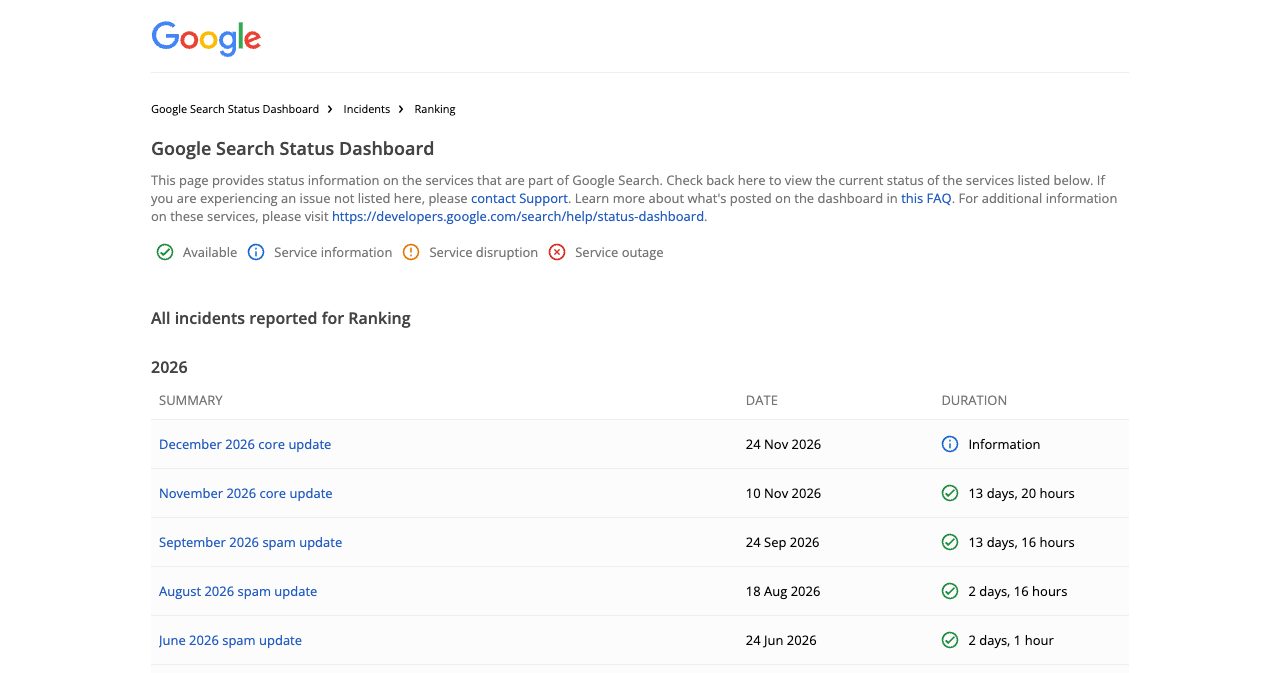
Official Google Search Status Dashboard ranking log captured November 27, 2026.
The full 2024 to 2026 Google ranking update log
Viewing November 2026 in isolation misses why so many SaaS blogs and directories feel battered right now. Look at the complete official release log pulled from the Google Search Status Dashboard ranking history:
| Year | Update name | Start date (UTC) | End date (UTC) | Exact duration | Official status log |
|---|---|---|---|---|---|
| 2026 | December 2026 core update | Pre-announced 2026-11-24 15:02 | Scheduled Dec 2026 (not live) | Pre-announcement | Incident AXrqxXXdtSjj3672ux7X |
| 2026 | November 2026 core update | 2026-11-10 18:06 | 2026-11-24 14:03 | 13 days, 20 hours | Incident WLxcJyC6jMWMfryxsKMc |
| 2026 | September 2026 spam update | 2026-09-24 16:15 | 2026-10-08 08:00 | 13 days, 16 hours | Incident XhUDXP7A67iHCD2kmbVu |
| 2026 | August 2026 spam update | 2026-08-18 16:27 | 2026-08-21 08:49 | 2 days, 16 hours | Incident LEubPCm2octf2uMqCFKE |
| 2026 | June 2026 spam update | 2026-06-24 16:00 | 2026-06-26 17:00 | 2 days, 1 hour | Incident YUX1peHev5a4fkxLDiUQ |
| 2026 | May 2026 core update | 2026-05-21 15:40 | 2026-06-02 12:40 | 11 days, 21 hours | Incident wdAXJk6LRRihEjpzEeWE |
| 2026 | March 2026 core update | 2026-03-27 09:00 | 2026-04-08 13:00 | 12 days, 4 hours | Incident 7eTbAa2jWdToLkraZj5y |
| 2026 | March 2026 spam update | 2026-03-24 19:00 | 2026-03-25 14:30 | 19 hours, 30 minutes | Incident VbnSXAH4SmEcxPtx4YSD |
| 2026 | February 2026 Discover core update | 2026-02-05 17:00 | 2026-02-27 10:00 | 21 days, 17 hours | Incident mYbNTqV1ytDc2fA8hUz4 |
| 2025 | December 2025 core update | 2025-12-11 17:25 | 2025-12-29 19:00 | 18 days, 2 hours | Incident DsirqJ1gpPRgVQeccPRv |
| 2025 | August 2025 spam update | 2025-08-26 | 2025-09-22 | 26 days, 15 hours | Dashboard history |
| 2025 | June 2025 core update | 2025-06-30 | 2025-07-16 | 16 days, 18 hours | Dashboard history |
| 2025 | March 2025 core update | 2025-03-13 | 2025-03-27 | 13 days, 21 hours | Dashboard history |
| 2024 | December 2024 spam update | 2024-12-19 | 2024-12-26 | 7 days, 2 hours | Dashboard history |
| 2024 | December 2024 core update | 2024-12-12 | 2024-12-18 | 6 days, 4 hours | Dashboard history |
| 2024 | November 2024 core update | 2024-11-11 | 2024-12-04 | 23 days, 13 hours | Dashboard history |
| 2024 | August 2024 core update | 2024-08-15 | 2024-09-03 | 19 days, 4 hours | Dashboard history |
| 2024 | June 2024 spam update | 2024-06-20 | 2024-06-27 | 7 days, 1 hour | Dashboard history |
| 2024 | March 2024 spam update | 2024-03-05 | 2024-03-20 | 14 days, 21 hours | Dashboard history |
| 2024 | March 2024 core update | 2024-03-05 | 2024-04-19 | 45 days | Dashboard history |
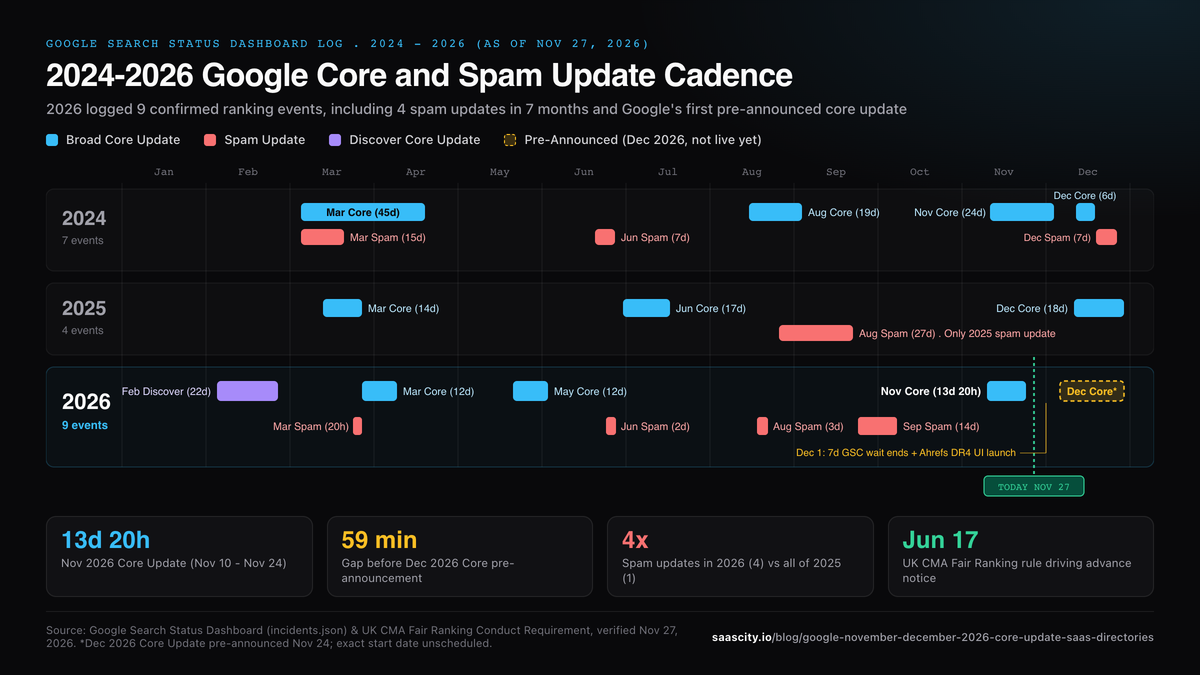
Confirmed Google Search ranking updates from 2024 to November 27, 2026, mapped against December 1 diagnostic overlaps.
Look at the density of 2026 compared to 2025. Google shipped nine confirmed ranking events in 2026: one February 2026 Discover core update, four separate spam updates, three completed broad core updates, and one pre-announced December core update.
The spam cadence tells the biggest story for SaaS and directory operators. In all of 2025, Google ran one spam update. Between March 24 and October 8, 2026, Google ran four spam updates in under seven months. As we covered in our August 2026 Spam Update breakdown, the August 18 to 21 rollout was brutal: SE Ranking data cited in Search Engine Land recorded an 82% spike in top-10 URLs dropping completely out of the top 100 compared to baseline churn. One month later, the September 24 to October 8 spam update ran for 13 days and 16 hours, targeting scaled content abuse and low-quality link footprints.
Sites that took glancing blows in August and September entered November 10 with weakened domain-level trust signals. When the November 2026 Core Update re-scored site-wide quality a month later, those compounding shocks hit thin blogs, programmatic landing-page farms, and unmoderated directories simultaneously.
What to expect in the December 2026 Google Core Update
As of November 27, 2026, the December 2026 Core Update is pre-announced and has not started rolling out yet. Google posted the advance notice on November 24 at 15:02 UTC, exactly 59 minutes after closing the November update, naming longer complex questions and personalized search results as its two explicit engineering goals.
Here is the verbatim text from Google's December 2026 core update pre-announcement:
"Preannounced the December 2026 core update, which focuses on multiple improvements to how our systems understand and rank relevant content (including for longer and more complex questions), as well as improving personalized results for people who have personalization turned on. This core update applies to all locations and languages where Google Search is available, and our guidance about general core updates applies. This update is scheduled to be released in December 2026."
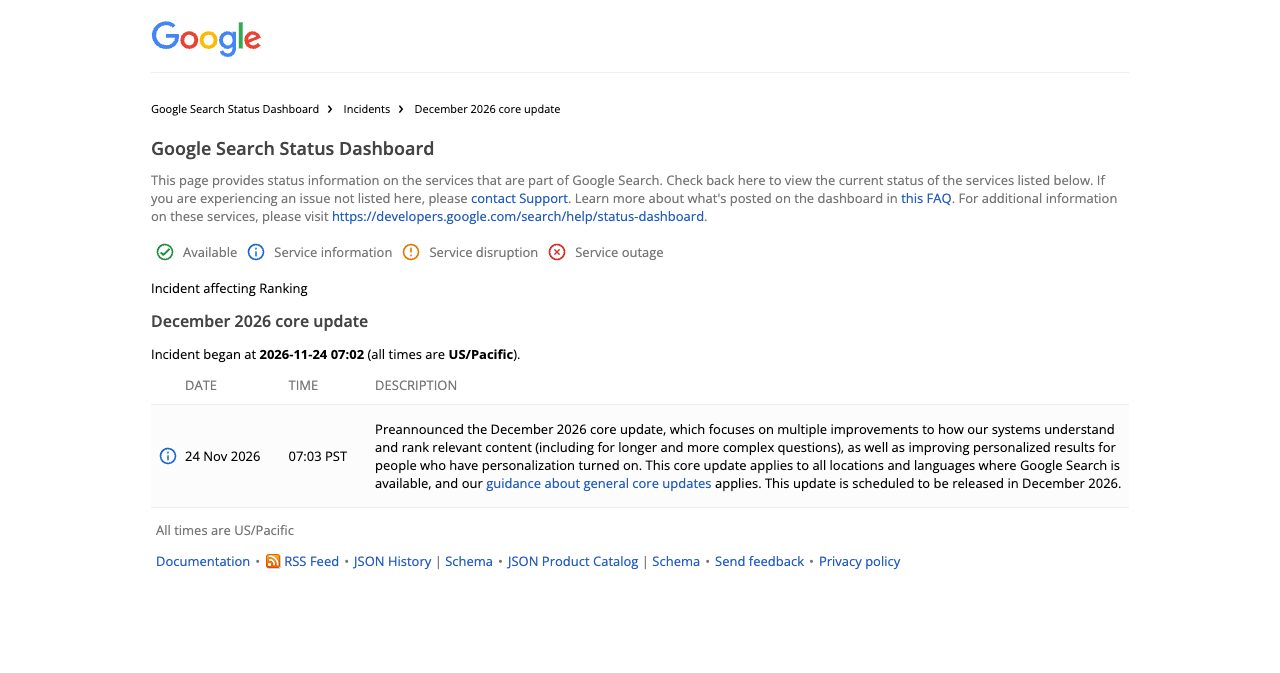
Google's November 24, 2026 pre-announcement of the December 2026 core update on the Search Status Dashboard.
When Barry Schwartz followed up on the active Information badge in his Search Engine Roundtable coverage, Google clarified that the rollout was not immediately imminent and has no locked start date beyond sometime in December 2026.
Why Google pre-announced a broad core update for the first time
Google did not suddenly decide to warn webmasters out of generosity. The pre-announcement is a direct regulatory consequence of the UK Competition and Markets Authority (CMA) enforcement actions following Google's Strategic Market Status (SMS) designation in general search.
On June 3, 2026, the UK CMA announced publisher-control conduct requirements covering how Google surfaces publisher content. Two weeks later, on June 17, 2026, the CMA imposed its Fair Ranking Conduct Requirement (detailed in the CMA Google Search case file). That requirement legally obligates Google to rank organic and AI-driven results on objective, non-discriminatory criteria, provide advance notice and transparency around material ranking changes, and maintain structured routes for site owners to raise concerns.
On November 24, 2026, minutes before posting the December core pre-announcement, Google published its new Google Search Ranking Hub and a brand-new policy page titled How to Stay Informed on Google Search Ranking Updates. That page spells out the new notice standard verbatim:
"When an update introduces actionable policy requirements or may cause broad ranking shifts for site owners, we provide notice based on the type of change. Additionally, for changes where UK users may experience a significant ranking shift, we provide advance notice to site owners in accordance with CMA's fair ranking conduct requirements for Google."
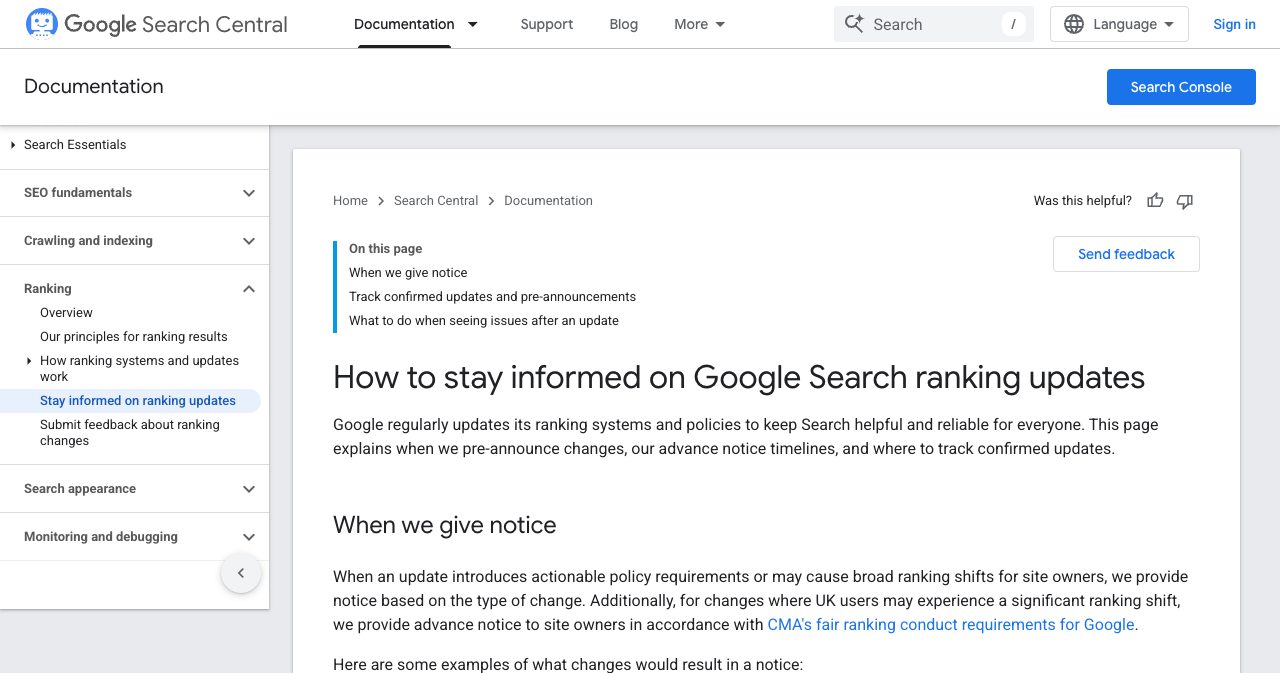
Google's new advance-notice policy page linking core update pre-announcements to the UK CMA fair ranking conduct requirements.
Because core updates apply globally across all languages and regions, UK Fair Ranking compliance just gave every SaaS founder and SEO operator worldwide an advance briefing on what Google is about to ship.
Historical November and December back-to-back precedent
Back-to-back year-end updates are now a documented Google pattern, even when the exact launch day shifts by a week:
| Year | November update | Gap between rollouts | December update(s) | Operational lesson |
|---|---|---|---|---|
| 2024 | Nov 11 to Dec 4 Core (23d 13h) | 8 days | Dec 12 to Dec 18 Core (6d 4h), followed by Dec 19 to Dec 26 Spam (7d 2h) | Different core systems shipped back to back; fixes shipped in late November had no time to be recrawled before December hit. |
| 2025 | None | N/A | Dec 11 to Dec 29 Core (18d 2h) | Mid-December launch stretched straight through Christmas and year-end retail distortion. |
| 2026 | Nov 10 to Nov 24 Core (13d 20h) | At least 7+ days (Dec date unconfirmed) | Dec 2026 Core pre-announced Nov 24 (longer complex queries + personalization) | First pre-announced core update; collides with Dec 1 post-November analysis window and Dec 1 Ahrefs DR4 launch. |
Both 2024 (December 12) and 2025 (December 11) saw mid-December starts. Google has not locked a date for December 2026, so engineering and marketing teams should treat early-to-mid December as the probable rollout window and finish high-priority structural cleanup right away instead of launching risky site-wide migrations mid-month.
Why does a December core update hit sites already in recovery differently than a standalone spring update? First, Google's own Core Updates documentation advises waiting at least a full week after completion before analyzing Search Console. For November 24, that week ends on December 1, meaning teams have barely closed their November post-mortem before December's rollout begins.
Second, B2B and consumer search behavior skews heavily around U.S. Thanksgiving (November 26), Black Friday (November 27), Cyber Monday (November 30), and late-December holiday shutdowns, masking whether a traffic dip is seasonal or algorithmic. Sites that started pruning thin pages or rewriting content in October or November also rarely complete a full Googlebot recrawl and site-wide classifier refresh in four weeks, so a December rollout can evaluate half-finished site changes and create temporary whiplash before gains settle in Q1 2027.
Target 1: longer and more complex questions (Query Fan-Out)
Google rarely names specific ranking subsystems in a core update announcement. Naming "longer and more complex questions" tells SaaS teams and directories exactly where Google is spending compute.
Users no longer type "best CRM" and click ten blue links. They type multi-constraint questions like "best CRM for a 15-person B2B SaaS using Stripe billing with SOC 2 compliance under $200 a month." When Google processes that query, its Query Fan-Out architecture splits the prompt into half a dozen hidden sub-queries: pricing tiers, Stripe native integration docs, SOC 2 security pages, team-size suitability, and third-party user reviews. It then retrieves specific passages from multiple URLs to rank organic results and synthesize AI Overviews or AI Mode responses.
Empirical data backs up why Google is tuning core ranking specifically for long queries. In July 2025, Pew Research Center tracked 900 U.S. adults across nearly 69,000 real Google searches and found that short one-to-two-word searches triggered AI summaries only 8% of the time, whereas questions of 10 or more words triggered AI summaries roughly 60% of the time. Meanwhile, Ahrefs' March 2026 study of 863,000 SERPs found that top-10 organic overlap with AI Overview citations fell in half over eight months, from 76.1% down to 37.9%, explicitly because Query Fan-Out pulls specialized answers from deeper positions.
Pages built around vague 2,500-word general guides that dodge concrete constraints lose under complex-query ranking. Pages that answer exact operational filters (pricing cutoffs, compliance certifications, integration caps, audited benchmarks) win both organic placements on long-tail commercial queries and fan-out retrieval slots.
Target 2: improved personalized results for opted-in users
Traditional SEO assumed a static SERP where rank #3 looked identical for every buyer in New York or London. Expanded personalization re-ranks results based on a searcher's prior clicks, repeat visits, signed-in Google activity, preferred ecosystems, and demonstrated brand familiarity. When a SaaS buyer previously read your documentation, watched a product walkthrough on YouTube, saw your brand discussed on Reddit, or clicked your listing on a curated directory, Google's personalization layer has concrete behavioral evidence to rank your domain higher on their next commercial search.
This shifts brand demand from a "nice-to-have" marketing metric into a direct search distribution lever. Anonymous programmatic domains with zero repeat visitors and zero branded search volume have no personalization surface to stand on. Products with steady branded queries, active documentation hubs, GitHub repositories, YouTube demos, and verified listings across curated software hubs gain compounding visibility every time a returning buyer searches again.
Anatomy of late-2026 ranking shifts: core signals, AI Overviews, and GEO
Late-2026 Google Search combines continuous SpamBrain enforcement, site-wide helpful content evaluation, entity corroboration, and Query Fan-Out retrieval across both classic blue links and AI features. High-performing sites publish original data and direct structured answers, while derivative aggregators lose organic traffic and AI citations in tandem.
A common mistake among founders is treating "traditional Google SEO" and "GEO/AEO" as separate channels with contradictory playbooks. Google's official AI Features and Your Website documentation explicitly rejects that split: there are no special AI meta tags or hidden files required to appear in AI Overviews or AI Mode. Indexability, clean architecture, structured data matching visible text, and original people-first content govern eligibility across classic Search and AI features alike. (We break down the cross-engine technical setup for ChatGPT, Perplexity, and Claude in our GEO and AI citations playbook.)
At the same time, click economics and citation selection changed dramatically between 2025 and late 2026. Every SaaS growth lead needs these four empirical studies on their desk before setting 2027 traffic forecasts:
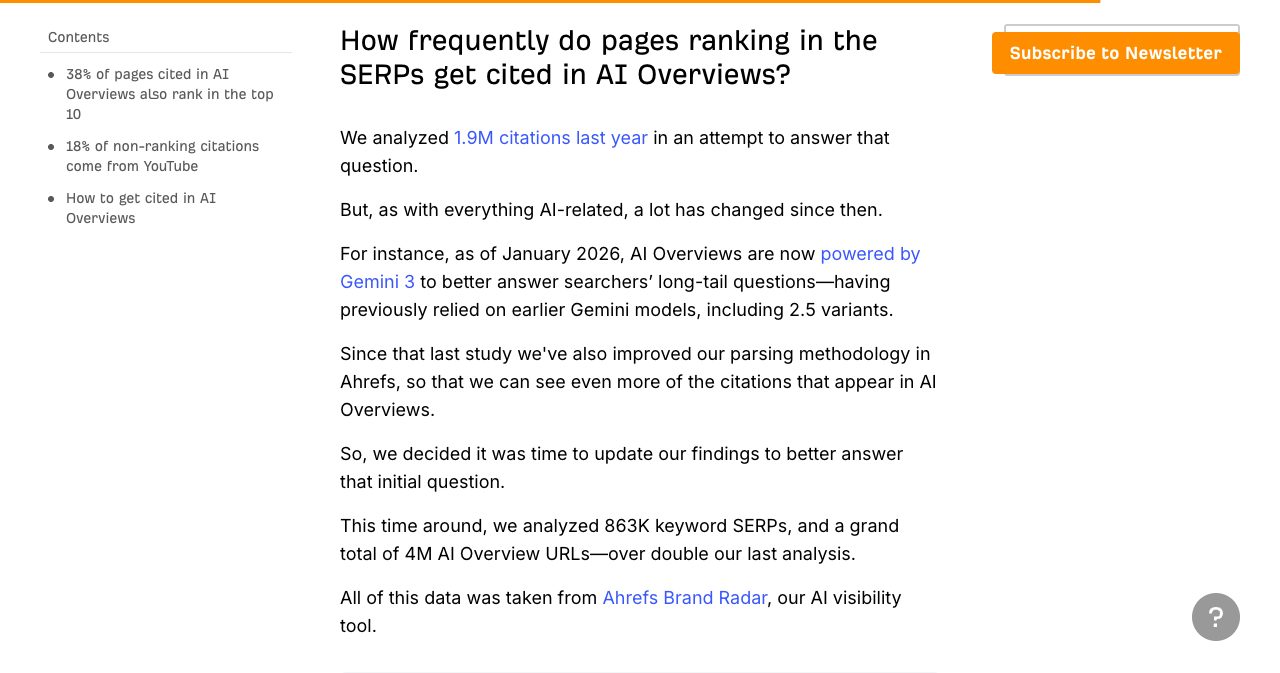
Ahrefs' March 2026 analysis of 863,000 SERPs and 4 million AI Overview URLs documenting top-10 citation decoupling.
| Empirical study | Sample size and date | Primary finding | Strategic implication for SaaS and directories |
|---|---|---|---|
| Ahrefs AI Overview Top-10 Overlap | 863,000 SERPs, 4M AIO URLs (March 2, 2026) | Only 37.9% of AI Overview citations rank in top 10 (down from 76.1% in July 2025); 31.2% rank #11-100 and 31.0% beyond #100. | Ranking #11-40 with crisp, constraint-specific answers can still earn AI Overview citations via Query Fan-Out. |
| Ahrefs AI Overviews CTR Update | 300,000 keywords (February 4, 2026) | AI Overviews correlate with 58% lower #1 organic CTR, deepening from 34.5% in April 2025. | Top-of-funnel "what is X" glossary traffic is structurally compressed; shift content budgets toward mid- and bottom-funnel buyer queries. |
| Seer Interactive AIO CTR Study | 53 brands, 5.47M queries, 2.43B impressions (April 24, 2026) | AIO organic CTR dipped to 1.3% in Dec 2025 before rebounding to 2.4% in Feb 2026 (+31% ex-outliers, still below Jan 2025's 3.2%). Cited brands earned 35% higher organic CTR and 91% higher paid CTR. | Getting cited inside the AI Overview protects click share and boosts paid-search conversion efficiency on the same query. |
| Pew Research Real-User Study | 900 U.S. adults, ~69,000 searches (July 22, 2025) | AI summaries appeared in 18% of all searches (8% on 1-2 word queries vs ~60% on 10+ word questions); link clicks dropped from 15% to 8% when an AI summary showed. | Long commercial questions trigger AI synthesis six out of ten times; structure answers for extraction and brand recall. |
One additional Ahrefs study comparing 730,000 response pairs between Google AI Mode and AI Overviews explains why brand entity strength matters even more heading into December 2026. While AI Mode and AI Overviews reached 86% semantic agreement on their conclusions, they shared only 13.7% URL citation overlap. AI Mode referenced roughly 2.5 times more brand and person entities than AI Overviews, and brands already cited in an AI Overview had a 61% chance of carrying over into AI Mode's expanded answer.
Put those numbers alongside what happened in the November 2026 Core Update. Lily Ray (Amsive) documented across client audits that when thin programmatic subfolders dropped in classic organic search during November 2026, their AI Overview and AI Mode citations dropped at the same time. Cheap tricks designed strictly to farm AI citations without real substance no longer survive core quality filters or Google's expanded spam policies, which explicitly cover manipulative attempts to game generative AI responses in Search.
What Google's late-2026 core systems reward vs. demote
Across analyst post-mortems from Glenn Gabe, Lily Ray, Marie Haynes, Aleyda Solis, and SISTRIX visibility tracking, the divide between winners and losers in 2026 comes down to Information Gain and site-wide coherence:
| Signal category | Demoted pattern in 2026 | Rewarded pattern in 2026 |
|---|---|---|
| Content originality | Rephrased consensus summaries of the current top 10 SERP, AI-spun definitions, scraped product descriptions | First-party datasets, proprietary benchmarks, real hands-on product testing, verifiable pricing and changelog audits |
| Site architecture | Bloated programmatic subfolders (/glossary/, /compare/, /alternatives/) with hundreds of near-duplicate templates | Focused topical clusters where every indexed URL serves a distinct search intent and passes an editorial quality floor |
| Authorship and accountability | Anonymous "Admin" posts, invented AI personas, zero disclosure of commercial relationships | Real teams or named practitioners with verifiable credentials, dated fact-checks, and a public editorial policy |
| Off-page and entity footprint | Automated 500-directory blasts, reciprocal badge rings, bought guest-post networks | Editorial links earned from original data, authentic Reddit and developer community mentions, curated software hubs |
| User utility | High-friction lead-gen walls, intrusive overlays, dead links, stale 2023 pricing presented as 2026 | Fast server-rendered pages, interactive tools, transparent tables, up-to-date facts that finish the user's task |
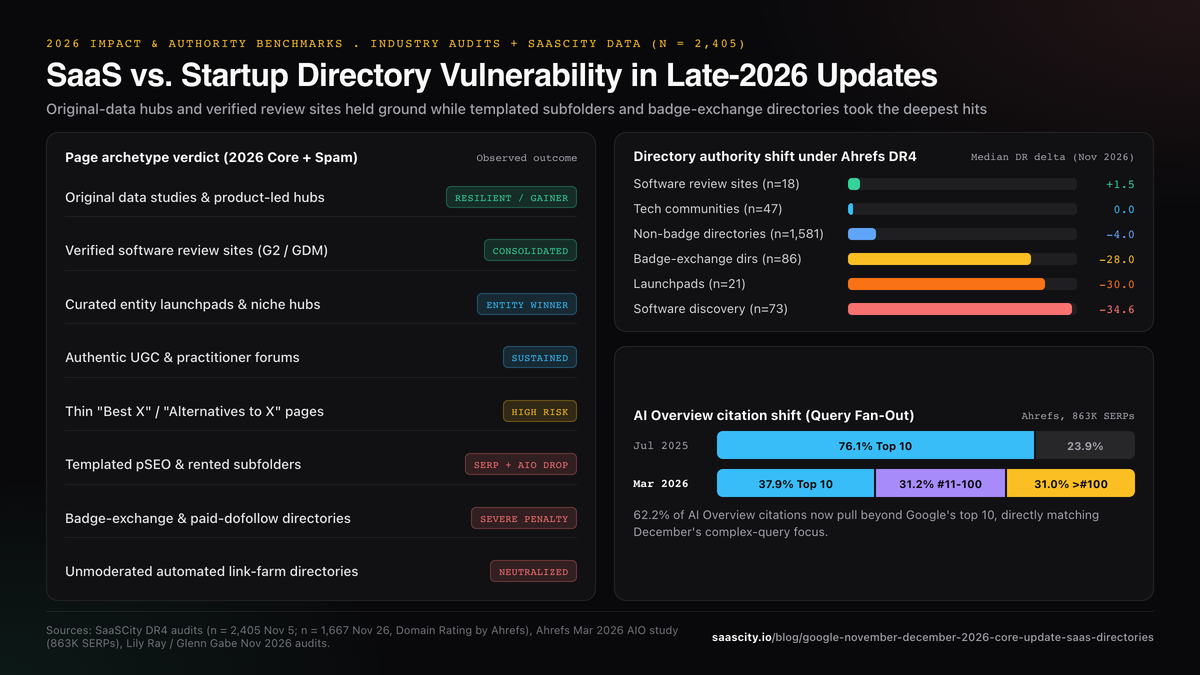
Late-2026 update vulnerability across SaaS and directory archetypes, paired with SaaSCity's November 2026 DR4 audit and Ahrefs AI Overview citation data.
SISTRIX regional visibility tracking through 2026 documented drops up to roughly 60% on aggressive lead-generation aggregators in competitive verticals like finance, legal, and health, alongside steep demotions for rapidly scaled AI blogs with deceptive author bios. Meanwhile, Reddit maintained strong organic and AI Overview visibility throughout late 2026 (even rebounding after mid-year turbulence on translated international subdomains), confirming that Google's systems heavily weight verifiable firsthand community consensus when evaluating software and buying advice.
Startup and SaaS founder recovery: diagnosis and 90-day playbook
SaaS blogs took their steepest 2026 losses in templated subfolders such as top-of-funnel glossaries, automated "X vs. Y" comparisons, and scraped competitor-alternatives pages, while core product and documentation pages often held steady. Recovery starts by waiting until December 1 to isolate holiday and DR4 noise, diagnosing whether the drop is Core, Spam, or technical bloat, and executing a disciplined 90-day prune-and-rebuild roadmap.
What broke for SaaS blogs in 2026
Three SaaS acquisition playbooks that minted free pipeline from 2021 through 2024 broke decisively in 2026:
- Top-of-funnel glossary farms. Publishing 400 short "What is [industry term]?" pages used to build easy impression volume. In 2026, AI Overviews absorb the answer directly (cutting #1 organic CTR by 58% per Ahrefs), and unedited AI glossaries dilute site-wide helpfulness scores across the entire domain.
- Templated "Best X" and "Competitor Alternatives" subfolders. Lily Ray's November 2026 audits showed a striking split inside single SaaS domains: main marketing and product pages held their rankings while mass-produced subfolders (
/alternatives/,/compare/,/templates/, area-code or integration matrices) crashed steeply in both Web Search and AI features. Spinning up 150 comparison pages by swapping competitor names inside an LLM template without real hands-on testing, verified pricing dates, or unique tradeoffs now sits directly in the crosshairs of both SpamBrain and core quality classifiers. (Our programmatic SEO guide for SaaS maps where legitimate database-backed pSEO ends and thin doorway spam begins.) - Unchecked backlink automation. Founders who bought "submit to 500 startup directories for $49" packages or joined reciprocal link-exchange Slack groups watched those links get neutralized or flagged during the four-update 2026 spam blitz.
Diagnosing core update drops vs. spam, technical bloat, and seasonal traps
Before touching a single URL, enforce Google's official stabilization window from its Core Updates guide:
"We recommend waiting at least a full week after a core update completes before analyzing your site in Search Console. After a week, try comparing this week with a week before the core update started rolling out."
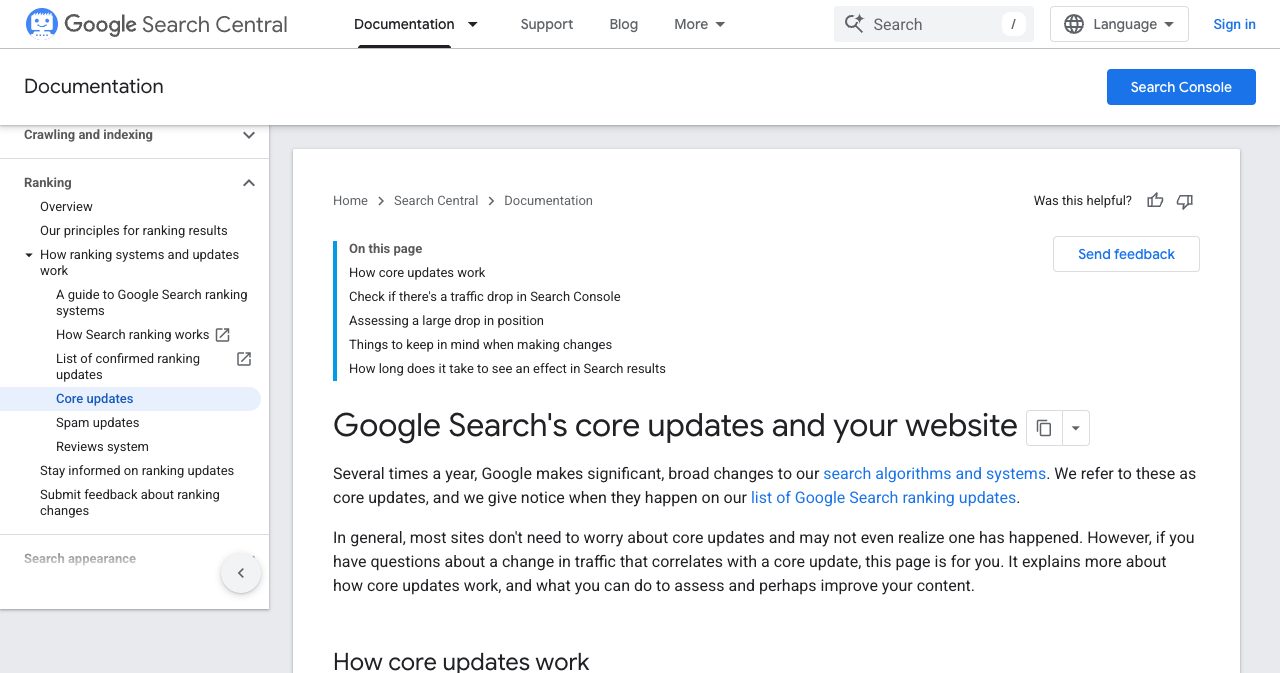
Google Search Central's core updates guidance for evaluating post-rollout Search Console shifts.
For the November 24 completion, wait until at least December 1, 2026, and compare December 1 to 7 against November 3 to 9. Never compare November 26 to 30 straight against mid-November: U.S. Thanksgiving (November 26), Black Friday (November 27), and Cyber Monday (November 30) cause steep B2B weekday traffic dips every year regardless of Google updates.
Watch out for one massive December 1 false alarm that will fool thousands of founders: on December 1, 2026, Ahrefs switches its standard dashboard from DR3 to the new DR4 model. As our 2,405-directory Ahrefs DR4 audit showed, DR4 strips out inflated subdomain and badge-exchange scores overnight. Domain Rating by Ahrefs is a third-party link metric and is not a Google ranking factor (explained in our Domain Rating and SEO breakdown). If your Ahrefs DR drops 15 points on December 1 while Google Search Console non-branded clicks remain flat, you did not get hit by a Google update.
Use this diagnostic matrix to separate root causes before making architectural changes:
| Root cause | Typical date signature in 2026 | Google Search Console symptom | Recovery path |
|---|---|---|---|
| November 2026 Core Update | Drop begins Nov 13 to 14, stabilizes by Nov 24 to Dec 1 | Position slips (e.g., #3 to #9 or #15) concentrated in specific informational or comparison subfolders; URLs stay indexed | Wait until Dec 1, prune dead/thin subfolders, enrich priority pages with primary data and complex-query answers; expect 3 to 6 months |
| August or September 2026 Spam Update | Sharp cliff on Aug 18 to 21 or Sep 24 to Oct 8 | Top-10 URLs fall completely out of top 100 (82% spike in Aug 2026); site-wide non-branded collapse; empty Manual Actions tab | Audit against Google spam policies, delete scaled/manipulative content, clean paid/reciprocal links, wait for SpamBrain reassessment |
| Technical or indexation bloat | Gradual decline over 2 to 6 months independent of rollout dates | Rising "Crawled - currently not indexed" and "Discovered - currently not indexed" counts; high Googlebot share on parameter or 404 URLs | Block parameter crawl traps in robots.txt, fix canonical loops, return 410 Gone on dead pages, repair broken internal links |
| Holiday seasonality or Dec 1 DR4 shift | Nov 26 to 30 B2B dip, or Dec 1 Ahrefs score drop | Average position stays stable while impressions dip across U.S. business queries; or GSC traffic is flat while Ahrefs DR falls | Do nothing to site architecture; compare weekday-to-weekday non-holiday baselines in early December |
Notice Google's own rule on small declines: if a page moved from position #2 to #4, do not rewrite it from scratch. Touching pages that still hold page one often creates worse instability right before the December rollout.
Exact Google Search Console regex filters and server log checks
Open Google Search Console, go to Performance -> Search results, set Date to Compare (Dec 1 - Dec 7, 2026 vs. Nov 3 - Nov 9, 2026, or Nov 17 - Nov 23 vs. Nov 3 - Nov 9 for an early weekday read excluding Thanksgiving), and run these exact regex filters to isolate where the damage sits:
# 1. Isolate templated SaaS subfolders (Page -> Custom regex -> Matches)
^https://yourdomain\.com/(alternatives|compare|vs|glossary|templates|integrations)/

# 2. Separate branded queries from non-branded demand (Query -> Custom regex -> Doesn't match)
(?i)(yourbrand|your brand|yourdomain)

# 3. Isolate longer complex queries (6+ words) targeted by December 2026 Core Update
^([^ ]+ ){5,}[^ ]+$

# 4. Find high-intent buyer comparison and pricing queries
(?i)\b(vs|versus|alternative|alternatives|pricing|review|reviews|best|for)\b
Next, cross-check your CDN or origin access logs over the past 30 days to see whether Googlebot is wasting crawl capacity on junk URLs instead of your core SaaS pages:
# Count Googlebot hits by status code and top URL prefixes (Nginx/Cloudflare log sample)
grep -i "Googlebot" access.log \
  | awk '{print $9, $7}' \
  | sed 's/?.*$/?QUERY_PARAMS/' \
  | sort | uniq -c | sort -rn | head -n 30
If more than 20% of Googlebot requests hit ?QUERY_PARAMS, 404 URLs, redirect chains, or empty tag pages, fix crawl efficiency immediately. Unlike site-wide content re-evaluations, crawl-budget repairs start helping within weeks.
Rebuilding SaaS pages for complex queries and December personalization
To prepare priority SaaS pages for both post-November recovery and December's complex-query upgrade, audit your top 20 commercial and comparison URLs against five structural requirements:
- Place a self-contained 40 to 60 word direct answer immediately under every major question heading so Google's Query Fan-Out, AI Overviews, and Perplexity can extract a factual passage without scraping three paragraphs of throat-clearing.
- Answer multi-constraint buyer combinations explicitly in tables: pricing tier cutoffs, seat minimums, native integrations, security compliance (SOC 2, HIPAA, GDPR), deployment model, and date checked.
- Prove firsthand product experience with real UI captures, benchmark test times, exact configuration commands, and named drawbacks of each tool (including your own).
- Ship valid, visible-content-matching JSON-LD (
SoftwareApplicationon product pages,Organizationsite-wide,FAQPagematching visible Q&As). Follow our JSON-LD structured data guide for SaaS and confirm every field matches text users see on screen:
{
  "@context": "https://schema.org",
  "@type": "SoftwareApplication",
  "name": "Acme Billing Analytics",
  "applicationCategory": "BusinessApplication",
  "operatingSystem": "Web",
  "url": "https://acmebilling.example/product",
  "description": "Real-time MRR, churn cohort, and Stripe revenue recognition dashboard for B2B SaaS teams under 100 seats.",
  "offers": {
    "@type": "Offer",
    "price": "79.00",
    "priceCurrency": "USD",
    "priceValidUntil": "2027-12-31",
    "availability": "https://schema.org/InStock"
  },
  "publisher": {
    "@type": "Organization",
    "name": "Acme Billing Inc.",
    "url": "https://acmebilling.example",
    "sameAs": [
      "https://github.com/acmebilling",
      "https://www.linkedin.com/company/acmebilling"
    ]
  }
}
- Build direct repeat-visit loops for December's personalization layer: publish a public changelog, host interactive calculators or free micro-tools that users bookmark, answer genuine category questions on Reddit and GitHub without spamming links, and maintain consistent brand facts across high-trust directories and documentation.
The 90-day SaaS SEO and GEO recovery roadmap
Divide recovery into four sequential phases so your team finishes technical cleanup cleanly without thrashing mid-rollout:
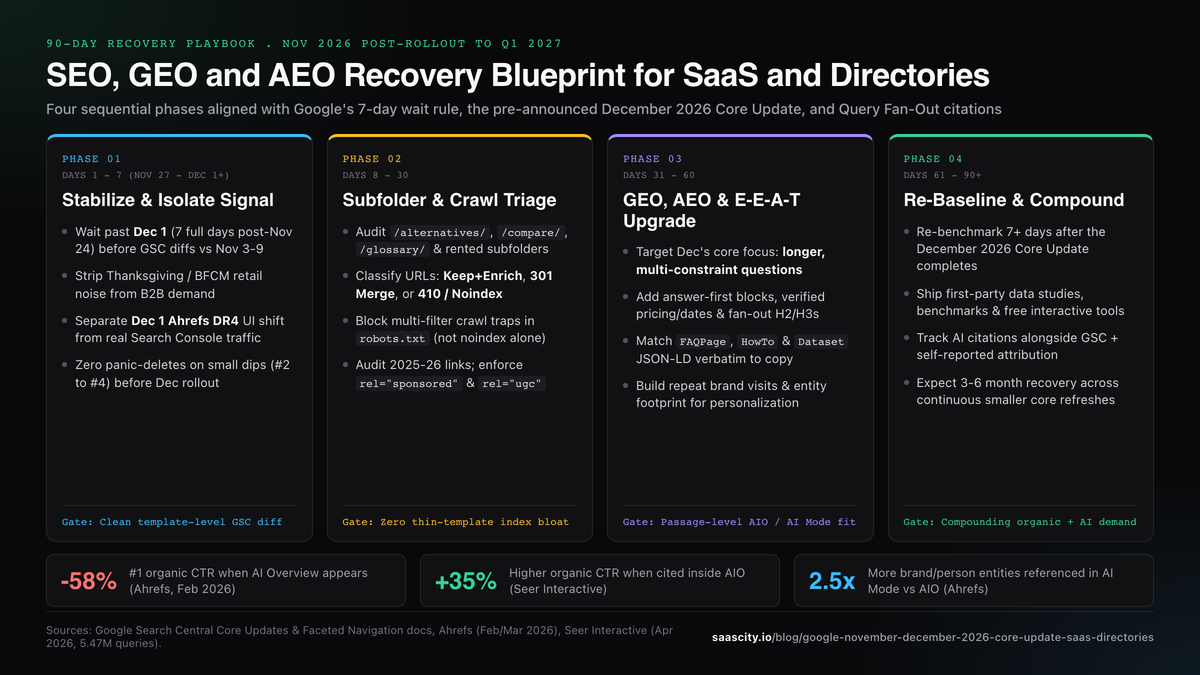
Four-phase 90-day recovery workflow built around Google's seven-day wait rule and the December 2026 core update focus.
- Phase 1: Stabilize and isolate (Days 1 to 14, Nov 27 to early Dec 2026). Hold major edits until December 1, separate Thanksgiving, Black Friday, Cyber Monday, and Ahrefs DR4 UI noise from Search Console performance, and segment branded clicks from non-branded clicks across templates.
- Phase 2: Subfolder and crawl triage (Days 15 to 35, Dec 2026). Map every URL in programmatic subfolders into Keep/Enrich, 301 Consolidate, or 410/Noindex buckets, block parameter crawl waste in
robots.txt, fix canonical chains, and audit 2025 to 2026 backlinks for spam footprints without launching risky domain migrations during the December rollout. - Phase 3: GEO, AEO, and E-E-A-T upgrade (Days 36 to 65, Jan 2027). After waiting seven days past December Core Update completion, execute subfolder pruning (
410 Goneon dead or irrelevant pages,301merges on cannibalizing duplicates), rebuild your top 15 commercial and comparison pages with firsthand testing, 40 to 60 word direct answers, and multi-constraint tables, and matchSoftwareApplication,FAQPage, andHowToJSON-LD verbatim to visible copy. - Phase 4: Re-baseline and compound (Days 66 to 90, Feb to Mar 2027). Ship two to three flagship Information Gain assets (original benchmark surveys, open CSV datasets, or interactive diagnostic tools) that earn editorial links and AI citations, expand multi-channel brand presence (YouTube product demos, curated software reviews, integration partner pages), and track leading metrics in GSC and AI answer engines (see our comparison of SEO vs. GEO visibility tracking tools).
Startup directories and aggregators: surviving the 2026 quality purge
Generic startup and AI directories suffered the sharpest compounding losses in 2026 because thin scraped blurbs, open dofollow link-selling, dead outbound URLs, and infinite faceted parameter pages directly trigger both SpamBrain and core quality downgrades. Surviving directories operate as curated verification hubs with strict indexation gates, clean rel="sponsored" and rel="ugc" markup, aggressive crawl control, and first-party structured data.
Market consolidation and first-party directory data
Two structural forces reshaped the software directory sector in 2026.
First, enterprise software reviews consolidated into a single giant. On January 29, 2026, G2 announced its acquisition of Gartner Digital Markets (Capterra, Software Advice, and GetApp), closing the deal on February 5, 2026 for approximately $110 million according to Gartner SEC filings. The combined G2 Digital Markets entity (my.G2) consolidates roughly 6 million reviews and more than 200 million annual software buyers under one umbrella. Those consolidated incumbents kept their transactional SERP authority, while increasing pay-to-play friction and vetting delays for bootstrapped and early-stage SaaS founders.
Second, lower-tier automated directories collapsed under simultaneous Google spam enforcement and link-graph devaluation. SaaSCity's open first-party datasets document the scale of that collapse across three audits:
- The 2026 SaaS directories quality study audited 2,972 domains marketed across founder launch lists. Exactly 1,306 domains (44.0%) failed basic viability checks: 217 were dead, parked, or returning 404; 179 had broken TLS, timeouts, or 5xx errors; 193 were link farms or spam shells with a median DR of 0; 172 were famous non-directories like Wikipedia or news outlets (65 of which had DR 70+); 75 were pure media sites; 188 were non-directory tools; and 282 had no working submission path. Only 1,666 live working directories survived the initial audit (1,667 live rows as of the November 26, 2026 dataset refresh).
- Our November 5, 2026 Ahrefs DR4 study across 2,405 directories (Domain Rating by Ahrefs) revealed a brutal split by directory business model. Established software review sites (n = 18, DR3 >= 30) gained a median +1.5 points (83 to 86), developer and founder communities (n = 47) held flat at 0 change (75 to 73), and tech media (n = 102) moved -0.5. By contrast, launchpads (n = 21) fell a median -30 points, software discovery sites (n = 73) plunged -34.6 points, and all 9 platform-hosted subdomain directories (hosted on Gumroad, Notion, Softr, GitHub Pages, Brick.do, and Pory.app) collapsed outright (for example,
aitoolhouse.gumroad.comfell from 92 to 1.7 andaiinfinity-meetpatel.notion.sitedropped from 92 to 2.3). - Our fresh November 26, 2026 dataset audit (download the open 1,667-directory CSV) shows exactly which directory tactic took the worst punishment: reciprocal badge exchanges.
| SaaSCity directory dataset (checked Nov 26, 2026) | Count (n) | Median DR3 | Median DR4 | Median delta | Dropped 20+ pts | Badge-exchange median delta | Non-badge median delta |
|---|---|---|---|---|---|---|---|
| All working SaaS directories | 1,667 | 34.0 | 23.0 | -5.0 | 352 | -28.0 (n = 86) | -4.0 (n = 1,581) |
| Dofollow SEO directories | 760 | 37.0 | 22.0 | -8.0 | 229 | -29.5 (n = 46) | -7.0 (n = 714) |
| Free dofollow directories | 414 | 41.0 | 21.5 | -10.0 | 142 | -23.0 (n = 25) | -9.0 (n = 389) |
| AI tool directories | 371 | 29.0 | 15.0 | -6.0 | 78 | N/A | N/A |
Source: SaaSCity open datasets (/data/saas-directories-dr4-2026.csv, /data/seo-directories-dr4-2026.csv, /data/free-dofollow-directories-dr4-2026.csv, /data/ai-directories-dr4-2026.csv), Domain Rating by Ahrefs, checked November 26, 2026.
Across all 1,667 live SaaS directories, the 86 sites running reciprocal badge-exchange schemes dropped a median 28 points under DR4 (and 29.5 points among dofollow SEO directories), compared to just 4 points for non-badge directories. Reciprocal "put our dofollow badge in your footer to earn a dofollow listing" rings are the textbook footprint both link-graph algorithms and Google's SpamBrain target first.
Surviving high-E-E-A-T directories vs. demoted link farms
Directories that survive late-2026 updates share specific architectural habits that demoted link farms skip:
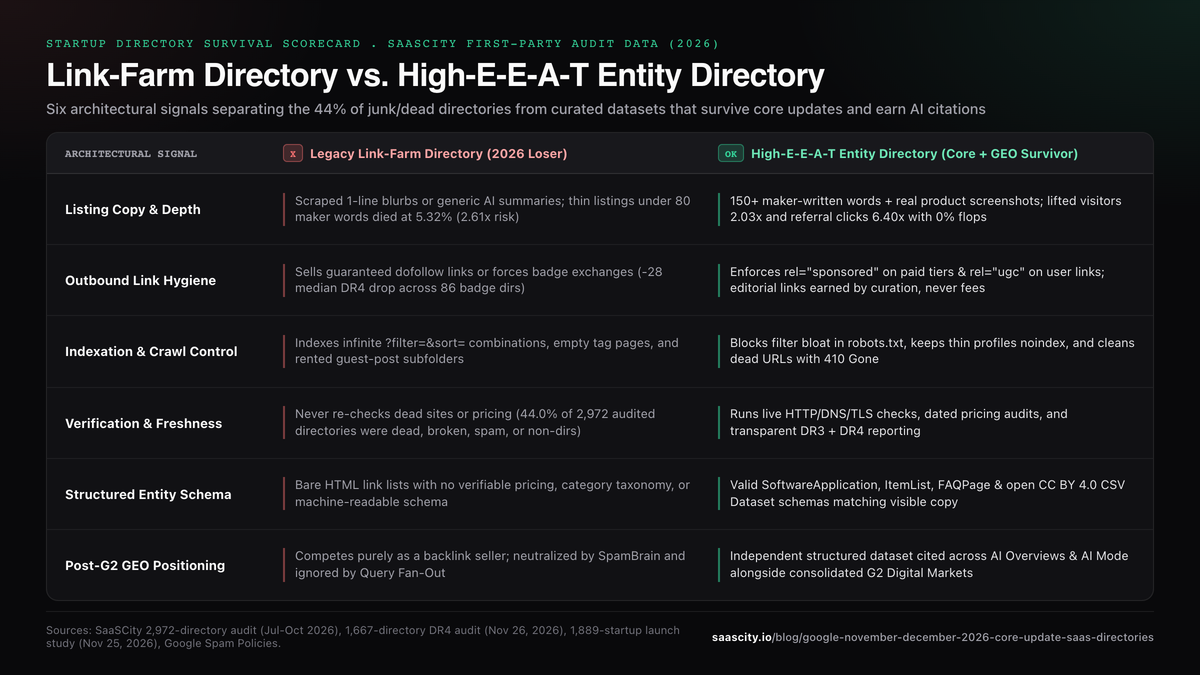
Six architectural signals separating penalized link-farm directories from high-E-E-A-T entity directories in 2026.
| Architectural dimension | Demoted link-farm directory | Surviving high-E-E-A-T directory |
|---|---|---|
| Listing copy | Scraped meta description or one-sentence founder tagline plus favicon | Human-reviewed profile with substantive original product details, checked pricing, live status check, and category context |
| Indexation policy | Indexes every submission, empty tag, dead startup, and multi-filter combo | Sitemap and robots directives stay strictly aligned; thin or unvetted profiles stay noindex; permanently dead or off-topic pages return 410 Gone |
| Outbound links | Sells "guaranteed dofollow backlinks" for $19 to $99; runs footer badge-exchange rings | rel="sponsored nofollow" on all paid placements; rel="ugc nofollow" on unvetted user links; editorial links earned strictly through independent curation |
| Faceted navigation | Crawlable ?pricing=free&tag=ai&sort=top&page=19 URLs creating 50,000 duplicate pages | Filter/sort parameters blocked in robots.txt; self-referencing canonicals strictly on curated hub pages |
| Editorial scope | Accepts off-topic spam verticals, gambling/pharma clutter, and rented guest-post subfolders | Strict niche moderation excluding spam-magnet categories; topical focus enforced via a public editorial policy |
| Original data | Zero first-party metrics; copies product captures and blurbs from Product Hunt | Publishes live/dead uptime checks, pricing audits, survival benchmarks, and downloadable CSV datasets |
| AI and GEO readiness | Unstructured HTML cards with missing schema and stale timestamps | Valid SoftwareApplication, ItemList, and Dataset JSON-LD with visible check dates and extractable comparison tables |
Killing thin listings and indexation bloat
Most directory owners accidentally poison their own domain authority by indexing every single listing the second a founder hits Submit. When 60% of a directory's indexed URLs contain two sentences of founder pitch copy and an outbound link, Google's site-wide quality classifier judges the whole site by its weakest majority.
Follow four architectural principles to eliminate thin-page drag without exposing fragile heuristics:
- Keep your XML sitemap and HTML
<meta name="robots">directives generated from the same eligibility rule. Advertising a URL insitemap.xmlwhile servingnoindexin the document<head>sends contradictory signals to Googlebot and wastes crawl budget on pages you do not want ranked. - Require original, human-authored product detail before a profile enters the index, and never pad thin submissions with boilerplate AI summaries to manufacture word count. If a founder submits only a one-line slogan, keep the profile accessible to logged-in or direct visitors while serving
noindexuntil it carries real product substance (pricing, use case, audience, and concrete capabilities). - Return HTTP
410 Gonefor shut-down startups, abandoned commodity pages, and retired off-topic posts instead of letting thousands of soft-404s rot in Google's index. Keep spam-magnet and off-topic niches permanently excluded from both search indexation and sitemaps. - Merge or
noindexmicro-categories with only one or two active products. An indexable category page titled "Best AI Podcast Thumbnail Generators" containing a single stale listing drags down every parent category around it.
Faceted navigation and crawl budget rules
Google's faceted navigation documentation and crawl budget guide are explicit about the biggest technical mistake directories make: relying on <meta name="robots" content="noindex"> alone to stop parameter bloat. Googlebot still has to download a noindex page to read the meta tag, which burns crawl capacity across tens of thousands of filter combinations (?sort=newest&pricing=freemium&tag=b2b&page=8).
Block non-canonical filter, sort, search, and pagination combinations directly in robots.txt (or render interactive filters via URL fragments # that search bots ignore), and reserve clean, static, self-canonicalized paths (/best-ai-directories, /free-dofollow-directories) strictly for high-demand curated hubs:
# Directory faceted navigation & crawl-budget protection (robots.txt)
User-agent: *
Disallow: /*?sort=
Disallow: /*?filter=
Disallow: /*?pricing=
Disallow: /*?tag=
Disallow: /*?q=
Disallow: /*&page=

# Keep AI search/citation bots open while optionally blocking training-only bots
User-agent: OAI-SearchBot
Allow: /

User-agent: PerplexityBot
Allow: /

User-agent: ClaudeBot
Allow: /

User-agent: Google-Extended
Allow: /

Sitemap: https://yourdirectory.example/sitemap.xml
You can generate and test exact bot directives using our free robots.txt generator. Also confirm that empty filter states return a genuine HTTP 404 or 410 instead of a 200 OK page saying "0 tools found."
Outbound link attributes and badge-exchange cleanup
Google's qualify your outbound links guide draws an unmistakable legalistic line for directories. Violating it puts a directory straight into SpamBrain's link-manipulation classifier:
<!-- 1. Paid featured listing, expedited review fee, or sponsored review -->
<a href="https://example-saas.com" rel="sponsored nofollow noopener">Visit Example SaaS</a>

<!-- 2. Unvetted user-submitted profile or free community submission -->
<a href="https://example-saas.com" rel="ugc nofollow noopener">Visit Example SaaS</a>

<!-- 3. Independent human-curated editorial pick (non-paid editorial recommendation) -->
<a href="https://example-saas.com" rel="noopener">Visit Example SaaS</a>
Follow three hard rules on link monetization:
- Never sell "guaranteed dofollow backlinks" as your checkout pitch. Selling PageRank violates Google's spam policies outright, and every payment-gated dofollow link belongs under
rel="sponsored"(explained in our glossary entries for rel="sponsored" and dofollow vs. nofollow). - Kill reciprocal badge-exchange requirements immediately. As our November 26 DR4 dataset proved, badge-exchange directories took a 7x worse median DR4 hit (-28 vs. -4) than non-badge directories. Award editorial links purely on independent review and product merit, never in exchange for footer backlinks or checkout fees.
- Publish a transparent editorial policy linked from your footer and every article explaining how submissions are reviewed, how sponsored placements are tagged, and how rankings are calculated.
Turning a directory into a GEO citation source
G2's $110 million absorption of Capterra, Software Advice, and GetApp created genuine market whitespace for independent directories. Enterprise buyers still check G2, while founders, developers, and AI answer engines hunting for independent indie SaaS benchmarks, live survival status, and non-pay-to-play pricing matrices have fewer trustworthy open sources.
Directories that survive 2027 will stop competing as backlink vending machines and position themselves as structured primary-data sources for Query Fan-Out and AI search. Publish dated uptime checks (flagging dead domains and HTTP 402 billing pauses), audited pricing tiers, downloadable CC BY 4.0 CSV datasets, transparent authority metrics (publishing both Ahrefs DR3 and DR4 openly instead of hiding behind legacy scores), and clean ItemList plus SoftwareApplication JSON-LD so ChatGPT, Perplexity, AI Mode, and Google AI Overviews cite your directory pages as ground-truth corroboration.
How SaaS founders should use startup directories after the 2026 updates
Founders should stop paying for automated 500-directory backlink blasts and submit selectively to 20 to 40 curated, human-reviewed directories and category review sites with 150+ words of original product copy per profile. Done selectively, directory profiles pass real buyer referrals, corroborate brand entities for Google's December personalization update, and feed AI search citations without triggering SpamBrain risk.
SaaSCity's 2026 indie SaaS mortality study (open 1,889-startup CSV) tracked 2,862 submissions, 1,889 human-approved launches, and 222,733 daily Ahrefs DR rows across 4,505 domains. The survival and traffic numbers explain why listing quality and domain hygiene matter far more than raw submission count:
| Signal measured (n = 1,889 approved SaaS launches) | Observed outcome | Operational takeaway |
|---|---|---|
| Domain Rating 0 vs. DR 25+ (custom domains) | DR 0 domains died at 14.16% vs. 1.19% at DR 25-49 and 0.00% at DR 50+ (0 of 122), a 14.38x mortality cliff (p = 6.29e-10) | Earning early legitimate domain authority through curated hubs and editorial mentions strongly correlates with survival past year one |
| Free subdomains and cheap promo TLDs | Platform subdomains (*.vercel.app) died at 17.65% vs. 3.32% on custom domains (5.31x); age-controlled promo TLDs (.online, .pro, .xyz, .lol) died at 19.44% vs. 3.70% on .com (5.26x, p = 4.03e-6) | Launch on a clean custom .com, .io, .ai, or .dev domain before investing in SEO or directory distribution |
| Maker copy length on unbadged free launches (n = 751) | Writing 150+ maker words (n = 145) drove 2.03x unique visitors (p = 1.71e-14), 6.40x outbound referral clicks, and 0.00% zero-visitor flops; thin listings under 80 words died at 5.32% vs. 2.04% for >= 80 words (2.61x) | Thin 40-word copy-paste directory blurbs waste your submission and fail modern indexation gates |
| Hosting and DNS hygiene | HTTP 402 billing pauses accounted for 24.62% (16 of 65) of shutdowns (15 of 16 on Vercel); expired TLS, Cloudflare 525, and lapsed DNS had 0.0% recovery and wiped up to 90% of Ahrefs DR within 7 days | Set up uptime monitoring and auto-renew billing before promoting links; a single week of DNS failure destroys months of authority |
Five-point vetting check before submitting your SaaS to any directory
Before submitting your startup or evaluating directory submission services, run each target directory through five quick checks (you can also audit candidate domains with our free Domain Rating checker):
- Check indexation and traffic, not legacy DR3. Search
site:directorydomain.comin Google. If the directory claims 5,000 startups while Google only indexes 40 pages, Google's quality classifiers already wrote it off as a link farm. - Inspect the link policy and badge requirements. Avoid any directory whose homepage sells "instant dofollow backlinks" or requires a site-wide footer badge link back to them. Those directories took the worst DR4 and SpamBrain hits of 2026.
- Check the category taxonomy and dead-link ratio. Click five random listings on the directory. If two return 404 errors or parked domains, the operator runs zero curation.
- Write a unique 150 to 250 word product profile for each top-tier hub instead of pasting the same two-sentence blurb across 40 sites. Include exact pricing, target persona, primary use case, and integrations so both human buyers and AI retrieval models can cite the profile accurately (follow our guide on how to write a high-converting directory listing).
- Pace submissions naturally across weeks and pair them with non-directory entity signals. Check our realistic data on how long backlinks take to index and work for micro-SaaS, and if you want controlled, human-approved founder submissions without outsourcing to spammy Fiverr gigs, you can review the Directory Submission Skill (
$29.99) or submit directly to SaaSCity.
Step-by-step core update recovery playbook for SaaS and directories
Execute these eight steps in sequence so you do not act on noisy Thanksgiving data or ship half-finished edits straight into the December rollout.
- Hold major edits until December 1 and isolate holiday and DR4 noise. Wait seven full days after the November 24 completion date before comparing Search Console performance against November 3 to 9, segmenting out Thanksgiving, Black Friday, Cyber Monday, and the December 1 Ahrefs DR4 UI transition.
- Segment drops by subfolder, query length, and update date. Use Google Search Console regex filters to separate branded clicks from non-branded clicks, isolate programmatic or directory subfolders, and check whether traffic fell during the August or September spam updates versus the November 13 to 14 core tremor.
- Prune or consolidate thin programmatic and off-topic subfolders. Audit every zero-impression glossary, alternatives, tag, and filter page, returning 410 Gone on permanently dead or off-topic URLs, 301 redirecting cannibalizing duplicates into one canonical resource, and keeping thin user-submitted profiles noindex until reviewed.
- Block faceted navigation crawl waste in robots.txt. Stop Googlebot from burning crawl budget on multi-filter, sort, and deep pagination URLs by disallowing low-value query parameters in robots.txt and keeping self-referencing canonicals strictly on curated indexable hubs.
- Enforce outbound link attribute hygiene across listings and editorial content. Apply rel="sponsored nofollow" to every paid listing or sponsored placement, rel="ugc nofollow" to unvetted user submissions, and remove reciprocal badge-exchange schemes that trigger link-manipulation signals.
- Rebuild priority pages for longer complex queries and Query Fan-Out. Add 40 to 60 word direct answer blocks under question-form headings, multi-constraint comparison tables with dated pricing, hands-on product UI proof, and verifiable primary data that Google's Query Fan-Out can extract.
- Align visible content with SoftwareApplication, FAQPage, and HowTo JSON-LD. Ensure structured data mirrors visible page copy verbatim, tie authorship to real domain profiles and an editorial policy page, and expose machine-readable CSV datasets or tables for AI citation retrieval.
- Track leading recovery indicators across GSC, server logs, and AI answers. Monitor Googlebot crawl allocation toward revenue pages, non-branded impressions on six-word-plus queries, position 11 to 20 climbs, branded search demand, and AI Overview or ChatGPT citation share before expecting full click recovery.
Recovery timelines and leading indicators to track before traffic rebounds
Technical crawl fixes, 410 Gone pruning, and internal link restructuring can improve Googlebot efficiency and long-tail impressions within 2 to 6 weeks, whereas site-wide core update and SpamBrain recoveries typically require 3 to 6 months across continuous smaller core updates or the next major broad core update.
Google's Core Updates documentation states this timeline plainly:
"If it's been a few months and you still haven't seen any effect, that could mean waiting until the next core update. However, you don't necessarily have to wait for a major core update to see the effect of your improvements. We're continually making smaller core updates."
Notice two separate clocks running at the same time. Page-level improvements (fixing broken canonicals, removing robots.txt blocks, tightening title/answer alignment on a page sitting at position #12, or merging two cannibalizing guides) often move during Google's continuous smaller core refreshes between major named updates. Site-wide quality re-evaluations (recovering after pruning 40% of a domain's thin programmatic pages or cleaning up months of SpamBrain link debt) almost always wait until Googlebot finishes recrawling the cleaned architecture and a subsequent broad core update re-scores the host.
Do not stare at total top-line organic sessions every morning during months one and two, because total clicks are the slowest lagging indicator. Track these six leading indicators weekly in Google Search Console, your server logs, and AI search checks:
| Leading indicator | Where to measure | Healthy early recovery signal (Weeks 2 to 8) | Warning sign requiring action |
|---|---|---|---|
| Googlebot crawl ratio on core pages | Origin or CDN access logs | >= 80% of Googlebot hits land on canonical 200 OK product, guide, and hub URLs | > 25% of Googlebot hits still burn on parameters, 404s, or redirect chains |
| Indexed-to-submitted sitemap ratio | GSC -> Indexing -> Pages (filtered by sitemap) | Shrinking "Crawled - currently not indexed" backlog; rising % of submitted URLs indexed | New high-effort guides stall in "Discovered - currently not indexed" for > 14 days |
| Non-branded impressions on 6+ word queries | GSC Performance with regex ^([^ ]+ ){5,}[^ ]+$ | Rising impression curve on multi-constraint buyer queries even before clicks jump | Flat or shrinking query count across rewritten priority pages |
| Page-two position climbs (#11 to #25) | GSC Performance filtered by query group | Target commercial URLs moving from #28 -> #16 -> #11 ahead of the next core refresh | Pages stuck beyond position #50 (signals unresolved spam or severe intent mismatch) |
| Branded search volume and direct visits | GSC branded regex + GA4 direct/referral | Rising monthly searches for your product name plus category terms (feeds Dec personalization) | Zero branded search growth despite heavy publishing volume |
| AI Overview, AI Mode, and LLM citation share | Monthly prompt log (ChatGPT, Perplexity, Google) + self-reported signup attribution | Priority pages and curated directory profiles appear as cited sources for complex buyer prompts | Competitors cited while your domain is omitted or misdescribed |
Pair those six metrics with one non-technical habit: add an open-text "How did you hear about us?" field to your SaaS signup form. When Seer Interactive and Pew Research show that a growing share of software buyers read an AI Overview or ChatGPT answer without clicking a blue link immediately, self-reported attribution captures the pipeline that analytics attributes to "Direct."
FAQ
When did the Google November 2026 core update start and finish?
The November 2026 core update started on November 10, 2026 at 18:06 UTC (1:06 PM ET) and completed on November 24, 2026 at 14:03 UTC (9:03 AM ET), lasting 13 days and 20 hours globally across all languages.
Is the Google December 2026 core update live yet?
No. As of November 27, 2026, the December 2026 core update has not started rolling out. Google pre-announced it on November 24, 2026 at 15:02 UTC (59 minutes after the November rollout finished) and confirmed it is scheduled for sometime in December 2026 without a locked launch date.
Why did Google pre-announce the December 2026 core update?
Google issued its first broad core update pre-announcement to comply with the UK Competition and Markets Authority (CMA) Fair Ranking Conduct Requirement imposed on June 17, 2026. On November 24, 2026, Google also launched its Search Ranking Hub documentation stating it will give advance notice when significant ranking shifts affect UK users.
What does the December 2026 core update target?
Google's pre-announcement states two explicit areas: multiple improvements to how its systems understand and rank content for longer and more complex questions, and improved personalized results for searchers who have personalization turned on.
How long should you wait after the November 2026 core update before auditing Search Console?
Google recommends waiting at least one full week after completion before comparing Search Console performance against the week before launch. For the November 24 finish, that stabilization date is December 1, 2026, and B2B SaaS teams should also strip out Thanksgiving (Nov 26), Black Friday (Nov 27), and Cyber Monday (Nov 30) seasonal dips.
Could a December 1 Domain Rating drop be caused by Google's core update?
No. Ahrefs switches its standard UI from DR3 to the new DR4 model on December 1, 2026, the exact day Google's one-week post-November analysis window opens. Domain Rating is an Ahrefs metric and is never a Google ranking signal, so check Google Search Console impressions and clicks before blaming an Ahrefs score drop on Google.
Why did SaaS programmatic SEO and alternatives pages lose traffic in late 2026?
Templated subfolders such as repetitive X-vs-Y matrices, boilerplate glossary definitions, and auto-generated competitor alternatives pages failed both SpamBrain's scaled content abuse enforcement across four 2026 spam updates and Google's core quality evaluation in May and November 2026.
How can I tell if my SaaS site was hit by a core update or one of the 2026 spam updates?
Overlay daily non-branded organic clicks in Google Search Console against the exact 2026 release windows: August 18 to 21 and September 24 to October 8 for the late-summer spam updates, versus November 10 to 24 for the November core update (with initial tremors landing November 13 to 14). Spam hits often drop pages out of the top 100 rapidly, whereas core updates re-rank pages across broader intent clusters.
Are startup directories still worth using for SaaS SEO after the 2026 updates?
Mass automated submissions to unmoderated dofollow directories carry spam risk and deliver near-zero traffic. Curated, human-reviewed directories and established software review platforms still drive referral clicks, corroborate brand entities across the web, and appear in AI Overview and ChatGPT citations.
How can a startup directory recover from Google core and spam updates?
Replace scraped blurbs with original product data and status checks, enforce rel="sponsored" on paid placements and rel="ugc nofollow" on unvetted user submissions, block infinite faceted filter parameters in robots.txt, return 410 Gone on dead or off-topic pages, and publish structured comparison datasets.
Does ranking in Google's top 10 still guarantee an AI Overview citation?
No. Ahrefs' March 2026 study of 863,000 SERPs and 4 million URLs found that only 37.9% of AI Overview citations rank in the organic top 10, down from 76.1% in July 2025, because Google's Query Fan-Out system pulls passages from positions 11 to 100 (31.2%) and beyond position 100 (31.0%).
How long does Google core update recovery take?
Google's official core update documentation notes that meaningful recovery often takes months, typically 3 to 6 months across continuous smaller core updates or the next major broad core update after sustained site-wide improvements are recrawled and re-evaluated.
Ready to put your product on the map?
Claim a permanent building on SaaSCity so founders and software buyers can discover your product on the live map. Pay once from $19.99, live within 24 hours.